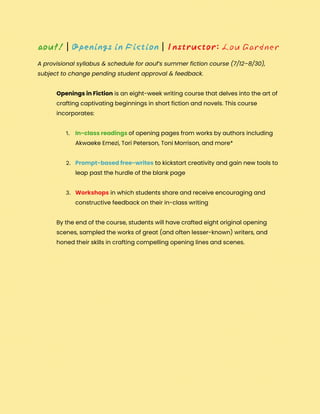
aouf! | Openings in Fiction | Instructor: Lou Gardner
A provisional syllabus & schedule for aouf’s summer fiction course (7/12–8/30),
subject to change pending student approval & feedback.
Openings in Fiction is an eight-week writing course that delves into the art of
crafting captivating beginnings in short fiction and novels. This course
incorporates:
1. In-class readings of opening pages from works by authors including
Akwaeke Emezi, Tori Peterson, Toni Morrison, and more*
2. Prompt-based free-writes to kickstart creativity and gain new tools to
leap past the hurdle of the blank page
3. Workshops in which students share and receive encouraging and
constructive feedback on their in-class writing
By the end of the course, students will have crafted eight original opening
scenes, sampled the works of great (and often lesser-known) writers, and
honed their skills in crafting compelling opening lines and scenes.
2
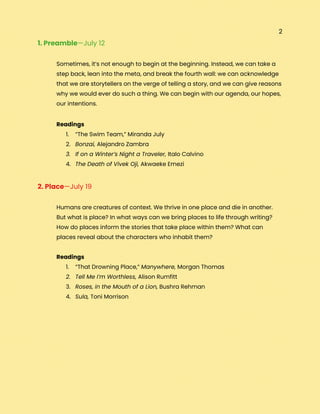
1. Preamble—July 12
Sometimes, it’s not enough to begin at the beginning. Instead, we can take a
step back, lean into the meta, and break the fourth wall: we can acknowledge
that we are storytellers on the verge of telling a story, and we can give reasons
why we would ever do such a thing. We can begin with our agenda, our hopes,
our intentions.
Readings
1. “The Swim Team,” Miranda July
2. Bonzai, Alejandro Zambra
3. If on a Winter’s Night a Traveler, Italo Calvino
4. The Death of Vivek Oji, Akwaeke Emezi
2. Place—July 19
Humans are creatures of context. We thrive in one place and die in another.
But what is place? In what ways can we bring places to life through writing?
How do places inform the stories that take place within them? What can
places reveal about the characters who inhabit them?
Readings
1. “That Drowning Place,” Manywhere, Morgan Thomas
2. Tell Me I’m Worthless, Alison Rumfitt
3. Roses, in the Mouth of a Lion, Bushra Rehman
4. Sula, Toni Morrison
3
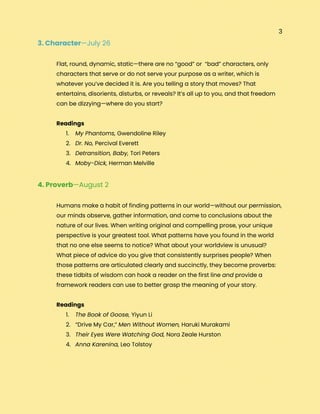
3. Character—July 26
Flat, round, dynamic, static—there are no “good” or “bad” characters, only
characters that serve or do not serve your purpose as a writer, which is
whatever you’ve decided it is. Are you telling a story that moves? That
entertains, disorients, disturbs, or reveals? It’s all up to you, and that freedom
can be dizzying—where do you start?
Readings
1. My Phantoms, Gwendoline Riley
2. Dr. No, Percival Everett
3. Detransition, Baby, Tori Peters
4. Moby-Dick, Herman Melville
4. Proverb—August 2
Humans make a habit of finding patterns in our world—without our permission,
our minds observe, gather information, and come to conclusions about the
nature of our lives. When writing original and compelling prose, your unique
perspective is your greatest tool. What patterns have you found in the world
that no one else seems to notice? What about your worldview is unusual?
What piece of advice do you give that consistently surprises people? When
those patterns are articulated clearly and succinctly, they become proverbs:
these tidbits of wisdom can hook a reader on the first line and provide a
framework readers can use to better grasp the meaning of your story.
Readings
1. The Book of Goose, Yiyun Li
2. “Drive My Car,” Men Without Women, Haruki Murakami
3. Their Eyes Were Watching God, Nora Zeale Hurston
4. Anna Karenina, Leo Tolstoy
4
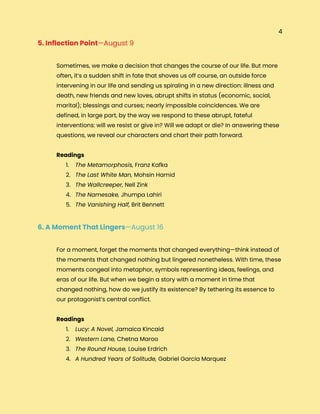
5. Inflection Point—August 9
Sometimes, we make a decision that changes the course of our life. But more
often, it’s a sudden shift in fate that shoves us off course, an outside force
intervening in our life and sending us spiraling in a new direction: illness and
death, new friends and new loves, abrupt shifts in status (economic, social,
marital); blessings and curses; nearly impossible coincidences. We are
defined, in large part, by the way we respond to these abrupt, fateful
interventions: will we resist or give in? Will we adapt or die? In answering these
questions, we reveal our characters and chart their path forward.
Readings
1. The Metamorphosis, Franz Kafka
2. The Last White Man, Mohsin Hamid
3. The Wallcreeper, Nell Zink
4. The Namesake, Jhumpa Lahiri
5. The Vanishing Half, Brit Bennett
6. A Moment That Lingers—August 16
For a moment, forget the moments that changed everything—think instead of
the moments that changed nothing but lingered nonetheless. With time, these
moments congeal into metaphor, symbols representing ideas, feelings, and
eras of our life. But when we begin a story with a moment in time that
changed nothing, how do we justify its existence? By tethering its essence to
our protagonist’s central conflict.
Readings
1. Lucy: A Novel, Jamaica Kincaid
2. Western Lane, Chetna Maroo
3. The Round House, Louise Erdrich
4. A Hundred Years of Solitude, Gabriel Garcia Marquez
5
7. Fiction in Drag—August 23
Fiction, like figure skating, is a game of rules, conventions, and technicalities.
When you open a book, you always know what to expect—a simple font, size 11
or so, in neat blocks you read from left to right in a book you read from front to
back. There are comma rules, verb rules, spelling rules—suddenly, creativity
seems suffocated, endangered, and yet over and over again, writers find
loopholes, ways to break free of convention. One solution? Fiction in drag:
fiction dressed up in the garb of another medium, like logic puzzles or text
messages, encyclopedia entries and legal documents. These innovative
frames can breathe life into a piece and offer a new perspective on a
narrative (and what constitutes fiction).
Readings
1. On Beauty, Zadie Smith
2. Several People Are Typing, Calvin Kasulke
3. Lolita, Vladimir Nobakov
4. DSM-5: Major Depressive Episode, Lou Gardner
8. Reflections—August 30
This final class will include an industry lesson (covering publishing, agencies,
and queries), a brief open free-write (students will respond to a prompt using
an approach of their choice), and a “showcase” at which students will read
aloud their favorite opening they’ve written (or read) during the course. After
class, all are welcome at a picnic hosted at Elysian Park and catered by a local
LGBTQ+-owned vegan vendor.

aouf! S23 Syllabus.pdf

  • 1.
    aouf! | Openingsin Fiction | Instructor: Lou Gardner A provisional syllabus & schedule for aouf’s summer fiction course (7/12–8/30), subject to change pending student approval & feedback. Openings in Fiction is an eight-week writing course that delves into the art of crafting captivating beginnings in short fiction and novels. This course incorporates: 1. In-class readings of opening pages from works by authors including Akwaeke Emezi, Tori Peterson, Toni Morrison, and more* 2. Prompt-based free-writes to kickstart creativity and gain new tools to leap past the hurdle of the blank page 3. Workshops in which students share and receive encouraging and constructive feedback on their in-class writing By the end of the course, students will have crafted eight original opening scenes, sampled the works of great (and often lesser-known) writers, and honed their skills in crafting compelling opening lines and scenes.
  • 2.
    2 1. Preamble—July 12 Sometimes,it’s not enough to begin at the beginning. Instead, we can take a step back, lean into the meta, and break the fourth wall: we can acknowledge that we are storytellers on the verge of telling a story, and we can give reasons why we would ever do such a thing. We can begin with our agenda, our hopes, our intentions. Readings 1. “The Swim Team,” Miranda July 2. Bonzai, Alejandro Zambra 3. If on a Winter’s Night a Traveler, Italo Calvino 4. The Death of Vivek Oji, Akwaeke Emezi 2. Place—July 19 Humans are creatures of context. We thrive in one place and die in another. But what is place? In what ways can we bring places to life through writing? How do places inform the stories that take place within them? What can places reveal about the characters who inhabit them? Readings 1. “That Drowning Place,” Manywhere, Morgan Thomas 2. Tell Me I’m Worthless, Alison Rumfitt 3. Roses, in the Mouth of a Lion, Bushra Rehman 4. Sula, Toni Morrison
  • 3.
    3 3. Character—July 26 Flat,round, dynamic, static—there are no “good” or “bad” characters, only characters that serve or do not serve your purpose as a writer, which is whatever you’ve decided it is. Are you telling a story that moves? That entertains, disorients, disturbs, or reveals? It’s all up to you, and that freedom can be dizzying—where do you start? Readings 1. My Phantoms, Gwendoline Riley 2. Dr. No, Percival Everett 3. Detransition, Baby, Tori Peters 4. Moby-Dick, Herman Melville 4. Proverb—August 2 Humans make a habit of finding patterns in our world—without our permission, our minds observe, gather information, and come to conclusions about the nature of our lives. When writing original and compelling prose, your unique perspective is your greatest tool. What patterns have you found in the world that no one else seems to notice? What about your worldview is unusual? What piece of advice do you give that consistently surprises people? When those patterns are articulated clearly and succinctly, they become proverbs: these tidbits of wisdom can hook a reader on the first line and provide a framework readers can use to better grasp the meaning of your story. Readings 1. The Book of Goose, Yiyun Li 2. “Drive My Car,” Men Without Women, Haruki Murakami 3. Their Eyes Were Watching God, Nora Zeale Hurston 4. Anna Karenina, Leo Tolstoy
  • 4.
    4 5. Inflection Point—August9 Sometimes, we make a decision that changes the course of our life. But more often, it’s a sudden shift in fate that shoves us off course, an outside force intervening in our life and sending us spiraling in a new direction: illness and death, new friends and new loves, abrupt shifts in status (economic, social, marital); blessings and curses; nearly impossible coincidences. We are defined, in large part, by the way we respond to these abrupt, fateful interventions: will we resist or give in? Will we adapt or die? In answering these questions, we reveal our characters and chart their path forward. Readings 1. The Metamorphosis, Franz Kafka 2. The Last White Man, Mohsin Hamid 3. The Wallcreeper, Nell Zink 4. The Namesake, Jhumpa Lahiri 5. The Vanishing Half, Brit Bennett 6. A Moment That Lingers—August 16 For a moment, forget the moments that changed everything—think instead of the moments that changed nothing but lingered nonetheless. With time, these moments congeal into metaphor, symbols representing ideas, feelings, and eras of our life. But when we begin a story with a moment in time that changed nothing, how do we justify its existence? By tethering its essence to our protagonist’s central conflict. Readings 1. Lucy: A Novel, Jamaica Kincaid 2. Western Lane, Chetna Maroo 3. The Round House, Louise Erdrich 4. A Hundred Years of Solitude, Gabriel Garcia Marquez
  • 5.
    5 7. Fiction inDrag—August 23 Fiction, like figure skating, is a game of rules, conventions, and technicalities. When you open a book, you always know what to expect—a simple font, size 11 or so, in neat blocks you read from left to right in a book you read from front to back. There are comma rules, verb rules, spelling rules—suddenly, creativity seems suffocated, endangered, and yet over and over again, writers find loopholes, ways to break free of convention. One solution? Fiction in drag: fiction dressed up in the garb of another medium, like logic puzzles or text messages, encyclopedia entries and legal documents. These innovative frames can breathe life into a piece and offer a new perspective on a narrative (and what constitutes fiction). Readings 1. On Beauty, Zadie Smith 2. Several People Are Typing, Calvin Kasulke 3. Lolita, Vladimir Nobakov 4. DSM-5: Major Depressive Episode, Lou Gardner 8. Reflections—August 30 This final class will include an industry lesson (covering publishing, agencies, and queries), a brief open free-write (students will respond to a prompt using an approach of their choice), and a “showcase” at which students will read aloud their favorite opening they’ve written (or read) during the course. After class, all are welcome at a picnic hosted at Elysian Park and catered by a local LGBTQ+-owned vegan vendor.