ASSIGNMENT 
ON 
REFERENCE MATERIALS IN SCIENCE 
ENCYCLOPEDIA, NEWSLETTERS, 
MAGAZINES, JOURNALS 
0 
SUBMITTED BY, 
L. ANJALI AJAYAN 
NATURAL SCIENCE 
CLASS NO: 100 
N.S.S TRAINING COLLEGE, 
PANDALAM 
SUBMITTED TO, 
Dr. PADMAPRIYA P.V 
ASSOCIATE PROFESSOR 
NATURAL SCIENCE 
N.S.S TRAINING COLLEGE, 
PANDALAM 
SUBMITTED ON, 
16-08-2014
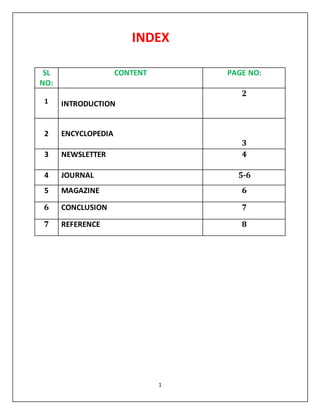
INDEX 
1 
SL 
NO: 
CONTENT PAGE NO: 
1 
INTRODUCTION 
2 
2 
ENCYCLOPEDIA 
3 
3 NEWSLETTER 
4 
4 JOURNAL 5-6 
5 MAGAZINE 6 
6 CONCLUSION 7 
7 REFERENCE 8
INTRODUCTION 
Referencing helps to create a map of knowledge, a web of 
pathways in knowledge and helps extends that knowledge. It 
means that we don’t have to reinvent the wheel. It effect, 
referencing multiple knowledge exponent. Explore exciting new 
content from the world’s leading scientists. Nowadays many 
reference materials are found on the internet, and can 
compiled a list of links to many of them in "Reference 
materials" for student and researchers. Most students and 
researchers use dictionaries, journals, science letters, 
encyclopedias, magazine, and other reference materials 
frequently. Web pages for news papers, magazines and TV 
network web pages from various countries on the internet 
2
CONTENT 
1) Encyclopedia 
A book or set of books containing articles on various topics, 
usually in alphabetical arrangement, covering all branches of 
knowledge or, less commonly, all aspects of one subject. It is a 
type of reference work, a compendium holding a summary of 
information from either all branches of knowledge. Internet 
encyclopedia is free to access. Free content, Almost anyone 
who can access the site can edit almost any of its article. It is 
the largest and most popular general reference work. An 
encyclopedia is a reference work used to look up information. It 
is typically arranged alphabetically according to subject and can 
be either a broad-based reference that contains general 
information, or a more comprehensive work about a specific 
subject. it includes encyclopedia for life science , biology, 
human biology, ecology, botany, etc. 
3
2) News letters 
Materials Letters is dedicated to publishing novel, cutting edge 
reports of broad interest to the materials community. The 
journal provides a forum for materials scientists and engineers, 
physicists, and chemists to rapidly communicate on the most 
important topics in the field of materials. A Letter reports an 
important novel research result, but is less substantial than an 
Article. Letters typically occupy four printed journal pages. This 
format begins with an introductory paragraph (not abstract) of 
150 words maximum, summarizing the background, rationale, 
main results and implications. This paragraph should be 
referenced, as in Nature style, and should be considered part of 
the main text, so that any subsequent introductory material 
avoids too much repetition of the introductory paragraph. The 
text is limited to 2000 words, excluding the introductory 
paragraph, Methods, references and figure legends. References 
are limited to 30. Letters include received/accepted dates and 
may be accompanied by supplementary information. Letters 
4
are peer reviewed, and authors must provide a competing 
financial interests statement before publication. 
5 
3) JOURNALS 
The Journal of Materials Science is now firmly established as 
the leading source of primary communication for scientists 
investigating the structure and properties. The Journal of 
Materials Science publishes reviews, full-length papers, and 
short communications recording original research results on, or 
techniques for studying the relationship between structure, 
properties, and uses of materials. The subjects are seen from 
international and interdisciplinary perspectives covering areas 
including metals, ceramics, glasses, polymers, electrical 
materials, composite materials, fibers, nanostructure materials, 
nanocomposites, and biological and biomedical materials. 
Some journals are:- 
Advances in Atmospheric Sciences 
ď‚· Agricultural and Forest Meteorology 
ď‚· International Journal of Biological Sciences 
ď‚· Journal of Cell Biology
ď‚· Journal of Molecular Biology 
ď‚· Journal of Theoretical Biology 
ď‚· Agronomy for Sustainable Development 
6 
ď‚· Journal of Animal Science 
ď‚· Journal of Soil and Water Conservation 
4) Magazine 
A science magazine is a periodical publication with news, 
opinions and reports about science for a non-expert audience. 
A periodical publication for scientific experts, in contrast, is 
called a "scientific journal". Science magazines are read by non-scientists 
and scientists who want accessible information on 
fields outside their specialization. 
Some Indian magazine are:- 
ď‚· Education Insider 
ď‚· Current Science 
ď‚· Sandarbh 
ď‚· Science Reporter(magazine)
7 
ď‚· Safari 
 विज्ञान प्रगति (Vigyan Pragati) 
CONCLUSION 
In the field of science, reference materials are very important 
because they help us develop a better understanding of the 
processes that have shaped, and continue to shape the world 
around us. Use appropriate reference materials to support 
scientific understanding, plan and carry out scientific 
investigations of various types such as: systematic 
observations, experiments requiring the identification of 
variables, collecting and organizing data, interpreting data in 
charts, tables, and graphics, analyze information, make 
predictions, and defend conclusions.
REFERENCE 
8 
Websites 
1. https://www.encyclopedia.org/…definition/imp. 
2. https://www.sciencemagazine.org/en/-role/ 
3. https://www.wikipedia.com›journal.imp/ 
4. https://www.sciencemagazine.com›newsletters.imp/
9

A.onlineassignment

  • 1.
    ASSIGNMENT ON REFERENCEMATERIALS IN SCIENCE ENCYCLOPEDIA, NEWSLETTERS, MAGAZINES, JOURNALS 0 SUBMITTED BY, L. ANJALI AJAYAN NATURAL SCIENCE CLASS NO: 100 N.S.S TRAINING COLLEGE, PANDALAM SUBMITTED TO, Dr. PADMAPRIYA P.V ASSOCIATE PROFESSOR NATURAL SCIENCE N.S.S TRAINING COLLEGE, PANDALAM SUBMITTED ON, 16-08-2014
  • 2.
    INDEX 1 SL NO: CONTENT PAGE NO: 1 INTRODUCTION 2 2 ENCYCLOPEDIA 3 3 NEWSLETTER 4 4 JOURNAL 5-6 5 MAGAZINE 6 6 CONCLUSION 7 7 REFERENCE 8
  • 3.
    INTRODUCTION Referencing helpsto create a map of knowledge, a web of pathways in knowledge and helps extends that knowledge. It means that we don’t have to reinvent the wheel. It effect, referencing multiple knowledge exponent. Explore exciting new content from the world’s leading scientists. Nowadays many reference materials are found on the internet, and can compiled a list of links to many of them in "Reference materials" for student and researchers. Most students and researchers use dictionaries, journals, science letters, encyclopedias, magazine, and other reference materials frequently. Web pages for news papers, magazines and TV network web pages from various countries on the internet 2
  • 4.
    CONTENT 1) Encyclopedia A book or set of books containing articles on various topics, usually in alphabetical arrangement, covering all branches of knowledge or, less commonly, all aspects of one subject. It is a type of reference work, a compendium holding a summary of information from either all branches of knowledge. Internet encyclopedia is free to access. Free content, Almost anyone who can access the site can edit almost any of its article. It is the largest and most popular general reference work. An encyclopedia is a reference work used to look up information. It is typically arranged alphabetically according to subject and can be either a broad-based reference that contains general information, or a more comprehensive work about a specific subject. it includes encyclopedia for life science , biology, human biology, ecology, botany, etc. 3
  • 5.
    2) News letters Materials Letters is dedicated to publishing novel, cutting edge reports of broad interest to the materials community. The journal provides a forum for materials scientists and engineers, physicists, and chemists to rapidly communicate on the most important topics in the field of materials. A Letter reports an important novel research result, but is less substantial than an Article. Letters typically occupy four printed journal pages. This format begins with an introductory paragraph (not abstract) of 150 words maximum, summarizing the background, rationale, main results and implications. This paragraph should be referenced, as in Nature style, and should be considered part of the main text, so that any subsequent introductory material avoids too much repetition of the introductory paragraph. The text is limited to 2000 words, excluding the introductory paragraph, Methods, references and figure legends. References are limited to 30. Letters include received/accepted dates and may be accompanied by supplementary information. Letters 4
  • 6.
    are peer reviewed,and authors must provide a competing financial interests statement before publication. 5 3) JOURNALS The Journal of Materials Science is now firmly established as the leading source of primary communication for scientists investigating the structure and properties. The Journal of Materials Science publishes reviews, full-length papers, and short communications recording original research results on, or techniques for studying the relationship between structure, properties, and uses of materials. The subjects are seen from international and interdisciplinary perspectives covering areas including metals, ceramics, glasses, polymers, electrical materials, composite materials, fibers, nanostructure materials, nanocomposites, and biological and biomedical materials. Some journals are:- Advances in Atmospheric Sciences ď‚· Agricultural and Forest Meteorology ď‚· International Journal of Biological Sciences ď‚· Journal of Cell Biology
  • 7.
    ď‚· Journal ofMolecular Biology ď‚· Journal of Theoretical Biology ď‚· Agronomy for Sustainable Development 6 ď‚· Journal of Animal Science ď‚· Journal of Soil and Water Conservation 4) Magazine A science magazine is a periodical publication with news, opinions and reports about science for a non-expert audience. A periodical publication for scientific experts, in contrast, is called a "scientific journal". Science magazines are read by non-scientists and scientists who want accessible information on fields outside their specialization. Some Indian magazine are:- ď‚· Education Insider ď‚· Current Science ď‚· Sandarbh ď‚· Science Reporter(magazine)
  • 8.
    7  Safari  विज्ञान प्रगति (Vigyan Pragati) CONCLUSION In the field of science, reference materials are very important because they help us develop a better understanding of the processes that have shaped, and continue to shape the world around us. Use appropriate reference materials to support scientific understanding, plan and carry out scientific investigations of various types such as: systematic observations, experiments requiring the identification of variables, collecting and organizing data, interpreting data in charts, tables, and graphics, analyze information, make predictions, and defend conclusions.
  • 9.
    REFERENCE 8 Websites 1. https://www.encyclopedia.org/…definition/imp. 2. https://www.sciencemagazine.org/en/-role/ 3. https://www.wikipedia.com›journal.imp/ 4. https://www.sciencemagazine.com›newsletters.imp/
  • 10.