Early Venture Evolution PDW
Chuck Eesley (Stanford University)
Lynn Wu (U. Penn – Wharton)
Wesley Koo (Stanford University)
David Hsu (U. Penn – Wharton)
Quick overview – 2 studies
• Early stage – MOOC randomized experiment
• Later stage – Stanford alumni data
Visions, Entrepreneurial Adaptation
and Social Networks:
Evidence from a Randomized Experiment on a
MOOC Platform
Charles Eesley (Stanford)
Lynn Wu (Wharton)
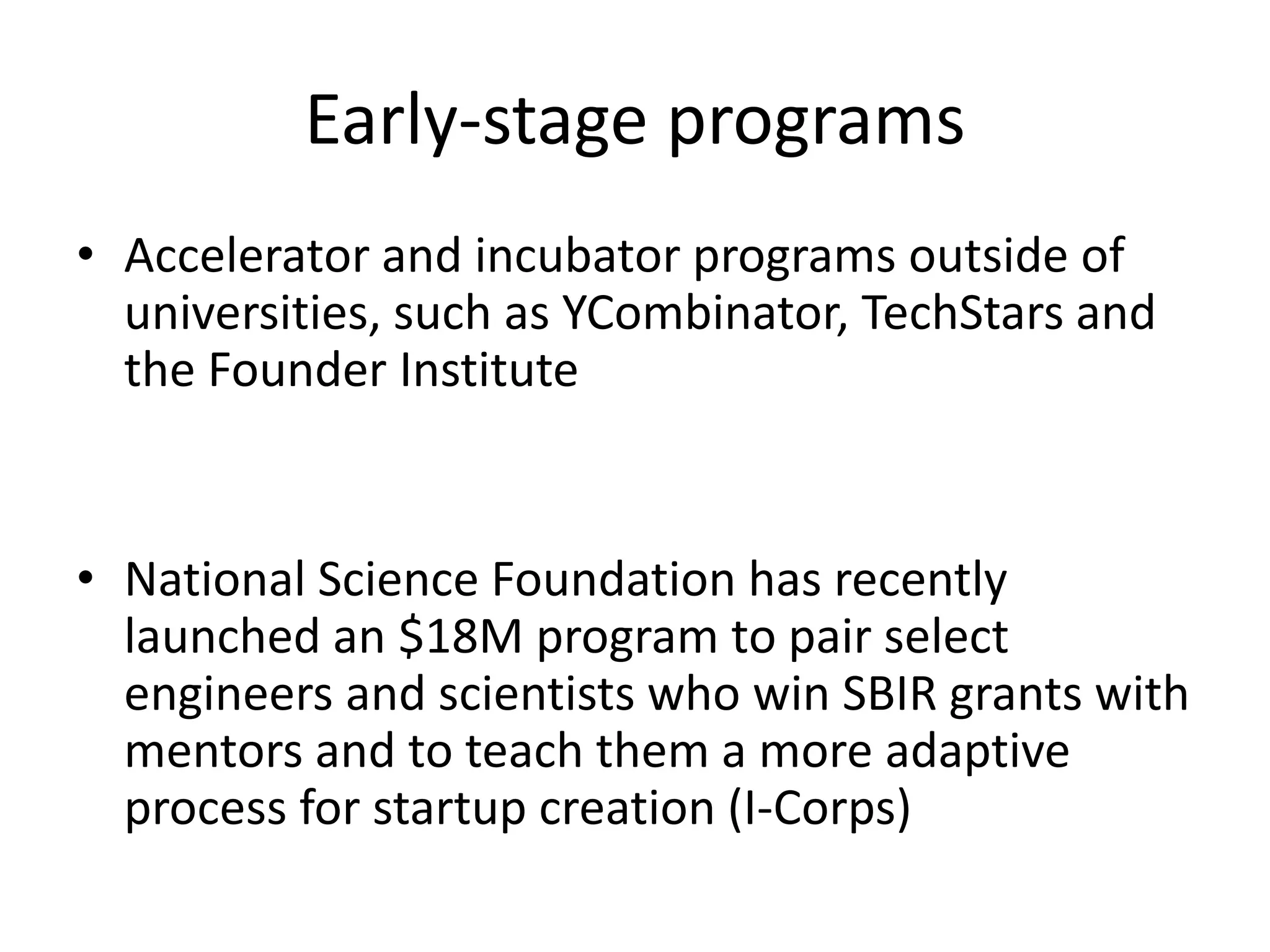
Early-stage programs
• Accelerator and incubator programs outside of
universities, such as YCombinator, TechStars and
the Founder Institute
• National Science Foundation has recently
launched an $18M program to pair select
engineers and scientists who win SBIR grants with
mentors and to teach them a more adaptive
process for startup creation (I-Corps)
Difficult to Observe Entrepreneurial
Processes
Planning Approach
• Create an unwavering vision
• Persistent in executing the
vision
• Less likely to modify the vision
to leverage newly available
resources
• Delmar and Shane, 2003;
Porter, 1980
Adaptive Approach
• Take adv. of new resources and
change the vision if necessary
• Suitable in uncertain
environment such as early stage
entrepreneurship?
• (Baker and Nelson 2005, Blank
2013, Brown and Eisenhardt
1997, McGrath 2010)
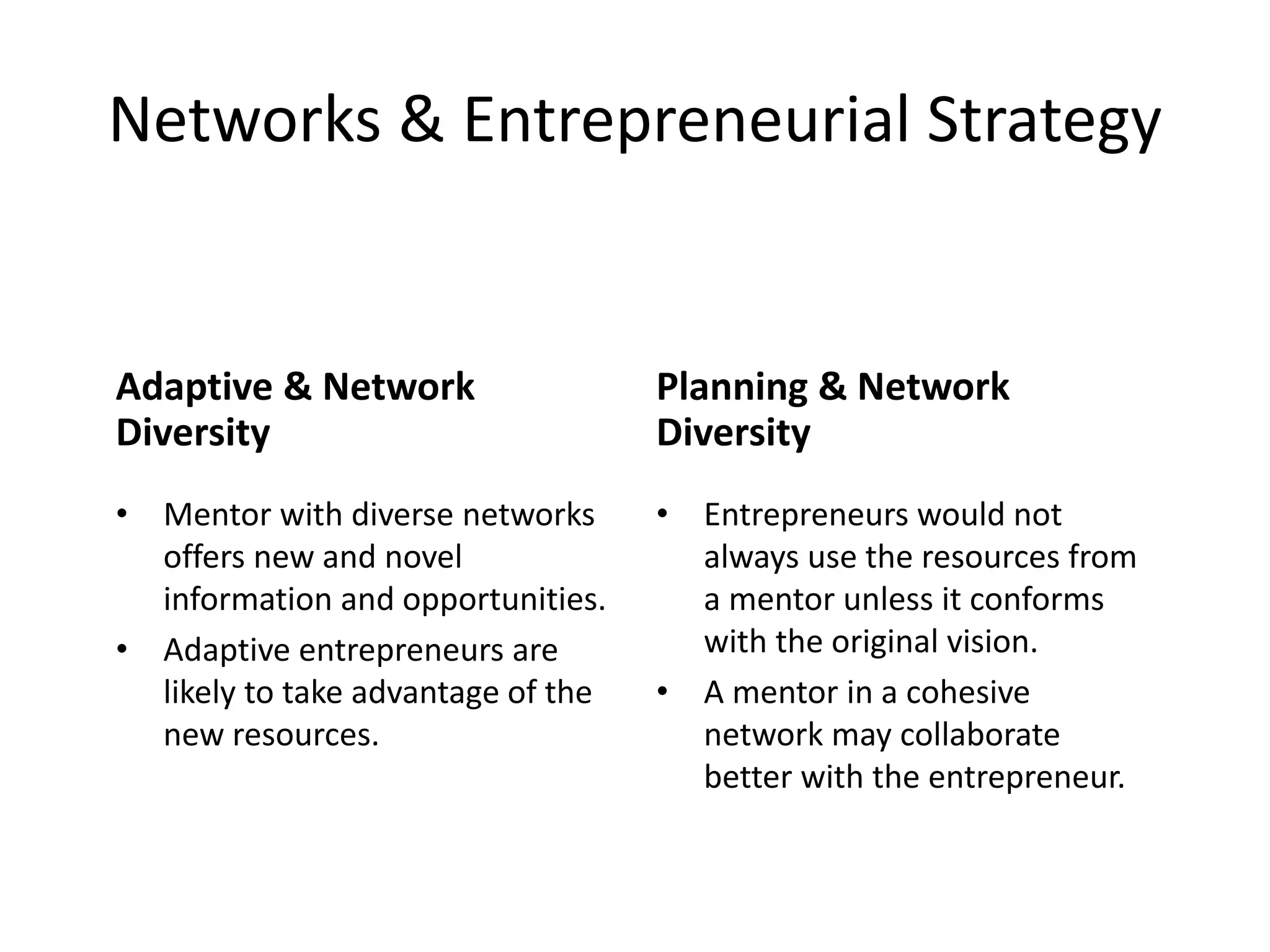
Networks & Entrepreneurial Strategy
Adaptive & Network
Diversity
• Mentor with diverse networks
offers new and novel
information and opportunities.
• Adaptive entrepreneurs are
likely to take advantage of the
new resources.
Planning & Network
Diversity
• Entrepreneurs would not
always use the resources from
a mentor unless it conforms
with the original vision.
• A mentor in a cohesive
network may collaborate
better with the entrepreneur.
Networks & Entrepreneurial Strategies
• Difficult to observe endogenous matching
process between mentors and mentees.
• Difficult to alter coworker and friendship ties.
• Difficult to observe the process of
entrepreneurship.
• Randomized experiments could help.
Setting & Data
• NovoEd class: Technology Entrepreneurship
• Class offered: Fall 2013 for 8 weeks
• Free to anyone
• Students in 61 countries in the world
• Goal: Create a video pitch at the end of the
class
Summary Statistics
Variable Obs. Mean Std. Dev. Min Max
English 1670 .588 .492 0 1
Male 1670 0.741 .438 0 1
Age 1670 2.169
(25-35)
.833 1 4
Final Grades 1410 11.649 2.858 3.288 19.971
Complete
any assign.
23918 .138 .345 0 1
Completion 23918 .0602 .458 0 1
Treatment Effects On Outcomes
(1) (2) (3) (4) (5)
Dependent
var.
Completed
Class
Final Grade Final Grade Earlier Grade Earlier Grade
Diverse -0.00273
(0.00774)
0.298
(0.269)
0.333
(0.267)
0.0499
(0.160)
0.0567
(0.159)
Diverse
Adaptive
0.00591
(0.00773)
0.448*
(0.265)
0.434*
(0.266)
-0.0824
(0.158)
-0.0652
(0.157)
Diverse
Planning
0.00575
(0.00773)
0.511**
(0.256)
0.451*
(0.259)
0.188
(0.158)
0.192
(0.157)
Planning 0.0134*
(0.00773)
0.525*
(0.302)
0.541*
(0.303)
0.125
(0.157)
0.125
(0.156)
Obs. 23,918 1,411 1,411 4,866 4,866
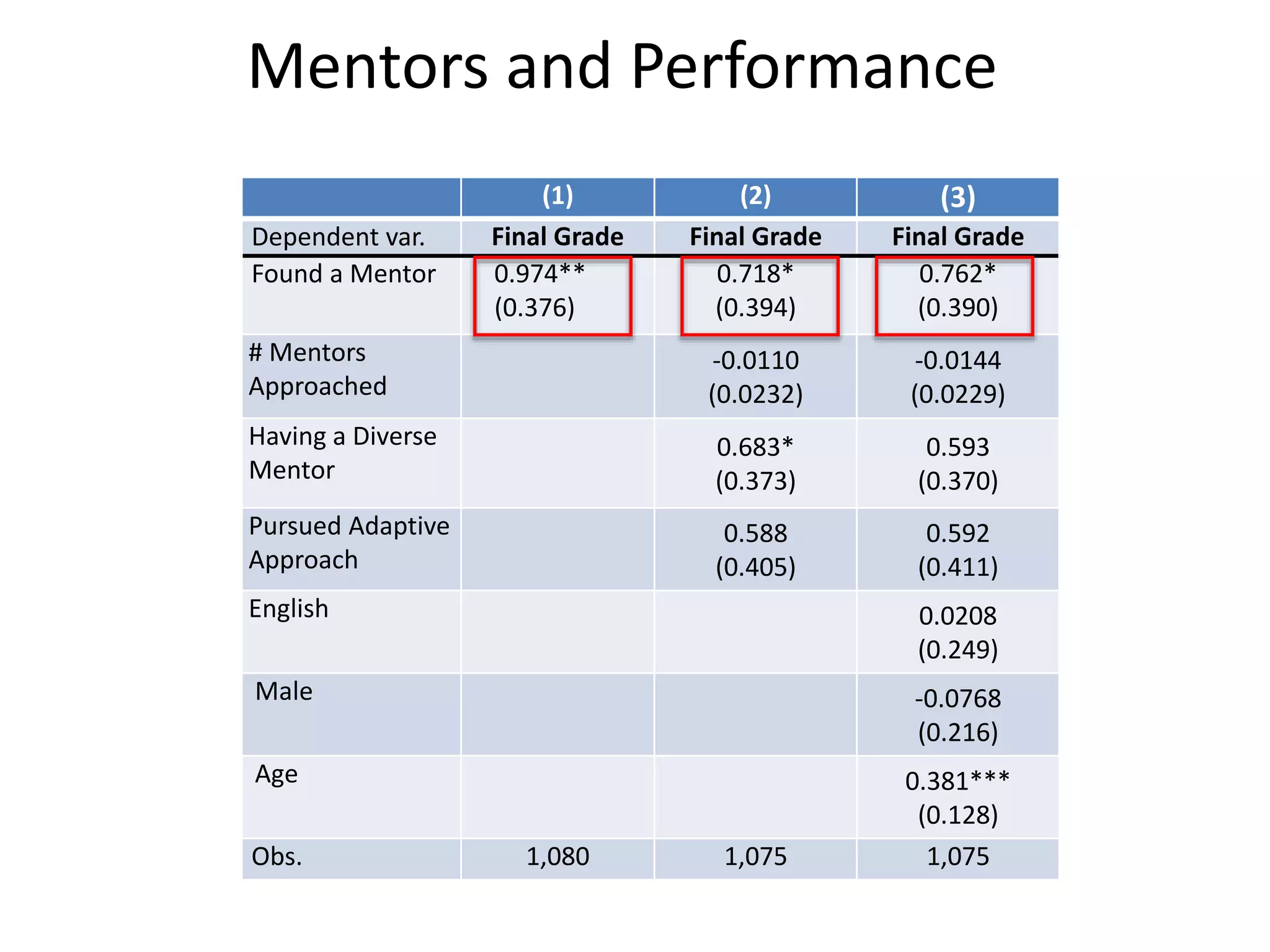
Mentors and Performance
(1) (2) (3)
Dependent var. Final Grade Final Grade Final Grade
Found a Mentor 0.974**
(0.376)
0.718*
(0.394)
0.762*
(0.390)
# Mentors
Approached
-0.0110
(0.0232)
-0.0144
(0.0229)
Having a Diverse
Mentor
0.683*
(0.373)
0.593
(0.370)
Pursued Adaptive
Approach
0.588
(0.405)
0.592
(0.411)
English 0.0208
(0.249)
Male -0.0768
(0.216)
Age 0.381***
(0.128)
Obs. 1,080 1,075 1,075
Effects of Strategic Change on Venture Performance:
The Implications of Change Location, Level and Top
Management Team Composition
Charles Eesley
Stanford University
David Hsu
Wharton School, Management Department,
University of Pennsylvania
Wesley Koo
Stanford University
Stanford Alumni Data
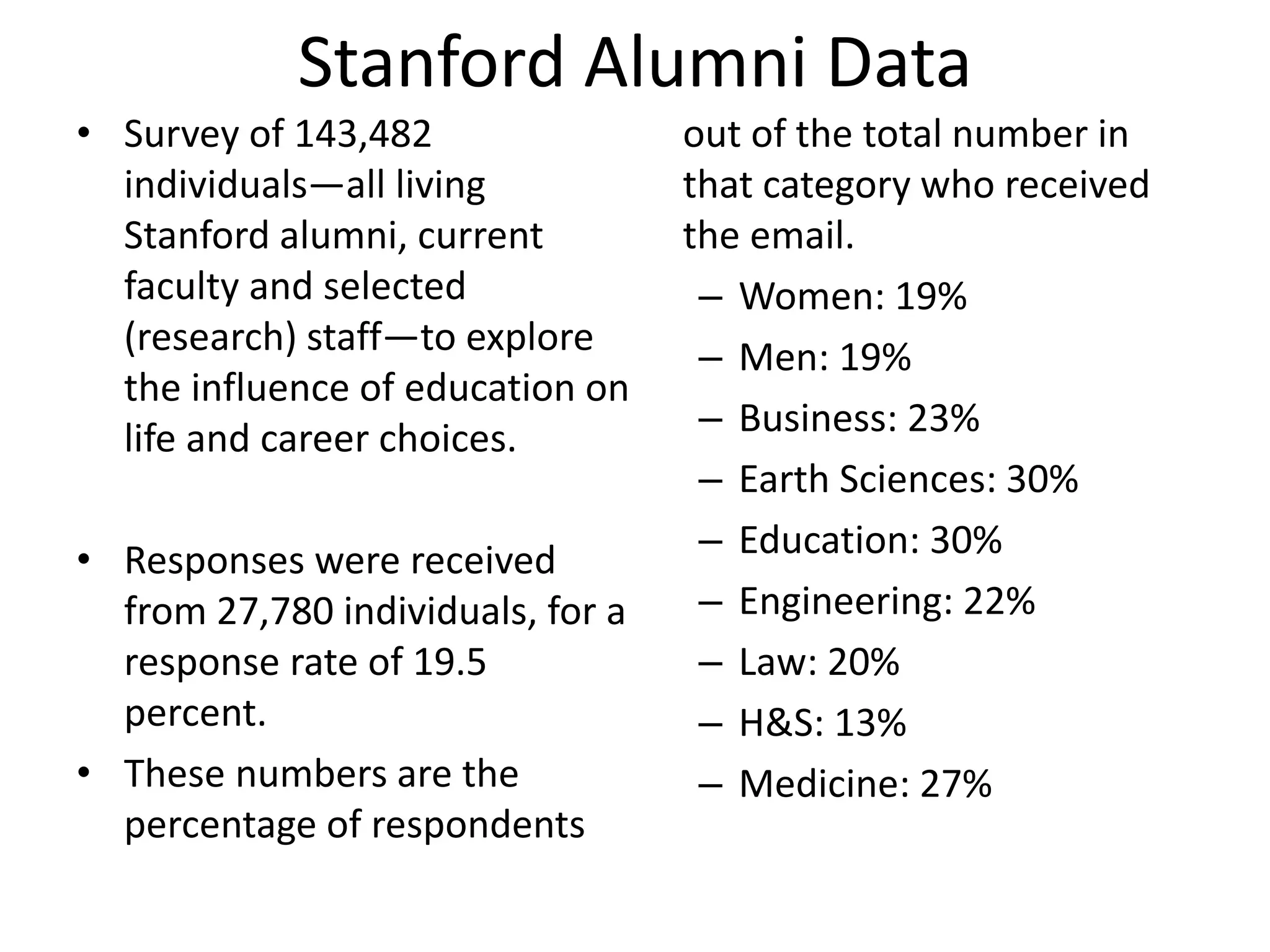
• Survey of 143,482
individuals—all living
Stanford alumni, current
faculty and selected
(research) staff—to explore
the influence of education on
life and career choices.
• Responses were received
from 27,780 individuals, for a
response rate of 19.5
percent.
• These numbers are the
percentage of respondents
out of the total number in
that category who received
the email.
– Women: 19%
– Men: 19%
– Business: 23%
– Earth Sciences: 30%
– Education: 30%
– Engineering: 22%
– Law: 20%
– H&S: 13%
– Medicine: 27%
IPO
minor, core 0.383** 0.409**
(0.120) (0.125)
major, core -0.0264 0.0953
(0.130) (0.136)
minor, peripheral 0.225+ 0.296*
(0.129) (0.135)
major, peripheral 0.152 0.229+
(0.122) (0.127)
industry fixed
effect
Y Y Y Y Y Y
department fixed
effect
Y Y Y Y Y Y
_cons -15.85 -15.87 -15.65 -15.86 -15.44 -15.32
(13.79) (13.74) (13.80) (13.80) (13.73) (13.80)
N 2300 2300 2300 2300 2300 2300
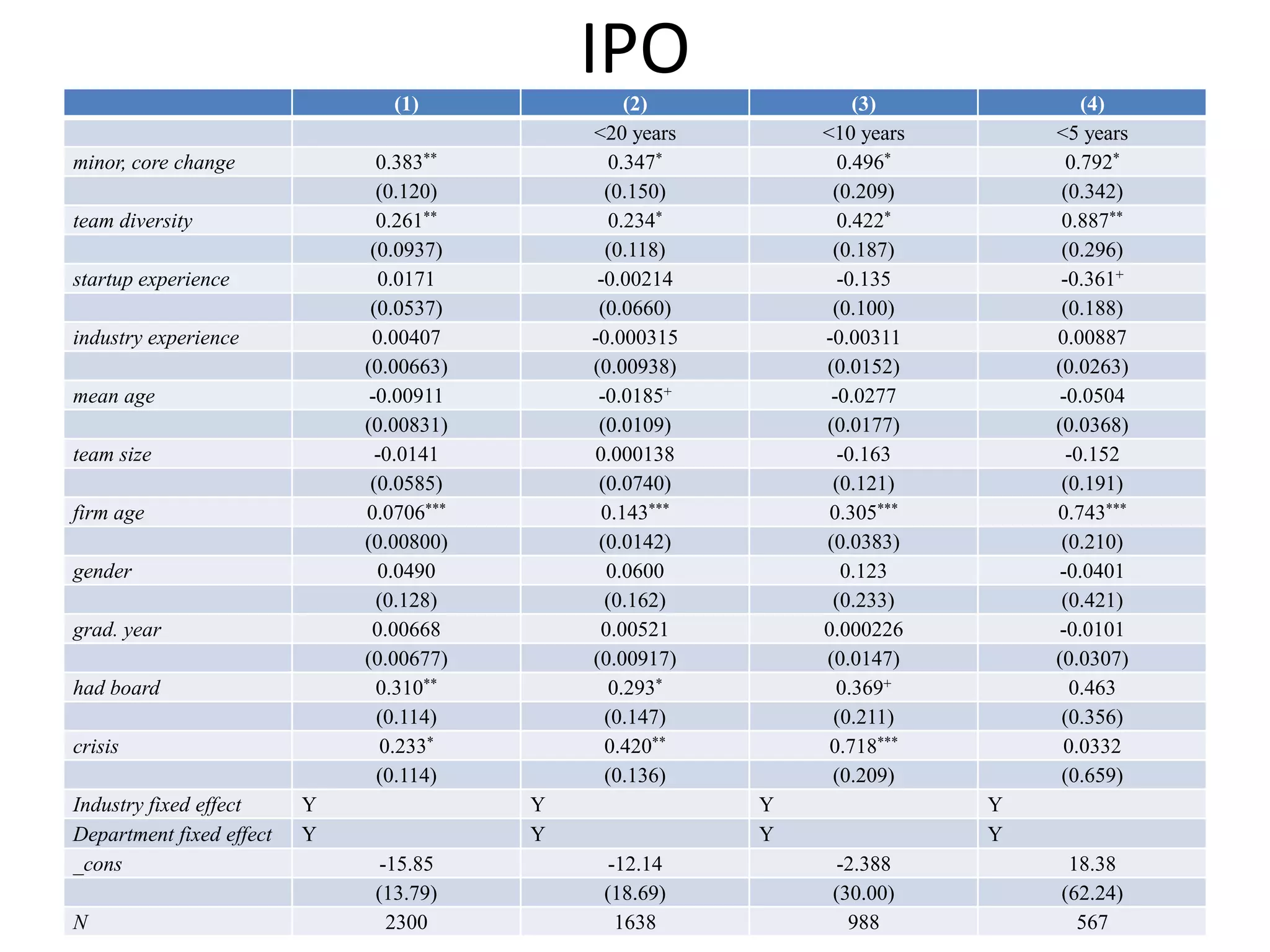
IPO(1) (2) (3) (4)
<20 years <10 years <5 years
minor, core change 0.383** 0.347* 0.496* 0.792*
(0.120) (0.150) (0.209) (0.342)
team diversity 0.261** 0.234* 0.422* 0.887**
(0.0937) (0.118) (0.187) (0.296)
startup experience 0.0171 -0.00214 -0.135 -0.361+
(0.0537) (0.0660) (0.100) (0.188)
industry experience 0.00407 -0.000315 -0.00311 0.00887
(0.00663) (0.00938) (0.0152) (0.0263)
mean age -0.00911 -0.0185+ -0.0277 -0.0504
(0.00831) (0.0109) (0.0177) (0.0368)
team size -0.0141 0.000138 -0.163 -0.152
(0.0585) (0.0740) (0.121) (0.191)
firm age 0.0706*** 0.143*** 0.305*** 0.743***
(0.00800) (0.0142) (0.0383) (0.210)
gender 0.0490 0.0600 0.123 -0.0401
(0.128) (0.162) (0.233) (0.421)
grad. year 0.00668 0.00521 0.000226 -0.0101
(0.00677) (0.00917) (0.0147) (0.0307)
had board 0.310** 0.293* 0.369+ 0.463
(0.114) (0.147) (0.211) (0.356)
crisis 0.233* 0.420** 0.718*** 0.0332
(0.114) (0.136) (0.209) (0.659)
Industry fixed effect Y Y Y Y
Department fixed effect Y Y Y Y
_cons -15.85 -12.14 -2.388 18.38
(13.79) (18.69) (30.00) (62.24)
N 2300 1638 988 567
Conclusion
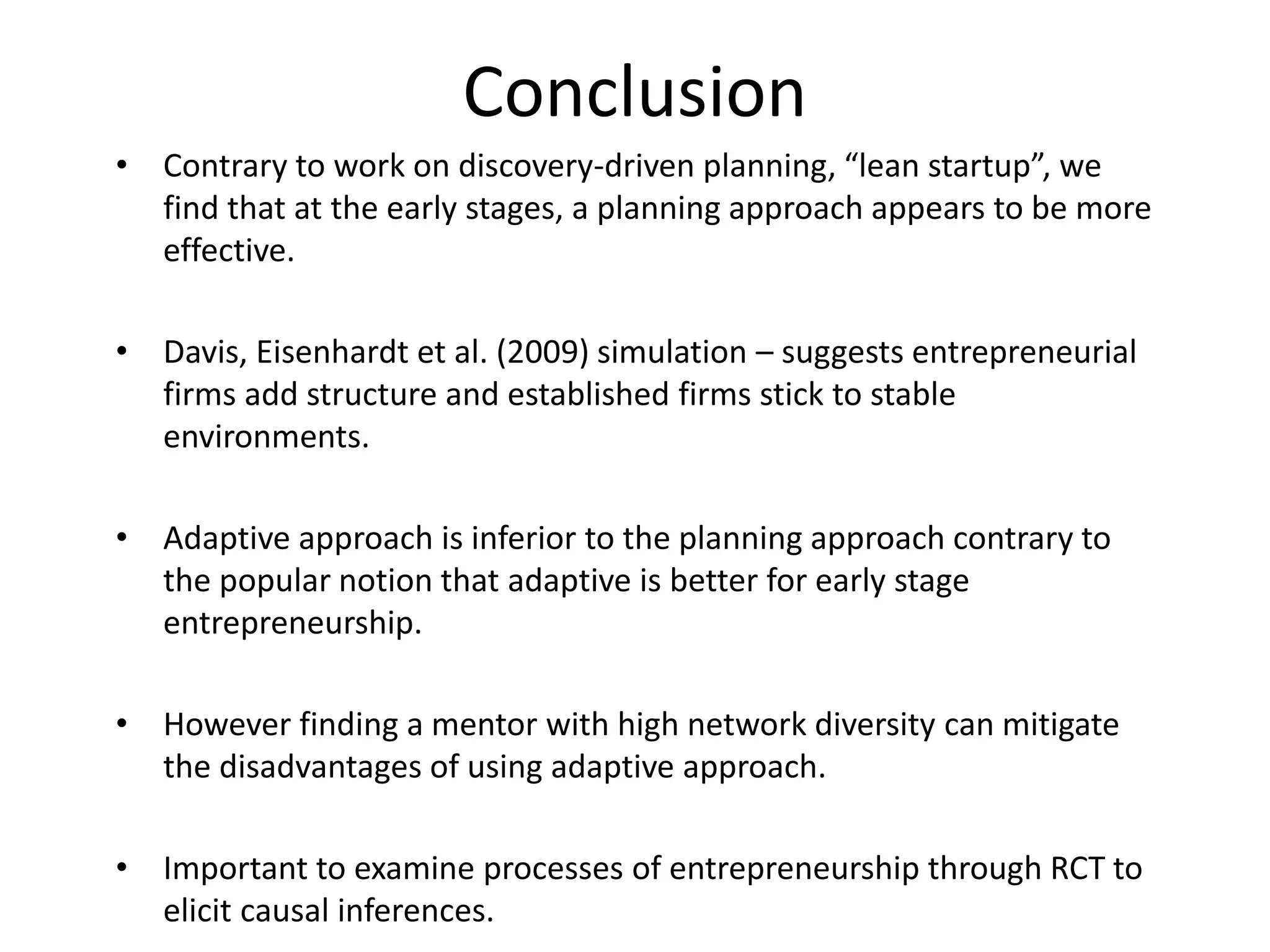
• Contrary to work on discovery-driven planning, “lean startup”, we
find that at the early stages, a planning approach appears to be more
effective.
• Davis, Eisenhardt et al. (2009) simulation – suggests entrepreneurial
firms add structure and established firms stick to stable
environments.
• Adaptive approach is inferior to the planning approach contrary to
the popular notion that adaptive is better for early stage
entrepreneurship.
• However finding a mentor with high network diversity can mitigate
the disadvantages of using adaptive approach.
• Important to examine processes of entrepreneurship through RCT to
elicit causal inferences.

Aom early venture_evolution_eesley

  • 1.
    Early Venture EvolutionPDW Chuck Eesley (Stanford University) Lynn Wu (U. Penn – Wharton) Wesley Koo (Stanford University) David Hsu (U. Penn – Wharton)
  • 2.
    Quick overview –2 studies • Early stage – MOOC randomized experiment • Later stage – Stanford alumni data
  • 3.
    Visions, Entrepreneurial Adaptation andSocial Networks: Evidence from a Randomized Experiment on a MOOC Platform Charles Eesley (Stanford) Lynn Wu (Wharton)
  • 4.
    Early-stage programs • Acceleratorand incubator programs outside of universities, such as YCombinator, TechStars and the Founder Institute • National Science Foundation has recently launched an $18M program to pair select engineers and scientists who win SBIR grants with mentors and to teach them a more adaptive process for startup creation (I-Corps)
  • 5.
    Difficult to ObserveEntrepreneurial Processes Planning Approach • Create an unwavering vision • Persistent in executing the vision • Less likely to modify the vision to leverage newly available resources • Delmar and Shane, 2003; Porter, 1980 Adaptive Approach • Take adv. of new resources and change the vision if necessary • Suitable in uncertain environment such as early stage entrepreneurship? • (Baker and Nelson 2005, Blank 2013, Brown and Eisenhardt 1997, McGrath 2010)
  • 6.
    Networks & EntrepreneurialStrategy Adaptive & Network Diversity • Mentor with diverse networks offers new and novel information and opportunities. • Adaptive entrepreneurs are likely to take advantage of the new resources. Planning & Network Diversity • Entrepreneurs would not always use the resources from a mentor unless it conforms with the original vision. • A mentor in a cohesive network may collaborate better with the entrepreneur.
  • 7.
    Networks & EntrepreneurialStrategies • Difficult to observe endogenous matching process between mentors and mentees. • Difficult to alter coworker and friendship ties. • Difficult to observe the process of entrepreneurship. • Randomized experiments could help.
  • 8.
    Setting & Data •NovoEd class: Technology Entrepreneurship • Class offered: Fall 2013 for 8 weeks • Free to anyone • Students in 61 countries in the world • Goal: Create a video pitch at the end of the class
  • 9.
    Summary Statistics Variable Obs.Mean Std. Dev. Min Max English 1670 .588 .492 0 1 Male 1670 0.741 .438 0 1 Age 1670 2.169 (25-35) .833 1 4 Final Grades 1410 11.649 2.858 3.288 19.971 Complete any assign. 23918 .138 .345 0 1 Completion 23918 .0602 .458 0 1
  • 10.
    Treatment Effects OnOutcomes (1) (2) (3) (4) (5) Dependent var. Completed Class Final Grade Final Grade Earlier Grade Earlier Grade Diverse -0.00273 (0.00774) 0.298 (0.269) 0.333 (0.267) 0.0499 (0.160) 0.0567 (0.159) Diverse Adaptive 0.00591 (0.00773) 0.448* (0.265) 0.434* (0.266) -0.0824 (0.158) -0.0652 (0.157) Diverse Planning 0.00575 (0.00773) 0.511** (0.256) 0.451* (0.259) 0.188 (0.158) 0.192 (0.157) Planning 0.0134* (0.00773) 0.525* (0.302) 0.541* (0.303) 0.125 (0.157) 0.125 (0.156) Obs. 23,918 1,411 1,411 4,866 4,866
  • 11.
    Mentors and Performance (1)(2) (3) Dependent var. Final Grade Final Grade Final Grade Found a Mentor 0.974** (0.376) 0.718* (0.394) 0.762* (0.390) # Mentors Approached -0.0110 (0.0232) -0.0144 (0.0229) Having a Diverse Mentor 0.683* (0.373) 0.593 (0.370) Pursued Adaptive Approach 0.588 (0.405) 0.592 (0.411) English 0.0208 (0.249) Male -0.0768 (0.216) Age 0.381*** (0.128) Obs. 1,080 1,075 1,075
  • 12.
    Effects of StrategicChange on Venture Performance: The Implications of Change Location, Level and Top Management Team Composition Charles Eesley Stanford University David Hsu Wharton School, Management Department, University of Pennsylvania Wesley Koo Stanford University
  • 13.
    Stanford Alumni Data •Survey of 143,482 individuals—all living Stanford alumni, current faculty and selected (research) staff—to explore the influence of education on life and career choices. • Responses were received from 27,780 individuals, for a response rate of 19.5 percent. • These numbers are the percentage of respondents out of the total number in that category who received the email. – Women: 19% – Men: 19% – Business: 23% – Earth Sciences: 30% – Education: 30% – Engineering: 22% – Law: 20% – H&S: 13% – Medicine: 27%
  • 15.
    IPO minor, core 0.383**0.409** (0.120) (0.125) major, core -0.0264 0.0953 (0.130) (0.136) minor, peripheral 0.225+ 0.296* (0.129) (0.135) major, peripheral 0.152 0.229+ (0.122) (0.127) industry fixed effect Y Y Y Y Y Y department fixed effect Y Y Y Y Y Y _cons -15.85 -15.87 -15.65 -15.86 -15.44 -15.32 (13.79) (13.74) (13.80) (13.80) (13.73) (13.80) N 2300 2300 2300 2300 2300 2300
  • 16.
    IPO(1) (2) (3)(4) <20 years <10 years <5 years minor, core change 0.383** 0.347* 0.496* 0.792* (0.120) (0.150) (0.209) (0.342) team diversity 0.261** 0.234* 0.422* 0.887** (0.0937) (0.118) (0.187) (0.296) startup experience 0.0171 -0.00214 -0.135 -0.361+ (0.0537) (0.0660) (0.100) (0.188) industry experience 0.00407 -0.000315 -0.00311 0.00887 (0.00663) (0.00938) (0.0152) (0.0263) mean age -0.00911 -0.0185+ -0.0277 -0.0504 (0.00831) (0.0109) (0.0177) (0.0368) team size -0.0141 0.000138 -0.163 -0.152 (0.0585) (0.0740) (0.121) (0.191) firm age 0.0706*** 0.143*** 0.305*** 0.743*** (0.00800) (0.0142) (0.0383) (0.210) gender 0.0490 0.0600 0.123 -0.0401 (0.128) (0.162) (0.233) (0.421) grad. year 0.00668 0.00521 0.000226 -0.0101 (0.00677) (0.00917) (0.0147) (0.0307) had board 0.310** 0.293* 0.369+ 0.463 (0.114) (0.147) (0.211) (0.356) crisis 0.233* 0.420** 0.718*** 0.0332 (0.114) (0.136) (0.209) (0.659) Industry fixed effect Y Y Y Y Department fixed effect Y Y Y Y _cons -15.85 -12.14 -2.388 18.38 (13.79) (18.69) (30.00) (62.24) N 2300 1638 988 567
  • 17.
    Conclusion • Contrary towork on discovery-driven planning, “lean startup”, we find that at the early stages, a planning approach appears to be more effective. • Davis, Eisenhardt et al. (2009) simulation – suggests entrepreneurial firms add structure and established firms stick to stable environments. • Adaptive approach is inferior to the planning approach contrary to the popular notion that adaptive is better for early stage entrepreneurship. • However finding a mentor with high network diversity can mitigate the disadvantages of using adaptive approach. • Important to examine processes of entrepreneurship through RCT to elicit causal inferences.