Brookfield Renewable Energy Group

Focusing on Renewable Power Generation


                                                             HYDROPOWER
                                         A TOOL FOR REGIONAL DEVELOPMENT
Cautionary Statement on Forward-Looking Information

    This presentation contains forward-looking statements and information within the meaning of the Canadian securities laws. Forward-looking statements may include
    estimates, plans, expectations, opinions, forecasts, projections, guidance or other statements that are not statements of fact. Forward-looking statements in this
    presentation include statements regarding Brookfield Renewable Energy Partners L.P. (“Brookfield Renewable”) and its anticipated ratings, the quality of Brookfield
    Renewable’s assets and the resiliency of the cash flow they will generate, Brookfield Renewable’s anticipated financial performance, the future growth prospects and
    distribution profile of Brookfield Renewable, the listing and liquidity of the Brookfield Renewable units, Brookfield Renewable’s access to capital and the
    approval, successful completion and timing of the transaction. Forward-looking statements can be identified by the use of words such as
    “will”, “expected”, “intend”, “continue”, and targets, or variations of such words and phrases. Although Brookfield Renewable believes its anticipated future
    results, performance or achievements expressed or implied by the forward-looking statements and information are based upon reasonable assumptions and
    expectations, they can give no assurance that such expectations will prove to have been correct. The reader should not place undue reliance on forward-looking
    statements and information as such statements and information involve known and unknown risks, uncertainties and other factors which may cause the actual
    results, performance or achievements of Brookfield Renewable to differ materially from anticipated future results, performance or achievement expressed or implied
    by such forward-looking statements and information.

    Factors that could cause actual results to differ materially from those contemplated or implied by forward-looking statements include, but are not limited to the risk
    that the conditions precedent to be met, and the regulatory and third party approvals to be obtained, for the combination to occur, are not met or obtained, the fact
    that Brookfield Renewable units will not be eligible for inclusion on any index, changes to hydrology at Brookfield Renewable’s hydroelectric stations or in wind
    conditions at Brookfield Renewable’s wind energy facilities, the risk that counterparties to Brookfield Renewable’s contracts do not fulfill their obligations, and as
    Brookfield Renewable’s contracts expire, it may not be able to replace them with agreements on similar terms, Brookfield Renewable’s operations being highly
    regulated and exposed to increased regulation which could result in additional costs, the risk that Brookfield Renewable’s concessions and licenses will not be
    renewed, the risk that a portion of Brookfield Renewable’s hydroelectric portfolio is subject to re-contracting and may become subject to price risk, the risk that
    Brookfield Renewable may fail to comply with the conditions in, or may not be able to maintain, its governmental permits, the risk that future acquisitions may
    subject Brookfield Renewable to additional risks, the risk that Brookfield Renewable may experience equipment failure, and other risks and factors detailed from time
    to time in Brookfield Renewable’s public filings. We caution that the foregoing list of important factors that may affect future results is not exhaustive. Except as
    required by law, Brookfield Renewable undertakes no obligation to publicly update or revise any forward-looking statements or information, whether written or
    oral, that may be as a result of new information, future events or otherwise.

    Non-GAAP Measures

    This presentation contains references to “EBITDA” and “FFO”, which do not have a standardized meaning prescribed by GAAP and are therefore unlikely to be
    comparable to similar measures used by other companies. Management believes that EBITDA and FFO are useful supplemental measures that may assist investors in
    assessing financial performance and the cash generated that is available to unitholders for distribution. EBITDA and FFO should not be considered as the sole
    measure of performance and should not be considered in isolation from, or a substitute for, analysis of the financial statements prepared in accordance with GAAP.

    All amounts in U.S. dollars unless otherwise specified.


2     | Brookfield Renewable Energy Group
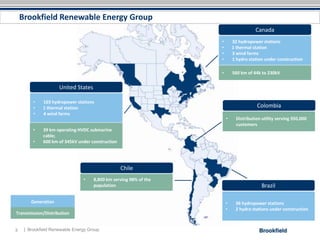
Brookfield Renewable Energy Group
                                                                                      Canada
                                                                   •       32 hydropower stations
                                                                   •       1 thermal station
                                                                   •       3 wind farms
                                                                   •       1 hydro station under construction

                                                                   •       560 km of 44k to 230kV


                     United States

         •   103 hydropower stations
         •   1 thermal station                                                         Colombia
         •   4 wind farms
                                                                       •     Distribution utility serving 350,000
                                                                             customers
         •   39 km operating HVDC submarine
             cable;
         •   600 km of 345kV under construction


                                                  Chile
                                •    8,800 km serving 98% of the
                                     population                                           Brazil

        Generation                                                     •    36 hydropower stations
                                                                       •    2 hydro stations under construction
Transmission/Distribution


3    | Brookfield Renewable Energy Group
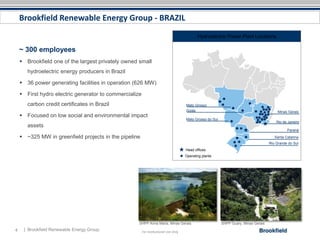
Brookfield Renewable Energy Group - BRAZIL
                                                                                            Hydroelectric Power Plant Locations

    ~ 300 employees
     Brookfield one of the largest privately owned small
       hydroelectric energy producers in Brazil

     36 power generating facilities in operation (626 MW)

     First hydro electric generator to commercialize
       carbon credit certificates in Brazil                                          Mato Grosso
                                                                                     Goiás                                                Minas Gerais
     Focused on low social and environmental impact
                                                                                     Mato Grosso do Sul
                                                                                                                                         Rio de Janeiro
       assets
                                                                                                                                               Paraná
     ~325 MW in greenfield projects in the pipeline                                                                                    Santa Catarina
                                                                                                                                     Rio Grande do Sul
                                                                                     Head offices
                                                                                     Operating plants


                                                    SHPP Anna Maria, Minas Gerais                         SHPP Guary, Minas Gerais
4    | Brookfield Renewable Energy Group                For Institutional Use Only
Poverty, sustainability and energy – developing hydropower – developing the country


    BRAZIL –
      FIGHTING POVERTY IS THE PATH TO SOCIAL AND ECONOMIC DEVELOPMENT
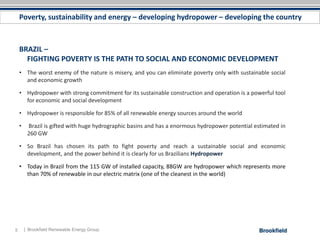
    • The worst enemy of the nature is misery, and you can eliminate poverty only with sustainable social
      and economic growth

    • Hydropower with strong commitment for its sustainable construction and operation is a powerful tool
      for economic and social development

    • Hydropower is responsible for 85% of all renewable energy sources around the world

    •    Brazil is gifted with huge hydrographic basins and has a enormous hydropower potential estimated in
         260 GW

    • So Brazil has chosen its path to fight poverty and reach a sustainable social and economic
      development, and the power behind it is clearly for us Brazilians Hydropower

    • Today in Brazil from the 115 GW of installed capacity, 88GW are hydropower which represents more
      than 70% of renewable in our electric matrix (one of the cleanest in the world)


5       | Brookfield Renewable Energy Group
Poverty, sustainability and energy – developing hydropower – developing the country


    BRAZIL –
      FIGHTING POVERTY IS THE PATH TO SOCIAL AND ECONOMIC DEVELOPMENT
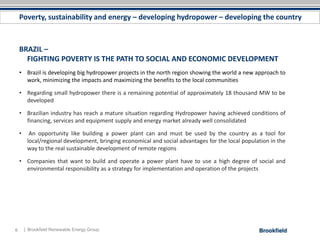
    • Brazil is developing big hydropower projects in the north region showing the world a new approach to
      work, minimizing the impacts and maximizing the benefits to the local communities

    • Regarding small hydropower there is a remaining potential of approximately 18 thousand MW to be
      developed

    • Brazilian industry has reach a mature situation regarding Hydropower having achieved conditions of
      financing, services and equipment supply and energy market already well consolidated

    •     An opportunity like building a power plant can and must be used by the country as a tool for
         local/regional development, bringing economical and social advantages for the local population in the
         way to the real sustainable development of remote regions

    • Companies that want to build and operate a power plant have to use a high degree of social and
      environmental responsibility as a strategy for implementation and operation of the projects


6       | Brookfield Renewable Energy Group
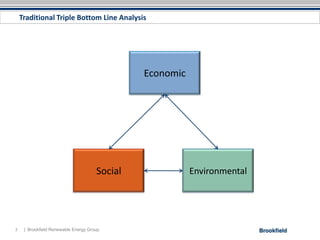
Traditional Triple Bottom Line Analysis


                                               Economic


                                      Social              Environmental


7    | Brookfield Renewable Energy Group
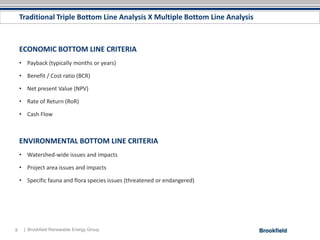
Traditional Triple Bottom Line Analysis X Multiple Bottom Line Analysis


    ECONOMIC BOTTOM LINE CRITERIA
    • Payback (typically months or years)

    • Benefit / Cost ratio (BCR)

    • Net present Value (NPV)

    • Rate of Return (RoR)

    • Cash Flow


    ENVIRONMENTAL BOTTOM LINE CRITERIA
    • Watershed-wide issues and impacts

    • Project area issues and impacts

    • Specific fauna and flora species issues (threatened or endangered)


8    | Brookfield Renewable Energy Group
Traditional Triple Bottom Line Analysis X Multiple Bottom Line Analysis


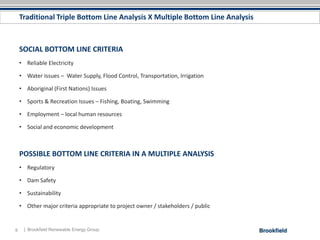
    SOCIAL BOTTOM LINE CRITERIA
    • Reliable Electricity

    • Water Issues – Water Supply, Flood Control, Transportation, Irrigation

    • Aboriginal (First Nations) Issues

    • Sports & Recreation Issues – Fishing, Boating, Swimming

    • Employment – local human resources

    • Social and economic development


    POSSIBLE BOTTOM LINE CRITERIA IN A MULTIPLE ANALYSIS
    • Regulatory

    • Dam Safety

    • Sustainability

    • Other major criteria appropriate to project owner / stakeholders / public


9    | Brookfield Renewable Energy Group
Traditional Triple Bottom Line Analysis X Multiple Bottom Line Analysis


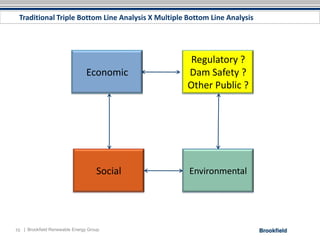
                                                     Regulatory ?
                                Economic            Dam Safety ?
                                                    Other Public ?


                                    Social          Environmental


10 | Brookfield Renewable Energy Group
Traditional Triple Bottom Line Analysis X Multiple Bottom Line Analysis


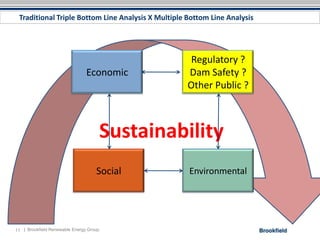
                                                     Regulatory ?
                                Economic            Dam Safety ?
                                                    Other Public ?


                                     Sustainability
                                    Social          Environmental


11 | Brookfield Renewable Energy Group
Multiple Bottom Line Analysis


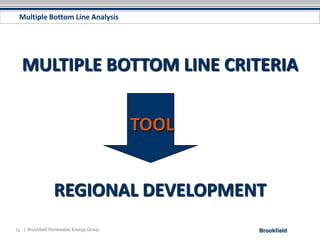
   MULTIPLE BOTTOM LINE CRITERIA


                                         TOOL


                 REGIONAL DEVELOPMENT
12 | Brookfield Renewable Energy Group
Multiple Bottom Line/Regional Development Approach – Advantages


 COMPETITION AMONG DEVELOPERS FOR THE BEST SITES
 • The discussions with the main stakeholders (mainly local communities, first nations, rural workers and
   land owners) set the stage for the need of a multiple bottom line/regional development approach in
   the development of hydropower plants in the country

 • In these discussions a Company want to have the stakeholders as partners playing in the same
   side, once in the public hearings it can make the difference if company will implement the project

 • The Governmental Agencies/Environmental Authorities (filled with NGO people) tend to speed the
   licensing process to companies that are used to work with some kind of multiple bottom line /regional
   development approach in the development of hydropower plants

 FINANCING THE PROJECTS
 • Companies that use a multiple bottom line/regional development approach, and for that can be
   considered “transparent” or “sustainable” or “green” have access to better interest rates and grace
   periods in the project financing

 • Multilateral agencies and Local Development Banks offer not only better financing conditions but also
   a fast track lane analysis process (that is the case of Brazilian BNDES – National Bank for Economic and
   Social Development), also financing with special conditions the voluntary local development projects


13 | Brookfield Renewable Energy Group
Brookfield and BNDES – financing development projects


 • Brookfield as many others private investors in the energy sector in Brazil
   finances the construction of its power plants trough the BNDES – Brazilian
   National Bank for Social and Economical Development, a Federal Government
   Institution aimed to finance the development of the country
 • Since 2008, BNDES has been approaching several borrowers trying to create a
   partnership where in exchange of better financing conditions (smaller interest
   rates, better grace periods and fast track in the loan analysis and approval), the
   private investor would take a social loan to invest in social projects for the
   communities
 • These social projects financing would have a special interest rate, and the
   money had to be used in social responsibility actions (voluntary actions not
   linked with the impacts of the project)


14 | Brookfield Renewable Energy Group
Brookfield Brazil – Barra do Brauna HPP


 • Barra do Braúna Hydroelectric Power Plant (49 MW) was the first one to use
   this social financing
 • From the total project finance (R$ 220 MI) Brookfield took 1% (R$ 2,2 MI) to
   implement social projects
 • As indicated by BNDES the projects should be located preferentially in the
   region close to the power plant, but it was not mandatory
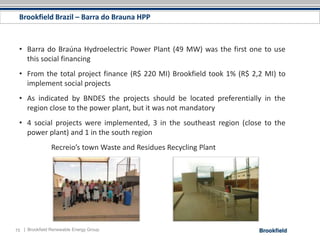
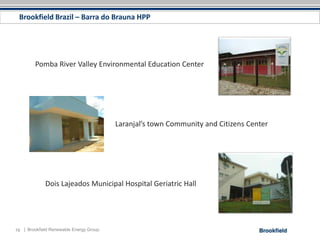
 • 4 social projects were implemented, 3 in the southeast region (close to the
   power plant) and 1 in the south region
                Recreio’s town Waste and Residues Recycling Plant


15 | Brookfield Renewable Energy Group
Brookfield Brazil – Barra do Brauna HPP


         Pomba River Valley Environmental Education Center


                                         Laranjal’s town Community and Citizens Center


             Dois Lajeados Municipal Hospital Geriatric Hall


16 | Brookfield Renewable Energy Group
Brookfield Brazil – Pezzi and Serra dos Cavalinhos II HPP


 • With the success of the Barra do Braúna case BNDES invited Brookfield to
   replicate the process in the financing of a small hydro plant in the Brazilian
   southern region
 • So Serra dos Cavalinhos II (29 MW) was the second case where social projects
   were supported by BNDES
 • From the total project finance (R$ 162 MI) Brookfield took 1% (R$ 1,6 MI) to
   implement social projects
 • 3 projects were selected and will be implemented during 2012 and 2013


17 | Brookfield Renewable Energy Group
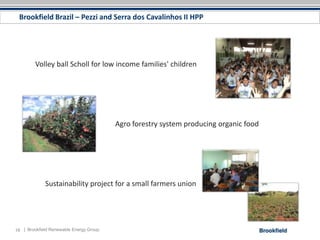
Brookfield Brazil – Pezzi and Serra dos Cavalinhos II HPP


         Volley ball Scholl for low income families' children


                                         Agro forestry system producing organic food


             Sustainability project for a small farmers union


18 | Brookfield Renewable Energy Group
Lessons learned: developing hydropower – developing the communities


 • Companies showing its will to be a partner of the local community during the
   environmental licensing process trough the early discussion and development
   of actions that will lead to local/regional development
 • Companies strongly believes that starting the process in partnership with the
   local people will enhance the chances of success of a project


              COMMUNITIES LOOKING
             FORWARD TO HAVE THESE
            INVESTMENTS IN ITS REGION
19 | Brookfield Renewable Energy Group
Final Remarks – Conclusions


                                         FINAL REMARKS
 • Hydropower is the energy behind Brazilian social and economic
   development
 • The importance of a commitment to the development of sustainable
   hydropower in a country like Brazil
 • Private investment in development, construction and operation of
   Hydro Power Plants is one of the pillars of this commitment
 • Using the development, construction and operation of Hydro Power
   Plants as tool for regional development is fundamental to achieve this
   commitment


20 | Brookfield Renewable Energy Group
Final Remarks – Conclusions


                                         CONCLUSION
     FOR A DEVELOPING COUNTRY SUCH AS BRAZIL, THE IMPLEMENTATION OF A
      HYDROPOWER PLANT IS NOT JUST A CONSTRUCTION OF A NEW POWER
     SOURCE (THAT IS VERY IMPORTANT AND NEEDED) BUT MORE THAN THAT IS A
     GOLDEN OPPORTUNITY TO BRING KNOWLEDGE AND DEVELOPMENT TO
     REMOTE REGIONS OTHERWISE OFTEN FORGOTTEN BY GOVERNMENTS AND
     POLITICS. THE PEOPLE LIVING IN THESE AREAS WITH THE COMPANIES AND
      PROFESSIONALS WORKING IN THIS FIELD ARE LEARNING HOW TO DEAL WITH
      THIS SITUATION BEING ALL PART OF THE PROCESS FOR THE SAKE OF THE
     PROJECT, THE ENVIRONMENT , THE COUNTRY AND THEIR OWN.


21 | Brookfield Renewable Energy Group
THANK YOU


                            Antonio Fonseca dos Santos
                      Environment Land and Social Responsibility Director
                         Brookfield Renewable Energy Group – Brazil
                           antonio.fonseca@brookfieldenergia.com


22 | Brookfield Renewable Energy Group

Antonio Fonseca, Brookfield

  • 1.
    Brookfield Renewable EnergyGroup Focusing on Renewable Power Generation HYDROPOWER A TOOL FOR REGIONAL DEVELOPMENT
  • 2.
    Cautionary Statement onForward-Looking Information This presentation contains forward-looking statements and information within the meaning of the Canadian securities laws. Forward-looking statements may include estimates, plans, expectations, opinions, forecasts, projections, guidance or other statements that are not statements of fact. Forward-looking statements in this presentation include statements regarding Brookfield Renewable Energy Partners L.P. (“Brookfield Renewable”) and its anticipated ratings, the quality of Brookfield Renewable’s assets and the resiliency of the cash flow they will generate, Brookfield Renewable’s anticipated financial performance, the future growth prospects and distribution profile of Brookfield Renewable, the listing and liquidity of the Brookfield Renewable units, Brookfield Renewable’s access to capital and the approval, successful completion and timing of the transaction. Forward-looking statements can be identified by the use of words such as “will”, “expected”, “intend”, “continue”, and targets, or variations of such words and phrases. Although Brookfield Renewable believes its anticipated future results, performance or achievements expressed or implied by the forward-looking statements and information are based upon reasonable assumptions and expectations, they can give no assurance that such expectations will prove to have been correct. The reader should not place undue reliance on forward-looking statements and information as such statements and information involve known and unknown risks, uncertainties and other factors which may cause the actual results, performance or achievements of Brookfield Renewable to differ materially from anticipated future results, performance or achievement expressed or implied by such forward-looking statements and information. Factors that could cause actual results to differ materially from those contemplated or implied by forward-looking statements include, but are not limited to the risk that the conditions precedent to be met, and the regulatory and third party approvals to be obtained, for the combination to occur, are not met or obtained, the fact that Brookfield Renewable units will not be eligible for inclusion on any index, changes to hydrology at Brookfield Renewable’s hydroelectric stations or in wind conditions at Brookfield Renewable’s wind energy facilities, the risk that counterparties to Brookfield Renewable’s contracts do not fulfill their obligations, and as Brookfield Renewable’s contracts expire, it may not be able to replace them with agreements on similar terms, Brookfield Renewable’s operations being highly regulated and exposed to increased regulation which could result in additional costs, the risk that Brookfield Renewable’s concessions and licenses will not be renewed, the risk that a portion of Brookfield Renewable’s hydroelectric portfolio is subject to re-contracting and may become subject to price risk, the risk that Brookfield Renewable may fail to comply with the conditions in, or may not be able to maintain, its governmental permits, the risk that future acquisitions may subject Brookfield Renewable to additional risks, the risk that Brookfield Renewable may experience equipment failure, and other risks and factors detailed from time to time in Brookfield Renewable’s public filings. We caution that the foregoing list of important factors that may affect future results is not exhaustive. Except as required by law, Brookfield Renewable undertakes no obligation to publicly update or revise any forward-looking statements or information, whether written or oral, that may be as a result of new information, future events or otherwise. Non-GAAP Measures This presentation contains references to “EBITDA” and “FFO”, which do not have a standardized meaning prescribed by GAAP and are therefore unlikely to be comparable to similar measures used by other companies. Management believes that EBITDA and FFO are useful supplemental measures that may assist investors in assessing financial performance and the cash generated that is available to unitholders for distribution. EBITDA and FFO should not be considered as the sole measure of performance and should not be considered in isolation from, or a substitute for, analysis of the financial statements prepared in accordance with GAAP. All amounts in U.S. dollars unless otherwise specified. 2 | Brookfield Renewable Energy Group
  • 3.
    Brookfield Renewable EnergyGroup Canada • 32 hydropower stations • 1 thermal station • 3 wind farms • 1 hydro station under construction • 560 km of 44k to 230kV United States • 103 hydropower stations • 1 thermal station Colombia • 4 wind farms • Distribution utility serving 350,000 customers • 39 km operating HVDC submarine cable; • 600 km of 345kV under construction Chile • 8,800 km serving 98% of the population Brazil Generation • 36 hydropower stations • 2 hydro stations under construction Transmission/Distribution 3 | Brookfield Renewable Energy Group
  • 4.
    Brookfield Renewable EnergyGroup - BRAZIL Hydroelectric Power Plant Locations ~ 300 employees  Brookfield one of the largest privately owned small hydroelectric energy producers in Brazil  36 power generating facilities in operation (626 MW)  First hydro electric generator to commercialize carbon credit certificates in Brazil Mato Grosso Goiás Minas Gerais  Focused on low social and environmental impact Mato Grosso do Sul Rio de Janeiro assets Paraná  ~325 MW in greenfield projects in the pipeline Santa Catarina Rio Grande do Sul Head offices Operating plants SHPP Anna Maria, Minas Gerais SHPP Guary, Minas Gerais 4 | Brookfield Renewable Energy Group For Institutional Use Only
  • 5.
    Poverty, sustainability andenergy – developing hydropower – developing the country BRAZIL – FIGHTING POVERTY IS THE PATH TO SOCIAL AND ECONOMIC DEVELOPMENT • The worst enemy of the nature is misery, and you can eliminate poverty only with sustainable social and economic growth • Hydropower with strong commitment for its sustainable construction and operation is a powerful tool for economic and social development • Hydropower is responsible for 85% of all renewable energy sources around the world • Brazil is gifted with huge hydrographic basins and has a enormous hydropower potential estimated in 260 GW • So Brazil has chosen its path to fight poverty and reach a sustainable social and economic development, and the power behind it is clearly for us Brazilians Hydropower • Today in Brazil from the 115 GW of installed capacity, 88GW are hydropower which represents more than 70% of renewable in our electric matrix (one of the cleanest in the world) 5 | Brookfield Renewable Energy Group
  • 6.
    Poverty, sustainability andenergy – developing hydropower – developing the country BRAZIL – FIGHTING POVERTY IS THE PATH TO SOCIAL AND ECONOMIC DEVELOPMENT • Brazil is developing big hydropower projects in the north region showing the world a new approach to work, minimizing the impacts and maximizing the benefits to the local communities • Regarding small hydropower there is a remaining potential of approximately 18 thousand MW to be developed • Brazilian industry has reach a mature situation regarding Hydropower having achieved conditions of financing, services and equipment supply and energy market already well consolidated • An opportunity like building a power plant can and must be used by the country as a tool for local/regional development, bringing economical and social advantages for the local population in the way to the real sustainable development of remote regions • Companies that want to build and operate a power plant have to use a high degree of social and environmental responsibility as a strategy for implementation and operation of the projects 6 | Brookfield Renewable Energy Group
  • 7.
    Traditional Triple BottomLine Analysis Economic Social Environmental 7 | Brookfield Renewable Energy Group
  • 8.
    Traditional Triple BottomLine Analysis X Multiple Bottom Line Analysis ECONOMIC BOTTOM LINE CRITERIA • Payback (typically months or years) • Benefit / Cost ratio (BCR) • Net present Value (NPV) • Rate of Return (RoR) • Cash Flow ENVIRONMENTAL BOTTOM LINE CRITERIA • Watershed-wide issues and impacts • Project area issues and impacts • Specific fauna and flora species issues (threatened or endangered) 8 | Brookfield Renewable Energy Group
  • 9.
    Traditional Triple BottomLine Analysis X Multiple Bottom Line Analysis SOCIAL BOTTOM LINE CRITERIA • Reliable Electricity • Water Issues – Water Supply, Flood Control, Transportation, Irrigation • Aboriginal (First Nations) Issues • Sports & Recreation Issues – Fishing, Boating, Swimming • Employment – local human resources • Social and economic development POSSIBLE BOTTOM LINE CRITERIA IN A MULTIPLE ANALYSIS • Regulatory • Dam Safety • Sustainability • Other major criteria appropriate to project owner / stakeholders / public 9 | Brookfield Renewable Energy Group
  • 10.
    Traditional Triple BottomLine Analysis X Multiple Bottom Line Analysis Regulatory ? Economic Dam Safety ? Other Public ? Social Environmental 10 | Brookfield Renewable Energy Group
  • 11.
    Traditional Triple BottomLine Analysis X Multiple Bottom Line Analysis Regulatory ? Economic Dam Safety ? Other Public ? Sustainability Social Environmental 11 | Brookfield Renewable Energy Group
  • 12.
    Multiple Bottom LineAnalysis MULTIPLE BOTTOM LINE CRITERIA TOOL REGIONAL DEVELOPMENT 12 | Brookfield Renewable Energy Group
  • 13.
    Multiple Bottom Line/RegionalDevelopment Approach – Advantages COMPETITION AMONG DEVELOPERS FOR THE BEST SITES • The discussions with the main stakeholders (mainly local communities, first nations, rural workers and land owners) set the stage for the need of a multiple bottom line/regional development approach in the development of hydropower plants in the country • In these discussions a Company want to have the stakeholders as partners playing in the same side, once in the public hearings it can make the difference if company will implement the project • The Governmental Agencies/Environmental Authorities (filled with NGO people) tend to speed the licensing process to companies that are used to work with some kind of multiple bottom line /regional development approach in the development of hydropower plants FINANCING THE PROJECTS • Companies that use a multiple bottom line/regional development approach, and for that can be considered “transparent” or “sustainable” or “green” have access to better interest rates and grace periods in the project financing • Multilateral agencies and Local Development Banks offer not only better financing conditions but also a fast track lane analysis process (that is the case of Brazilian BNDES – National Bank for Economic and Social Development), also financing with special conditions the voluntary local development projects 13 | Brookfield Renewable Energy Group
  • 14.
    Brookfield and BNDES– financing development projects • Brookfield as many others private investors in the energy sector in Brazil finances the construction of its power plants trough the BNDES – Brazilian National Bank for Social and Economical Development, a Federal Government Institution aimed to finance the development of the country • Since 2008, BNDES has been approaching several borrowers trying to create a partnership where in exchange of better financing conditions (smaller interest rates, better grace periods and fast track in the loan analysis and approval), the private investor would take a social loan to invest in social projects for the communities • These social projects financing would have a special interest rate, and the money had to be used in social responsibility actions (voluntary actions not linked with the impacts of the project) 14 | Brookfield Renewable Energy Group
  • 15.
    Brookfield Brazil –Barra do Brauna HPP • Barra do Braúna Hydroelectric Power Plant (49 MW) was the first one to use this social financing • From the total project finance (R$ 220 MI) Brookfield took 1% (R$ 2,2 MI) to implement social projects • As indicated by BNDES the projects should be located preferentially in the region close to the power plant, but it was not mandatory • 4 social projects were implemented, 3 in the southeast region (close to the power plant) and 1 in the south region Recreio’s town Waste and Residues Recycling Plant 15 | Brookfield Renewable Energy Group
  • 16.
    Brookfield Brazil –Barra do Brauna HPP Pomba River Valley Environmental Education Center Laranjal’s town Community and Citizens Center Dois Lajeados Municipal Hospital Geriatric Hall 16 | Brookfield Renewable Energy Group
  • 17.
    Brookfield Brazil –Pezzi and Serra dos Cavalinhos II HPP • With the success of the Barra do Braúna case BNDES invited Brookfield to replicate the process in the financing of a small hydro plant in the Brazilian southern region • So Serra dos Cavalinhos II (29 MW) was the second case where social projects were supported by BNDES • From the total project finance (R$ 162 MI) Brookfield took 1% (R$ 1,6 MI) to implement social projects • 3 projects were selected and will be implemented during 2012 and 2013 17 | Brookfield Renewable Energy Group
  • 18.
    Brookfield Brazil –Pezzi and Serra dos Cavalinhos II HPP Volley ball Scholl for low income families' children Agro forestry system producing organic food Sustainability project for a small farmers union 18 | Brookfield Renewable Energy Group
  • 19.
    Lessons learned: developinghydropower – developing the communities • Companies showing its will to be a partner of the local community during the environmental licensing process trough the early discussion and development of actions that will lead to local/regional development • Companies strongly believes that starting the process in partnership with the local people will enhance the chances of success of a project COMMUNITIES LOOKING FORWARD TO HAVE THESE INVESTMENTS IN ITS REGION 19 | Brookfield Renewable Energy Group
  • 20.
    Final Remarks –Conclusions FINAL REMARKS • Hydropower is the energy behind Brazilian social and economic development • The importance of a commitment to the development of sustainable hydropower in a country like Brazil • Private investment in development, construction and operation of Hydro Power Plants is one of the pillars of this commitment • Using the development, construction and operation of Hydro Power Plants as tool for regional development is fundamental to achieve this commitment 20 | Brookfield Renewable Energy Group
  • 21.
    Final Remarks –Conclusions CONCLUSION FOR A DEVELOPING COUNTRY SUCH AS BRAZIL, THE IMPLEMENTATION OF A HYDROPOWER PLANT IS NOT JUST A CONSTRUCTION OF A NEW POWER SOURCE (THAT IS VERY IMPORTANT AND NEEDED) BUT MORE THAN THAT IS A GOLDEN OPPORTUNITY TO BRING KNOWLEDGE AND DEVELOPMENT TO REMOTE REGIONS OTHERWISE OFTEN FORGOTTEN BY GOVERNMENTS AND POLITICS. THE PEOPLE LIVING IN THESE AREAS WITH THE COMPANIES AND PROFESSIONALS WORKING IN THIS FIELD ARE LEARNING HOW TO DEAL WITH THIS SITUATION BEING ALL PART OF THE PROCESS FOR THE SAKE OF THE PROJECT, THE ENVIRONMENT , THE COUNTRY AND THEIR OWN. 21 | Brookfield Renewable Energy Group
  • 22.
    THANK YOU Antonio Fonseca dos Santos Environment Land and Social Responsibility Director Brookfield Renewable Energy Group – Brazil antonio.fonseca@brookfieldenergia.com 22 | Brookfield Renewable Energy Group

Editor's Notes

  • #3 I may make some forward-looking statements in today’s presentation and would ask you to bear in mind the various risk factors which you can find more clearly laid out in our regulatory filings.
  • #4 180 power facilities1,200 employees in 3 countries10 markets in North and South America2,000 MW in development pipelineFacilities on 68 river systems5,800 miles of transmission under management or in construction