INTRODUCTION
ANTILOCK BRAKING SYSTEM 1
• Anti-lock braking system (ABS) is an automobile safety system that allows
the wheels on a motor vehicle to maintain tractive contact with the road surface
according to driver inputs while braking, preventing the wheels from locking up
and avoiding uncontrolled skidding.
• ABS generally offers improved vehicle control and decreases stopping distances
on dry and slippery surfaces.
• ABS modulates the brake line pressure independent of the pedal force, to bring
the wheel speed back to the slip level range that is necessary for optimal
braking performance.
PROJECT OUTLINE
ANTILOCK BRAKING SYSTEM 2
• Objectives of ABS
• Components of ABS
• Working of ABS
• Mathematical model
• System model
• Results
• Conclusion
• References
OBJECTIVES OF ABS
ANTILOCK BRAKING SYSTEM 3
• To reduce stopping distance
1. The road surface type and conditions can be inferred from the vehicle's
braking pressure, wheel slip measurements, and deceleration rate
comparisons.
2. The wheel slip is regulated so that the road adhesion coefficient is
maximized. By keeping all of the wheels of a vehicle near the maximum
friction coefficient, an antilock system can attain maximum fictional
force
3. In turn, this strategy leads to the minimization of the vehicle stopping
distance.
ANTILOCK BRAKING SYSTEM 4
• Stability
1. A locked-up wheel generates a reduced braking force, smaller than the peak
value of the available adhesion between tires and road. A locked-up wheel
will also lose its capability to sustain any lateral force. This may result in the
loss of vehicle stability.
2. The basic purpose of a conventional ABS system is thus to prevent any
wheel from locking and to keep the longitudinal slip in an operational range
by cycling the braking pressure.
ANTILOCK BRAKING SYSTEM 5
• Steerability
1. Good peak frictional force control is necessary in order to achieve
satisfactory lateral forces and, therefore, satisfactory steer-ability.
2. If an obstacle appears without warning, emergency braking may not be
sufficient. When the wheels are locked, car no longer respond to the driver’s
steering intention.
3. With ABS car remains steerable even during emergency braking, and thus the
obstacle can be safely avoided.
COMPONENTS OF ABS
ANTILOCK BRAKING SYSTEM 6
The primary components of the ABS braking system are:
• Electronic control unit (ECU)
1. It receives signals from the sensors in the circuit and controls the brake
pressure at the road wheels according to the data analysed by the Unit.
2. ECU assists the vehicle operator to prevent wheel lockup by regulating the
wheel slip.
• Hydraulic control unit or modulator
1. It receives operating signals from the ECU to apply or release the brakes
under ABS conditions.
2. It executes the commands using three solenoid valves connected in series
with the master cylinder and the brake circuits- one valve for each front
wheel hydraulic circuit, and one for both of the rear wheels. Thus brakes can
be actuated by controlling hydraulic pressure.
ANTILOCK BRAKING SYSTEM 7
• Power booster and master cylinder assembly
1. It is activated when the driver pushes down on the brake pedal. The master
cylinder transforms the applied pedal force into hydraulic pressure which
is transmitted simultaneously to all four wheels.
2. It provides the power assistance required during braking.
• Wheel sensor unit
1. Speed sensors are comprised of a magnet wrapped in a coil and a toothed
sensor ring. An electrical field given off by the contact between the magnet
and the toothed ring creates a AC voltage.
2. The voltage frequency is directly proportional to the wheel's rotational
speed.
3. It monitors the rotational speed of the wheel and transmits this data to the
ABS control module.
WORKING OF ABS
ANTILOCK BRAKING SYSTEM 8
• If a wheel-speed sensor signals a lock up - the ECU sends a current to the
hydraulic unit. This energizes the solenoid valve. The action of the valve
isolates the brake circuit from the master cylinder. This stops the braking
pressure at that wheel from rising, and keeps it constant. It allows wheel
velocity to increase and slip to decrease.
• When the velocity increases, ECU re-applies the brake pressure to restrict
the wheel slip to a particular value.
• Hydraulic control unit controls the brake pressure in each wheel cylinder
based on the inputs from the system sensor. This in result controls the wheel
speed.
MATHEMATICAL MODEL
ANTILOCK BRAKING SYSTEM 9
• Wheel slip:
When the braking action is initiated, a slippage between the tire and the
contacted road surface will occur, which make the speed of the vehicle to be
different from that of the tire.
• The longitudinal slip is defined as
𝑆 =
𝑉𝑐𝑜𝑠𝛼 − 𝜔𝑅𝑤
𝑉𝑐𝑜𝑠𝛼
The side slip angle is
𝛼 = 𝑡𝑎𝑛−1 𝑉𝑠𝑦
𝑉𝑥
Force and velocity components on tyre
ANTILOCK BRAKING SYSTEM 10
• Vehicle Dynamics
According to Newton's second law, the equation of motion of the
simplified vehicle can be expressed by,
𝑚𝑡𝑉 = −𝐹𝑡 − 𝐹𝑎
The road friction force is given by Coulomb law
𝐹𝑡 = 𝜇𝑁
The total mass of the quarter vehicle can be written as
𝑚𝑡 = 𝑚𝑡𝑖𝑟𝑒 +
𝑚𝑐
4
Thus, the total normal load cm be expressed by
𝑁 = 𝑚𝑡𝑔 − 𝐹𝑙
𝐹𝑙 is the longitudinal weight transfer load due to braking
ANTILOCK BRAKING SYSTEM 11
Simulink model for vehicle dynamics
ANTILOCK BRAKING SYSTEM 12
• Wheel dynamics
According to Newton's second law, the equation of motion at wheel
level for the rotational DOF is given by,
𝐽𝑤𝜔 = −𝑇𝑏 + 𝐹𝑡𝑅𝑤
ANTILOCK BRAKING SYSTEM 13
Simulink model for wheel dynamics
SYSTEM MODEL
ANTILOCK BRAKING SYSTEM 14
Assumption: Only a linear model was considered and does not include actual road
conditions. The system here is modelled only for straight line braking.
INPUT PARAMETERS FOR SIMULINK MODEL
ANTILOCK BRAKING SYSTEM 15
Gravitational constant 𝑔 = 32.18 𝑓𝑡/𝑠2
Initial velocity of vehicle 𝑣0 = 88 𝑓𝑡/𝑠
Wheel Radius 𝑅𝑟 = 1.25 𝑓𝑡
Mass of vehicle 𝑚 = 50 lbs
Maximum Braking Torque 𝑇𝑏𝑚𝑎𝑥
= 1500 𝑙𝑏𝑓 ∗ 𝑓𝑡
Hydraulic Lag 𝑇𝐵 = 0.01 𝑠
Moment of Inertia 𝐽𝑤 = 5 𝑓𝑡4
RESULTS
ANTILOCK BRAKING SYSTEM 16
VEHICLE SPEED AND WHEEL SPEED
(WITHOUT ABS)
ANTILOCK BRAKING SYSTEM 17
ANTILOCK BRAKING SYSTEM 18
VEHICLE SPEED AND WHEEL SPEED
(WITH ABS)
SLIP (WITHOUT ABS)
ANTILOCK BRAKING SYSTEM 19
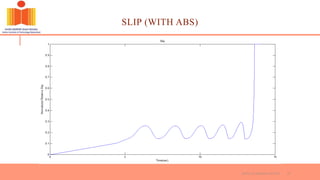
SLIP (WITH ABS)
ANTILOCK BRAKING SYSTEM 20
STOPPING DISTANCE (WITHOUT ABS)
ANTILOCK BRAKING SYSTEM 21
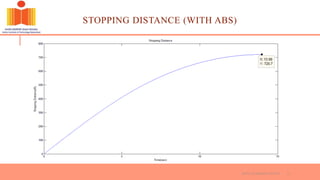
STOPPING DISTANCE (WITH ABS)
ANTILOCK BRAKING SYSTEM 22
CONCLUSION
ANTILOCK BRAKING SYSTEM 23
• It is inferred that ABS improves the braking performance.
• The stopping distance after using ABS system has considerably reduced.
• The error in slip and desired slip is used to manipulate brake pressure in brake
cylinder.
REFERENCES
ANTILOCK BRAKING SYSTEM 24
• Tianku Fu,“Modelling and performance analysis of ABS system with non-linear control”,
2000.
• Tobias Eriksson,“Co-simulation of full vehicle model in Adams and anti-lock brake system
model in Simulink”, 2014.
ANTILOCK BRAKING SYSTEM 25
THANK YOU!

AbS PpT.pptx

  • 1.
    INTRODUCTION ANTILOCK BRAKING SYSTEM1 • Anti-lock braking system (ABS) is an automobile safety system that allows the wheels on a motor vehicle to maintain tractive contact with the road surface according to driver inputs while braking, preventing the wheels from locking up and avoiding uncontrolled skidding. • ABS generally offers improved vehicle control and decreases stopping distances on dry and slippery surfaces. • ABS modulates the brake line pressure independent of the pedal force, to bring the wheel speed back to the slip level range that is necessary for optimal braking performance.
  • 2.
    PROJECT OUTLINE ANTILOCK BRAKINGSYSTEM 2 • Objectives of ABS • Components of ABS • Working of ABS • Mathematical model • System model • Results • Conclusion • References
  • 3.
    OBJECTIVES OF ABS ANTILOCKBRAKING SYSTEM 3 • To reduce stopping distance 1. The road surface type and conditions can be inferred from the vehicle's braking pressure, wheel slip measurements, and deceleration rate comparisons. 2. The wheel slip is regulated so that the road adhesion coefficient is maximized. By keeping all of the wheels of a vehicle near the maximum friction coefficient, an antilock system can attain maximum fictional force 3. In turn, this strategy leads to the minimization of the vehicle stopping distance.
  • 4.
    ANTILOCK BRAKING SYSTEM4 • Stability 1. A locked-up wheel generates a reduced braking force, smaller than the peak value of the available adhesion between tires and road. A locked-up wheel will also lose its capability to sustain any lateral force. This may result in the loss of vehicle stability. 2. The basic purpose of a conventional ABS system is thus to prevent any wheel from locking and to keep the longitudinal slip in an operational range by cycling the braking pressure.
  • 5.
    ANTILOCK BRAKING SYSTEM5 • Steerability 1. Good peak frictional force control is necessary in order to achieve satisfactory lateral forces and, therefore, satisfactory steer-ability. 2. If an obstacle appears without warning, emergency braking may not be sufficient. When the wheels are locked, car no longer respond to the driver’s steering intention. 3. With ABS car remains steerable even during emergency braking, and thus the obstacle can be safely avoided.
  • 6.
    COMPONENTS OF ABS ANTILOCKBRAKING SYSTEM 6 The primary components of the ABS braking system are: • Electronic control unit (ECU) 1. It receives signals from the sensors in the circuit and controls the brake pressure at the road wheels according to the data analysed by the Unit. 2. ECU assists the vehicle operator to prevent wheel lockup by regulating the wheel slip. • Hydraulic control unit or modulator 1. It receives operating signals from the ECU to apply or release the brakes under ABS conditions. 2. It executes the commands using three solenoid valves connected in series with the master cylinder and the brake circuits- one valve for each front wheel hydraulic circuit, and one for both of the rear wheels. Thus brakes can be actuated by controlling hydraulic pressure.
  • 7.
    ANTILOCK BRAKING SYSTEM7 • Power booster and master cylinder assembly 1. It is activated when the driver pushes down on the brake pedal. The master cylinder transforms the applied pedal force into hydraulic pressure which is transmitted simultaneously to all four wheels. 2. It provides the power assistance required during braking. • Wheel sensor unit 1. Speed sensors are comprised of a magnet wrapped in a coil and a toothed sensor ring. An electrical field given off by the contact between the magnet and the toothed ring creates a AC voltage. 2. The voltage frequency is directly proportional to the wheel's rotational speed. 3. It monitors the rotational speed of the wheel and transmits this data to the ABS control module.
  • 8.
    WORKING OF ABS ANTILOCKBRAKING SYSTEM 8 • If a wheel-speed sensor signals a lock up - the ECU sends a current to the hydraulic unit. This energizes the solenoid valve. The action of the valve isolates the brake circuit from the master cylinder. This stops the braking pressure at that wheel from rising, and keeps it constant. It allows wheel velocity to increase and slip to decrease. • When the velocity increases, ECU re-applies the brake pressure to restrict the wheel slip to a particular value. • Hydraulic control unit controls the brake pressure in each wheel cylinder based on the inputs from the system sensor. This in result controls the wheel speed.
  • 9.
    MATHEMATICAL MODEL ANTILOCK BRAKINGSYSTEM 9 • Wheel slip: When the braking action is initiated, a slippage between the tire and the contacted road surface will occur, which make the speed of the vehicle to be different from that of the tire. • The longitudinal slip is defined as 𝑆 = 𝑉𝑐𝑜𝑠𝛼 − 𝜔𝑅𝑤 𝑉𝑐𝑜𝑠𝛼 The side slip angle is 𝛼 = 𝑡𝑎𝑛−1 𝑉𝑠𝑦 𝑉𝑥 Force and velocity components on tyre
  • 10.
    ANTILOCK BRAKING SYSTEM10 • Vehicle Dynamics According to Newton's second law, the equation of motion of the simplified vehicle can be expressed by, 𝑚𝑡𝑉 = −𝐹𝑡 − 𝐹𝑎 The road friction force is given by Coulomb law 𝐹𝑡 = 𝜇𝑁 The total mass of the quarter vehicle can be written as 𝑚𝑡 = 𝑚𝑡𝑖𝑟𝑒 + 𝑚𝑐 4 Thus, the total normal load cm be expressed by 𝑁 = 𝑚𝑡𝑔 − 𝐹𝑙 𝐹𝑙 is the longitudinal weight transfer load due to braking
  • 11.
    ANTILOCK BRAKING SYSTEM11 Simulink model for vehicle dynamics
  • 12.
    ANTILOCK BRAKING SYSTEM12 • Wheel dynamics According to Newton's second law, the equation of motion at wheel level for the rotational DOF is given by, 𝐽𝑤𝜔 = −𝑇𝑏 + 𝐹𝑡𝑅𝑤
  • 13.
    ANTILOCK BRAKING SYSTEM13 Simulink model for wheel dynamics
  • 14.
    SYSTEM MODEL ANTILOCK BRAKINGSYSTEM 14 Assumption: Only a linear model was considered and does not include actual road conditions. The system here is modelled only for straight line braking.
  • 15.
    INPUT PARAMETERS FORSIMULINK MODEL ANTILOCK BRAKING SYSTEM 15 Gravitational constant 𝑔 = 32.18 𝑓𝑡/𝑠2 Initial velocity of vehicle 𝑣0 = 88 𝑓𝑡/𝑠 Wheel Radius 𝑅𝑟 = 1.25 𝑓𝑡 Mass of vehicle 𝑚 = 50 lbs Maximum Braking Torque 𝑇𝑏𝑚𝑎𝑥 = 1500 𝑙𝑏𝑓 ∗ 𝑓𝑡 Hydraulic Lag 𝑇𝐵 = 0.01 𝑠 Moment of Inertia 𝐽𝑤 = 5 𝑓𝑡4
  • 16.
  • 17.
    VEHICLE SPEED ANDWHEEL SPEED (WITHOUT ABS) ANTILOCK BRAKING SYSTEM 17
  • 18.
    ANTILOCK BRAKING SYSTEM18 VEHICLE SPEED AND WHEEL SPEED (WITH ABS)
  • 19.
    SLIP (WITHOUT ABS) ANTILOCKBRAKING SYSTEM 19
  • 20.
    SLIP (WITH ABS) ANTILOCKBRAKING SYSTEM 20
  • 21.
    STOPPING DISTANCE (WITHOUTABS) ANTILOCK BRAKING SYSTEM 21
  • 22.
    STOPPING DISTANCE (WITHABS) ANTILOCK BRAKING SYSTEM 22
  • 23.
    CONCLUSION ANTILOCK BRAKING SYSTEM23 • It is inferred that ABS improves the braking performance. • The stopping distance after using ABS system has considerably reduced. • The error in slip and desired slip is used to manipulate brake pressure in brake cylinder.
  • 24.
    REFERENCES ANTILOCK BRAKING SYSTEM24 • Tianku Fu,“Modelling and performance analysis of ABS system with non-linear control”, 2000. • Tobias Eriksson,“Co-simulation of full vehicle model in Adams and anti-lock brake system model in Simulink”, 2014.
  • 25.