Antiepileptic Drugs
1
2
Objectives
• Classify antiepileptic drugs
• Describe pharmacology of antiepileptic drugs
– Mechanism of action
– Relevant pharmacokinetics
– Indications
– Adverse drug reactions
– Important drug interactions
• Explain pharmacological management of
epilepsy
MECHANISM OF ACTION OF ANTIEPILEPTIC DRUGS
Three main mechanisms –
• Enhancement of GABA action
• Inhibition of sodium channel function
•Inhibition of calcium channel function.
Other mechanisms include -
- Inhibition of glutamate release and
- Block of glutamate receptors.
5
Classification of Anticonvulsants
Action on Ion
Channels
Enhance
GABA
Transmission
Inhibit EAA
Transmissi
on
Na+: Benzodiazepines Felbamate
Phenytoin,
Carbamazepine,
Lamotrigine
Topiramate
(diazepam,
clonazepam)
Barbiturates
(phenobarbital)
Topiramate
Valproic acid Valproic acid
Ca++: Gabapentin
Ethosuximide Vigabatrin
Valproic acid Topiramate
Felbamate
Mechanism of action of antiepileptic
drugs
Phenytoin, Carbamazepine,
felbamate, lamotrigine, valproic acid
•Block voltage-dependent sodium
channels at high firing frequencies
Mechanism of action of antiepileptic drugs
 Barbiturates
•Prolong GABA-mediated chloride
channel openings
 Benzodiazepines
• Increase frequency of GABA-
mediated chloride channel
openings
7
Valproate
May enhance GABA transmission in
specific circuits
 Blocks voltage-dependent sodium channels
 Blocks T-type calcium currents
Ethosuximide
• Blocks slow, threshold, “transient” (T-type) calcium
channels in thalamic neurons
8
Mechanism of action of antiepileptic drugs(AEDs)
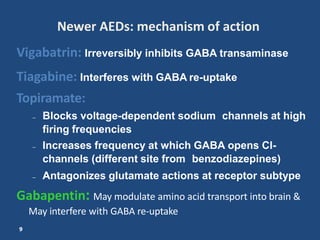
Newer AEDs: mechanism of action
Vigabatrin: Irreversibly inhibits GABA transaminase
Tiagabine: Interferes with GABA re-uptake
Topiramate:
– Blocks voltage-dependent sodium channels at high
firing frequencies
– Increases frequency at which GABA opens Cl-
channels (different site from benzodiazepines)
– Antagonizes glutamate actions at receptor subtype
Gabapentin: May modulate amino acid transport into brain &
May interfere with GABA re-uptake
9
Phenobarbitone
• GABA-facilitatory
• GABA-mimetic
• Adverse effects
– sedative action.
– Long term administration - behavioral
abnormalities, impairment of learning and
memory, hyperactivity in children, mental
confusion in older people.
– Rashes, megaloblastic anaemia and osteo-
malacia on prolonged use.
Uses/indications
• Generalized tonic-clonic (GTC), simple partial
(SP) and complex partial (CP) seizures:
60 mg 1-3 times a day in adults; in children (3-6
mg/kg/ day).
• Status epilepticus: may be injected i.m. or i.v.
but response is slow to develop.
• not effective in absence seizures.
Phenytoin (Diphenylhydantoin)
• Most commonly used.
• Phenytoin prolongs the inactivated state of
voltage sensitive neuronal Na+ channel and
reduces the neuronal excitability.
Pharmacokinetics
• Absorption is formulation dependent
• highly bound to plasma proteins
• fosphenytoin is for IV, IM routes
• The kinetics changes from first order to zero
order over the therapeutic range(small
increments in dose produce
disproportionately high plasma
concentrations.)
• The t1/2 - 12-24 hours progressively ↑es upto
60 hr when plasma concentration rises above
10 ug/ml as metabolizing enzymes get
saturated.
Uses
• Generalized tonic-clonic, simple and comp
lex partial seizures.
• It is ineffective in absence seizures.
Dose: 100 mg BD, maximum 400 mg/day; Children 5-8
mg/kg/day,
• Status epilepticus: occasionally used by slow
i.v. injection.
• Trigeminal neuralgia - second choice drug to
carbamazepine.
Adverse effect
At therapeutic levels -
• Gum hypertrophy:
• Hirsutism:
• Hypersensitivity reactions:
• Megaloblastic anaemia:
• Osteomalacia:
• Hyper-glycaemia.
• foetal hydantoin syndrome (hypoplastic phalanges, cleft
palate, hare lip, microcephaly),due to its areneoxide
metabolite.
Adverse effect
At high plasma levels (dose related toxicity)
• CNS- Cerebellar and vestibular manifestations:
ataxia, vertigo, diplopia, nystagmus are the most
characteristic features.
Drowsiness, behavioral alterations, mental
confusion and hallucinations.
• GIT - Epigastric pain, nausea and vomiting:
minimised by taking the drug with meals.
• CVS – hypotension & arrhythmias.
Carbamazepine
• Adverse effects
– Dose related neurotoxicity—sedation, dizziness,
vertigo, diplopia and ataxia.
– Vomiting, diarrhea
– Acute intoxication - coma, convulsions and
cardiovascular collapse.
– Hypersensitivity reactions:rashes,photosensitivity
hepatitis, lupus like syndrome
– Water retention and hyponatremia in the elderly as it
enhances ADH action.
– Teratogenic
Uses
• It is the most effective drug for CPS
• First choice drug with phenytoin for GTC and
SPS .
• Trigeminal and related neuralgias - is the drug
of choice.
• Manic depressive illness and acute mania - as
an alternative to lithium
ETHOSUXIMIDE
• Inhibit T type Ca+2 current in thalamic
neurons.
• Adverse effects
– GI intolerance, tiredness, mood changes,
agitation, headache, drowsiness and inability
to concentrate
• Uses
– Only in ABSENCE SEIZURES but Use has now
declined as many consider valproic acid to be
superior to it.
VALPROIC ACID (Sodium Valproate)
Multiple mechanisms of action :
• Phenytoin like frequency dependent
prolongation of Na* channel inactivation.
• Attenuation of Ca2+ mediated 'T' current
(ethosuximide like)
• Augmentation of release of inhibitory
transmitter GABA by inhibiting its degradation
(by GABA-transaminase) & by increasing its
synthesis.
Uses
• Highly effective in absence seizure.
• Alternative /adjuvant drug for GTCS, SPS and
CPS.
• Myoclonic and atonic seizures—control is
often incomplete, but it is the drug of choice.
• Mania and bipolar illness: as alternative to
lithium.
Adverse effects
• anorexia, vomiting, loose motions, heart burn
• Drowsiness, ataxia, tremors
• Alopecia, curling of hair, increased bleeding
tendency
• Fulminant hepatitis (very rare0
• Pancreatitis
• High incidence of PCOD in young girls
• Teraotogenic
22
LAMOTRIGINE
Blocks sodium as well as high voltage
dependent calcium channels
Uses
• Broad spectrum antiepileptic.
• Refractory cases of partial seizures and GTCS
• Absence and myoclonic or akinetic epilepsy .
• Lennox-gastaut syndrome
Adverse effects
• sleepiness, dizziness, diplopia,ataxia and vomiting.
• better tolerated than carbamazepine or phenytoin.
• Rash may be a severe
GABAPENTIN
• Enhances GABA release in brain.
• does not act as agonist at GABAA receptor.
• Reduces seizure frequency in refractory partial
seizures with or without generalization.
• Effective in SPS and CPS
• Manic depressive illness and migraine
• first line drug for pain - diabetic neuropathy and
postherpetic neuralgia,
• Adverse effects - mild sedation, tiredness, dizziness
and unsteadiness.
VIGABATRIN
• Inhibitor of GABA-transaminase which degrades
GABA
• Effective in refractory epilepsy, specially partial
seizures with or without generalization.
• Adverse effects- behavioral changes, depression
and psychosis . drowsiness, amnesia, visual field
contraction, motor disturbances, agitation in
children.
TIAGABINE
• Recently developed anticonvulsant -
potentiates GABA mediated neuronal
inhibition by depressing GABA transporter
GAT-1 which removes synaptically released
GABA into neurons & glial cells.
• Uses – add on therapy of partial seizures with
or without secondary generalization.
• Adverse effects- mild sedation, nervousness,
asthenia, amnesia & abdominal pain.
27
28
29
Reference
• Lippincots illustrated pharmacology 6th edition
page 157-168
• Essentials of Medical Pharmacology 7th edition
by KD tripathi
30

antiepilepticsnaser-pptx

  • 1.
  • 2.
    2 Objectives • Classify antiepilepticdrugs • Describe pharmacology of antiepileptic drugs – Mechanism of action – Relevant pharmacokinetics – Indications – Adverse drug reactions – Important drug interactions • Explain pharmacological management of epilepsy
  • 4.
    MECHANISM OF ACTIONOF ANTIEPILEPTIC DRUGS Three main mechanisms – • Enhancement of GABA action • Inhibition of sodium channel function •Inhibition of calcium channel function. Other mechanisms include - - Inhibition of glutamate release and - Block of glutamate receptors.
  • 5.
    5 Classification of Anticonvulsants Actionon Ion Channels Enhance GABA Transmission Inhibit EAA Transmissi on Na+: Benzodiazepines Felbamate Phenytoin, Carbamazepine, Lamotrigine Topiramate (diazepam, clonazepam) Barbiturates (phenobarbital) Topiramate Valproic acid Valproic acid Ca++: Gabapentin Ethosuximide Vigabatrin Valproic acid Topiramate Felbamate
  • 6.
    Mechanism of actionof antiepileptic drugs Phenytoin, Carbamazepine, felbamate, lamotrigine, valproic acid •Block voltage-dependent sodium channels at high firing frequencies
  • 7.
    Mechanism of actionof antiepileptic drugs  Barbiturates •Prolong GABA-mediated chloride channel openings  Benzodiazepines • Increase frequency of GABA- mediated chloride channel openings 7
  • 8.
    Valproate May enhance GABAtransmission in specific circuits  Blocks voltage-dependent sodium channels  Blocks T-type calcium currents Ethosuximide • Blocks slow, threshold, “transient” (T-type) calcium channels in thalamic neurons 8 Mechanism of action of antiepileptic drugs(AEDs)
  • 9.
    Newer AEDs: mechanismof action Vigabatrin: Irreversibly inhibits GABA transaminase Tiagabine: Interferes with GABA re-uptake Topiramate: – Blocks voltage-dependent sodium channels at high firing frequencies – Increases frequency at which GABA opens Cl- channels (different site from benzodiazepines) – Antagonizes glutamate actions at receptor subtype Gabapentin: May modulate amino acid transport into brain & May interfere with GABA re-uptake 9
  • 10.
    Phenobarbitone • GABA-facilitatory • GABA-mimetic •Adverse effects – sedative action. – Long term administration - behavioral abnormalities, impairment of learning and memory, hyperactivity in children, mental confusion in older people. – Rashes, megaloblastic anaemia and osteo- malacia on prolonged use.
  • 11.
    Uses/indications • Generalized tonic-clonic(GTC), simple partial (SP) and complex partial (CP) seizures: 60 mg 1-3 times a day in adults; in children (3-6 mg/kg/ day). • Status epilepticus: may be injected i.m. or i.v. but response is slow to develop. • not effective in absence seizures.
  • 12.
    Phenytoin (Diphenylhydantoin) • Mostcommonly used. • Phenytoin prolongs the inactivated state of voltage sensitive neuronal Na+ channel and reduces the neuronal excitability.
  • 13.
    Pharmacokinetics • Absorption isformulation dependent • highly bound to plasma proteins • fosphenytoin is for IV, IM routes • The kinetics changes from first order to zero order over the therapeutic range(small increments in dose produce disproportionately high plasma concentrations.) • The t1/2 - 12-24 hours progressively ↑es upto 60 hr when plasma concentration rises above 10 ug/ml as metabolizing enzymes get saturated.
  • 14.
    Uses • Generalized tonic-clonic,simple and comp lex partial seizures. • It is ineffective in absence seizures. Dose: 100 mg BD, maximum 400 mg/day; Children 5-8 mg/kg/day, • Status epilepticus: occasionally used by slow i.v. injection. • Trigeminal neuralgia - second choice drug to carbamazepine.
  • 15.
    Adverse effect At therapeuticlevels - • Gum hypertrophy: • Hirsutism: • Hypersensitivity reactions: • Megaloblastic anaemia: • Osteomalacia: • Hyper-glycaemia. • foetal hydantoin syndrome (hypoplastic phalanges, cleft palate, hare lip, microcephaly),due to its areneoxide metabolite.
  • 16.
    Adverse effect At highplasma levels (dose related toxicity) • CNS- Cerebellar and vestibular manifestations: ataxia, vertigo, diplopia, nystagmus are the most characteristic features. Drowsiness, behavioral alterations, mental confusion and hallucinations. • GIT - Epigastric pain, nausea and vomiting: minimised by taking the drug with meals. • CVS – hypotension & arrhythmias.
  • 17.
    Carbamazepine • Adverse effects –Dose related neurotoxicity—sedation, dizziness, vertigo, diplopia and ataxia. – Vomiting, diarrhea – Acute intoxication - coma, convulsions and cardiovascular collapse. – Hypersensitivity reactions:rashes,photosensitivity hepatitis, lupus like syndrome – Water retention and hyponatremia in the elderly as it enhances ADH action. – Teratogenic
  • 18.
    Uses • It isthe most effective drug for CPS • First choice drug with phenytoin for GTC and SPS . • Trigeminal and related neuralgias - is the drug of choice. • Manic depressive illness and acute mania - as an alternative to lithium
  • 19.
    ETHOSUXIMIDE • Inhibit Ttype Ca+2 current in thalamic neurons. • Adverse effects – GI intolerance, tiredness, mood changes, agitation, headache, drowsiness and inability to concentrate • Uses – Only in ABSENCE SEIZURES but Use has now declined as many consider valproic acid to be superior to it.
  • 20.
    VALPROIC ACID (SodiumValproate) Multiple mechanisms of action : • Phenytoin like frequency dependent prolongation of Na* channel inactivation. • Attenuation of Ca2+ mediated 'T' current (ethosuximide like) • Augmentation of release of inhibitory transmitter GABA by inhibiting its degradation (by GABA-transaminase) & by increasing its synthesis.
  • 21.
    Uses • Highly effectivein absence seizure. • Alternative /adjuvant drug for GTCS, SPS and CPS. • Myoclonic and atonic seizures—control is often incomplete, but it is the drug of choice. • Mania and bipolar illness: as alternative to lithium.
  • 22.
    Adverse effects • anorexia,vomiting, loose motions, heart burn • Drowsiness, ataxia, tremors • Alopecia, curling of hair, increased bleeding tendency • Fulminant hepatitis (very rare0 • Pancreatitis • High incidence of PCOD in young girls • Teraotogenic 22
  • 23.
    LAMOTRIGINE Blocks sodium aswell as high voltage dependent calcium channels Uses • Broad spectrum antiepileptic. • Refractory cases of partial seizures and GTCS • Absence and myoclonic or akinetic epilepsy . • Lennox-gastaut syndrome Adverse effects • sleepiness, dizziness, diplopia,ataxia and vomiting. • better tolerated than carbamazepine or phenytoin. • Rash may be a severe
  • 24.
    GABAPENTIN • Enhances GABArelease in brain. • does not act as agonist at GABAA receptor. • Reduces seizure frequency in refractory partial seizures with or without generalization. • Effective in SPS and CPS • Manic depressive illness and migraine • first line drug for pain - diabetic neuropathy and postherpetic neuralgia, • Adverse effects - mild sedation, tiredness, dizziness and unsteadiness.
  • 25.
    VIGABATRIN • Inhibitor ofGABA-transaminase which degrades GABA • Effective in refractory epilepsy, specially partial seizures with or without generalization. • Adverse effects- behavioral changes, depression and psychosis . drowsiness, amnesia, visual field contraction, motor disturbances, agitation in children.
  • 26.
    TIAGABINE • Recently developedanticonvulsant - potentiates GABA mediated neuronal inhibition by depressing GABA transporter GAT-1 which removes synaptically released GABA into neurons & glial cells. • Uses – add on therapy of partial seizures with or without secondary generalization. • Adverse effects- mild sedation, nervousness, asthenia, amnesia & abdominal pain.
  • 27.
  • 28.
  • 29.
  • 30.
    Reference • Lippincots illustratedpharmacology 6th edition page 157-168 • Essentials of Medical Pharmacology 7th edition by KD tripathi 30