Anticoagulants, also known as
blood thinners, are medications
that help prevent blood clots from
forming. They work by interfering
with the blood's clotting process,
which can be helpful for people
who are at risk of developing blood
clots, such as those with:
1. Atrial fibrillation: A heart rhythm
problem that increases the risk of
stroke.
2. Deep vein thrombosis (DVT): A blood
clot that forms in a deep vein, usually
in the leg.
3. Pulmonary embolism (PE): A blood
clot that travels to the lungs from a
deep vein clot.
4. Heart attack or stroke: These
conditions can damage blood vessels
and increase the risk of blood clots.
anticoagulants 1
There are different types of anticoagulants, each
with its own advantages and disadvantages. The
most common types include:
1. Warfarin (Coumadin): This is an older type of
anticoagulant that requires regular blood tests
to monitor its effects.
2. Heparin: This is a fast-acting anticoagulant that
is often used in hospital settings. It can be given
as an injection or through an IV.
3. New oral anticoagulants (NOACs): These are
newer medications that are taken by mouth
and do not require regular blood
tests. Examples include dabigatran
(Pradaxa), rivaroxaban (Xarelto), apixaban
(Eliquis), and edoxaban (Savaysa).
anticoagulants 2
Anticoagulants can be effective in
preventing blood clots, but they
can also increase the risk of
bleeding. It is important to talk to
your doctor about the risks and
benefits of taking anticoagulants
before starting treatment.
anticoagulants 3
Here are some additional things to
keep in mind about anticoagulants:
1. They are not a cure for blood
clots, but they can help prevent
them from forming.
2. They need to be taken exactly
as prescribed by your doctor.
3. They can interact with other
medications, so it is important
to tell your doctor about all the
medications you are taking.
anticoagulants 4
there are several different anticoagulants used for
blood sampling, each with its own specific
properties and purposes. The choice of
anticoagulant depends on the type of test being
performed. Here are the most common ones:
EDTA (ethylenediaminetetraacetic acid): This is the
most commonly used anticoagulant for blood cell
counts and differentials. It works by chelating
calcium, which is necessary for blood clotting. EDTA
tubes are usually lavender-topped.
anticoagulants 5
Heparin: This anticoagulant
works by inhibiting the activation
of thrombin, which is an enzyme
essential for blood
clotting. Heparin tubes are usually
green-topped. It is often used for
coagulation studies, blood
cultures, and some chemistry tests.
anticoagulants 6
Sodium citrate: This anticoagulant
works by chelating calcium similar
to EDTA, but it also has the effect
of slightly alkalinizing the blood. It
is often used for coagulation
studies and blood gas
analysis. Sodium citrate tubes are
usually blue-topped.
anticoagulants 7
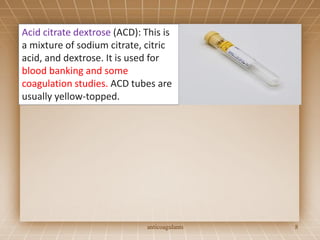
Acid citrate dextrose (ACD): This is
a mixture of sodium citrate, citric
acid, and dextrose. It is used for
blood banking and some
coagulation studies. ACD tubes are
usually yellow-topped.
anticoagulants 8

anticoagulants.pdf

  • 1.
    Anticoagulants, also knownas blood thinners, are medications that help prevent blood clots from forming. They work by interfering with the blood's clotting process, which can be helpful for people who are at risk of developing blood clots, such as those with: 1. Atrial fibrillation: A heart rhythm problem that increases the risk of stroke. 2. Deep vein thrombosis (DVT): A blood clot that forms in a deep vein, usually in the leg. 3. Pulmonary embolism (PE): A blood clot that travels to the lungs from a deep vein clot. 4. Heart attack or stroke: These conditions can damage blood vessels and increase the risk of blood clots. anticoagulants 1
  • 2.
    There are differenttypes of anticoagulants, each with its own advantages and disadvantages. The most common types include: 1. Warfarin (Coumadin): This is an older type of anticoagulant that requires regular blood tests to monitor its effects. 2. Heparin: This is a fast-acting anticoagulant that is often used in hospital settings. It can be given as an injection or through an IV. 3. New oral anticoagulants (NOACs): These are newer medications that are taken by mouth and do not require regular blood tests. Examples include dabigatran (Pradaxa), rivaroxaban (Xarelto), apixaban (Eliquis), and edoxaban (Savaysa). anticoagulants 2
  • 3.
    Anticoagulants can beeffective in preventing blood clots, but they can also increase the risk of bleeding. It is important to talk to your doctor about the risks and benefits of taking anticoagulants before starting treatment. anticoagulants 3
  • 4.
    Here are someadditional things to keep in mind about anticoagulants: 1. They are not a cure for blood clots, but they can help prevent them from forming. 2. They need to be taken exactly as prescribed by your doctor. 3. They can interact with other medications, so it is important to tell your doctor about all the medications you are taking. anticoagulants 4
  • 5.
    there are severaldifferent anticoagulants used for blood sampling, each with its own specific properties and purposes. The choice of anticoagulant depends on the type of test being performed. Here are the most common ones: EDTA (ethylenediaminetetraacetic acid): This is the most commonly used anticoagulant for blood cell counts and differentials. It works by chelating calcium, which is necessary for blood clotting. EDTA tubes are usually lavender-topped. anticoagulants 5
  • 6.
    Heparin: This anticoagulant worksby inhibiting the activation of thrombin, which is an enzyme essential for blood clotting. Heparin tubes are usually green-topped. It is often used for coagulation studies, blood cultures, and some chemistry tests. anticoagulants 6
  • 7.
    Sodium citrate: Thisanticoagulant works by chelating calcium similar to EDTA, but it also has the effect of slightly alkalinizing the blood. It is often used for coagulation studies and blood gas analysis. Sodium citrate tubes are usually blue-topped. anticoagulants 7
  • 8.
    Acid citrate dextrose(ACD): This is a mixture of sodium citrate, citric acid, and dextrose. It is used for blood banking and some coagulation studies. ACD tubes are usually yellow-topped. anticoagulants 8