Antipyretic Analysis
M. Gomathy
Assistant Professor
Department of Chemistry
Sri Sarada Niketan College Of Science for Women.
Karur.
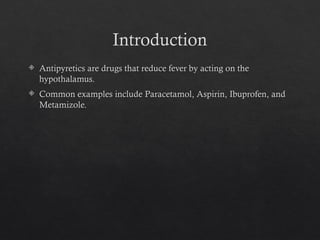
Introduction
 Antipyretics are drugs that reduce fever by acting on the
hypothalamus.
 Common examples include Paracetamol, Aspirin, Ibuprofen, and
Metamizole.
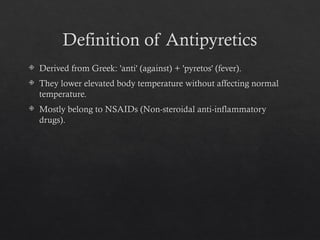
Definition of Antipyretics
 Derived from Greek: 'anti' (against) + 'pyretos' (fever).
 They lower elevated body temperature without affecting normal
temperature.
 Mostly belong to NSAIDs (Non-steroidal anti-inflammatory
drugs).
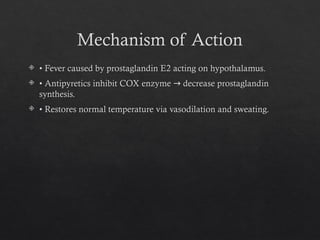
Mechanism of Action
 • Fever caused by prostaglandin E2 acting on hypothalamus.
 • Antipyretics inhibit COX enzyme decrease prostaglandin
→
synthesis.
 • Restores normal temperature via vasodilation and sweating.
Common Antipyretic Drugs
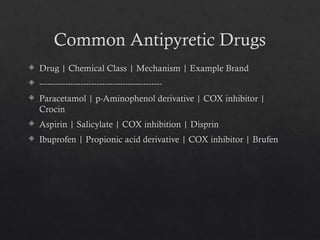
 Drug | Chemical Class | Mechanism | Example Brand
 -----------------------------------------------
 Paracetamol | p-Aminophenol derivative | COX inhibitor |
Crocin
 Aspirin | Salicylate | COX inhibition | Disprin
 Ibuprofen | Propionic acid derivative | COX inhibitor | Brufen
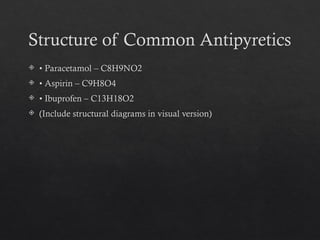
Structure of Common Antipyretics
 • Paracetamol – C8H9NO2
 • Aspirin – C9H8O4
 • Ibuprofen – C13H18O2
 (Include structural diagrams in visual version)
Analytical Importance
 • Ensures purity and potency of formulations.
 • Verifies correct dosage and safety.
 • Applied to tablets, syrups, and capsules.
Analytical Methods Used
 1. Spectrophotometric Method – UV-visible absorption at 243 nm.
 2. Titrimetric Method – Iodometric or redox titration.
 3. Chromatographic Techniques – HPLC, TLC.
 4. FT-IR Spectroscopy – Identifies functional groups.
Spectrophotometric Estimation of Paracetamol
 • Principle: Beer–Lambert’s Law
 • max = 243 nm (UV region)
λ
 Procedure:
 1. Dissolve sample in ethanol/water.
 2. Measure absorbance.
 3. Compare with standard curve.
Titrimetric Analysis Example
 • Iodometric titration of Paracetamol:
 Paracetamol oxidized by iodine in acidic medium.
 Endpoint: Starch indicator blue color disappears.
→
 Used for quantitative estimation in tablets.
Chromatographic Analysis
 • HPLC conditions:
 Column: C18
 Mobile phase: Methanol:Water (60:40)
 Detector: UV (243 nm)
 Retention time: ~3.5 min for Paracetamol.
Quality Control Parameters
 • Assay of active ingredient
 • Dissolution rate
 • Uniformity of content
 • pH, moisture content, impurities.
Applications of Antipyretic Analysis
 • Drug formulation and stability testing
 • Bioavailability studies
 • Detection of counterfeit drugs
 • Pharmacokinetic and toxicity studies.
Safety and Toxicity
 • Overdose causes liver damage (Paracetamol toxicity).
 • Safe dose: 500–1000 mg every 6 hours (max 4 g/day).
 • Analytical control prevents adverse effects.
Summary & References
 Summary:
 • Antipyretics inhibit prostaglandin synthesis to reduce fever.
 • Analytical methods (UV, HPLC, titration) ensure quality.
 References:
 • Beckett & Stenlake – Practical Pharmaceutical Chemistry
 • Indian Pharmacopoeia
 • WHO Guidelines on Drug Quality Control.
Anti_ Pyretic, mechanism, structure ,importance

  • 1.
    Antipyretic Analysis M. Gomathy AssistantProfessor Department of Chemistry Sri Sarada Niketan College Of Science for Women. Karur.
  • 2.
    Introduction  Antipyretics aredrugs that reduce fever by acting on the hypothalamus.  Common examples include Paracetamol, Aspirin, Ibuprofen, and Metamizole.
  • 3.
    Definition of Antipyretics Derived from Greek: 'anti' (against) + 'pyretos' (fever).  They lower elevated body temperature without affecting normal temperature.  Mostly belong to NSAIDs (Non-steroidal anti-inflammatory drugs).
  • 4.
    Mechanism of Action • Fever caused by prostaglandin E2 acting on hypothalamus.  • Antipyretics inhibit COX enzyme decrease prostaglandin → synthesis.  • Restores normal temperature via vasodilation and sweating.
  • 5.
    Common Antipyretic Drugs Drug | Chemical Class | Mechanism | Example Brand  -----------------------------------------------  Paracetamol | p-Aminophenol derivative | COX inhibitor | Crocin  Aspirin | Salicylate | COX inhibition | Disprin  Ibuprofen | Propionic acid derivative | COX inhibitor | Brufen
  • 6.
    Structure of CommonAntipyretics  • Paracetamol – C8H9NO2  • Aspirin – C9H8O4  • Ibuprofen – C13H18O2  (Include structural diagrams in visual version)
  • 7.
    Analytical Importance  •Ensures purity and potency of formulations.  • Verifies correct dosage and safety.  • Applied to tablets, syrups, and capsules.
  • 8.
    Analytical Methods Used 1. Spectrophotometric Method – UV-visible absorption at 243 nm.  2. Titrimetric Method – Iodometric or redox titration.  3. Chromatographic Techniques – HPLC, TLC.  4. FT-IR Spectroscopy – Identifies functional groups.
  • 9.
    Spectrophotometric Estimation ofParacetamol  • Principle: Beer–Lambert’s Law  • max = 243 nm (UV region) λ  Procedure:  1. Dissolve sample in ethanol/water.  2. Measure absorbance.  3. Compare with standard curve.
  • 10.
    Titrimetric Analysis Example • Iodometric titration of Paracetamol:  Paracetamol oxidized by iodine in acidic medium.  Endpoint: Starch indicator blue color disappears. →  Used for quantitative estimation in tablets.
  • 11.
    Chromatographic Analysis  •HPLC conditions:  Column: C18  Mobile phase: Methanol:Water (60:40)  Detector: UV (243 nm)  Retention time: ~3.5 min for Paracetamol.
  • 12.
    Quality Control Parameters • Assay of active ingredient  • Dissolution rate  • Uniformity of content  • pH, moisture content, impurities.
  • 13.
    Applications of AntipyreticAnalysis  • Drug formulation and stability testing  • Bioavailability studies  • Detection of counterfeit drugs  • Pharmacokinetic and toxicity studies.
  • 14.
    Safety and Toxicity • Overdose causes liver damage (Paracetamol toxicity).  • Safe dose: 500–1000 mg every 6 hours (max 4 g/day).  • Analytical control prevents adverse effects.
  • 15.
    Summary & References Summary:  • Antipyretics inhibit prostaglandin synthesis to reduce fever.  • Analytical methods (UV, HPLC, titration) ensure quality.  References:  • Beckett & Stenlake – Practical Pharmaceutical Chemistry  • Indian Pharmacopoeia  • WHO Guidelines on Drug Quality Control.