Anti-Counterfeiting Filters for Currencies, IDs and Goods TechConnect Summit 2007 Presented by Thomas Martinuzzo, Jr. Eng. Project Leader, Business Development May 2007
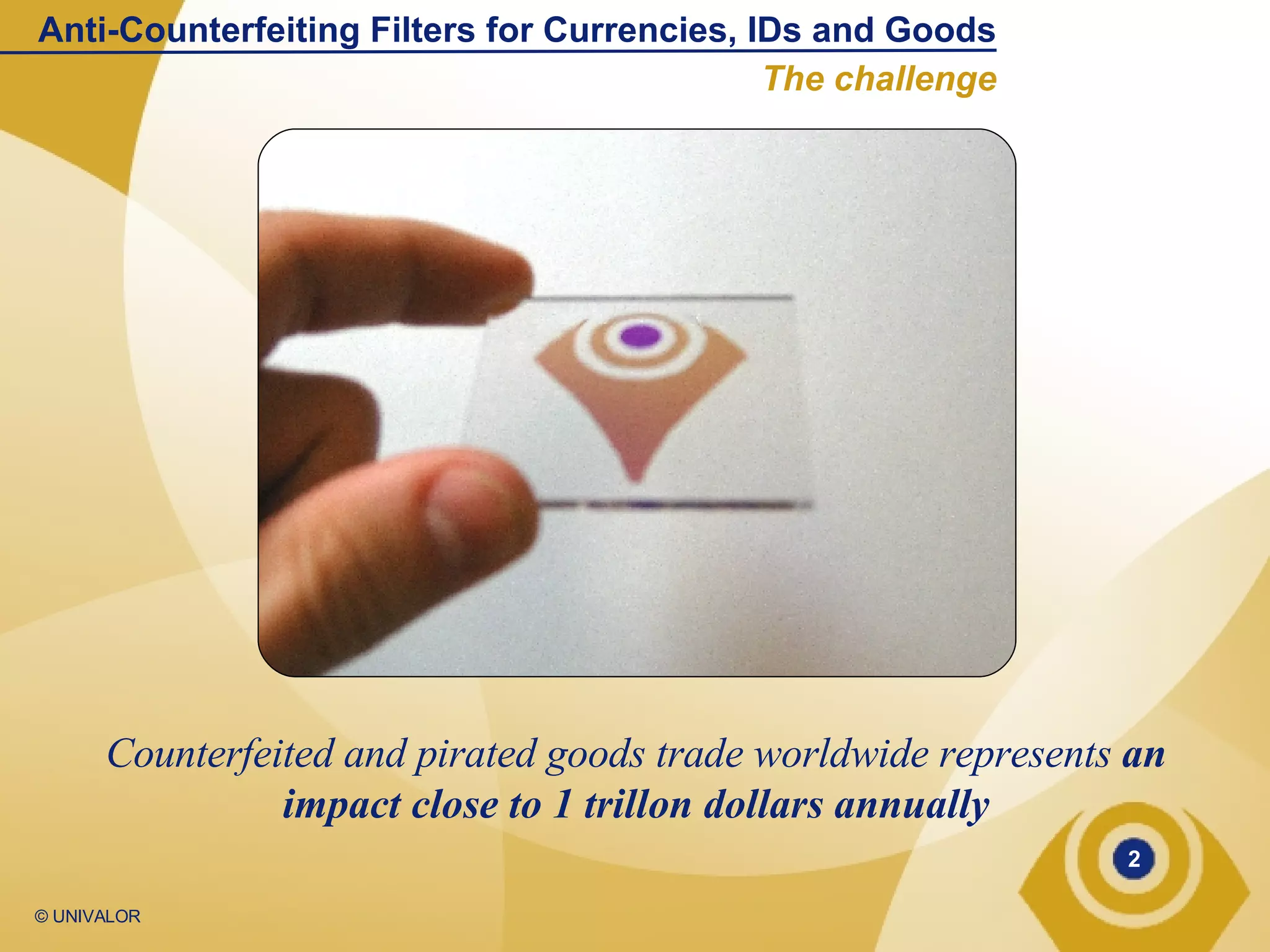
Counterfeited and pirated goods trade worldwide represents  an impact close to 1 trillon dollars annually Anti-Counterfeiting Filters for Currencies, IDs and Goods The challenge
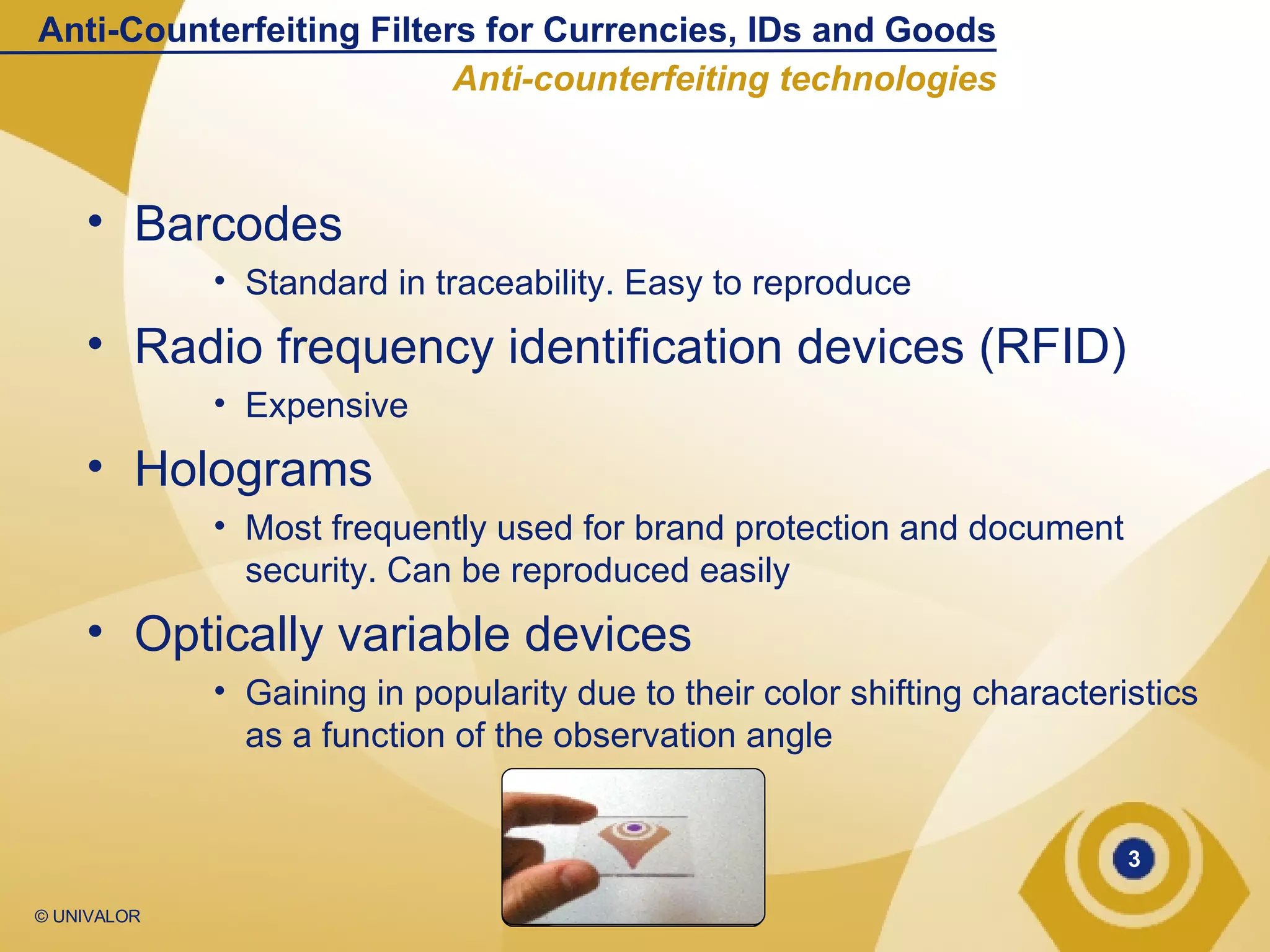
Barcodes  Standard in traceability. Easy to reproduce Radio frequency identification devices (RFID) Expensive Holograms Most frequently used for brand protection and document security. Can be reproduced easily Optically variable devices Gaining in popularity due to their color shifting characteristics as a function of the observation angle Anti-Counterfeiting Filters for Currencies, IDs and Goods Anti-counterfeiting technologies
Our technology addresses two different markets Traceability of consumer goods and items Traceability of banknotes and original documents The paradox of these markets The higher is the cost of acquiring counterfeiting technology, the better is the dissuasion The cost of security devices implanted has to be the lowest Anti-Counterfeiting Filters for Currencies, IDs and Goods The Market
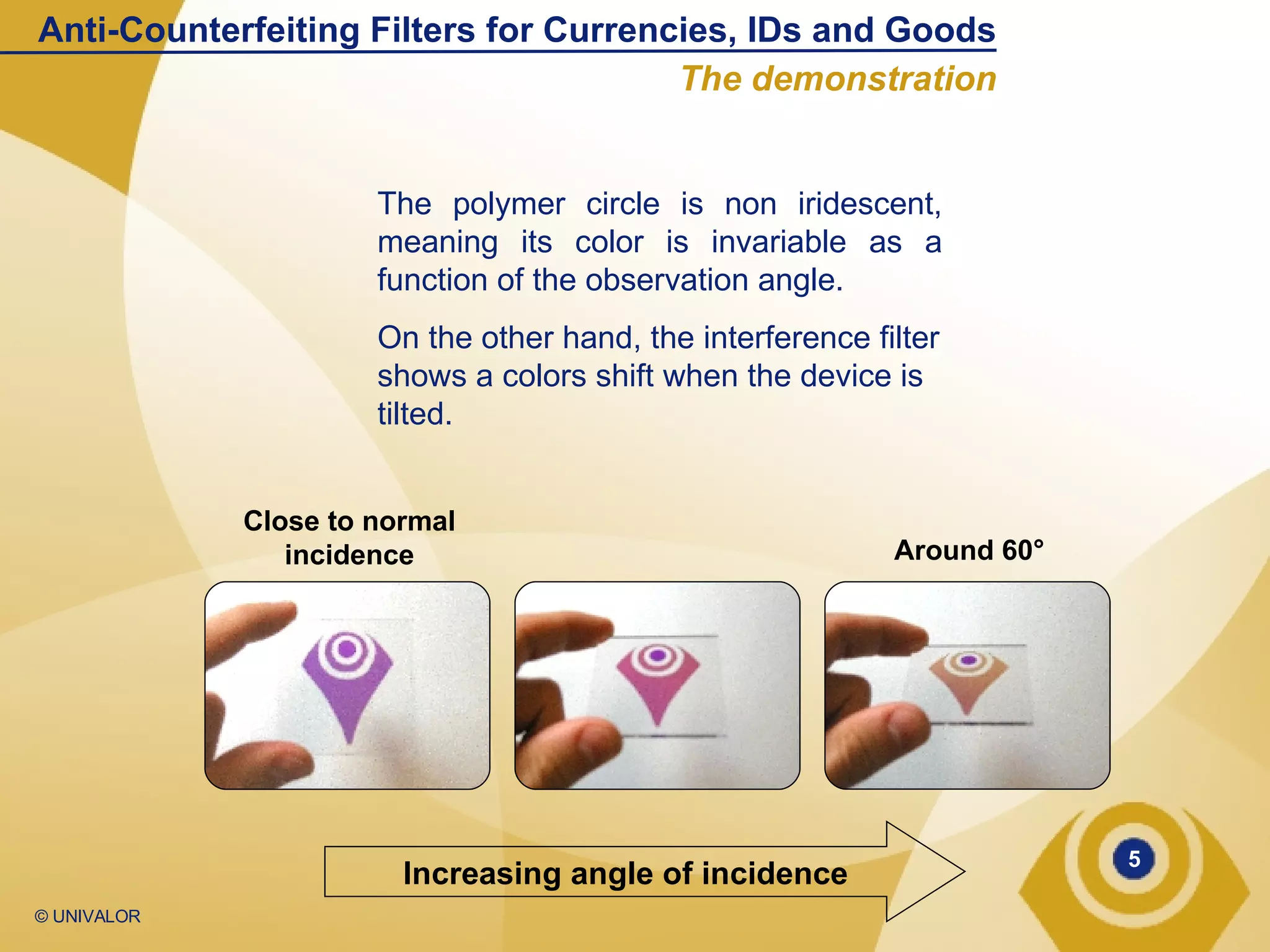
The polymer circle is non iridescent, meaning its color is invariable as a function of the observation angle.  On the other hand, the interference filter shows a colors shift when the device is tilted. Anti-Counterfeiting Filters for Currencies, IDs and Goods The demonstration Increasing angle of incidence Close to normal incidence Around 60°
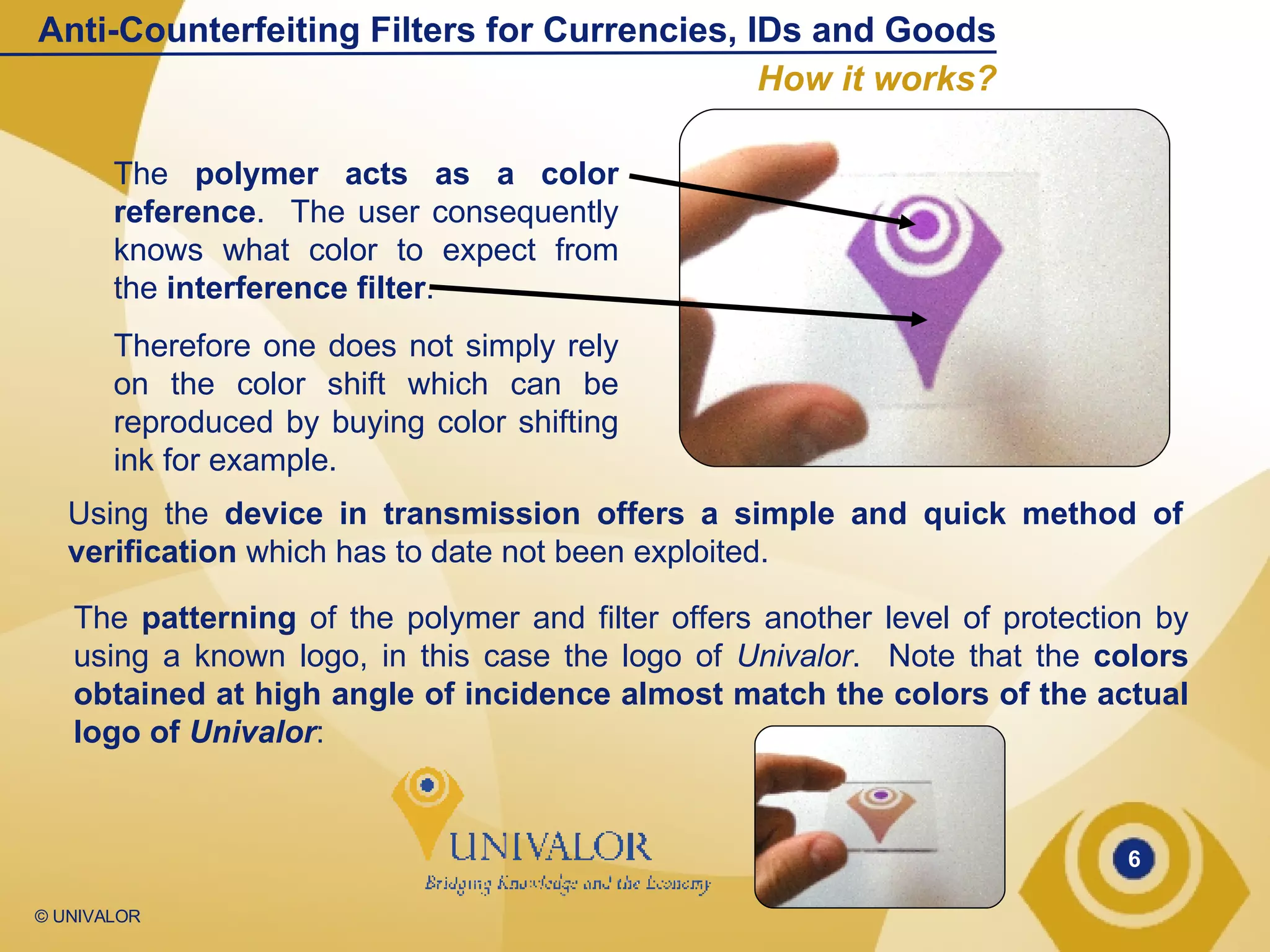
The  polymer   acts as a color reference .  The user consequently knows what color to expect from the  interference filter .  Therefore one does not simply rely on the color shift which can be reproduced by buying color shifting ink for example. Using the  device in transmission offers a simple and quick method of verification  which has to date not been exploited. The  patterning  of the polymer and filter offers another level of protection by using a known logo, in this case the logo of  Univalor .  Note that the  colors obtained at high angle of incidence almost match the colors of the actual logo of  Univalor : Anti-Counterfeiting Filters for Currencies, IDs and Goods How it works?
The principle behind the matching colors is based on the  metameric effect  in witch two objects having different reflection or transmission spectra still show the same color for a specific illuminant (light source). Comparison of the polymer’s and filter’s transmission spectra In order to ensure a metameric match under as many illuminants as possible, the spectra must intersect as many times as possible.  The ideal case would be to identical spectra . As we can see in the example of the Univalor logo, the polymer and filter are very similar at normal  incidence . Anti-Counterfeiting Filters for Currencies, IDs and Goods Design consideration Transmission Wavelength [nm]
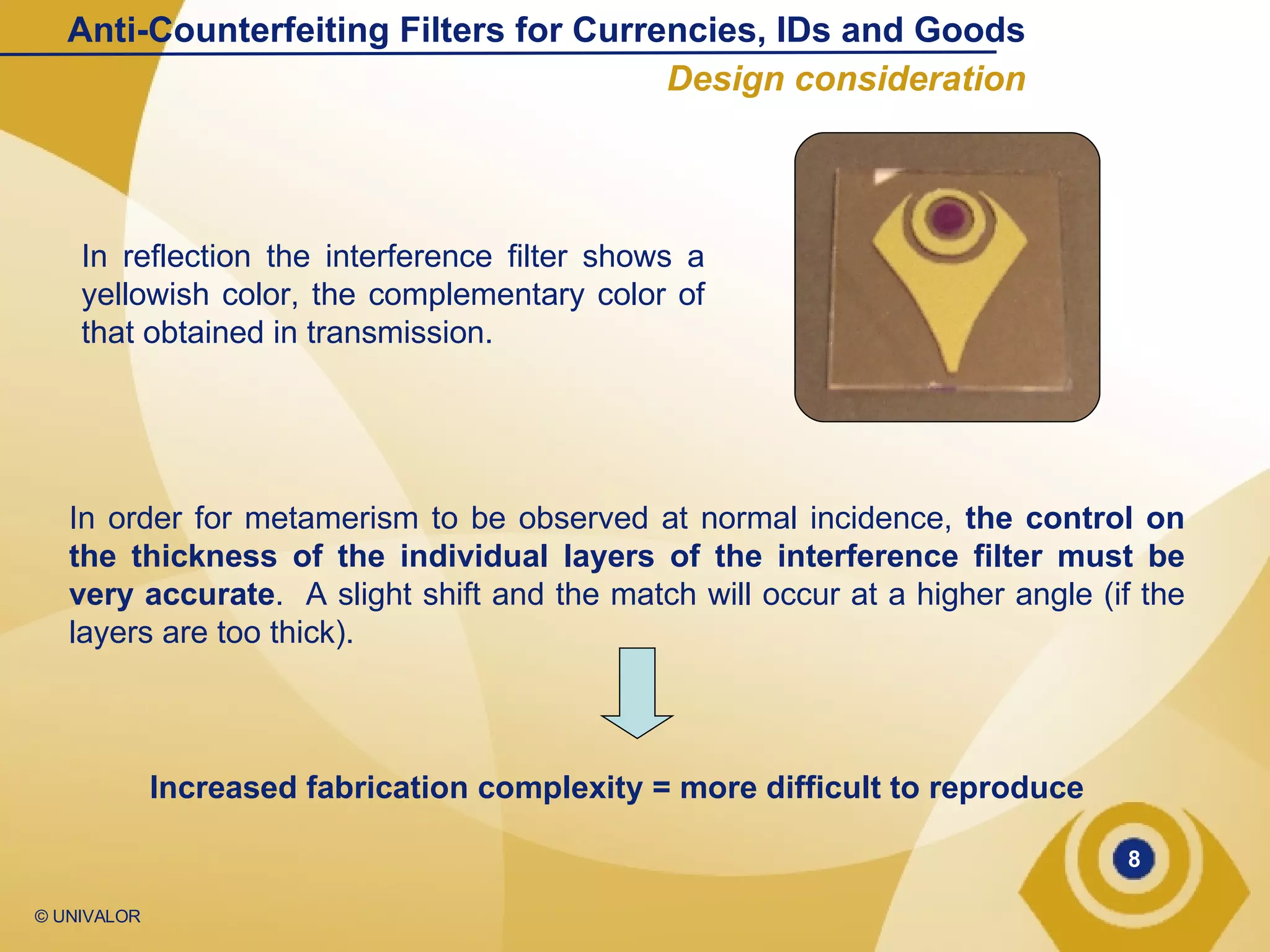
In reflection the interference filter shows a yellowish color, the complementary color of that obtained in transmission. In order for metamerism to be observed at normal incidence,  the control on the thickness of the individual layers of the interference filter must be very accurate .  A slight shift and the match will occur at a higher angle (if the layers are too thick). Increased fabrication complexity = more difficult to reproduce Anti-Counterfeiting Filters for Currencies, IDs and Goods Design consideration
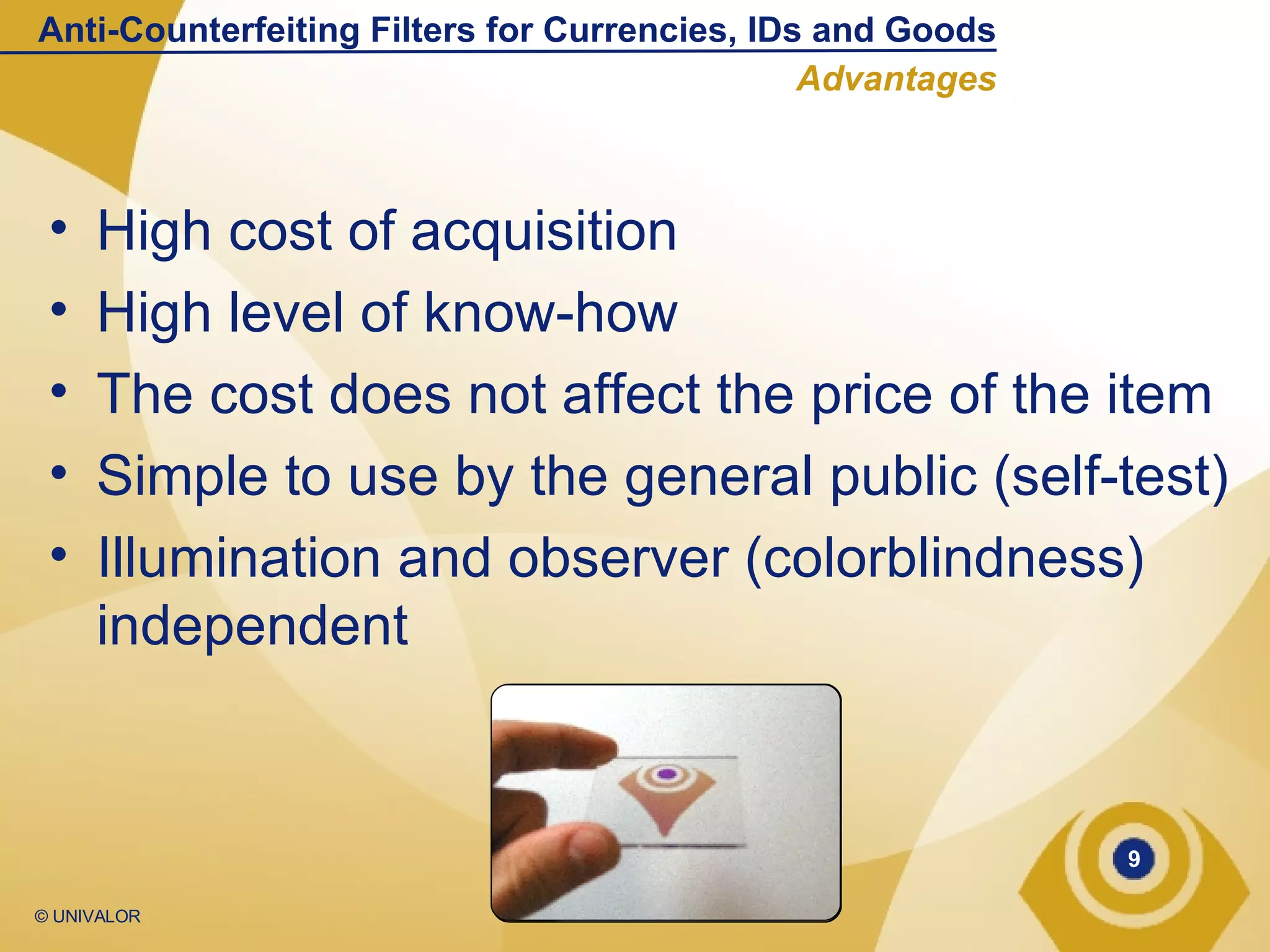
High cost of acquisition High level of know-how The cost does not affect the price of the item Simple to use by the general public (self-test) Illumination and observer (colorblindness) independent Anti-Counterfeiting Filters for Currencies, IDs and Goods Advantages
Thanks! Seeking :  partners for licensing For more information about the science :  Ludvik Martinu, Ph.D.  [email_address] 1 514 340 4711 ext : 4099 Commercialization and licensing : Didier Leconte, MBA  [email_address] 1 514 340 3243 ext : 4224 Thomas Martinuzzo, Jr. Eng.  [email_address] 1 514 340 3243 ext: 4243

Anti Counterfeiting Filters

  • 1.
    Anti-Counterfeiting Filters forCurrencies, IDs and Goods TechConnect Summit 2007 Presented by Thomas Martinuzzo, Jr. Eng. Project Leader, Business Development May 2007
  • 2.
    Counterfeited and piratedgoods trade worldwide represents an impact close to 1 trillon dollars annually Anti-Counterfeiting Filters for Currencies, IDs and Goods The challenge
  • 3.
    Barcodes Standardin traceability. Easy to reproduce Radio frequency identification devices (RFID) Expensive Holograms Most frequently used for brand protection and document security. Can be reproduced easily Optically variable devices Gaining in popularity due to their color shifting characteristics as a function of the observation angle Anti-Counterfeiting Filters for Currencies, IDs and Goods Anti-counterfeiting technologies
  • 4.
    Our technology addressestwo different markets Traceability of consumer goods and items Traceability of banknotes and original documents The paradox of these markets The higher is the cost of acquiring counterfeiting technology, the better is the dissuasion The cost of security devices implanted has to be the lowest Anti-Counterfeiting Filters for Currencies, IDs and Goods The Market
  • 5.
    The polymer circleis non iridescent, meaning its color is invariable as a function of the observation angle. On the other hand, the interference filter shows a colors shift when the device is tilted. Anti-Counterfeiting Filters for Currencies, IDs and Goods The demonstration Increasing angle of incidence Close to normal incidence Around 60°
  • 6.
    The polymer acts as a color reference . The user consequently knows what color to expect from the interference filter . Therefore one does not simply rely on the color shift which can be reproduced by buying color shifting ink for example. Using the device in transmission offers a simple and quick method of verification which has to date not been exploited. The patterning of the polymer and filter offers another level of protection by using a known logo, in this case the logo of Univalor . Note that the colors obtained at high angle of incidence almost match the colors of the actual logo of Univalor : Anti-Counterfeiting Filters for Currencies, IDs and Goods How it works?
  • 7.
    The principle behindthe matching colors is based on the metameric effect in witch two objects having different reflection or transmission spectra still show the same color for a specific illuminant (light source). Comparison of the polymer’s and filter’s transmission spectra In order to ensure a metameric match under as many illuminants as possible, the spectra must intersect as many times as possible. The ideal case would be to identical spectra . As we can see in the example of the Univalor logo, the polymer and filter are very similar at normal incidence . Anti-Counterfeiting Filters for Currencies, IDs and Goods Design consideration Transmission Wavelength [nm]
  • 8.
    In reflection theinterference filter shows a yellowish color, the complementary color of that obtained in transmission. In order for metamerism to be observed at normal incidence, the control on the thickness of the individual layers of the interference filter must be very accurate . A slight shift and the match will occur at a higher angle (if the layers are too thick). Increased fabrication complexity = more difficult to reproduce Anti-Counterfeiting Filters for Currencies, IDs and Goods Design consideration
  • 9.
    High cost ofacquisition High level of know-how The cost does not affect the price of the item Simple to use by the general public (self-test) Illumination and observer (colorblindness) independent Anti-Counterfeiting Filters for Currencies, IDs and Goods Advantages
  • 10.
    Thanks! Seeking : partners for licensing For more information about the science : Ludvik Martinu, Ph.D. [email_address] 1 514 340 4711 ext : 4099 Commercialization and licensing : Didier Leconte, MBA [email_address] 1 514 340 3243 ext : 4224 Thomas Martinuzzo, Jr. Eng. [email_address] 1 514 340 3243 ext: 4243

Editor's Notes

  • #2 Good morning, My name is Thomas and I work for Univalor, the commercialization arm of Univerity of Montréal and most of its affiliated institutions. The technology I’m going to present to you comes from Polytechnique of Montréal our engineering school. This is a new anti-counterfeiting system.