Do education and research activities
matter in rural areas?
Anna Guðrún Edvardsdóttir
Ph.D student at School of Education
University of Iceland
Myself
• Born in Reykjavík
• Lived in a small town (Bolungarvík) in
Northwest Iceland for 24 years
• Was a teacher and a principal at the local
compulsory school
• Was chairman of the municipality
• Was chairman of the Association of the
municipalities of the Westfjords
The research questions – main study
• The guiding research question:
What aspects of the knowledge society system have an effect on
the rural development system and sustainability system in rural
communities in Iceland and Scotland?
• The subquestions are:
1. How do the knowledge society system, the rural development system and the
sustainability system work individually and together and how do they affect each
other?
2. What is the educational, sociological and political discourse about the three
systems in Iceland and in Scotland?
3. Do East Iceland and Westfjords in Iceland and the Highlands and Islands in
Soctland function differently in any way? If yes/no, how and why?
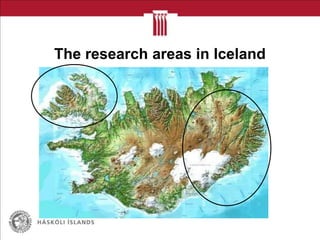
The research areas in Iceland
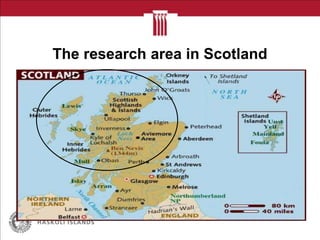
The research area in Scotland
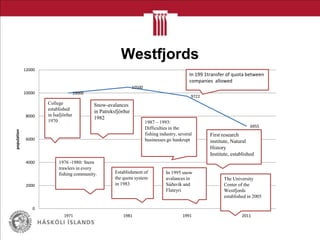
Westfjords
10000
10500
9722
6955
0
2000
4000
6000
8000
10000
12000
1971 1981 1991 2011
population
College
established
in Ísafjörður
1970
1976 -1980: Stern
trawlers in every
fishing community.
Snow-avalances
in Patreksfjörður
1982
Establishment of
the quota system
in 1983
1987 – 1993:
Difficulties in the
fishing industry, several
businesses go bankrupt
In 199 1transfer of quota between
companies allowed
In 1995 snow
avalances in
Súðavík and
Flateyri
First research
institute, Natural
History
Institute, established
The University
Center of the
Westfjords
established in 2005
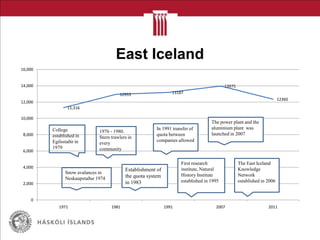
East Iceland
11,316
12953 13187
13975
12360
0
2,000
4,000
6,000
8,000
10,000
12,000
14,000
16,000
1971 1981 1991 2007 2011
College
established in
Egilsstaðir in
1979
Snow avalances in
Neskaupstaður 1974
1976 - 1980.
Stern trawlers in
every
community
Establishment of
the quota system
in 1983
In 1991 transfer of
quota between
companies allowed
First research
institute, Natural
History Institute
established in 1995
The East Iceland
Knowledge
Network
established in 2006
The power plant and the
aluminium plant was
launched in 2007
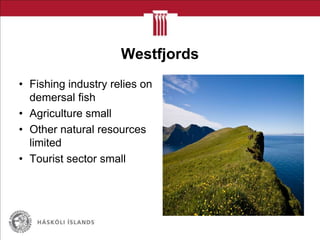
Westfjords
• Fishing industry relies on
demersal fish
• Agriculture small
• Other natural resources
limited
• Tourist sector small
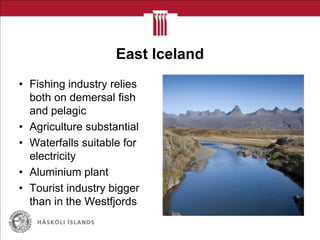
East Iceland
• Fishing industry relies
both on demersal fish
and pelagic
• Agriculture substantial
• Waterfalls suitable for
electricity
• Aluminium plant
• Tourist industry bigger
than in the Westfjords
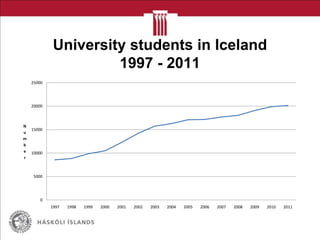
University students in Iceland
1997 - 2011
0
5000
10000
15000
20000
25000
1997 1998 1999 2000 2001 2002 2003 2004 2005 2006 2007 2008 2009 2010 2011
N
u
m
b
e
r
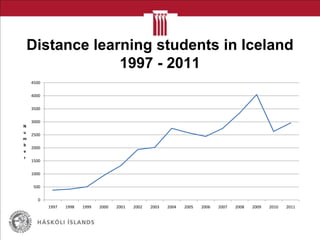
Distance learning students in Iceland
1997 - 2011
0
500
1000
1500
2000
2500
3000
3500
4000
4500
1997 1998 1999 2000 2001 2002 2003 2004 2005 2006 2007 2008 2009 2010 2011
N
u
m
b
e
r
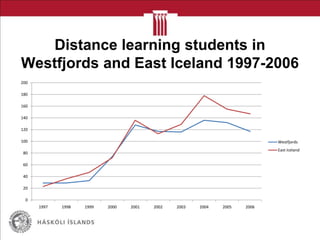
Distance learning students in
Westfjords and East Iceland 1997-2006
0
20
40
60
80
100
120
140
160
180
200
1997 1998 1999 2000 2001 2002 2003 2004 2005 2006
Westfjords
East Iceland
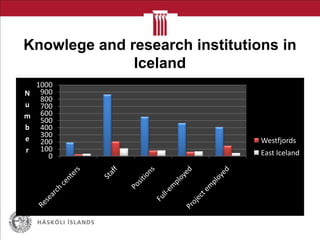
Knowlege and research institutions in
Iceland
0
100
200
300
400
500
600
700
800
900
1000
N
u
m
b
e
r
Westfjords
East Iceland
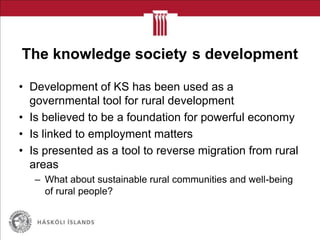
The knowledge society s development
• Development of KS has been used as a
governmental tool for rural development
• Is believed to be a foundation for powerful economy
• Is linked to employment matters
• Is presented as a tool to reverse migration from rural
areas
– What about sustainable rural communities and well-being
of rural people?
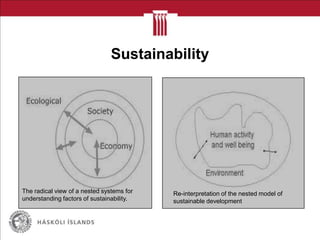
Sustainability
The radical view of a nested systems for
understanding factors of sustainability.
Re-interpretation of the nested model of
sustainable development
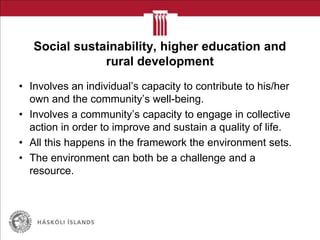
Social sustainability, higher education and
rural development
• Involves an individual‟s capacity to contribute to his/her
own and the community‟s well-being.
• Involves a community‟s capacity to engage in collective
action in order to improve and sustain a quality of life.
• All this happens in the framework the environment sets.
• The environment can both be a challenge and a
resource.
Social sustainability, higher education and
rural development
• Higher education and research can play a big role in
social sustainability.
• Universities need to have distance learners in mind when
they plan research projects and study lines, not only what
is “suitable” for the rural areas.
• Universities need to develop a curriculum which nurtures
sustainable knowledge, skills and values.
• Sustainable education - transformative learning
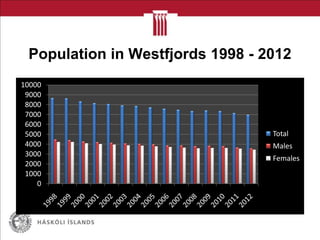
Population in Westfjords 1998 - 2012
0
1000
2000
3000
4000
5000
6000
7000
8000
9000
10000
Total
Males
Females
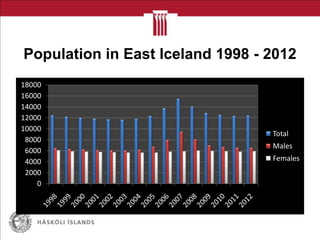
Population in East Iceland 1998 - 2012
0
2000
4000
6000
8000
10000
12000
14000
16000
18000
Total
Males
Females
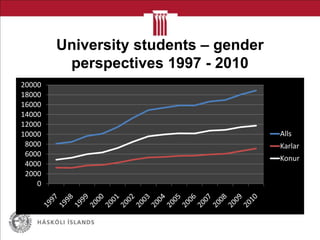
University students – gender
perspectives 1997 - 2010
0
2000
4000
6000
8000
10000
12000
14000
16000
18000
20000
Alls
Karlar
Konur
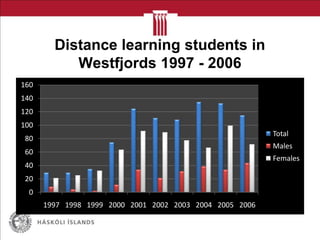
Distance learning students in
Westfjords 1997 - 2006
0
20
40
60
80
100
120
140
160
1997 1998 1999 2000 2001 2002 2003 2004 2005 2006
Total
Males
Females
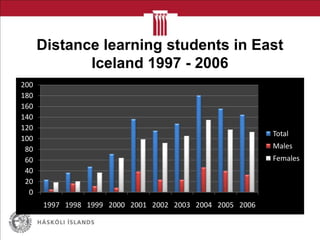
Distance learning students in East
Iceland 1997 - 2006
0
20
40
60
80
100
120
140
160
180
200
1997 1998 1999 2000 2001 2002 2003 2004 2005 2006
Total
Males
Females
Rural women
• Research has shown that rural women:
– live in communities that favour male values
– have more responsibility for the household
– have less „action space‟
– have fewer opportunities
– have limited access to the area‟s rescources
– do not have the same access to power in local politics
– use higher education to strengthen their status
– decide on the family residence
Conclusions
• The RDP emhasise higher education and research
activities as key players in regional development.
• In spite of increased number of research institutions
and development of distance learning the migration
from rural areas has not stopped.
• We need to look at the concept “quality of life” or “the
good life”.
• Stop linking higher education and research activities
to the economy.
• Consider social sustainability.

Annagudrunedrardsdottirkiruna28feb12 120227110236-phpapp02

  • 1.
    Do education andresearch activities matter in rural areas? Anna Guðrún Edvardsdóttir Ph.D student at School of Education University of Iceland
  • 2.
    Myself • Born inReykjavík • Lived in a small town (Bolungarvík) in Northwest Iceland for 24 years • Was a teacher and a principal at the local compulsory school • Was chairman of the municipality • Was chairman of the Association of the municipalities of the Westfjords
  • 3.
    The research questions– main study • The guiding research question: What aspects of the knowledge society system have an effect on the rural development system and sustainability system in rural communities in Iceland and Scotland? • The subquestions are: 1. How do the knowledge society system, the rural development system and the sustainability system work individually and together and how do they affect each other? 2. What is the educational, sociological and political discourse about the three systems in Iceland and in Scotland? 3. Do East Iceland and Westfjords in Iceland and the Highlands and Islands in Soctland function differently in any way? If yes/no, how and why?
  • 4.
  • 5.
    The research areain Scotland
  • 6.
    Westfjords 10000 10500 9722 6955 0 2000 4000 6000 8000 10000 12000 1971 1981 19912011 population College established in Ísafjörður 1970 1976 -1980: Stern trawlers in every fishing community. Snow-avalances in Patreksfjörður 1982 Establishment of the quota system in 1983 1987 – 1993: Difficulties in the fishing industry, several businesses go bankrupt In 199 1transfer of quota between companies allowed In 1995 snow avalances in Súðavík and Flateyri First research institute, Natural History Institute, established The University Center of the Westfjords established in 2005
  • 7.
    East Iceland 11,316 12953 13187 13975 12360 0 2,000 4,000 6,000 8,000 10,000 12,000 14,000 16,000 19711981 1991 2007 2011 College established in Egilsstaðir in 1979 Snow avalances in Neskaupstaður 1974 1976 - 1980. Stern trawlers in every community Establishment of the quota system in 1983 In 1991 transfer of quota between companies allowed First research institute, Natural History Institute established in 1995 The East Iceland Knowledge Network established in 2006 The power plant and the aluminium plant was launched in 2007
  • 8.
    Westfjords • Fishing industryrelies on demersal fish • Agriculture small • Other natural resources limited • Tourist sector small
  • 9.
    East Iceland • Fishingindustry relies both on demersal fish and pelagic • Agriculture substantial • Waterfalls suitable for electricity • Aluminium plant • Tourist industry bigger than in the Westfjords
  • 10.
    University students inIceland 1997 - 2011 0 5000 10000 15000 20000 25000 1997 1998 1999 2000 2001 2002 2003 2004 2005 2006 2007 2008 2009 2010 2011 N u m b e r
  • 11.
    Distance learning studentsin Iceland 1997 - 2011 0 500 1000 1500 2000 2500 3000 3500 4000 4500 1997 1998 1999 2000 2001 2002 2003 2004 2005 2006 2007 2008 2009 2010 2011 N u m b e r
  • 12.
    Distance learning studentsin Westfjords and East Iceland 1997-2006 0 20 40 60 80 100 120 140 160 180 200 1997 1998 1999 2000 2001 2002 2003 2004 2005 2006 Westfjords East Iceland
  • 13.
    Knowlege and researchinstitutions in Iceland 0 100 200 300 400 500 600 700 800 900 1000 N u m b e r Westfjords East Iceland
  • 14.
    The knowledge societys development • Development of KS has been used as a governmental tool for rural development • Is believed to be a foundation for powerful economy • Is linked to employment matters • Is presented as a tool to reverse migration from rural areas – What about sustainable rural communities and well-being of rural people?
  • 15.
    Sustainability The radical viewof a nested systems for understanding factors of sustainability. Re-interpretation of the nested model of sustainable development
  • 16.
    Social sustainability, highereducation and rural development • Involves an individual‟s capacity to contribute to his/her own and the community‟s well-being. • Involves a community‟s capacity to engage in collective action in order to improve and sustain a quality of life. • All this happens in the framework the environment sets. • The environment can both be a challenge and a resource.
  • 17.
    Social sustainability, highereducation and rural development • Higher education and research can play a big role in social sustainability. • Universities need to have distance learners in mind when they plan research projects and study lines, not only what is “suitable” for the rural areas. • Universities need to develop a curriculum which nurtures sustainable knowledge, skills and values. • Sustainable education - transformative learning
  • 18.
    Population in Westfjords1998 - 2012 0 1000 2000 3000 4000 5000 6000 7000 8000 9000 10000 Total Males Females
  • 19.
    Population in EastIceland 1998 - 2012 0 2000 4000 6000 8000 10000 12000 14000 16000 18000 Total Males Females
  • 20.
    University students –gender perspectives 1997 - 2010 0 2000 4000 6000 8000 10000 12000 14000 16000 18000 20000 Alls Karlar Konur
  • 21.
    Distance learning studentsin Westfjords 1997 - 2006 0 20 40 60 80 100 120 140 160 1997 1998 1999 2000 2001 2002 2003 2004 2005 2006 Total Males Females
  • 22.
    Distance learning studentsin East Iceland 1997 - 2006 0 20 40 60 80 100 120 140 160 180 200 1997 1998 1999 2000 2001 2002 2003 2004 2005 2006 Total Males Females
  • 23.
    Rural women • Researchhas shown that rural women: – live in communities that favour male values – have more responsibility for the household – have less „action space‟ – have fewer opportunities – have limited access to the area‟s rescources – do not have the same access to power in local politics – use higher education to strengthen their status – decide on the family residence
  • 24.
    Conclusions • The RDPemhasise higher education and research activities as key players in regional development. • In spite of increased number of research institutions and development of distance learning the migration from rural areas has not stopped. • We need to look at the concept “quality of life” or “the good life”. • Stop linking higher education and research activities to the economy. • Consider social sustainability.