North
America
South
America
Africa
Europe
Asia
Australia
Arctic
Antarctica
Click the labels to see which animals
are from the area selected.
North America
South America
Africa
Europe
Asia Australia
Antarctica
Arctic
Finished?
North America
Map
alligator beaver
Brown bear
moose
Photo courtesy of cliff1066 (@flickr.com) - granted under creative commons licence - attribution
Alligator
• Alligators are reptiles.
• They lay eggs.
• Alligators eat any meat but mostly fish,
birds and turtles.
• They have lived on earth for millions of
years.
• They live in the Southern parts of North
America such as Louisiana and Florida.
• They have a powerful bite but their jaw
muscles are very weak, an adult human
can hold open an alligator’s jaw.
• Adult males can be over 3
metres long.
• They were once an
endangered species
Home
Beaver
• Beavers are found by streams, ponds,
rivers and lakes.
• They feed on trees and tree bark.
• They live in colonies with their
families.
• Beavers build dams and lodges.
• Dams and lodges are built for
protection against predators.
• They can stay underwater for up to 15
minutes.
• Their feet and tails help them
to swim really well.
• They are nocturnal and work at
night
• Young beavers are called kits.
Home
Brown Bear
• Brown bears are also known as grizzly
bears.
• They eat grass, fruit, insects, roots and
bulbs of plants and when hungry
enough they will eat small animals.
• They live in forested mountain areas
and near rivers.
• In Autumn they eat huge amounts of
food so they can hibernate through the
winter.
• Adult males can be over 2 metres tall.
• They hibernate in dens, a
‘bedroom’ at the end of a
tunnel.
Home
• Moose are the largest member of the
deer family.
• Male moose are called bull moose.
• Bull moose shed their antlers during
the winter and grow new ones every
year.
• Female moose are called cows.
• Moose have hairy skin that hangs
under the throat called a bell.
• Moose have a hump.
• They are around 7 feet tall.
• Moose are great swimmers.
Home
Moose
South America
red eyed tree frog toucan
sloth
squirrel monkey
Home
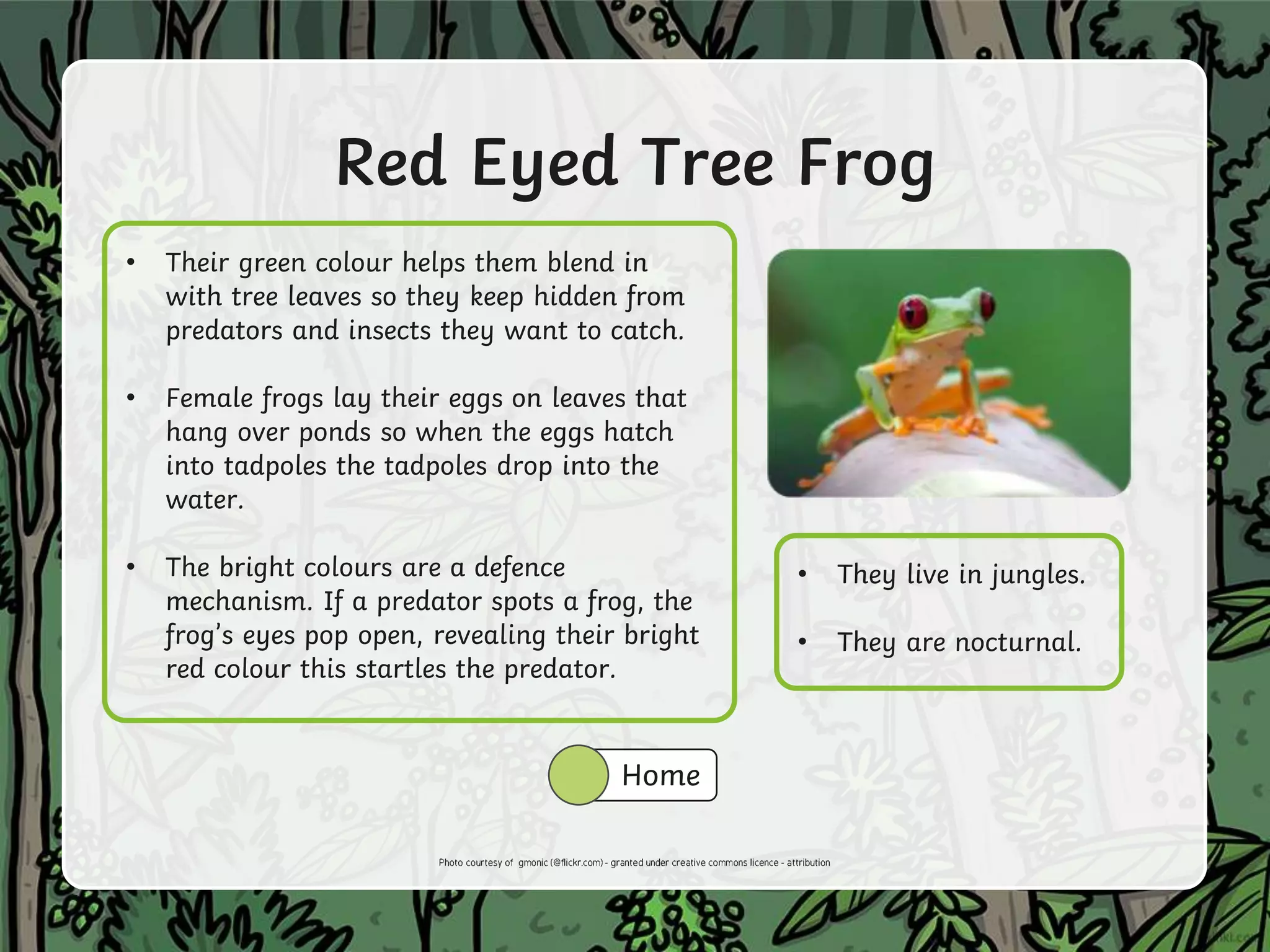
Red Eyed Tree Frog
• Their green colour helps them blend in
with tree leaves so they keep hidden from
predators and insects they want to catch.
• Female frogs lay their eggs on leaves that
hang over ponds so when the eggs hatch
into tadpoles the tadpoles drop into the
water.
• The bright colours are a defence
mechanism. If a predator spots a frog, the
frog’s eyes pop open, revealing their bright
red colour this startles the predator.
Home
• They live in jungles.
• They are nocturnal.
Toucan
• They live in jungles.
• They eat bird eggs, insects, fruit, reptiles,
rodents and other birds.
• Toucans have huge beaks called bills.
• The average bill size is 8 inches long.
• They use their bills for keeping cool and to
reach for food.
• Big cats such as jaguars are natural
predators of the toucan.
Home
Squirrel Monkey
• Squirrel monkeys live in tropical
rainforest.
• They live in the middle part of the
forest canopy.
• They eat fruit and insects.
• They live in large groups.
• Baby squirrel monkeys cling to their
mother’s fur and travel around with
them.
Home
Sloth
• Sloths sleep for up to 20 hours a day.
• They only wake up to feed.
• They spend most of the time hanging
from trees.
• They eat leaves, twigs and fruit.
• Sloths are very slow.
Home
Africa
Map
african elephant hippo
lion
zebra
• African elephants are the largest
land mammals on Earth.
• A male elephant is called a bull,
a female is called a cow and a
baby elephant is called a calf.
• Elephants travel in herds of 10 or
more.
• They eat grasses, leaves, shrubs,
branches and fruit.
• Elephants love to swim.
Home
African Elephant
• Elephants have long noses called
trunks.
• The full name for hippo is
hippopotamus which means river horse.
• It is the third largest land mammal.
• A male hippo is called a bull, a female
is called a cow and a baby hippo is
called a calf.
• Hippos can be very aggressive,
especially when they feel threatened.
• They are one of the most dangerous
animals in Africa.
Hippo
• They mostly eat grass.
• They rest in water to keep
their bodies cool.
Home
• They are part of the horse family.
• Each zebra has a unique pattern of
black and white stripes.
• They mostly eat grass and leaves.
• They are very nervous animals.
• They live in herds.
• When zebras are grouped together,
their stripes make it hard for a lion or
leopard to pick out one zebra to chase.
Zebra
• They have excellent eyesight
and hearing.
Home
• They are the second largest big cat
species in the world (after tigers).
• Lions can reach speeds of 50 miles an
hour, but not for very long.
• The roar of a lion can be heard 5 miles
away.
• Lionesses (female lions) are better
hunters than males so do most of the
hunting for the pride.
• The hair around a male lions head is
called a mane.
Lion
• They eat meat and hunt
animals such as antelope and
zebra.
• They live in groups called
prides.
• Lions rest for 20 hours a day.
Home
Europe: United Kingdom
Map
badger hedgehog
red squirrel
puffin
• A male badger is called a boar, a female is a
sow and the young are called cubs.
• They have excellent hearing and sense of
smell.
• They live in groups of up to 14 adults.
• They dig systems of underground tunnels
and nesting chambers called setts where
they sleep and rear their young.
• They are strong and heavy and have sharp
clawed feet making them the fastest digging
animal on Earth.
Home
Badger
• They are nocturnal.
• The biggest threat to
badgers are cars.
• Hedgehogs eat insects, worms, snails,
mice and frogs.
• They are nocturnal and sleep in
bushes or woodland.
• They hibernate in winter.
• They have a coat of about 5000
spines.
• They have excellent sense of smell and
use their snouts to sniff out prey.
• They are solitary animals.
Hedgehog
• Spines act as a defence against
foxes and badgers.
Home
• Puffins nest in the UK in summer
months.
• They nest on the cliff face.
• Their beaks are only bright coloured
and stripy during breeding season.
• Outside of breeding season they
spend their time far out at sea.
• They are excellent swimmers.
• They eat small fish and sand eels.
Puffin
• Puffins nest in burrows like
rabbits.
Home
• Red squirrels are native to the UK (unlike
grey squirrels) but it is very rare to see
one. Most live in Scotland.
• The spread of grey squirrels is the main
threat to red squirrel survival.
• Grey squirrels steal food and give red
squirrels squirrelpox.
• Their long fluffy tails keep them balanced
when jumping from tree to tree.
• Red squirrels eat nuts, fungi, berries and
ripe fruits.
Red Squirrel
• A squirrels nest is called
a drey.
• Squirrels hibernate in
winter.
Home
Asia: China
Map
Click to explore Asia
Asia: India
tiger peacock
Snow leopard
black buck
Asia: India
Map
• The tiger is the biggest species of the
cat family.
• A group of tigers is known as an
ambush or streak.
• Tigers are good swimmers.
• Tigers usually hunt alone at night
time.
• The stripes on each tiger are unique.
• Their stripes camouflage them in long
grasses.
Back Home
Tiger
• They spend hot days lying in
pools and streams.
• Real name is peafowl. Only the males
are called peacocks.
• Females are called peahens and babies
are called peachicks.
• Peacocks live in forests.
• They eat grain, insects, small reptiles
and mammals, berries, figs, leaves,
seeds and flower parts.
• The male has bright, beautiful feathers
while the female has drab mottled
brown feathers.
Peacock
• The male’s feathers are bright
and beautiful to attract mates.
• A group of peafowl is called a
party or a pride.
Back Home
• Black buck are a species of antelope.
• They are one of the fastest animals on
• Earth and can outrun almost any other
animal over long distances.
• They mainly eat grasses, leaves, shrubs,
fruit and flowers.
• They live on grasslands, dry thorn and
scrublands.
• They have sharp eyesight and speed to
protect themselves from predators such as
dogs and wolves.
Black Buck
• They live in groups of 15-20.
Back Home
• A male is called a leopard, a female
is called a leopardess, a baby is
called a cub.
• They like to live in steep, rocky
places.
• In summer they stay high in the
mountains, in winter they come
down into the forests.
• They hunt and eat sheep, goats, birds
and other small animals.
• They are solitary animals.
Snow Leopard
• Snow leopards are often hunted
by humans so they are an
endangered species.
• The cubs stay with the mother
for 2 years before they go off
alone.
Back Home
panda golden monkey
yak
golden pheasant
Asia: China
Map
• The giant panda (shown in the picture)
is native to China.
• It has a black and white fur coat and
large black patches around its eyes.
• They live for around 20 years in the
wild.
• Giant pandas mostly eat bamboo.
• They are an endangered species.
• It is estimated only 2000 are left in the
wild.
Back
Panda
• They are very good
climbers.
Home
• Also known as a snub nosed monkey.
• They live in the forests in the mountains
of China.
• In summer they eat tree leaves, in winter
they eat bark and lichen.
• Golden monkeys are said to have the
largest herd amongst monkeys that live
in trees.
• It is endangered due to being hunted for
its fur and also from deforestation.
Golden Monkey
Back Home
• Golden pheasants are very bright in
colour.
• People have been known to keep them
as pets.
• They feed on grain, leaves and insects.
• Chinese people believe these birds to be
very important in their culture and
you can find examples of them in art
mythology and literature.
• They are also seen as a token of good
luck.
• Golden pheasants have been
introduced to the UK in some
areas.
• They usually live on hills and
mountains in areas with trees
and bushes.
Golden Pheasant
Back Home
• There are two types of Yak. Wild and
domestic.
• Domestic yak is smaller and less furry
and used for fur, meat and
transportation. It has a high population.
• Wild yak is larger and shaggier. Not
many remain.
• They live high up on hills and
mountains.
• They like cold baths in lakes and rivers.
Yak
• They can grow up to 6.5 feet
high.
• They have thick horns to
break through ice and dig in
snow.
Back Home
kookaburra wombat
kangaroo
koala
Australia
Map
• They are also known as the laughing
kookaburra because their call sounds
like a person laughing.
• They also tip their head back like a
person laughing when they call.
• They live in big trees.
• Kookaburra eat insects, mice, lizards,
other birds and snakes.
Home
Kookaburra
• The wombat is a marsupial.
• The wombat is the largest
burrowing animal in the world.
• They are solitary animals.
• They are nocturnal.
• They are rarely seen in the wild.
• They live in wet forested, sloping
areas.
• They feed on grass, roots, bark
and moss.
Wombat
• Females have a pouch for their
young.
• Baby wombats are called joeys.
• Their teeth grow constantly
because they are worn down
from eating.
Home
• Koalas are not bears. They are
marsupials.
• They eat eucalyptus leaves and
almost nothing else.
• The closest relative to a koala is a
wombat.
• They have sharp claws to help them
climb trees.
• A baby koala is called a joey.
Koala
• Joeys live in their mothers
pouch for 6 months and stay
with the mother for 6 months
after.
Home
• There are 4 types of kangaroo.
• Kangaroos are marsupials.
• The red kangaroo is the largest
marsupial in the world.
• They hop around quickly on 2 legs or
walk around slowly on 4.
• They have very powerful legs.
• They can jump very high.
• Most kangaroos eat grass.
Kangaroo
• Female kangaroos have pouches
to carry the baby kangaroo.
• Baby kangaroos are called
joeys.
• The joey stays in its mothers
pouch for 10 months before
leaving the pouch for good.
Home
arctic tern weddel seal
orca
emperor penguin
Antarctica
Map
• Arctic terns have the longest migration
journey of any bird.
• They spend most of their time flying.
• They land once every 1 to 3 years to
nest.
• They fly from the Arctic to the
• Antarctic every year and then fly back.
• They have perfect wings for flying
long distances.
Home
Arctic Tern
• Weddell seals live further south than
any other mammal.
• They live in holes in the ice breathing
through the gaps.
• Every year the females come out from
under the ice to give birth to baby
seals called pups.
• They feed on fish, squid and krill.
• Young Weddell seals love to play fight.
• Weddell seal pups are really cute.
Weddel Seal
Home
• Penguins cannot fly.
• Instead of wings penguins have flippers
to help them swim in the water.
• They can stay underwater for up to 20
minutes.
• Emperor penguins are the biggest
penguin out of 17 species.
• Their colours help keep them
camouflaged in the sea.
• They huddle together to keep warm in
large groups.
Emperor Penguin
• They breed in the winter.
• Males look after the eggs whilst
females go to feed.
• They eat fish and other sea life.
• After two months the females
return and regurgitate food for
the now hatched chicks.
Home
• Also known as killer whales.
• They aren’t whales, they are the
largest of dolphins.
• They can weigh up to 6 tonnes.
• They can grow to be as long as a bus.
• They can live up to 80 years old.
• Their black and white colouring acts
as camouflage underwater.
• They are one of the world's most
powerful predators.
Orca
• They eat seals, sea lions, whales,
fish, squid, penguins and other
sea birds.
• They are very intelligent.
• They live in groups called pods
with up to 40 in a group.
• They work together to hunt.
Home
polar bear reindeer / caribou
lemming
arctic hare
Arctic
Map
• Polar bears have black fur underneath
their outer layer of white fur.
• It is the largest land carnivore.
• Polar bears hunt seals on the sea ice.
• They spend most of their time at sea.
• Polar bears keep warm due to 10cm of
blubber under the skin.
• They have a really good sense of smell.
Home
Polar Bear
• Polar bears are now
endangered due to the
melting of sea ice meaning
they have less hunting area.
• Reindeer are also called caribou.
• Males and females both grow antlers.
• Male antlers can grow 5 feet tall.
• They spend summer feeding on grasses,
mushrooms and plants in the arctic
tundra.
• They travel south during winter months to
warmer climates.
• They dig for food with their large hooves.
Reindeer / Caribou
• Females are called cows,
males are called bulls,
young are called calves.
Home
• They are the largest type of hare.
• In summer months arctic hares are
brown and grey but in winter their
fur is white. This is so they are
camouflaged against the landscape.
• They have shorter ears than most
hares so they stay warmer.
• They have very good eyesight and
sense of smell.
• They sometimes huddle in large
groups to stay warm.
Arctic Hare
• They eat leaves, bark, twigs,
roots, grasses and flowers.
• Their most common enemy
is the wolf.
Home
• Lemmings are small rodents.
• They are the smallest mammals in
the arctic.
• They are close relatives to voles.
• They are solitary and meet only to
mate.
• They have very sharp teeth to gnaw
through roots, moss and soil.
• They are the prey of wolves, foxes and
owls.
Lemming
• Baby lemmings are born under
the snow.
• They burrow paths under the
snow.
• They make nests out of hair,
lichen and grass.
Home
What Have You Learnt?
Where are
zebras from?
Where are
tigers from?
Where are
polar bears
from?
What is the most interesting thing you have learnt today?
What is
your
favourite
animal?
Where are
emperor
penguins
from?
Animals around the World

Animals around the World

  • 2.
    North America South America Africa Europe Asia Australia Arctic Antarctica Click the labelsto see which animals are from the area selected. North America South America Africa Europe Asia Australia Antarctica Arctic Finished?
  • 3.
  • 4.
    Photo courtesy ofcliff1066 (@flickr.com) - granted under creative commons licence - attribution Alligator • Alligators are reptiles. • They lay eggs. • Alligators eat any meat but mostly fish, birds and turtles. • They have lived on earth for millions of years. • They live in the Southern parts of North America such as Louisiana and Florida. • They have a powerful bite but their jaw muscles are very weak, an adult human can hold open an alligator’s jaw. • Adult males can be over 3 metres long. • They were once an endangered species Home
  • 5.
    Beaver • Beavers arefound by streams, ponds, rivers and lakes. • They feed on trees and tree bark. • They live in colonies with their families. • Beavers build dams and lodges. • Dams and lodges are built for protection against predators. • They can stay underwater for up to 15 minutes. • Their feet and tails help them to swim really well. • They are nocturnal and work at night • Young beavers are called kits. Home
  • 6.
    Brown Bear • Brownbears are also known as grizzly bears. • They eat grass, fruit, insects, roots and bulbs of plants and when hungry enough they will eat small animals. • They live in forested mountain areas and near rivers. • In Autumn they eat huge amounts of food so they can hibernate through the winter. • Adult males can be over 2 metres tall. • They hibernate in dens, a ‘bedroom’ at the end of a tunnel. Home
  • 7.
    • Moose arethe largest member of the deer family. • Male moose are called bull moose. • Bull moose shed their antlers during the winter and grow new ones every year. • Female moose are called cows. • Moose have hairy skin that hangs under the throat called a bell. • Moose have a hump. • They are around 7 feet tall. • Moose are great swimmers. Home Moose
  • 8.
    South America red eyedtree frog toucan sloth squirrel monkey Home
  • 9.
    Red Eyed TreeFrog • Their green colour helps them blend in with tree leaves so they keep hidden from predators and insects they want to catch. • Female frogs lay their eggs on leaves that hang over ponds so when the eggs hatch into tadpoles the tadpoles drop into the water. • The bright colours are a defence mechanism. If a predator spots a frog, the frog’s eyes pop open, revealing their bright red colour this startles the predator. Home • They live in jungles. • They are nocturnal.
  • 10.
    Toucan • They livein jungles. • They eat bird eggs, insects, fruit, reptiles, rodents and other birds. • Toucans have huge beaks called bills. • The average bill size is 8 inches long. • They use their bills for keeping cool and to reach for food. • Big cats such as jaguars are natural predators of the toucan. Home
  • 11.
    Squirrel Monkey • Squirrelmonkeys live in tropical rainforest. • They live in the middle part of the forest canopy. • They eat fruit and insects. • They live in large groups. • Baby squirrel monkeys cling to their mother’s fur and travel around with them. Home
  • 12.
    Sloth • Sloths sleepfor up to 20 hours a day. • They only wake up to feed. • They spend most of the time hanging from trees. • They eat leaves, twigs and fruit. • Sloths are very slow. Home
  • 13.
  • 14.
    • African elephantsare the largest land mammals on Earth. • A male elephant is called a bull, a female is called a cow and a baby elephant is called a calf. • Elephants travel in herds of 10 or more. • They eat grasses, leaves, shrubs, branches and fruit. • Elephants love to swim. Home African Elephant • Elephants have long noses called trunks.
  • 15.
    • The fullname for hippo is hippopotamus which means river horse. • It is the third largest land mammal. • A male hippo is called a bull, a female is called a cow and a baby hippo is called a calf. • Hippos can be very aggressive, especially when they feel threatened. • They are one of the most dangerous animals in Africa. Hippo • They mostly eat grass. • They rest in water to keep their bodies cool. Home
  • 16.
    • They arepart of the horse family. • Each zebra has a unique pattern of black and white stripes. • They mostly eat grass and leaves. • They are very nervous animals. • They live in herds. • When zebras are grouped together, their stripes make it hard for a lion or leopard to pick out one zebra to chase. Zebra • They have excellent eyesight and hearing. Home
  • 17.
    • They arethe second largest big cat species in the world (after tigers). • Lions can reach speeds of 50 miles an hour, but not for very long. • The roar of a lion can be heard 5 miles away. • Lionesses (female lions) are better hunters than males so do most of the hunting for the pride. • The hair around a male lions head is called a mane. Lion • They eat meat and hunt animals such as antelope and zebra. • They live in groups called prides. • Lions rest for 20 hours a day. Home
  • 18.
    Europe: United Kingdom Map badgerhedgehog red squirrel puffin
  • 19.
    • A malebadger is called a boar, a female is a sow and the young are called cubs. • They have excellent hearing and sense of smell. • They live in groups of up to 14 adults. • They dig systems of underground tunnels and nesting chambers called setts where they sleep and rear their young. • They are strong and heavy and have sharp clawed feet making them the fastest digging animal on Earth. Home Badger • They are nocturnal. • The biggest threat to badgers are cars.
  • 20.
    • Hedgehogs eatinsects, worms, snails, mice and frogs. • They are nocturnal and sleep in bushes or woodland. • They hibernate in winter. • They have a coat of about 5000 spines. • They have excellent sense of smell and use their snouts to sniff out prey. • They are solitary animals. Hedgehog • Spines act as a defence against foxes and badgers. Home
  • 21.
    • Puffins nestin the UK in summer months. • They nest on the cliff face. • Their beaks are only bright coloured and stripy during breeding season. • Outside of breeding season they spend their time far out at sea. • They are excellent swimmers. • They eat small fish and sand eels. Puffin • Puffins nest in burrows like rabbits. Home
  • 22.
    • Red squirrelsare native to the UK (unlike grey squirrels) but it is very rare to see one. Most live in Scotland. • The spread of grey squirrels is the main threat to red squirrel survival. • Grey squirrels steal food and give red squirrels squirrelpox. • Their long fluffy tails keep them balanced when jumping from tree to tree. • Red squirrels eat nuts, fungi, berries and ripe fruits. Red Squirrel • A squirrels nest is called a drey. • Squirrels hibernate in winter. Home
  • 23.
    Asia: China Map Click toexplore Asia Asia: India
  • 24.
  • 25.
    • The tigeris the biggest species of the cat family. • A group of tigers is known as an ambush or streak. • Tigers are good swimmers. • Tigers usually hunt alone at night time. • The stripes on each tiger are unique. • Their stripes camouflage them in long grasses. Back Home Tiger • They spend hot days lying in pools and streams.
  • 26.
    • Real nameis peafowl. Only the males are called peacocks. • Females are called peahens and babies are called peachicks. • Peacocks live in forests. • They eat grain, insects, small reptiles and mammals, berries, figs, leaves, seeds and flower parts. • The male has bright, beautiful feathers while the female has drab mottled brown feathers. Peacock • The male’s feathers are bright and beautiful to attract mates. • A group of peafowl is called a party or a pride. Back Home
  • 27.
    • Black buckare a species of antelope. • They are one of the fastest animals on • Earth and can outrun almost any other animal over long distances. • They mainly eat grasses, leaves, shrubs, fruit and flowers. • They live on grasslands, dry thorn and scrublands. • They have sharp eyesight and speed to protect themselves from predators such as dogs and wolves. Black Buck • They live in groups of 15-20. Back Home
  • 28.
    • A maleis called a leopard, a female is called a leopardess, a baby is called a cub. • They like to live in steep, rocky places. • In summer they stay high in the mountains, in winter they come down into the forests. • They hunt and eat sheep, goats, birds and other small animals. • They are solitary animals. Snow Leopard • Snow leopards are often hunted by humans so they are an endangered species. • The cubs stay with the mother for 2 years before they go off alone. Back Home
  • 29.
    panda golden monkey yak goldenpheasant Asia: China Map
  • 30.
    • The giantpanda (shown in the picture) is native to China. • It has a black and white fur coat and large black patches around its eyes. • They live for around 20 years in the wild. • Giant pandas mostly eat bamboo. • They are an endangered species. • It is estimated only 2000 are left in the wild. Back Panda • They are very good climbers. Home
  • 31.
    • Also knownas a snub nosed monkey. • They live in the forests in the mountains of China. • In summer they eat tree leaves, in winter they eat bark and lichen. • Golden monkeys are said to have the largest herd amongst monkeys that live in trees. • It is endangered due to being hunted for its fur and also from deforestation. Golden Monkey Back Home
  • 32.
    • Golden pheasantsare very bright in colour. • People have been known to keep them as pets. • They feed on grain, leaves and insects. • Chinese people believe these birds to be very important in their culture and you can find examples of them in art mythology and literature. • They are also seen as a token of good luck. • Golden pheasants have been introduced to the UK in some areas. • They usually live on hills and mountains in areas with trees and bushes. Golden Pheasant Back Home
  • 33.
    • There aretwo types of Yak. Wild and domestic. • Domestic yak is smaller and less furry and used for fur, meat and transportation. It has a high population. • Wild yak is larger and shaggier. Not many remain. • They live high up on hills and mountains. • They like cold baths in lakes and rivers. Yak • They can grow up to 6.5 feet high. • They have thick horns to break through ice and dig in snow. Back Home
  • 34.
  • 35.
    • They arealso known as the laughing kookaburra because their call sounds like a person laughing. • They also tip their head back like a person laughing when they call. • They live in big trees. • Kookaburra eat insects, mice, lizards, other birds and snakes. Home Kookaburra
  • 36.
    • The wombatis a marsupial. • The wombat is the largest burrowing animal in the world. • They are solitary animals. • They are nocturnal. • They are rarely seen in the wild. • They live in wet forested, sloping areas. • They feed on grass, roots, bark and moss. Wombat • Females have a pouch for their young. • Baby wombats are called joeys. • Their teeth grow constantly because they are worn down from eating. Home
  • 37.
    • Koalas arenot bears. They are marsupials. • They eat eucalyptus leaves and almost nothing else. • The closest relative to a koala is a wombat. • They have sharp claws to help them climb trees. • A baby koala is called a joey. Koala • Joeys live in their mothers pouch for 6 months and stay with the mother for 6 months after. Home
  • 38.
    • There are4 types of kangaroo. • Kangaroos are marsupials. • The red kangaroo is the largest marsupial in the world. • They hop around quickly on 2 legs or walk around slowly on 4. • They have very powerful legs. • They can jump very high. • Most kangaroos eat grass. Kangaroo • Female kangaroos have pouches to carry the baby kangaroo. • Baby kangaroos are called joeys. • The joey stays in its mothers pouch for 10 months before leaving the pouch for good. Home
  • 39.
    arctic tern weddelseal orca emperor penguin Antarctica Map
  • 40.
    • Arctic ternshave the longest migration journey of any bird. • They spend most of their time flying. • They land once every 1 to 3 years to nest. • They fly from the Arctic to the • Antarctic every year and then fly back. • They have perfect wings for flying long distances. Home Arctic Tern
  • 41.
    • Weddell sealslive further south than any other mammal. • They live in holes in the ice breathing through the gaps. • Every year the females come out from under the ice to give birth to baby seals called pups. • They feed on fish, squid and krill. • Young Weddell seals love to play fight. • Weddell seal pups are really cute. Weddel Seal Home
  • 42.
    • Penguins cannotfly. • Instead of wings penguins have flippers to help them swim in the water. • They can stay underwater for up to 20 minutes. • Emperor penguins are the biggest penguin out of 17 species. • Their colours help keep them camouflaged in the sea. • They huddle together to keep warm in large groups. Emperor Penguin • They breed in the winter. • Males look after the eggs whilst females go to feed. • They eat fish and other sea life. • After two months the females return and regurgitate food for the now hatched chicks. Home
  • 43.
    • Also knownas killer whales. • They aren’t whales, they are the largest of dolphins. • They can weigh up to 6 tonnes. • They can grow to be as long as a bus. • They can live up to 80 years old. • Their black and white colouring acts as camouflage underwater. • They are one of the world's most powerful predators. Orca • They eat seals, sea lions, whales, fish, squid, penguins and other sea birds. • They are very intelligent. • They live in groups called pods with up to 40 in a group. • They work together to hunt. Home
  • 44.
    polar bear reindeer/ caribou lemming arctic hare Arctic Map
  • 45.
    • Polar bearshave black fur underneath their outer layer of white fur. • It is the largest land carnivore. • Polar bears hunt seals on the sea ice. • They spend most of their time at sea. • Polar bears keep warm due to 10cm of blubber under the skin. • They have a really good sense of smell. Home Polar Bear • Polar bears are now endangered due to the melting of sea ice meaning they have less hunting area.
  • 46.
    • Reindeer arealso called caribou. • Males and females both grow antlers. • Male antlers can grow 5 feet tall. • They spend summer feeding on grasses, mushrooms and plants in the arctic tundra. • They travel south during winter months to warmer climates. • They dig for food with their large hooves. Reindeer / Caribou • Females are called cows, males are called bulls, young are called calves. Home
  • 47.
    • They arethe largest type of hare. • In summer months arctic hares are brown and grey but in winter their fur is white. This is so they are camouflaged against the landscape. • They have shorter ears than most hares so they stay warmer. • They have very good eyesight and sense of smell. • They sometimes huddle in large groups to stay warm. Arctic Hare • They eat leaves, bark, twigs, roots, grasses and flowers. • Their most common enemy is the wolf. Home
  • 48.
    • Lemmings aresmall rodents. • They are the smallest mammals in the arctic. • They are close relatives to voles. • They are solitary and meet only to mate. • They have very sharp teeth to gnaw through roots, moss and soil. • They are the prey of wolves, foxes and owls. Lemming • Baby lemmings are born under the snow. • They burrow paths under the snow. • They make nests out of hair, lichen and grass. Home
  • 49.
    What Have YouLearnt? Where are zebras from? Where are tigers from? Where are polar bears from? What is the most interesting thing you have learnt today? What is your favourite animal? Where are emperor penguins from?