What are adaptations?
Featuresthat help the living things to:
-cope with the non-living factors in the environment
-Get food, water and air.
-hide from predators.
-reproduce
3.
Two general typesof adaptations
Structure adaptation Behavioral adaptation
-physical features
-Body colour, shape and
covering
-ways in which a living
thing behave to survive.
-for example: migration
A flipper isa broad,
flattened limb
adapted for aquatic
locomotion.
Adaptations for moving in water
26.
Webbed feet aretoes that are
connected by a thin piece of skin.
They are an adaptation that has
developed in many aquatic animals
that live in or near the water or who
need to be able to move through the
water quickly.
Adaptations for moving in water
29.
A swim bladder,also known as an air
bladder or gas bladder, is a gas-filled
organ found in most bony fish that
helps them control their buoyancy. It
acts like a built-in buoyancy compensation
device, allowing fish to adjust their position in
the water column without constantly
swimming to stay afloat.
Adaptations for moving in water
31.
A blowhole isthe single or
paired opening on top of its
head that functions as its
nostril, allowing it to breathe
air. It's not a simple
opening; it's a complex
structure connected to the
dolphin's lungs.
Adaptations for moving in water
32.
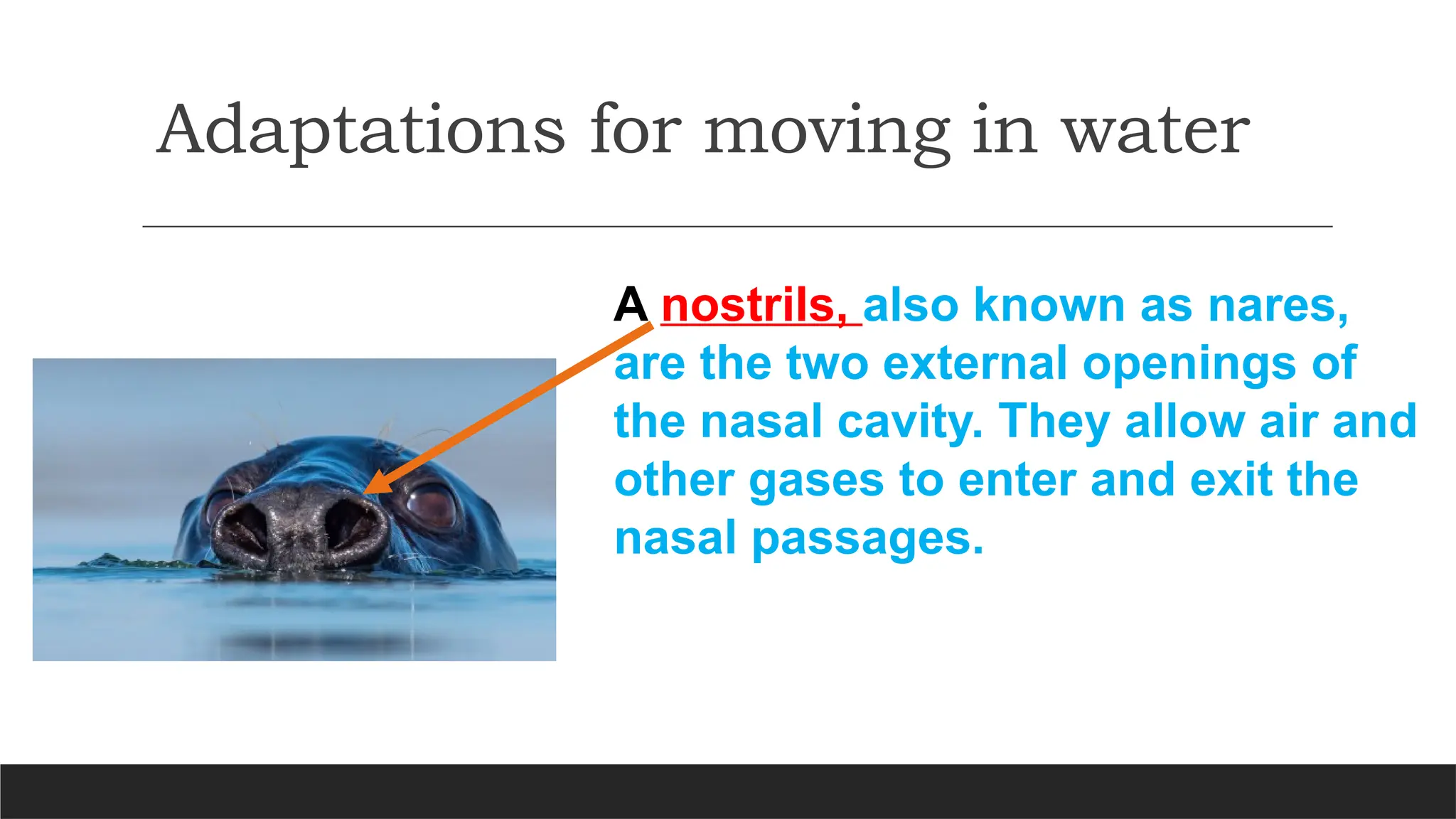
A nostrils, alsoknown as nares,
are the two external openings of
the nasal cavity. They allow air and
other gases to enter and exit the
nasal passages.
Adaptations for moving in water
Strong flight musclesare crucial for
birds and some insects to achieve
powered flight. In birds, the pectoralis
muscles are the most prominent,
responsible for the downstroke of the
wings, while the supracoracoideus
muscle assists with the
upstroke. These muscles, along with
others like the coraco-brachialis and
tensor muscles, work together to power
and control wing movements during
flight.
Adaptations for flight
40.
Bird feathers areboth lightweight
and strong due to their unique
structure and the material they
are made of, keratin. This
combination allows birds to fly
efficiently and provides protection
from the elements.
Adaptations for flight
Plants seeds disperseby:
Air
Seeds dispersed by wind are light and have structure that help
them to travel long distances before falling to the ground.
Dandelion head
Shorea seed
Angsana seeds
dispersed by wind using a unique
parachute-like structure made of
bristles attached to each seed.
68.
Plants seeds disperseby:
Water
Some fruits can float in water. They carry their seeds across
seas and oceans.
Lotus seeds
Coconut seed
Mangrove plants
69.
Plants seeds disperseby:
animals
Some seeds have hooks or thorns that help them stick onto animals that brush
past them. These animals carry the seeds away from there parent plants.
burdock
cocklebur
guava
70.
Plants seeds disperseby:
explosion
Some plants disperse by seeds explosion. When these seed pods are ripe, they
split open with a force releasing the seeds inside them.
Rubber fruit Pea pod Okra
71.
Let us try:
Burdockseeds
disperse by animals
Okra seeds disperse
by______________
Cottonwood tree
disperse
by______________