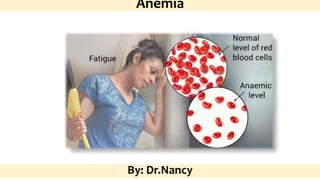
Anemia
By: Dr.Nancy
• What is anemia
• What are symptoms and signs of anemia
• What is classification and different types of anemia
• What are causes of different types of anemia
Learning Objectives
Anemia ( An-without, emia- blood ) is a decrease in the RBC count,
hemoglobin and/ or Hematocrit values resulting in a lower ability for
the blood to carry oxygen to body tissues.
PATHOPHYSIOLOGY:
Decrease in RBCs , Hb or Hct level
Diminished 02 carrying capacity
Hypoxia and hypoxia induced effect on organ function
Sign and symptoms of anemia.
Anaemia
• Significant reduction (at least 10 %) in
circulating red cell mass or their
hemoglobin content appropriate for the
age and sex, leading to corresponding
decrease in the Oxygen - carrying capacity
of blood.
• WHO criteria - Hb < 13 gm/dl in men & Hb <
12 gm/dl in women
Normal Appearance
Pallor due to Anemia
•Normal Values
Category values Reference
Men >13g/dl
women >12g/dl
Pregnant women >11g/dl
Infant from 2 to 6 months >9.5g/dl
Children from 6 month to 24 months >10.5g/dl
2yrs to 11yrs >11.5g/dl
Children from 12 years >12g/dl
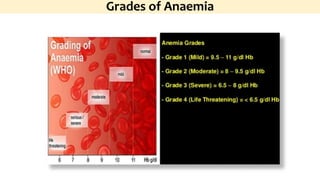
Grades of Anaemia
Classification of Anaemias:
1. On the basis of cause
-Blood Loss
-Inadequate production of normal blood cells
-Excessive destruction of blood cells
2. On the basis of morphology
- Microcytic
- -Marcocytic
- -Normocytic
• Types of Anemia
Based on the clinical picture-
1.Iron Deficiency anemia – Excessive loss of iron , women at high risk- menstrual blood and
growing fetus.
2.Megalobastic anemia- Less intake of vitamin B12 and folic acid- Red bone barrow produce
abnormal RBC eg Cancer drugs
3. Pernicious anemia- inability of stomach to absorb vitamin Bb12 in small intestine
4.Hemorrhagic anemia-Eexcessive loss of RBC through bleeding, stomach ulcers,
menstruction.
5.Hemolytic anemia-RBC plasma membrane ruptures
- Thalassemia anemia- Less synthesis of hemoglobin. Found in population of Mediterranean
sea.
- Sickle cell anemia- Hereditary blood disorder, characterized by red blood cells that assume
an abnormal, rigid, sickle shape
6. Aplastic anemia- Destruction of red bone marrow
Risk Factors
1. Poor socio economic class
2. Multiparity
3. Teenage pregnancy
4. Menstrual problem
Symptoms
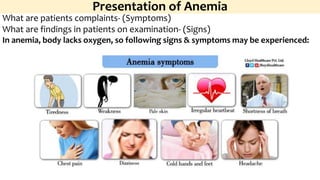
1. Easy fatigue and loss of energy
2. Unusally rapid heart beat
3. Shortness of breath and headache
4. Difficulty concentrating
5. Dizziness
6. Pale skin
7. Leg cramps
8. Insomnia
• Anemia Caused by Iron Deficiency
People with an iron deficiency may experience these symptoms:
1. A hunger for strange substance such as paper, ice, or dirt
2. Upward curvature of nails, referred to as koilonychias
3. Soreness of the mouth cracks at the corners
Anemia Caused by vitamin B12 deficiency
People whose anemia is caused by a deficiency of Vitamin B12 may have
these symptoms:
1. A tingling , “ pins and needles” sensation in the hands or feet
2. Lost sense of touch
3. Dementia
4. Hallucinations
5. Stiffnes of the arms and legs
Signs of Anmeia:
1. Brittle nails
2. Koilonychia ( Spoon shaped nails)
3. Brittle hair
4. Dysphagia and glossitis
5. Plummer vinson/ Kelly Patterson
Investigations
The red cell population is defined by:
1. Quantitative parameters: 2. Qualitative Parameters
- Volume packed cells- the hematocrit - Mean corpuscular volume
- Hemoglobin concentration - Mean corpuscular hemoglobin
- Red cell concentration per unit volume - Mean corpuscular hemoglobin conc
Iinvestigations:
Hemotocrit ( Packed cell Volume) : it is the proportion of the volume of
blood sample that is occupied by RBC
Men – 42-52% Women – 36-48%
Cell Volume Hemoglobin Concentration :- It is the amount of hemoglobin per
unit volume of blood
Men- 14-17 gms/dl Women- 12-16 gms/dl
Red cell count: Total number of Red cells per unit volume of blood sample.
Men- 4.2- 5.4 * 10 6 / mm3
Women – 3.6- 5.0 * 10 6/ mm3
Mean Corpuscular volume : it is the average volume a RBC
Normal 82-98 mm3
Management:
Care Objectives
1.Determine the cause of iron deficiency
The etiology os often multifactorial; even when there is an obvious
cause
Aim of treatment
Normalize hemoglobin level and rell cell
Lifesytle management
It is recommended that patients with iron deficiency receive dietary
advice.
Non- Pharmacological Management:
1. Tea and Coffee inhibit iron absorption when consumed with meal or
shortly after a meal
2. Vitamin C (ascorbic acid) is also powerful enhancer of iron
absorption
3. Promote and support exclusive breastfeeding for about 6 months
followed by breastfeeding with appropriate complementary foods,
including iron- rich through the secondary year of life.
Approach to diagnosis for a case of anemia- Understanding Anemia
• What are patients complaints- (Symptoms)
• What are findings in patients on examination- (Signs)
• Probable diagnosis of anemia
• Investigations – RBCs count, Hb esti. and PCV –
Hematological Indices to reach to near the diagnosis
- Specific tests for final diagnosis
Presentation of Anemia
What are patients complaints- (Symptoms)
What are findings in patients on examination- (Signs)
In anemia, body lacks oxygen, so following signs & symptoms may be experienced:
Fe++ is required for Heme Synthesis (↓ Haemoglobin)
Decreased Red Cell Production- Nutritional Deficiency- Iron Deficiency
Causes of Iron deficiency anemia:
Clinical Features:
During Early Phase- General for anemia
Iron Therapy :
Decreased Red Cell Production- Nutritional Deficiency- Iron Deficiency
Pathophysiology
•
Decreased Red Cell Production- Nutritional Deficiency- Maturation factors Deficiency
(Megaloblastic Anaemia)
Causes:
Megaloblastic anaemia
Clinical feature:
Management/Treatment:
Decreased Blood Cells Production - Dysplastic / Aplastic Anaemia
Primary
Secondary
Causes:
Bone marrow is the site of Blood cells production
Dysplastic /Aplastic Anaemia
Presentation-
Management-
Decreased Red Cell Production - Anaemis of chronic disease
Pathophysiology
Causes
Decreased Red Cell Survival - Hemolytic anemia-
Intracorpuscular Defect-Hereditary Disorders
Pathophysiology
Causes
Pathophysiology -
Decreased Red Cell Survival - Hemolytic anemia-
Hereditary Spherocytosis
Pathophysiology
Decreased Red Cell Survival - Hemolytic anemia-
Glucose-6-PO4 – Dehydrogenase Deficiency
Most common of haemoglobinopathies- Sickle Cell Anaemia
Thalassemia
Decreased Red Cell Survival - Hemolytic anemia-
Globin chain Synthesis abnormality-
Decreased Red Cell Survival - Extra corpuscular Hemolytic Anemia
-Acquired disorder-Nonimmune hemolytic anemias
Chemicals and drugs -
Animal venoms –
Infectious agents –
Caused by physical injury to RBCs
Autoimmune hemolytic anaemia (AIHA) :
▪ Warm antibody hemolytic anemia -▪ Cold antibody hemolytic anemia
Decreased Red Cell Survival - Extra corpuscular Hemolytic Anemia
-Acquired disorder-Immuno hemolytic anemias
Decreased Red Cell Survival - Extra corpuscular Hemolytic Anemia
-Acquired disorder-Immuno hemolytic anemias
Acute blood loss anemia, also called hemorrhagic anemia, occurs due to acute
hemorrhage (bleeding).
Decreased Red Cell Survival - Post hemorrhagic anemia
Significant reduction (at least 10 %) in circulating …………or their ……………………appropriate for the age
and sex, leading to corresponding decrease in the …………………………of blood.
WHO criteria - Hb < ……. gm/dl in men & Hb < ……. gm/dl in women.
……………………………….type of Anemia includes Iron deficiency, Thalassemia, lead poisoning
MCV-……………the causes include Vit B12 and/or Folic acid Deficiency
Chronic blood loss leads to…………………………………………………………………
................................................. anemia is a type of megaloblastic anemia there is decreased availability of IF
Tuberculosis may cause anemia ……………………………………………………….
Self Assessment
Thank you

anemia.pptx

  • 1.
  • 2.
    • What isanemia • What are symptoms and signs of anemia • What is classification and different types of anemia • What are causes of different types of anemia Learning Objectives
  • 3.
    Anemia ( An-without,emia- blood ) is a decrease in the RBC count, hemoglobin and/ or Hematocrit values resulting in a lower ability for the blood to carry oxygen to body tissues. PATHOPHYSIOLOGY: Decrease in RBCs , Hb or Hct level Diminished 02 carrying capacity Hypoxia and hypoxia induced effect on organ function Sign and symptoms of anemia.
  • 4.
    Anaemia • Significant reduction(at least 10 %) in circulating red cell mass or their hemoglobin content appropriate for the age and sex, leading to corresponding decrease in the Oxygen - carrying capacity of blood. • WHO criteria - Hb < 13 gm/dl in men & Hb < 12 gm/dl in women Normal Appearance Pallor due to Anemia
  • 5.
    •Normal Values Category valuesReference Men >13g/dl women >12g/dl Pregnant women >11g/dl Infant from 2 to 6 months >9.5g/dl Children from 6 month to 24 months >10.5g/dl 2yrs to 11yrs >11.5g/dl Children from 12 years >12g/dl
  • 6.
  • 7.
    Classification of Anaemias: 1.On the basis of cause -Blood Loss -Inadequate production of normal blood cells -Excessive destruction of blood cells 2. On the basis of morphology - Microcytic - -Marcocytic - -Normocytic
  • 8.
    • Types ofAnemia Based on the clinical picture- 1.Iron Deficiency anemia – Excessive loss of iron , women at high risk- menstrual blood and growing fetus. 2.Megalobastic anemia- Less intake of vitamin B12 and folic acid- Red bone barrow produce abnormal RBC eg Cancer drugs 3. Pernicious anemia- inability of stomach to absorb vitamin Bb12 in small intestine 4.Hemorrhagic anemia-Eexcessive loss of RBC through bleeding, stomach ulcers, menstruction. 5.Hemolytic anemia-RBC plasma membrane ruptures - Thalassemia anemia- Less synthesis of hemoglobin. Found in population of Mediterranean sea. - Sickle cell anemia- Hereditary blood disorder, characterized by red blood cells that assume an abnormal, rigid, sickle shape 6. Aplastic anemia- Destruction of red bone marrow
  • 9.
    Risk Factors 1. Poorsocio economic class 2. Multiparity 3. Teenage pregnancy 4. Menstrual problem Symptoms 1. Easy fatigue and loss of energy 2. Unusally rapid heart beat 3. Shortness of breath and headache 4. Difficulty concentrating 5. Dizziness 6. Pale skin 7. Leg cramps 8. Insomnia
  • 10.
    • Anemia Causedby Iron Deficiency People with an iron deficiency may experience these symptoms: 1. A hunger for strange substance such as paper, ice, or dirt 2. Upward curvature of nails, referred to as koilonychias 3. Soreness of the mouth cracks at the corners Anemia Caused by vitamin B12 deficiency People whose anemia is caused by a deficiency of Vitamin B12 may have these symptoms: 1. A tingling , “ pins and needles” sensation in the hands or feet 2. Lost sense of touch 3. Dementia 4. Hallucinations 5. Stiffnes of the arms and legs
  • 11.
    Signs of Anmeia: 1.Brittle nails 2. Koilonychia ( Spoon shaped nails) 3. Brittle hair 4. Dysphagia and glossitis 5. Plummer vinson/ Kelly Patterson Investigations The red cell population is defined by: 1. Quantitative parameters: 2. Qualitative Parameters - Volume packed cells- the hematocrit - Mean corpuscular volume - Hemoglobin concentration - Mean corpuscular hemoglobin - Red cell concentration per unit volume - Mean corpuscular hemoglobin conc
  • 12.
    Iinvestigations: Hemotocrit ( Packedcell Volume) : it is the proportion of the volume of blood sample that is occupied by RBC Men – 42-52% Women – 36-48% Cell Volume Hemoglobin Concentration :- It is the amount of hemoglobin per unit volume of blood Men- 14-17 gms/dl Women- 12-16 gms/dl Red cell count: Total number of Red cells per unit volume of blood sample. Men- 4.2- 5.4 * 10 6 / mm3 Women – 3.6- 5.0 * 10 6/ mm3 Mean Corpuscular volume : it is the average volume a RBC Normal 82-98 mm3
  • 13.
    Management: Care Objectives 1.Determine thecause of iron deficiency The etiology os often multifactorial; even when there is an obvious cause Aim of treatment Normalize hemoglobin level and rell cell Lifesytle management It is recommended that patients with iron deficiency receive dietary advice.
  • 14.
    Non- Pharmacological Management: 1.Tea and Coffee inhibit iron absorption when consumed with meal or shortly after a meal 2. Vitamin C (ascorbic acid) is also powerful enhancer of iron absorption 3. Promote and support exclusive breastfeeding for about 6 months followed by breastfeeding with appropriate complementary foods, including iron- rich through the secondary year of life.
  • 15.
    Approach to diagnosisfor a case of anemia- Understanding Anemia • What are patients complaints- (Symptoms) • What are findings in patients on examination- (Signs) • Probable diagnosis of anemia • Investigations – RBCs count, Hb esti. and PCV – Hematological Indices to reach to near the diagnosis - Specific tests for final diagnosis
  • 16.
    Presentation of Anemia Whatare patients complaints- (Symptoms) What are findings in patients on examination- (Signs) In anemia, body lacks oxygen, so following signs & symptoms may be experienced:
  • 17.
    Fe++ is requiredfor Heme Synthesis (↓ Haemoglobin) Decreased Red Cell Production- Nutritional Deficiency- Iron Deficiency Causes of Iron deficiency anemia:
  • 18.
    Clinical Features: During EarlyPhase- General for anemia Iron Therapy : Decreased Red Cell Production- Nutritional Deficiency- Iron Deficiency
  • 19.
    Pathophysiology • Decreased Red CellProduction- Nutritional Deficiency- Maturation factors Deficiency (Megaloblastic Anaemia)
  • 20.
  • 21.
  • 22.
    Decreased Blood CellsProduction - Dysplastic / Aplastic Anaemia Primary Secondary Causes: Bone marrow is the site of Blood cells production
  • 23.
  • 24.
    Decreased Red CellProduction - Anaemis of chronic disease Pathophysiology Causes
  • 25.
    Decreased Red CellSurvival - Hemolytic anemia- Intracorpuscular Defect-Hereditary Disorders Pathophysiology Causes
  • 26.
    Pathophysiology - Decreased RedCell Survival - Hemolytic anemia- Hereditary Spherocytosis
  • 27.
    Pathophysiology Decreased Red CellSurvival - Hemolytic anemia- Glucose-6-PO4 – Dehydrogenase Deficiency
  • 28.
    Most common ofhaemoglobinopathies- Sickle Cell Anaemia Thalassemia Decreased Red Cell Survival - Hemolytic anemia- Globin chain Synthesis abnormality-
  • 29.
    Decreased Red CellSurvival - Extra corpuscular Hemolytic Anemia -Acquired disorder-Nonimmune hemolytic anemias Chemicals and drugs - Animal venoms – Infectious agents – Caused by physical injury to RBCs
  • 30.
    Autoimmune hemolytic anaemia(AIHA) : ▪ Warm antibody hemolytic anemia -▪ Cold antibody hemolytic anemia Decreased Red Cell Survival - Extra corpuscular Hemolytic Anemia -Acquired disorder-Immuno hemolytic anemias
  • 31.
    Decreased Red CellSurvival - Extra corpuscular Hemolytic Anemia -Acquired disorder-Immuno hemolytic anemias
  • 32.
    Acute blood lossanemia, also called hemorrhagic anemia, occurs due to acute hemorrhage (bleeding). Decreased Red Cell Survival - Post hemorrhagic anemia
  • 33.
    Significant reduction (atleast 10 %) in circulating …………or their ……………………appropriate for the age and sex, leading to corresponding decrease in the …………………………of blood. WHO criteria - Hb < ……. gm/dl in men & Hb < ……. gm/dl in women. ……………………………….type of Anemia includes Iron deficiency, Thalassemia, lead poisoning MCV-……………the causes include Vit B12 and/or Folic acid Deficiency Chronic blood loss leads to………………………………………………………………… ................................................. anemia is a type of megaloblastic anemia there is decreased availability of IF Tuberculosis may cause anemia ………………………………………………………. Self Assessment
  • 34.