
UHI Research and Postgraduate Conference
28-29th
October 2010
COMMUNITIES, COASTS AND MOUNTAINS
EDORA
(European Development Opportunities in Rural Areas)
Andrew Copus
Centre for Remote and Rural Studies
andrew.copus@uhi.ac.uk
The EDORA Project Objectives
(According to the Specification)
…to describe the main processes of change which
are resulting in the increasing differentiation of
rural areas.
…to identify development opportunities and
constraints for different kinds of rural areas…
…to consider how such knowledge can be
translated into guiding principles to support the
development of appropriate cohesion policy.
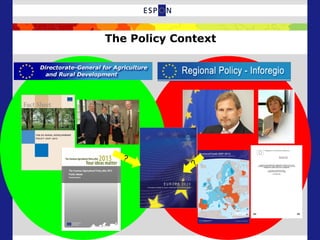
The Policy Context
?
?
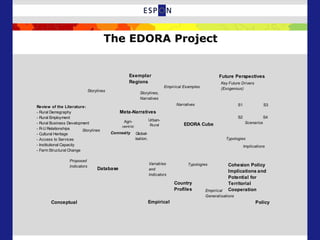
The EDORA Project
Review of the Literature:
- Rural Demography
- Rural Employment
- Rural Business Development
- R-U Relationships
- Cultural Heritage
- Access to Services
- Institutional Capacity
- Farm Structural Change
Exemplar
Regions
Cohesion Policy
Implications and
Potential for
Territorial
Cooperation
Storylines
Database
Proposed
Indicators
Variables
and
Indicators
Future Perspectives
S1 S3
S4S2
Key Future Drivers
(Exogenous)
Country
Profiles
EDORA Cube
Storylines
Typologies
Narratives
Empirical Examples
Storylines,
Narratives
Implications
Empirical
Generalisations
Typologies
Agri-
centric
Urban-
Rural
Global-
isation.
Meta-Narratives
Connexity
Conceptual Empirical Policy
Scenarios
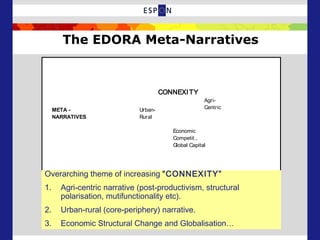
The EDORA Meta-Narratives
Overarching theme of increasing “CONNEXITY”
1. Agri-centric narrative (post-productivism, structural
polarisation, mutifunctionality etc).
2. Urban-rural (core-periphery) narrative.
3. Economic Structural Change and Globalisation…
CONNEXI TY
Urban-
Rural
Agri-
Centric
Economic
Competit.,
Global Capital
META -
NARRATIVES
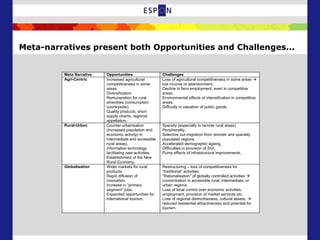
Meta-narratives present both Opportunities and Challenges...
Meta Narrative Opportunities Challenges
Agri-Centric Increased agricultural
competitiveness in some
areas.
Diversification.
Remuneration for rural
amenities (consumption
countryside).
Quality products, short
supply chains, regional
appellation.
Loss of agricultural competitiveness in some areas 
low income or abandonment.
Decline in farm employment, even in competitive
areas.
Environmental effects of intensification in competitive
areas.
Difficulty in valuation of public goods.
Rural-Urban Counter-urbanisation
(increased population and
economic activity) in
intermediate and accessible
rural areas).
Information technology
facilitating new activities.
Establishment of the New
Rural Economy.
Sparsity (especially in remote rural areas)
Peripherality.
Selective out-migration from remoter and sparsely
populated regions.
Accelerated demographic ageing.
Difficulties in provision of SGI.
Pump effects of infrastructure improvements.
Globalisation Wider markets for rural
products.
Rapid diffusion of
innovation.
Increase in “primary
segment” jobs.
Expanded opportunities for
international tourism.
Restructuring – loss of competitiveness for
“traditional” activities.
“Rationalisation” of globally controlled activities 
concentration in accessible rural, intermediate, or
urban regions.
Loss of local control over economic activities,
employment, provision of market services etc.
Loss of regional distinctiveness, cultural assets, 
reduced residential attractiveness and potential for
tourism.
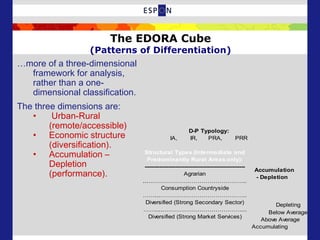
The EDORA Cube
(Patterns of Differentiation)
…more of a three-dimensional
framework for analysis,
rather than a one-
dimensional classification.
The three dimensions are:
• Urban-Rural
(remote/accessible)
• Economic structure
(diversification).
• Accumulation –
Depletion
(performance).
Structural Types (Intermediate and
Predominantly Rural Areas only):
-------------------------------------------------------
Agrarian
...…………………………………………..
Consumption Countryside
……...……………………………………..
Diversified (Strong Secondary Sector)
…….....…………………………………...
Diversified (Strong Market Services)
D-P Typology:
IA, IR, PRA, PRR
Accumulating
Above Average
Below Average
Depleting
Accumulation
- Depletion
!
! ! !
!
!
!
!
!
!
!!
!
!
!
!
!
!
!
!
!
!
!
!
!
!
!
!
!
!
!
!
!
!
!
!
!
!
!
!
!
!
!
!
!
!
!
!
!
!
Acores
Guyane
Madeira
Réunion
Canarias
MartiniqueGuadeloupe
Zagreb
Valletta
Budapest
Bratislava
Roma
Riga
Oslo
Bern
Wien
Kyiv
Vaduz
Paris
Praha
Minsk
Tounis
Lisboa
Skopje Ankara
Madrid
Tirana
Sofiya
London
Berlin
Dublin
Athinai
Tallinn
Nicosia
Beograd
Vilnius
Kishinev
Sarajevo
Helsinki
Warszawa
Podgorica
El-Jazair
Ljubljana
Stockholm
Reykjavik
København
Bucuresti
Amsterdam
Luxembourg
Bruxelles/Brussel
Urban-Rural
!
! ! !
!
!
!
!
!
!
!!
!
!
!
!
!
!
!
!
!
!
!
!
!
!
!
!
!
!
!
!
!
!
!
!
!
!
!
!
!
!
!
!
!
!
!
!
!
!
Acores
Guyane
Madeira
Réunion
Canarias
MartiniqueGuadeloupe
Zagreb
Valletta
Budapest
Bratislava
Roma
Riga
Oslo
Bern
Wien
Kyiv
Vaduz
Paris
Praha
Minsk
Tounis
Lisboa
Skopje Ankara
Madrid
Tirana
Sofiya
London
Berlin
Dublin
Athinai
Tallinn
Nicosia
Beograd
Vilnius
Kishinev
Sarajevo
Helsinki
Warszawa
Podgorica
El-Jazair
Ljubljana
Stockholm
Reykjavik
København
Bucuresti
Amsterdam
Luxembourg
Bruxelles/Brussel
Economic
Structure
!
! ! !
!
!
!
!
!
!
!!
!
!
!
!
!
!
!
!
!
!
!
!
!
!
!
!
!
!
!
!
!
!
!
!
!
!
!
!
!
!
!
!
!
!
!
!
!
!
Acores
Guyane
Madeira
Réunion
Canarias
MartiniqueGuadeloupe
Zagreb
Valletta
Budapest
Bratislava
Roma
Riga
Oslo
Bern
Wien
Kyiv
Vaduz
Paris
Praha
Minsk
Tounis
Lisboa
Skopje Ankara
Madrid
Tirana
Sofiya
London
Berlin
Dublin
Athinai
Tallinn
Nicosia
Beograd
Vilnius
Kishinev
Sarajevo
Helsinki
Warszawa
Podgorica
El-Jazair
Ljubljana
Stockholm
Reykjavik
København
Bucuresti
Amsterdam
Luxembourg
Bruxelles/Brussel
Accumulation -
Depletion
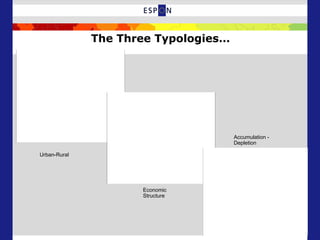
The Three Typologies…
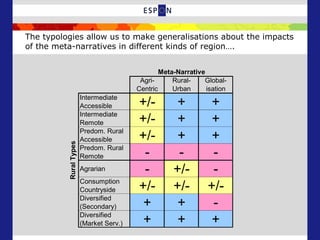
The typologies allow us to make generalisations about the impacts
of the meta-narratives in different kinds of region….
Agri-
Centric
Rural-
Urban
Global-
isation
Intermediate
Accessible +/- + +
Intermediate
Remote +/- + +
Predom. Rural
Accessible +/- + +
Predom. Rural
Remote - - -
Agrarian - +/- -
Consumption
Countryside +/- +/- +/-
Diversified
(Secondary) + + -
Diversified
(Market Serv.) + + +
Meta-NarrativeRuralTypes
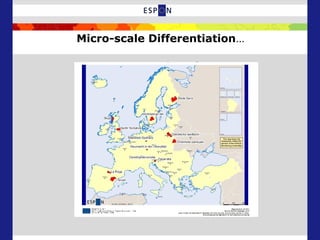
Micro-scale Differentiation…
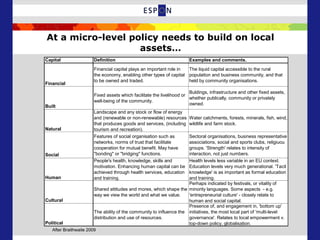
At a micro-level policy needs to build on local
assets…
Capital Definition Examples and comments.
Financial
Financial capital plays an important role in
the economy, enabling other types of capital
to be owned and traded.
The liquid capital accessible to the rural
population and business community, and that
held by community organisations.
Built
Fixed assets which facilitate the livelihood or
well-being of the community.
Buldings, infrastructure and other fixed assets,
whether publically, community or privately
owned.
Natural
Landscape and any stock or flow of energy
and (renewable or non-renewable) resources
that produces goods and services, (including
tourism and recreation).
Water catchments, forests, minerals, fish, wind,
wildlife and farm stock.
Social
Features of social organisation such as
networks, norms of trust that facilitate
cooperation for mutual benefit. May have
"bonding" or "bridging" functions.
Sectoral organisations, business representative
associations, social and sports clubs, religiuou
groups. 'Strength' relates to intensity of
interaction, not just numbers.
Human
People's health, knowledge, skills and
motivation. Enhancing human capital can be
achieved through health services, education
and training.
Health levels less variable in an EU context.
Education levels very much generational. 'Tacit
knowledge' is as important as formal education
and training.
Cultural
Shared attitudes and mores, which shape the
way we view the world and what we value.
Perhaps indicated by festivals, or vitality of
minority languages. Some aspects - e.g.
'entrepreneurial culture' - closely relate to
human and social capital.
Political
The ability of the community to influence the
distribution and use of resources.
Presence of, and engagement in, 'bottom up'
initiatives, the most local part of 'multi-level
governance'. Relates to local empowerment v.
top-down policy, globalisation.
After Braithwaite 2009
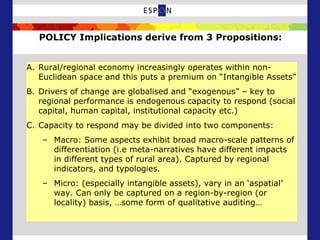
POLICY Implications derive from 3 Propositions:
A. Rural/regional economy increasingly operates within non-
Euclidean space and this puts a premium on “Intangible Assets”
B. Drivers of change are globalised and “exogenous” – key to
regional performance is endogenous capacity to respond (social
capital, human capital, institutional capacity etc.)
C. Capacity to respond may be divided into two components:
– Macro: Some aspects exhibit broad macro-scale patterns of
differentiation (i.e meta-narratives have different impacts
in different types of rural area). Captured by regional
indicators, and typologies.
– Micro: (especially intangible assets), vary in an ‘aspatial’
way. Can only be captured on a region-by-region (or
locality) basis, …some form of qualitative auditing…
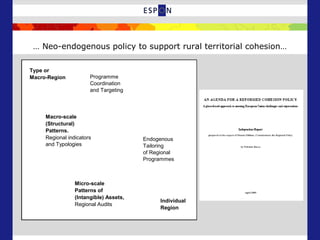
… Neo-endogenous policy to support rural territorial cohesion…
Endogenous
Tailoring
of Regional
Programmes
Micro-scale
Patterns of
(Intangible) Assets,
Regional Audits
Individual
Region
Programme
Coordination
and Targeting
Macro-scale
(Structural)
Patterns.
Regional indicators
and Typologies
Type or
Macro-Region
…Thank you for your attention.

European Development Opportunities in Rural Areas (EDORA) [Andrew Copus]

  • 1.
    UHI Research andPostgraduate Conference 28-29th October 2010 COMMUNITIES, COASTS AND MOUNTAINS EDORA (European Development Opportunities in Rural Areas) Andrew Copus Centre for Remote and Rural Studies andrew.copus@uhi.ac.uk
  • 2.
    The EDORA ProjectObjectives (According to the Specification) …to describe the main processes of change which are resulting in the increasing differentiation of rural areas. …to identify development opportunities and constraints for different kinds of rural areas… …to consider how such knowledge can be translated into guiding principles to support the development of appropriate cohesion policy.
  • 3.
  • 4.
    The EDORA Project Reviewof the Literature: - Rural Demography - Rural Employment - Rural Business Development - R-U Relationships - Cultural Heritage - Access to Services - Institutional Capacity - Farm Structural Change Exemplar Regions Cohesion Policy Implications and Potential for Territorial Cooperation Storylines Database Proposed Indicators Variables and Indicators Future Perspectives S1 S3 S4S2 Key Future Drivers (Exogenous) Country Profiles EDORA Cube Storylines Typologies Narratives Empirical Examples Storylines, Narratives Implications Empirical Generalisations Typologies Agri- centric Urban- Rural Global- isation. Meta-Narratives Connexity Conceptual Empirical Policy Scenarios
  • 5.
    The EDORA Meta-Narratives Overarchingtheme of increasing “CONNEXITY” 1. Agri-centric narrative (post-productivism, structural polarisation, mutifunctionality etc). 2. Urban-rural (core-periphery) narrative. 3. Economic Structural Change and Globalisation… CONNEXI TY Urban- Rural Agri- Centric Economic Competit., Global Capital META - NARRATIVES
  • 6.
    Meta-narratives present bothOpportunities and Challenges... Meta Narrative Opportunities Challenges Agri-Centric Increased agricultural competitiveness in some areas. Diversification. Remuneration for rural amenities (consumption countryside). Quality products, short supply chains, regional appellation. Loss of agricultural competitiveness in some areas  low income or abandonment. Decline in farm employment, even in competitive areas. Environmental effects of intensification in competitive areas. Difficulty in valuation of public goods. Rural-Urban Counter-urbanisation (increased population and economic activity) in intermediate and accessible rural areas). Information technology facilitating new activities. Establishment of the New Rural Economy. Sparsity (especially in remote rural areas) Peripherality. Selective out-migration from remoter and sparsely populated regions. Accelerated demographic ageing. Difficulties in provision of SGI. Pump effects of infrastructure improvements. Globalisation Wider markets for rural products. Rapid diffusion of innovation. Increase in “primary segment” jobs. Expanded opportunities for international tourism. Restructuring – loss of competitiveness for “traditional” activities. “Rationalisation” of globally controlled activities  concentration in accessible rural, intermediate, or urban regions. Loss of local control over economic activities, employment, provision of market services etc. Loss of regional distinctiveness, cultural assets,  reduced residential attractiveness and potential for tourism.
  • 7.
    The EDORA Cube (Patternsof Differentiation) …more of a three-dimensional framework for analysis, rather than a one- dimensional classification. The three dimensions are: • Urban-Rural (remote/accessible) • Economic structure (diversification). • Accumulation – Depletion (performance). Structural Types (Intermediate and Predominantly Rural Areas only): ------------------------------------------------------- Agrarian ...………………………………………….. Consumption Countryside ……...…………………………………….. Diversified (Strong Secondary Sector) …….....…………………………………... Diversified (Strong Market Services) D-P Typology: IA, IR, PRA, PRR Accumulating Above Average Below Average Depleting Accumulation - Depletion
  • 8.
    ! ! ! ! ! ! ! ! ! ! !! ! ! ! ! ! ! ! ! ! ! ! ! ! ! ! ! ! ! ! ! ! ! ! ! ! ! ! ! ! ! ! ! ! ! ! ! ! ! Acores Guyane Madeira Réunion Canarias MartiniqueGuadeloupe Zagreb Valletta Budapest Bratislava Roma Riga Oslo Bern Wien Kyiv Vaduz Paris Praha Minsk Tounis Lisboa SkopjeAnkara Madrid Tirana Sofiya London Berlin Dublin Athinai Tallinn Nicosia Beograd Vilnius Kishinev Sarajevo Helsinki Warszawa Podgorica El-Jazair Ljubljana Stockholm Reykjavik København Bucuresti Amsterdam Luxembourg Bruxelles/Brussel Urban-Rural ! ! ! ! ! ! ! ! ! ! !! ! ! ! ! ! ! ! ! ! ! ! ! ! ! ! ! ! ! ! ! ! ! ! ! ! ! ! ! ! ! ! ! ! ! ! ! ! ! Acores Guyane Madeira Réunion Canarias MartiniqueGuadeloupe Zagreb Valletta Budapest Bratislava Roma Riga Oslo Bern Wien Kyiv Vaduz Paris Praha Minsk Tounis Lisboa Skopje Ankara Madrid Tirana Sofiya London Berlin Dublin Athinai Tallinn Nicosia Beograd Vilnius Kishinev Sarajevo Helsinki Warszawa Podgorica El-Jazair Ljubljana Stockholm Reykjavik København Bucuresti Amsterdam Luxembourg Bruxelles/Brussel Economic Structure ! ! ! ! ! ! ! ! ! ! !! ! ! ! ! ! ! ! ! ! ! ! ! ! ! ! ! ! ! ! ! ! ! ! ! ! ! ! ! ! ! ! ! ! ! ! ! ! ! Acores Guyane Madeira Réunion Canarias MartiniqueGuadeloupe Zagreb Valletta Budapest Bratislava Roma Riga Oslo Bern Wien Kyiv Vaduz Paris Praha Minsk Tounis Lisboa Skopje Ankara Madrid Tirana Sofiya London Berlin Dublin Athinai Tallinn Nicosia Beograd Vilnius Kishinev Sarajevo Helsinki Warszawa Podgorica El-Jazair Ljubljana Stockholm Reykjavik København Bucuresti Amsterdam Luxembourg Bruxelles/Brussel Accumulation - Depletion The Three Typologies…
  • 9.
    The typologies allowus to make generalisations about the impacts of the meta-narratives in different kinds of region…. Agri- Centric Rural- Urban Global- isation Intermediate Accessible +/- + + Intermediate Remote +/- + + Predom. Rural Accessible +/- + + Predom. Rural Remote - - - Agrarian - +/- - Consumption Countryside +/- +/- +/- Diversified (Secondary) + + - Diversified (Market Serv.) + + + Meta-NarrativeRuralTypes
  • 10.
  • 11.
    At a micro-levelpolicy needs to build on local assets… Capital Definition Examples and comments. Financial Financial capital plays an important role in the economy, enabling other types of capital to be owned and traded. The liquid capital accessible to the rural population and business community, and that held by community organisations. Built Fixed assets which facilitate the livelihood or well-being of the community. Buldings, infrastructure and other fixed assets, whether publically, community or privately owned. Natural Landscape and any stock or flow of energy and (renewable or non-renewable) resources that produces goods and services, (including tourism and recreation). Water catchments, forests, minerals, fish, wind, wildlife and farm stock. Social Features of social organisation such as networks, norms of trust that facilitate cooperation for mutual benefit. May have "bonding" or "bridging" functions. Sectoral organisations, business representative associations, social and sports clubs, religiuou groups. 'Strength' relates to intensity of interaction, not just numbers. Human People's health, knowledge, skills and motivation. Enhancing human capital can be achieved through health services, education and training. Health levels less variable in an EU context. Education levels very much generational. 'Tacit knowledge' is as important as formal education and training. Cultural Shared attitudes and mores, which shape the way we view the world and what we value. Perhaps indicated by festivals, or vitality of minority languages. Some aspects - e.g. 'entrepreneurial culture' - closely relate to human and social capital. Political The ability of the community to influence the distribution and use of resources. Presence of, and engagement in, 'bottom up' initiatives, the most local part of 'multi-level governance'. Relates to local empowerment v. top-down policy, globalisation. After Braithwaite 2009
  • 12.
    POLICY Implications derivefrom 3 Propositions: A. Rural/regional economy increasingly operates within non- Euclidean space and this puts a premium on “Intangible Assets” B. Drivers of change are globalised and “exogenous” – key to regional performance is endogenous capacity to respond (social capital, human capital, institutional capacity etc.) C. Capacity to respond may be divided into two components: – Macro: Some aspects exhibit broad macro-scale patterns of differentiation (i.e meta-narratives have different impacts in different types of rural area). Captured by regional indicators, and typologies. – Micro: (especially intangible assets), vary in an ‘aspatial’ way. Can only be captured on a region-by-region (or locality) basis, …some form of qualitative auditing…
  • 13.
    … Neo-endogenous policyto support rural territorial cohesion… Endogenous Tailoring of Regional Programmes Micro-scale Patterns of (Intangible) Assets, Regional Audits Individual Region Programme Coordination and Targeting Macro-scale (Structural) Patterns. Regional indicators and Typologies Type or Macro-Region
  • 14.
    …Thank you foryour attention.