Submitted By:
Gurvinder Kaur
L-2019-A-22-
BTFT
Submitted To:
Dr. Suman kumari
Assistant Professor
Department of Microbiology
PAU Ludhiana
Food preservation is as old as human civilization. Preservation of foods
inhibits spoilage cause by bacterial growth, oxidation, insects or
desiccation.
 Early humans, probably by trial and error, also started to develop basic
forms of food preservation, which possible also made safer, e.g. drying,
salting, fermentation.
The Chinese reportedly preserved vegetables by fermentation in
prehistoric times and Plinius preserved white cabbage in earthenware
pots in Italy in the first century AD.
The earliest recorded instances of food preservation date back to
ancient Egypt and the drying of grains and subsequent storage in seal
silos.
The stored grain could be kept for several
years to insure against famine in case the
Nile River flooded.
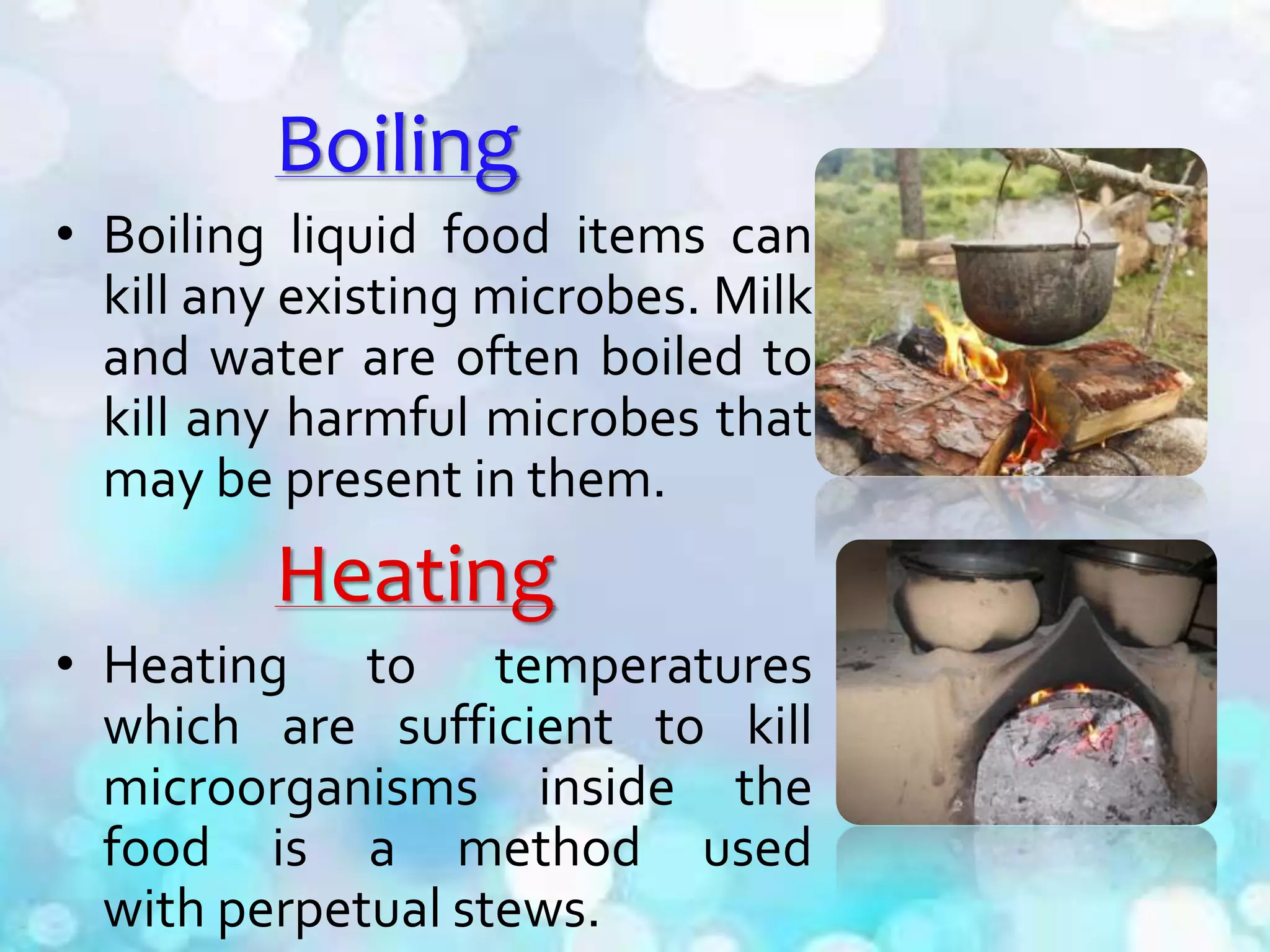
Boiling
• Boiling liquid food items can
kill any existing microbes. Milk
and water are often boiled to
kill any harmful microbes that
may be present in them.
Heating
• Heating to temperatures
which are sufficient to kill
microorganisms inside the
food is a method used
with perpetual stews.
CANNING
• Canning is one of the newest forms of food preservation
starting up in the 1790’s by a Frenchman Nicholas Appert.
Canning is the process in which foods are placed in jars or cans
and heated to a temperature that destroys microorganisms
and inactivates enzymes. This heating and later cooling forms a
vacuum seal. The vacuum seal prevents other microorganisms
from recontamination the food within the jar or can.
• The interesting thing is that although they had the process,
they did not fully understand why it worked. It was thought
that the exclusion of air was responsible for the preservations.
It was not until 1864 when Louis Pasteur discovered the
relationship between microorganisms and food spoilage did it
become clearer.
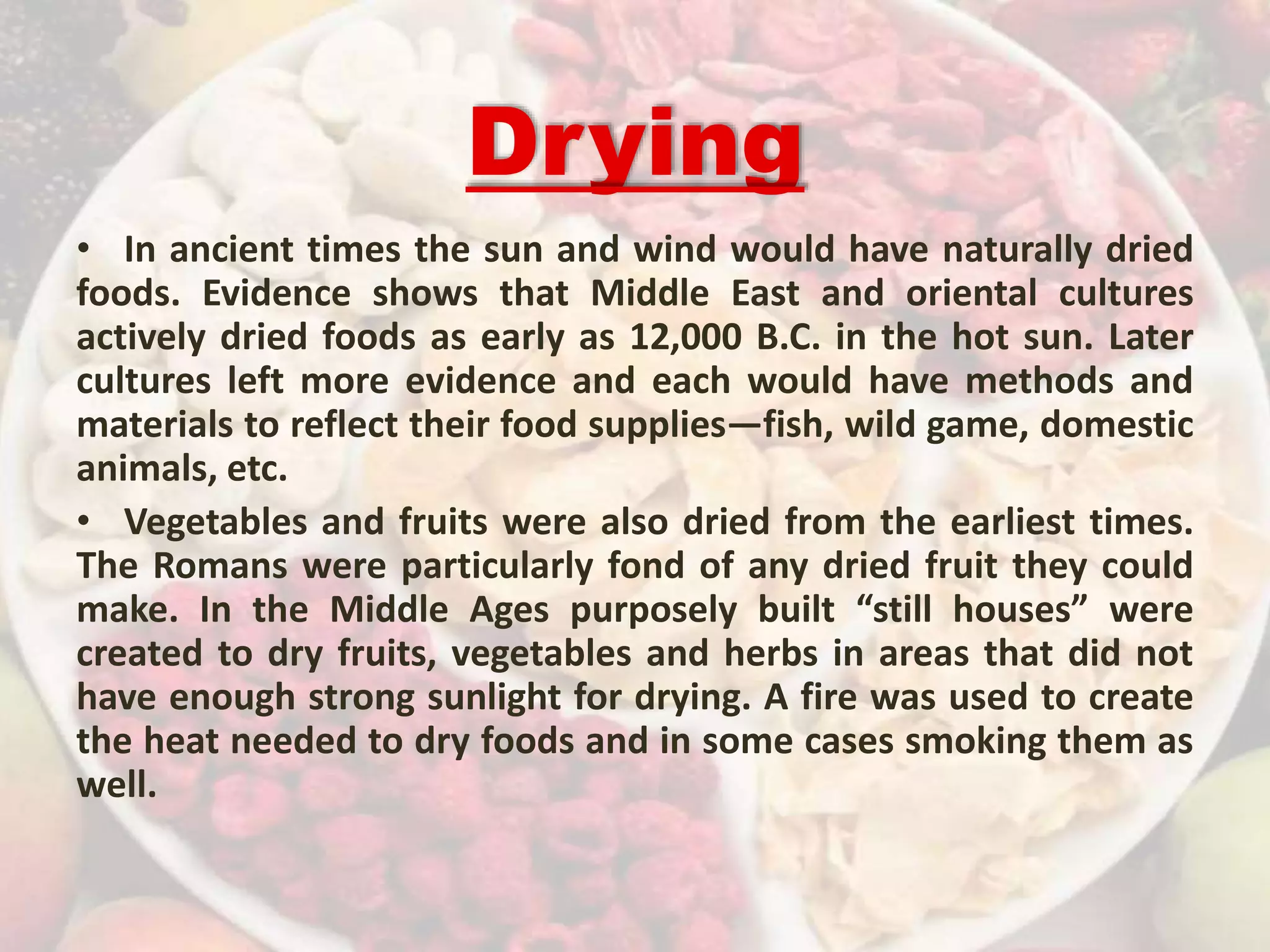
Drying
• In ancient times the sun and wind would have naturally dried
foods. Evidence shows that Middle East and oriental cultures
actively dried foods as early as 12,000 B.C. in the hot sun. Later
cultures left more evidence and each would have methods and
materials to reflect their food supplies—fish, wild game, domestic
animals, etc.
• Vegetables and fruits were also dried from the earliest times.
The Romans were particularly fond of any dried fruit they could
make. In the Middle Ages purposely built “still houses” were
created to dry fruits, vegetables and herbs in areas that did not
have enough strong sunlight for drying. A fire was used to create
the heat needed to dry foods and in some cases smoking them as
well.
• Freezing was an obvious preservation method to the appropriate
climates. Any geographic area that had freezing temperatures for
even part of a year made use of the temperature to preserve foods.
Less than freezing temperatures were used to prolong storage times.
Cellars, caves and cool streams were put to good use for that
purpose.
• In America estates had icehouses built to store ice and food on ice.
Soon the “icehouse” became an “icebox”. In the 1800’s mechanical
refrigeration was invented and was quickly put to use. Also in the
late 1800’s Clarence Birdseye discovered that quick freezing at very
low temperatures made for better tasting meats and vegetables.
After some time he perfected his “quick freeze” process and
revolutionized this method of food preservation.
Fermenting
Fermentation was not invented, but rather discovered. No doubt that
the first beer was discovered when a few grains of barley were left in the
rain. Opportunistic microorganisms fermented the starch-derived sugars
into alcohols. So too can be said about fruits fermented into wine,
cabbage into Kim chi or sauerkraut, and so on. The skill of ancient
peoples to observe, harness, and encourage these fermentations are
admirable. Some anthropologists believe that mankind settled down
from nomadic wanderers into farmers to grow barley to make beer in
roughly 10,000 BC. Beer was nutritious and the alcohol was divine. It was
treated as a gift from the gods.
Fermentation was a valuable food preservation method. It not only
could preserve foods, but it also created more nutritious foods and was
used to create more palatable foods from less than desirable ingredients.
Microorganisms responsible for fermentations can produce vitamins as
they ferment. This produces a more nutritious end product from the
ingredients.
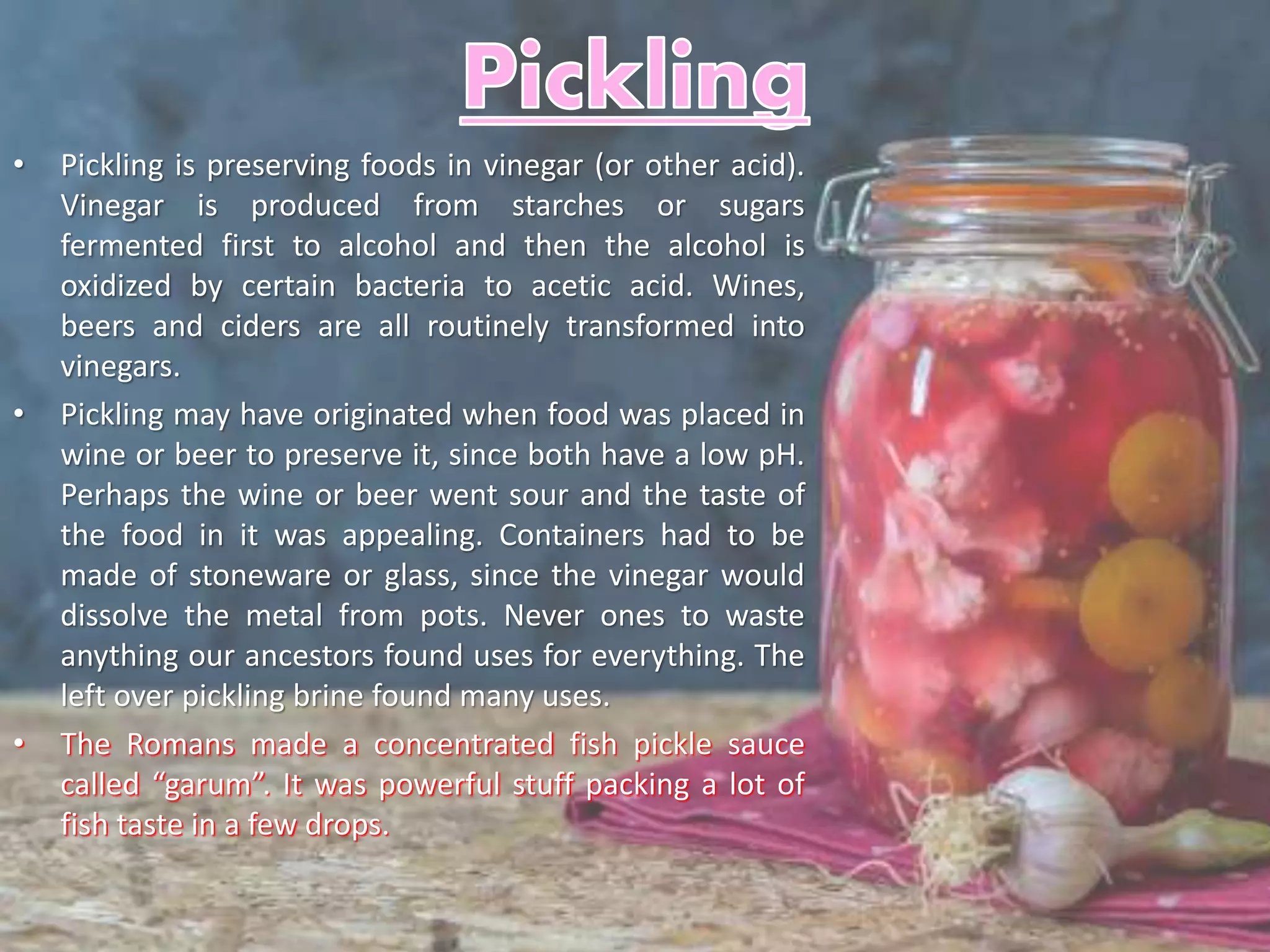
• Pickling is preserving foods in vinegar (or other acid).
Vinegar is produced from starches or sugars
fermented first to alcohol and then the alcohol is
oxidized by certain bacteria to acetic acid. Wines,
beers and ciders are all routinely transformed into
vinegars.
• Pickling may have originated when food was placed in
wine or beer to preserve it, since both have a low pH.
Perhaps the wine or beer went sour and the taste of
the food in it was appealing. Containers had to be
made of stoneware or glass, since the vinegar would
dissolve the metal from pots. Never ones to waste
anything our ancestors found uses for everything. The
left over pickling brine found many uses.
• The Romans made a concentrated fish pickle sauce
called “garum”. It was powerful stuff packing a lot of
fish taste in a few drops.
Curing
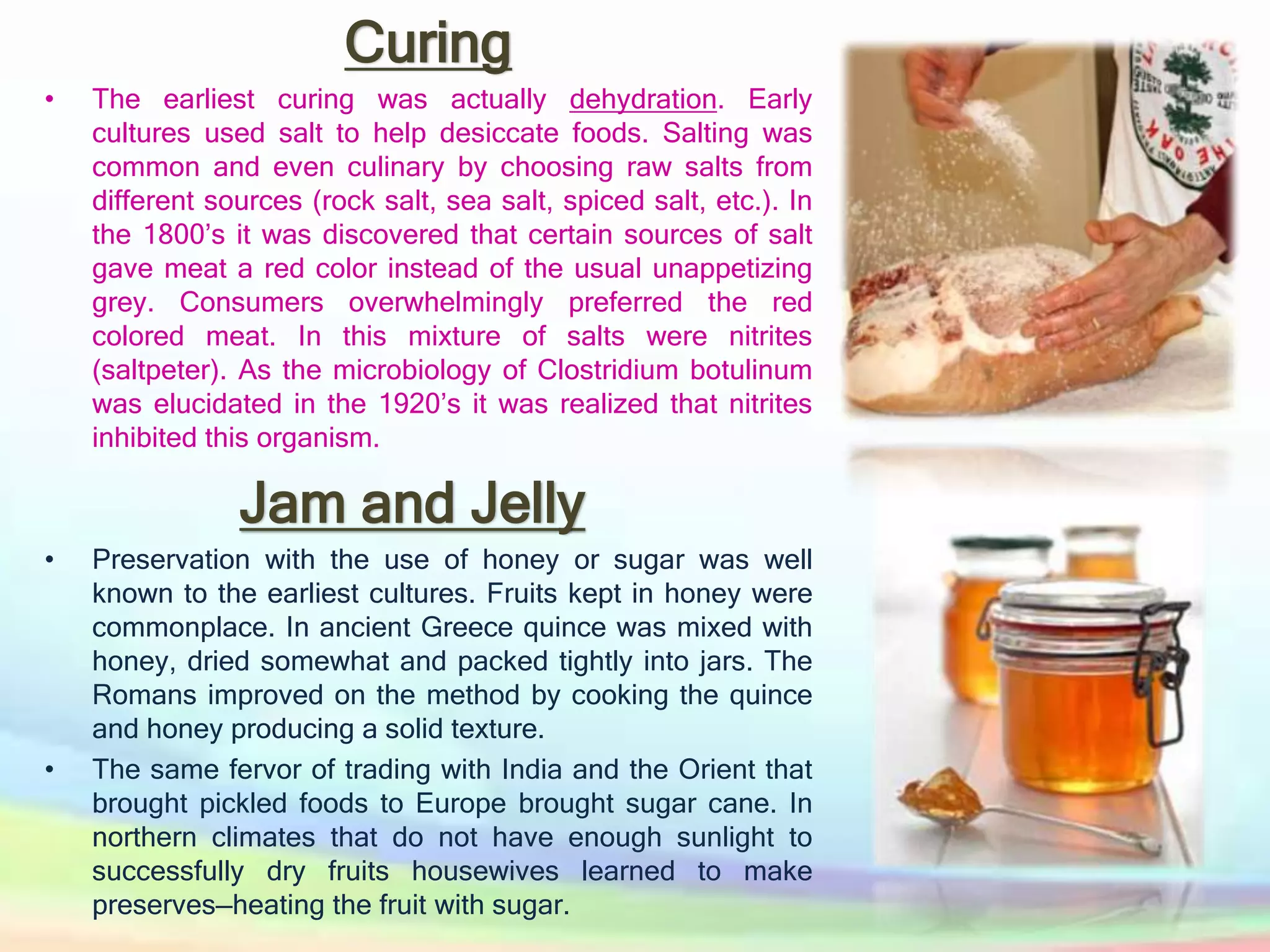
• The earliest curing was actually dehydration. Early
cultures used salt to help desiccate foods. Salting was
common and even culinary by choosing raw salts from
different sources (rock salt, sea salt, spiced salt, etc.). In
the 1800’s it was discovered that certain sources of salt
gave meat a red color instead of the usual unappetizing
grey. Consumers overwhelmingly preferred the red
colored meat. In this mixture of salts were nitrites
(saltpeter). As the microbiology of Clostridium botulinum
was elucidated in the 1920’s it was realized that nitrites
inhibited this organism.
Jam and Jelly
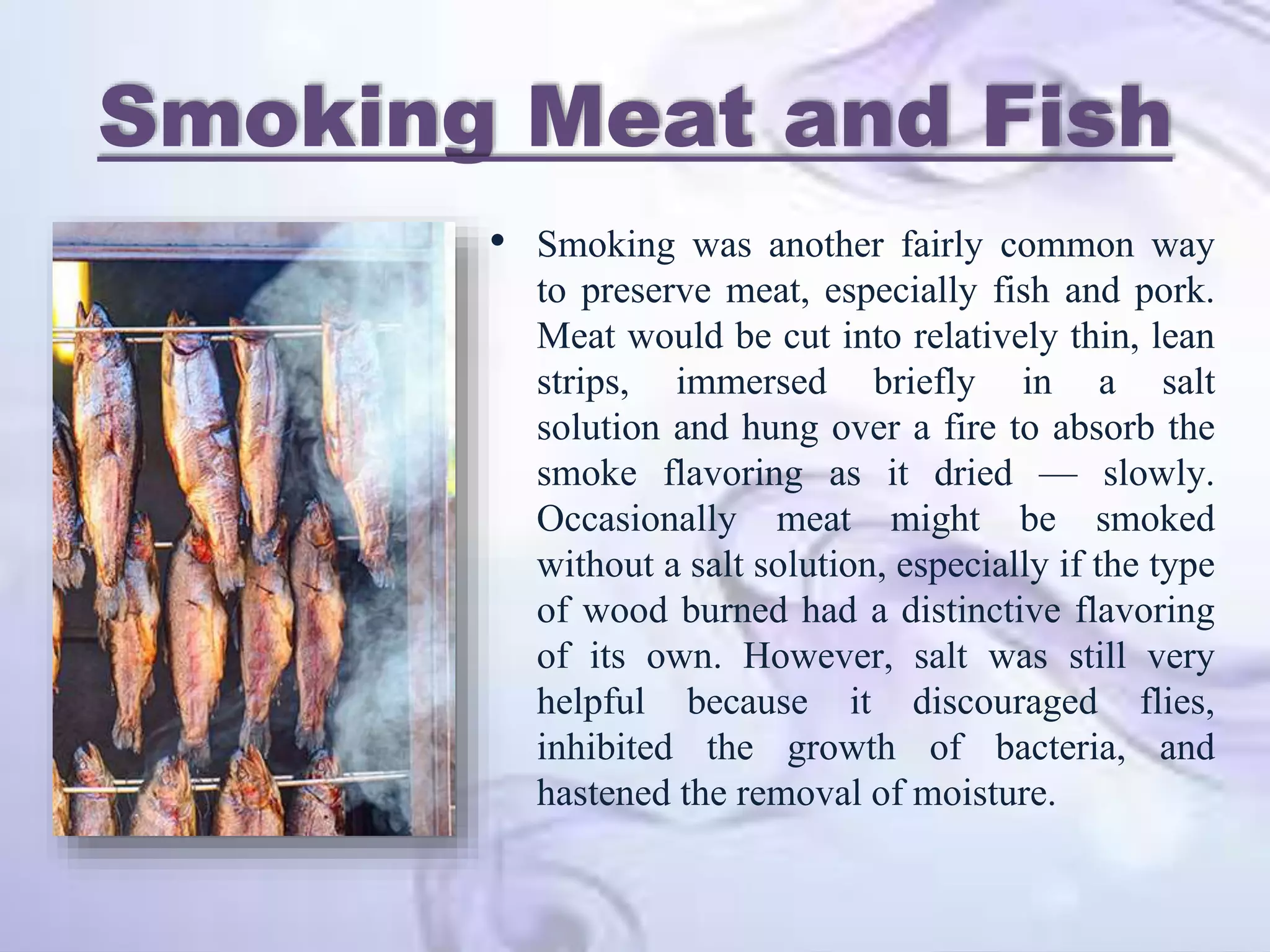
• Preservation with the use of honey or sugar was well
known to the earliest cultures. Fruits kept in honey were
commonplace. In ancient Greece quince was mixed with
honey, dried somewhat and packed tightly into jars. The
Romans improved on the method by cooking the quince
and honey producing a solid texture.
• The same fervor of trading with India and the Orient that
brought pickled foods to Europe brought sugar cane. In
northern climates that do not have enough sunlight to
successfully dry fruits housewives learned to make
preserves—heating the fruit with sugar.
Smoking Meat and Fish
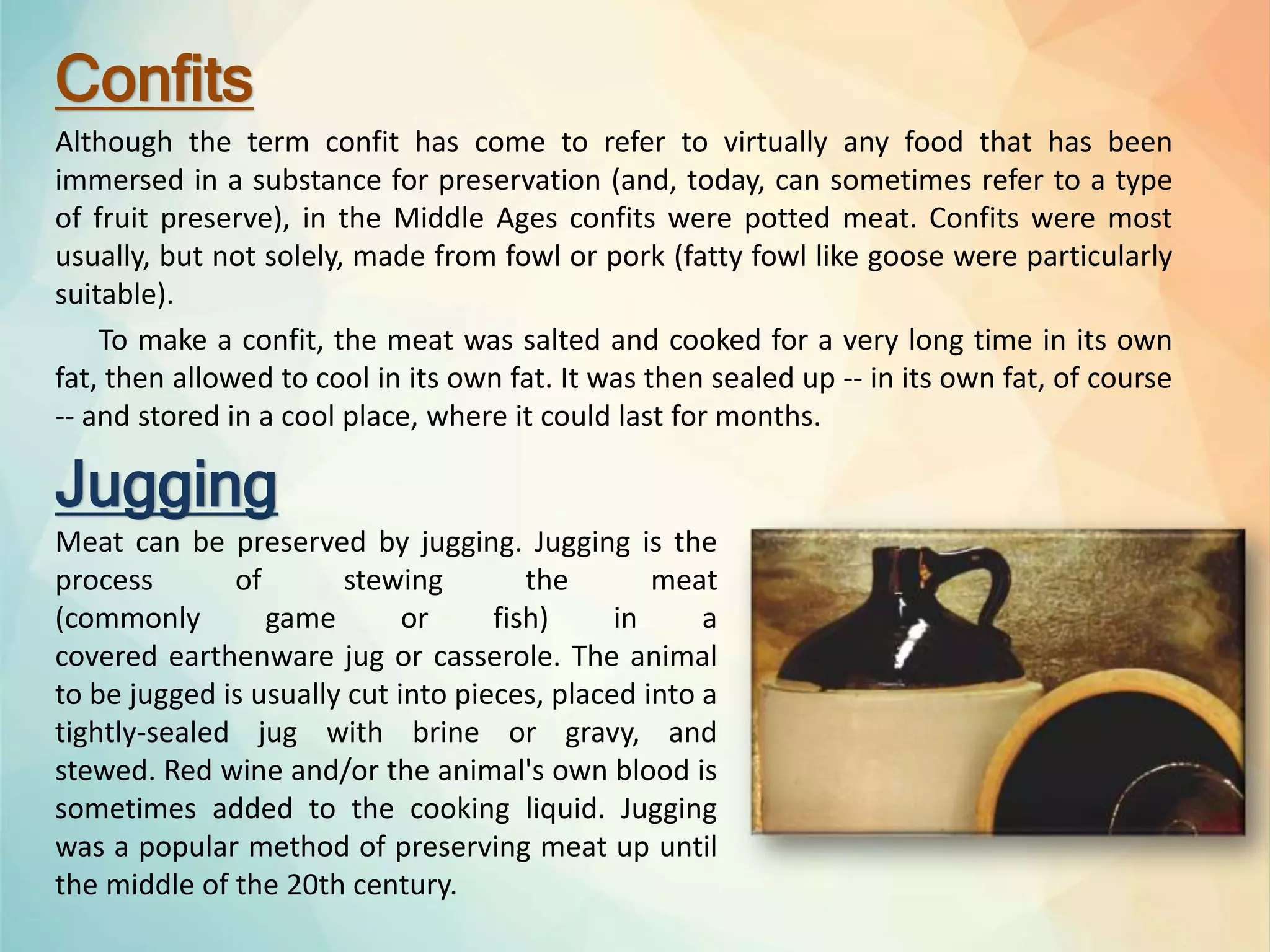
• Smoking was another fairly common way
to preserve meat, especially fish and pork.
Meat would be cut into relatively thin, lean
strips, immersed briefly in a salt
solution and hung over a fire to absorb the
smoke flavoring as it dried — slowly.
Occasionally meat might be smoked
without a salt solution, especially if the type
of wood burned had a distinctive flavoring
of its own. However, salt was still very
helpful because it discouraged flies,
inhibited the growth of bacteria, and
hastened the removal of moisture.
Confits
Although the term confit has come to refer to virtually any food that has been
immersed in a substance for preservation (and, today, can sometimes refer to a type
of fruit preserve), in the Middle Ages confits were potted meat. Confits were most
usually, but not solely, made from fowl or pork (fatty fowl like goose were particularly
suitable).
To make a confit, the meat was salted and cooked for a very long time in its own
fat, then allowed to cool in its own fat. It was then sealed up -- in its own fat, of course
-- and stored in a cool place, where it could last for months.
Jugging
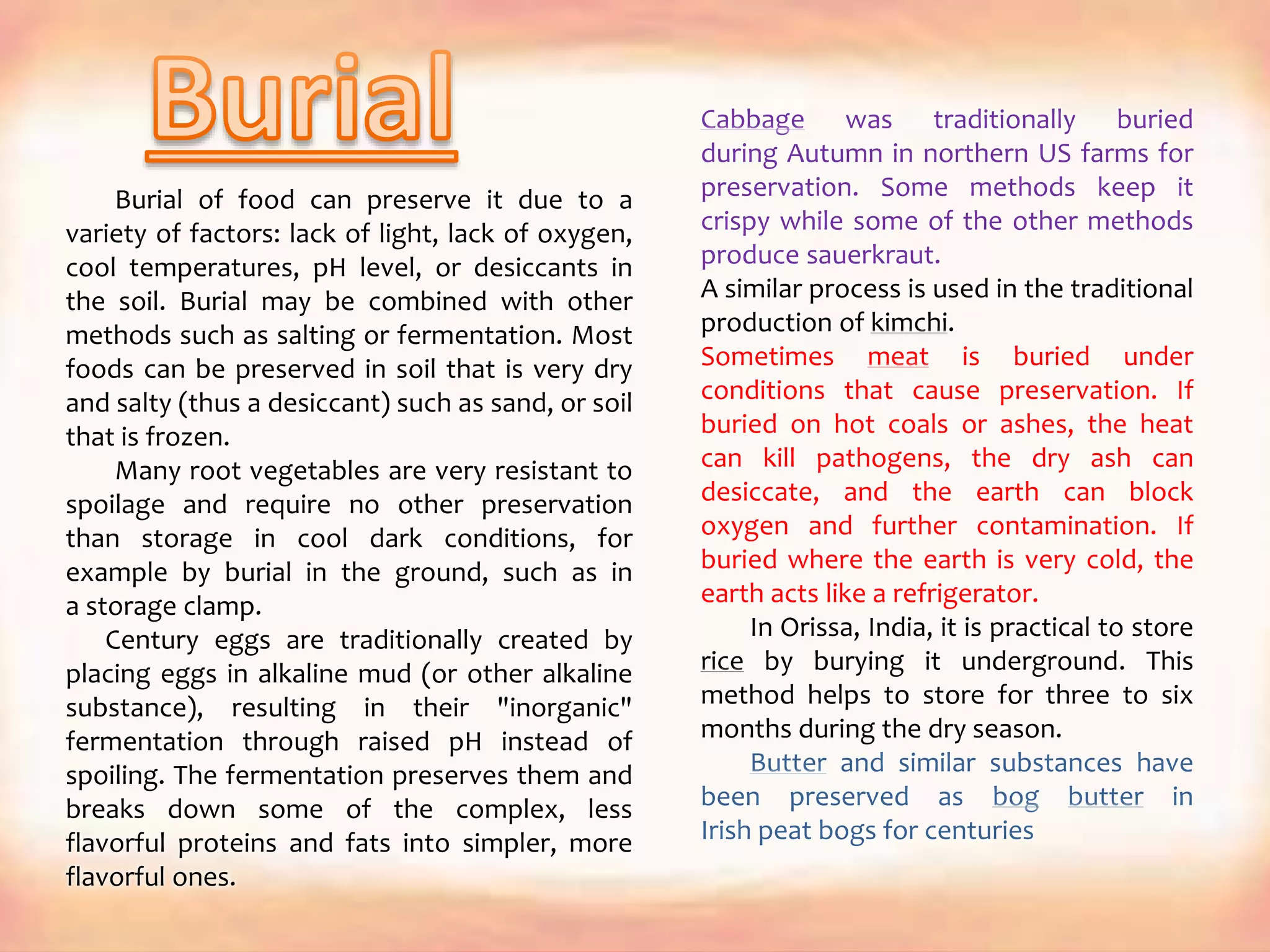
Meat can be preserved by jugging. Jugging is the
process of stewing the meat
(commonly game or fish) in a
covered earthenware jug or casserole. The animal
to be jugged is usually cut into pieces, placed into a
tightly-sealed jug with brine or gravy, and
stewed. Red wine and/or the animal's own blood is
sometimes added to the cooking liquid. Jugging
was a popular method of preserving meat up until
the middle of the 20th century.
Burial of food can preserve it due to a
variety of factors: lack of light, lack of oxygen,
cool temperatures, pH level, or desiccants in
the soil. Burial may be combined with other
methods such as salting or fermentation. Most
foods can be preserved in soil that is very dry
and salty (thus a desiccant) such as sand, or soil
that is frozen.
Many root vegetables are very resistant to
spoilage and require no other preservation
than storage in cool dark conditions, for
example by burial in the ground, such as in
a storage clamp.
Century eggs are traditionally created by
placing eggs in alkaline mud (or other alkaline
substance), resulting in their "inorganic"
fermentation through raised pH instead of
spoiling. The fermentation preserves them and
breaks down some of the complex, less
flavorful proteins and fats into simpler, more
flavorful ones.
Cabbage was traditionally buried
during Autumn in northern US farms for
preservation. Some methods keep it
crispy while some of the other methods
produce sauerkraut.
A similar process is used in the traditional
production of kimchi.
Sometimes meat is buried under
conditions that cause preservation. If
buried on hot coals or ashes, the heat
can kill pathogens, the dry ash can
desiccate, and the earth can block
oxygen and further contamination. If
buried where the earth is very cold, the
earth acts like a refrigerator.
In Orissa, India, it is practical to store
rice by burying it underground. This
method helps to store for three to six
months during the dry season.
Butter and similar substances have
been preserved as bog butter in
Irish peat bogs for centuries
• www.google.com
• www.thoughtco.com
• www.wikipedia.com

ANCIENT METHODS OF FOOD PRESERVATION

  • 1.
    Submitted By: Gurvinder Kaur L-2019-A-22- BTFT SubmittedTo: Dr. Suman kumari Assistant Professor Department of Microbiology PAU Ludhiana
  • 2.
    Food preservation isas old as human civilization. Preservation of foods inhibits spoilage cause by bacterial growth, oxidation, insects or desiccation.  Early humans, probably by trial and error, also started to develop basic forms of food preservation, which possible also made safer, e.g. drying, salting, fermentation. The Chinese reportedly preserved vegetables by fermentation in prehistoric times and Plinius preserved white cabbage in earthenware pots in Italy in the first century AD. The earliest recorded instances of food preservation date back to ancient Egypt and the drying of grains and subsequent storage in seal silos. The stored grain could be kept for several years to insure against famine in case the Nile River flooded.
  • 4.
    Boiling • Boiling liquidfood items can kill any existing microbes. Milk and water are often boiled to kill any harmful microbes that may be present in them. Heating • Heating to temperatures which are sufficient to kill microorganisms inside the food is a method used with perpetual stews.
  • 5.
    CANNING • Canning isone of the newest forms of food preservation starting up in the 1790’s by a Frenchman Nicholas Appert. Canning is the process in which foods are placed in jars or cans and heated to a temperature that destroys microorganisms and inactivates enzymes. This heating and later cooling forms a vacuum seal. The vacuum seal prevents other microorganisms from recontamination the food within the jar or can. • The interesting thing is that although they had the process, they did not fully understand why it worked. It was thought that the exclusion of air was responsible for the preservations. It was not until 1864 when Louis Pasteur discovered the relationship between microorganisms and food spoilage did it become clearer.
  • 6.
    Drying • In ancienttimes the sun and wind would have naturally dried foods. Evidence shows that Middle East and oriental cultures actively dried foods as early as 12,000 B.C. in the hot sun. Later cultures left more evidence and each would have methods and materials to reflect their food supplies—fish, wild game, domestic animals, etc. • Vegetables and fruits were also dried from the earliest times. The Romans were particularly fond of any dried fruit they could make. In the Middle Ages purposely built “still houses” were created to dry fruits, vegetables and herbs in areas that did not have enough strong sunlight for drying. A fire was used to create the heat needed to dry foods and in some cases smoking them as well.
  • 7.
    • Freezing wasan obvious preservation method to the appropriate climates. Any geographic area that had freezing temperatures for even part of a year made use of the temperature to preserve foods. Less than freezing temperatures were used to prolong storage times. Cellars, caves and cool streams were put to good use for that purpose. • In America estates had icehouses built to store ice and food on ice. Soon the “icehouse” became an “icebox”. In the 1800’s mechanical refrigeration was invented and was quickly put to use. Also in the late 1800’s Clarence Birdseye discovered that quick freezing at very low temperatures made for better tasting meats and vegetables. After some time he perfected his “quick freeze” process and revolutionized this method of food preservation.
  • 8.
    Fermenting Fermentation was notinvented, but rather discovered. No doubt that the first beer was discovered when a few grains of barley were left in the rain. Opportunistic microorganisms fermented the starch-derived sugars into alcohols. So too can be said about fruits fermented into wine, cabbage into Kim chi or sauerkraut, and so on. The skill of ancient peoples to observe, harness, and encourage these fermentations are admirable. Some anthropologists believe that mankind settled down from nomadic wanderers into farmers to grow barley to make beer in roughly 10,000 BC. Beer was nutritious and the alcohol was divine. It was treated as a gift from the gods. Fermentation was a valuable food preservation method. It not only could preserve foods, but it also created more nutritious foods and was used to create more palatable foods from less than desirable ingredients. Microorganisms responsible for fermentations can produce vitamins as they ferment. This produces a more nutritious end product from the ingredients.
  • 9.
    • Pickling ispreserving foods in vinegar (or other acid). Vinegar is produced from starches or sugars fermented first to alcohol and then the alcohol is oxidized by certain bacteria to acetic acid. Wines, beers and ciders are all routinely transformed into vinegars. • Pickling may have originated when food was placed in wine or beer to preserve it, since both have a low pH. Perhaps the wine or beer went sour and the taste of the food in it was appealing. Containers had to be made of stoneware or glass, since the vinegar would dissolve the metal from pots. Never ones to waste anything our ancestors found uses for everything. The left over pickling brine found many uses. • The Romans made a concentrated fish pickle sauce called “garum”. It was powerful stuff packing a lot of fish taste in a few drops.
  • 10.
    Curing • The earliestcuring was actually dehydration. Early cultures used salt to help desiccate foods. Salting was common and even culinary by choosing raw salts from different sources (rock salt, sea salt, spiced salt, etc.). In the 1800’s it was discovered that certain sources of salt gave meat a red color instead of the usual unappetizing grey. Consumers overwhelmingly preferred the red colored meat. In this mixture of salts were nitrites (saltpeter). As the microbiology of Clostridium botulinum was elucidated in the 1920’s it was realized that nitrites inhibited this organism. Jam and Jelly • Preservation with the use of honey or sugar was well known to the earliest cultures. Fruits kept in honey were commonplace. In ancient Greece quince was mixed with honey, dried somewhat and packed tightly into jars. The Romans improved on the method by cooking the quince and honey producing a solid texture. • The same fervor of trading with India and the Orient that brought pickled foods to Europe brought sugar cane. In northern climates that do not have enough sunlight to successfully dry fruits housewives learned to make preserves—heating the fruit with sugar.
  • 11.
    Smoking Meat andFish • Smoking was another fairly common way to preserve meat, especially fish and pork. Meat would be cut into relatively thin, lean strips, immersed briefly in a salt solution and hung over a fire to absorb the smoke flavoring as it dried — slowly. Occasionally meat might be smoked without a salt solution, especially if the type of wood burned had a distinctive flavoring of its own. However, salt was still very helpful because it discouraged flies, inhibited the growth of bacteria, and hastened the removal of moisture.
  • 12.
    Confits Although the termconfit has come to refer to virtually any food that has been immersed in a substance for preservation (and, today, can sometimes refer to a type of fruit preserve), in the Middle Ages confits were potted meat. Confits were most usually, but not solely, made from fowl or pork (fatty fowl like goose were particularly suitable). To make a confit, the meat was salted and cooked for a very long time in its own fat, then allowed to cool in its own fat. It was then sealed up -- in its own fat, of course -- and stored in a cool place, where it could last for months. Jugging Meat can be preserved by jugging. Jugging is the process of stewing the meat (commonly game or fish) in a covered earthenware jug or casserole. The animal to be jugged is usually cut into pieces, placed into a tightly-sealed jug with brine or gravy, and stewed. Red wine and/or the animal's own blood is sometimes added to the cooking liquid. Jugging was a popular method of preserving meat up until the middle of the 20th century.
  • 13.
    Burial of foodcan preserve it due to a variety of factors: lack of light, lack of oxygen, cool temperatures, pH level, or desiccants in the soil. Burial may be combined with other methods such as salting or fermentation. Most foods can be preserved in soil that is very dry and salty (thus a desiccant) such as sand, or soil that is frozen. Many root vegetables are very resistant to spoilage and require no other preservation than storage in cool dark conditions, for example by burial in the ground, such as in a storage clamp. Century eggs are traditionally created by placing eggs in alkaline mud (or other alkaline substance), resulting in their "inorganic" fermentation through raised pH instead of spoiling. The fermentation preserves them and breaks down some of the complex, less flavorful proteins and fats into simpler, more flavorful ones. Cabbage was traditionally buried during Autumn in northern US farms for preservation. Some methods keep it crispy while some of the other methods produce sauerkraut. A similar process is used in the traditional production of kimchi. Sometimes meat is buried under conditions that cause preservation. If buried on hot coals or ashes, the heat can kill pathogens, the dry ash can desiccate, and the earth can block oxygen and further contamination. If buried where the earth is very cold, the earth acts like a refrigerator. In Orissa, India, it is practical to store rice by burying it underground. This method helps to store for three to six months during the dry season. Butter and similar substances have been preserved as bog butter in Irish peat bogs for centuries
  • 14.