LIB 617 Readings and Research in Young Adult LiteratureFall 2011Analyzing Multicultural Literature
Why analyze literature?To discover the full spectrum of the contentSeptember 5, 2011Analyzing Multicultural Literature2
A little Newtonian physicsIsaac Newton first used the word spectrum (Latin for “appearance” or “apparition”) in print in 1671 in describing his experiments in optics. Newton observed that, when a narrow beam of white sunlight strikes the face of a glassprism at an angle, some is reflected and some of the beam passes into and through the glass, emerging as different colored bands. NationMasterEncyclopedia> Visible light3
Spectrum requires a prismEstonian composer ArvoPärt:I could compare my music to white light which contains all colours. Only a prism can divide the colours and make them appear; this prism could be the spirit of the listener. about his music:  Alina  4
Prism as a filterHistorian Doris Kearns Goodwin:The biographer finds that the past is not simply the past, but a prism through which the subject filters his own changing self-image. Goodwin, Doris Kearns (1979). ‘‘Angles of Vision’’, in: Mark Pachter (Ed.), Telling Lives: the biographer’s art. Washington, DC: New Republic Books. Cited in Debate and Reflection:  How to Write Journalism History5
A prism to view the full spectrum of literaturePersonal6RealInventedSMiley face
Personal?Do you feel as if you’re involved; part of the action?That these are real people we’re dealing with—some identifiable personalities (even when they’re not “people”?September 5, 2011Analyzing Multicultural Literature7
Real?Is there something that makes you feel that this could have happened? Even when it couldn’t in real life?September 5, 2011Analyzing Multicultural Literature8
Invented?Is this story invented, created by one or more authors (not necessarily “artificial,” rather, is it fiction)? September 5, 2011Analyzing Multicultural Literature9
Smiley Face?Does it seem generic, impersonal?September 5, 2011Analyzing Multicultural Literature10
Two ContinuumsReal				      InventedPersonal	                SMiley Face
Put ‘em together! RealPersonalSMileyInvented
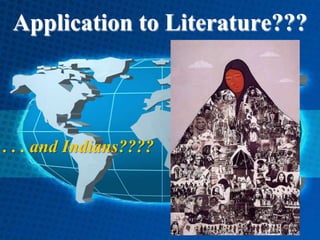
Application to Literature???. . . and Indians????
Top Left Sector of Matrix14RealUp close and personal—and real!Folklore:  consists of culture, including stories, music, dance, legends, oral history, proverbs, jokes, popular beliefs, customs and so forth within a particular population comprising the traditions (including oral traditions) of that culture, subculture, or group. It is also the set of practices through which those expressive genres are shared. (Wikipedia)PersonalInvented
A rival to Paul Bunyan and John HenryFink, Mike, 1770?–1823?American border hero, whose exploits have been so elaborated in legend that the actual facts of his life are difficult to discover. He was born probably at the frontier post of Pittsburgh, took part in the wars against the Native Americans of the Ohio region, and subsequently became a keelboatman on the flatboats of the Ohio and Mississippi rivers. He later turned to trapping.“Mike Fink.” The Columbia Encyclopedia, Sixth Edition. 2008. Retrieved September 17, 2009 from Encyclopedia.com: http://www.encyclopedia.com/doc/1E1-Fink-Mik.htmlSee also Mike Fink: an American anti-heroSeptember 5, 2011Analyzing Multicultural Literature15
Mike Fink taleBy “the then beautiful village of Louisville”Among [a] band of [Indian] outcasts was a Cherokee, who bore the name of Proud Joe . . . Joe still wore, with Indian dignity, his scalplock; he ornamented it with taste, and cherished it, as report said, until some Indian messenger of vengeance should tear it from his head, as expiatory of his numerous crimes.  Mike had noticed this peculiarity; and, reaching out his hand, plucked from the revered scalplock a hawk's feather.  . . . [Mike’s] ball had cut it clear from his head; the cord around the root, in which were placed feathers and other ornaments, still held it together; the concussion had merely stunned its owner; farther - he had escaped all bodily harm! “Mike Fink, the Keel-boatman” in Thorpe, T.B.  (1854). The Hive of “The Bee Hunter.”  A Repository of Sketches, Including Peculiar American Character, Scenery, and Rural Sports. September 5, 2011Analyzing Multicultural Literature16
Bottom Left Sector of Matrix17Invented, but personal and believable RealPersonalQuality literature, sometimes adaptations, or else original writing, with universal appeal and meaning for everyman and everywomanInvented
A personal, if invented YA storyThe Absolutely True Diary of a Part-Time Indian, Sherman AlexieThe National Book Award-winning novel THE ABSOLUTELY TRUE DIARY OF A PART-TIME INDIAN by Sherman Alexie is such a magnanimous stew of reality and hope --- and the particular traumatic existence of a reservation teen in contemporary America --- that you can't possibly put it down, no matter how sad, disgusted or freaked out it makes you. Reviewed by Jana SicilianoSeptember 5, 2011Analyzing Multicultural Literature18
Personal, invented and more controversialThe “Little House” seriesIf Pa Ingalls had built his little house on the periphery of an antebellum southern mansion and Mrs. Wilder had described its Black slaves in the same terms she depicted the Osage Indians, her book long ago would have been barred from children’s eyes, or at least sanitized like some editions of Mark Twain’s The Adventures of Huckleberry Finn. Mrs. Wilder’s book even contains the popular variation of General Sheridan’s racist remark about what constitutes a good Indian.Dennis McAuliffe, Jr., Little House on the PrairieSeptember 5, 2011Analyzing Multicultural Literature19
Real Smileys!Top Right of the Matrix20RealRecognizable stories, but unoriginal and shallow
A real smiley?My Heart Is On the GroundAnn RinaldiThe book adds to the great body of misinformation about Native life and struggle in the United States and Canada. This one book epitomizes the utter lack of sensitivity and respect that has come to characterize the vast majority of children's books about Native Americans. Non-Native readers of My Heart Is On the Ground will continue to be validated in whatever feelings of superiority they may have; Native children will continue to be humiliated.Review in Oyate.  See also the accompanying essay “Literary License” or “Mutated Plagiarism”?  and Fiction Posing As TruthSeptember 5, 2011Analyzing Multicultural Literature21
Invented smileys[perhaps contrived?]Bottom Right of the Matrix22Generic, unoriginal, impersonal, shallowInvented
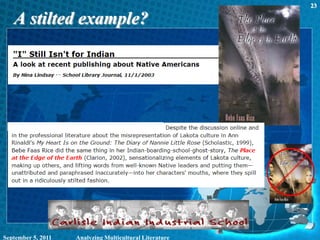
A stilted example?September 5, 2011Analyzing Multicultural Literature23
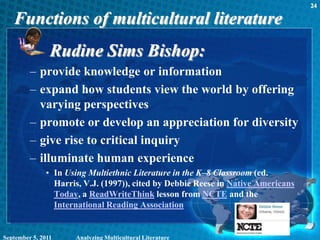
Functions of multicultural literatureRudine Sims Bishop:provide knowledge or informationexpand how students view the world by offering varying perspectivespromote or develop an appreciation for diversitygive rise to critical inquiryilluminate human experienceIn Using Multiethnic Literature in the K–8 Classroom (ed. Harris, V.J. (1997)), cited by Debbie Reese in Native Americans Today, a ReadWriteThink lesson from NCTE and the International Reading AssociationSeptember 5, 2011Analyzing Multicultural Literature24
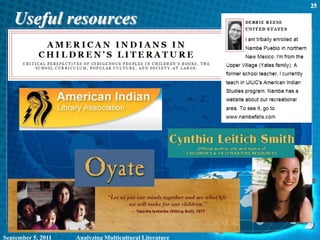
Useful resourcesSeptember 5, 2011Analyzing Multicultural Literature25

Analyzing multicultural literature

  • 1.
    LIB 617 Readingsand Research in Young Adult LiteratureFall 2011Analyzing Multicultural Literature
  • 2.
    Why analyze literature?Todiscover the full spectrum of the contentSeptember 5, 2011Analyzing Multicultural Literature2
  • 3.
    A little NewtonianphysicsIsaac Newton first used the word spectrum (Latin for “appearance” or “apparition”) in print in 1671 in describing his experiments in optics. Newton observed that, when a narrow beam of white sunlight strikes the face of a glassprism at an angle, some is reflected and some of the beam passes into and through the glass, emerging as different colored bands. NationMasterEncyclopedia> Visible light3
  • 4.
    Spectrum requires aprismEstonian composer ArvoPärt:I could compare my music to white light which contains all colours. Only a prism can divide the colours and make them appear; this prism could be the spirit of the listener. about his music: Alina  4
  • 5.
    Prism as afilterHistorian Doris Kearns Goodwin:The biographer finds that the past is not simply the past, but a prism through which the subject filters his own changing self-image. Goodwin, Doris Kearns (1979). ‘‘Angles of Vision’’, in: Mark Pachter (Ed.), Telling Lives: the biographer’s art. Washington, DC: New Republic Books. Cited in Debate and Reflection: How to Write Journalism History5
  • 6.
    A prism toview the full spectrum of literaturePersonal6RealInventedSMiley face
  • 7.
    Personal?Do you feelas if you’re involved; part of the action?That these are real people we’re dealing with—some identifiable personalities (even when they’re not “people”?September 5, 2011Analyzing Multicultural Literature7
  • 8.
    Real?Is there somethingthat makes you feel that this could have happened? Even when it couldn’t in real life?September 5, 2011Analyzing Multicultural Literature8
  • 9.
    Invented?Is this storyinvented, created by one or more authors (not necessarily “artificial,” rather, is it fiction)? September 5, 2011Analyzing Multicultural Literature9
  • 10.
    Smiley Face?Does itseem generic, impersonal?September 5, 2011Analyzing Multicultural Literature10
  • 11.
    Two ContinuumsReal InventedPersonal SMiley Face
  • 12.
    Put ‘em together!RealPersonalSMileyInvented
  • 13.
  • 14.
    Top Left Sectorof Matrix14RealUp close and personal—and real!Folklore: consists of culture, including stories, music, dance, legends, oral history, proverbs, jokes, popular beliefs, customs and so forth within a particular population comprising the traditions (including oral traditions) of that culture, subculture, or group. It is also the set of practices through which those expressive genres are shared. (Wikipedia)PersonalInvented
  • 15.
    A rival toPaul Bunyan and John HenryFink, Mike, 1770?–1823?American border hero, whose exploits have been so elaborated in legend that the actual facts of his life are difficult to discover. He was born probably at the frontier post of Pittsburgh, took part in the wars against the Native Americans of the Ohio region, and subsequently became a keelboatman on the flatboats of the Ohio and Mississippi rivers. He later turned to trapping.“Mike Fink.” The Columbia Encyclopedia, Sixth Edition. 2008. Retrieved September 17, 2009 from Encyclopedia.com: http://www.encyclopedia.com/doc/1E1-Fink-Mik.htmlSee also Mike Fink: an American anti-heroSeptember 5, 2011Analyzing Multicultural Literature15
  • 16.
    Mike Fink taleBy“the then beautiful village of Louisville”Among [a] band of [Indian] outcasts was a Cherokee, who bore the name of Proud Joe . . . Joe still wore, with Indian dignity, his scalplock; he ornamented it with taste, and cherished it, as report said, until some Indian messenger of vengeance should tear it from his head, as expiatory of his numerous crimes. Mike had noticed this peculiarity; and, reaching out his hand, plucked from the revered scalplock a hawk's feather. . . . [Mike’s] ball had cut it clear from his head; the cord around the root, in which were placed feathers and other ornaments, still held it together; the concussion had merely stunned its owner; farther - he had escaped all bodily harm! “Mike Fink, the Keel-boatman” in Thorpe, T.B. (1854). The Hive of “The Bee Hunter.” A Repository of Sketches, Including Peculiar American Character, Scenery, and Rural Sports. September 5, 2011Analyzing Multicultural Literature16
  • 17.
    Bottom Left Sectorof Matrix17Invented, but personal and believable RealPersonalQuality literature, sometimes adaptations, or else original writing, with universal appeal and meaning for everyman and everywomanInvented
  • 18.
    A personal, ifinvented YA storyThe Absolutely True Diary of a Part-Time Indian, Sherman AlexieThe National Book Award-winning novel THE ABSOLUTELY TRUE DIARY OF A PART-TIME INDIAN by Sherman Alexie is such a magnanimous stew of reality and hope --- and the particular traumatic existence of a reservation teen in contemporary America --- that you can't possibly put it down, no matter how sad, disgusted or freaked out it makes you. Reviewed by Jana SicilianoSeptember 5, 2011Analyzing Multicultural Literature18
  • 19.
    Personal, invented andmore controversialThe “Little House” seriesIf Pa Ingalls had built his little house on the periphery of an antebellum southern mansion and Mrs. Wilder had described its Black slaves in the same terms she depicted the Osage Indians, her book long ago would have been barred from children’s eyes, or at least sanitized like some editions of Mark Twain’s The Adventures of Huckleberry Finn. Mrs. Wilder’s book even contains the popular variation of General Sheridan’s racist remark about what constitutes a good Indian.Dennis McAuliffe, Jr., Little House on the PrairieSeptember 5, 2011Analyzing Multicultural Literature19
  • 20.
    Real Smileys!Top Rightof the Matrix20RealRecognizable stories, but unoriginal and shallow
  • 21.
    A real smiley?MyHeart Is On the GroundAnn RinaldiThe book adds to the great body of misinformation about Native life and struggle in the United States and Canada. This one book epitomizes the utter lack of sensitivity and respect that has come to characterize the vast majority of children's books about Native Americans. Non-Native readers of My Heart Is On the Ground will continue to be validated in whatever feelings of superiority they may have; Native children will continue to be humiliated.Review in Oyate. See also the accompanying essay “Literary License” or “Mutated Plagiarism”? and Fiction Posing As TruthSeptember 5, 2011Analyzing Multicultural Literature21
  • 22.
    Invented smileys[perhaps contrived?]BottomRight of the Matrix22Generic, unoriginal, impersonal, shallowInvented
  • 23.
    A stilted example?September5, 2011Analyzing Multicultural Literature23
  • 24.
    Functions of multiculturalliteratureRudine Sims Bishop:provide knowledge or informationexpand how students view the world by offering varying perspectivespromote or develop an appreciation for diversitygive rise to critical inquiryilluminate human experienceIn Using Multiethnic Literature in the K–8 Classroom (ed. Harris, V.J. (1997)), cited by Debbie Reese in Native Americans Today, a ReadWriteThink lesson from NCTE and the International Reading AssociationSeptember 5, 2011Analyzing Multicultural Literature24
  • 25.
    Useful resourcesSeptember 5,2011Analyzing Multicultural Literature25