Afik Gal, 2014
The newest version of this document can be found at
http://severalthingscometomind.com
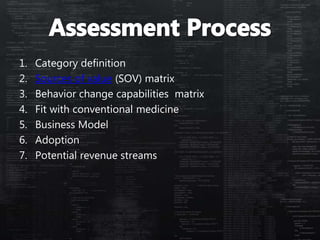
1. Category definition
2. Sources of value (SOV) matrix
3. Behavior change capabilities matrix
4. Fit with conventional medicine
5. Business Model
6. Adoption
7. Potential revenue streams
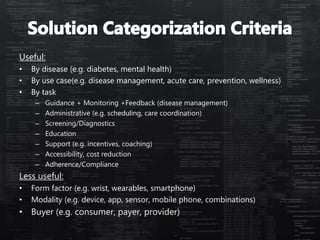
Useful:
• By disease (e.g. diabetes, mental health)
• By use case(e.g. disease management, acute care, prevention, wellness)
• By task
– Guidance + Monitoring +Feedback (disease management)
– Administrative (e.g. scheduling, care coordination)
– Screening/Diagnostics
– Education
– Support (e.g. incentives, coaching)
– Accessibility, cost reduction
– Adherence/Compliance
Less useful:
• Form factor (e.g. wrist, wearables, smartphone)
• Modality (e.g. device, app, sensor, mobile phone, combinations)
• Buyer (e.g. consumer, payer, provider)
http://mhealthwatch.com/strategy-analytics-
nike-still-dominates-mobile-health-apps-23085
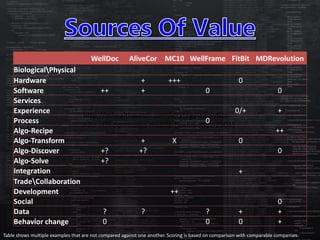
WellDoc AliveCor MC10 WellFrame FitBit MDRevolution
BiologicalPhysical
Hardware + +++ 0
Software ++ + 0 0
Services
Experience 0/+ +
Process 0
Algo-Recipe ++
Algo-Transform + X 0
Algo-Discover +? +? 0
Algo-Solve +?
Integration +
TradeCollaboration
Development ++
Social 0
Data ? ? ? + +
Behavior change 0 0 0 +
Table shows multiple examples that are not compared against one another. Scoring is based on comparison with comparable companies.
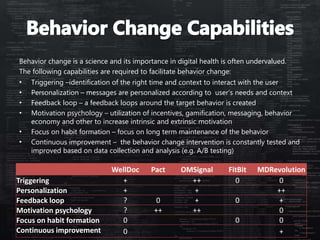
Behavior change is a science and its importance in digital health is often undervalued.
The following capabilities are required to facilitate behavior change:
• Triggering –identification of the right time and context to interact with the user
• Personalization – messages are personalized according to user’s needs and context
• Feedback loop – a feedback loops around the target behavior is created
• Motivation psychology – utilization of incentives, gamification, messaging, behavior
economy and other to increase intrinsic and extrinsic motivation
• Focus on habit formation – focus on long term maintenance of the behavior
• Continuous improvement – the behavior change intervention is constantly tested and
improved based on data collection and analysis (e.g. A/B testing)
WellDoc Pact OMSignal FitBit MDRevolution
Triggering + ++ 0 0
Personalization + + ++
Feedback loop ? 0 + 0 +
Motivation psychology ? ++ ++ 0
Focus on habit formation 0 0 0
Continuous improvement 0 +
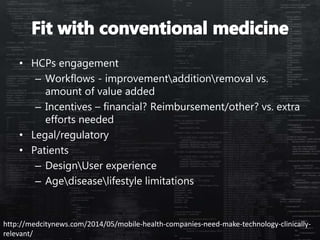
• HCPs engagement
– Workflows - improvementadditionremoval vs.
amount of value added
– Incentives – financial? Reimbursement/other? vs. extra
efforts needed
• Legal/regulatory
• Patients
– DesignUser experience
– Agediseaselifestyle limitations
http://medcitynews.com/2014/05/mobile-health-companies-need-make-technology-clinically-
relevant/
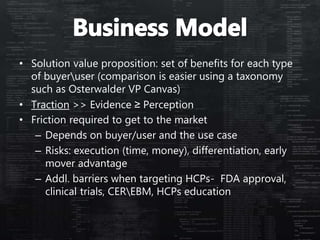
• Solution value proposition: set of benefits for each type
of buyeruser (comparison is easier using a taxonomy
such as Osterwalder VP Canvas)
• Traction >> Evidence ≥ Perception
• Friction required to get to the market
– Depends on buyer/user and the use case
– Risks: execution (time, money), differentiation, early
mover advantage
– Addl. barriers when targeting HCPs- FDA approval,
clinical trials, CEREBM, HCPs education
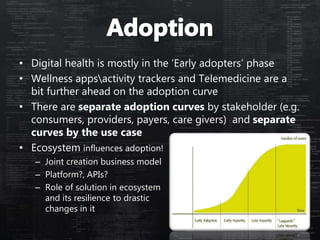
• Digital health is mostly in the ‘Early adopters’ phase
• Wellness appsactivity trackers and Telemedicine are a
bit further ahead on the adoption curve
• There are separate adoption curves by stakeholder (e.g.
consumers, providers, payers, care givers) and separate
curves by the use case
• Ecosystem influences adoption!
– Joint creation business model
– Platform?, APIs?
– Role of solution in ecosystem
and its resilience to drastic
changes in it
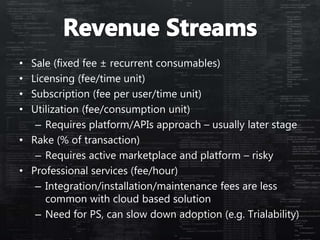
• Sale (fixed fee ± recurrent consumables)
• Licensing (fee/time unit)
• Subscription (fee per user/time unit)
• Utilization (fee/consumption unit)
– Requires platform/APIs approach – usually later stage
• Rake (% of transaction)
– Requires active marketplace and platform – risky
• Professional services (fee/hour)
– Integration/installation/maintenance fees are less
common with cloud based solution
– Need for PS, can slow down adoption (e.g. Trialability)
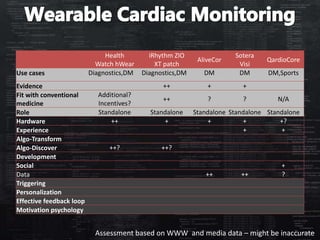
Health
Watch hWear
iRhythm ZIO
XT patch
AliveCor
Sotera
Visi
QardioCore
Use cases Diagnostics,DM Diagnostics,DM DM DM DM,Sports
Evidence ++ + +
Fit with conventional
medicine
Additional?
Incentives?
++ ? ? N/A
Role Standalone Standalone Standalone Standalone Standalone
Hardware ++ + + + +?
Experience + +
Algo-Transform
Algo-Discover ++? ++?
Development
Social +
Data ++ ++ ?
Triggering
Personalization
Effective feedback loop
Motivation psychology
Assessment based on WWW and media data – might be inaccurate
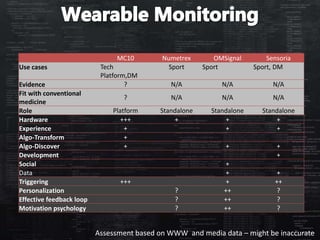
MC10 Numetrex OMSignal Sensoria
Use cases Tech
Platform,DM
Sport Sport Sport, DM
Evidence ? N/A N/A N/A
Fit with conventional
medicine
? N/A N/A N/A
Role Platform Standalone Standalone Standalone
Hardware +++ + + +
Experience + + +
Algo-Transform +
Algo-Discover + + +
Development +
Social +
Data + +
Triggering +++ + ++
Personalization ? ++ ?
Effective feedback loop ? ++ ?
Motivation psychology ? ++ ?
Assessment based on WWW and media data – might be inaccurate

Analyzing Digital Health Solutions

  • 1.
    Afik Gal, 2014 Thenewest version of this document can be found at http://severalthingscometomind.com
  • 2.
    1. Category definition 2.Sources of value (SOV) matrix 3. Behavior change capabilities matrix 4. Fit with conventional medicine 5. Business Model 6. Adoption 7. Potential revenue streams
  • 3.
    Useful: • By disease(e.g. diabetes, mental health) • By use case(e.g. disease management, acute care, prevention, wellness) • By task – Guidance + Monitoring +Feedback (disease management) – Administrative (e.g. scheduling, care coordination) – Screening/Diagnostics – Education – Support (e.g. incentives, coaching) – Accessibility, cost reduction – Adherence/Compliance Less useful: • Form factor (e.g. wrist, wearables, smartphone) • Modality (e.g. device, app, sensor, mobile phone, combinations) • Buyer (e.g. consumer, payer, provider)
  • 4.
    http://mhealthwatch.com/strategy-analytics- nike-still-dominates-mobile-health-apps-23085 WellDoc AliveCor MC10WellFrame FitBit MDRevolution BiologicalPhysical Hardware + +++ 0 Software ++ + 0 0 Services Experience 0/+ + Process 0 Algo-Recipe ++ Algo-Transform + X 0 Algo-Discover +? +? 0 Algo-Solve +? Integration + TradeCollaboration Development ++ Social 0 Data ? ? ? + + Behavior change 0 0 0 + Table shows multiple examples that are not compared against one another. Scoring is based on comparison with comparable companies.
  • 5.
    Behavior change isa science and its importance in digital health is often undervalued. The following capabilities are required to facilitate behavior change: • Triggering –identification of the right time and context to interact with the user • Personalization – messages are personalized according to user’s needs and context • Feedback loop – a feedback loops around the target behavior is created • Motivation psychology – utilization of incentives, gamification, messaging, behavior economy and other to increase intrinsic and extrinsic motivation • Focus on habit formation – focus on long term maintenance of the behavior • Continuous improvement – the behavior change intervention is constantly tested and improved based on data collection and analysis (e.g. A/B testing) WellDoc Pact OMSignal FitBit MDRevolution Triggering + ++ 0 0 Personalization + + ++ Feedback loop ? 0 + 0 + Motivation psychology ? ++ ++ 0 Focus on habit formation 0 0 0 Continuous improvement 0 +
  • 6.
    • HCPs engagement –Workflows - improvementadditionremoval vs. amount of value added – Incentives – financial? Reimbursement/other? vs. extra efforts needed • Legal/regulatory • Patients – DesignUser experience – Agediseaselifestyle limitations http://medcitynews.com/2014/05/mobile-health-companies-need-make-technology-clinically- relevant/
  • 7.
    • Solution valueproposition: set of benefits for each type of buyeruser (comparison is easier using a taxonomy such as Osterwalder VP Canvas) • Traction >> Evidence ≥ Perception • Friction required to get to the market – Depends on buyer/user and the use case – Risks: execution (time, money), differentiation, early mover advantage – Addl. barriers when targeting HCPs- FDA approval, clinical trials, CEREBM, HCPs education
  • 8.
    • Digital healthis mostly in the ‘Early adopters’ phase • Wellness appsactivity trackers and Telemedicine are a bit further ahead on the adoption curve • There are separate adoption curves by stakeholder (e.g. consumers, providers, payers, care givers) and separate curves by the use case • Ecosystem influences adoption! – Joint creation business model – Platform?, APIs? – Role of solution in ecosystem and its resilience to drastic changes in it
  • 9.
    • Sale (fixedfee ± recurrent consumables) • Licensing (fee/time unit) • Subscription (fee per user/time unit) • Utilization (fee/consumption unit) – Requires platform/APIs approach – usually later stage • Rake (% of transaction) – Requires active marketplace and platform – risky • Professional services (fee/hour) – Integration/installation/maintenance fees are less common with cloud based solution – Need for PS, can slow down adoption (e.g. Trialability)
  • 10.
    Health Watch hWear iRhythm ZIO XTpatch AliveCor Sotera Visi QardioCore Use cases Diagnostics,DM Diagnostics,DM DM DM DM,Sports Evidence ++ + + Fit with conventional medicine Additional? Incentives? ++ ? ? N/A Role Standalone Standalone Standalone Standalone Standalone Hardware ++ + + + +? Experience + + Algo-Transform Algo-Discover ++? ++? Development Social + Data ++ ++ ? Triggering Personalization Effective feedback loop Motivation psychology Assessment based on WWW and media data – might be inaccurate
  • 11.
    MC10 Numetrex OMSignalSensoria Use cases Tech Platform,DM Sport Sport Sport, DM Evidence ? N/A N/A N/A Fit with conventional medicine ? N/A N/A N/A Role Platform Standalone Standalone Standalone Hardware +++ + + + Experience + + + Algo-Transform + Algo-Discover + + + Development + Social + Data + + Triggering +++ + ++ Personalization ? ++ ? Effective feedback loop ? ++ ? Motivation psychology ? ++ ? Assessment based on WWW and media data – might be inaccurate