Measure what matters.
From volume to value-based
marketing in a mobile age
Demian Matarazzo
Marketing Science Head of South Cone
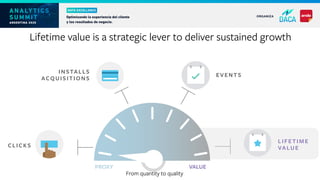
Lifetime value is a strategic lever to deliver sustained growth
INSTALLS
ACQUISITIONS
EVENTS
LIFETIME
VALUECLICKS
PROXY VALUE
From quantity to quality
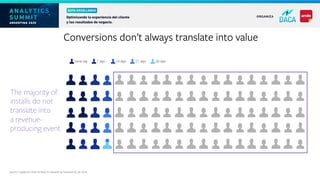
Conversions don’t always translate into value
Same day 7 days 14 days 21 days 28 days
The majority of
installs do not
translate into
a revenue-
producing event
Source: “Loyalty Isn’t Over, It’s Now On Demand” by Facebook IQ, Jan 2018.
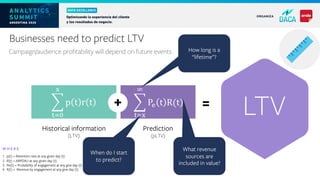
Campaign/audience profitability will depend on future events
Businesses need to predict LTV
1. p(t) = Retention rate at any given day (t)
2. R(t) = ARPDAU at any given day (t)
3. Pe(t) = Probability of engagement at any give day (t)
4. R(t) = Revenue by engagement at any give day (t)
W H E R E
Historical information
(LTV)
!
!"#
$
p t r t
Prediction
(pLTV)
!
!"$
%
P& t R(t)+ =
LTV
When do I start
to predict?
How long is a
“lifetime”?
What revenue
sources are
included in value?
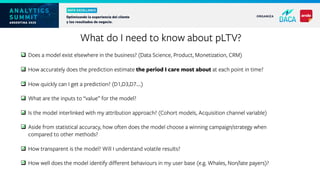
q Does a model exist elsewhere in the business? (Data Science, Product, Monetization, CRM)
q How accurately does the prediction estimate the period I care most about at each point in time?
q How quickly can I get a prediction? (D1,D3,D7….)
q What are the inputs to “value” for the model?
q Is the model interlinked with my attribution approach? (Cohort models, Acquisition channel variable)
q Aside from statistical accuracy, how often does the model choose a winning campaign/strategy when
compared to other methods?
q How transparent is the model? Will I understand volatile results?
q How well does the model identify different behaviours in my user base (e.g. Whales, Non/late payers)?
ü .
ü .
ü .
ü .
ü .
ü .
ü .
ü .
What do I need to know about pLTV?
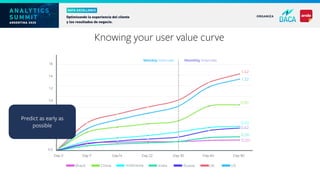
Knowing your user value curve
Predict as early as
possible
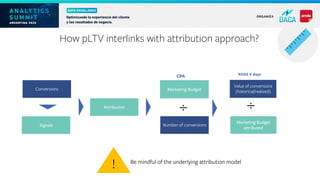
How pLTV interlinks with attribution approach?
Marketing Budget
Number of conversions
÷
Value of conversions
(historical/realized)
CPA ROAS X days
÷
Marketing Budget
attributed
Be mindful of the underlying attribution model
!
Signals
Conversions
Attribution
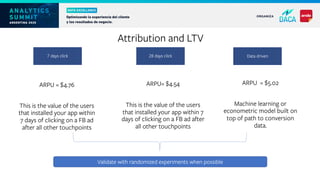
ARPU = $4.76
This is the value of the users
that installed your app within
7 days of clicking on a FB ad
after all other touchpoints
ARPU= $4.54
This is the value of the users
that installed your app within 7
days of clicking on a FB ad after
all other touchpoints
ARPU = $5.02
Machine learning or
econometric model built on
top of path to conversion
data.
Attribution and LTV
Validate with randomized experiments when possible
7 days click 28 days click Data driven
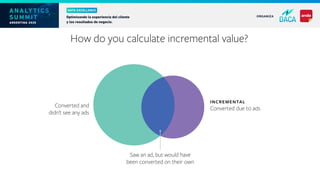
How do you calculate incremental value?
INCREMENTAL
Converted due to ads
Saw an ad, but would have
been converted on their own
Converted and
didn’t see any ads
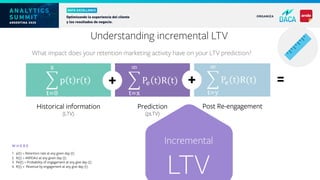
What impact does your retention marketing activity have on your LTV prediction?
Understanding incremental LTV
1. p(t) = Retention rate at any given day (t)
2. R(t) = ARPDAU at any given day (t)
3. Pe(t) = Probability of engagement at any give day (t)
4. R(t) = Revenue by engagement at any give day (t)
W H E R E
Historical information
(LTV)
!
!"#
$
p t r t
Post Re-engagement
!
!"'
%
P& t R(t)
Prediction
(pLTV)
!
!"$
%
P& t R(t)+ + =
Incremental
LTV
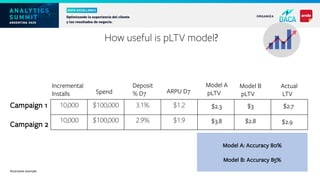
How useful is pLTV model?
10,000 $100,000 3.1% $1.2
10,000 $100,000 2.9% $1.9
Campaign 1
Campaign 2
Model A: Accuracy 80%
Model B: Accuracy 85%
Incremental
Installs
Deposit
% D7Spend
Model A
pLTVARPU D7
Model B
pLTV
Actual
LTV
$2.3
$3.8
$3
$2.8
$2.7
$2.9
Illustrative example
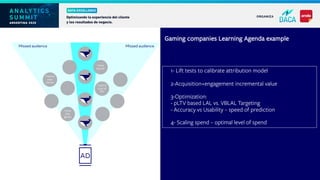
AD
I love
this IP
I have a
new
device
I watch
a lot of
RV
I love
this
genre
Missed audienceMissed audience
1- Lift tests to calibrate attribution model
2-Acquisition+engagement incremental value
3-Optimization:
- pLTV based LAL vs. VBLAL Targeting
- Accuracy vs Usability – speed of prediction
4- Scaling spend – optimal level of spend
Gaming companies Learning Agenda example
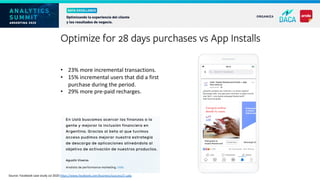
• 23% more incremental transactions.
• 15% incremental users that did a first
purchase during the period.
• 29% more pre-paid recharges.
Optimize for 28 days purchases vs App Installs
Source: Facebook case study Jul 2020 https://www.facebook.com/business/success/2-uala
Appendix
NOT USED
Internal Only – presentation flow
• Marketing de performance evoluciono a maximizar el valor del
negocio. La idea es brevemente contar el enfoque de la industria de
Gaming, la mas avanzada en su estrategia en FB en el topico.
• Predecir el Life Time Value es complejo pero hoy modelos son open
source.
• lo importante es
• tener un enfoque holistico.
• evaluar como conectar el pLTV con el modelo de atribucion.
• Para marketing, evaluar que modelo elije a las campañas medios que major performan
ex-post, ni importa tanto el accuracy del pLTV vs LTV
• En Fb y otras plataformas, usar la informacion de pLTV para optimizar y testear.
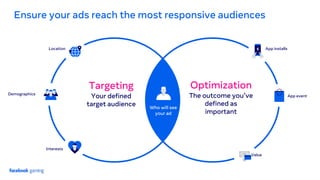
Ensure your ads reach the most responsive audiences
Targeting
Your defined
target audience
Optimization
The outcome you’ve
defined as
important
Who will see
your ad
Location
Demographics
Interests
App installs
App event
Value

Analytics Summit Argentina 2020

  • 2.
    Measure what matters. Fromvolume to value-based marketing in a mobile age Demian Matarazzo Marketing Science Head of South Cone
  • 3.
    Lifetime value isa strategic lever to deliver sustained growth INSTALLS ACQUISITIONS EVENTS LIFETIME VALUECLICKS PROXY VALUE From quantity to quality
  • 4.
    Conversions don’t alwaystranslate into value Same day 7 days 14 days 21 days 28 days The majority of installs do not translate into a revenue- producing event Source: “Loyalty Isn’t Over, It’s Now On Demand” by Facebook IQ, Jan 2018.
  • 5.
    Campaign/audience profitability willdepend on future events Businesses need to predict LTV 1. p(t) = Retention rate at any given day (t) 2. R(t) = ARPDAU at any given day (t) 3. Pe(t) = Probability of engagement at any give day (t) 4. R(t) = Revenue by engagement at any give day (t) W H E R E Historical information (LTV) ! !"# $ p t r t Prediction (pLTV) ! !"$ % P& t R(t)+ = LTV When do I start to predict? How long is a “lifetime”? What revenue sources are included in value?
  • 6.
    q Does amodel exist elsewhere in the business? (Data Science, Product, Monetization, CRM) q How accurately does the prediction estimate the period I care most about at each point in time? q How quickly can I get a prediction? (D1,D3,D7….) q What are the inputs to “value” for the model? q Is the model interlinked with my attribution approach? (Cohort models, Acquisition channel variable) q Aside from statistical accuracy, how often does the model choose a winning campaign/strategy when compared to other methods? q How transparent is the model? Will I understand volatile results? q How well does the model identify different behaviours in my user base (e.g. Whales, Non/late payers)? ü . ü . ü . ü . ü . ü . ü . ü . What do I need to know about pLTV?
  • 7.
    Knowing your uservalue curve Predict as early as possible
  • 8.
    How pLTV interlinkswith attribution approach? Marketing Budget Number of conversions ÷ Value of conversions (historical/realized) CPA ROAS X days ÷ Marketing Budget attributed Be mindful of the underlying attribution model ! Signals Conversions Attribution
  • 10.
    ARPU = $4.76 Thisis the value of the users that installed your app within 7 days of clicking on a FB ad after all other touchpoints ARPU= $4.54 This is the value of the users that installed your app within 7 days of clicking on a FB ad after all other touchpoints ARPU = $5.02 Machine learning or econometric model built on top of path to conversion data. Attribution and LTV Validate with randomized experiments when possible 7 days click 28 days click Data driven
  • 11.
    How do youcalculate incremental value? INCREMENTAL Converted due to ads Saw an ad, but would have been converted on their own Converted and didn’t see any ads
  • 12.
    What impact doesyour retention marketing activity have on your LTV prediction? Understanding incremental LTV 1. p(t) = Retention rate at any given day (t) 2. R(t) = ARPDAU at any given day (t) 3. Pe(t) = Probability of engagement at any give day (t) 4. R(t) = Revenue by engagement at any give day (t) W H E R E Historical information (LTV) ! !"# $ p t r t Post Re-engagement ! !"' % P& t R(t) Prediction (pLTV) ! !"$ % P& t R(t)+ + = Incremental LTV
  • 13.
    How useful ispLTV model? 10,000 $100,000 3.1% $1.2 10,000 $100,000 2.9% $1.9 Campaign 1 Campaign 2 Model A: Accuracy 80% Model B: Accuracy 85% Incremental Installs Deposit % D7Spend Model A pLTVARPU D7 Model B pLTV Actual LTV $2.3 $3.8 $3 $2.8 $2.7 $2.9 Illustrative example
  • 14.
    AD I love this IP Ihave a new device I watch a lot of RV I love this genre Missed audienceMissed audience 1- Lift tests to calibrate attribution model 2-Acquisition+engagement incremental value 3-Optimization: - pLTV based LAL vs. VBLAL Targeting - Accuracy vs Usability – speed of prediction 4- Scaling spend – optimal level of spend Gaming companies Learning Agenda example
  • 15.
    • 23% moreincremental transactions. • 15% incremental users that did a first purchase during the period. • 29% more pre-paid recharges. Optimize for 28 days purchases vs App Installs Source: Facebook case study Jul 2020 https://www.facebook.com/business/success/2-uala
  • 17.
  • 18.
    Internal Only –presentation flow • Marketing de performance evoluciono a maximizar el valor del negocio. La idea es brevemente contar el enfoque de la industria de Gaming, la mas avanzada en su estrategia en FB en el topico. • Predecir el Life Time Value es complejo pero hoy modelos son open source. • lo importante es • tener un enfoque holistico. • evaluar como conectar el pLTV con el modelo de atribucion. • Para marketing, evaluar que modelo elije a las campañas medios que major performan ex-post, ni importa tanto el accuracy del pLTV vs LTV • En Fb y otras plataformas, usar la informacion de pLTV para optimizar y testear.
  • 19.
    Ensure your adsreach the most responsive audiences Targeting Your defined target audience Optimization The outcome you’ve defined as important Who will see your ad Location Demographics Interests App installs App event Value