1
American Institute of Aeronautics and Astronautics
Analysis of Anomalous Thrust Experiments from an
Asymmetric Cavity
By Kurt Zeller and Brian Kraft
Aerospace Engineering, California Polytechnic State University, San Luis Obispo, CA, 93408
A novel propulsion technology has been investigated at several institutions which utilizes a
resonant microwave cavity to produce thrust without ejecting propellant. Six independent
experiments have taken place; NASA JSC Eagleworks has obtained 0.02 N/kW using 2.6 W
1
, Northwestern Polytechnic University (NWPU) in Xi'an, Shaanxi, China has yielded 1.03
N/kW at a power of 300 W 2
, and Satellite Propulsion Research Ltd. has observed 0.33 N/kW
at a power less than 600 W 3
. Guido Fetta has also observed 0.95 N/kW using 10.5 W in a
pill-box shaped resonant cavity.4
Martin Tajmar obtained 0.028 mN/kW at Dresden
University in Germany.5
Finally, an independent experimenter, Dave Distler, acheived 0.197
mN/kW.6
If this development in propulsion technology is further substantiated it is projected
to replace conventional electronic propulsion in the near future.
I. Introduction
Current space propulsion technology is severely limited by the amount of mass required to produce thrust.
Ion propulsion has been increasing in popularity due to the high specific impulse but fails to provide the
amount of thrust required for faster and further missions. A new means of propulsion has been proposed and
tested and results indicate that it will replace the current standard of propulsion for satellites and interplanetary
spacecraft.
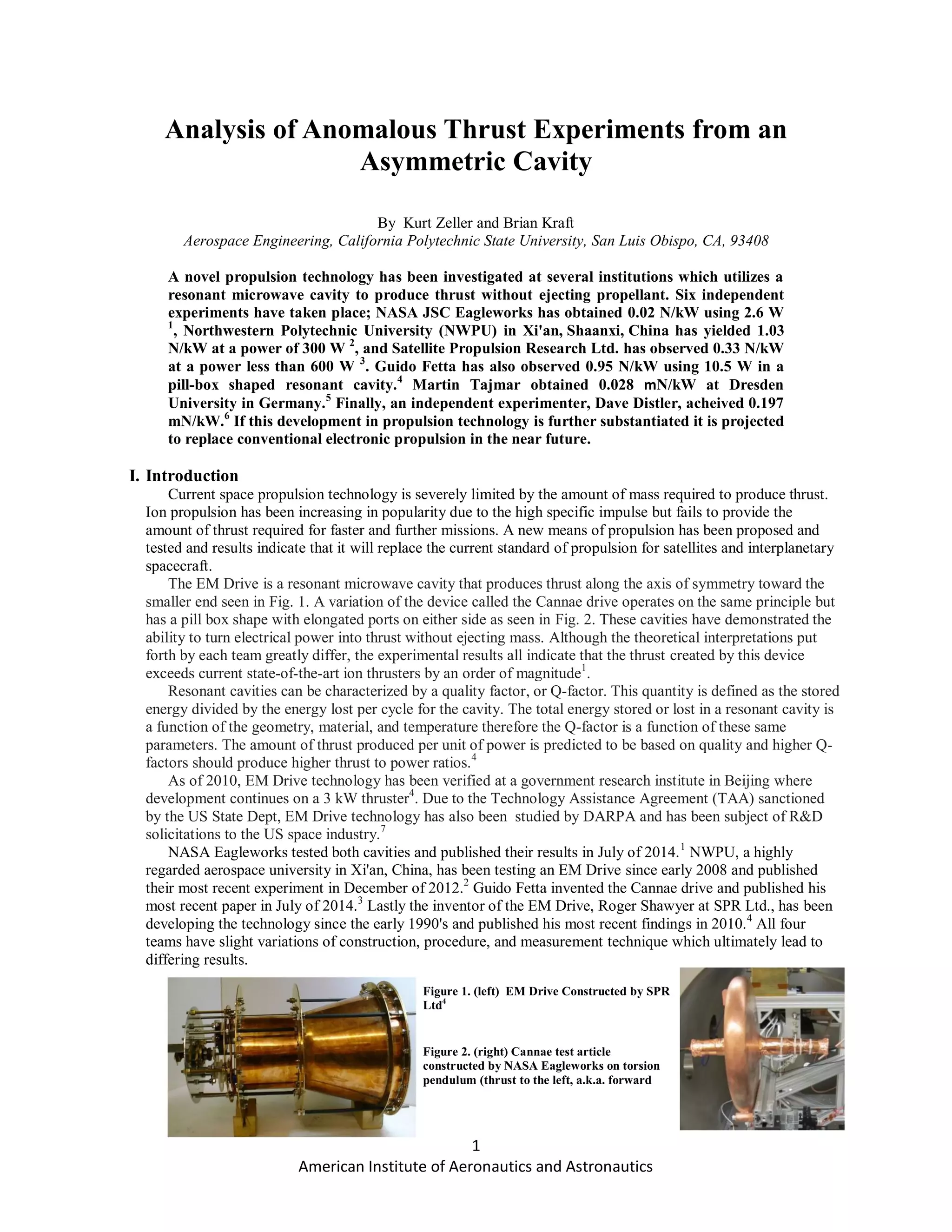
The EM Drive is a resonant microwave cavity that produces thrust along the axis of symmetry toward the
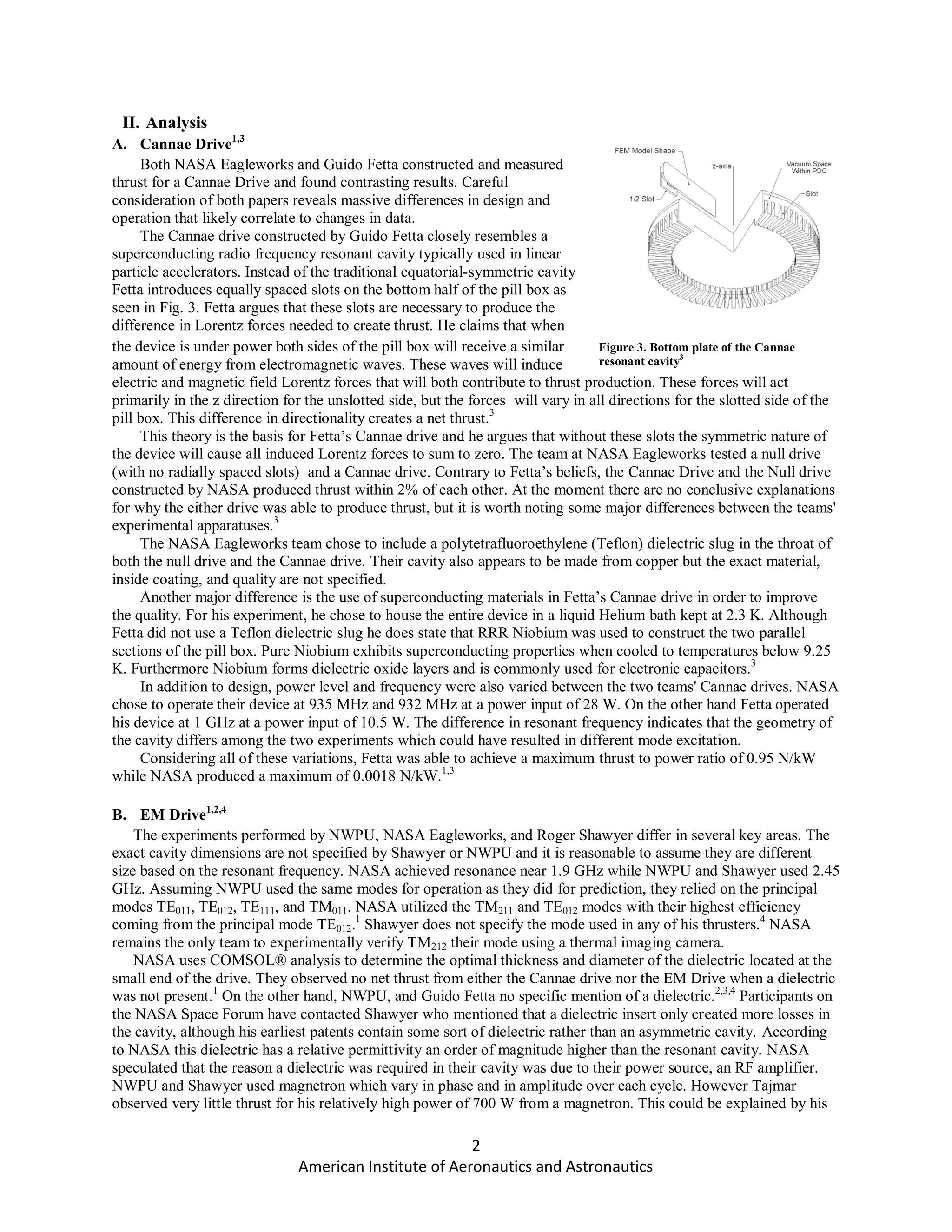
smaller end seen in Fig. 1. A variation of the device called the Cannae drive operates on the same principle but
has a pill box shape with elongated ports on either side as seen in Fig. 2. These cavities have demonstrated the
ability to turn electrical power into thrust without ejecting mass. Although the theoretical interpretations put
forth by each team greatly differ, the experimental results all indicate that the thrust created by this device
exceeds current state-of-the-art ion thrusters by an order of magnitude1
.
Resonant cavities can be characterized by a quality factor, or Q-factor. This quantity is defined as the stored
energy divided by the energy lost per cycle for the cavity. The total energy stored or lost in a resonant cavity is
a function of the geometry, material, and temperature therefore the Q-factor is a function of these same
parameters. The amount of thrust produced per unit of power is predicted to be based on quality and higher Q-
factors should produce higher thrust to power ratios.4
As of 2010, EM Drive technology has been verified at a government research institute in Beijing where
development continues on a 3 kW thruster4
. Due to the Technology Assistance Agreement (TAA) sanctioned
by the US State Dept, EM Drive technology has also been studied by DARPA and has been subject of R&D
solicitations to the US space industry.7
NASA Eagleworks tested both cavities and published their results in July of 2014.1
NWPU, a highly
regarded aerospace university in Xi'an, China, has been testing an EM Drive since early 2008 and published
their most recent experiment in December of 2012.2
Guido Fetta invented the Cannae drive and published his
most recent paper in July of 2014.3
Lastly the inventor of the EM Drive, Roger Shawyer at SPR Ltd., has been
developing the technology since the early 1990's and published his most recent findings in 2010.4
All four
teams have slight variations of construction, procedure, and measurement technique which ultimately lead to
differing results.
Figure 2. (right) Cannae test article
constructed by NASA Eagleworks on torsion
pendulum (thrust to the left, a.k.a. forward
orientation) 1
Figure 1. (left) EM Drive Constructed by SPR
Ltd4
2
American Institute of Aeronautics and Astronautics
II. Analysis
A. Cannae Drive1,3
Both NASA Eagleworks and Guido Fetta constructed and measured
thrust for a Cannae Drive and found contrasting results. Careful
consideration of both papers reveals massive differences in design and
operation that likely correlate to changes in data.
The Cannae drive constructed by Guido Fetta closely resembles a
superconducting radio frequency resonant cavity typically used in linear
particle accelerators. Instead of the traditional equatorial-symmetric cavity
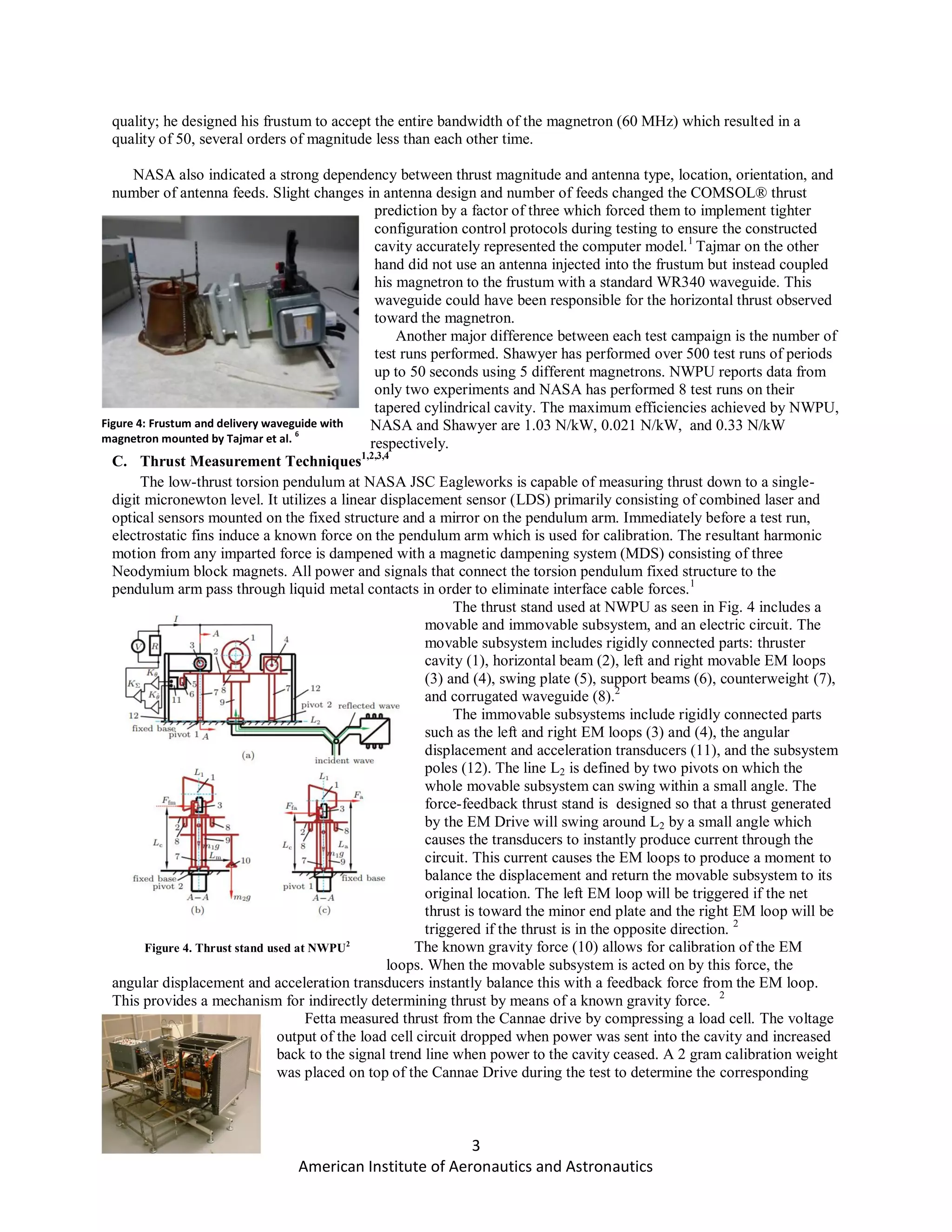
Fetta introduces equally spaced slots on the bottom half of the pill box as
seen in Fig. 3. Fetta argues that these slots are necessary to produce the
difference in Lorentz forces needed to create thrust. He claims that when
the device is under power both sides of the pill box will receive a similar
amount of energy from electromagnetic waves. These waves will induce
electric and magnetic field Lorentz forces that will both contribute to thrust production. These forces will act
primarily in the z direction for the unslotted side, but the forces will vary in all directions for the slotted side of the
pill box. This difference in directionality creates a net thrust.3
This theory is the basis for Fetta’s Cannae drive and he argues that without these slots the symmetric nature of
the device will cause all induced Lorentz forces to sum to zero. The team at NASA Eagleworks tested a null drive
(with no radially spaced slots) and a Cannae drive. Contrary to Fetta’s beliefs, the Cannae Drive and the Null drive
constructed by NASA produced thrust within 2% of each other. At the moment there are no conclusive explanations
for why the either drive was able to produce thrust, but it is worth noting some major differences between the teams'
experimental apparatuses.3
The NASA Eagleworks team chose to include a polytetrafluoroethylene (Teflon) dielectric slug in the throat of
both the null drive and the Cannae drive. Their cavity also appears to be made from copper but the exact material,
inside coating, and quality are not specified.
Another major difference is the use of superconducting materials in Fetta’s Cannae drive in order to improve
the quality. For his experiment, he chose to house the entire device in a liquid Helium bath kept at 2.3 K. Although
Fetta did not use a Teflon dielectric slug he does state that RRR Niobium was used to construct the two parallel
sections of the pill box. Pure Niobium exhibits superconducting properties when cooled to temperatures below 9.25
K. Furthermore Niobium forms dielectric oxide layers and is commonly used for electronic capacitors.3
In addition to design, power level and frequency were also varied between the two teams' Cannae drives. NASA
chose to operate their device at 935 MHz and 932 MHz at a power input of 28 W. On the other hand Fetta operated
his device at 1 GHz at a power input of 10.5 W. The difference in resonant frequency indicates that the geometry of
the cavity differs among the two experiments which could have resulted in different mode excitation.
Considering all of these variations, Fetta was able to achieve a maximum thrust to power ratio of 0.95 N/kW
while NASA produced a maximum of 0.0018 N/kW.1,3
B. EM Drive1,2,4
The experiments performed by NWPU, NASA Eagleworks, and Roger Shawyer differ in several key areas. The
exact cavity dimensions are not specified by Shawyer or NWPU and it is reasonable to assume they are different
size based on the resonant frequency. NASA achieved resonance near 1.9 GHz while NWPU and Shawyer used 2.45
GHz. Assuming NWPU used the same modes for operation as they did for prediction, they relied on the principal
modes TE011, TE012, TE111, and TM011. NASA utilized the TM211 and TE012 modes with their highest efficiency
coming from the principal mode TE012.1
Shawyer does not specify the mode used in any of his thrusters.4
NASA
remains the only team to experimentally verify TM212 their mode using a thermal imaging camera.
NASA uses COMSOL® analysis to determine the optimal thickness and diameter of the dielectric located at the
small end of the drive. They observed no net thrust from either the Cannae drive nor the EM Drive when a dielectric
was not present.1
On the other hand, NWPU, and Guido Fetta no specific mention of a dielectric.2,3,4
Participants on
the NASA Space Forum have contacted Shawyer who mentioned that a dielectric insert only created more losses in
the cavity, although his earliest patents contain some sort of dielectric rather than an asymmetric cavity. According
to NASA this dielectric has a relative permittivity an order of magnitude higher than the resonant cavity. NASA
speculated that the reason a dielectric was required in their cavity was due to their power source, an RF amplifier.
NWPU and Shawyer used magnetron which vary in phase and in amplitude over each cycle. However Tajmar
observed very little thrust for his relatively high power of 700 W from a magnetron. This could be explained by his
Figure 3. Bottom plate of the Cannae
resonant cavity3
3
American Institute of Aeronautics and Astronautics
quality; he designed his frustum to accept the entire bandwidth of the magnetron (60 MHz) which resulted in a
quality of 50, several orders of magnitude less than each other time.
NASA also indicated a strong dependency between thrust magnitude and antenna type, location, orientation, and
number of antenna feeds. Slight changes in antenna design and number of feeds changed the COMSOL® thrust
prediction by a factor of three which forced them to implement tighter
configuration control protocols during testing to ensure the constructed
cavity accurately represented the computer model.1
Tajmar on the other
hand did not use an antenna injected into the frustum but instead coupled
his magnetron to the frustum with a standard WR340 waveguide. This
waveguide could have been responsible for the horizontal thrust observed
toward the magnetron.
Another major difference between each test campaign is the number of
test runs performed. Shawyer has performed over 500 test runs of periods
up to 50 seconds using 5 different magnetrons. NWPU reports data from
only two experiments and NASA has performed 8 test runs on their
tapered cylindrical cavity. The maximum efficiencies achieved by NWPU,
NASA and Shawyer are 1.03 N/kW, 0.021 N/kW, and 0.33 N/kW
respectively.
C. Thrust Measurement Techniques1,2,3,4
The low-thrust torsion pendulum at NASA JSC Eagleworks is capable of measuring thrust down to a single-
digit micronewton level. It utilizes a linear displacement sensor (LDS) primarily consisting of combined laser and
optical sensors mounted on the fixed structure and a mirror on the pendulum arm. Immediately before a test run,
electrostatic fins induce a known force on the pendulum arm which is used for calibration. The resultant harmonic
motion from any imparted force is dampened with a magnetic dampening system (MDS) consisting of three
Neodymium block magnets. All power and signals that connect the torsion pendulum fixed structure to the
pendulum arm pass through liquid metal contacts in order to eliminate interface cable forces.1
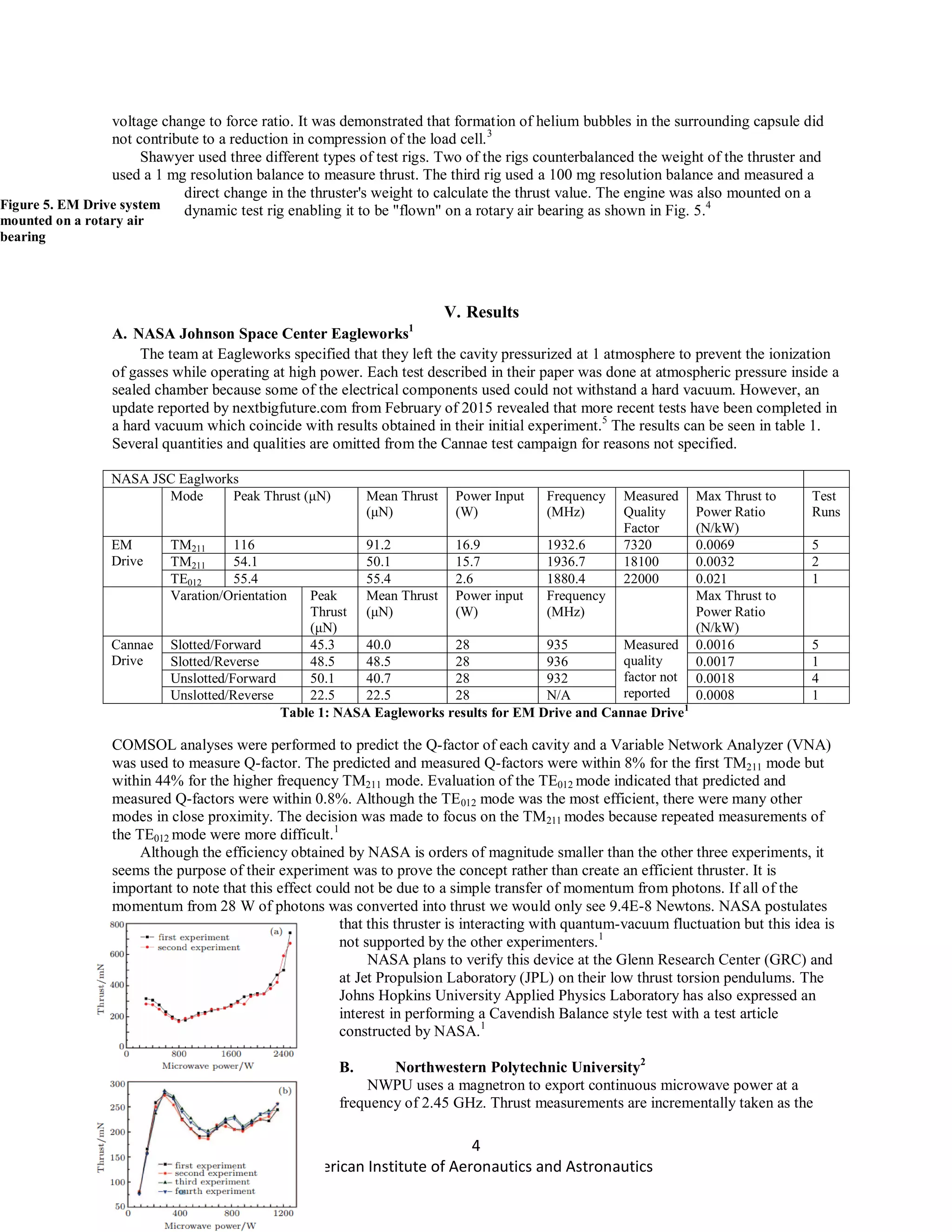
The thrust stand used at NWPU as seen in Fig. 4 includes a
movable and immovable subsystem, and an electric circuit. The
movable subsystem includes rigidly connected parts: thruster
cavity (1), horizontal beam (2), left and right movable EM loops
(3) and (4), swing plate (5), support beams (6), counterweight (7),
and corrugated waveguide (8).2
The immovable subsystems include rigidly connected parts
such as the left and right EM loops (3) and (4), the angular
displacement and acceleration transducers (11), and the subsystem
poles (12). The line L2 is defined by two pivots on which the
whole movable subsystem can swing within a small angle. The
force-feedback thrust stand is designed so that a thrust generated
by the EM Drive will swing around L2 by a small angle which
causes the transducers to instantly produce current through the
circuit. This current causes the EM loops to produce a moment to
balance the displacement and return the movable subsystem to its
original location. The left EM loop will be triggered if the net
thrust is toward the minor end plate and the right EM loop will be
triggered if the thrust is in the opposite direction. 2
The known gravity force (10) allows for calibration of the EM
loops. When the movable subsystem is acted on by this force, the
angular displacement and acceleration transducers instantly balance this with a feedback force from the EM loop.
This provides a mechanism for indirectly determining thrust by means of a known gravity force. 2
Fetta measured thrust from the Cannae drive by compressing a load cell. The voltage
output of the load cell circuit dropped when power was sent into the cavity and increased
back to the signal trend line when power to the cavity ceased. A 2 gram calibration weight
was placed on top of the Cannae Drive during the test to determine the corresponding
Figure 4. Thrust stand used at NWPU2
Figure 4: Frustum and delivery waveguide with
magnetron mounted by Tajmar et al.
6
4
American Institute of Aeronautics and Astronautics
voltage change to force ratio. It was demonstrated that formation of helium bubbles in the surrounding capsule did
not contribute to a reduction in compression of the load cell.3
Shawyer used three different types of test rigs. Two of the rigs counterbalanced the weight of the thruster and
used a 1 mg resolution balance to measure thrust. The third rig used a 100 mg resolution balance and measured a
direct change in the thruster's weight to calculate the thrust value. The engine was also mounted on a
dynamic test rig enabling it to be "flown" on a rotary air bearing as shown in Fig. 5.4
V. Results
A. NASA Johnson Space Center Eagleworks1
The team at Eagleworks specified that they left the cavity pressurized at 1 atmosphere to prevent the ionization
of gasses while operating at high power. Each test described in their paper was done at atmospheric pressure inside a
sealed chamber because some of the electrical components used could not withstand a hard vacuum. However, an
update reported by nextbigfuture.com from February of 2015 revealed that more recent tests have been completed in
a hard vacuum which coincide with results obtained in their initial experiment.5
The results can be seen in table 1.
Several quantities and qualities are omitted from the Cannae test campaign for reasons not specified.
NASA JSC Eaglworks
Mode Peak Thrust (μN) Mean Thrust
(μN)
Power Input
(W)
Frequency
(MHz)
Measured
Quality
Factor
Max Thrust to
Power Ratio
(N/kW)
Test
Runs
EM
Drive
TM211 116 91.2 16.9 1932.6 7320 0.0069 5
TM211 54.1 50.1 15.7 1936.7 18100 0.0032 2
TE012 55.4 55.4 2.6 1880.4 22000 0.021 1
Varation/Orientation Peak
Thrust
(μN)
Mean Thrust
(μN)
Power input
(W)
Frequency
(MHz)
Max Thrust to
Power Ratio
(N/kW)
Cannae
Drive
Slotted/Forward 45.3 40.0 28 935 Measured
quality
factor not
reported
0.0016 5
Slotted/Reverse 48.5 48.5 28 936 0.0017 1
Unslotted/Forward 50.1 40.7 28 932 0.0018 4
Unslotted/Reverse 22.5 22.5 28 N/A 0.0008 1
Table 1: NASA Eagleworks results for EM Drive and Cannae Drive1
COMSOL analyses were performed to predict the Q-factor of each cavity and a Variable Network Analyzer (VNA)
was used to measure Q-factor. The predicted and measured Q-factors were within 8% for the first TM211 mode but
within 44% for the higher frequency TM211 mode. Evaluation of the TE012 mode indicated that predicted and
measured Q-factors were within 0.8%. Although the TE012 mode was the most efficient, there were many other
modes in close proximity. The decision was made to focus on the TM211 modes because repeated measurements of
the TE012 mode were more difficult.1
Although the efficiency obtained by NASA is orders of magnitude smaller than the other three experiments, it
seems the purpose of their experiment was to prove the concept rather than create an efficient thruster. It is
important to note that this effect could not be due to a simple transfer of momentum from photons. If all of the
momentum from 28 W of photons was converted into thrust we would only see 9.4E-8 Newtons. NASA postulates
that this thruster is interacting with quantum-vacuum fluctuation but this idea is
not supported by the other experimenters.1
NASA plans to verify this device at the Glenn Research Center (GRC) and
at Jet Propulsion Laboratory (JPL) on their low thrust torsion pendulums. The
Johns Hopkins University Applied Physics Laboratory has also expressed an
interest in performing a Cavendish Balance style test with a test article
constructed by NASA.1
B. Northwestern Polytechnic University2
NWPU uses a magnetron to export continuous microwave power at a
frequency of 2.45 GHz. Thrust measurements are incrementally taken as the
Figure 5. EM Drive system
mounted on a rotary air
bearing
5
American Institute of Aeronautics and Astronautics
power is increased for two test runs: 300 W to 2500 W, and 80 W to 1200 W. During the first experiment, a thrust
of 310 mN was observed for an input power of 300 W. As the power was increased to 800 W the thrust decreased to
160 mN. Finally the thrust increased to 750 mN as the power was brought to 2500 W.2
During the second experiment, a thrust of 270 mN was observed at 300 W; thrust then decreased to 180 mN at
600 W. As the power was increased to 1200 W the thrust increased to 250 mN. The plots in Fig. 6 show the non
linear nature of thrust versus input power. Further analysis was performed on the magnetron output to determine that
the nominal output powers of 200, 300, 400, 500, 600 and 700 W actually produced practical powers of 13, 120, 85,
65, 45, and 48 W respectively. Correcting for this relation shows that the EM thrust increases with practical power
increase. Although the predicted and observed trends agree, the calculations done by NWPU are not consistent with
experimental results. This error is attributed to properties of the thruster cavity and magnetron frequency spectrum.2
It is determined that more than 50% of the microwave power can be absorbed by the resonant cavity to produce
EM thrust when the magnetron frequency is between 2.4492 GHz and 2.4508 GHz. NWPU reports a total error of
12% and a repeatability error of 8% and concludes that microwave energy in a resonant cavity can definitely
produce a net thrust.2
C. Guido Fetta Cannae Drive3
On January 3rd, 2011 Guido Fetta sent 4-5 second pulses of 10.5 W at 1047.335 MHz to
his resonant cavity submerged in liquid helium at 2.3 K. He observed a reduction in compression force on the load
cell corresponding to a thrust of 7-10 mN which can be seen in Fig. 7. The liquid helium was maintained at
equilibrium at 50 Torr
during the first
experiment. Additional
tests seen in Fig. 8
were performed on the
second day with the
liquid helium at a
temperature of 4.2 K,
which resulted in thrust
measurements of 7
mN. The Q-factor was
measured to be 1.08E7
and only marginally varied between 2.3 K and 4.2 K. The stored power in the cavity
was determined to be 7.73 E-3 Joules.3
Numerical prediction indicated a net Lorentz force of 16.7 mN at this energy
level. The error is attributed to limitations in the measured Q-factor, the data available
to calculate stored energy, and the load cell sensitivity. Cannae plans to test a new,
larger cavity with improved geometry and signal-port design.3
D. Roger Shawyer at Satellite Propulsion Research Ltd.4
Shawyer began his first test of the EM drive in 2001 and has since tested a
number of variations of the thruster. For his first test, an engine was constructed with
a maximum diameter of 160 mm and an operating frequency of 2.45 GHz. Measurements showed that the Q-factor
for this device was 5,900. When a power of 850 W was applied a mean thrust of 16mN was measured which was
within 4% of the predicted thrust output. Overall, Shawyer conducted 450 test runs with periods of up to 50 seconds,
using 5 different magnetrons. A second engine, known as the Demonstrator Engine, was developed in 2003. This
engine had a maximum diameter of 280 mm and operated at a frequency of 2.45 GHz. Measurements showed that
the Q-factor for this device was 45,000 and the design factor was found to be 0.844. A water-cooled magnetron with
a variable power output was used for this engine with a maximum power of 1.2 kW. A total of 134 test runs were
conducted and the maximum thrust to power ratio was found to be 0.243 N/kW at a power of 421 W. In addition to
these two thrusters, Shawyer completed a third engine which he refers to as the Flight Thruster. This thruster was
slightly smaller than the previous generation and featured a maximum diameter of 265 mm and a base-plate height
of 164 mm. The frequency of operation was not given for this device but Shawyer does mention that the Flight
Thruster utilizes a frequency tracking algorithm and has been tested up to a power of 600 W. The Flight Thruster
Figure 6. NWPU measured total net EM
thrust at microwave power ranges (a) 300-
2500 W (b) 80-1200 W [2]
Figure 7. Day 1 testing with helium temperature below 3 K [4]
Figure 8. Day 2 testing with helium at 4.2 K [4]
6
American Institute of Aeronautics and Astronautics
featured a Q-factor of 60,000 and as a result was able to produce the highest thrust to power ratio recorded by
Shawyer, 0.33 N/kW.4
E. Martin Tajmar at Dresden University, Germany
Using a 700 microwave oven magnetron with a central frequency of 2.44 GHz Tajmar observed thrust values
considerably smaller than other teams. This could readily be explained by their small quality which is three to four
orders of magnitude less than other teams. Their knife-edge balance was deemed inappropriate for small thrust
measurement of this nature because thermal effects due to the magnetron were dominant.
Later tests using a high vacuum (4*10-6
mbar) on a low-thrust torsion pendulum revealed a force of ±20 μN which is
still an order of magnitude larger than radiation pressure. The thrust appeared to linger after the magnetron was
turned off as if the drive had built up energy and was slowly fading back. However critics have commented that this
effect could be completely dependent upon temperature. After attempting to eliminate all sources of error the team
concluded that future testing is required to determine whether the thrust observed was authentic.
VI. Conclusion
The results obtained from each experiment indicate that resonant cavities can create a net thrust. While the
mechanism of this thrust is still to be determined the efficiency seems to be only limited by material properties and
dimensions of the cavity. Although the role of the dielectric inside the cavity is not yet known, it appears to be a
critical component that should be further investigated. According to NASA, the most difficult obstacle in achieving
net thrust is maintaining resonance. They indicate that the cavity should be designed with a target mode that is
isolated in frequency from other possible modes to allow for efficient manual tuning. This isolation will also allow a
phase-lock loop to be implemented so that resonant frequency is controlled and maintained automatically.1
Unlike current satellite technologies, the EM drive is capable of producing thrust without the use of propellant.
This is a massive advantage over other forms of propulsion which typically require a large percentage of total mass
be attributed to fuel storage. The EM drive has applications for nearly any space mission and has the potential to
revolutionize the aerospace industry. In comparison to current ion engines, studies have shown that the EM Drive
can decrease spacecraft mass by a factor of 10, increase thrust by a factor of 3 and increase the thrust period by a
factor of 30, all while maintaining the same input power requirements.4
NASA has also projected that future EM
drives will be capable of producing .4 N/kW which is 7 times higher than current state of the art Hall Thrusters.1
Using this power ratio, a mission to Saturn and its moon would take a shorter period of time than current
conjunction-class Mars missions*
.
Another advantage of massless propulsion is the absence of an exhaust plume during thruster operation which
would have potential military applications. It would be difficult to track a spacecraft that does not produce exhaust,
making the EM drive the ideal candidate for covert satellite propulsion. Additionally, the EM Drive provides
constant thrust that would allow for highly maneuverable spacecraft. Constant thrust production also allows
satellites to maintain lower orbits which are currently impractical due to risk of drag induced reentry. The EM drive
has a number of commercial applications as well and will be utilized in the future to transfer satellites from LEO to
GEO orbit. A study by Shawyer has shown that the EM Drive could divide a typical initial launch mass in half,
double the lifetime of the vessel, and produce transfer times from LEO to GEO of less than 40 days.4
References
1
Brady, D. A, White H. G, March P., Lawrence J.T., and Davies F. J., "Anomalous Thrust Production from an RF Test
Device Measured on a Low-Thrust Torsion Pendulum", NASA Lyndon B. Johnson Space Center, Houston, Texas 77058, July
2014
2
Juan Y., Yu-Quan W., Yan-Jie M., Peng-Fei L., Le Y., Yang W., and Guo-Qiang H., "Prediction and experimental
measurement of the electromagnetic thrust generated by a microwave thruster system", College of Astronautics, Northwestern
Polytechnic University, Xi’an 710072, China, Dec 2012
3
Fetta G., "Numerical and Experimental Results for a Novel Propulsion Technology Requiring no On-Board Propellant",
Cannae LLC., Doylestown PA, 18901, July 2014
4
Shawyer R., "The EM Drive-A New Satellite Propulsion Technology", SPR. Ltd., UK
*Conjunction-class missions to Mars have the lowest power requirements but longest transit times. This type of mission
can be compared to an operation-class mission where power requirements are extremely high but transit times will be much
shorter. Both are viable plans for future space exploration.
7
American Institute of Aeronautics and Astronautics
5
Tajmar, M., Fiedler, G., "Direct Thrust Measurements of an EM Drive and Evaluation of Possible Side-Effects" Dresden
University of Technology, Germany
6
Dristler, D., "Microwave Energy Injection into a Conical Frustum: The NSF-1701 Phase I Test Report", Chagrin Fall,
OH.
7
Wang B., "Update on EM Drive Work at NASA Eagleworks", 3 Feb 2015, URL:
http://nextbigfuture.com/2015/02/update-on-emdrive-work-at-nasa.html [cited 28 March 2015]

Analysis of Anomalous Thrust Experiments from an Asymmetric Cavity

  • 1.
    1 American Institute ofAeronautics and Astronautics Analysis of Anomalous Thrust Experiments from an Asymmetric Cavity By Kurt Zeller and Brian Kraft Aerospace Engineering, California Polytechnic State University, San Luis Obispo, CA, 93408 A novel propulsion technology has been investigated at several institutions which utilizes a resonant microwave cavity to produce thrust without ejecting propellant. Six independent experiments have taken place; NASA JSC Eagleworks has obtained 0.02 N/kW using 2.6 W 1 , Northwestern Polytechnic University (NWPU) in Xi'an, Shaanxi, China has yielded 1.03 N/kW at a power of 300 W 2 , and Satellite Propulsion Research Ltd. has observed 0.33 N/kW at a power less than 600 W 3 . Guido Fetta has also observed 0.95 N/kW using 10.5 W in a pill-box shaped resonant cavity.4 Martin Tajmar obtained 0.028 mN/kW at Dresden University in Germany.5 Finally, an independent experimenter, Dave Distler, acheived 0.197 mN/kW.6 If this development in propulsion technology is further substantiated it is projected to replace conventional electronic propulsion in the near future. I. Introduction Current space propulsion technology is severely limited by the amount of mass required to produce thrust. Ion propulsion has been increasing in popularity due to the high specific impulse but fails to provide the amount of thrust required for faster and further missions. A new means of propulsion has been proposed and tested and results indicate that it will replace the current standard of propulsion for satellites and interplanetary spacecraft. The EM Drive is a resonant microwave cavity that produces thrust along the axis of symmetry toward the smaller end seen in Fig. 1. A variation of the device called the Cannae drive operates on the same principle but has a pill box shape with elongated ports on either side as seen in Fig. 2. These cavities have demonstrated the ability to turn electrical power into thrust without ejecting mass. Although the theoretical interpretations put forth by each team greatly differ, the experimental results all indicate that the thrust created by this device exceeds current state-of-the-art ion thrusters by an order of magnitude1 . Resonant cavities can be characterized by a quality factor, or Q-factor. This quantity is defined as the stored energy divided by the energy lost per cycle for the cavity. The total energy stored or lost in a resonant cavity is a function of the geometry, material, and temperature therefore the Q-factor is a function of these same parameters. The amount of thrust produced per unit of power is predicted to be based on quality and higher Q- factors should produce higher thrust to power ratios.4 As of 2010, EM Drive technology has been verified at a government research institute in Beijing where development continues on a 3 kW thruster4 . Due to the Technology Assistance Agreement (TAA) sanctioned by the US State Dept, EM Drive technology has also been studied by DARPA and has been subject of R&D solicitations to the US space industry.7 NASA Eagleworks tested both cavities and published their results in July of 2014.1 NWPU, a highly regarded aerospace university in Xi'an, China, has been testing an EM Drive since early 2008 and published their most recent experiment in December of 2012.2 Guido Fetta invented the Cannae drive and published his most recent paper in July of 2014.3 Lastly the inventor of the EM Drive, Roger Shawyer at SPR Ltd., has been developing the technology since the early 1990's and published his most recent findings in 2010.4 All four teams have slight variations of construction, procedure, and measurement technique which ultimately lead to differing results. Figure 2. (right) Cannae test article constructed by NASA Eagleworks on torsion pendulum (thrust to the left, a.k.a. forward orientation) 1 Figure 1. (left) EM Drive Constructed by SPR Ltd4
  • 2.
    2 American Institute ofAeronautics and Astronautics II. Analysis A. Cannae Drive1,3 Both NASA Eagleworks and Guido Fetta constructed and measured thrust for a Cannae Drive and found contrasting results. Careful consideration of both papers reveals massive differences in design and operation that likely correlate to changes in data. The Cannae drive constructed by Guido Fetta closely resembles a superconducting radio frequency resonant cavity typically used in linear particle accelerators. Instead of the traditional equatorial-symmetric cavity Fetta introduces equally spaced slots on the bottom half of the pill box as seen in Fig. 3. Fetta argues that these slots are necessary to produce the difference in Lorentz forces needed to create thrust. He claims that when the device is under power both sides of the pill box will receive a similar amount of energy from electromagnetic waves. These waves will induce electric and magnetic field Lorentz forces that will both contribute to thrust production. These forces will act primarily in the z direction for the unslotted side, but the forces will vary in all directions for the slotted side of the pill box. This difference in directionality creates a net thrust.3 This theory is the basis for Fetta’s Cannae drive and he argues that without these slots the symmetric nature of the device will cause all induced Lorentz forces to sum to zero. The team at NASA Eagleworks tested a null drive (with no radially spaced slots) and a Cannae drive. Contrary to Fetta’s beliefs, the Cannae Drive and the Null drive constructed by NASA produced thrust within 2% of each other. At the moment there are no conclusive explanations for why the either drive was able to produce thrust, but it is worth noting some major differences between the teams' experimental apparatuses.3 The NASA Eagleworks team chose to include a polytetrafluoroethylene (Teflon) dielectric slug in the throat of both the null drive and the Cannae drive. Their cavity also appears to be made from copper but the exact material, inside coating, and quality are not specified. Another major difference is the use of superconducting materials in Fetta’s Cannae drive in order to improve the quality. For his experiment, he chose to house the entire device in a liquid Helium bath kept at 2.3 K. Although Fetta did not use a Teflon dielectric slug he does state that RRR Niobium was used to construct the two parallel sections of the pill box. Pure Niobium exhibits superconducting properties when cooled to temperatures below 9.25 K. Furthermore Niobium forms dielectric oxide layers and is commonly used for electronic capacitors.3 In addition to design, power level and frequency were also varied between the two teams' Cannae drives. NASA chose to operate their device at 935 MHz and 932 MHz at a power input of 28 W. On the other hand Fetta operated his device at 1 GHz at a power input of 10.5 W. The difference in resonant frequency indicates that the geometry of the cavity differs among the two experiments which could have resulted in different mode excitation. Considering all of these variations, Fetta was able to achieve a maximum thrust to power ratio of 0.95 N/kW while NASA produced a maximum of 0.0018 N/kW.1,3 B. EM Drive1,2,4 The experiments performed by NWPU, NASA Eagleworks, and Roger Shawyer differ in several key areas. The exact cavity dimensions are not specified by Shawyer or NWPU and it is reasonable to assume they are different size based on the resonant frequency. NASA achieved resonance near 1.9 GHz while NWPU and Shawyer used 2.45 GHz. Assuming NWPU used the same modes for operation as they did for prediction, they relied on the principal modes TE011, TE012, TE111, and TM011. NASA utilized the TM211 and TE012 modes with their highest efficiency coming from the principal mode TE012.1 Shawyer does not specify the mode used in any of his thrusters.4 NASA remains the only team to experimentally verify TM212 their mode using a thermal imaging camera. NASA uses COMSOL® analysis to determine the optimal thickness and diameter of the dielectric located at the small end of the drive. They observed no net thrust from either the Cannae drive nor the EM Drive when a dielectric was not present.1 On the other hand, NWPU, and Guido Fetta no specific mention of a dielectric.2,3,4 Participants on the NASA Space Forum have contacted Shawyer who mentioned that a dielectric insert only created more losses in the cavity, although his earliest patents contain some sort of dielectric rather than an asymmetric cavity. According to NASA this dielectric has a relative permittivity an order of magnitude higher than the resonant cavity. NASA speculated that the reason a dielectric was required in their cavity was due to their power source, an RF amplifier. NWPU and Shawyer used magnetron which vary in phase and in amplitude over each cycle. However Tajmar observed very little thrust for his relatively high power of 700 W from a magnetron. This could be explained by his Figure 3. Bottom plate of the Cannae resonant cavity3
  • 3.
    3 American Institute ofAeronautics and Astronautics quality; he designed his frustum to accept the entire bandwidth of the magnetron (60 MHz) which resulted in a quality of 50, several orders of magnitude less than each other time. NASA also indicated a strong dependency between thrust magnitude and antenna type, location, orientation, and number of antenna feeds. Slight changes in antenna design and number of feeds changed the COMSOL® thrust prediction by a factor of three which forced them to implement tighter configuration control protocols during testing to ensure the constructed cavity accurately represented the computer model.1 Tajmar on the other hand did not use an antenna injected into the frustum but instead coupled his magnetron to the frustum with a standard WR340 waveguide. This waveguide could have been responsible for the horizontal thrust observed toward the magnetron. Another major difference between each test campaign is the number of test runs performed. Shawyer has performed over 500 test runs of periods up to 50 seconds using 5 different magnetrons. NWPU reports data from only two experiments and NASA has performed 8 test runs on their tapered cylindrical cavity. The maximum efficiencies achieved by NWPU, NASA and Shawyer are 1.03 N/kW, 0.021 N/kW, and 0.33 N/kW respectively. C. Thrust Measurement Techniques1,2,3,4 The low-thrust torsion pendulum at NASA JSC Eagleworks is capable of measuring thrust down to a single- digit micronewton level. It utilizes a linear displacement sensor (LDS) primarily consisting of combined laser and optical sensors mounted on the fixed structure and a mirror on the pendulum arm. Immediately before a test run, electrostatic fins induce a known force on the pendulum arm which is used for calibration. The resultant harmonic motion from any imparted force is dampened with a magnetic dampening system (MDS) consisting of three Neodymium block magnets. All power and signals that connect the torsion pendulum fixed structure to the pendulum arm pass through liquid metal contacts in order to eliminate interface cable forces.1 The thrust stand used at NWPU as seen in Fig. 4 includes a movable and immovable subsystem, and an electric circuit. The movable subsystem includes rigidly connected parts: thruster cavity (1), horizontal beam (2), left and right movable EM loops (3) and (4), swing plate (5), support beams (6), counterweight (7), and corrugated waveguide (8).2 The immovable subsystems include rigidly connected parts such as the left and right EM loops (3) and (4), the angular displacement and acceleration transducers (11), and the subsystem poles (12). The line L2 is defined by two pivots on which the whole movable subsystem can swing within a small angle. The force-feedback thrust stand is designed so that a thrust generated by the EM Drive will swing around L2 by a small angle which causes the transducers to instantly produce current through the circuit. This current causes the EM loops to produce a moment to balance the displacement and return the movable subsystem to its original location. The left EM loop will be triggered if the net thrust is toward the minor end plate and the right EM loop will be triggered if the thrust is in the opposite direction. 2 The known gravity force (10) allows for calibration of the EM loops. When the movable subsystem is acted on by this force, the angular displacement and acceleration transducers instantly balance this with a feedback force from the EM loop. This provides a mechanism for indirectly determining thrust by means of a known gravity force. 2 Fetta measured thrust from the Cannae drive by compressing a load cell. The voltage output of the load cell circuit dropped when power was sent into the cavity and increased back to the signal trend line when power to the cavity ceased. A 2 gram calibration weight was placed on top of the Cannae Drive during the test to determine the corresponding Figure 4. Thrust stand used at NWPU2 Figure 4: Frustum and delivery waveguide with magnetron mounted by Tajmar et al. 6
  • 4.
    4 American Institute ofAeronautics and Astronautics voltage change to force ratio. It was demonstrated that formation of helium bubbles in the surrounding capsule did not contribute to a reduction in compression of the load cell.3 Shawyer used three different types of test rigs. Two of the rigs counterbalanced the weight of the thruster and used a 1 mg resolution balance to measure thrust. The third rig used a 100 mg resolution balance and measured a direct change in the thruster's weight to calculate the thrust value. The engine was also mounted on a dynamic test rig enabling it to be "flown" on a rotary air bearing as shown in Fig. 5.4 V. Results A. NASA Johnson Space Center Eagleworks1 The team at Eagleworks specified that they left the cavity pressurized at 1 atmosphere to prevent the ionization of gasses while operating at high power. Each test described in their paper was done at atmospheric pressure inside a sealed chamber because some of the electrical components used could not withstand a hard vacuum. However, an update reported by nextbigfuture.com from February of 2015 revealed that more recent tests have been completed in a hard vacuum which coincide with results obtained in their initial experiment.5 The results can be seen in table 1. Several quantities and qualities are omitted from the Cannae test campaign for reasons not specified. NASA JSC Eaglworks Mode Peak Thrust (μN) Mean Thrust (μN) Power Input (W) Frequency (MHz) Measured Quality Factor Max Thrust to Power Ratio (N/kW) Test Runs EM Drive TM211 116 91.2 16.9 1932.6 7320 0.0069 5 TM211 54.1 50.1 15.7 1936.7 18100 0.0032 2 TE012 55.4 55.4 2.6 1880.4 22000 0.021 1 Varation/Orientation Peak Thrust (μN) Mean Thrust (μN) Power input (W) Frequency (MHz) Max Thrust to Power Ratio (N/kW) Cannae Drive Slotted/Forward 45.3 40.0 28 935 Measured quality factor not reported 0.0016 5 Slotted/Reverse 48.5 48.5 28 936 0.0017 1 Unslotted/Forward 50.1 40.7 28 932 0.0018 4 Unslotted/Reverse 22.5 22.5 28 N/A 0.0008 1 Table 1: NASA Eagleworks results for EM Drive and Cannae Drive1 COMSOL analyses were performed to predict the Q-factor of each cavity and a Variable Network Analyzer (VNA) was used to measure Q-factor. The predicted and measured Q-factors were within 8% for the first TM211 mode but within 44% for the higher frequency TM211 mode. Evaluation of the TE012 mode indicated that predicted and measured Q-factors were within 0.8%. Although the TE012 mode was the most efficient, there were many other modes in close proximity. The decision was made to focus on the TM211 modes because repeated measurements of the TE012 mode were more difficult.1 Although the efficiency obtained by NASA is orders of magnitude smaller than the other three experiments, it seems the purpose of their experiment was to prove the concept rather than create an efficient thruster. It is important to note that this effect could not be due to a simple transfer of momentum from photons. If all of the momentum from 28 W of photons was converted into thrust we would only see 9.4E-8 Newtons. NASA postulates that this thruster is interacting with quantum-vacuum fluctuation but this idea is not supported by the other experimenters.1 NASA plans to verify this device at the Glenn Research Center (GRC) and at Jet Propulsion Laboratory (JPL) on their low thrust torsion pendulums. The Johns Hopkins University Applied Physics Laboratory has also expressed an interest in performing a Cavendish Balance style test with a test article constructed by NASA.1 B. Northwestern Polytechnic University2 NWPU uses a magnetron to export continuous microwave power at a frequency of 2.45 GHz. Thrust measurements are incrementally taken as the Figure 5. EM Drive system mounted on a rotary air bearing
  • 5.
    5 American Institute ofAeronautics and Astronautics power is increased for two test runs: 300 W to 2500 W, and 80 W to 1200 W. During the first experiment, a thrust of 310 mN was observed for an input power of 300 W. As the power was increased to 800 W the thrust decreased to 160 mN. Finally the thrust increased to 750 mN as the power was brought to 2500 W.2 During the second experiment, a thrust of 270 mN was observed at 300 W; thrust then decreased to 180 mN at 600 W. As the power was increased to 1200 W the thrust increased to 250 mN. The plots in Fig. 6 show the non linear nature of thrust versus input power. Further analysis was performed on the magnetron output to determine that the nominal output powers of 200, 300, 400, 500, 600 and 700 W actually produced practical powers of 13, 120, 85, 65, 45, and 48 W respectively. Correcting for this relation shows that the EM thrust increases with practical power increase. Although the predicted and observed trends agree, the calculations done by NWPU are not consistent with experimental results. This error is attributed to properties of the thruster cavity and magnetron frequency spectrum.2 It is determined that more than 50% of the microwave power can be absorbed by the resonant cavity to produce EM thrust when the magnetron frequency is between 2.4492 GHz and 2.4508 GHz. NWPU reports a total error of 12% and a repeatability error of 8% and concludes that microwave energy in a resonant cavity can definitely produce a net thrust.2 C. Guido Fetta Cannae Drive3 On January 3rd, 2011 Guido Fetta sent 4-5 second pulses of 10.5 W at 1047.335 MHz to his resonant cavity submerged in liquid helium at 2.3 K. He observed a reduction in compression force on the load cell corresponding to a thrust of 7-10 mN which can be seen in Fig. 7. The liquid helium was maintained at equilibrium at 50 Torr during the first experiment. Additional tests seen in Fig. 8 were performed on the second day with the liquid helium at a temperature of 4.2 K, which resulted in thrust measurements of 7 mN. The Q-factor was measured to be 1.08E7 and only marginally varied between 2.3 K and 4.2 K. The stored power in the cavity was determined to be 7.73 E-3 Joules.3 Numerical prediction indicated a net Lorentz force of 16.7 mN at this energy level. The error is attributed to limitations in the measured Q-factor, the data available to calculate stored energy, and the load cell sensitivity. Cannae plans to test a new, larger cavity with improved geometry and signal-port design.3 D. Roger Shawyer at Satellite Propulsion Research Ltd.4 Shawyer began his first test of the EM drive in 2001 and has since tested a number of variations of the thruster. For his first test, an engine was constructed with a maximum diameter of 160 mm and an operating frequency of 2.45 GHz. Measurements showed that the Q-factor for this device was 5,900. When a power of 850 W was applied a mean thrust of 16mN was measured which was within 4% of the predicted thrust output. Overall, Shawyer conducted 450 test runs with periods of up to 50 seconds, using 5 different magnetrons. A second engine, known as the Demonstrator Engine, was developed in 2003. This engine had a maximum diameter of 280 mm and operated at a frequency of 2.45 GHz. Measurements showed that the Q-factor for this device was 45,000 and the design factor was found to be 0.844. A water-cooled magnetron with a variable power output was used for this engine with a maximum power of 1.2 kW. A total of 134 test runs were conducted and the maximum thrust to power ratio was found to be 0.243 N/kW at a power of 421 W. In addition to these two thrusters, Shawyer completed a third engine which he refers to as the Flight Thruster. This thruster was slightly smaller than the previous generation and featured a maximum diameter of 265 mm and a base-plate height of 164 mm. The frequency of operation was not given for this device but Shawyer does mention that the Flight Thruster utilizes a frequency tracking algorithm and has been tested up to a power of 600 W. The Flight Thruster Figure 6. NWPU measured total net EM thrust at microwave power ranges (a) 300- 2500 W (b) 80-1200 W [2] Figure 7. Day 1 testing with helium temperature below 3 K [4] Figure 8. Day 2 testing with helium at 4.2 K [4]
  • 6.
    6 American Institute ofAeronautics and Astronautics featured a Q-factor of 60,000 and as a result was able to produce the highest thrust to power ratio recorded by Shawyer, 0.33 N/kW.4 E. Martin Tajmar at Dresden University, Germany Using a 700 microwave oven magnetron with a central frequency of 2.44 GHz Tajmar observed thrust values considerably smaller than other teams. This could readily be explained by their small quality which is three to four orders of magnitude less than other teams. Their knife-edge balance was deemed inappropriate for small thrust measurement of this nature because thermal effects due to the magnetron were dominant. Later tests using a high vacuum (4*10-6 mbar) on a low-thrust torsion pendulum revealed a force of ±20 μN which is still an order of magnitude larger than radiation pressure. The thrust appeared to linger after the magnetron was turned off as if the drive had built up energy and was slowly fading back. However critics have commented that this effect could be completely dependent upon temperature. After attempting to eliminate all sources of error the team concluded that future testing is required to determine whether the thrust observed was authentic. VI. Conclusion The results obtained from each experiment indicate that resonant cavities can create a net thrust. While the mechanism of this thrust is still to be determined the efficiency seems to be only limited by material properties and dimensions of the cavity. Although the role of the dielectric inside the cavity is not yet known, it appears to be a critical component that should be further investigated. According to NASA, the most difficult obstacle in achieving net thrust is maintaining resonance. They indicate that the cavity should be designed with a target mode that is isolated in frequency from other possible modes to allow for efficient manual tuning. This isolation will also allow a phase-lock loop to be implemented so that resonant frequency is controlled and maintained automatically.1 Unlike current satellite technologies, the EM drive is capable of producing thrust without the use of propellant. This is a massive advantage over other forms of propulsion which typically require a large percentage of total mass be attributed to fuel storage. The EM drive has applications for nearly any space mission and has the potential to revolutionize the aerospace industry. In comparison to current ion engines, studies have shown that the EM Drive can decrease spacecraft mass by a factor of 10, increase thrust by a factor of 3 and increase the thrust period by a factor of 30, all while maintaining the same input power requirements.4 NASA has also projected that future EM drives will be capable of producing .4 N/kW which is 7 times higher than current state of the art Hall Thrusters.1 Using this power ratio, a mission to Saturn and its moon would take a shorter period of time than current conjunction-class Mars missions* . Another advantage of massless propulsion is the absence of an exhaust plume during thruster operation which would have potential military applications. It would be difficult to track a spacecraft that does not produce exhaust, making the EM drive the ideal candidate for covert satellite propulsion. Additionally, the EM Drive provides constant thrust that would allow for highly maneuverable spacecraft. Constant thrust production also allows satellites to maintain lower orbits which are currently impractical due to risk of drag induced reentry. The EM drive has a number of commercial applications as well and will be utilized in the future to transfer satellites from LEO to GEO orbit. A study by Shawyer has shown that the EM Drive could divide a typical initial launch mass in half, double the lifetime of the vessel, and produce transfer times from LEO to GEO of less than 40 days.4 References 1 Brady, D. A, White H. G, March P., Lawrence J.T., and Davies F. J., "Anomalous Thrust Production from an RF Test Device Measured on a Low-Thrust Torsion Pendulum", NASA Lyndon B. Johnson Space Center, Houston, Texas 77058, July 2014 2 Juan Y., Yu-Quan W., Yan-Jie M., Peng-Fei L., Le Y., Yang W., and Guo-Qiang H., "Prediction and experimental measurement of the electromagnetic thrust generated by a microwave thruster system", College of Astronautics, Northwestern Polytechnic University, Xi’an 710072, China, Dec 2012 3 Fetta G., "Numerical and Experimental Results for a Novel Propulsion Technology Requiring no On-Board Propellant", Cannae LLC., Doylestown PA, 18901, July 2014 4 Shawyer R., "The EM Drive-A New Satellite Propulsion Technology", SPR. Ltd., UK *Conjunction-class missions to Mars have the lowest power requirements but longest transit times. This type of mission can be compared to an operation-class mission where power requirements are extremely high but transit times will be much shorter. Both are viable plans for future space exploration.
  • 7.
    7 American Institute ofAeronautics and Astronautics 5 Tajmar, M., Fiedler, G., "Direct Thrust Measurements of an EM Drive and Evaluation of Possible Side-Effects" Dresden University of Technology, Germany 6 Dristler, D., "Microwave Energy Injection into a Conical Frustum: The NSF-1701 Phase I Test Report", Chagrin Fall, OH. 7 Wang B., "Update on EM Drive Work at NASA Eagleworks", 3 Feb 2015, URL: http://nextbigfuture.com/2015/02/update-on-emdrive-work-at-nasa.html [cited 28 March 2015]