LABORATORY
GAS SENSOR
SOLUTIONS
YOUR LAB,
YOUR SAFETY,
OUR PRIORITY
32
Contents
Introduction									4
Ax60+ Multi-gas CO2 & O2 Safety Monitor					6
O2NE+ O2 Depletion Monitor							8
Safe-Ox+ O2 Enrichment & Depletion Monitor 					12		 		
Aspida O2 and CO2 Portable Monitor						14
Example Laboratory Setup							16	 			
analoxsensortechnology.com V01
4
ANALOX SENSOR TECHNOLOGY (AST)
Analox is an acknowledged authority on
gas detection sensors and are recognised
internationally for our gas sensor technology
expertise. Since 1981 we have been producing
systems for detecting potentially hazardous gases
such as carbon dioxide (CO2) and nitrogen (N2).
Our experience has shown that a reliable gas
detection and monitoring system plays a crucial
role in managing air quality for a safe environment.
Carbon dioxide (CO2) is widely used as a
laboratory gas in cryogenic applications, sample
transportation and cell culture incubators.
Other gases stored in laboratories include inert
gases such as argon (Ar), nitrogen (N2) and
helium (He) which are used as carrier gases,
or in cryogenics. Whereas a leak of CO2 will
cause a higher concentration of this gas in the
atmosphere, a leak of any of these gases can
lead to oxygen (O2) depletion.
Laboratories also store and operate with high
levels of O2; a leak of enriched O2 could also prove
to be a fire risk.
LABORATORY INDUSTRY
LABORATORIES
A wide variety of gases are used in labs such as carbon
dioxide, argon, helium, nitrogen and oxygen. These gases
pose a serious risk should they leak, this risk can occur
from fixed piped gas systems or individual cylinders
of gases.
STAFF SAFETY
Your workforce is your most valuable asset and
protecting them from risks in the lab is your number
one priority. This means it is also our number one priority.
Gas monitoring will help improve staff and public safety
and help mitigate risk of serious incidents; it also helps
you to comply with local and international legislation
on exposure limits.
LABORATORY PROCESS SOLUTIONS
Whether you have a scientific, medical, research or
educational laboratory, process monitoring is key to your
success. Analox Sensor Technology offer a wide variety
of highly accurate process sensors which can be used
with our control panels or integrated with your own
systems for a full OEM solution.
INTRODUCTION
FROM 370KM ABOVE THE EARTH
TO 11,000M UNDER THE SEA.
Providing your niche custom gas detection since 1981
ACHIEVEMENTS
With a growing need and interest from the laboratory market, Analox have designed and developed
a portfolio of custom gas monitoring solutions to detect a wide range of commonly used laboratory
gases including: O2, CO2, CO, H2S and flammable gases.
In early 2015 our existing range was complemented by the Ax60, a CO2 detector and alarm which
was shortlisted by S-Lab Awards and offers protection for people working in the proximity of
elevated levels of CO2. We now offer the upgraded Ax60+ version, which has added functionality
and multi-gas capability.
In the same year we also installed several monitors across laboratories at the Centre for Process
Innovation (CPI), a UK-based technology centre. These were the A50, a fixed CO2 monitor, and the
Safe-Ox+ an oxygen depletion and enrichment monitor. A total of 24 units are installed to keep
personnel safe while trials and experiments are conducted in a laboratory environment.
54
76
DID
YOU KNO
W?
?The alarm set points can be easily changed by the user.
Ax60+
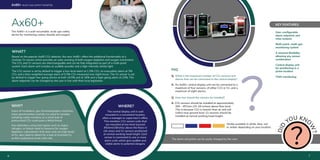
The Ax60+ is a wall-mountable, multi-gas safety
device for monitoring carbon dioxide and oxygen.
WHY?
Users of incubators, gas chromatography machines,
mass spectrometers and dry ice need to consider
installing safety monitors as a small leak of
pressurised CO2 could pose a lethal threat.
Any laboratory using inert gases such as argon,
nitrogen, or helium need to measure for oxygen
depletion. Laboratories that store and use high levels
of O2, also need to detect for a leak of enriched O2
as this could prove to be a fire risk.
WHERE?
The central display unit is wall
mounted in a convenient location,
often a manager or supervisor’s office.
This displays readings from the CO2
sensor units that are mounted at low
level (around 450mm/18inches above
the floor) in risk areas and O2 sensors
positioned at normal working head
height. Each sensor is connected
to one or more alarm units which
give audible and visible alerts to any
potential danger.
WHAT?
Based on the popular Ax60 CO2 detector, the new Ax60+ offers the additional functionality of a
modular O2 sensor which provides an early warning of both oxygen depletion and oxygen enrichment.
The CO2 and O2 sensors are interchangeable and can be fully integrated as part of a multi-point
system. Each alarm unit includes an audible sounder and a high-intensity strobe light.
The CO2 sensor is set by default to trigger a low-level alarm at 1.5% CO2, an evacuation alarm at 3%
CO2 and a time-weighted average alarm of 0.5% CO2 measured over eight hours. The O2 sensor is set
by default to trigger low-going alarms at both 19.5% and at 18% and a high-going alarm at 23%. The
alarm setpoints can be changed by the user in line with their local legislation.
KEY FEATURES
User-configurable
alarm setpoints and
relay outputs
Multi-point, multi-gas
monitoring system
4-channel flexibility
allowing any sensor
combination
Central display unit
for positioning in a
prime location
TWA monitoring
AX60+ MULTI-GAS SAFETY MONITOR
FAQ
Q.	What is the maximum number of CO2 sensors and
alarms that can be connected to the central display?
A.	An Ax60+ central display unit can be connected to a
maximum of four sensors, of either CO2 or O2, and a
maximum of eight alarms.
Q.	 How low should the sensors be installed?
A. CO2 sensors should be installed at approximately
305-457 mm (15-18 inches) above floor level.
This is because CO2 is heavier than air and will
collect near ground level. O2 sensors should be
installed at normal working head height.
?Strobe available in white, blue, red
or amber depending on your location.
98
DID
YOU KNO
W?
?Most competitor O2 monitors need calibrating every 6 months. The O2NE+ only needs
calibrating every 12 months saving maintenance time and running costs.
O2NE+
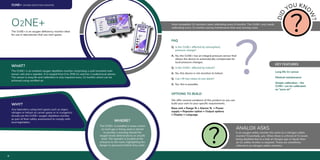
The O2NE+ is an oxygen deficiency monitor ideal
for use in laboratories that use inert gases.
WHY?
Any laboratory using inert gases such as argon,
nitrogen or helium as carrier gases or in cryogenics
should use the O2NE+ oxygen depletion monitor
as part of their safety assessment to comply with
local legislation.
WHERE?
The O2NE+ is installed in areas where
an inert gas is being used or stored
to provide a warning should the
oxygen levels deteriorate to an unsafe
level. The repeater is located at the
entrance to the room, highlighting the
danger to personnel before they enter.
WHAT?
The O2NE+ is an ambient oxygen depletion monitor comprising a wall mounted main
sensor unit and a repeater. It is ranged from 0 to 25% O2 and has 2 audio/visual alarms.
The sensor is long life and calibration is only required every 12 months which can be
achieved using certified air.
FAQ
Q.	Is the O2NE+ affected by atmospheric
pressure change?
A.	No, the O2NE+ has an integral pressure sensor that
allows the device to automatically compensate for
local pressure changes.
Q.	Is the O2NE+ affected by helium?
A.	No, this device is not sensitive to helium.
Q.	Can I fit two relays to one alarm?
A. Yes, this is possible.
KEY FEATURES
Long life O2 sensor
Minimal maintenance
Simple calibration - the
O2NE+ can be calibrated
on “pure air”
Is an oxygen safety monitor the same as a nitrogen safety
monitor? Essentially, yes. When there is a threat of O2 levels
being depleted due to a leak of nitrogen gas or liquid, then
an O2 safety monitor is required. These are sometimes
referred to as nitrogen safety monitors.
?
ANALOX ASKS
OPTIONS TO BUILD
We offer several variations of this product so you can
build your own to your specific requirements.
Base unit • Range % • Alarms % • Power
supply • Repeater option • Output options
• Display • Language
O2NE+ O2 DEPLETION MONITOR
?
11
We are experts in lean
manufacturing techniques
and are equipped to
manufacture one-off
specials or produce
runs of 1000’s at our
UK headquarters.
...because we’re small enough
to care but big enough to cope
?
Analox are the
‘go to’ company when
expertise is required
for setting gas safety
standards. We have been
involved with TUV, HSE
and DEFSTAN standards to
name but a few.
?
...because we don’t just meet standards
- we set them
10 11
1312
Safe-Ox+
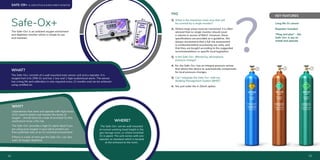
The Safe-Ox+ is an ambient oxygen enrichment
and depletion monitor which is simple to use
and maintain.
WHY?
Laboratories that store and operate with high levels
of O2 need to detect and monitor the levels of
oxygen - should there be a leak of enriched O2 this
could prove to be a fire risk.
The Safe-Ox+ provides a high O2 alarm ideal if you
are using pure oxygen in your lab to protect you
from potential risks of an O2 enriched environment.
If there is a leak of inert gas the Safe-Ox+ can also
warn of oxygen depletion.
WHERE?
The Safe-Ox+ can be wall mounted
at normal working head height in the
gas storage room, or where enriched
O2 is piped. The unit comes with one
repeater as standard which should be
located at the entrance to the room.
WHAT?
The Safe-Ox+ consists of a wall mounted main sensor unit and a repeater. It is
ranged from 0 to 25% O2 and has 1 low and 1 high audio/visual alarm. The sensor
has a long life and calibration is only required every 12 months and can be achieved
using certified air.
SAFE-OX+ O2 DEPLETION & ENRICHMENT MONITOR
FAQ
Q.	What is the maximum room area that will
be covered by a single monitor?
A.	Where large areas must be monitored, it is often
advised that no single monitor should cover
a volume in excess of 80m³. However, these
specifications are provided as a guideline. We
always recommend that a full risk assessment
is conducted before purchasing our units, and
that they are bought according to the suggested
recommendations or specific local legislation.
Q.	Is the Safe-Ox+ affected by atmospheric
pressure change?
A. No, the Safe-Ox+ has an integral pressure sensor
that allows the device to automatically compensate
for local pressure changes.
Q.	Can I integrate the Safe-Ox+ with my
Building Management System (BMS)?
A. Yes, just order the 4-20mA option.
KEY FEATURES
Long life O2 sensor
Repeater included
“Plug and play” - the
Safe-Ox+ is easy to
install and operate
?
1514
ASPIDA O2 & CO2 PORTABLE MONITOR
Aspida
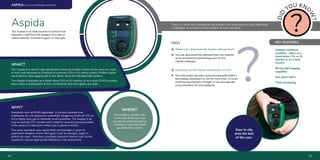
The Aspida is an ideal solution to protect lone
laboratory staff from the dangers of a leak of
carbon dioxide, enriched oxygen, or inert gas.
WHY?
Standards such as EH40 applicable in Europe mandate that
employees are not exposed to potentially dangerous levels of CO2 as
it is a highly toxic gas in relatively small quantities. The Aspida is an
easy to operate CO2 monitor and is ideal for ensuring personal safety
in the areas of a laboratory where gas is piped or stored.
The same standards also require that consideration is given to
asphyxiant dangers where inert gases such as nitrogen, argon or
helium are used - therefore a portable, personal monitor such as the
Aspida O2 may be appropriate following a risk assessment.
WHERE?
The Aspida is usually worn
on the belt of the user but
can also be wall mounted as
a backup to a primary fixed
gas detection system.
WHAT?
The Aspida is a robust, high specification personal monitor which can be worn on a belt
or even wall mounted as a backup to a primary CO2 or O2 safety system. It offers audio/
visual alarms, data logging and a man down alarm for individual lab workers.
The Aspida is available as a stand-alone CO2 or O2 monitor, or as a dual CO2/O2 monitor,
ideal where a combination of CO2, enriched O2 and inert gases are used.
DID
YOU KNO
W?
?There is a multi-user function on the Aspida if you work back-to-back shifts with
a colleague, to cut down on the number of units you need.
FAQ’s
Q.	Where can I download the Aspida software from?
A.	You can download the software from our website
www.analoxsensortechnology.com on the
Aspida webpage.
Q.	How long can the Aspida continuously run for?
A. The instrument operates using rechargeable battery
technology, allowing it to run for more than 12 hours
continuously between charges. It can also operate
using standard AA-size batteries.
KEY FEATURES
Multiple variations
available - either as a
stand alone CO2 or O2
monitor or as a dual
CO2/O2
Data logging capability
Man down alarm
TWA monitoring
Easy to clip
onto the belt
of the user.
?
1716
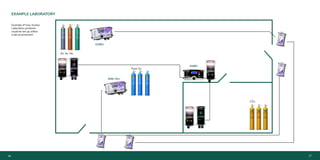
EXAMPLE LABORATORY
Example of how Analox
Laboratory products
could be set up within
a lab environment.
CO2
Pure O2
N2, Ar, He
O2NE+
Safe-Ox+
Ax60+
19
?
The Analox team understand how their roles impact
on safety critical products. We have a dedicated team
ensuring 1000’s of people’s lives are safe and who
have assisted Analox in winning various awards.
...because
safety
is
at
the
heart
of
everything
w
e
do
Analox manufacture products specifically for the laboratory industry, but also for a vast range of other industries
including beverage and hospitality, commercial diving and breathing air.
To see what else Analox have to offer, please visit our website at: www.analoxsensortechnology.com
analoxsensortechnology.com
18
@analoxsensors
analox_ltd
analoxltd
US: +1 (714) 891 4478
+44 (0) 1642 711400
info@analox.biz
+1 (714) 891 4478
UK: +44 (0) 1642 711400
info@analox.biz
US: (714) 891 4478

Analox Sensor Technology Laboratory Brochure

  • 1.
  • 2.
    32 Contents Introduction 4 Ax60+ Multi-gas CO2& O2 Safety Monitor 6 O2NE+ O2 Depletion Monitor 8 Safe-Ox+ O2 Enrichment & Depletion Monitor 12 Aspida O2 and CO2 Portable Monitor 14 Example Laboratory Setup 16 analoxsensortechnology.com V01
  • 3.
    4 ANALOX SENSOR TECHNOLOGY(AST) Analox is an acknowledged authority on gas detection sensors and are recognised internationally for our gas sensor technology expertise. Since 1981 we have been producing systems for detecting potentially hazardous gases such as carbon dioxide (CO2) and nitrogen (N2). Our experience has shown that a reliable gas detection and monitoring system plays a crucial role in managing air quality for a safe environment. Carbon dioxide (CO2) is widely used as a laboratory gas in cryogenic applications, sample transportation and cell culture incubators. Other gases stored in laboratories include inert gases such as argon (Ar), nitrogen (N2) and helium (He) which are used as carrier gases, or in cryogenics. Whereas a leak of CO2 will cause a higher concentration of this gas in the atmosphere, a leak of any of these gases can lead to oxygen (O2) depletion. Laboratories also store and operate with high levels of O2; a leak of enriched O2 could also prove to be a fire risk. LABORATORY INDUSTRY LABORATORIES A wide variety of gases are used in labs such as carbon dioxide, argon, helium, nitrogen and oxygen. These gases pose a serious risk should they leak, this risk can occur from fixed piped gas systems or individual cylinders of gases. STAFF SAFETY Your workforce is your most valuable asset and protecting them from risks in the lab is your number one priority. This means it is also our number one priority. Gas monitoring will help improve staff and public safety and help mitigate risk of serious incidents; it also helps you to comply with local and international legislation on exposure limits. LABORATORY PROCESS SOLUTIONS Whether you have a scientific, medical, research or educational laboratory, process monitoring is key to your success. Analox Sensor Technology offer a wide variety of highly accurate process sensors which can be used with our control panels or integrated with your own systems for a full OEM solution. INTRODUCTION FROM 370KM ABOVE THE EARTH TO 11,000M UNDER THE SEA. Providing your niche custom gas detection since 1981 ACHIEVEMENTS With a growing need and interest from the laboratory market, Analox have designed and developed a portfolio of custom gas monitoring solutions to detect a wide range of commonly used laboratory gases including: O2, CO2, CO, H2S and flammable gases. In early 2015 our existing range was complemented by the Ax60, a CO2 detector and alarm which was shortlisted by S-Lab Awards and offers protection for people working in the proximity of elevated levels of CO2. We now offer the upgraded Ax60+ version, which has added functionality and multi-gas capability. In the same year we also installed several monitors across laboratories at the Centre for Process Innovation (CPI), a UK-based technology centre. These were the A50, a fixed CO2 monitor, and the Safe-Ox+ an oxygen depletion and enrichment monitor. A total of 24 units are installed to keep personnel safe while trials and experiments are conducted in a laboratory environment. 54
  • 4.
    76 DID YOU KNO W? ?The alarmset points can be easily changed by the user. Ax60+ The Ax60+ is a wall-mountable, multi-gas safety device for monitoring carbon dioxide and oxygen. WHY? Users of incubators, gas chromatography machines, mass spectrometers and dry ice need to consider installing safety monitors as a small leak of pressurised CO2 could pose a lethal threat. Any laboratory using inert gases such as argon, nitrogen, or helium need to measure for oxygen depletion. Laboratories that store and use high levels of O2, also need to detect for a leak of enriched O2 as this could prove to be a fire risk. WHERE? The central display unit is wall mounted in a convenient location, often a manager or supervisor’s office. This displays readings from the CO2 sensor units that are mounted at low level (around 450mm/18inches above the floor) in risk areas and O2 sensors positioned at normal working head height. Each sensor is connected to one or more alarm units which give audible and visible alerts to any potential danger. WHAT? Based on the popular Ax60 CO2 detector, the new Ax60+ offers the additional functionality of a modular O2 sensor which provides an early warning of both oxygen depletion and oxygen enrichment. The CO2 and O2 sensors are interchangeable and can be fully integrated as part of a multi-point system. Each alarm unit includes an audible sounder and a high-intensity strobe light. The CO2 sensor is set by default to trigger a low-level alarm at 1.5% CO2, an evacuation alarm at 3% CO2 and a time-weighted average alarm of 0.5% CO2 measured over eight hours. The O2 sensor is set by default to trigger low-going alarms at both 19.5% and at 18% and a high-going alarm at 23%. The alarm setpoints can be changed by the user in line with their local legislation. KEY FEATURES User-configurable alarm setpoints and relay outputs Multi-point, multi-gas monitoring system 4-channel flexibility allowing any sensor combination Central display unit for positioning in a prime location TWA monitoring AX60+ MULTI-GAS SAFETY MONITOR FAQ Q. What is the maximum number of CO2 sensors and alarms that can be connected to the central display? A. An Ax60+ central display unit can be connected to a maximum of four sensors, of either CO2 or O2, and a maximum of eight alarms. Q. How low should the sensors be installed? A. CO2 sensors should be installed at approximately 305-457 mm (15-18 inches) above floor level. This is because CO2 is heavier than air and will collect near ground level. O2 sensors should be installed at normal working head height. ?Strobe available in white, blue, red or amber depending on your location.
  • 5.
    98 DID YOU KNO W? ?Most competitorO2 monitors need calibrating every 6 months. The O2NE+ only needs calibrating every 12 months saving maintenance time and running costs. O2NE+ The O2NE+ is an oxygen deficiency monitor ideal for use in laboratories that use inert gases. WHY? Any laboratory using inert gases such as argon, nitrogen or helium as carrier gases or in cryogenics should use the O2NE+ oxygen depletion monitor as part of their safety assessment to comply with local legislation. WHERE? The O2NE+ is installed in areas where an inert gas is being used or stored to provide a warning should the oxygen levels deteriorate to an unsafe level. The repeater is located at the entrance to the room, highlighting the danger to personnel before they enter. WHAT? The O2NE+ is an ambient oxygen depletion monitor comprising a wall mounted main sensor unit and a repeater. It is ranged from 0 to 25% O2 and has 2 audio/visual alarms. The sensor is long life and calibration is only required every 12 months which can be achieved using certified air. FAQ Q. Is the O2NE+ affected by atmospheric pressure change? A. No, the O2NE+ has an integral pressure sensor that allows the device to automatically compensate for local pressure changes. Q. Is the O2NE+ affected by helium? A. No, this device is not sensitive to helium. Q. Can I fit two relays to one alarm? A. Yes, this is possible. KEY FEATURES Long life O2 sensor Minimal maintenance Simple calibration - the O2NE+ can be calibrated on “pure air” Is an oxygen safety monitor the same as a nitrogen safety monitor? Essentially, yes. When there is a threat of O2 levels being depleted due to a leak of nitrogen gas or liquid, then an O2 safety monitor is required. These are sometimes referred to as nitrogen safety monitors. ? ANALOX ASKS OPTIONS TO BUILD We offer several variations of this product so you can build your own to your specific requirements. Base unit • Range % • Alarms % • Power supply • Repeater option • Output options • Display • Language O2NE+ O2 DEPLETION MONITOR ?
  • 6.
    11 We are expertsin lean manufacturing techniques and are equipped to manufacture one-off specials or produce runs of 1000’s at our UK headquarters. ...because we’re small enough to care but big enough to cope ? Analox are the ‘go to’ company when expertise is required for setting gas safety standards. We have been involved with TUV, HSE and DEFSTAN standards to name but a few. ? ...because we don’t just meet standards - we set them 10 11
  • 7.
    1312 Safe-Ox+ The Safe-Ox+ isan ambient oxygen enrichment and depletion monitor which is simple to use and maintain. WHY? Laboratories that store and operate with high levels of O2 need to detect and monitor the levels of oxygen - should there be a leak of enriched O2 this could prove to be a fire risk. The Safe-Ox+ provides a high O2 alarm ideal if you are using pure oxygen in your lab to protect you from potential risks of an O2 enriched environment. If there is a leak of inert gas the Safe-Ox+ can also warn of oxygen depletion. WHERE? The Safe-Ox+ can be wall mounted at normal working head height in the gas storage room, or where enriched O2 is piped. The unit comes with one repeater as standard which should be located at the entrance to the room. WHAT? The Safe-Ox+ consists of a wall mounted main sensor unit and a repeater. It is ranged from 0 to 25% O2 and has 1 low and 1 high audio/visual alarm. The sensor has a long life and calibration is only required every 12 months and can be achieved using certified air. SAFE-OX+ O2 DEPLETION & ENRICHMENT MONITOR FAQ Q. What is the maximum room area that will be covered by a single monitor? A. Where large areas must be monitored, it is often advised that no single monitor should cover a volume in excess of 80m³. However, these specifications are provided as a guideline. We always recommend that a full risk assessment is conducted before purchasing our units, and that they are bought according to the suggested recommendations or specific local legislation. Q. Is the Safe-Ox+ affected by atmospheric pressure change? A. No, the Safe-Ox+ has an integral pressure sensor that allows the device to automatically compensate for local pressure changes. Q. Can I integrate the Safe-Ox+ with my Building Management System (BMS)? A. Yes, just order the 4-20mA option. KEY FEATURES Long life O2 sensor Repeater included “Plug and play” - the Safe-Ox+ is easy to install and operate ?
  • 8.
    1514 ASPIDA O2 &CO2 PORTABLE MONITOR Aspida The Aspida is an ideal solution to protect lone laboratory staff from the dangers of a leak of carbon dioxide, enriched oxygen, or inert gas. WHY? Standards such as EH40 applicable in Europe mandate that employees are not exposed to potentially dangerous levels of CO2 as it is a highly toxic gas in relatively small quantities. The Aspida is an easy to operate CO2 monitor and is ideal for ensuring personal safety in the areas of a laboratory where gas is piped or stored. The same standards also require that consideration is given to asphyxiant dangers where inert gases such as nitrogen, argon or helium are used - therefore a portable, personal monitor such as the Aspida O2 may be appropriate following a risk assessment. WHERE? The Aspida is usually worn on the belt of the user but can also be wall mounted as a backup to a primary fixed gas detection system. WHAT? The Aspida is a robust, high specification personal monitor which can be worn on a belt or even wall mounted as a backup to a primary CO2 or O2 safety system. It offers audio/ visual alarms, data logging and a man down alarm for individual lab workers. The Aspida is available as a stand-alone CO2 or O2 monitor, or as a dual CO2/O2 monitor, ideal where a combination of CO2, enriched O2 and inert gases are used. DID YOU KNO W? ?There is a multi-user function on the Aspida if you work back-to-back shifts with a colleague, to cut down on the number of units you need. FAQ’s Q. Where can I download the Aspida software from? A. You can download the software from our website www.analoxsensortechnology.com on the Aspida webpage. Q. How long can the Aspida continuously run for? A. The instrument operates using rechargeable battery technology, allowing it to run for more than 12 hours continuously between charges. It can also operate using standard AA-size batteries. KEY FEATURES Multiple variations available - either as a stand alone CO2 or O2 monitor or as a dual CO2/O2 Data logging capability Man down alarm TWA monitoring Easy to clip onto the belt of the user. ?
  • 9.
    1716 EXAMPLE LABORATORY Example ofhow Analox Laboratory products could be set up within a lab environment. CO2 Pure O2 N2, Ar, He O2NE+ Safe-Ox+ Ax60+
  • 10.
    19 ? The Analox teamunderstand how their roles impact on safety critical products. We have a dedicated team ensuring 1000’s of people’s lives are safe and who have assisted Analox in winning various awards. ...because safety is at the heart of everything w e do Analox manufacture products specifically for the laboratory industry, but also for a vast range of other industries including beverage and hospitality, commercial diving and breathing air. To see what else Analox have to offer, please visit our website at: www.analoxsensortechnology.com analoxsensortechnology.com 18
  • 11.
    @analoxsensors analox_ltd analoxltd US: +1 (714)891 4478 +44 (0) 1642 711400 info@analox.biz +1 (714) 891 4478 UK: +44 (0) 1642 711400 info@analox.biz US: (714) 891 4478