Advanced Hearing Care SC | (843) 628-4844 | http://advhearing.com
	
  
Discover	
  more	
  great	
  content	
  here:	
  	
  
https://www.facebook.com/advhearing
https://twitter.com/HearMtPleasant
http://www.youtube.com/user/advhearing1
http://www.pinterest.com/advhearingsc
	
  
An Introduction to Analog vs. Digital Hearing Aids
	
  
A little bit of history and an explanation of how analog devices work versus how
digital devices work is necessary to understand the differences between analog and
digital hearing aids. Historically, analog technology appeared first, and consequently
the majority of hearing aids were analog until digital signal processing (DSP) was
developed, at which point digital hearing aids appeared. The majority of (roughly
90%) hearing aids sold in the US today are digital, although you can still get analog
hearing aids because some people prefer them, and they are often less expensive.
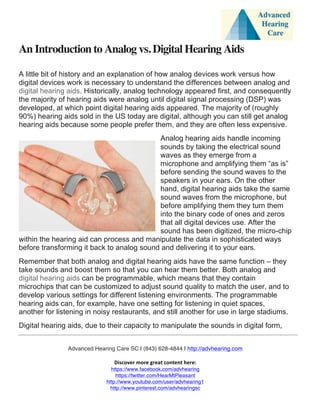
Analog hearing aids handle incoming
sounds by taking the electrical sound
waves as they emerge from a
microphone and amplifying them “as is”
before sending the sound waves to the
speakers in your ears. On the other
hand, digital hearing aids take the same
sound waves from the microphone, but
before amplifying them they turn them
into the binary code of ones and zeros
that all digital devices use. After the
sound has been digitized, the micro-chip
within the hearing aid can process and manipulate the data in sophisticated ways
before transforming it back to analog sound and delivering it to your ears.
Remember that both analog and digital hearing aids have the same function – they
take sounds and boost them so that you can hear them better. Both analog and
digital hearing aids can be programmable, which means that they contain
microchips that can be customized to adjust sound quality to match the user, and to
develop various settings for different listening environments. The programmable
hearing aids can, for example, have one setting for listening in quiet spaces,
another for listening in noisy restaurants, and still another for use in large stadiums.
Digital hearing aids, due to their capacity to manipulate the sounds in digital form,


Advanced Hearing Care SC | (843) 628-4844 | http://advhearing.com
	
  
Discover	
  more	
  great	
  content	
  here:	
  	
  
https://www.facebook.com/advhearing
https://twitter.com/HearMtPleasant
http://www.youtube.com/user/advhearing1
http://www.pinterest.com/advhearingsc
	
  
often offer more features and flexibility, and are often user-configurable. For
example, digital hearing aids may offer multiple channels and memories, permitting
them to save more location-specific profiles. Other capabilities of digital hearing aids
include the ability to automatically minimize background noise and eliminate
feedback or whistling, or the ability to prefer the sound of voices to other sounds.
Price-wise, most analog hearing aids are still less expensive than digital hearing
aids, but some reduced-feature digital hearing aids are now in a similar general
price range. There is often a perceivable difference in sound quality, but the
question of whether analog or digital is “better” is entirely up to the individual, and
the ways that they are used.	
  

Analog vs. Digital Hearing Aids

  • 1.
          AdvancedHearing Care SC | (843) 628-4844 | http://advhearing.com   Discover  more  great  content  here:     https://www.facebook.com/advhearing https://twitter.com/HearMtPleasant http://www.youtube.com/user/advhearing1 http://www.pinterest.com/advhearingsc   An Introduction to Analog vs. Digital Hearing Aids   A little bit of history and an explanation of how analog devices work versus how digital devices work is necessary to understand the differences between analog and digital hearing aids. Historically, analog technology appeared first, and consequently the majority of hearing aids were analog until digital signal processing (DSP) was developed, at which point digital hearing aids appeared. The majority of (roughly 90%) hearing aids sold in the US today are digital, although you can still get analog hearing aids because some people prefer them, and they are often less expensive. Analog hearing aids handle incoming sounds by taking the electrical sound waves as they emerge from a microphone and amplifying them “as is” before sending the sound waves to the speakers in your ears. On the other hand, digital hearing aids take the same sound waves from the microphone, but before amplifying them they turn them into the binary code of ones and zeros that all digital devices use. After the sound has been digitized, the micro-chip within the hearing aid can process and manipulate the data in sophisticated ways before transforming it back to analog sound and delivering it to your ears. Remember that both analog and digital hearing aids have the same function – they take sounds and boost them so that you can hear them better. Both analog and digital hearing aids can be programmable, which means that they contain microchips that can be customized to adjust sound quality to match the user, and to develop various settings for different listening environments. The programmable hearing aids can, for example, have one setting for listening in quiet spaces, another for listening in noisy restaurants, and still another for use in large stadiums. Digital hearing aids, due to their capacity to manipulate the sounds in digital form,
  • 2.
          AdvancedHearing Care SC | (843) 628-4844 | http://advhearing.com   Discover  more  great  content  here:     https://www.facebook.com/advhearing https://twitter.com/HearMtPleasant http://www.youtube.com/user/advhearing1 http://www.pinterest.com/advhearingsc   often offer more features and flexibility, and are often user-configurable. For example, digital hearing aids may offer multiple channels and memories, permitting them to save more location-specific profiles. Other capabilities of digital hearing aids include the ability to automatically minimize background noise and eliminate feedback or whistling, or the ability to prefer the sound of voices to other sounds. Price-wise, most analog hearing aids are still less expensive than digital hearing aids, but some reduced-feature digital hearing aids are now in a similar general price range. There is often a perceivable difference in sound quality, but the question of whether analog or digital is “better” is entirely up to the individual, and the ways that they are used.