Contra Costa Hearing Aid Center|	
  (925) 203-9134|	
  http://contracostahearing.com	


Discover	
  more	
  great	
  content	
  here:	
  
https://twitter.com/HearingWalnutCr
http://www.youtube.com/user/contracostahearing
https://www.facebook.com/pages/Contra-­‐Costa-­‐Hearing-­‐Aid-­‐Center/115013795175990	
  
http://www.pinterest.com/contracostahear
The Basics of Digital versus Analog Hearing Aids
	
  
To understand the difference between analog and digital hearing aids,
you need to first appreciate the history of analog vs digital, and the
alternative ways that they process and amplify sounds. Historically,
analog technology appeared first, and consequently most hearing aids
were analog until digital signal processing (DSP) was developed, after
which digital hearing aids appeared. Currently, the majority (90%) of the
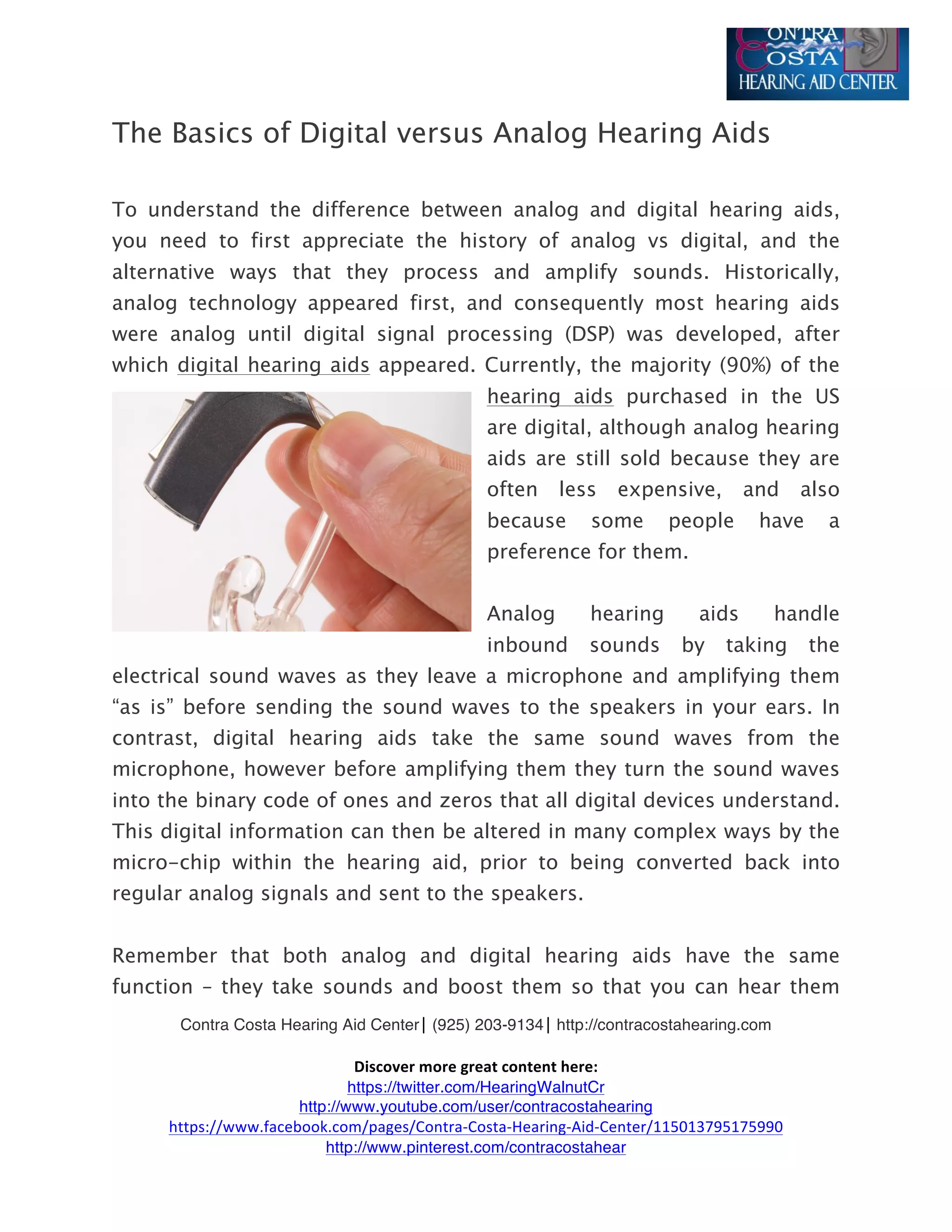
hearing aids purchased in the US
are digital, although analog hearing
aids are still sold because they are
often less expensive, and also
because some people have a
preference for them.
Analog hearing aids handle
inbound sounds by taking the
electrical sound waves as they leave a microphone and amplifying them
“as is” before sending the sound waves to the speakers in your ears. In
contrast, digital hearing aids take the same sound waves from the
microphone, however before amplifying them they turn the sound waves
into the binary code of ones and zeros that all digital devices understand.
This digital information can then be altered in many complex ways by the
micro-chip within the hearing aid, prior to being converted back into
regular analog signals and sent to the speakers.
Remember that both analog and digital hearing aids have the same
function – they take sounds and boost them so that you can hear them
 
Contra Costa Hearing Aid Center|	
  (925) 203-9134|	
  http://contracostahearing.com	


Discover	
  more	
  great	
  content	
  here:	
  
https://twitter.com/HearingWalnutCr
http://www.youtube.com/user/contracostahearing
https://www.facebook.com/pages/Contra-­‐Costa-­‐Hearing-­‐Aid-­‐Center/115013795175990	
  
http://www.pinterest.com/contracostahear
more easily. Both analog and digital hearing aids can be programmable,
which means that they contain microchips that can be modified to adjust
sound quality to suit the user, and to create various settings for different
environments. For example, there can be different settings for low-noise
locations like libraries, for noisy restaurants, and for outdoor spaces like
stadiums.
Digital hearing aids, because of their ability to manipulate the sounds in
digital form, generally offer more features and flexibility, and are
commonly user-configurable. For example, digital hearing aids may offer
numerous channels and memories, allowing them to store more
environment-specific profiles. Other features of digital hearing aids
include the ability to automatically reduce background noise and remove
feedback or whistling, or the ability to prefer the sound of human voices
over other sounds.
Price-wise, most analog hearing aids continue to be less expensive than
digital hearing aids, however, some reduced-feature digital hearing aids
fall into the same general price range. There is often a noticable
difference in sound quality, but the question of whether analog or digital
is “better” is up to the wearer, and the ways that they are used to hearing
sounds.	


Digital versus Analog Hearing Aids

  • 1.
      Contra Costa HearingAid Center|  (925) 203-9134|  http://contracostahearing.com     Discover  more  great  content  here:   https://twitter.com/HearingWalnutCr http://www.youtube.com/user/contracostahearing https://www.facebook.com/pages/Contra-­‐Costa-­‐Hearing-­‐Aid-­‐Center/115013795175990   http://www.pinterest.com/contracostahear The Basics of Digital versus Analog Hearing Aids   To understand the difference between analog and digital hearing aids, you need to first appreciate the history of analog vs digital, and the alternative ways that they process and amplify sounds. Historically, analog technology appeared first, and consequently most hearing aids were analog until digital signal processing (DSP) was developed, after which digital hearing aids appeared. Currently, the majority (90%) of the hearing aids purchased in the US are digital, although analog hearing aids are still sold because they are often less expensive, and also because some people have a preference for them. Analog hearing aids handle inbound sounds by taking the electrical sound waves as they leave a microphone and amplifying them “as is” before sending the sound waves to the speakers in your ears. In contrast, digital hearing aids take the same sound waves from the microphone, however before amplifying them they turn the sound waves into the binary code of ones and zeros that all digital devices understand. This digital information can then be altered in many complex ways by the micro-chip within the hearing aid, prior to being converted back into regular analog signals and sent to the speakers. Remember that both analog and digital hearing aids have the same function – they take sounds and boost them so that you can hear them
  • 2.
      Contra Costa HearingAid Center|  (925) 203-9134|  http://contracostahearing.com     Discover  more  great  content  here:   https://twitter.com/HearingWalnutCr http://www.youtube.com/user/contracostahearing https://www.facebook.com/pages/Contra-­‐Costa-­‐Hearing-­‐Aid-­‐Center/115013795175990   http://www.pinterest.com/contracostahear more easily. Both analog and digital hearing aids can be programmable, which means that they contain microchips that can be modified to adjust sound quality to suit the user, and to create various settings for different environments. For example, there can be different settings for low-noise locations like libraries, for noisy restaurants, and for outdoor spaces like stadiums. Digital hearing aids, because of their ability to manipulate the sounds in digital form, generally offer more features and flexibility, and are commonly user-configurable. For example, digital hearing aids may offer numerous channels and memories, allowing them to store more environment-specific profiles. Other features of digital hearing aids include the ability to automatically reduce background noise and remove feedback or whistling, or the ability to prefer the sound of human voices over other sounds. Price-wise, most analog hearing aids continue to be less expensive than digital hearing aids, however, some reduced-feature digital hearing aids fall into the same general price range. There is often a noticable difference in sound quality, but the question of whether analog or digital is “better” is up to the wearer, and the ways that they are used to hearing sounds.