December 22,2022
Design Thinking
Design Thinking
2
3
Design Thinking
4
Design Thinking
5
What is Design?
6
What is Design Thinking?
-
-
-
7
What is Design Thinking?
-
-
-
8
What is Design Thinking?
-
-
-
9
What is Design Thinking?
10
Why Design Thinking?
11
Why Design Thinking?
12
Why Design Thinking?
13
Why Design Thinking?
14
Why Design Thinking?
15
Why Design Thinking?
16
Why Design Thinking?
17
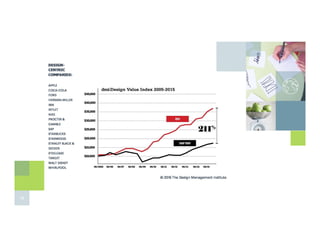
The return shown by the Design Management
Institute’s 2015 Design Value Index (DVI) over the S&P
500.
DVI is based on a portfolio of 16 publicly traded stocks
from companies considered to be “design-centric”,
contingent on a set of criteria that reflects best
practices in design management.
This marks the third year in a row we have seen such
results in excess of 200% over the S&P.
18
19
How Design Thinking?
Design Thinking Process
21
The five-stage
Design Thinking
model
proposed by
the Hasso-
Plattner
Institute of
Design at
Stanford
(d.school)
Stage I Empathize: Observe and
engage with users and immerse
yourself into user environment to
uncover their wants and needs.
Stage II Define: The problem as
a specific and meaningful
challenge, based on the needs
and insights drawn from
Empathizing
Stage III Ideate: Generate
fantastic design alternatives.
22
The five-stage
Design Thinking
model
proposed by
the Hasso-
Plattner
Institute of
Design at
Stanford
(d.school)
Stage IV Prototype: A prototype can be
anything that takes a physical form – be
it a wall of post-it notes, a role-playing
activity, a space, an object, a model, an
interface, or even a storyboard. “Show,
don’t tell.”
Stage V Test: Testing is the chance to
get feedback on your solutions, refine
solutions to make them better, and
continue to learn about your users.
“Share. Don’t sell.”
Stage VI Iterate: As much as time
permits, or till you get the best solution.
23

An Introduction to Design Thinking Concept