Chapter
1
SVPEC
FMS
The Evolution of
Management Thought
2
Overview
 The need to increase efficiency and
effectiveness has driven the evolution of
management theory
 Job specialization, the division of labor and
the study of how people do things is central
to the pursuit of increased efficiency
3
Overview
 Theories about the best ways to
motivate and control employees
have evolved
 The study of the external
environment’s impact on an
organization has become a central
issue in management thought
4
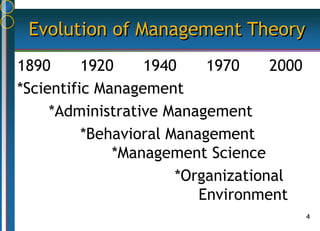
Evolution of Management Theory
1890 1920 1940 1970 2000
*Scientific Management
*Administrative Management
*Behavioral Management
*Management Science
*Organizational
Environment
5
Job Specialization and
the Division of Labor
Adam Smith (18th century economist)
•Observed that firms manufactured
pins in one of two different ways:
- Craft-style—each worker did all
steps.
- Production—each worker
specialized in one step.
6
Job Specialization and
the Division of Labor
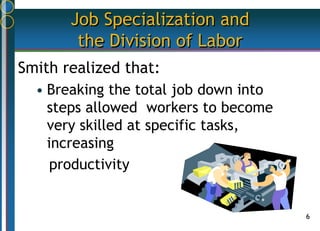
Smith realized that:
• Breaking the total job down into
steps allowed workers to become
very skilled at specific tasks,
increasing
productivity
7
F.W. Taylor and Scientific
Management
Scientific Management
The systematic study of the
relationships between people and
tasks in order to redesign the work
process for higher efficiency.
TAKE THE WATCH APART AND
REASSEMBLE IT DIFFERENTLY TO MAKE
IT TICK FASTER.
8
Scientific Management
 Defined and popularized by Taylor
in the early 1900’s.
 Sought to reduce the time a worker
spent on each task by optimizing
the way the task was done.
 Focused on the process.
9
Four Principles of Scientific
Management
1) Study the ways jobs are performed
and determine new ways to do them.
 Gather detailed time and motion
information.
 Try different methods to see which is
best.
10
Four Principles of Scientific
Management
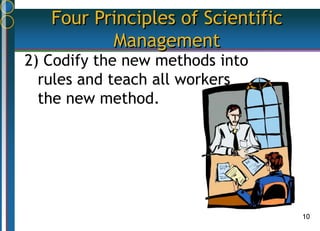
2) Codify the new methods into
rules and teach all workers
the new method.
11
Four Principles of Scientific
Management
3) Determine who’s skills best match the
rules.
4) Establish fair levels of performance; pay
a premium for higher performance.
 Note: all still done by Toyota today
but improvement process (kaizen) in
hands of employees, not managers –
you will see why this point is
important
12
Problems with Scientific
Management
 Specialized jobs became boring and dull.
 Managers frequently did not reward workers for
increased output, so workers purposely
‘underperformed.”
 Management used conveyors belts to force a specific
work pace, making workers depersonalized cogs in a
machine.
 Unions rose to negotiate work rules.
13
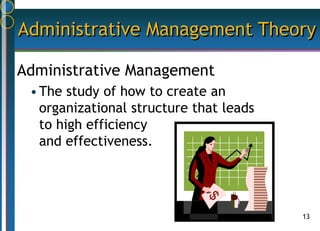
Administrative Management Theory
Administrative Management
•The study of how to create an
organizational structure that leads
to high efficiency
and effectiveness.
14
Administrative Management Theory
Max Weber
•Developed the concept of bureaucracy as a
formal system of organization and
administration designed to ensure
efficiency and effectiveness.
15
Weber’s Principles of Bureaucracy
1) A manager’s formal authority derives
from the position he holds in the
organization.
2) Position should be based on
performance, not social standing or
personal contacts.
16
Weber’s Principles of Bureaucracy
3) The extent of each position’s
formal responsibilities and it’s
relationship to other positions
should be clearly specified.
4) Authority can be exercised
effectively when positions are
arranged hierarchically (the many-
layered cake).
17
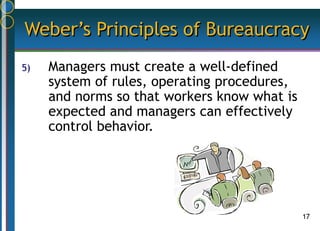
Weber’s Principles of Bureaucracy
5) Managers must create a well-defined
system of rules, operating procedures,
and norms so that workers know what is
expected and managers can effectively
control behavior.
18
Rules, SOPs and Norms
 Rules – formal written instructions that
specify actions to be taken under different
circumstances
 Standard Operating Procedures (SOPs) –
specific sets of written instructions about
how to perform a certain aspect of a task
 Norms – unwritten, informal codes of
conduct that prescribe how people should
act in particular situations – IBM dress code
in the 70s.
19
Fayol’s Principles of Management
 Division of Labor: allows for job specialization.
• jobs can have too much specialization leading
to poor quality and worker dissatisfaction.
 Authority and Responsibility
• both formal and informal authority resulting
from special expertise.
 Unity of Command
• Employees should have only one boss. If not,
chaos and confusion.
20
Fayol’s Principles of Management
 Line of Authority
•A clear chain of command from top to
bottom of the firm.
 Centralization
•The degree to which authority rests at the
top of the organization.
 Unity of Direction
•A single plan of action to guide the
organization.
21
Fayol’s Principles of Management
 Equity - The provision of justice and the fair
and impartial treatment of all employees.
 Order - The arrangement of employees in
order to optimize value for the organization
and provide career opportunities.
 Initiative - The fostering of creativity and
innovation by encouraging employees to act
on their own.
22
Fayol’s Principles of Management
 Discipline
•Obedient, applied, respectful employees
are necessary for the organization to
function.
 Equitable Remuneration of Personnel
•An equitable and uniform payment
system that motivates employees to
contribute to organizational success.
23
Fayol’s Principles of Management
 Stability of Personnel Tenure
• Long-term employment is important for the
development of skills that improve the
organization’s performance (it also makes
employees feel secure, but beware complacency)
 Subordination of Individual Interest to the
Common Interest
• The interest of the organization takes precedence
over that of the individual employee.
24
Fayol’s Principles of Management
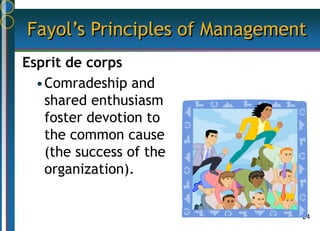
Esprit de corps
•Comradeship and
shared enthusiasm
foster devotion to
the common cause
(the success of the
organization).
25
Behavioral Management Theory
(The next evolutionary step)
Behavioral Management
•The study of how managers should behave
in order to motivate employees to achieve
organizational goals.
26
Behavioral Management
Mary Parker Follett
•Concerned that Taylor ignored the human
side of the organization
 Suggested workers help in analyzing
their jobs
 If workers have relevant knowledge of
the task, then they should control the
task
 This is the heart of the Toyota
Production System (TPS)
27
The Hawthorne Studies
Human Relations Implications
•Hawthorne effect — workers responded to
management attention and were more
productive.
•Gave rise to the field of Organizational
Behavior and the Human Relations
Movement: the study of the factors that
impact how individuals and groups respond
and act in organizations.
28
Theory X and Theory Y
Douglas McGregor proposed two different sets
of assumptions about workers.
•Theory X assumes the average worker is
lazy, dislikes work and will do as little as
possible (you have all met this person).
 Managers must closely supervise and
control through reward and punishment
(carrot and stick).
 Mostly wrong!
29
Theory X and Theory Y
•Theory Y assumes workers want to do a
good job and the job itself will determine
if the worker likes the work.
 Managers should allow workers greater
latitude and create an organization to
stimulate the workers.
 Mostly right!
30
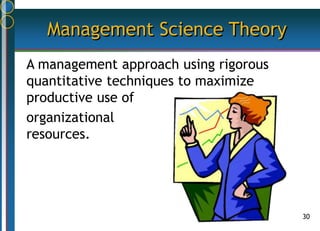
Management Science Theory
A management approach using rigorous
quantitative techniques to maximize
productive use of
organizational
resources.
31
Management Science Theory
•Quantitative management — utilizes
linear and nonlinear programming,
modeling, simulation systems and
queuing and chaos theory.
•Operations management —
techniques used to analyze all
aspects of the production system.
32
Management Science Theory
•Total Quality Management (TQM) —
focuses on analyzing input,
conversion, and output activities to
increase product quality (SPC, PDCA,
Deming, Juran, Japan)
•Management Information Systems
(MIS) — provide information vital for
effective decision making and control
33
Organizational Environment Theory
Organizational Environment:
The set of outside forces and
conditions that affect a manager’s
ability to acquire and use resources
efficiently and effectively – THE
WORLD IN YOUR FACE
34
Contingency Theory
There is no one best way to organize
Organizational structures and control
systems a manager chooses are
contingent on characteristics of the
external environment. Organization
needs to be flexible and adaptive.
More correct than other theories
35
Type of Structure
Mechanistic Structure
•Authority is centralized at the top.
•Employees are closely monitored and
managed -- Theory X.
•Can be very efficient in a stable
environment; GM a decade ago.
•Not effective in today’s environment.
36
Type of Structure
Organic Structure
• Authority is decentralized throughout the
organization; looser control (Theory Y)
• Reliance on shared norms and culture is greater
• Heavy reliance on cross-functional teams
• Works best when environment is unstable and
rapidly changing
• Toyota to a degree; most silicon valley companies
37
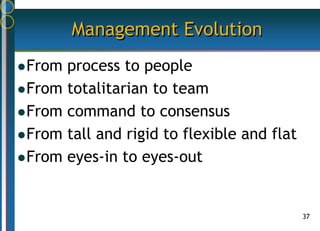
Management Evolution
From process to people
From totalitarian to team
From command to consensus
From tall and rigid to flexible and flat
From eyes-in to eyes-out
38
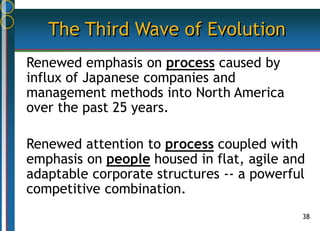
The Third Wave of Evolution
Renewed emphasis on process caused by
influx of Japanese companies and
management methods into North America
over the past 25 years.
Renewed attention to process coupled with
emphasis on people housed in flat, agile and
adaptable corporate structures -- a powerful
competitive combination.

Management Thought Evolution1.ppt

  • 1.
  • 2.
    2 Overview  The needto increase efficiency and effectiveness has driven the evolution of management theory  Job specialization, the division of labor and the study of how people do things is central to the pursuit of increased efficiency
  • 3.
    3 Overview  Theories aboutthe best ways to motivate and control employees have evolved  The study of the external environment’s impact on an organization has become a central issue in management thought
  • 4.
    4 Evolution of ManagementTheory 1890 1920 1940 1970 2000 *Scientific Management *Administrative Management *Behavioral Management *Management Science *Organizational Environment
  • 5.
    5 Job Specialization and theDivision of Labor Adam Smith (18th century economist) •Observed that firms manufactured pins in one of two different ways: - Craft-style—each worker did all steps. - Production—each worker specialized in one step.
  • 6.
    6 Job Specialization and theDivision of Labor Smith realized that: • Breaking the total job down into steps allowed workers to become very skilled at specific tasks, increasing productivity
  • 7.
    7 F.W. Taylor andScientific Management Scientific Management The systematic study of the relationships between people and tasks in order to redesign the work process for higher efficiency. TAKE THE WATCH APART AND REASSEMBLE IT DIFFERENTLY TO MAKE IT TICK FASTER.
  • 8.
    8 Scientific Management  Definedand popularized by Taylor in the early 1900’s.  Sought to reduce the time a worker spent on each task by optimizing the way the task was done.  Focused on the process.
  • 9.
    9 Four Principles ofScientific Management 1) Study the ways jobs are performed and determine new ways to do them.  Gather detailed time and motion information.  Try different methods to see which is best.
  • 10.
    10 Four Principles ofScientific Management 2) Codify the new methods into rules and teach all workers the new method.
  • 11.
    11 Four Principles ofScientific Management 3) Determine who’s skills best match the rules. 4) Establish fair levels of performance; pay a premium for higher performance.  Note: all still done by Toyota today but improvement process (kaizen) in hands of employees, not managers – you will see why this point is important
  • 12.
    12 Problems with Scientific Management Specialized jobs became boring and dull.  Managers frequently did not reward workers for increased output, so workers purposely ‘underperformed.”  Management used conveyors belts to force a specific work pace, making workers depersonalized cogs in a machine.  Unions rose to negotiate work rules.
  • 13.
    13 Administrative Management Theory AdministrativeManagement •The study of how to create an organizational structure that leads to high efficiency and effectiveness.
  • 14.
    14 Administrative Management Theory MaxWeber •Developed the concept of bureaucracy as a formal system of organization and administration designed to ensure efficiency and effectiveness.
  • 15.
    15 Weber’s Principles ofBureaucracy 1) A manager’s formal authority derives from the position he holds in the organization. 2) Position should be based on performance, not social standing or personal contacts.
  • 16.
    16 Weber’s Principles ofBureaucracy 3) The extent of each position’s formal responsibilities and it’s relationship to other positions should be clearly specified. 4) Authority can be exercised effectively when positions are arranged hierarchically (the many- layered cake).
  • 17.
    17 Weber’s Principles ofBureaucracy 5) Managers must create a well-defined system of rules, operating procedures, and norms so that workers know what is expected and managers can effectively control behavior.
  • 18.
    18 Rules, SOPs andNorms  Rules – formal written instructions that specify actions to be taken under different circumstances  Standard Operating Procedures (SOPs) – specific sets of written instructions about how to perform a certain aspect of a task  Norms – unwritten, informal codes of conduct that prescribe how people should act in particular situations – IBM dress code in the 70s.
  • 19.
    19 Fayol’s Principles ofManagement  Division of Labor: allows for job specialization. • jobs can have too much specialization leading to poor quality and worker dissatisfaction.  Authority and Responsibility • both formal and informal authority resulting from special expertise.  Unity of Command • Employees should have only one boss. If not, chaos and confusion.
  • 20.
    20 Fayol’s Principles ofManagement  Line of Authority •A clear chain of command from top to bottom of the firm.  Centralization •The degree to which authority rests at the top of the organization.  Unity of Direction •A single plan of action to guide the organization.
  • 21.
    21 Fayol’s Principles ofManagement  Equity - The provision of justice and the fair and impartial treatment of all employees.  Order - The arrangement of employees in order to optimize value for the organization and provide career opportunities.  Initiative - The fostering of creativity and innovation by encouraging employees to act on their own.
  • 22.
    22 Fayol’s Principles ofManagement  Discipline •Obedient, applied, respectful employees are necessary for the organization to function.  Equitable Remuneration of Personnel •An equitable and uniform payment system that motivates employees to contribute to organizational success.
  • 23.
    23 Fayol’s Principles ofManagement  Stability of Personnel Tenure • Long-term employment is important for the development of skills that improve the organization’s performance (it also makes employees feel secure, but beware complacency)  Subordination of Individual Interest to the Common Interest • The interest of the organization takes precedence over that of the individual employee.
  • 24.
    24 Fayol’s Principles ofManagement Esprit de corps •Comradeship and shared enthusiasm foster devotion to the common cause (the success of the organization).
  • 25.
    25 Behavioral Management Theory (Thenext evolutionary step) Behavioral Management •The study of how managers should behave in order to motivate employees to achieve organizational goals.
  • 26.
    26 Behavioral Management Mary ParkerFollett •Concerned that Taylor ignored the human side of the organization  Suggested workers help in analyzing their jobs  If workers have relevant knowledge of the task, then they should control the task  This is the heart of the Toyota Production System (TPS)
  • 27.
    27 The Hawthorne Studies HumanRelations Implications •Hawthorne effect — workers responded to management attention and were more productive. •Gave rise to the field of Organizational Behavior and the Human Relations Movement: the study of the factors that impact how individuals and groups respond and act in organizations.
  • 28.
    28 Theory X andTheory Y Douglas McGregor proposed two different sets of assumptions about workers. •Theory X assumes the average worker is lazy, dislikes work and will do as little as possible (you have all met this person).  Managers must closely supervise and control through reward and punishment (carrot and stick).  Mostly wrong!
  • 29.
    29 Theory X andTheory Y •Theory Y assumes workers want to do a good job and the job itself will determine if the worker likes the work.  Managers should allow workers greater latitude and create an organization to stimulate the workers.  Mostly right!
  • 30.
    30 Management Science Theory Amanagement approach using rigorous quantitative techniques to maximize productive use of organizational resources.
  • 31.
    31 Management Science Theory •Quantitativemanagement — utilizes linear and nonlinear programming, modeling, simulation systems and queuing and chaos theory. •Operations management — techniques used to analyze all aspects of the production system.
  • 32.
    32 Management Science Theory •TotalQuality Management (TQM) — focuses on analyzing input, conversion, and output activities to increase product quality (SPC, PDCA, Deming, Juran, Japan) •Management Information Systems (MIS) — provide information vital for effective decision making and control
  • 33.
    33 Organizational Environment Theory OrganizationalEnvironment: The set of outside forces and conditions that affect a manager’s ability to acquire and use resources efficiently and effectively – THE WORLD IN YOUR FACE
  • 34.
    34 Contingency Theory There isno one best way to organize Organizational structures and control systems a manager chooses are contingent on characteristics of the external environment. Organization needs to be flexible and adaptive. More correct than other theories
  • 35.
    35 Type of Structure MechanisticStructure •Authority is centralized at the top. •Employees are closely monitored and managed -- Theory X. •Can be very efficient in a stable environment; GM a decade ago. •Not effective in today’s environment.
  • 36.
    36 Type of Structure OrganicStructure • Authority is decentralized throughout the organization; looser control (Theory Y) • Reliance on shared norms and culture is greater • Heavy reliance on cross-functional teams • Works best when environment is unstable and rapidly changing • Toyota to a degree; most silicon valley companies
  • 37.
    37 Management Evolution From processto people From totalitarian to team From command to consensus From tall and rigid to flexible and flat From eyes-in to eyes-out
  • 38.
    38 The Third Waveof Evolution Renewed emphasis on process caused by influx of Japanese companies and management methods into North America over the past 25 years. Renewed attention to process coupled with emphasis on people housed in flat, agile and adaptable corporate structures -- a powerful competitive combination.