An Interactive Educational Environment for
Preschool Children
Ahmad Zmily, Christina B. Class, Yaser Mowafi, and Dirar Abu-Saymeh
School of Information Technology and Engineering
German Jordanian University
Amman, Jordan
{ahmad.zmily; christina.class; yaser.mowafi; dirar.abusaymeh;}@gju.edu.jo
Abstract. Early years in children education are vital in terms of their
social, physical, intellectual, creative, and emotional progress. Those
years lay the foundation for later school success and development. In
recent years, the pervasiveness of mobile devices and smart phones has
broadened the provision of learning content. The development of WLAN
and NFC technologies in mobile devices over the last years empowered
interactive learning that can provide learning content associated with
learning contexts, and subsequently provide personalized learning sup-
port for each learner. In this paper, we propose a novel approach for
an interactive learning environment for preschool education. The inter-
active environment utilizes smart handheld devices equipped with NFC
and wireless sensor networks to enhance the educational environments.
Our proposal focuses on creating a fun, educational, interactive environ-
ment that allows kids to learn while they play. We created a pedagogical
concept for basic skills related to the number core as an important math-
ematical concept for children. To demonstrate the proposed approach,
we developed an application that implemented parts of this concept for
the Android OS.
1 Introduction
First few years in children’s life are crucial in terms of their social, physical,
intellectual, creative, and emotional development. During those years, the growth
of mental and physical abilities progress at an astonishing rate. As a matter of
fact, a very high proportion of learning for humans takes place during the early
years. The learning capabilities of humans continue for the rest of their lives but
not at the intensity that is demonstrated in the preschool years. Those preschool
years in particular are the time when children need high quality personal care
and learning experiences.
Early childhood education refers to the formal teaching of young children
before the age of normal schooling by people outside the family and typically
in settings outside the home. The early learning experiences help children’s in-
tellectual, social and emotional development which lays the foundation for later
school success. Studies have shown that high quality or high rated preschools
have a long term effect in improving the outcomes of children (Schaefer & Cohen
2000).
A HighScope research study examined 123 children from Ypsilanti, Michigan
born in poverty and at high risk of failing in school (Schweinhart et al. 2005).
In that study, 3 and 4-year old children were randomly divided into a program
group that received a high-quality preschool program and a comparison group
who received no preschool program. The study found that adults at age 40 who
had the preschool program had higher earnings, were more likely to hold a job,
had committed fewer crimes, and were more likely to have graduated from high
school than adults who did not receive a preschool program.
Preschool participation in the U.S. has been increasing steadily. ”In 1960,
just 10% of the U.S. 3- and 4-year olds were enrolled in any type of classroom”
(Barnett 2008). Figures from 2008 show that nearly three quarters of children
enroll in a preschool classroom at age 4 and about half do so at age 3 (Bar-
nett 2008). These trends have been accompanied by growth in private preschool
education and child care, state-funded pre-K, preschool special education, and
federal Head Start programs (Barnett & Yarosz 2007).
Early childhood education is unique as children learn more efficiently and
gain more knowledge through play-based activities. Wenner in (Wenner 2009)
discussed the role of free, imaginative play in young children’s healthy develop-
ment. In her article, she concluded that: young children’s play is essential for
healthy social, emotional and cognitive growth; imaginative, child-directed play
is more helpful than structured play; and young children who do not engage in
free play are at-risk of developing into anxious, socially maladjusted adults.
The pervasiveness of mobile devices and smart phones has broadened the
provision of learning content from e-learning to mobile learning (m-learning).
With the emphasis of providing learning content at the right time and the right
place, the advantage of m-learning is to provide learners with learning content
beyond the physical classroom setting. Meanwhile, the continual development
and proliferation of WLAN and RFID sensing technologies in mobile devices
over the last years have enabled the development of context-aware ubiquitous
learning that can provide learning content associated with learning contexts,
and subsequently provide personalized learning support for each learner (Chen
& Huang 2012).
Recently, mobile and ubiquitous learning has become a popular trend in
education. Ubiquitous learning environments can enhance students learning ex-
perience. For example, integrating the learning environment with real-time inter-
action and navigation support of the learning content enhances students’ under-
standing of the learning content. Moreover, ubiquitous learning provides learners
with an alternative approach of scaffolding information in a real-world context,
which enables learners to interact more actively and thus promotes their learn-
ing process. Most mobile and ubiquitous learning applications merely focused
on education for children older than 6 years, high school, and collage students.
In this paper, we propose an interactive learning environment for preschool
education. The interactive environment utilizes smart handheld devices equipped
with Near Field Communication (NFC) and wireless sensor networks to enhance
the educational environments in kindergarten. Our proposal focuses on creat-
ing a fun, educational, interactive environment that allows kids to learn while
they play. The interactive environment helps improving childrens ability to play,
share, and collaborate with other children. In addition, the environment im-
proves children’s physical motor skills and their understanding of the real phys-
ical world. Our interactive environment is a complement for preschool teachers
and educators. As a matter of fact, the presence of preschool teachers and educa-
tors is important to help children fully utilize the learning environment, resolve
any possible conflict between children, and prevent any frustration in case a child
fails to interact successfully with the learning environment.
To evaluate our proposed interactive learning environment, we created a ped-
agogical concept for basic skills related to the number core as an important
mathematical concept for children. We developed an application that imple-
mented parts of this concept for the Android OS. The application prompts a
child to search for a given number of objects and count them. The child has to
move around and collect the required number of objects from his surrounding
environment. In addition, children can interactively count collected objects while
the application provides feedback about the number of counted objects.
The remainder of this paper is structured as follows. In Section 2, we de-
scribe in details the pedagogical and didactical model of our interactive learning
environment for preschool children. Section 3 presents the different experimental
tasks developed for the proposed environment and shows the methodology used
along with the initial results. In Section 4, we discuss related work and describe
how the proposed work differs from previous related studies. We conclude with
final comments and potential future work in Section 5.
2 Pedagogical and Didactical Model
In this paper we describe a concept and a prototype for an interactive learning
environment for preschool children. Using mobile technology and NFC tags, we
aim at creating a playful environment that supports: children’s learning; their
experiences in the real world; and their natural desire to move and play. To
achieve this goal, it is essential to design the application and the environment
based on a well-founded and sound concept. In this section we present main
aspects of the concept and the environment.
Swiss scholar Jean Piaget suggested that children go through distinct stages
of cognitive development. Each stage of development gives the child a new set of
mental tools to process information. The task of the teacher is to match appro-
priate content to the development stage of the child. Piaget’s work lacks several
important dimensions: it treats the stages as relatively discrete rather than over-
lapping and varying among individuals, and it does not take into account the
learners’ social relationships to the wider world (Jarvis et al. 2003).
Our proposed concept is based on developmental aspects of human learning.
Appropriate pedagogy has to take into account children’s development stage.
Age gives an indication for the current stage but not necessarily for all children.
J. E. Ormrod in (Ormrod 2009) discussed this limitation for the development
stages of Piaget. We consider that similar limitations hold for all development
stages that might be defined. We integrate implications of Piagetian and Neo-
Piagetian theories as mentioned in (Ormrod 2009). We specifically focus on the
following implications from (Ormrod 2009):
– children can learn a lot based on personal experiences,
– interaction with other children can foster learning and understanding while
not eliminating the risk of confirmation bias,
– children need to master basic concepts in one domain before they can learn
more advanced concepts in the same domain.
Therefore, our application allows the child to make different experiences in his
own environment. As he shares the environment with his peers, interaction is
facilitated within the same age group or may be triggered by curiosity among dif-
ferent age groups. To help children master those concepts, feedback and support
are provided instantaneously.
J. S. Lee in (Lee 2006) presented common beliefs of preschool teachers for
appropriate pedagogy for 4-year-old children. We developed our concept based
on the following characteristics of adequate pedagogy listed in (Lee 2006):
– working with the environment should be fun,
– choices are important,
– the environment is linked to interests and everyday lifes experiences,
– learning avoids pressure and stress when is based on play, exploration and
discovery.
As interaction is critical when inquiry-based methods are applied (Wang et al.
2010) and human interaction is important for the social construction of meaning
and scaffolding(Ormrod 2009), our concept offers a range of possibilities that are
complemented by interaction with educators and peers.
Information and Communication Technologies have been used for some time
in education. Many educational as well as edutainment applications have been
developed for different age groups including children in preschool education.
Aronin and Floyd (Aronin & Floyd 2013) discussed several apps for iPad in
preschool environment to convey basic STEM (science, technology, engineering,
and math) concepts. Wang et al. (Wang et al. 2010) suggested that inquiry
based learning in early childhood education should incorporate technology and
presented some sample applications for different purposes in children’s inquiry
learning. Clements and Sarama (Clements & Sarama 2007) discussed the results
of applying basic teaching material based on computed and paper activities to
learn concepts related to numerals and shapes. Their study has shown that even
a small number of experiments were sufficient to produce large relative learning
gains.
As sound understanding of basic mathematical concepts like numbers, mea-
surements, and geometry is important for success in school and further educa-
tion, the learning paths should be carefully designed. Hence, we have based our
presented concept on the learning paths of numbers, relations, and operations
presented in (Committee on Early Childhood Mathematics 2009). We focus on
the number core that includes:
– knowing the number word list (1,2,3,...),
– understanding cardinality,
– understanding and applying 1-to-1 counting correspondence,
– reading and writing number symbols, as well as
– applying the cardinal counting principle.
The Committee on Early Childhood Mathematics presented the development of
the number core for the following four steps: ages 2 and 3; age 4 / prekinder-
garten; age 5 / kindergarten; and grade 1 (Committee on Early Childhood Math-
ematics 2009). They also defined relevant competences for each step.
In order to evaluate the concept of the interactive learning environment for
preschool children, we have developed in more details a concept for 1-to-1 count-
ing correspondence application in the number core as defined in (Committee on
Early Childhood Mathematics 2009). The developed application prompts chil-
dren to count objects and provides instant feedback on the counted number of
objects. Contrary to the aforementioned applications, the objects to be counted
are real world objects from the physical environment. Our interactive educational
environment brings real world objects (plastic fruits, vegetables, animals, balls,
toy blocks, etc) to the application and seamlessly integrates both. Those objects
can be used for undirected playing activities as well as for instructional games to
foster counting skills. Instead of counting objects that are displayed on a screen,
the child can use the application to count any of the objects he is interacting
with. Equally the application may prompt the child to search for a given number
of objects and count them. Thus it invites the child to move around and collect
those objects from his surrounding environment. Conflicts that may rise during
such tasks can be handled by the educator to help children develop skills to take
into account another point of view, i.e. to overcome the egocentrism as defined
by Piaget (Ormrod 2009), and to develop conflict resolution strategies. While
the application cannot be used to develop those skills, it can trigger learning
situation. Additionally, we developed collaborative tasks that are coordinated
on different devices (e.g. one child must find 3 animal toys and the other one 3
vegetable toys and only after both have found their respective number of toys,
the task is considered to be fulfilled).
Our developed application helps children in learning how to count objects us-
ing a 1-to-1 counting correspondence. As young children are interested in count-
ing many objects, our application allows the child to start the counting process
whenever he likes. Since every tagged object is counted, the application keeps
track of the already counted objects so that the same object cannot be counted
twice. The child has the option to restrict counting to objects with specific char-
acteristics, like animals, fruit, red objects, etc. Additionally, the child can choose
to find and count objects. In that case, the application, prompts the child to find
a specified number of objects with specific characteristics and count them. The
number of objects to be found as well as the complexity of the characteristics
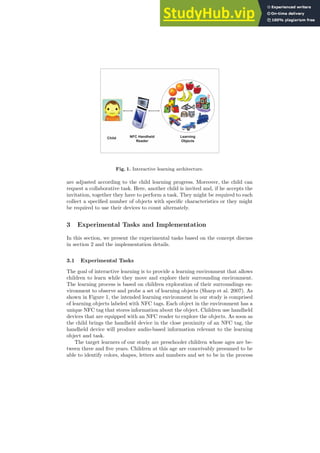
Child NFC Handheld
Reader
Learning
Objects
Fig. 1. Interactive learning architecture.
are adjusted according to the child learning progress. Moreover, the child can
request a collaborative task. Here, another child is invited and, if he accepts the
invitation, together they have to perform a task. They might be required to each
collect a specified number of objects with specific characteristics or they might
be required to use their devices to count alternately.
3 Experimental Tasks and Implementation
In this section, we present the experimental tasks based on the concept discuss
in section 2 and the implementation details.
3.1 Experimental Tasks
The goal of interactive learning is to provide a learning environment that allows
children to learn while they move and explore their surrounding environment.
The learning process is based on children exploration of their surroundings en-
vironment to observe and probe a set of learning objects (Sharp et al. 2007). As
shown in Figure 1, the intended learning environment in our study is comprised
of learning objects labeled with NFC tags. Each object in the environment has a
unique NFC tag that stores information about the object. Children use handheld
devices that are equipped with an NFC reader to explore the objects. As soon as
the child brings the handheld device in the close proximity of an NFC tag, the
handheld device will produce audio-based information relevant to the learning
object and task.
The target learners of our study are preschooler children whose ages are be-
tween three and five years. Children at this age are conceivably presumed to be
able to identify colors, shapes, letters and numbers and set to be in the process
Successfully
Completed
Learning task
Identify color
Yes
No
Learning task
Identify type
Successfully
Completed
Learning task
Identify color and type
Yes
No
1st Level of
Complexity
2nd Level of
Complexity
3rd Level of
Complexity
Repeat
similar
task
Repeat
similar
task
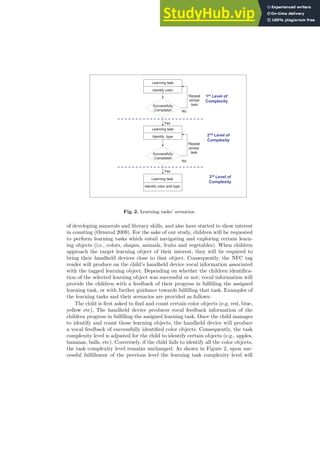
Fig. 2. Learning tasks’ scenarios.
of developing numerals and literacy skills, and also have started to show interest
in counting (Ormrod 2009). For the sake of our study, children will be requested
to perform learning tasks which entail navigating and exploring certain learn-
ing objects (i.e., colors, shapes, animals, fruits and vegetables). When children
approach the target learning object of their interest, they will be required to
bring their handheld devices close to that object. Consequently, the NFC tag
reader will produce on the child’s handheld device vocal information associated
with the tagged learning object. Depending on whether the children identifica-
tion of the selected learning object was successful or not; vocal information will
provide the children with a feedback of their progress in fulfilling the assigned
learning task, or with further guidance towards fulfilling that task. Examples of
the learning tasks and their scenarios are provided as follows:
The child is first asked to find and count certain color objects (e.g. red, blue,
yellow etc). The handheld device produces vocal feedback information of the
children progress in fulfilling the assigned learning task. Once the child manages
to identify and count those learning objects, the handheld device will produce
a vocal feedback of successfully identified color objects. Consequently, the task
complexity level is adjusted for the child to identify certain objects (e.g., apples,
bananas, balls, etc). Conversely, if the child fails to identify all the color objects,
the task complexity level remains unchanged. As shown in Figure 2, upon suc-
cessful fulfillment of the previous level the learning task complexity level will
Human Control Interface
Tags
Database
Speaker
Assessment Management
Child
NFC Tag Reader
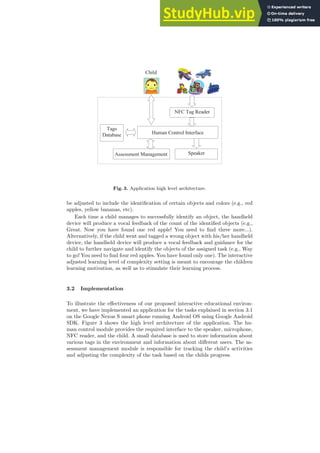
Fig. 3. Application high level architecture.
be adjusted to include the identification of certain objects and colors (e.g., red
apples, yellow bananas, etc).
Each time a child manages to successfully identify an object, the handheld
device will produce a vocal feedback of the count of the identified objects (e.g.,
Great. Now you have found one red apple! You need to find three more...).
Alternatively, if the child went and tagged a wrong object with his/her handheld
device, the handheld device will produce a vocal feedback and guidance for the
child to further navigate and identify the objects of the assigned task (e.g., Way
to go! You need to find four red apples. You have found only one). The interactive
adjusted learning level of complexity setting is meant to encourage the children
learning motivation, as well as to stimulate their learning process.
3.2 Implementation
To illustrate the effectiveness of our proposed interactive educational environ-
ment, we have implemented an application for the tasks explained in section 3.1
on the Google Nexus S smart phone running Android OS using Google Android
SDK. Figure 3 shows the high level architecture of the application. The hu-
man control module provides the required interface to the speaker, microphone,
NFC reader, and the child. A small database is used to store information about
various tags in the environment and information about different users. The as-
sessment management module is responsible for tracking the child’s activities
and adjusting the complexity of the task based on the childs progress.
4 Related Work
Near Field Communication (NFC) and RFID tags have been increasingly used
in recent years in various aspects of business operations and personal life. Use
of RFIDs as part of the educational process has seen limited activity. Kashiwagi
et al. (Kashiwagi et al. 2009) have attempted to evaluate the benefits of incor-
porating real objects into a language learning system. To accomplish this, the
objects are labeled with RFID tags to allow a system to automatically identify
the objects. Audio questions prompt the learner to choose between objects and
provide corrective feedback for incorrect selections.
Yahya et al (Yahya et al. 2012) presented a concept for a contextual inter-
active learning tool for preschoolers that utilizes RFID tags. The children can
grab an RFID tagged object and pass it over an RFID reader which triggers
the playback of a corresponding media such as an audio or video describing the
object.
RFIDs have also been used to develop active playtime games for preschoolers
as described by Hirokazu et al. (Hirokazu et al. 2006). The game is based on
the popular ”treasure hunt” game in which the proposed system provides hints
about finding the treasure. The objective of the game was not focused on the
educational aspects but rather focused on reducing the monitoring pressure of
teachers during playtime.
Hunag et al (Huang et al. 2008) introduced a new interactive tool for teach-
ing ASL to deaf preschool children. An RFID reader and an LCD screen were
embedded in a tidy bear. Children can place flash cards on the bear to trigger
ASL educational videos related to the picture on the flash cards.
5 Conclusion
In this paper, we describe a concept and a prototype for an interactive learn-
ing environment for preschool children. We use mobile and NFC technologies
to create a fun, educational, interactive environment that allows kids to learn
while they play. The interactive environment helps improving childrens ability
to play, share, and collaborate with other children. In addition, the environment
improves children’s physical motor skills and their understanding of the real
physical world. We developed an application that helps children to learn how to
count objects using a 1-to-1 counting correspondence.
For future work, we would like to evaluate our proposed solution and deploy
it in a real preschool classroom to study the response and the impact of the inter-
active environment on different children age groups. It would be also interesting
to perform a complete usability study for the interactive environment.
References
Aronin, S. & Floyd, K. K. (2013), ‘Using an iPad in Inclusive Preschool
Classrooms to Introduce STEM Concepts’, Teaching Exceptional Chil-
dren, 45(4), 34–39.
Barnett, W. S. (2008), Preschool Education and its Lasting Effects: Research and
Policy Implications, Great Lakes Center for Education Research & Practice.
Barnett, W. S. & Yarosz, D. J. (2007), ‘Who Goes to Preschool and Why Does
It Matter?’, Preschool Policy Matters 7, .
Chen, C.-C. & Huang, T.-C. (2012), ‘Learning in a u-Museum: Developing
a Context-aware Ubiquitous Learning Environment’, Computers & Educa-
tion, 59(3), 873–883.
Clements, D. H. & Sarama, J. (2007), ‘Effects of Preschool Mathematics Cur-
riculum: Summative Research on the BuildingBlocks Project’, Journal for
Research in Mathematics Education, 38(2), 136–163.
Committee on Early Childhood Mathematics, N. R. C. (2009), Mathematics
Learning in Early Childhood: Paths Toward Excellence and Equity, The Na-
tional Academies Press.
Hirokazu, B., Hitomi, S., Yoko, O., Yasuhiro, B., Shin’ichi, S. & Kazu, O. (2006),
‘Design and Trial Production of a Tool for Active Playtime in Preschools by
using RFID’, IPSJ SIG Technical Reports, 2006(74(CE-85)), 41–48.
Huang, K., Smith, J., Spreen, K. & Jones, M. F. (2008), Breaking the Sound
Barrier: Designing an Interactive Tool for Language Acquisition in Preschool
Deaf Children, in ‘Proceedings of the 7th international conference on Interac-
tion design and children’, ACM, pp. 210–216.
Jarvis, P., Holford, J. & Griffin, C. (2003), The Theory and Practice of Learning,
2 edn, Routledge.
Kashiwagi, H., Xue, Y., Sun, Y., Kang, M. & Ohtsuki, K. (2009), A Language
Learning System Utilizing RFID Technology for Total Physical Response Ac-
tivities, in ‘Human-Computer Interaction. Interacting in Various Application
Domains’, Vol. 5613 of Lecture Notes in Computer Science, Springer Berlin
Heidelberg, pp. 119–128.
Lee, J. S. (2006), ‘Preschool Teachers’ Shared Beliefs About Appropriate Peda-
gogy for 4-Years-Olds’, Early Childhood Education Journal, 33(6), 433–441.
Ormrod, J. E. (2009), Human Learning, 5 edn, Pearson Education.
Schaefer, S. & Cohen, J. (2000), Making Investments in Young Children: What
the Research on Early Care and Education Tells Us., National Association of
Child Advocates.
Schweinhart, L. J., Montie, J., Xiang, Z., Barnett, W. S., Belfield, C. R. & Nores,
M. (2005), ‘Lifetime Effects: the HighScope Perry Preschool Study Through
Age 40’.
Sharp, H., Rogers, Y. & Preece, J. (2007), Interaction Design : Beyond Human-
Computer Interaction, Wiley.
Wang, F., Kinzie, M. B., McGuire, P. & Pan, E. (2010), ‘Applying Technology
to Inquiry-Based Learning in Early Childhood Education’, Early Childhood
Education Journal, 37, 381–380.
Wenner, M. (2009), ‘The Serious Need for Play’, Scientific American, .
Yahya, W. F. F., Noor, N. M. M., Hamzah, M. P. & Hassan, M. N. (2012), A
Review on Interactive Learning Tools for Preschool Children Using RFID, in
‘UMT 11th International Annual Symposium on Sustainability Science and
Management’.

An Interactive Educational Environment For Preschool Children

  • 1.
    An Interactive EducationalEnvironment for Preschool Children Ahmad Zmily, Christina B. Class, Yaser Mowafi, and Dirar Abu-Saymeh School of Information Technology and Engineering German Jordanian University Amman, Jordan {ahmad.zmily; christina.class; yaser.mowafi; dirar.abusaymeh;}@gju.edu.jo Abstract. Early years in children education are vital in terms of their social, physical, intellectual, creative, and emotional progress. Those years lay the foundation for later school success and development. In recent years, the pervasiveness of mobile devices and smart phones has broadened the provision of learning content. The development of WLAN and NFC technologies in mobile devices over the last years empowered interactive learning that can provide learning content associated with learning contexts, and subsequently provide personalized learning sup- port for each learner. In this paper, we propose a novel approach for an interactive learning environment for preschool education. The inter- active environment utilizes smart handheld devices equipped with NFC and wireless sensor networks to enhance the educational environments. Our proposal focuses on creating a fun, educational, interactive environ- ment that allows kids to learn while they play. We created a pedagogical concept for basic skills related to the number core as an important math- ematical concept for children. To demonstrate the proposed approach, we developed an application that implemented parts of this concept for the Android OS. 1 Introduction First few years in children’s life are crucial in terms of their social, physical, intellectual, creative, and emotional development. During those years, the growth of mental and physical abilities progress at an astonishing rate. As a matter of fact, a very high proportion of learning for humans takes place during the early years. The learning capabilities of humans continue for the rest of their lives but not at the intensity that is demonstrated in the preschool years. Those preschool years in particular are the time when children need high quality personal care and learning experiences. Early childhood education refers to the formal teaching of young children before the age of normal schooling by people outside the family and typically in settings outside the home. The early learning experiences help children’s in- tellectual, social and emotional development which lays the foundation for later school success. Studies have shown that high quality or high rated preschools
  • 2.
    have a longterm effect in improving the outcomes of children (Schaefer & Cohen 2000). A HighScope research study examined 123 children from Ypsilanti, Michigan born in poverty and at high risk of failing in school (Schweinhart et al. 2005). In that study, 3 and 4-year old children were randomly divided into a program group that received a high-quality preschool program and a comparison group who received no preschool program. The study found that adults at age 40 who had the preschool program had higher earnings, were more likely to hold a job, had committed fewer crimes, and were more likely to have graduated from high school than adults who did not receive a preschool program. Preschool participation in the U.S. has been increasing steadily. ”In 1960, just 10% of the U.S. 3- and 4-year olds were enrolled in any type of classroom” (Barnett 2008). Figures from 2008 show that nearly three quarters of children enroll in a preschool classroom at age 4 and about half do so at age 3 (Bar- nett 2008). These trends have been accompanied by growth in private preschool education and child care, state-funded pre-K, preschool special education, and federal Head Start programs (Barnett & Yarosz 2007). Early childhood education is unique as children learn more efficiently and gain more knowledge through play-based activities. Wenner in (Wenner 2009) discussed the role of free, imaginative play in young children’s healthy develop- ment. In her article, she concluded that: young children’s play is essential for healthy social, emotional and cognitive growth; imaginative, child-directed play is more helpful than structured play; and young children who do not engage in free play are at-risk of developing into anxious, socially maladjusted adults. The pervasiveness of mobile devices and smart phones has broadened the provision of learning content from e-learning to mobile learning (m-learning). With the emphasis of providing learning content at the right time and the right place, the advantage of m-learning is to provide learners with learning content beyond the physical classroom setting. Meanwhile, the continual development and proliferation of WLAN and RFID sensing technologies in mobile devices over the last years have enabled the development of context-aware ubiquitous learning that can provide learning content associated with learning contexts, and subsequently provide personalized learning support for each learner (Chen & Huang 2012). Recently, mobile and ubiquitous learning has become a popular trend in education. Ubiquitous learning environments can enhance students learning ex- perience. For example, integrating the learning environment with real-time inter- action and navigation support of the learning content enhances students’ under- standing of the learning content. Moreover, ubiquitous learning provides learners with an alternative approach of scaffolding information in a real-world context, which enables learners to interact more actively and thus promotes their learn- ing process. Most mobile and ubiquitous learning applications merely focused on education for children older than 6 years, high school, and collage students. In this paper, we propose an interactive learning environment for preschool education. The interactive environment utilizes smart handheld devices equipped
  • 3.
    with Near FieldCommunication (NFC) and wireless sensor networks to enhance the educational environments in kindergarten. Our proposal focuses on creat- ing a fun, educational, interactive environment that allows kids to learn while they play. The interactive environment helps improving childrens ability to play, share, and collaborate with other children. In addition, the environment im- proves children’s physical motor skills and their understanding of the real phys- ical world. Our interactive environment is a complement for preschool teachers and educators. As a matter of fact, the presence of preschool teachers and educa- tors is important to help children fully utilize the learning environment, resolve any possible conflict between children, and prevent any frustration in case a child fails to interact successfully with the learning environment. To evaluate our proposed interactive learning environment, we created a ped- agogical concept for basic skills related to the number core as an important mathematical concept for children. We developed an application that imple- mented parts of this concept for the Android OS. The application prompts a child to search for a given number of objects and count them. The child has to move around and collect the required number of objects from his surrounding environment. In addition, children can interactively count collected objects while the application provides feedback about the number of counted objects. The remainder of this paper is structured as follows. In Section 2, we de- scribe in details the pedagogical and didactical model of our interactive learning environment for preschool children. Section 3 presents the different experimental tasks developed for the proposed environment and shows the methodology used along with the initial results. In Section 4, we discuss related work and describe how the proposed work differs from previous related studies. We conclude with final comments and potential future work in Section 5. 2 Pedagogical and Didactical Model In this paper we describe a concept and a prototype for an interactive learning environment for preschool children. Using mobile technology and NFC tags, we aim at creating a playful environment that supports: children’s learning; their experiences in the real world; and their natural desire to move and play. To achieve this goal, it is essential to design the application and the environment based on a well-founded and sound concept. In this section we present main aspects of the concept and the environment. Swiss scholar Jean Piaget suggested that children go through distinct stages of cognitive development. Each stage of development gives the child a new set of mental tools to process information. The task of the teacher is to match appro- priate content to the development stage of the child. Piaget’s work lacks several important dimensions: it treats the stages as relatively discrete rather than over- lapping and varying among individuals, and it does not take into account the learners’ social relationships to the wider world (Jarvis et al. 2003). Our proposed concept is based on developmental aspects of human learning. Appropriate pedagogy has to take into account children’s development stage.
  • 4.
    Age gives anindication for the current stage but not necessarily for all children. J. E. Ormrod in (Ormrod 2009) discussed this limitation for the development stages of Piaget. We consider that similar limitations hold for all development stages that might be defined. We integrate implications of Piagetian and Neo- Piagetian theories as mentioned in (Ormrod 2009). We specifically focus on the following implications from (Ormrod 2009): – children can learn a lot based on personal experiences, – interaction with other children can foster learning and understanding while not eliminating the risk of confirmation bias, – children need to master basic concepts in one domain before they can learn more advanced concepts in the same domain. Therefore, our application allows the child to make different experiences in his own environment. As he shares the environment with his peers, interaction is facilitated within the same age group or may be triggered by curiosity among dif- ferent age groups. To help children master those concepts, feedback and support are provided instantaneously. J. S. Lee in (Lee 2006) presented common beliefs of preschool teachers for appropriate pedagogy for 4-year-old children. We developed our concept based on the following characteristics of adequate pedagogy listed in (Lee 2006): – working with the environment should be fun, – choices are important, – the environment is linked to interests and everyday lifes experiences, – learning avoids pressure and stress when is based on play, exploration and discovery. As interaction is critical when inquiry-based methods are applied (Wang et al. 2010) and human interaction is important for the social construction of meaning and scaffolding(Ormrod 2009), our concept offers a range of possibilities that are complemented by interaction with educators and peers. Information and Communication Technologies have been used for some time in education. Many educational as well as edutainment applications have been developed for different age groups including children in preschool education. Aronin and Floyd (Aronin & Floyd 2013) discussed several apps for iPad in preschool environment to convey basic STEM (science, technology, engineering, and math) concepts. Wang et al. (Wang et al. 2010) suggested that inquiry based learning in early childhood education should incorporate technology and presented some sample applications for different purposes in children’s inquiry learning. Clements and Sarama (Clements & Sarama 2007) discussed the results of applying basic teaching material based on computed and paper activities to learn concepts related to numerals and shapes. Their study has shown that even a small number of experiments were sufficient to produce large relative learning gains. As sound understanding of basic mathematical concepts like numbers, mea- surements, and geometry is important for success in school and further educa- tion, the learning paths should be carefully designed. Hence, we have based our
  • 5.
    presented concept onthe learning paths of numbers, relations, and operations presented in (Committee on Early Childhood Mathematics 2009). We focus on the number core that includes: – knowing the number word list (1,2,3,...), – understanding cardinality, – understanding and applying 1-to-1 counting correspondence, – reading and writing number symbols, as well as – applying the cardinal counting principle. The Committee on Early Childhood Mathematics presented the development of the number core for the following four steps: ages 2 and 3; age 4 / prekinder- garten; age 5 / kindergarten; and grade 1 (Committee on Early Childhood Math- ematics 2009). They also defined relevant competences for each step. In order to evaluate the concept of the interactive learning environment for preschool children, we have developed in more details a concept for 1-to-1 count- ing correspondence application in the number core as defined in (Committee on Early Childhood Mathematics 2009). The developed application prompts chil- dren to count objects and provides instant feedback on the counted number of objects. Contrary to the aforementioned applications, the objects to be counted are real world objects from the physical environment. Our interactive educational environment brings real world objects (plastic fruits, vegetables, animals, balls, toy blocks, etc) to the application and seamlessly integrates both. Those objects can be used for undirected playing activities as well as for instructional games to foster counting skills. Instead of counting objects that are displayed on a screen, the child can use the application to count any of the objects he is interacting with. Equally the application may prompt the child to search for a given number of objects and count them. Thus it invites the child to move around and collect those objects from his surrounding environment. Conflicts that may rise during such tasks can be handled by the educator to help children develop skills to take into account another point of view, i.e. to overcome the egocentrism as defined by Piaget (Ormrod 2009), and to develop conflict resolution strategies. While the application cannot be used to develop those skills, it can trigger learning situation. Additionally, we developed collaborative tasks that are coordinated on different devices (e.g. one child must find 3 animal toys and the other one 3 vegetable toys and only after both have found their respective number of toys, the task is considered to be fulfilled). Our developed application helps children in learning how to count objects us- ing a 1-to-1 counting correspondence. As young children are interested in count- ing many objects, our application allows the child to start the counting process whenever he likes. Since every tagged object is counted, the application keeps track of the already counted objects so that the same object cannot be counted twice. The child has the option to restrict counting to objects with specific char- acteristics, like animals, fruit, red objects, etc. Additionally, the child can choose to find and count objects. In that case, the application, prompts the child to find a specified number of objects with specific characteristics and count them. The number of objects to be found as well as the complexity of the characteristics
  • 6.
    Child NFC Handheld Reader Learning Objects Fig.1. Interactive learning architecture. are adjusted according to the child learning progress. Moreover, the child can request a collaborative task. Here, another child is invited and, if he accepts the invitation, together they have to perform a task. They might be required to each collect a specified number of objects with specific characteristics or they might be required to use their devices to count alternately. 3 Experimental Tasks and Implementation In this section, we present the experimental tasks based on the concept discuss in section 2 and the implementation details. 3.1 Experimental Tasks The goal of interactive learning is to provide a learning environment that allows children to learn while they move and explore their surrounding environment. The learning process is based on children exploration of their surroundings en- vironment to observe and probe a set of learning objects (Sharp et al. 2007). As shown in Figure 1, the intended learning environment in our study is comprised of learning objects labeled with NFC tags. Each object in the environment has a unique NFC tag that stores information about the object. Children use handheld devices that are equipped with an NFC reader to explore the objects. As soon as the child brings the handheld device in the close proximity of an NFC tag, the handheld device will produce audio-based information relevant to the learning object and task. The target learners of our study are preschooler children whose ages are be- tween three and five years. Children at this age are conceivably presumed to be able to identify colors, shapes, letters and numbers and set to be in the process
  • 7.
    Successfully Completed Learning task Identify color Yes No Learningtask Identify type Successfully Completed Learning task Identify color and type Yes No 1st Level of Complexity 2nd Level of Complexity 3rd Level of Complexity Repeat similar task Repeat similar task Fig. 2. Learning tasks’ scenarios. of developing numerals and literacy skills, and also have started to show interest in counting (Ormrod 2009). For the sake of our study, children will be requested to perform learning tasks which entail navigating and exploring certain learn- ing objects (i.e., colors, shapes, animals, fruits and vegetables). When children approach the target learning object of their interest, they will be required to bring their handheld devices close to that object. Consequently, the NFC tag reader will produce on the child’s handheld device vocal information associated with the tagged learning object. Depending on whether the children identifica- tion of the selected learning object was successful or not; vocal information will provide the children with a feedback of their progress in fulfilling the assigned learning task, or with further guidance towards fulfilling that task. Examples of the learning tasks and their scenarios are provided as follows: The child is first asked to find and count certain color objects (e.g. red, blue, yellow etc). The handheld device produces vocal feedback information of the children progress in fulfilling the assigned learning task. Once the child manages to identify and count those learning objects, the handheld device will produce a vocal feedback of successfully identified color objects. Consequently, the task complexity level is adjusted for the child to identify certain objects (e.g., apples, bananas, balls, etc). Conversely, if the child fails to identify all the color objects, the task complexity level remains unchanged. As shown in Figure 2, upon suc- cessful fulfillment of the previous level the learning task complexity level will
  • 8.
    Human Control Interface Tags Database Speaker AssessmentManagement Child NFC Tag Reader Fig. 3. Application high level architecture. be adjusted to include the identification of certain objects and colors (e.g., red apples, yellow bananas, etc). Each time a child manages to successfully identify an object, the handheld device will produce a vocal feedback of the count of the identified objects (e.g., Great. Now you have found one red apple! You need to find three more...). Alternatively, if the child went and tagged a wrong object with his/her handheld device, the handheld device will produce a vocal feedback and guidance for the child to further navigate and identify the objects of the assigned task (e.g., Way to go! You need to find four red apples. You have found only one). The interactive adjusted learning level of complexity setting is meant to encourage the children learning motivation, as well as to stimulate their learning process. 3.2 Implementation To illustrate the effectiveness of our proposed interactive educational environ- ment, we have implemented an application for the tasks explained in section 3.1 on the Google Nexus S smart phone running Android OS using Google Android SDK. Figure 3 shows the high level architecture of the application. The hu- man control module provides the required interface to the speaker, microphone, NFC reader, and the child. A small database is used to store information about various tags in the environment and information about different users. The as- sessment management module is responsible for tracking the child’s activities and adjusting the complexity of the task based on the childs progress.
  • 9.
    4 Related Work NearField Communication (NFC) and RFID tags have been increasingly used in recent years in various aspects of business operations and personal life. Use of RFIDs as part of the educational process has seen limited activity. Kashiwagi et al. (Kashiwagi et al. 2009) have attempted to evaluate the benefits of incor- porating real objects into a language learning system. To accomplish this, the objects are labeled with RFID tags to allow a system to automatically identify the objects. Audio questions prompt the learner to choose between objects and provide corrective feedback for incorrect selections. Yahya et al (Yahya et al. 2012) presented a concept for a contextual inter- active learning tool for preschoolers that utilizes RFID tags. The children can grab an RFID tagged object and pass it over an RFID reader which triggers the playback of a corresponding media such as an audio or video describing the object. RFIDs have also been used to develop active playtime games for preschoolers as described by Hirokazu et al. (Hirokazu et al. 2006). The game is based on the popular ”treasure hunt” game in which the proposed system provides hints about finding the treasure. The objective of the game was not focused on the educational aspects but rather focused on reducing the monitoring pressure of teachers during playtime. Hunag et al (Huang et al. 2008) introduced a new interactive tool for teach- ing ASL to deaf preschool children. An RFID reader and an LCD screen were embedded in a tidy bear. Children can place flash cards on the bear to trigger ASL educational videos related to the picture on the flash cards. 5 Conclusion In this paper, we describe a concept and a prototype for an interactive learn- ing environment for preschool children. We use mobile and NFC technologies to create a fun, educational, interactive environment that allows kids to learn while they play. The interactive environment helps improving childrens ability to play, share, and collaborate with other children. In addition, the environment improves children’s physical motor skills and their understanding of the real physical world. We developed an application that helps children to learn how to count objects using a 1-to-1 counting correspondence. For future work, we would like to evaluate our proposed solution and deploy it in a real preschool classroom to study the response and the impact of the inter- active environment on different children age groups. It would be also interesting to perform a complete usability study for the interactive environment. References Aronin, S. & Floyd, K. K. (2013), ‘Using an iPad in Inclusive Preschool Classrooms to Introduce STEM Concepts’, Teaching Exceptional Chil- dren, 45(4), 34–39.
  • 10.
    Barnett, W. S.(2008), Preschool Education and its Lasting Effects: Research and Policy Implications, Great Lakes Center for Education Research & Practice. Barnett, W. S. & Yarosz, D. J. (2007), ‘Who Goes to Preschool and Why Does It Matter?’, Preschool Policy Matters 7, . Chen, C.-C. & Huang, T.-C. (2012), ‘Learning in a u-Museum: Developing a Context-aware Ubiquitous Learning Environment’, Computers & Educa- tion, 59(3), 873–883. Clements, D. H. & Sarama, J. (2007), ‘Effects of Preschool Mathematics Cur- riculum: Summative Research on the BuildingBlocks Project’, Journal for Research in Mathematics Education, 38(2), 136–163. Committee on Early Childhood Mathematics, N. R. C. (2009), Mathematics Learning in Early Childhood: Paths Toward Excellence and Equity, The Na- tional Academies Press. Hirokazu, B., Hitomi, S., Yoko, O., Yasuhiro, B., Shin’ichi, S. & Kazu, O. (2006), ‘Design and Trial Production of a Tool for Active Playtime in Preschools by using RFID’, IPSJ SIG Technical Reports, 2006(74(CE-85)), 41–48. Huang, K., Smith, J., Spreen, K. & Jones, M. F. (2008), Breaking the Sound Barrier: Designing an Interactive Tool for Language Acquisition in Preschool Deaf Children, in ‘Proceedings of the 7th international conference on Interac- tion design and children’, ACM, pp. 210–216. Jarvis, P., Holford, J. & Griffin, C. (2003), The Theory and Practice of Learning, 2 edn, Routledge. Kashiwagi, H., Xue, Y., Sun, Y., Kang, M. & Ohtsuki, K. (2009), A Language Learning System Utilizing RFID Technology for Total Physical Response Ac- tivities, in ‘Human-Computer Interaction. Interacting in Various Application Domains’, Vol. 5613 of Lecture Notes in Computer Science, Springer Berlin Heidelberg, pp. 119–128. Lee, J. S. (2006), ‘Preschool Teachers’ Shared Beliefs About Appropriate Peda- gogy for 4-Years-Olds’, Early Childhood Education Journal, 33(6), 433–441. Ormrod, J. E. (2009), Human Learning, 5 edn, Pearson Education. Schaefer, S. & Cohen, J. (2000), Making Investments in Young Children: What the Research on Early Care and Education Tells Us., National Association of Child Advocates. Schweinhart, L. J., Montie, J., Xiang, Z., Barnett, W. S., Belfield, C. R. & Nores, M. (2005), ‘Lifetime Effects: the HighScope Perry Preschool Study Through Age 40’. Sharp, H., Rogers, Y. & Preece, J. (2007), Interaction Design : Beyond Human- Computer Interaction, Wiley. Wang, F., Kinzie, M. B., McGuire, P. & Pan, E. (2010), ‘Applying Technology to Inquiry-Based Learning in Early Childhood Education’, Early Childhood Education Journal, 37, 381–380. Wenner, M. (2009), ‘The Serious Need for Play’, Scientific American, . Yahya, W. F. F., Noor, N. M. M., Hamzah, M. P. & Hassan, M. N. (2012), A Review on Interactive Learning Tools for Preschool Children Using RFID, in ‘UMT 11th International Annual Symposium on Sustainability Science and Management’.