Digital Enterprise Research Institute                                                     www.deri.ie


               An architecture for privacy-enabled user profile
                        portability on the Web of Data

                                                 Benjamin Heitmann, James G. Kim,
                                           Alexandre Passant, Conor Hayes, Hong-Gee Kim


              Funded by Science Foundation Ireland under
                  Grant No. SFI/08/CE/I1380 (Líon-2)

 Copyright 2009 Digital Enterprise Research Institute. All rights reserved.
                                                                               Chapter
Motivation
Digital Enterprise Research Institute                                                      www.deri.ie


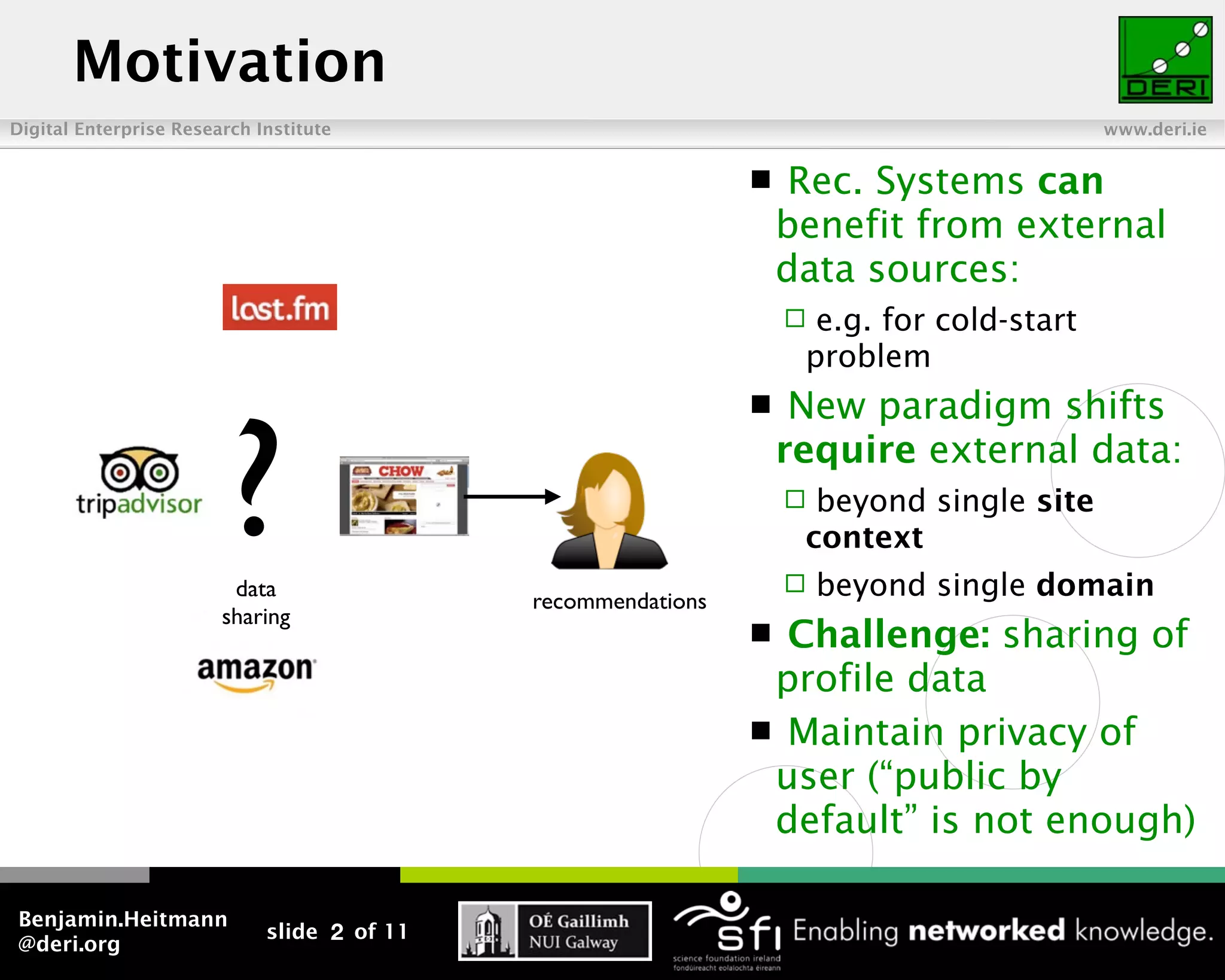
                                                                   Rec. Systems can
                                                                   benefit from external
                                                                   data sources:
                                                                    e.g. for cold-start
                                                                    problem


                         ?
                                                                   New paradigm shifts
                                                                   require external data:
                                                                    beyond single site
                                                                    context
                         data
                                             recommendations
                                                                      beyond single domain
                        sharing
                                                                Challenge: sharing of
                                                                profile data
                                                                Maintain privacy of
                                                                user (“public by
                                                                default” is not enough)

Benjamin.Heitmann
                             slide 2 of 11
@deri.org
Outline
Digital Enterprise Research Institute                         www.deri.ie


         The challenge: portable and private user profiles

         Background: Introducing Linked Data

         An architecture to enable portable and private
         user profiles
            Foundation standards
            Roles
            Communication pattern


         Qualitative evaluation
         Related work

Benjamin.Heitmann
                             slide 3 of 11
@deri.org
The challenge:
       portable and private user profiles
Digital Enterprise Research Institute                                                         www.deri.ie


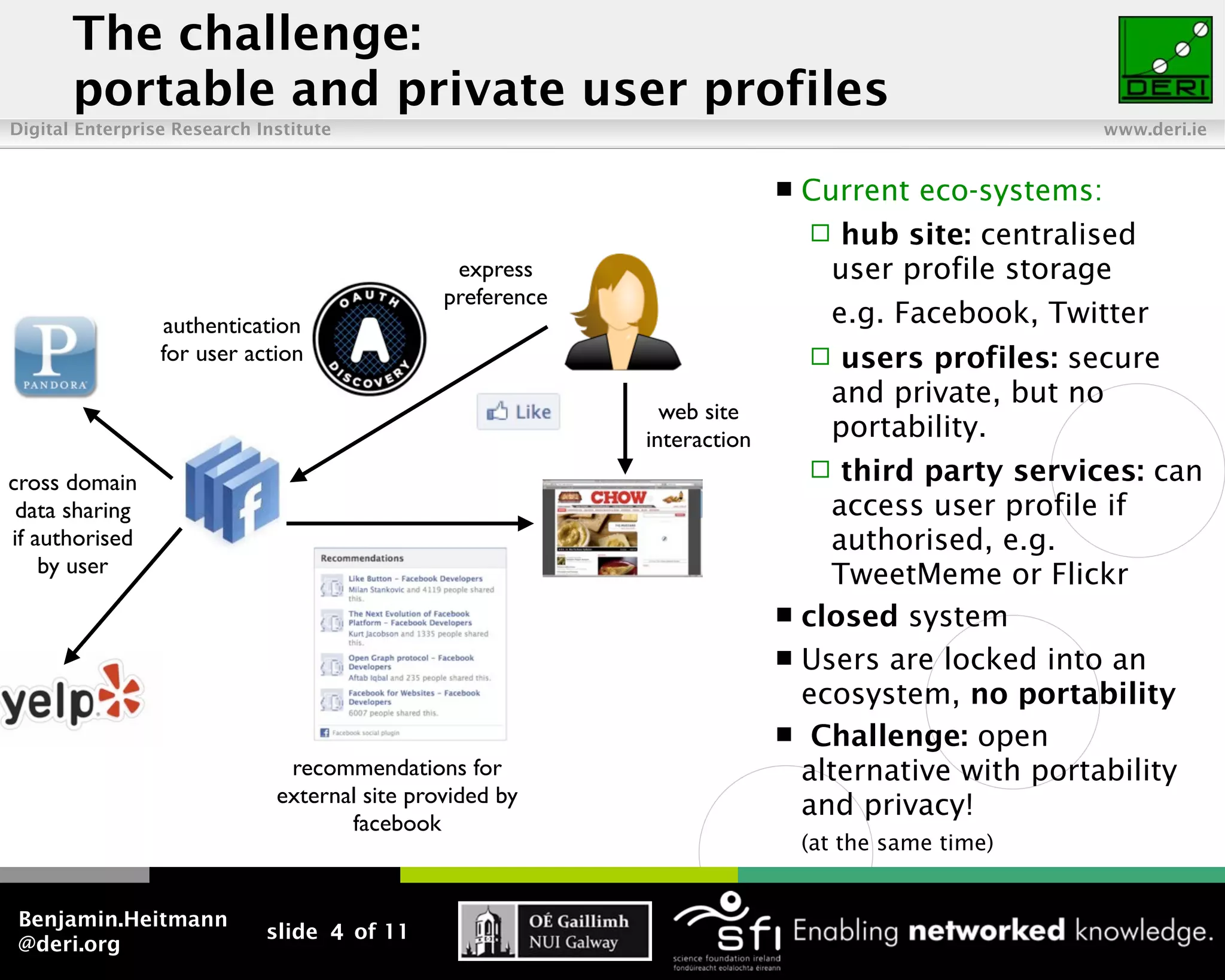
                                                                        Current eco-systems:
                                                                          hub site: centralised
                                                express                    user profile storage
                                               preference
                 authentication                                            e.g. Facebook, Twitter
                 for user action                                            users profiles: secure
                                                                            and private, but no
                                                              web site
                                                            interaction     portability.
                                                                            third party services: can
cross domain
 data sharing                                                               access user profile if
if authorised                                                               authorised, e.g.
    by user                                                                 TweetMeme or Flickr
                                                                         closed system
                                                                         Users are locked into an
                                                                          ecosystem, no portability
                                                                         Challenge: open
                               recommendations for                        alternative with portability
                              external site provided by                   and privacy!
                                     facebook
                                                                         (at the same time)


 Benjamin.Heitmann
                             slide 4 of 11
 @deri.org
Background:
       The Web of Data and Linked Data
Digital Enterprise Research Institute                                         www.deri.ie


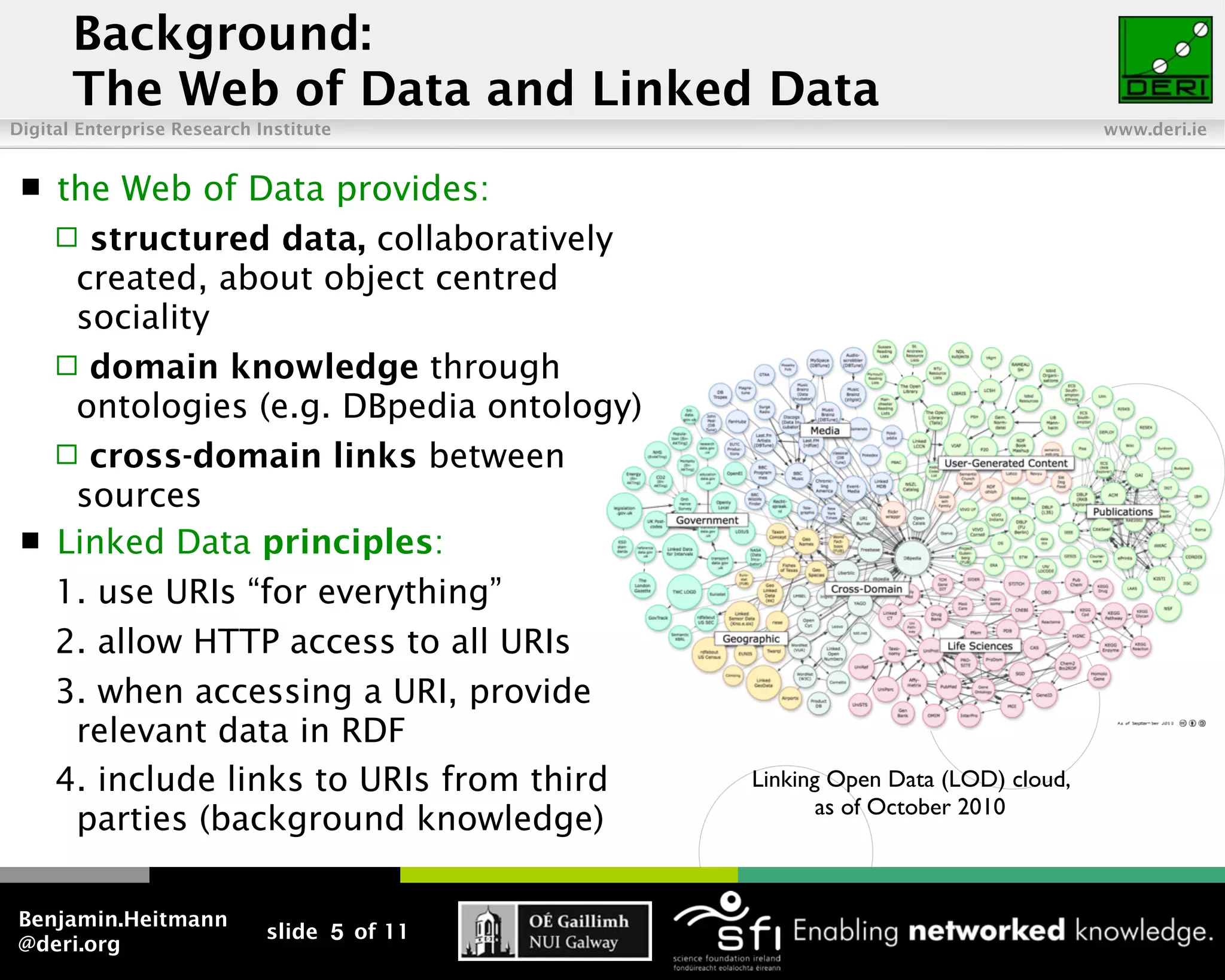
    the Web of Data provides:
      structured data, collaboratively
      created, about object centred
      sociality
      domain knowledge through
      ontologies (e.g. DBpedia ontology)
      cross-domain links between
      sources
    Linked Data principles:
     1. use URIs “for everything”
     2. allow HTTP access to all URIs
     3. when accessing a URI, provide
      relevant data in RDF
     4. include links to URIs from third     Linking Open Data (LOD) cloud,
                                                    as of October 2010
      parties (background knowledge)

Benjamin.Heitmann
                             slide 5 of 11
@deri.org
Foundation standards
Digital Enterprise Research Institute                                                          www.deri.ie


                                                      no logo


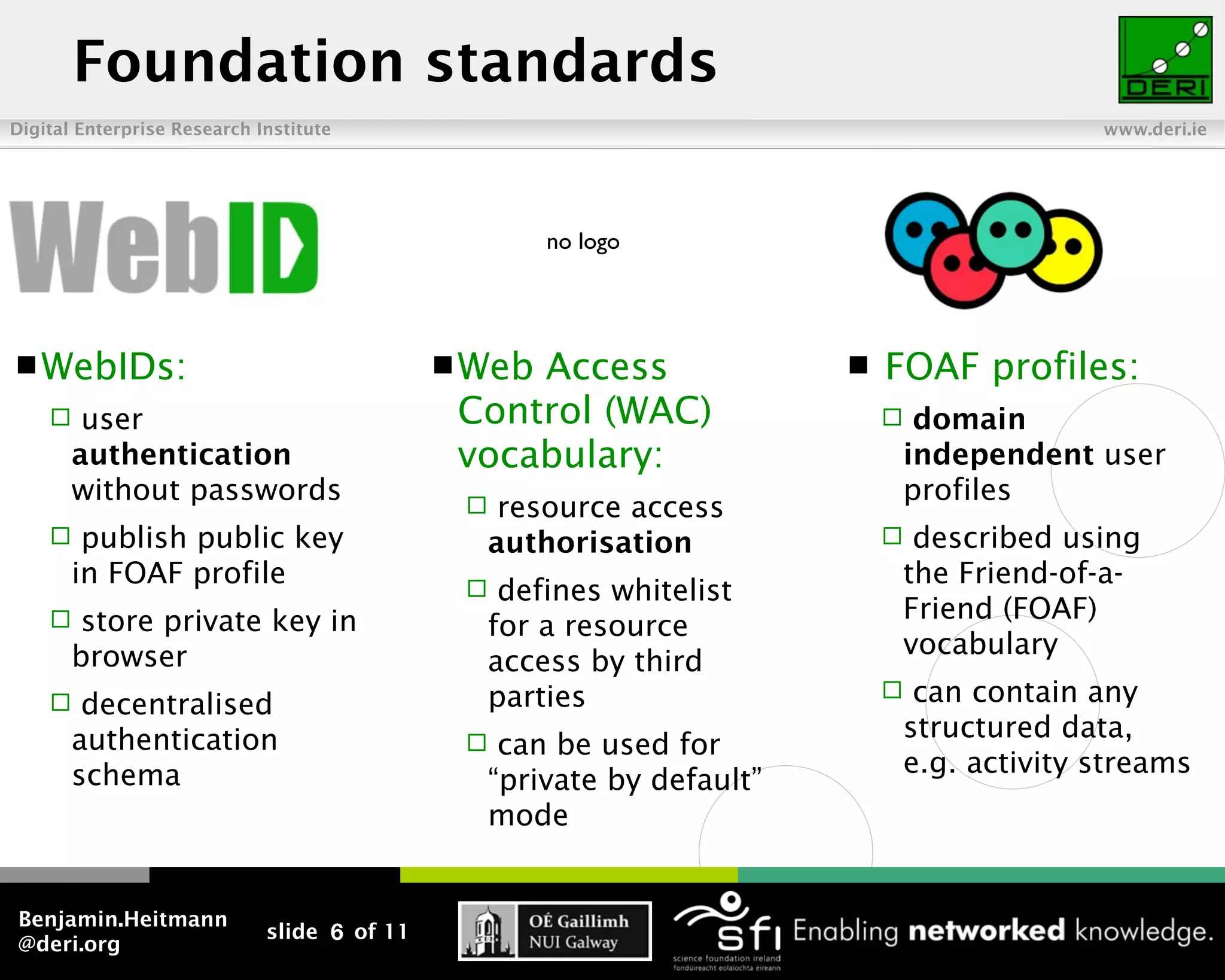
 WebIDs:                                     WebAccess                    FOAF profiles:
        user                                 Control (WAC)                      domain
        authentication                        vocabulary:                        independent user
        without passwords                                                        profiles
                                                  resource access
        publish public key                       authorisation                  described using
        in FOAF profile                                                          the Friend-of-a-
                                                  defines whitelist
        store private key in                                                    Friend (FOAF)
                                                  for a resource
        browser                                                                  vocabulary
                                                  access by third
        decentralised                            parties                        can contain any
        authentication                                                           structured data,
                                                  can be used for
        schema                                                                   e.g. activity streams
                                                  “private by default”
                                                  mode


Benjamin.Heitmann
                             slide 6 of 11
@deri.org
Alternative: architecture for private and
       portable user profiles
Digital Enterprise Research Institute                                                             www.deri.ie


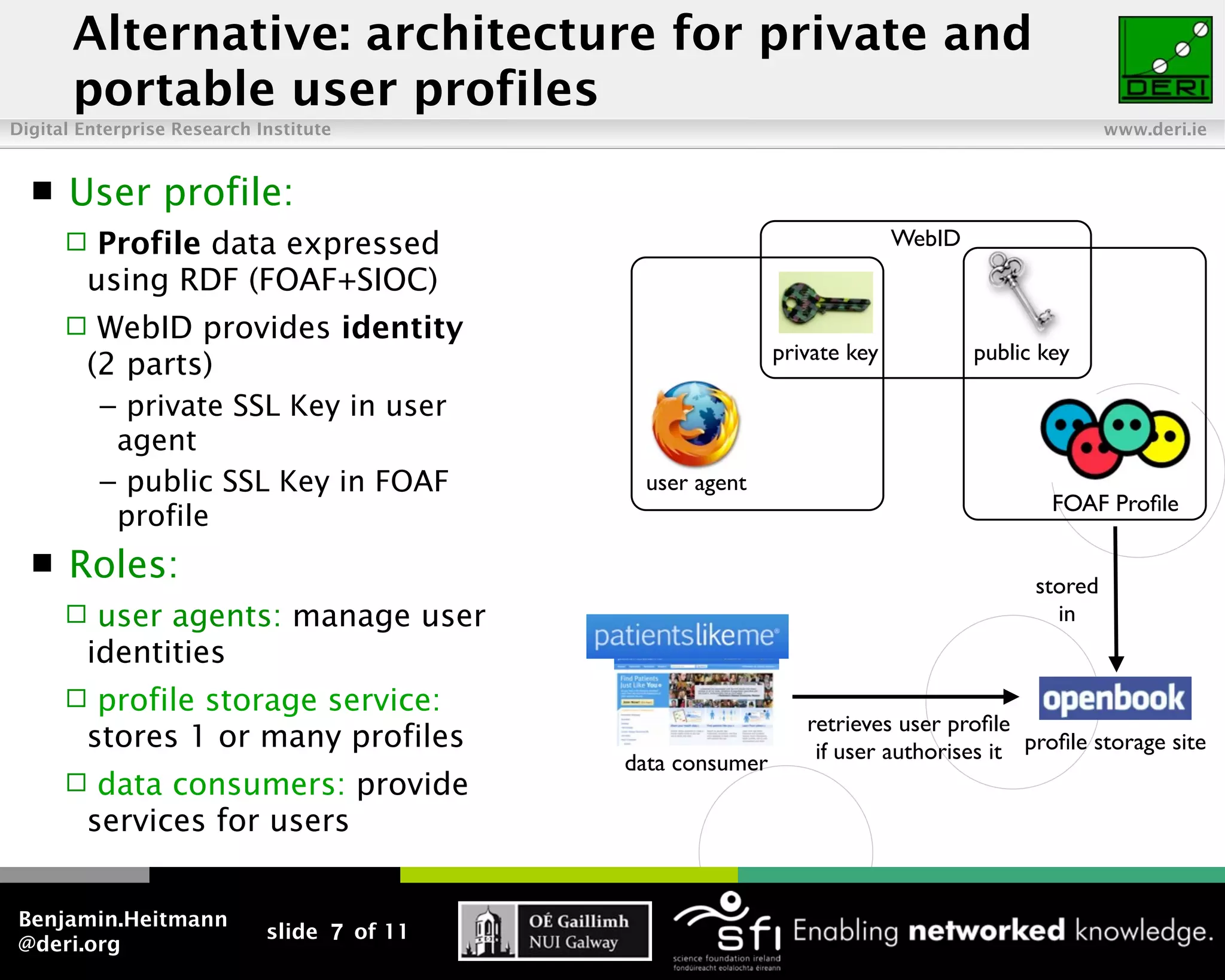
     User profile:
        Profile data expressed                                            WebID
        using RDF (FOAF+SIOC)
        WebID provides identity
                                                             private key           public key
        (2 parts)
          – private SSL Key in user
           agent
          – public SSL Key in FOAF            user agent
                                                                                           FOAF Profile
           profile
     Roles:                                                                             stored
        user agents: manage user                                                          in
        identities
        profile storage service:
                                                                retrieves user profile
        stores 1 or many profiles                                if user authorises it profile storage site
                                             data consumer
        data consumers: provide
        services for users


Benjamin.Heitmann
                             slide 7 of 11
@deri.org
Communication pattern of the proposed
       architecture
Digital Enterprise Research Institute                                                        www.deri.ie


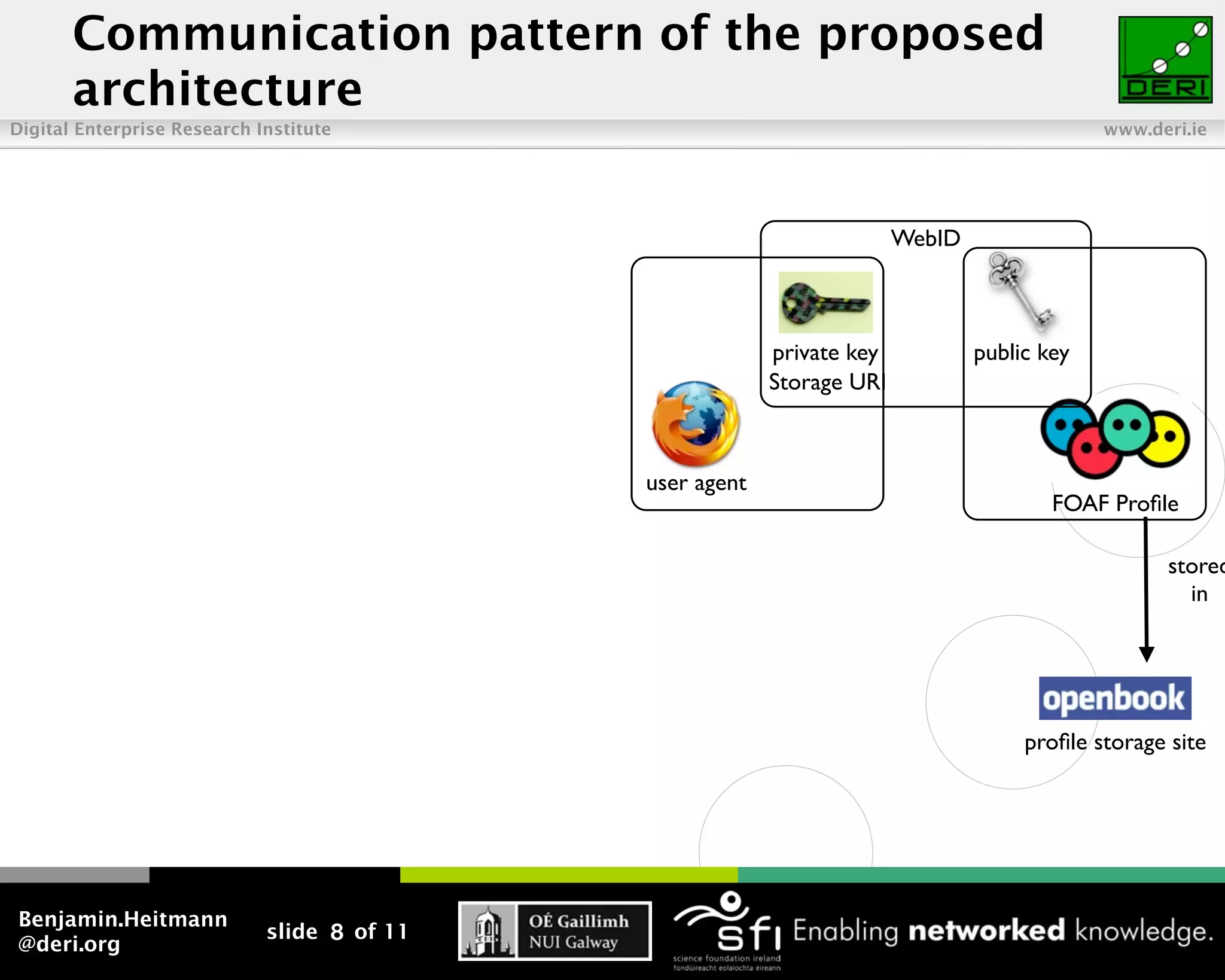
                                                                        WebID


                                                          private key           public key
                                                          Storage URI


                                             user agent
                                                                                        FOAF Profile

                                                                                                    stored
                                                                                                      in


                                                                                     profile storage site


Benjamin.Heitmann
                             slide 8 of 11
@deri.org
Communication pattern of the proposed
       architecture
Digital Enterprise Research Institute                                                        www.deri.ie


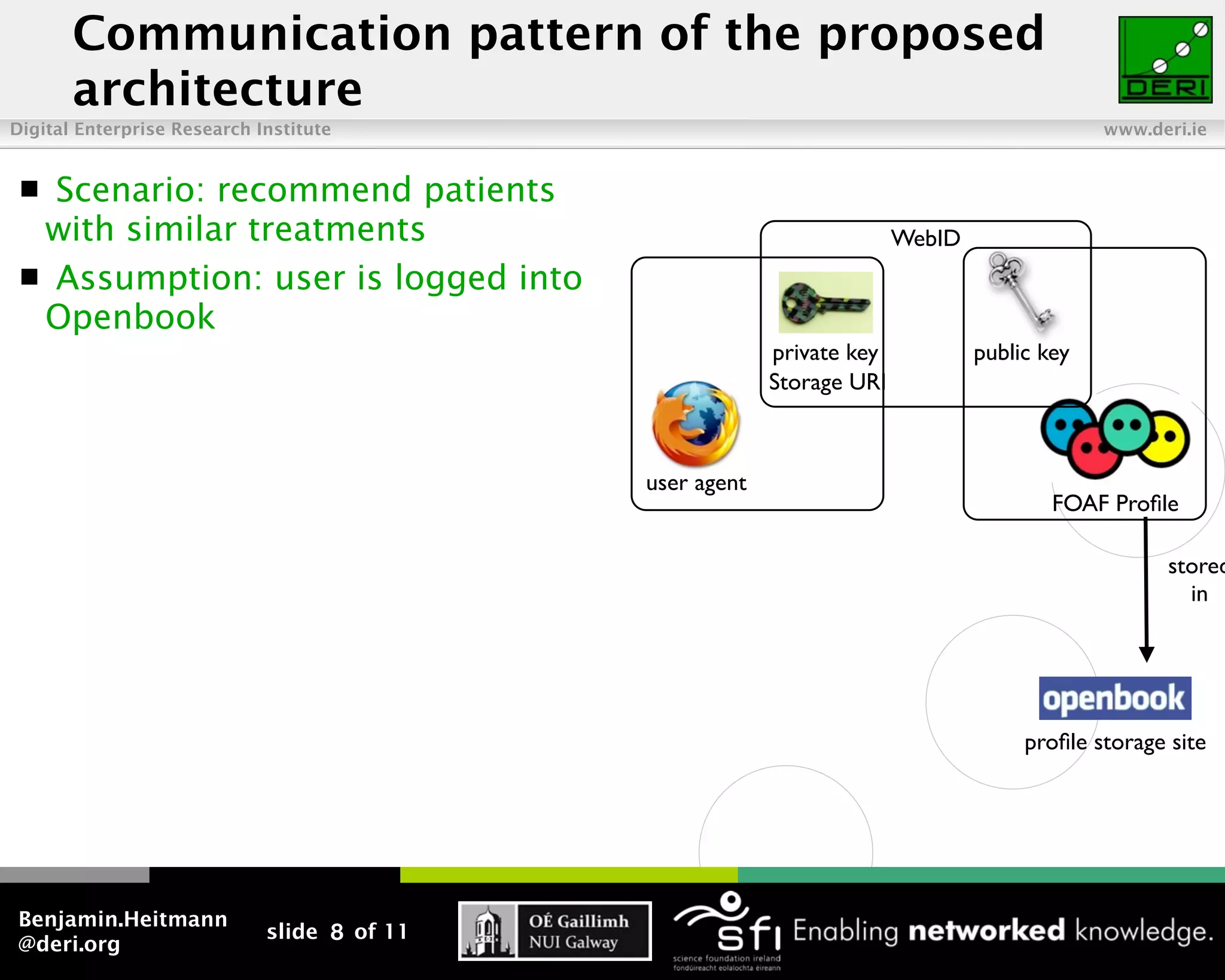
  Scenario: recommend patients
  with similar treatments                                               WebID
  Assumption: user is logged into
  Openbook
                                                          private key           public key
                                                          Storage URI


                                             user agent
                                                                                        FOAF Profile

                                                                                                    stored
                                                                                                      in


                                                                                     profile storage site


Benjamin.Heitmann
                             slide 8 of 11
@deri.org
Communication pattern of the proposed
       architecture
Digital Enterprise Research Institute                                                           www.deri.ie


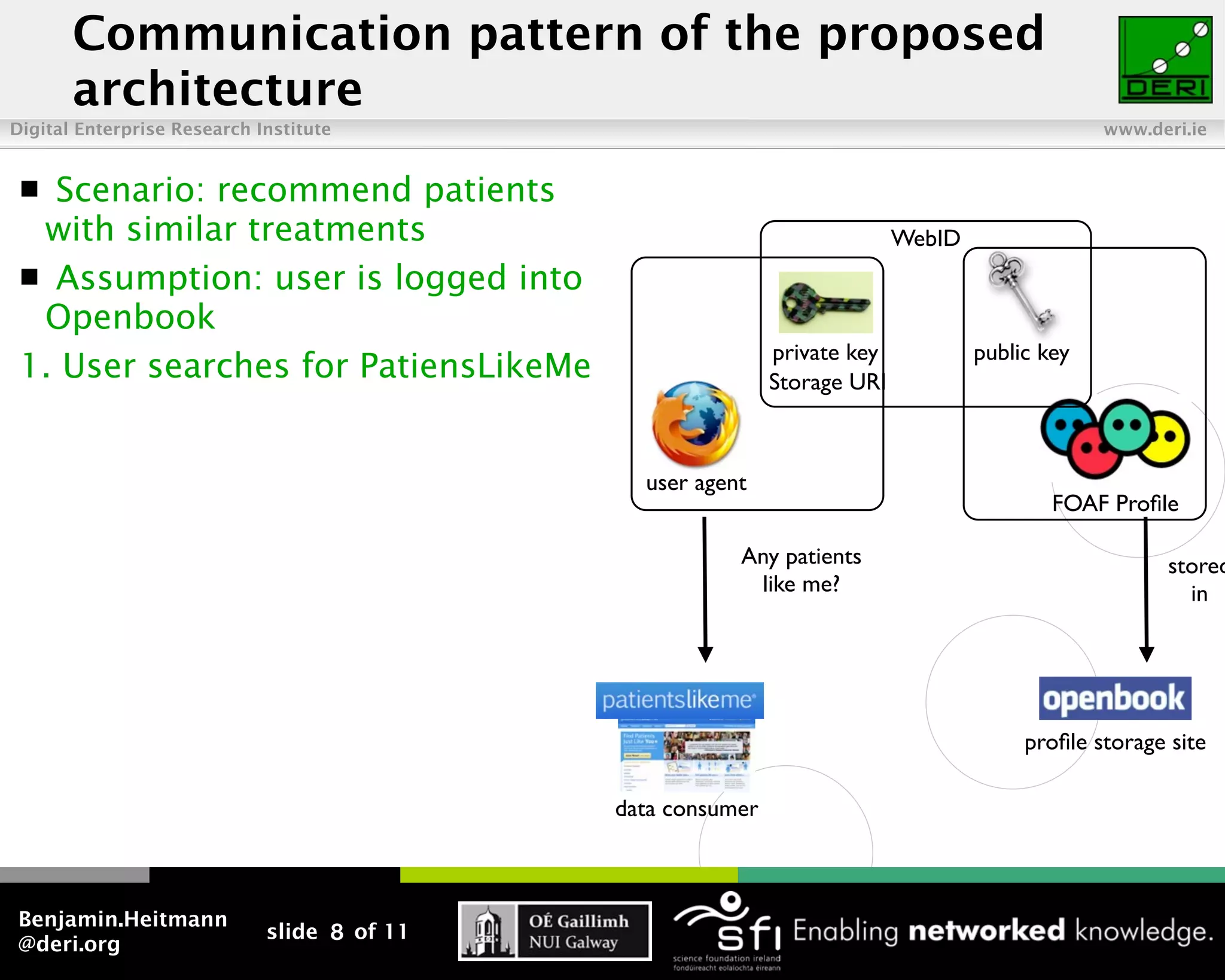
  Scenario: recommend patients
  with similar treatments                                                  WebID
  Assumption: user is logged into
  Openbook
                                                             private key           public key
 1. User searches for PatiensLikeMe                          Storage URI


                                               user agent
                                                                                           FOAF Profile

                                                        Any patients                                   stored
                                                         like me?                                        in


                                                                                        profile storage site

                                             data consumer


Benjamin.Heitmann
                             slide 8 of 11
@deri.org
Communication pattern of the proposed
       architecture
Digital Enterprise Research Institute                                                                www.deri.ie


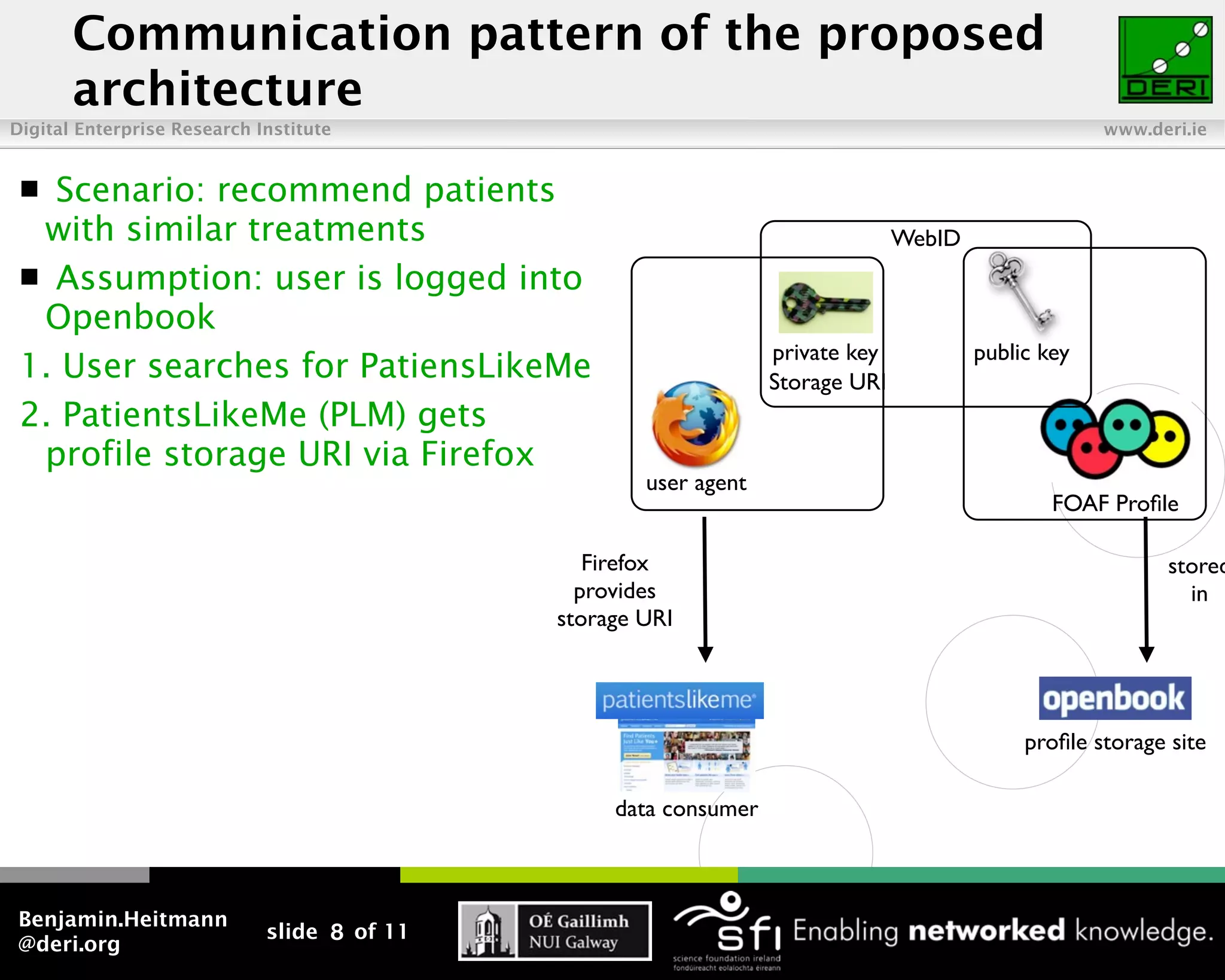
  Scenario: recommend patients
  with similar treatments                                                       WebID
  Assumption: user is logged into
  Openbook
                                                                  private key           public key
 1. User searches for PatiensLikeMe                               Storage URI
 2. PatientsLikeMe (PLM) gets
  profile storage URI via Firefox
                                                     user agent
                                                                                                FOAF Profile

                                                Firefox                                                     stored
                                               provides                                                       in
                                             storage URI


                                                                                             profile storage site

                                                  data consumer


Benjamin.Heitmann
                             slide 8 of 11
@deri.org
Communication pattern of the proposed
       architecture
Digital Enterprise Research Institute                                                           www.deri.ie


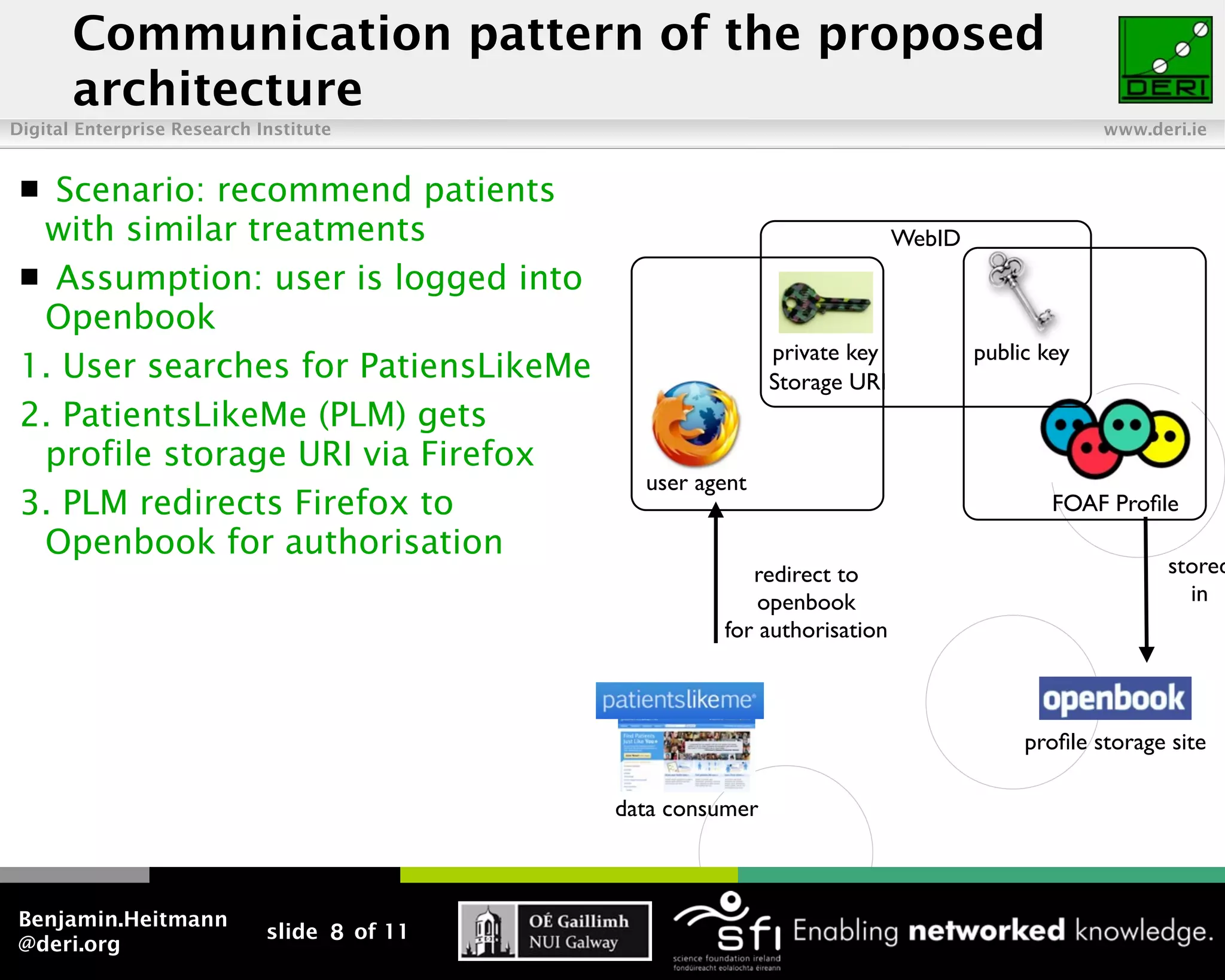
  Scenario: recommend patients
  with similar treatments                                                  WebID
  Assumption: user is logged into
  Openbook
                                                             private key           public key
 1. User searches for PatiensLikeMe                          Storage URI
 2. PatientsLikeMe (PLM) gets
  profile storage URI via Firefox
                                               user agent
 3. PLM redirects Firefox to                                                               FOAF Profile
  Openbook for authorisation
                                                         redirect to                                   stored
                                                          openbook                                       in
                                                      for authorisation


                                                                                        profile storage site

                                             data consumer


Benjamin.Heitmann
                             slide 8 of 11
@deri.org
Communication pattern of the proposed
       architecture
Digital Enterprise Research Institute                                                            www.deri.ie


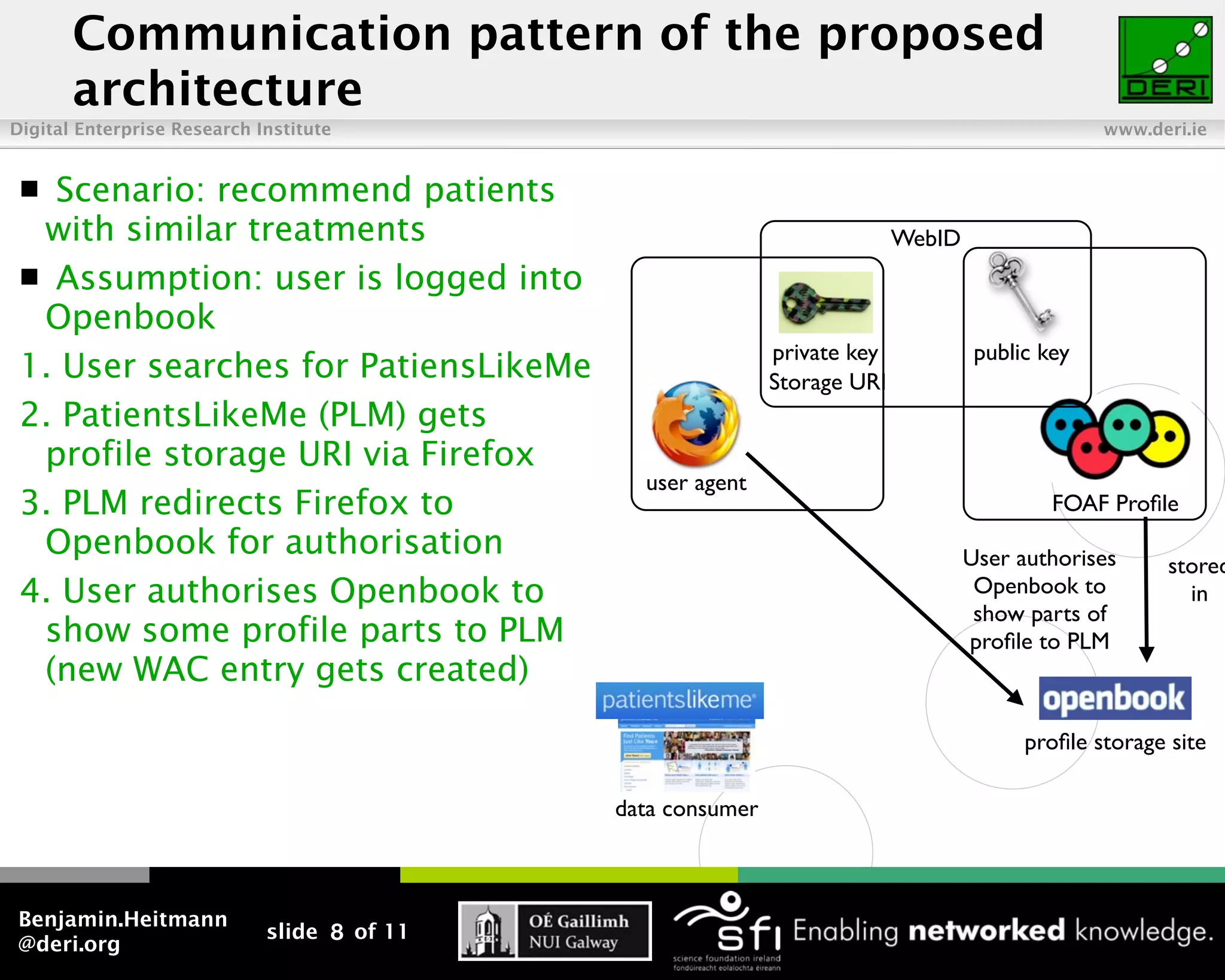
  Scenario: recommend patients
  with similar treatments                                                  WebID
  Assumption: user is logged into
  Openbook
                                                             private key            public key
 1. User searches for PatiensLikeMe                          Storage URI
 2. PatientsLikeMe (PLM) gets
  profile storage URI via Firefox
                                               user agent
 3. PLM redirects Firefox to                                                                FOAF Profile
  Openbook for authorisation                                                       User authorises      stored
 4. User authorises Openbook to                                                     Openbook to           in
                                                                                    show parts of
  show some profile parts to PLM                                                   profile to PLM
  (new WAC entry gets created)

                                                                                         profile storage site

                                             data consumer


Benjamin.Heitmann
                             slide 8 of 11
@deri.org
Communication pattern of the proposed
       architecture
Digital Enterprise Research Institute                                                           www.deri.ie


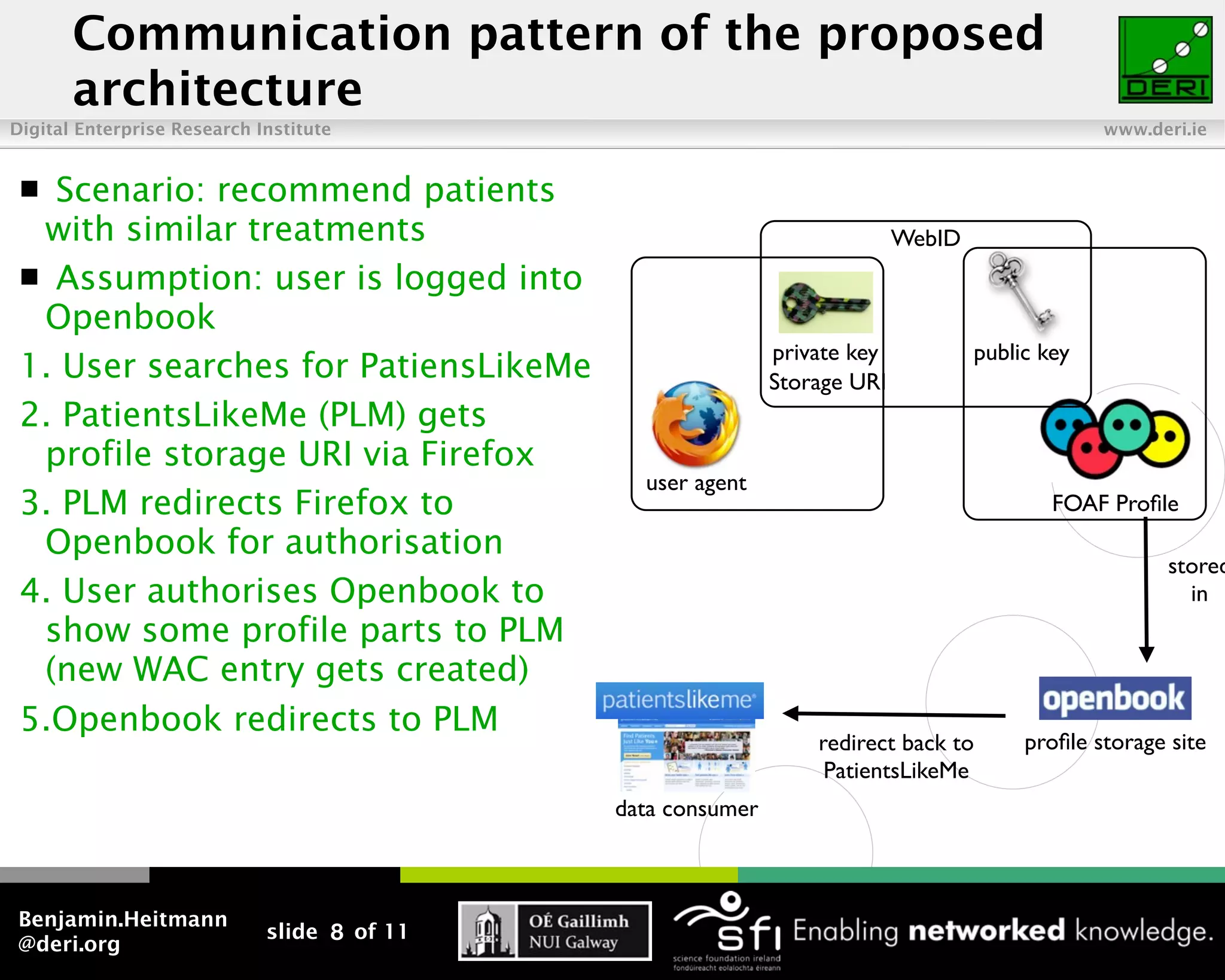
  Scenario: recommend patients
  with similar treatments                                                  WebID
  Assumption: user is logged into
  Openbook
                                                             private key           public key
 1. User searches for PatiensLikeMe                          Storage URI
 2. PatientsLikeMe (PLM) gets
  profile storage URI via Firefox
                                               user agent
 3. PLM redirects Firefox to                                                               FOAF Profile
  Openbook for authorisation
                                                                                                       stored
 4. User authorises Openbook to                                                                          in
  show some profile parts to PLM
  (new WAC entry gets created)
 5.Openbook redirects to PLM
                                                                 redirect back to       profile storage site
                                                                  PatientsLikeMe
                                             data consumer


Benjamin.Heitmann
                             slide 8 of 11
@deri.org
Communication pattern of the proposed
       architecture
Digital Enterprise Research Institute                                                           www.deri.ie


  Scenario: recommend patients
  with similar treatments                                                  WebID
  Assumption: user is logged into
  Openbook
                                                             private key           public key
 1. User searches for PatiensLikeMe                          Storage URI
 2. PatientsLikeMe (PLM) gets
  profile storage URI via Firefox
                                               user agent
 3. PLM redirects Firefox to                                                               FOAF Profile
  Openbook for authorisation
                                                                                                       stored
 4. User authorises Openbook to                                                                          in
  show some profile parts to PLM                            PatientsLikeMe retrieves profile
  (new WAC entry gets created)                                         parts now
 5.Openbook redirects to PLM
                                                                                        profile storage site
 6.Now PLM accesses parts of
  profile data on openbook                   data consumer


Benjamin.Heitmann
                             slide 8 of 11
@deri.org
Qualitative evaluation
Digital Enterprise Research Institute                                        www.deri.ie


      Based on evaluation framework for privacy enhanced
      technologies by Wang+Kobsa [20,15]
      Protection of identity:
            user can create and choose identities without constraints
            allows pseudonymity, unobservability, deniability, anonymity
            alternatively identities can be assigned by organisations
        Control over user data:
            profile data can be optionally self-hosted
            open standards allow portability, no lock-in to any ecosystem
        Non-functional requirements:
            Universality: one universal, standards based eco-system
            Scalability: no bottlenecks or central points of failure
           Reuse of infrastructure: standards from WWW and Web of Data
           are reused


Benjamin.Heitmann
                             slide 9 of 11
@deri.org
Related work (“the competition”)
Digital Enterprise Research Institute                                                              www.deri.ie


                                                                                       no logo


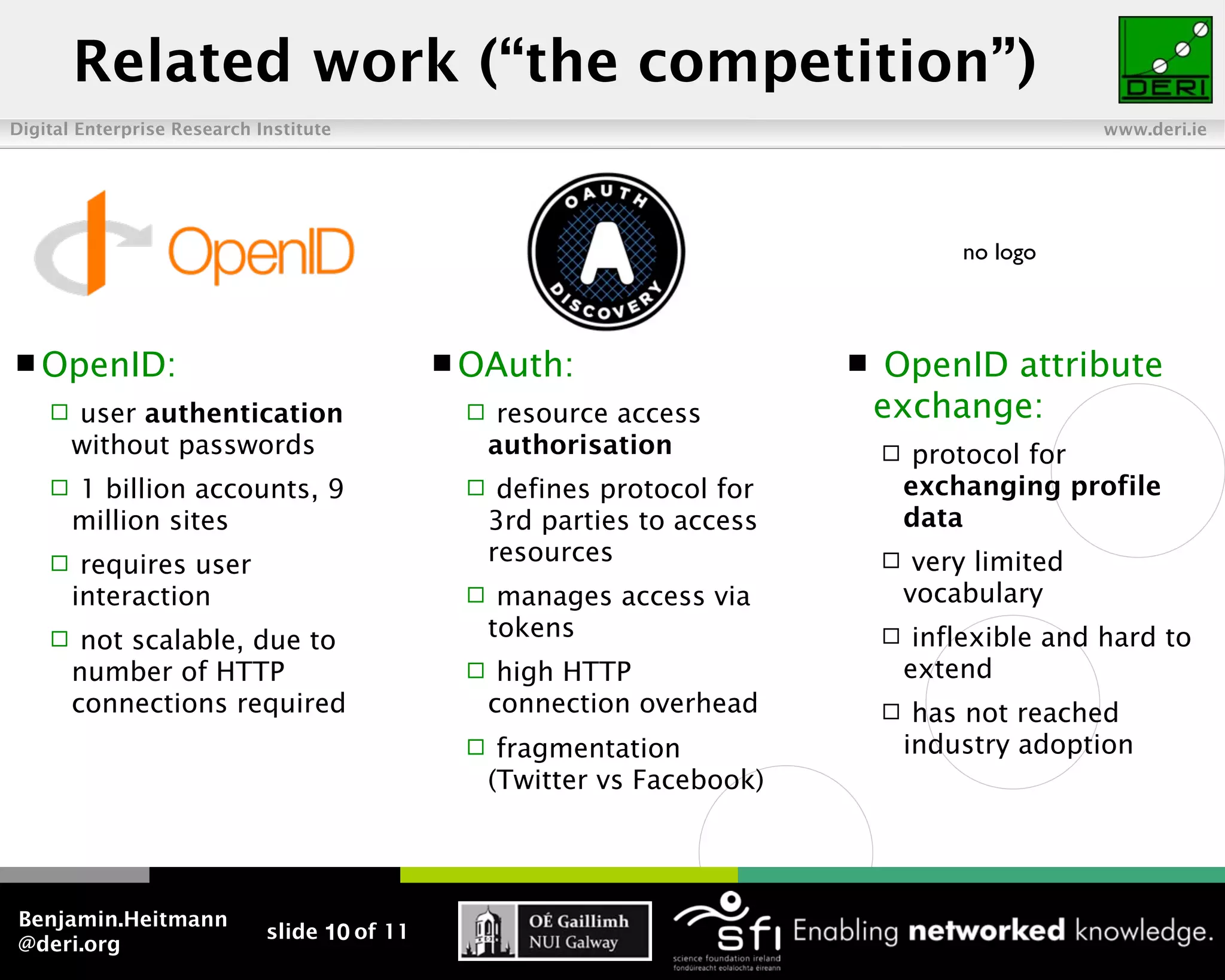
 OpenID:                                      OAuth:                         OpenID attribute
       user authentication                        resource access            exchange:
        without passwords                          authorisation                   protocol for
       1 billion accounts, 9                      defines protocol for           exchanging profile
        million sites                              3rd parties to access           data
        requires user                             resources                       very limited
        interaction                                manages access via             vocabulary
        not scalable, due to                      tokens                          inflexible and hard to
        number of HTTP                             high HTTP                      extend
        connections required                       connection overhead             has not reached
                                                   fragmentation                  industry adoption
                                                   (Twitter vs Facebook)


Benjamin.Heitmann
                             slide 10 of 11
@deri.org
Summary
Digital Enterprise Research Institute                                    www.deri.ie


         coming paradigm shifts towards
         social eco-systems:
            recommendations in a multi-site and cross-domain context
      current eco-systems are built around centralised
      and closed hub sites
      alternative: eco-systems centred around secure
      and portable user profiles (“private by default”)
            foundation: WebIDs and FOAF profiles
            provides incentives for users to share their profile data
            can enable a universal, decentralised social eco-system
        Future work: implement and evaluate prototype
         with all parties in a cross-domain setting


Benjamin.Heitmann
                             slide 11 of 11
@deri.org

An architecture for privacy-enabled user profile portability on the Web of Data

  • 1.
    Digital Enterprise ResearchInstitute www.deri.ie An architecture for privacy-enabled user profile portability on the Web of Data Benjamin Heitmann, James G. Kim, Alexandre Passant, Conor Hayes, Hong-Gee Kim Funded by Science Foundation Ireland under Grant No. SFI/08/CE/I1380 (Líon-2)  Copyright 2009 Digital Enterprise Research Institute. All rights reserved. Chapter
  • 2.
    Motivation Digital Enterprise ResearchInstitute www.deri.ie  Rec. Systems can benefit from external data sources:  e.g. for cold-start problem ?  New paradigm shifts require external data:  beyond single site context data recommendations  beyond single domain sharing  Challenge: sharing of profile data  Maintain privacy of user (“public by default” is not enough) Benjamin.Heitmann slide 2 of 11 @deri.org
  • 3.
    Outline Digital Enterprise ResearchInstitute www.deri.ie  The challenge: portable and private user profiles  Background: Introducing Linked Data  An architecture to enable portable and private user profiles  Foundation standards  Roles  Communication pattern  Qualitative evaluation  Related work Benjamin.Heitmann slide 3 of 11 @deri.org
  • 4.
    The challenge: portable and private user profiles Digital Enterprise Research Institute www.deri.ie  Current eco-systems:  hub site: centralised express user profile storage preference authentication e.g. Facebook, Twitter for user action  users profiles: secure and private, but no web site interaction portability.  third party services: can cross domain data sharing access user profile if if authorised authorised, e.g. by user TweetMeme or Flickr  closed system  Users are locked into an ecosystem, no portability  Challenge: open recommendations for alternative with portability external site provided by and privacy! facebook (at the same time) Benjamin.Heitmann slide 4 of 11 @deri.org
  • 5.
    Background: The Web of Data and Linked Data Digital Enterprise Research Institute www.deri.ie  the Web of Data provides:  structured data, collaboratively created, about object centred sociality  domain knowledge through ontologies (e.g. DBpedia ontology)  cross-domain links between sources  Linked Data principles: 1. use URIs “for everything” 2. allow HTTP access to all URIs 3. when accessing a URI, provide relevant data in RDF 4. include links to URIs from third Linking Open Data (LOD) cloud, as of October 2010 parties (background knowledge) Benjamin.Heitmann slide 5 of 11 @deri.org
  • 6.
    Foundation standards Digital EnterpriseResearch Institute www.deri.ie no logo  WebIDs:  WebAccess  FOAF profiles:  user Control (WAC)  domain authentication vocabulary: independent user without passwords profiles  resource access  publish public key authorisation  described using in FOAF profile the Friend-of-a-  defines whitelist  store private key in Friend (FOAF) for a resource browser vocabulary access by third  decentralised parties  can contain any authentication structured data,  can be used for schema e.g. activity streams “private by default” mode Benjamin.Heitmann slide 6 of 11 @deri.org
  • 7.
    Alternative: architecture forprivate and portable user profiles Digital Enterprise Research Institute www.deri.ie  User profile:  Profile data expressed WebID using RDF (FOAF+SIOC)  WebID provides identity private key public key (2 parts) – private SSL Key in user agent – public SSL Key in FOAF user agent FOAF Profile profile  Roles: stored  user agents: manage user in identities  profile storage service: retrieves user profile stores 1 or many profiles if user authorises it profile storage site data consumer  data consumers: provide services for users Benjamin.Heitmann slide 7 of 11 @deri.org
  • 8.
    Communication pattern ofthe proposed architecture Digital Enterprise Research Institute www.deri.ie WebID private key public key Storage URI user agent FOAF Profile stored in profile storage site Benjamin.Heitmann slide 8 of 11 @deri.org
  • 9.
    Communication pattern ofthe proposed architecture Digital Enterprise Research Institute www.deri.ie  Scenario: recommend patients with similar treatments WebID  Assumption: user is logged into Openbook private key public key Storage URI user agent FOAF Profile stored in profile storage site Benjamin.Heitmann slide 8 of 11 @deri.org
  • 10.
    Communication pattern ofthe proposed architecture Digital Enterprise Research Institute www.deri.ie  Scenario: recommend patients with similar treatments WebID  Assumption: user is logged into Openbook private key public key 1. User searches for PatiensLikeMe Storage URI user agent FOAF Profile Any patients stored like me? in profile storage site data consumer Benjamin.Heitmann slide 8 of 11 @deri.org
  • 11.
    Communication pattern ofthe proposed architecture Digital Enterprise Research Institute www.deri.ie  Scenario: recommend patients with similar treatments WebID  Assumption: user is logged into Openbook private key public key 1. User searches for PatiensLikeMe Storage URI 2. PatientsLikeMe (PLM) gets profile storage URI via Firefox user agent FOAF Profile Firefox stored provides in storage URI profile storage site data consumer Benjamin.Heitmann slide 8 of 11 @deri.org
  • 12.
    Communication pattern ofthe proposed architecture Digital Enterprise Research Institute www.deri.ie  Scenario: recommend patients with similar treatments WebID  Assumption: user is logged into Openbook private key public key 1. User searches for PatiensLikeMe Storage URI 2. PatientsLikeMe (PLM) gets profile storage URI via Firefox user agent 3. PLM redirects Firefox to FOAF Profile Openbook for authorisation redirect to stored openbook in for authorisation profile storage site data consumer Benjamin.Heitmann slide 8 of 11 @deri.org
  • 13.
    Communication pattern ofthe proposed architecture Digital Enterprise Research Institute www.deri.ie  Scenario: recommend patients with similar treatments WebID  Assumption: user is logged into Openbook private key public key 1. User searches for PatiensLikeMe Storage URI 2. PatientsLikeMe (PLM) gets profile storage URI via Firefox user agent 3. PLM redirects Firefox to FOAF Profile Openbook for authorisation User authorises stored 4. User authorises Openbook to Openbook to in show parts of show some profile parts to PLM profile to PLM (new WAC entry gets created) profile storage site data consumer Benjamin.Heitmann slide 8 of 11 @deri.org
  • 14.
    Communication pattern ofthe proposed architecture Digital Enterprise Research Institute www.deri.ie  Scenario: recommend patients with similar treatments WebID  Assumption: user is logged into Openbook private key public key 1. User searches for PatiensLikeMe Storage URI 2. PatientsLikeMe (PLM) gets profile storage URI via Firefox user agent 3. PLM redirects Firefox to FOAF Profile Openbook for authorisation stored 4. User authorises Openbook to in show some profile parts to PLM (new WAC entry gets created) 5.Openbook redirects to PLM redirect back to profile storage site PatientsLikeMe data consumer Benjamin.Heitmann slide 8 of 11 @deri.org
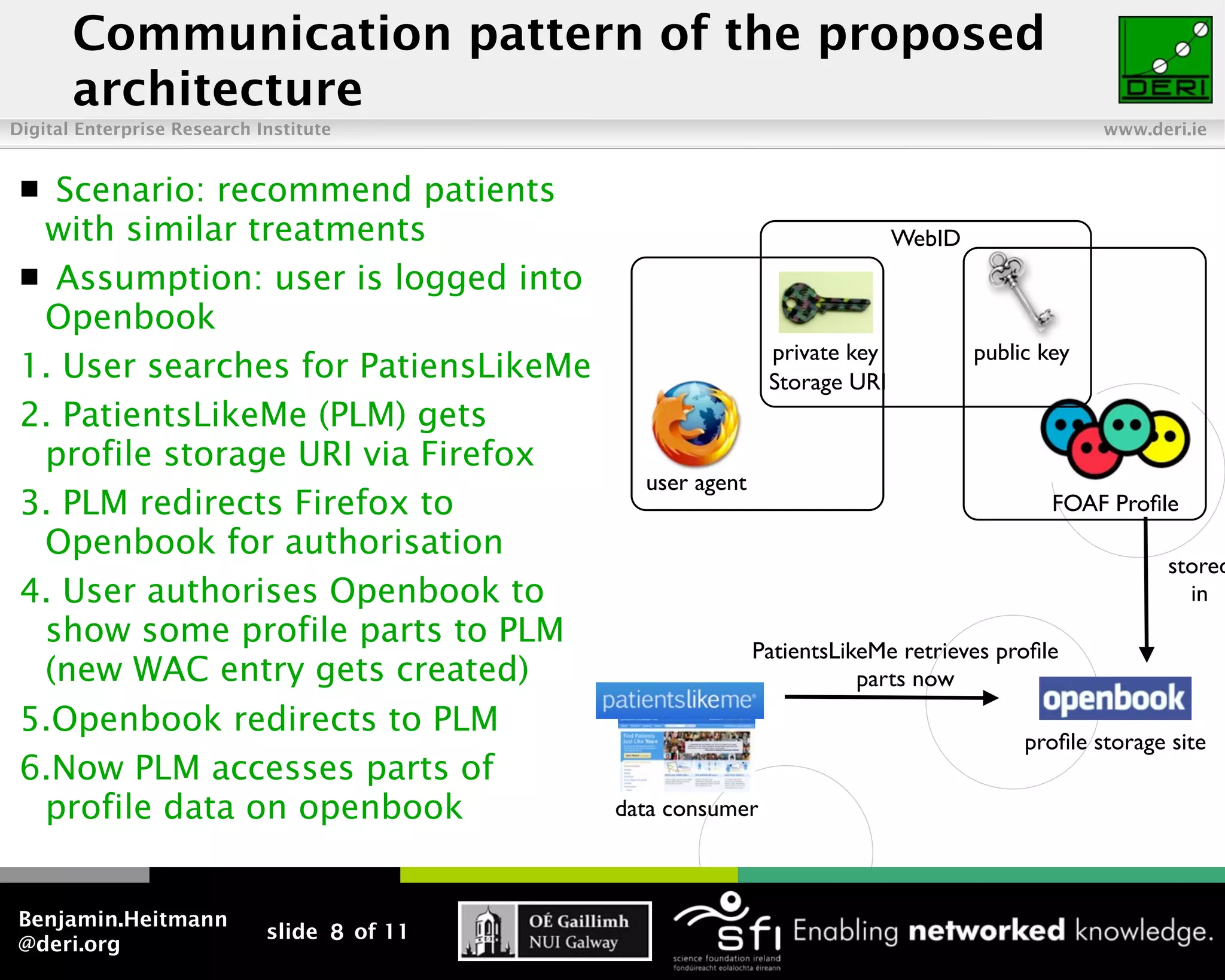
  • 15.
    Communication pattern ofthe proposed architecture Digital Enterprise Research Institute www.deri.ie  Scenario: recommend patients with similar treatments WebID  Assumption: user is logged into Openbook private key public key 1. User searches for PatiensLikeMe Storage URI 2. PatientsLikeMe (PLM) gets profile storage URI via Firefox user agent 3. PLM redirects Firefox to FOAF Profile Openbook for authorisation stored 4. User authorises Openbook to in show some profile parts to PLM PatientsLikeMe retrieves profile (new WAC entry gets created) parts now 5.Openbook redirects to PLM profile storage site 6.Now PLM accesses parts of profile data on openbook data consumer Benjamin.Heitmann slide 8 of 11 @deri.org
  • 16.
    Qualitative evaluation Digital EnterpriseResearch Institute www.deri.ie  Based on evaluation framework for privacy enhanced technologies by Wang+Kobsa [20,15]  Protection of identity:  user can create and choose identities without constraints  allows pseudonymity, unobservability, deniability, anonymity  alternatively identities can be assigned by organisations  Control over user data:  profile data can be optionally self-hosted  open standards allow portability, no lock-in to any ecosystem  Non-functional requirements:  Universality: one universal, standards based eco-system  Scalability: no bottlenecks or central points of failure  Reuse of infrastructure: standards from WWW and Web of Data are reused Benjamin.Heitmann slide 9 of 11 @deri.org
  • 17.
    Related work (“thecompetition”) Digital Enterprise Research Institute www.deri.ie no logo  OpenID:  OAuth:  OpenID attribute  user authentication  resource access exchange: without passwords authorisation  protocol for  1 billion accounts, 9  defines protocol for exchanging profile million sites 3rd parties to access data  requires user resources  very limited interaction  manages access via vocabulary  not scalable, due to tokens  inflexible and hard to number of HTTP  high HTTP extend connections required connection overhead  has not reached  fragmentation industry adoption (Twitter vs Facebook) Benjamin.Heitmann slide 10 of 11 @deri.org
  • 18.
    Summary Digital Enterprise ResearchInstitute www.deri.ie  coming paradigm shifts towards social eco-systems:  recommendations in a multi-site and cross-domain context  current eco-systems are built around centralised and closed hub sites  alternative: eco-systems centred around secure and portable user profiles (“private by default”)  foundation: WebIDs and FOAF profiles  provides incentives for users to share their profile data  can enable a universal, decentralised social eco-system  Future work: implement and evaluate prototype with all parties in a cross-domain setting Benjamin.Heitmann slide 11 of 11 @deri.org