Global patent index
An advanced tool for searching
the EPO's worldwide patent data
What can Global patent index do for you?
What is in Global patent index?
Global patent index is the right complementary tool
to Espacenet if you need:
Everything you need
to know before you start
>Fast, precise and detailed patent searches
>Patent monitoring
>Results customisable to your needs
>Simple statistics
>More than 90 million patents from the EPO's worldwide patent data
collection (over 90 patent granting authorities)
>Bibliographic data and abstracts
>Citation data
>Legal status and patent family data
>National and international patent classification data
>Machine translation (Patent Translate) for titles and abstracts
>Hyperlinks to the original patent documents in PDF format and to
drawings (mosaics) in Espacenet
>Secure (https) access
>Powerful, precise and detailed control over your search
>A tool for submitting long and complex queries
>Access to the data indexes so that you can verify formats and
spelling variations of the search terms
>A means of filtering the results at family or patent document level
>A means of retrieving documents according to their kind code
>A tool for visualising results statistically
>Customisable display and export for your results
>Exports in various formats
Getting started
Register for your two-month free trial by going to
www.epo.org/gpi
Once you have received your login name and password by
email, click on the Open Global patent index button at
www.epo.org/gpi, log in and select Global patent index from
the list of databases.
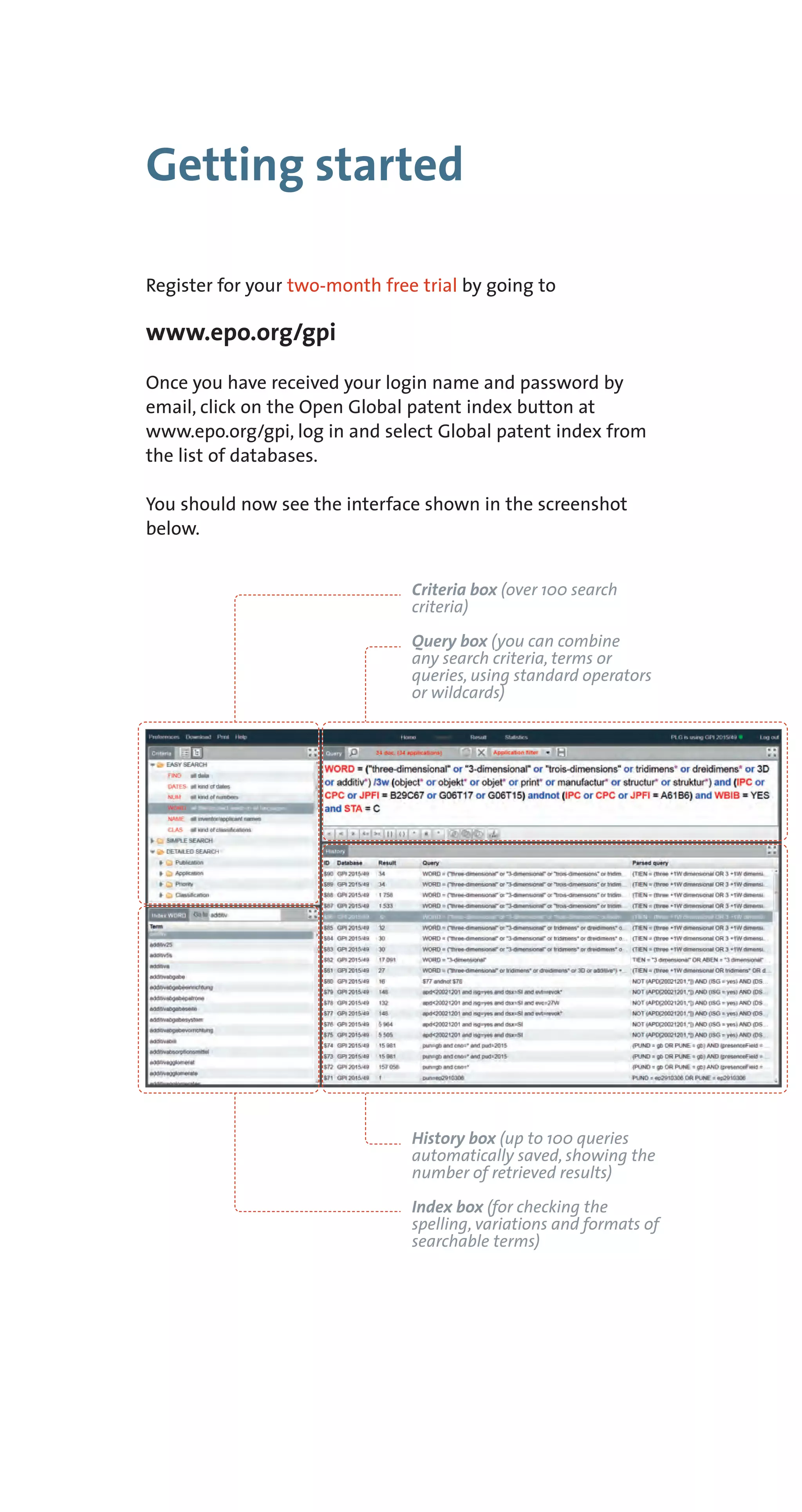
You should now see the interface shown in the screenshot
below.
Criteria box (over 100 search
criteria)
Query box (you can combine
any search criteria, terms or
queries, using standard operators
or wildcards)
History box (up to 100 queries
automatically saved, showing the
number of retrieved results)
Index box (for checking the
spelling, variations and formats of
searchable terms)
Searching with
Global patent index
To proceed, type your search query in the Query box,
using any search criteria and terms you require and
combining them with the required operators (Boolean,
proximity, arithmetic) or wildcards.
To help you build your query, the following features are
available:
> the operator toolbar
(simply clicking on an icon will place it in your query)
> the Criteria box to find the right search criteria (you can
double-click or drag and drop the search criteria to
place them in the Query box)
> the Index box to check the spelling, variations and
formats of search terms (you can double-click or drag and
drop the search term to place it in the Query box)
> the History box to check the correct formulation of your
queries and combine any past queries (e.g. $54 andnot $57)
> the option of saving queries on your own computer and
reloading them, e.g. for regular monitoring.
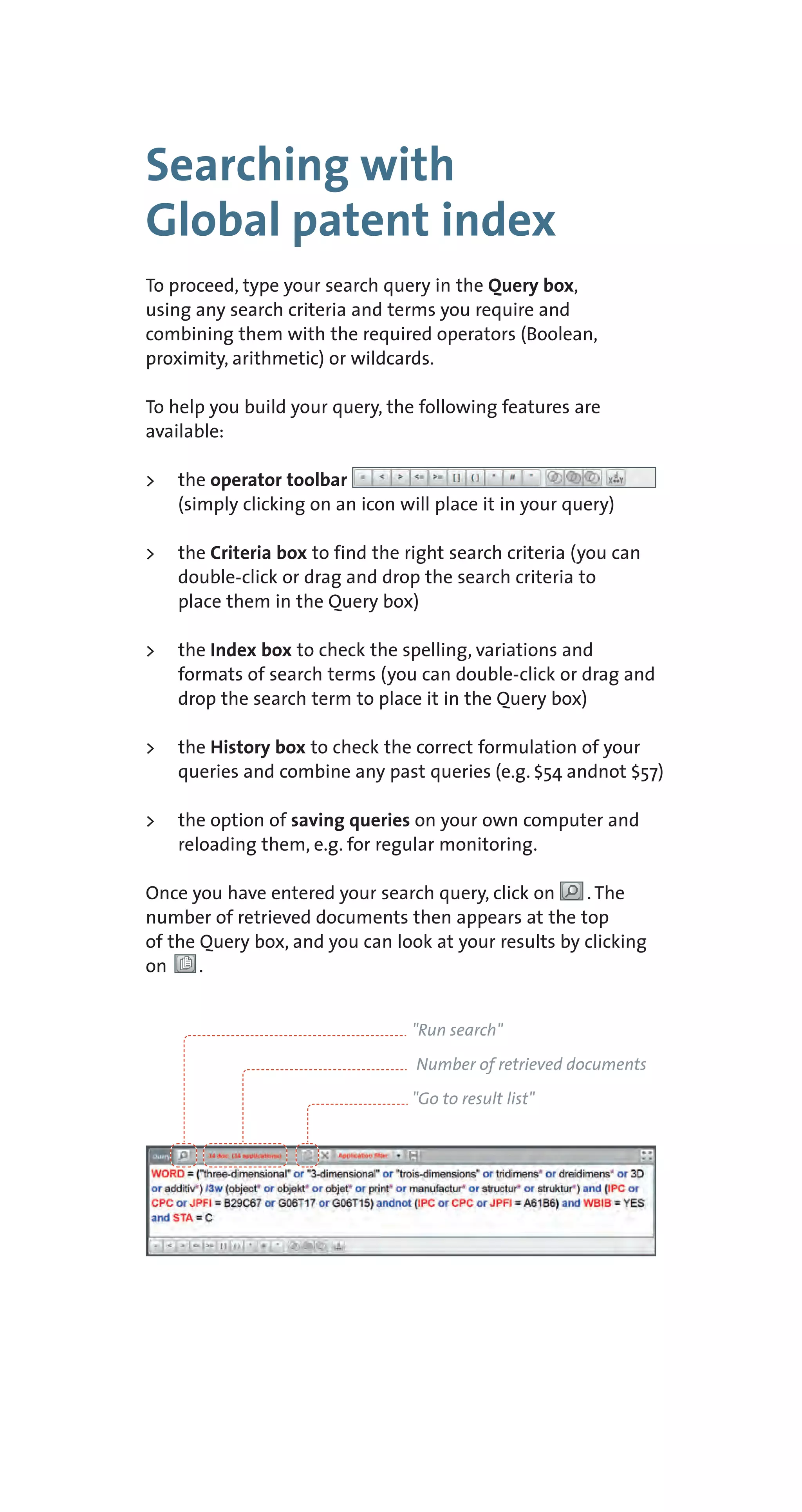
Once you have entered your search query, click on . The
number of retrieved documents then appears at the top
of the Query box, and you can look at your results by clicking
on .
"Run search"
Number of retrieved documents
"Go to result list"
Looking at the results
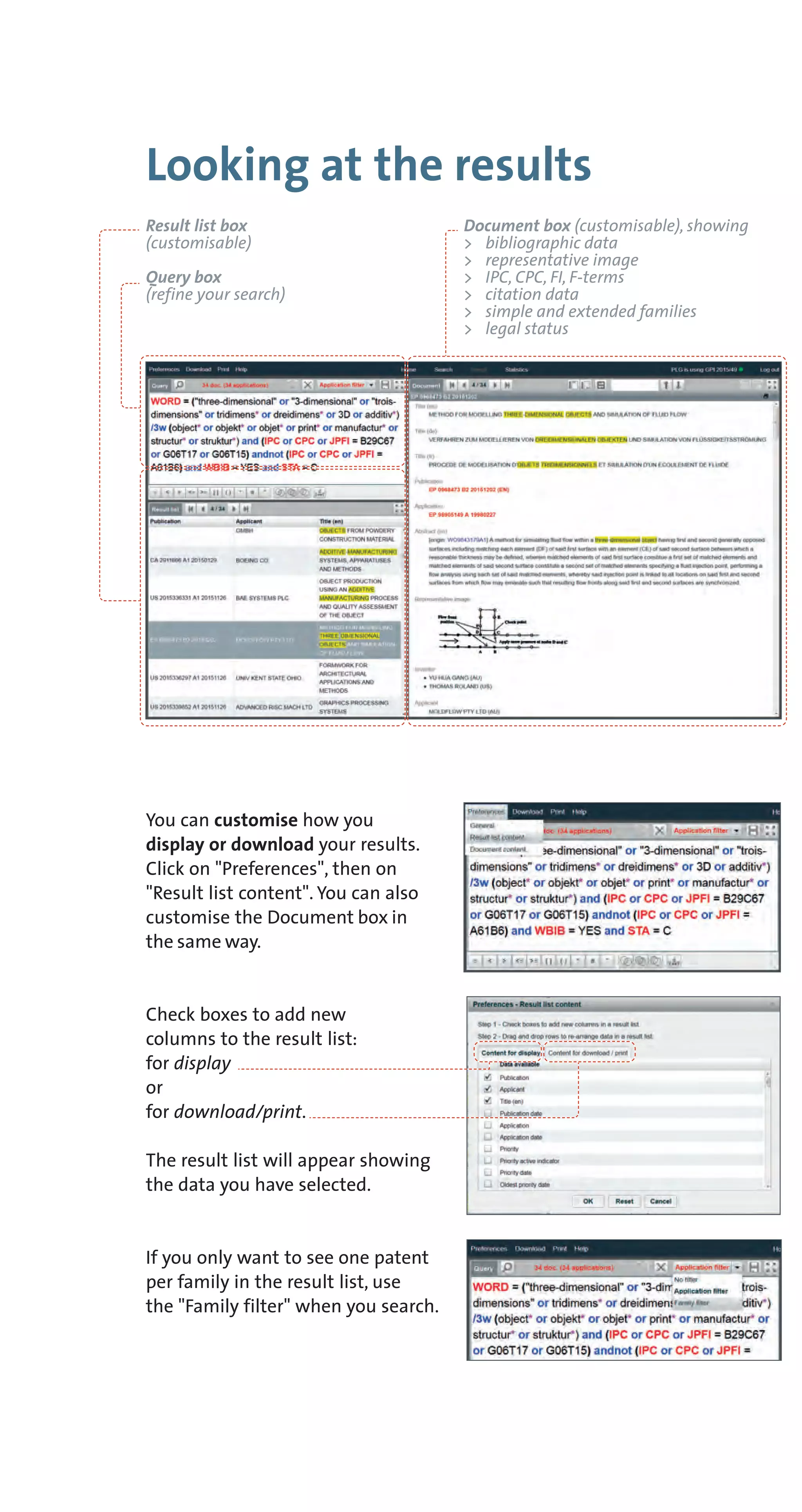
You can customise how you
display or download your results.
Click on "Preferences", then on
"Result list content". You can also
customise the Document box in
the same way.
Check boxes to add new
columns to the result list:
for display
or
for download/print.
The result list will appear showing
the data you have selected.
If you only want to see one patent
per family in the result list, use
the "Family filter" when you search.
Result list box
(customisable)
Query box
(refine your search)
Document box (customisable), showing
> bibliographic data
> representative image
> IPC, CPC, FI, F-terms
> citation data
> simple and extended families
> legal status
Analysing and sharing
your results
Visualising your results
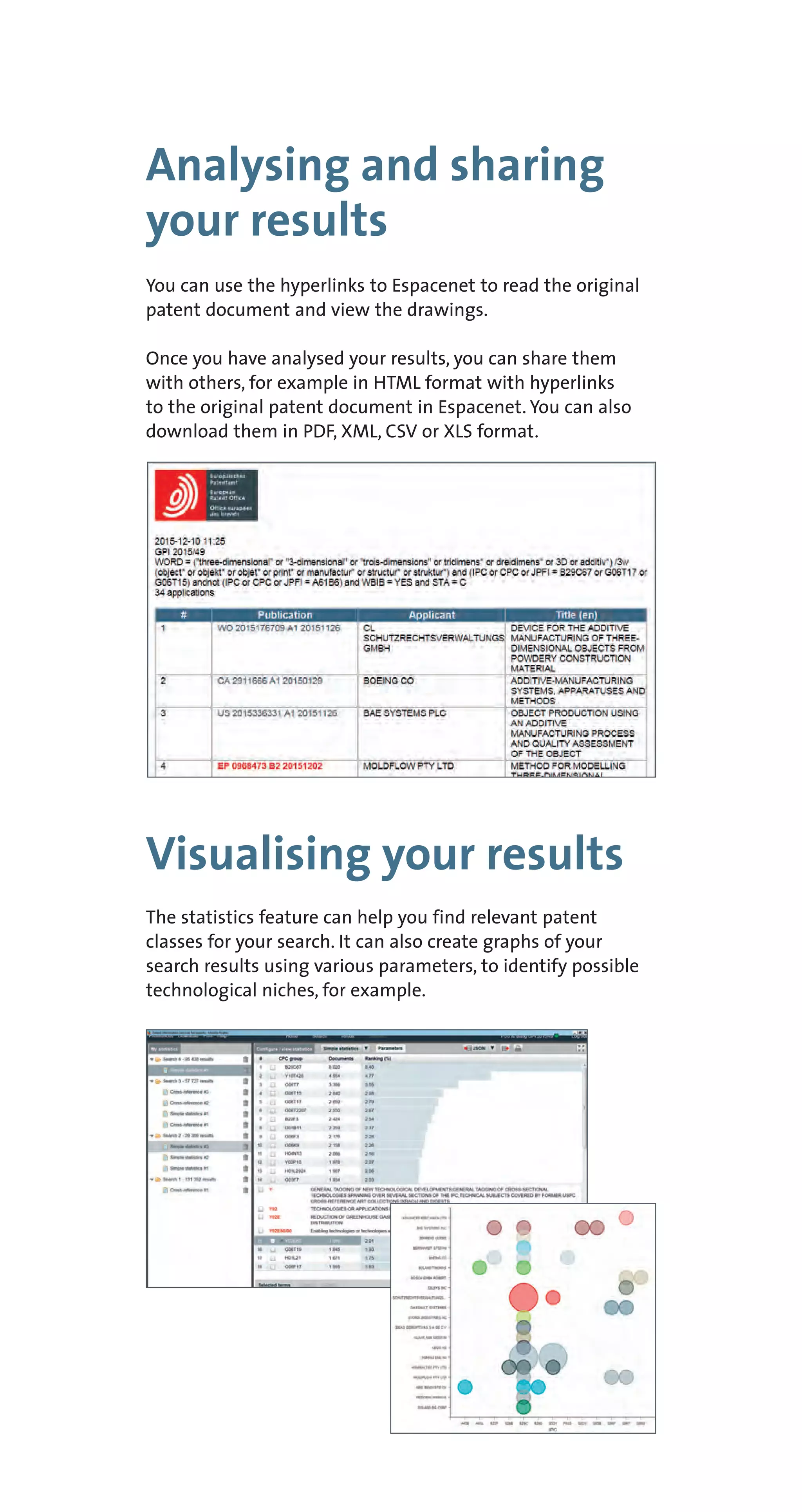
You can use the hyperlinks to Espacenet to read the original
patent document and view the drawings.
Once you have analysed your results, you can share them
with others, for example in HTML format with hyperlinks
to the original patent document in Espacenet. You can also
download them in PDF, XML, CSV or XLS format.
The statistics feature can help you find relevant patent
classes for your search. It can also create graphs of your
search results using various parameters, to identify possible
technological niches, for example.
Published and edited by European Patent Office,Vienna, Austria © EPO 2015 All rights reserved
Examples of search criteria
Search operators
Search criteria
Operator
Description
Description
Example
Additional resources
Online manual: www.epo.org/gpi
Free online classroom sessions: www.epo.org/gpi
Helpdesk: patentinformation@epo.org
FIND
NUM
WORD
TIEN
ABEN
NAME
PUC
PUN
PUK
PUD
IPC
CPC
JPFT
INV
INVC
APP
APPC
CCAT
CPOP
DLE
STA
FIND = wind and energy and F03D7/00
NUM = "EP 00 102 3744"
NUM = EP20000120374
NUM = 00120374
WORD = argon and (reinigung or purifi*)
TIEN = nanocomposite*
ABEN = laser +1W beam
NAME = "FROMONT GAELLE"
NAME = FROMONT and GAELLE
PUC = CH or FR or DE or EP or GB or US or WO
PUN = JP1922738C
PUK = B1
PUD = 2000*
PUD [2000-01-01, 2000-12-31]
PUD >= 01/01/2000 and PUD <= 31/12/2000
IPC = "A01 B1/02"
IPC = A01B1/02
IPC = A01B000102
CPC = C08K3/00 or C08L101/00
JPFT = 2G045/AA13 or 2G045/AA25
INV = "GONIDEC PATRICK"
INV = RICHARD /2W RENSBURG
INVC = JP
APP = HISPANOSUIZA or "HISPANO SUIZA"
APPC = ES
CCAT = X or Y andnot (P or E or D or A or L or
O or T)
CPOP = WO8503893A1
DLE = "20090226"
Use the DLE index to select the most recent date
for patent monitoring in the current week
STA = C
STA = A
Use in combination with DLE e.g. to select only
the new publications added in the current week
(C stands for "created", A for "amended")
All data
All kinds of patent numbers
All indexed title/abstract words
in all languages
All indexed title words
in English
All indexed abstract words
in English
All inventors/applicants
Publication country code
Publication number
Publication kind code
Publication date
IPC (all editions)
Cooperative Patent Classification
F-terms
Inventor's name
Inventor's country of residence
Applicant's name
Applicant's country of residence
Citation category
Patent cited in opposition phase
Date of last exchange
Document status
Boolean operators
AND, OR, NOT By default (but customisable): OR between terms of a given criterion or
between criteria; AND between queries. Left takes precedence over right.
Proximity operators
+xW Word1 at maximum x word(s) from word2 in that order
/xW Word1 at maximum x word(s) from word2 in any order
Arithmetic operators
= Equal to
<= Less than or equal to
>= Greater than or equal to
[ ] Date range
( ) Brackets to force the order of operations
Truncation (left, middle and right truncation allowed)
* Any number of wildcard characters
# One wildcard character
String search
" " Search for exact expression
Where to get additional help
Visit our website www.epo.org
> Patent search at www.epo.org/espacenet
> European Patent Register at www.epo.org/register
> Online filing services at www.epo.org/online-services
> Job vacancies at www.epo.org/jobs
> Quick access to FAQs, publications, forms and tools at
www.epo.org/service-support
Visit www.epo.org/contact to access
> Contact forms to send enquiries by mail
> Directions for getting to the EPO
> Our postal addresses
> Our switchboard numbers
> Our Customer Services phone number
Follow us on
> www.facebook.com/europeanpatentoffice
> www.twitter.com/EPOorg
> www.youtube.com/EPOfilms
> www.linkedin.com/company/european-patent-office
www.epo.org

An advanced tool for searching the epo's worldwide patent data

  • 1.
    Global patent index Anadvanced tool for searching the EPO's worldwide patent data
  • 2.
    What can Globalpatent index do for you? What is in Global patent index? Global patent index is the right complementary tool to Espacenet if you need: Everything you need to know before you start >Fast, precise and detailed patent searches >Patent monitoring >Results customisable to your needs >Simple statistics >More than 90 million patents from the EPO's worldwide patent data collection (over 90 patent granting authorities) >Bibliographic data and abstracts >Citation data >Legal status and patent family data >National and international patent classification data >Machine translation (Patent Translate) for titles and abstracts >Hyperlinks to the original patent documents in PDF format and to drawings (mosaics) in Espacenet >Secure (https) access >Powerful, precise and detailed control over your search >A tool for submitting long and complex queries >Access to the data indexes so that you can verify formats and spelling variations of the search terms >A means of filtering the results at family or patent document level >A means of retrieving documents according to their kind code >A tool for visualising results statistically >Customisable display and export for your results >Exports in various formats
  • 3.
    Getting started Register foryour two-month free trial by going to www.epo.org/gpi Once you have received your login name and password by email, click on the Open Global patent index button at www.epo.org/gpi, log in and select Global patent index from the list of databases. You should now see the interface shown in the screenshot below. Criteria box (over 100 search criteria) Query box (you can combine any search criteria, terms or queries, using standard operators or wildcards) History box (up to 100 queries automatically saved, showing the number of retrieved results) Index box (for checking the spelling, variations and formats of searchable terms)
  • 4.
    Searching with Global patentindex To proceed, type your search query in the Query box, using any search criteria and terms you require and combining them with the required operators (Boolean, proximity, arithmetic) or wildcards. To help you build your query, the following features are available: > the operator toolbar (simply clicking on an icon will place it in your query) > the Criteria box to find the right search criteria (you can double-click or drag and drop the search criteria to place them in the Query box) > the Index box to check the spelling, variations and formats of search terms (you can double-click or drag and drop the search term to place it in the Query box) > the History box to check the correct formulation of your queries and combine any past queries (e.g. $54 andnot $57) > the option of saving queries on your own computer and reloading them, e.g. for regular monitoring. Once you have entered your search query, click on . The number of retrieved documents then appears at the top of the Query box, and you can look at your results by clicking on . "Run search" Number of retrieved documents "Go to result list"
  • 5.
    Looking at theresults You can customise how you display or download your results. Click on "Preferences", then on "Result list content". You can also customise the Document box in the same way. Check boxes to add new columns to the result list: for display or for download/print. The result list will appear showing the data you have selected. If you only want to see one patent per family in the result list, use the "Family filter" when you search. Result list box (customisable) Query box (refine your search) Document box (customisable), showing > bibliographic data > representative image > IPC, CPC, FI, F-terms > citation data > simple and extended families > legal status
  • 6.
    Analysing and sharing yourresults Visualising your results You can use the hyperlinks to Espacenet to read the original patent document and view the drawings. Once you have analysed your results, you can share them with others, for example in HTML format with hyperlinks to the original patent document in Espacenet. You can also download them in PDF, XML, CSV or XLS format. The statistics feature can help you find relevant patent classes for your search. It can also create graphs of your search results using various parameters, to identify possible technological niches, for example.
  • 7.
    Published and editedby European Patent Office,Vienna, Austria © EPO 2015 All rights reserved Examples of search criteria Search operators Search criteria Operator Description Description Example Additional resources Online manual: www.epo.org/gpi Free online classroom sessions: www.epo.org/gpi Helpdesk: patentinformation@epo.org FIND NUM WORD TIEN ABEN NAME PUC PUN PUK PUD IPC CPC JPFT INV INVC APP APPC CCAT CPOP DLE STA FIND = wind and energy and F03D7/00 NUM = "EP 00 102 3744" NUM = EP20000120374 NUM = 00120374 WORD = argon and (reinigung or purifi*) TIEN = nanocomposite* ABEN = laser +1W beam NAME = "FROMONT GAELLE" NAME = FROMONT and GAELLE PUC = CH or FR or DE or EP or GB or US or WO PUN = JP1922738C PUK = B1 PUD = 2000* PUD [2000-01-01, 2000-12-31] PUD >= 01/01/2000 and PUD <= 31/12/2000 IPC = "A01 B1/02" IPC = A01B1/02 IPC = A01B000102 CPC = C08K3/00 or C08L101/00 JPFT = 2G045/AA13 or 2G045/AA25 INV = "GONIDEC PATRICK" INV = RICHARD /2W RENSBURG INVC = JP APP = HISPANOSUIZA or "HISPANO SUIZA" APPC = ES CCAT = X or Y andnot (P or E or D or A or L or O or T) CPOP = WO8503893A1 DLE = "20090226" Use the DLE index to select the most recent date for patent monitoring in the current week STA = C STA = A Use in combination with DLE e.g. to select only the new publications added in the current week (C stands for "created", A for "amended") All data All kinds of patent numbers All indexed title/abstract words in all languages All indexed title words in English All indexed abstract words in English All inventors/applicants Publication country code Publication number Publication kind code Publication date IPC (all editions) Cooperative Patent Classification F-terms Inventor's name Inventor's country of residence Applicant's name Applicant's country of residence Citation category Patent cited in opposition phase Date of last exchange Document status Boolean operators AND, OR, NOT By default (but customisable): OR between terms of a given criterion or between criteria; AND between queries. Left takes precedence over right. Proximity operators +xW Word1 at maximum x word(s) from word2 in that order /xW Word1 at maximum x word(s) from word2 in any order Arithmetic operators = Equal to <= Less than or equal to >= Greater than or equal to [ ] Date range ( ) Brackets to force the order of operations Truncation (left, middle and right truncation allowed) * Any number of wildcard characters # One wildcard character String search " " Search for exact expression
  • 8.
    Where to getadditional help Visit our website www.epo.org > Patent search at www.epo.org/espacenet > European Patent Register at www.epo.org/register > Online filing services at www.epo.org/online-services > Job vacancies at www.epo.org/jobs > Quick access to FAQs, publications, forms and tools at www.epo.org/service-support Visit www.epo.org/contact to access > Contact forms to send enquiries by mail > Directions for getting to the EPO > Our postal addresses > Our switchboard numbers > Our Customer Services phone number Follow us on > www.facebook.com/europeanpatentoffice > www.twitter.com/EPOorg > www.youtube.com/EPOfilms > www.linkedin.com/company/european-patent-office www.epo.org