STRATEGIC MANAGEMENT
Case Study Presentation
Group 1:-
Aakriti Sharma (19DM001)
Aditya Singh Parihar (19DM020)
Anuja Chatterjee (19DM039)
Bikrampreet Singh (19DM059)
Ishita Sharma (19DM083)
Mariya Ali (19DM109)
Company Profile
• Established: April 1, 1976.
• Founder: Steve Jobs, Steve Wozniak and Ronald Wayne.
• Industry: Computer Hardware
Computer Software
Consumer electronics
Digital distribution
• CEO: Tim Cook
• Headquarter: Cupertino, California, U.S.
• Revenue: US$265.595 billion (2018)
Store and Services- App Store, Game centre,
iAd, ibook store, itunes, iwork.com, icloud.
Major Hardware Products
• Apple TV
• iPad
• iPhone
• iPod (Classic, Nano, Shuffle, Touch)
• Mac (iMac, MacBook Air, MacBook Pro,
Mini, Pro)
Major Software Products
• Mac OS X
• iOS
• iTunes
• iWork
• Quick Time
• Safari
• iLife
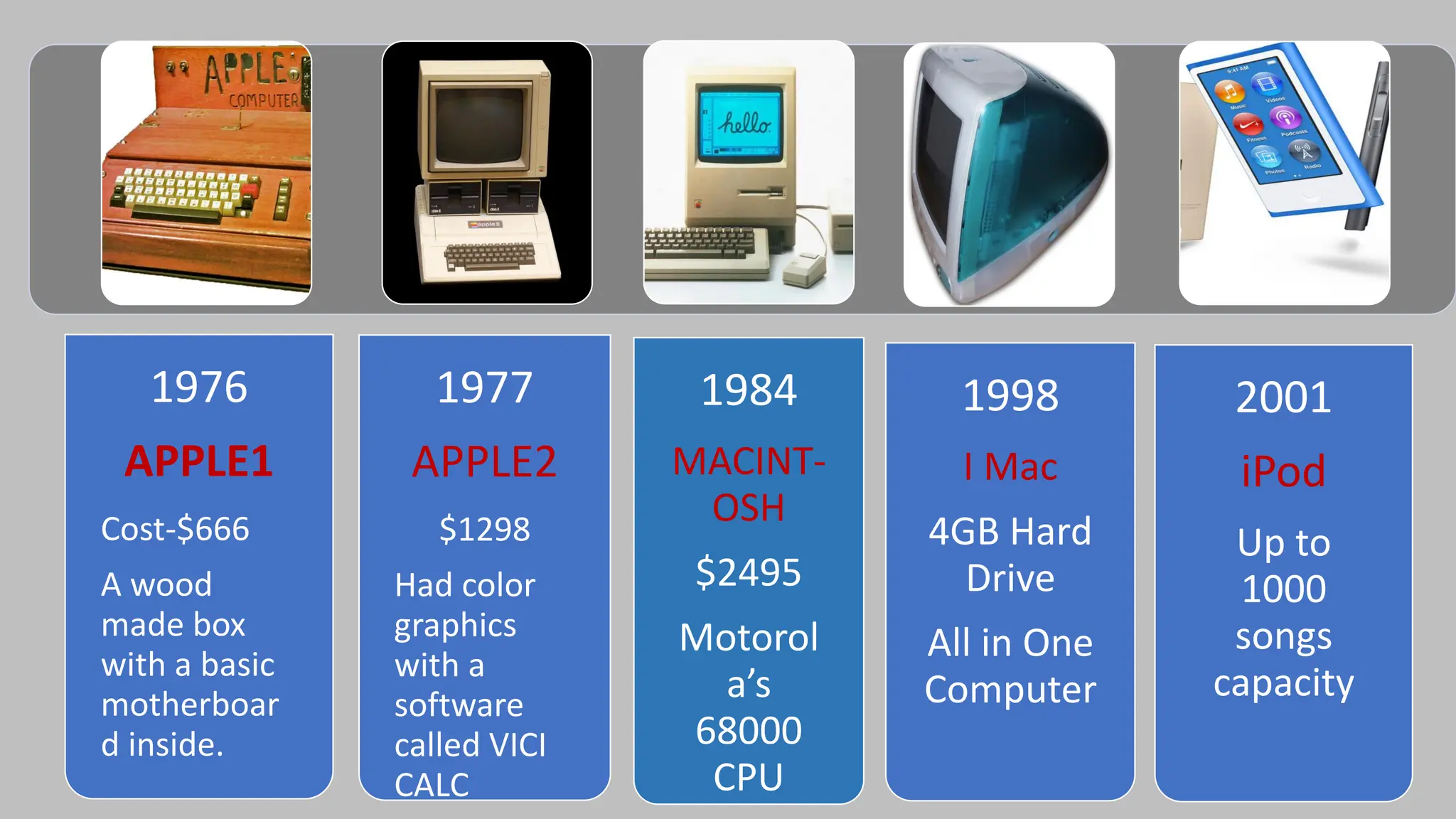
1976
APPLE1
Cost-$666
A wood
made box
with a basic
motherboar
d inside.
1977
APPLE2
$1298
Had color
graphics
with a
software
called VICI
CALC
1984
MACINT-
OSH
$2495
Motorol
a’s
68000
CPU
1998
I Mac
4GB Hard
Drive
All in One
Computer
2001
iPod
Up to
1000
songs
capacity
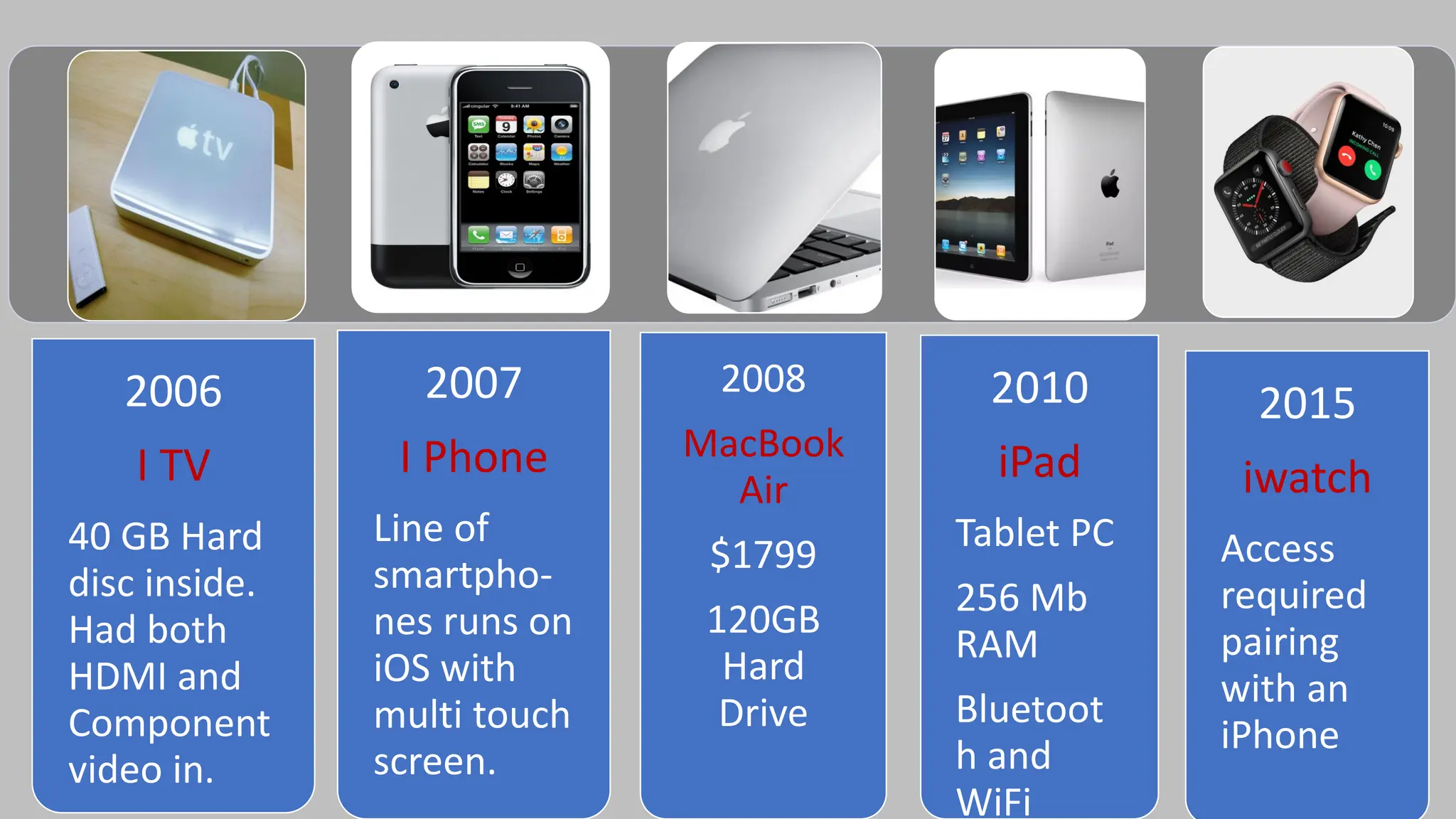
2008
MacBook
Air
$1799
120GB
Hard
Drive
2007
I Phone
Line of
smartpho-
nes runs on
iOS with
multi touch
screen.
2010
iPad
Tablet PC
256 Mb
RAM
Bluetoot
h and
WiFi
2015
iwatch
Access
required
pairing
with an
iPhone
2006
I TV
40 GB Hard
disc inside.
Had both
HDMI and
Component
video in.
Summary of the Case
At the End of 2014, Apple Inc. recorded the most profitable quarter of any
firm in history, and its market capitalization soon topped $700 billion.
Apple Inc. in 2015 explores the History Of Apple, Its success under Steve
Jobs, its continued growth under Tim Cook, and the challenges faced by the
company.
With iPod sales continuing their free fall, Tablet sales in decline, and the
Macintosh’s market share remaining small, Apple was increasingly dependent
on the iPhone to thrive its growth.
Could Cook continue Apple’s dominance in the market in the face of
growing competition and revitalize its products? Could Apple watch and
Apple Pay really be the next iphone and iTunes?
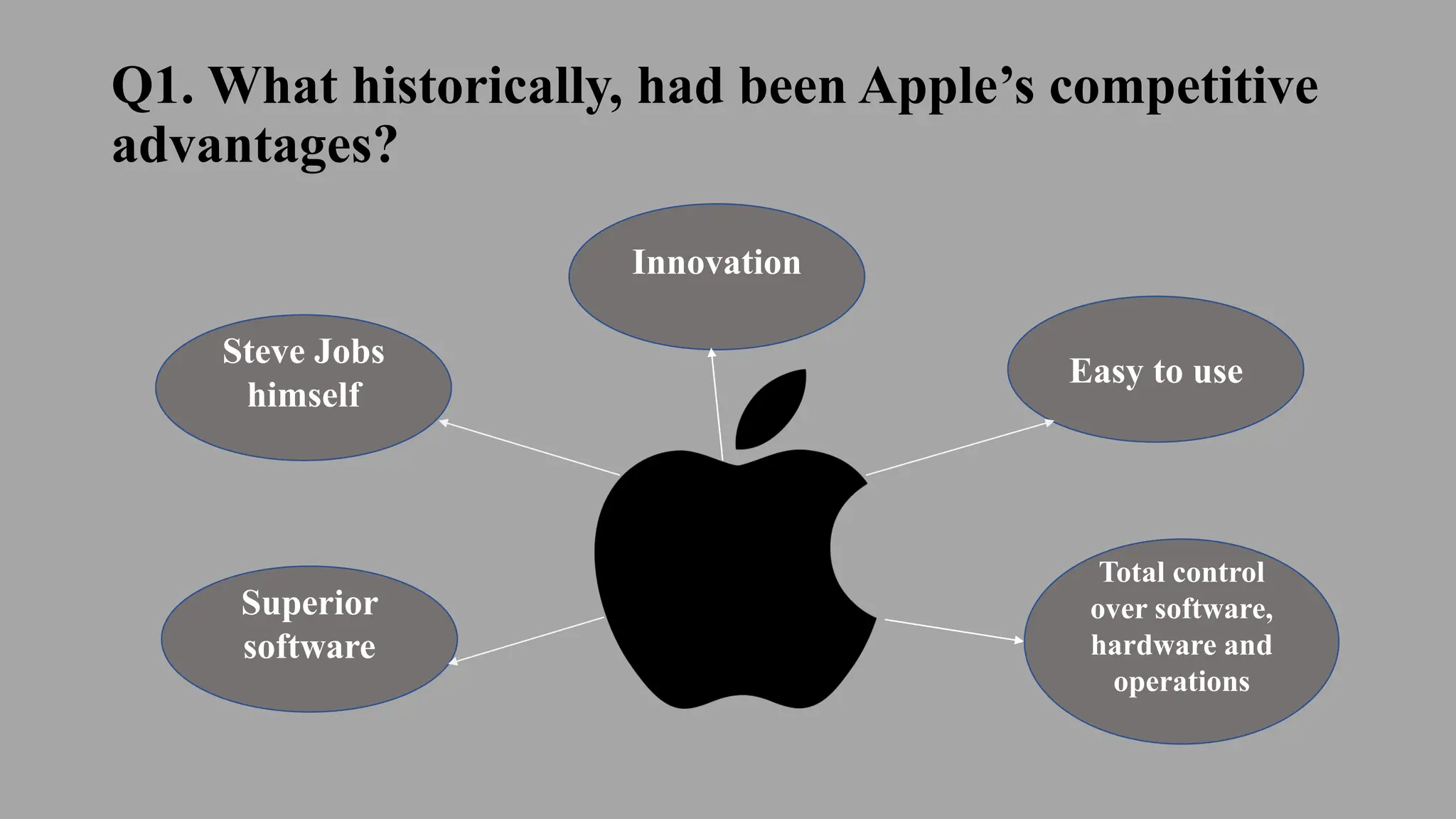
Q1. What historically, had been Apple’s competitive
advantages?
Innovation
Easy to use
Steve Jobs
himself
Superior
software
Total control
over software,
hardware and
operations
Q2. Analyse the PC industry?
 Apple being the pioneer for the first usable personal device, it was IBM that bought PCs
into the mainstream in 1980s.
 In early 1990s, WINTEL (windows OS combined with an Intel processor) dominated the
industry.
 In early 2000s the industry boomed and by 2013 the emerging markets accounted for 58%
of PCs shipment.
 The standardisation of components led PC makers to cut spending on R&D to between 1%
and 3% of revenue.
 The demand of laptop grew due to lower prices, representing 56% of shipments in 2014.
 PC fell into 5 categories- home, SMB, corporate, education & government.
 Shift in PC customers from full service dealers to manufacturers, superstores, electronic
retailers, web based retailers and white box channels.
The three top PC vendors- Lenovo, Hewlett-Packard and Dell accounted
for 51.1% of worldwide shipment in 2014.
Suppliers to PC industry fell into two categories-
* that made product with many sources- memory chips, keyboards
* that made product with few sources – microprocessor, OP
In recent years PC applications has slowed down due to increased focus
on new devices like phones and tablets.
Jobs viewed all the new emerging digital devices as a part of an
integrated strategy to deliver breakthrough user experience.
Q2. Why did apple struggle historically in PC’s?
• Even though Macintosh sales had grown faster than the industry in recent years,
Apple’s share of worldwide PC’s remained in single digits.
• Apple practiced horizontal and vertical integration . It relied on its own proprietary
designs and refused to license its software to third parties.
• IBM PCs not only gained more market share, but also emerged as a new standard in
the industry- thanks to its relatively “open” system for developers/ suit of software
• Lack of compatible software
• As IBM’s compatibles dropped in price, Mac looked overpriced. Also as the
volume leader , IBM was attracting majority of new applications.
• Apple had a high cost structure: 9% to R&D compared to 5% at Compaq and 1% at
IBM clone manufactures.
• Mac did not run on industry standard WINTEL ( Windows OS + Intel Chips) which
most application development went to.
Q. 4 Evaluate Apple’s Strategy for Apple Watch?
Has Tim Cook taken the right approach?
Would you suggest any course correction?
Apple’s Strategy: -
Broad Differentiation
Tim Cook taking forward “The Digital
Hub” strategy as used by Steve Jobs.
Course Correction: -
To make the watch compatible to all
versions of Iphone. This will broaden the
scope of customers who are willing to buy
the apple watch.
Q3. How sustainable is Apple’s competitive
position?
• Brand Value
• Research and development – 150mn
• Ability to product thinner, faster, and more intelligent mobiles
• Subsidies received around $400 per phone or higher.
• Steve Jobs bought two ARM microprocessor designing companies for
about $400mn.
Recommendations:-
• The company should cautiously invest in tapping into the low-end market
which might increase the company’s revenues.
• The company should also invest progressively in research and development
so as to maintain its position in the current market.
• The financial future of the company is greatly dependent on the ability of
the company to progressively make improvements of the Mac platform as
well as Apple’s hardware, services and the software available to
consumers.
• The company should also seek to upgrade and maintain the appeal of its
design to its consumers in order to ensure that it establishes a higher
standard for new entrants in the market.

ammar.pdf nshshshsbsbsbdbbxbdbdbdbbdbdbdbdbdbdb

  • 1.
    STRATEGIC MANAGEMENT Case StudyPresentation Group 1:- Aakriti Sharma (19DM001) Aditya Singh Parihar (19DM020) Anuja Chatterjee (19DM039) Bikrampreet Singh (19DM059) Ishita Sharma (19DM083) Mariya Ali (19DM109)
  • 2.
    Company Profile • Established:April 1, 1976. • Founder: Steve Jobs, Steve Wozniak and Ronald Wayne. • Industry: Computer Hardware Computer Software Consumer electronics Digital distribution • CEO: Tim Cook • Headquarter: Cupertino, California, U.S. • Revenue: US$265.595 billion (2018)
  • 3.
    Store and Services-App Store, Game centre, iAd, ibook store, itunes, iwork.com, icloud. Major Hardware Products • Apple TV • iPad • iPhone • iPod (Classic, Nano, Shuffle, Touch) • Mac (iMac, MacBook Air, MacBook Pro, Mini, Pro) Major Software Products • Mac OS X • iOS • iTunes • iWork • Quick Time • Safari • iLife
  • 4.
    1976 APPLE1 Cost-$666 A wood made box witha basic motherboar d inside. 1977 APPLE2 $1298 Had color graphics with a software called VICI CALC 1984 MACINT- OSH $2495 Motorol a’s 68000 CPU 1998 I Mac 4GB Hard Drive All in One Computer 2001 iPod Up to 1000 songs capacity
  • 5.
    2008 MacBook Air $1799 120GB Hard Drive 2007 I Phone Line of smartpho- nesruns on iOS with multi touch screen. 2010 iPad Tablet PC 256 Mb RAM Bluetoot h and WiFi 2015 iwatch Access required pairing with an iPhone 2006 I TV 40 GB Hard disc inside. Had both HDMI and Component video in.
  • 6.
    Summary of theCase At the End of 2014, Apple Inc. recorded the most profitable quarter of any firm in history, and its market capitalization soon topped $700 billion. Apple Inc. in 2015 explores the History Of Apple, Its success under Steve Jobs, its continued growth under Tim Cook, and the challenges faced by the company. With iPod sales continuing their free fall, Tablet sales in decline, and the Macintosh’s market share remaining small, Apple was increasingly dependent on the iPhone to thrive its growth. Could Cook continue Apple’s dominance in the market in the face of growing competition and revitalize its products? Could Apple watch and Apple Pay really be the next iphone and iTunes?
  • 7.
    Q1. What historically,had been Apple’s competitive advantages? Innovation Easy to use Steve Jobs himself Superior software Total control over software, hardware and operations
  • 8.
    Q2. Analyse thePC industry?  Apple being the pioneer for the first usable personal device, it was IBM that bought PCs into the mainstream in 1980s.  In early 1990s, WINTEL (windows OS combined with an Intel processor) dominated the industry.  In early 2000s the industry boomed and by 2013 the emerging markets accounted for 58% of PCs shipment.  The standardisation of components led PC makers to cut spending on R&D to between 1% and 3% of revenue.  The demand of laptop grew due to lower prices, representing 56% of shipments in 2014.  PC fell into 5 categories- home, SMB, corporate, education & government.  Shift in PC customers from full service dealers to manufacturers, superstores, electronic retailers, web based retailers and white box channels.
  • 9.
    The three topPC vendors- Lenovo, Hewlett-Packard and Dell accounted for 51.1% of worldwide shipment in 2014. Suppliers to PC industry fell into two categories- * that made product with many sources- memory chips, keyboards * that made product with few sources – microprocessor, OP In recent years PC applications has slowed down due to increased focus on new devices like phones and tablets. Jobs viewed all the new emerging digital devices as a part of an integrated strategy to deliver breakthrough user experience.
  • 10.
    Q2. Why didapple struggle historically in PC’s? • Even though Macintosh sales had grown faster than the industry in recent years, Apple’s share of worldwide PC’s remained in single digits. • Apple practiced horizontal and vertical integration . It relied on its own proprietary designs and refused to license its software to third parties. • IBM PCs not only gained more market share, but also emerged as a new standard in the industry- thanks to its relatively “open” system for developers/ suit of software • Lack of compatible software • As IBM’s compatibles dropped in price, Mac looked overpriced. Also as the volume leader , IBM was attracting majority of new applications. • Apple had a high cost structure: 9% to R&D compared to 5% at Compaq and 1% at IBM clone manufactures. • Mac did not run on industry standard WINTEL ( Windows OS + Intel Chips) which most application development went to.
  • 11.
    Q. 4 EvaluateApple’s Strategy for Apple Watch? Has Tim Cook taken the right approach? Would you suggest any course correction? Apple’s Strategy: - Broad Differentiation Tim Cook taking forward “The Digital Hub” strategy as used by Steve Jobs. Course Correction: - To make the watch compatible to all versions of Iphone. This will broaden the scope of customers who are willing to buy the apple watch.
  • 12.
    Q3. How sustainableis Apple’s competitive position? • Brand Value • Research and development – 150mn • Ability to product thinner, faster, and more intelligent mobiles • Subsidies received around $400 per phone or higher. • Steve Jobs bought two ARM microprocessor designing companies for about $400mn.
  • 13.
    Recommendations:- • The companyshould cautiously invest in tapping into the low-end market which might increase the company’s revenues. • The company should also invest progressively in research and development so as to maintain its position in the current market. • The financial future of the company is greatly dependent on the ability of the company to progressively make improvements of the Mac platform as well as Apple’s hardware, services and the software available to consumers. • The company should also seek to upgrade and maintain the appeal of its design to its consumers in order to ensure that it establishes a higher standard for new entrants in the market.