The Science of LATISSE®
(bimatoprost ophthalmic solution) 0.03%
LATISSE®
(bimatoprost ophthalmic solution) 0.03%
Indication: LATISSE®
(bimatoprost ophthalmic solution) 0.03% is
indicated to treat hypotrichosis of the eyelashes by increasing their
growth, including length, thickness, and darkness.
Important Safety Information:
Contraindications: LATISSE®
is contraindicated in patients with
hypersensitivity to bimatoprost or any other ingredient in this product.
LATISSE®
(bimatoprost ophthalmic solution) 0.03%
Important Safety Information (cont’d)
Warnings and Precautions: In patients using LUMIGAN®
(bimatoprost
ophthalmic solution) 0.03% or other prostaglandin analogs for the
treatment of elevated intraocular pressure (IOP), the concomitant use
of LATISSE®
may interfere with the desired reduction in IOP. Patients
using prostaglandin analogs including LUMIGAN®
for IOP reduction
should only use LATISSE®
after consulting with their physician and
should be monitored for changes to their intraocular pressure.
Increased iris pigmentation has occurred when the same formulation of
bimatoprost ophthalmic solution (LUMIGAN®
) was instilled directly onto
the eye. Although iridal pigmentation was not reported in clinical
studies with LATISSE®
, patients should be advised about the potential
for increased brown iris pigmentation which is likely to be permanent.
Bimatoprost has been reported to cause pigment changes (darkening)
to periorbital pigmented tissues and eyelashes.
LATISSE®
(bimatoprost ophthalmic solution) 0.03%
Important Safety Information (cont’d)
Warnings and Precautions (cont’d): There is the potential for hair
growth to occur in areas where LATISSE®
solution comes in repeated
contact with skin surfaces.
LATISSE®
solution should be used with caution in patients with active
intraocular inflammation (eg, uveitis) because the inflammation may be
exacerbated.
LATISSE®
contains benzalkonium chloride, which may be absorbed by
soft contact lenses. Contact lenses should be removed prior to
application of solution and may be reinserted 15 minutes following its
administration.
LATISSE®
(bimatoprost ophthalmic solution) 0.03%
Important Safety Information (cont’d)
Adverse Reactions: The most frequently reported adverse events
were eye pruritus, conjunctival hyperemia, skin hyperpigmentation,
ocular irritation, dry eye symptoms, and erythema of the eyelid. These
events occurred in less than 4% of patients.
Dosage and Administration: Apply nightly directly to the skin of the
upper eyelid margin at the base of the eyelashes using the
accompanying applicators. Blot any excess solution beyond the eyelid
margin. Dispose of the applicator after one use. Repeat for the
opposite eyelid margin using a new sterile applicator. Do not apply to
the lower eyelash line.
Other Safety Information
Macular edema, including cystoid macular edema, has been reported
during treatment with bimatoprost ophthalmic solution (LUMIGAN®
) for
elevated intraocular pressure (IOP). LATISSE®
should be used with
caution in aphakic patients, in pseudophakic patients with a torn
posterior lens capsule, or in patients with known risk factors for
macular edema.
There have been reports of bacterial keratitis associated with the use
of multiple-dose containers of topical ophthalmic products.
Patients should also be informed of the possibility of disparity between
eyes in length, thickness, pigmentation, number of eyelashes or vellus
hairs, and/or direction of eyelash growth.
For more information on LATISSE®
, please refer to
full prescribing information.
LATISSE®
(bimatoprost ophthalmic solution) 0.03%
Is a Structural Prostaglandin Analog1
 Precise mechanism of action is
unknown
 LATISSE®
solution likely
penetrates the hair follicle via
the dermis
– The physicochemical
properties of LATISSE®
solution favor its effective skin
absorption to the dermis
where hair follicles reside
 LATISSE®
is believed to exert
its effects by stimulating the
prostamide receptor2,3
1. LATISSE®
[package insert]. Irvine, CA: Allergan, Inc.; 2008; 2. Woodward DF et al. Pharm Ther. 2008;120:71-80;
3. Woodward DF et al. Br J Pharmacol. 2008;153:410-419.
Molecular Structure of LATISSE®
(bimatoprost ophthalmic solution) 0.03%
LATISSE®
(bimatoprost ophthalmic solution) 0.03%
Increases Overall Eyelash Prominence
Precise mechanism of action is unknown1
1. LATISSE®
[package insert]. Irvine, CA: Allergan, Inc.; 2008; 2. Johnstone MA, Albert DM. Surv Ophthalmol. 2002;47(suppl 1):S185-S202;
3. Elder MJ. Ophthal Plast Reconstr Surg. 1997;13:21-25; 4. Na JI et al. Br J Derm. 2006;155:1170-1176; 5. Data on file. Allergan, Inc.
Stimulates transition
from telogen to
anagen5
Prolongs
anagen1
Normal Eyelash Cycle2-4
Effect of LATISSE®
 Percent of
eyelashes in
anagen1
Anagen
≈ 1-2 months
Catagen
≈ 15 days
Telogen
≈ 4-9 months
Exogen
A Multicenter, Double-Masked, Randomized,
Parallel Study Assessing the Safety and Efficacy
of Once-Daily Application of LATISSE®
(bimatoprost ophthalmic solution) 0.03%
Compared With Vehicle in Increasing Overall
Eyelash Prominence
INVESTIGATORS
Alastair Carruthers, MA, BM, BCh Richard G. Glogau, MD
Jean Carruthers, MD Derek H. Jones, MD
Joel L. Cohen, MD Gary P. Lask, MD
Sue Ellen Cox, MD Stacy Smith, MD
Doris J. Day, MD Wm. Philip Werschler, MD
Lisa Donofrio, MD David Wirta, MD
Steven Fagien, MD, FACS Jessica Wu, MD
Dee Anna Glaser, MD Steven Yoelin, MD
Study Design to Measure Efficacy and Safety
 Randomized, multicenter, double-masked, vehicle-controlled trial
 Daily treatment for 4 months with 1-month posttreatment follow-up
 Primary efficacy measure
– Global eyelash assessment (GEA) scale
 Secondary efficacy measure
– Digital image analysis
 Safety measures
– Adverse events (AEs)
– Ocular—biomicroscopy, intraocular pressure (IOP), ophthalmoscopy
(dilated), and visual acuity
– Nonocular—pulse rate, blood pressure (systolic/diastolic)
Please see Important Safety Information on slides 2-6.
Primary Efficacy Measure Was a Validated
GEA Scale*
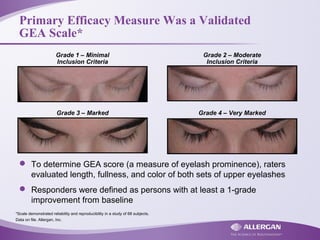
 To determine GEA score (a measure of eyelash prominence), raters
evaluated length, fullness, and color of both sets of upper eyelashes
 Responders were defined as persons with at least a 1-grade
improvement from baseline
Grade 1 – Minimal
Inclusion Criteria
Grade 2 – Moderate
Inclusion Criteria
Grade 3 – Marked Grade 4 – Very Marked
*Scale demonstrated reliability and reproducibility in a study of 68 subjects.
Data on file. Allergan, Inc.
Secondary Efficacy Measure Was
Digital Image Analysis
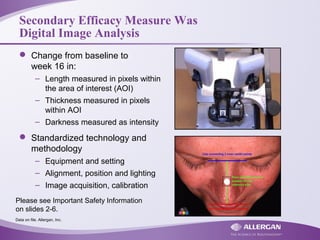
 Change from baseline to
week 16 in:
– Length measured in pixels within
the area of interest (AOI)
– Thickness measured in pixels
within AOI
– Darkness measured as intensity
 Standardized technology and
methodology
– Equipment and setting
– Alignment, position and lighting
– Image acquisition, calibration
Data on file. Allergan, Inc.
Please see Important Safety Information
on slides 2-6.
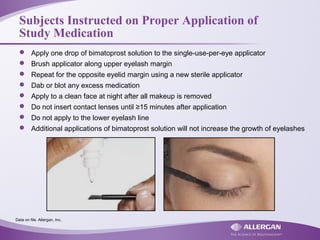
Subjects Instructed on Proper Application of
Study Medication
 Apply one drop of bimatoprost solution to the single-use-per-eye applicator
 Brush applicator along upper eyelash margin
 Repeat for the opposite eyelid margin using a new sterile applicator
 Dab or blot any excess medication
 Apply to a clean face at night after all makeup is removed
 Do not insert contact lenses until ≥15 minutes after application
 Do not apply to the lower eyelash line
 Additional applications of bimatoprost solution will not increase the growth of eyelashes
Data on file. Allergan, Inc.
LATISSE®
(bimatoprost ophthalmic solution) 0.03%
Applicators
 Proper use of LATISSE®
requires the accompanying FDA-approved sterile applicators1
 The FDA-approved sterile applicators are designed to help patients properly apply the product
– Volume of bimatoprost when applied to the eyelid margin with the applicator is ≈ 5% of the volume used as
an eyedrop2
 Do not apply LATISSE®
in the eye or to the lower lid1
 DO NOT APPLY in your eye or to the lower lid because excess hair growth outside the treatment area
may occur. ONLY use the sterile applicators supplied with LATISSE®
to apply the product1
 Do not allow the tip of the bottle or applicator to contact surrounding structures, fingers, or any other
unintended surface in order to avoid contamination by common bacteria known to cause infections.1
There
have been reports of bacterial keratitis associated with the use of multiple-dose containers of topical
ophthalmic products
 LATISSE®
contains benzalkonium chloride, which may be absorbed by soft contact lenses. Contact lenses
should be removed prior to application of LATISSE®
and may be reinserted 15 minutes following its
administration1
 It is possible for hair growth to occur in other areas of your skin that LATISSE®
frequently touches. Any
excess solution outside the upper eyelid margin should be blotted with a tissue or other absorbent
material to reduce the chance of this from happening. It is also possible for a difference in eyelash length,
thickness, fullness, pigmentation, number of eyelash hairs, and/or direction of eyelash1
1. . LATISSE®
[package insert]. Irvine, CA: Allergan, Inc 2. Data on file. Allergan, Inc.
Please see Important Safety Information on slides 2-6.
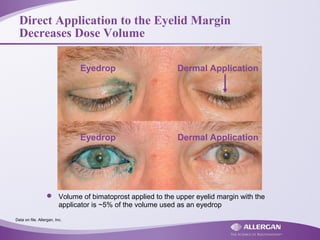
Direct Application to the Eyelid Margin
Decreases Dose Volume
Dermal ApplicationEyedrop
Eyedrop Dermal Application
 Volume of bimatoprost applied to the upper eyelid margin with the
applicator is ~5% of the volume used as an eyedrop
Data on file. Allergan, Inc.
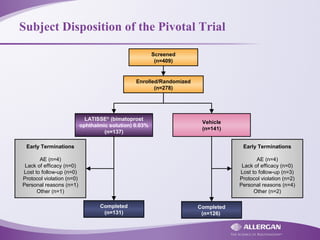
Subject Disposition of the Pivotal Trial
LATISSE®
(bimatoprost
ophthalmic solution) 0.03%
(n=137)
Completed
(n=131)
Completed
(n=126)
Early Terminations
AE (n=4)
Lack of efficacy (n=0)
Lost to follow-up (n=3)
Protocol violation (n=2)
Personal reasons (n=4)
Other (n=2)
Early Terminations
AE (n=4)
Lack of efficacy (n=0)
Lost to follow-up (n=0)
Protocol violation (n=0)
Personal reasons (n=1)
Other (n=1)
Vehicle
(n=141)
Enrolled/Randomized
(n=278)
Screened
(n=409)
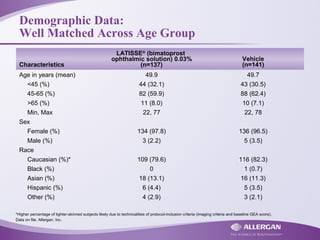
Demographic Data:
Well Matched Across Age Group
Characteristics
LATISSE®
(bimatoprost
ophthalmic solution) 0.03%
(n=137)
Vehicle
(n=141)
Age in years (mean) 49.9 49.7
<45 (%) 44 (32.1) 43 (30.5)
45-65 (%) 82 (59.9) 88 (62.4)
>65 (%) 11 (8.0) 10 (7.1)
Min, Max 22, 77 22, 78
Sex
Female (%) 134 (97.8) 136 (96.5)
Male (%) 3 (2.2) 5 (3.5)
Race
Caucasian (%)* 109 (79.6) 116 (82.3)
Black (%) 0 1 (0.7)
Asian (%) 18 (13.1) 16 (11.3)
Hispanic (%) 6 (4.4) 5 (3.5)
Other (%) 4 (2.9) 3 (2.1)
*Higher percentage of lighter-skinned subjects likely due to technicalities of protocol-inclusion criteria (imaging criteria and baseline GEA score).
Data on file. Allergan, Inc.
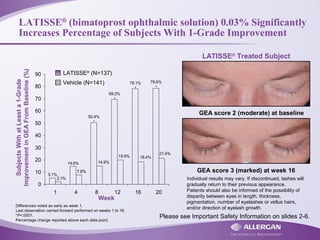
LATISSE®
(bimatoprost ophthalmic solution) 0.03% Significantly
Increases Percentage of Subjects With 1-Grade Improvement
5.1%
14.6%
50.4%
*
69.3%
*
78.1%
*
78.6%
*
21.4%
18.4%19.9%
14.9%
7.8%
2.1%
0
10
20
30
40
50
60
70
80
90
1 4 8 12 16 20
Differences noted as early as week 1.
Last observation carried forward performed on weeks 1 to 16.
*P<.0001.
Percentage change reported above each data point.
GEA score 2 (moderate) at baseline
GEA score 3 (marked) at week 16
Week
SubjectsWithatLeasta1-Grade
ImprovementinGEAFromBaseline(%)
LATISSE®
(N=137)
Vehicle (N=141)
LATISSE®
Treated Subject
Individual results may vary. If discontinued, lashes will
gradually return to their previous appearance.
Patients should also be informed of the possibility of
disparity between eyes in length, thickness,
pigmentation, number of eyelashes or vellus hairs,
and/or direction of eyelash growth.
Please see Important Safety Information on slides 2-6.
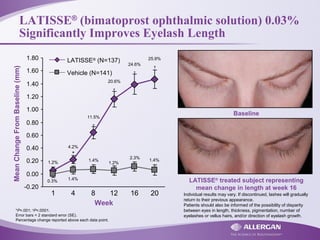
LATISSE®
(bimatoprost ophthalmic solution) 0.03%
Significantly Improves Eyelash Length
*P=.001; †P<.0001.
Error bars = 2 standard error (SE).
Percentage change reported above each data point.
MeanChangeFromBaseline(mm)
Week
1 4 8 12 16 20
†
†
†
†
*
-0.20
0.00
0.20
0.40
0.60
0.80
1.00
1.20
1.40
1.60
1.80
1.2%
1.4%
2.3%
1.2%
1.4%
1.4%0.3%
25.9%
24.6%
20.6%
11.5%
4.2%
LATISSE®
(N=137)
Vehicle (N=141)
LATISSE®
treated subject representing
mean change in length at week 16
Baseline
Individual results may vary. If discontinued, lashes will gradually
return to their previous appearance.
Patients should also be informed of the possibility of disparity
between eyes in length, thickness, pigmentation, number of
eyelashes or vellus hairs, and/or direction of eyelash growth.
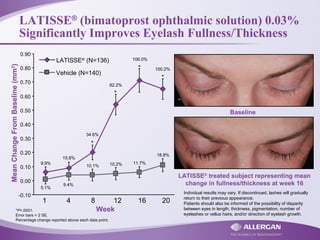
LATISSE®
(bimatoprost ophthalmic solution) 0.03%
Significantly Improves Eyelash Fullness/Thickness
*P<.0001.
Error bars = 2 SE.
Percentage change reported above each data point.
Week
MeanChangeFromBaseline(mm2
)
*
*
*
*
1 4 8 12 16 20
-0.10
0.00
0.10
0.20
0.30
0.40
0.50
0.60
0.70
0.80
0.90
9.9%
18.8%
11.7%10.2%10.1%
9.4%
5.1%
100.2%
106.0%
82.2%
34.6%
15.8%
LATISSE®
(N=136)
Vehicle (N=140)
LATISSE®
treated subject representing mean
change in fullness/thickness at week 16
Baseline
Individual results may vary. If discontinued, lashes will gradually
return to their previous appearance.
Patients should also be informed of the possibility of disparity
between eyes in length, thickness, pigmentation, number of
eyelashes or vellus hairs, and/or direction of eyelash growth.
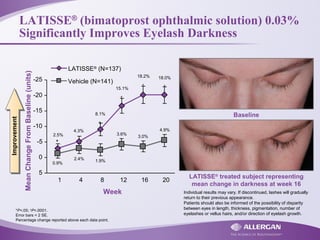
LATISSE®
(bimatoprost ophthalmic solution) 0.03%
Significantly Improves Eyelash Darkness
*P<.05; †P<.0001.
Error bars = 2 SE.
Percentage change reported above each data point.
LATISSE®
treated subject representing
mean change in darkness at week 16
LATISSE®
(N=137)
Vehicle (N=141)
MeanChangeFromBaseline(units)
Week
*
†
††
†
ImprovementImprovement
-25
-20
-15
-10
-5
0
5
1 4 8 12 16 20
2.5% 3.0%
3.6%
1.9%2.4%
4.9%
0.9%
18.0%18.2%
15.1%
8.1%
4.3%
Baseline
Individual results may vary. If discontinued, lashes will gradually
return to their previous appearance.
Patients should also be informed of the possibility of disparity
between eyes in length, thickness, pigmentation, number of
eyelashes or vellus hairs, and/or direction of eyelash growth.
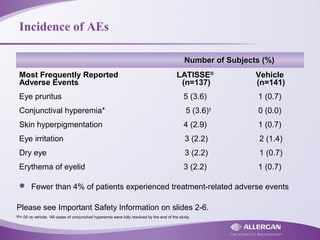
Incidence of AEs
Number of Subjects (%)
Most Frequently Reported
Adverse Events
LATISSE®
(n=137)
Vehicle
(n=141)
Eye pruritus 5 (3.6) 1 (0.7)
Conjunctival hyperemia* 5 (3.6)†
0 (0.0)
Skin hyperpigmentation 4 (2.9) 1 (0.7)
Eye irritation 3 (2.2) 2 (1.4)
Dry eye 3 (2.2) 1 (0.7)
Erythema of eyelid 3 (2.2) 1 (0.7)
*P<.05 vs vehicle; †
All cases of conjunctival hyperemia were fully resolved by the end of the study.
 Fewer than 4% of patients experienced treatment-related adverse events
Please see Important Safety Information on slides 2-6.
Iris Pigmentation
Increased iris pigmentation has occurred when the same
formulation of bimatoprost ophthalmic solution
(LUMIGAN®
) was instilled directly into the eye. Although
iridal pigmentation was not reported in clinical studies
with LATISSE®
(bimatoprost ophthalmic solution) 0.03%,
patients should be advised about the potential for
increased brown iris pigmentation which is likely to be
permanent1
No patients (0%) experienced iris pigmentation changes
(dermal application)
Lack of iris pigmentation change in the LATISSE®
trials
likely due to upper eyelid margin application2
1. LATISSE®
[package insert]. Irvine, CA: Allergan, Inc.; 2008; 2. Data on file. Allergan, Inc.
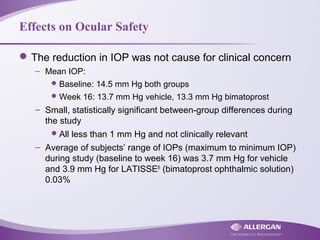
Effects on Ocular Safety
The reduction in IOP was not cause for clinical concern
– Mean IOP:
Baseline: 14.5 mm Hg both groups
Week 16: 13.7 mm Hg vehicle, 13.3 mm Hg bimatoprost
– Small, statistically significant between-group differences during
the study
All less than 1 mm Hg and not clinically relevant
– Average of subjects’ range of IOPs (maximum to minimum IOP)
during study (baseline to week 16) was 3.7 mm Hg for vehicle
and 3.9 mm Hg for LATISSE®
(bimatoprost ophthalmic solution)
0.03%
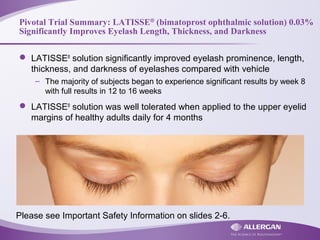
Pivotal Trial Summary: LATISSE®
(bimatoprost ophthalmic solution) 0.03%
Significantly Improves Eyelash Length, Thickness, and Darkness
 LATISSE®
solution significantly improved eyelash prominence, length,
thickness, and darkness of eyelashes compared with vehicle
– The majority of subjects began to experience significant results by week 8
with full results in 12 to 16 weeks
 LATISSE®
solution was well tolerated when applied to the upper eyelid
margins of healthy adults daily for 4 months
Please see Important Safety Information on slides 2-6.
Perspectives on the Role of LATISSE®
(bimatoprost ophthalmic solution) 0.03%
as a Potential Catalyst for Your Practice
A Market Category in Medical Aesthetics
LATISSE®
(bimatoprost ophthalmic solution) 0.03%:
Could Be a Catalyst for Medical Aesthetics
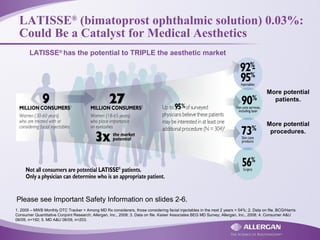
1. 2009 – MWB Monthly DTC Tracker = Among MD Rx considerers, those considering facial injectables in the next 2 years = 54%; 2. Data on file. BCG/Harris
Consumer Quantitative Conjoint Research; Allergan, Inc., 2008; 3. Data on file. Kaiser Associates BEG MD Survey; Allergan, Inc., 2008; 4. Consumer A&U
06/09, n=192; 5. MD A&U 06/09, n=203.
More potential
patients.
More potential
procedures.
LATISSE®
has the potential to TRIPLE the aesthetic market
Please see Important Safety Information on slides 2-6.
1. Data on file. Allergan, Inc. 2008. BCG Harris Consumer Quantitative Conjoint Research; 2. Data on file. LATISSE®
MD A&U Q2-09 Report, July 13, 2009,
Allergan, Inc.; 3, Data on file. LATISSE®
Consumer A&U Q2-09 Report, July 13, 2009, Allergan, Inc.;
4. Data on file. LATISSE®
Value Proposition, September 2009, Allergan, Inc.
LATISSE®
(bimatoprost ophthalmic solution) 0.03%
Could Be a Catalyst for Medical Aesthetics
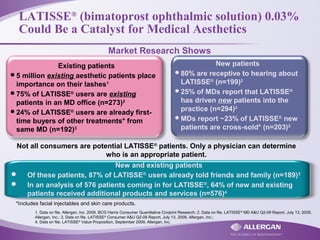
Existing patients
5 million existing aesthetic patients place
importance on their lashes1
75% of LATISSE®
users are existing
patients in an MD office (n=273)2
24% of LATISSE®
users are already first-
time buyers of other treatments* from
same MD (n=192)3
New patients
80% are receptive to hearing about
LATISSE®
(n=199)2
25% of MDs report that LATISSE®
has driven new patients into the
practice (n=294)2
MDs report ~23% of LATISSE®
new
patients are cross-sold* (n=203)2
New and existing patients
 Of these patients, 87% of LATISSE®
users already told friends and family (n=189)3
 In an analysis of 576 patients coming in for LATISSE®
, 64% of new and existing
patients received additional products and services (n=576)4
*IIncludes facial injectables and skin care products.
Market Research Shows
Not all consumers are potential LATISSE®
patients. Only a physician can determine
who is an appropriate patient.
LATISSE®
(bimatoprost ophthalmic solution) 0.03%
Advertising
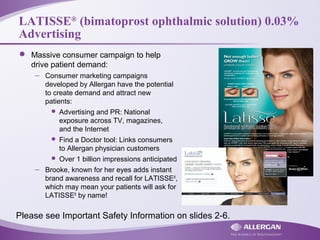
 Massive consumer campaign to help
drive patient demand:
– Consumer marketing campaigns
developed by Allergan have the potential
to create demand and attract new
patients:
 Advertising and PR: National
exposure across TV, magazines,
and the Internet
 Find a Doctor tool: Links consumers
to Allergan physician customers
 Over 1 billion impressions anticipated
– Brooke, known for her eyes adds instant
brand awareness and recall for LATISSE®
,
which may mean your patients will ask for
LATISSE®
by name!
Please see Important Safety Information on slides 2-6.
LATISSE®
(bimatoprost ophthalmic solution) 0.03%:
Practice Analysis Objective and Methodology
Objective
 To support market research findings that patients using LATISSE®
present an opportunity to expand the aesthetic marketplace
Methodology
 39 participating accounts in dispensing and nondispensing states
 Plastic surgeons, dermatologists, and other
 576 LATISSE®
patient consults occurred, which included new and
existing patients
 Consult requests for LATISSE®
only (demand)
 Data on additional products or services purchased during the
consult were captured in the study
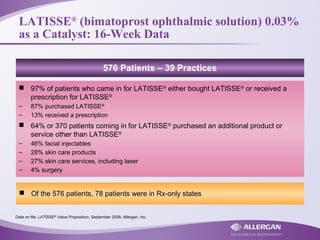
 Of the 576 patients, 78 patients were in Rx-only states
 97% of patients who came in for LATISSE®
either bought LATISSE®
or received a
prescription for LATISSE®
– 87% purchased LATISSE®
– 13% received a prescription
 64% or 370 patients coming in for LATISSE®
purchased an additional product or
service other than LATISSE®
– 46% facial injectables
– 28% skin care products
– 27% skin care services, including laser
– 4% surgery
LATISSE®
(bimatoprost ophthalmic solution) 0.03%
as a Catalyst: 16-Week Data
576 Patients – 39 Practices
Data on file. LATISSE®
Value Proposition, September 2009, Allergan, Inc.
LATISSE®
(bimatoprost ophthalmic solution) 0.03%:
Increasing the Growth of Eyelashes
LATISSE®
is the first and
only treatment approved
by the FDA indicated to
treat hypotrichosis* of the
eyelashes by increasing
their growth including
length, thickness,
and darkness
*Hypotrichosis is another name for having inadequate or not enough eyelashes.
FDA=US Food and Drug Administration.
LATISSE®
[package insert]. Irvine, CA: Allergan, Inc.
LATISSE®
(bimatoprost ophthalmic solution) 0.03%
Indication: LATISSE®
(bimatoprost ophthalmic solution) 0.03% is
indicated to treat hypotrichosis of the eyelashes by increasing their
growth, including length, thickness, and darkness.
Important Safety Information:
Contraindications: LATISSE®
is contraindicated in patients with
hypersensitivity to bimatoprost or any other ingredient in this product.
LATISSE®
(bimatoprost ophthalmic solution) 0.03%
Important Safety Information (cont’d)
Warnings and Precautions: In patients using LUMIGAN®
(bimatoprost
ophthalmic solution) 0.03% or other prostaglandin analogs for the
treatment of elevated intraocular pressure (IOP), the concomitant use
of LATISSE®
may interfere with the desired reduction in IOP. Patients
using prostaglandin analogs including LUMIGAN®
for IOP reduction
should only use LATISSE®
after consulting with their physician and
should be monitored for changes to their intraocular pressure.
Increased iris pigmentation has occurred when the same formulation of
bimatoprost ophthalmic solution (LUMIGAN®
) was instilled directly onto
the eye. Although iridal pigmentation was not reported in clinical
studies with LATISSE®
, patients should be advised about the potential
for increased brown iris pigmentation which is likely to be permanent.
Bimatoprost has been reported to cause pigment changes (darkening)
to periorbital pigmented tissues and eyelashes.
LATISSE®
(bimatoprost ophthalmic solution) 0.03%
Important Safety Information (cont’d)
Warnings and Precautions (cont’d): There is the potential for hair
growth to occur in areas where LATISSE®
solution comes in repeated
contact with skin surfaces.
LATISSE®
solution should be used with caution in patients with active
intraocular inflammation (eg, uveitis) because the inflammation may be
exacerbated.
LATISSE®
contains benzalkonium chloride, which may be absorbed by
soft contact lenses. Contact lenses should be removed prior to
application of solution and may be reinserted 15 minutes following its
administration.
LATISSE®
(bimatoprost ophthalmic solution) 0.03%
Important Safety Information (cont’d)
Adverse Reactions: The most frequently reported adverse events
were eye pruritus, conjunctival hyperemia, skin hyperpigmentation,
ocular irritation, dry eye symptoms, and erythema of the eyelid. These
events occurred in less than 4% of patients.
Dosage and Administration: Apply nightly directly to the skin of the
upper eyelid margin at the base of the eyelashes using the
accompanying applicators. Blot any excess solution beyond the eyelid
margin. Dispose of the applicator after one use. Repeat for the
opposite eyelid margin using a new sterile applicator. Do not apply to
the lower eyelash line.
Other Safety Information
Macular edema, including cystoid macular edema, has been reported
during treatment with bimatoprost ophthalmic solution (LUMIGAN®
) for
elevated intraocular pressure (IOP). LATISSE®
should be used with
caution in aphakic patients, in pseudophakic patients with a torn
posterior lens capsule, or in patients with known risk factors for
macular edema.
There have been reports of bacterial keratitis associated with the use
of multiple-dose containers of topical ophthalmic products.
Patients should also be informed of the possibility of disparity between
eyes in length, thickness, pigmentation, number of eyelashes or vellus
hairs, and/or direction of eyelash growth.
For more information on LATISSE®
, please refer to
full prescribing information.
©2010 Allergan, Inc. ® and ™ marks owned by Allergan, Inc.
APC87SE10

The Science of Latisse

  • 1.
    The Science ofLATISSE® (bimatoprost ophthalmic solution) 0.03%
  • 2.
    LATISSE® (bimatoprost ophthalmic solution)0.03% Indication: LATISSE® (bimatoprost ophthalmic solution) 0.03% is indicated to treat hypotrichosis of the eyelashes by increasing their growth, including length, thickness, and darkness. Important Safety Information: Contraindications: LATISSE® is contraindicated in patients with hypersensitivity to bimatoprost or any other ingredient in this product.
  • 3.
    LATISSE® (bimatoprost ophthalmic solution)0.03% Important Safety Information (cont’d) Warnings and Precautions: In patients using LUMIGAN® (bimatoprost ophthalmic solution) 0.03% or other prostaglandin analogs for the treatment of elevated intraocular pressure (IOP), the concomitant use of LATISSE® may interfere with the desired reduction in IOP. Patients using prostaglandin analogs including LUMIGAN® for IOP reduction should only use LATISSE® after consulting with their physician and should be monitored for changes to their intraocular pressure. Increased iris pigmentation has occurred when the same formulation of bimatoprost ophthalmic solution (LUMIGAN® ) was instilled directly onto the eye. Although iridal pigmentation was not reported in clinical studies with LATISSE® , patients should be advised about the potential for increased brown iris pigmentation which is likely to be permanent. Bimatoprost has been reported to cause pigment changes (darkening) to periorbital pigmented tissues and eyelashes.
  • 4.
    LATISSE® (bimatoprost ophthalmic solution)0.03% Important Safety Information (cont’d) Warnings and Precautions (cont’d): There is the potential for hair growth to occur in areas where LATISSE® solution comes in repeated contact with skin surfaces. LATISSE® solution should be used with caution in patients with active intraocular inflammation (eg, uveitis) because the inflammation may be exacerbated. LATISSE® contains benzalkonium chloride, which may be absorbed by soft contact lenses. Contact lenses should be removed prior to application of solution and may be reinserted 15 minutes following its administration.
  • 5.
    LATISSE® (bimatoprost ophthalmic solution)0.03% Important Safety Information (cont’d) Adverse Reactions: The most frequently reported adverse events were eye pruritus, conjunctival hyperemia, skin hyperpigmentation, ocular irritation, dry eye symptoms, and erythema of the eyelid. These events occurred in less than 4% of patients. Dosage and Administration: Apply nightly directly to the skin of the upper eyelid margin at the base of the eyelashes using the accompanying applicators. Blot any excess solution beyond the eyelid margin. Dispose of the applicator after one use. Repeat for the opposite eyelid margin using a new sterile applicator. Do not apply to the lower eyelash line.
  • 6.
    Other Safety Information Macularedema, including cystoid macular edema, has been reported during treatment with bimatoprost ophthalmic solution (LUMIGAN® ) for elevated intraocular pressure (IOP). LATISSE® should be used with caution in aphakic patients, in pseudophakic patients with a torn posterior lens capsule, or in patients with known risk factors for macular edema. There have been reports of bacterial keratitis associated with the use of multiple-dose containers of topical ophthalmic products. Patients should also be informed of the possibility of disparity between eyes in length, thickness, pigmentation, number of eyelashes or vellus hairs, and/or direction of eyelash growth. For more information on LATISSE® , please refer to full prescribing information.
  • 7.
    LATISSE® (bimatoprost ophthalmic solution)0.03% Is a Structural Prostaglandin Analog1  Precise mechanism of action is unknown  LATISSE® solution likely penetrates the hair follicle via the dermis – The physicochemical properties of LATISSE® solution favor its effective skin absorption to the dermis where hair follicles reside  LATISSE® is believed to exert its effects by stimulating the prostamide receptor2,3 1. LATISSE® [package insert]. Irvine, CA: Allergan, Inc.; 2008; 2. Woodward DF et al. Pharm Ther. 2008;120:71-80; 3. Woodward DF et al. Br J Pharmacol. 2008;153:410-419. Molecular Structure of LATISSE® (bimatoprost ophthalmic solution) 0.03%
  • 8.
    LATISSE® (bimatoprost ophthalmic solution)0.03% Increases Overall Eyelash Prominence Precise mechanism of action is unknown1 1. LATISSE® [package insert]. Irvine, CA: Allergan, Inc.; 2008; 2. Johnstone MA, Albert DM. Surv Ophthalmol. 2002;47(suppl 1):S185-S202; 3. Elder MJ. Ophthal Plast Reconstr Surg. 1997;13:21-25; 4. Na JI et al. Br J Derm. 2006;155:1170-1176; 5. Data on file. Allergan, Inc. Stimulates transition from telogen to anagen5 Prolongs anagen1 Normal Eyelash Cycle2-4 Effect of LATISSE®  Percent of eyelashes in anagen1 Anagen ≈ 1-2 months Catagen ≈ 15 days Telogen ≈ 4-9 months Exogen
  • 9.
    A Multicenter, Double-Masked,Randomized, Parallel Study Assessing the Safety and Efficacy of Once-Daily Application of LATISSE® (bimatoprost ophthalmic solution) 0.03% Compared With Vehicle in Increasing Overall Eyelash Prominence INVESTIGATORS Alastair Carruthers, MA, BM, BCh Richard G. Glogau, MD Jean Carruthers, MD Derek H. Jones, MD Joel L. Cohen, MD Gary P. Lask, MD Sue Ellen Cox, MD Stacy Smith, MD Doris J. Day, MD Wm. Philip Werschler, MD Lisa Donofrio, MD David Wirta, MD Steven Fagien, MD, FACS Jessica Wu, MD Dee Anna Glaser, MD Steven Yoelin, MD
  • 10.
    Study Design toMeasure Efficacy and Safety  Randomized, multicenter, double-masked, vehicle-controlled trial  Daily treatment for 4 months with 1-month posttreatment follow-up  Primary efficacy measure – Global eyelash assessment (GEA) scale  Secondary efficacy measure – Digital image analysis  Safety measures – Adverse events (AEs) – Ocular—biomicroscopy, intraocular pressure (IOP), ophthalmoscopy (dilated), and visual acuity – Nonocular—pulse rate, blood pressure (systolic/diastolic) Please see Important Safety Information on slides 2-6.
  • 11.
    Primary Efficacy MeasureWas a Validated GEA Scale*  To determine GEA score (a measure of eyelash prominence), raters evaluated length, fullness, and color of both sets of upper eyelashes  Responders were defined as persons with at least a 1-grade improvement from baseline Grade 1 – Minimal Inclusion Criteria Grade 2 – Moderate Inclusion Criteria Grade 3 – Marked Grade 4 – Very Marked *Scale demonstrated reliability and reproducibility in a study of 68 subjects. Data on file. Allergan, Inc.
  • 12.
    Secondary Efficacy MeasureWas Digital Image Analysis  Change from baseline to week 16 in: – Length measured in pixels within the area of interest (AOI) – Thickness measured in pixels within AOI – Darkness measured as intensity  Standardized technology and methodology – Equipment and setting – Alignment, position and lighting – Image acquisition, calibration Data on file. Allergan, Inc. Please see Important Safety Information on slides 2-6.
  • 13.
    Subjects Instructed onProper Application of Study Medication  Apply one drop of bimatoprost solution to the single-use-per-eye applicator  Brush applicator along upper eyelash margin  Repeat for the opposite eyelid margin using a new sterile applicator  Dab or blot any excess medication  Apply to a clean face at night after all makeup is removed  Do not insert contact lenses until ≥15 minutes after application  Do not apply to the lower eyelash line  Additional applications of bimatoprost solution will not increase the growth of eyelashes Data on file. Allergan, Inc.
  • 14.
    LATISSE® (bimatoprost ophthalmic solution)0.03% Applicators  Proper use of LATISSE® requires the accompanying FDA-approved sterile applicators1  The FDA-approved sterile applicators are designed to help patients properly apply the product – Volume of bimatoprost when applied to the eyelid margin with the applicator is ≈ 5% of the volume used as an eyedrop2  Do not apply LATISSE® in the eye or to the lower lid1  DO NOT APPLY in your eye or to the lower lid because excess hair growth outside the treatment area may occur. ONLY use the sterile applicators supplied with LATISSE® to apply the product1  Do not allow the tip of the bottle or applicator to contact surrounding structures, fingers, or any other unintended surface in order to avoid contamination by common bacteria known to cause infections.1 There have been reports of bacterial keratitis associated with the use of multiple-dose containers of topical ophthalmic products  LATISSE® contains benzalkonium chloride, which may be absorbed by soft contact lenses. Contact lenses should be removed prior to application of LATISSE® and may be reinserted 15 minutes following its administration1  It is possible for hair growth to occur in other areas of your skin that LATISSE® frequently touches. Any excess solution outside the upper eyelid margin should be blotted with a tissue or other absorbent material to reduce the chance of this from happening. It is also possible for a difference in eyelash length, thickness, fullness, pigmentation, number of eyelash hairs, and/or direction of eyelash1 1. . LATISSE® [package insert]. Irvine, CA: Allergan, Inc 2. Data on file. Allergan, Inc. Please see Important Safety Information on slides 2-6.
  • 15.
    Direct Application tothe Eyelid Margin Decreases Dose Volume Dermal ApplicationEyedrop Eyedrop Dermal Application  Volume of bimatoprost applied to the upper eyelid margin with the applicator is ~5% of the volume used as an eyedrop Data on file. Allergan, Inc.
  • 16.
    Subject Disposition ofthe Pivotal Trial LATISSE® (bimatoprost ophthalmic solution) 0.03% (n=137) Completed (n=131) Completed (n=126) Early Terminations AE (n=4) Lack of efficacy (n=0) Lost to follow-up (n=3) Protocol violation (n=2) Personal reasons (n=4) Other (n=2) Early Terminations AE (n=4) Lack of efficacy (n=0) Lost to follow-up (n=0) Protocol violation (n=0) Personal reasons (n=1) Other (n=1) Vehicle (n=141) Enrolled/Randomized (n=278) Screened (n=409)
  • 17.
    Demographic Data: Well MatchedAcross Age Group Characteristics LATISSE® (bimatoprost ophthalmic solution) 0.03% (n=137) Vehicle (n=141) Age in years (mean) 49.9 49.7 <45 (%) 44 (32.1) 43 (30.5) 45-65 (%) 82 (59.9) 88 (62.4) >65 (%) 11 (8.0) 10 (7.1) Min, Max 22, 77 22, 78 Sex Female (%) 134 (97.8) 136 (96.5) Male (%) 3 (2.2) 5 (3.5) Race Caucasian (%)* 109 (79.6) 116 (82.3) Black (%) 0 1 (0.7) Asian (%) 18 (13.1) 16 (11.3) Hispanic (%) 6 (4.4) 5 (3.5) Other (%) 4 (2.9) 3 (2.1) *Higher percentage of lighter-skinned subjects likely due to technicalities of protocol-inclusion criteria (imaging criteria and baseline GEA score). Data on file. Allergan, Inc.
  • 18.
    LATISSE® (bimatoprost ophthalmic solution)0.03% Significantly Increases Percentage of Subjects With 1-Grade Improvement 5.1% 14.6% 50.4% * 69.3% * 78.1% * 78.6% * 21.4% 18.4%19.9% 14.9% 7.8% 2.1% 0 10 20 30 40 50 60 70 80 90 1 4 8 12 16 20 Differences noted as early as week 1. Last observation carried forward performed on weeks 1 to 16. *P<.0001. Percentage change reported above each data point. GEA score 2 (moderate) at baseline GEA score 3 (marked) at week 16 Week SubjectsWithatLeasta1-Grade ImprovementinGEAFromBaseline(%) LATISSE® (N=137) Vehicle (N=141) LATISSE® Treated Subject Individual results may vary. If discontinued, lashes will gradually return to their previous appearance. Patients should also be informed of the possibility of disparity between eyes in length, thickness, pigmentation, number of eyelashes or vellus hairs, and/or direction of eyelash growth. Please see Important Safety Information on slides 2-6.
  • 19.
    LATISSE® (bimatoprost ophthalmic solution)0.03% Significantly Improves Eyelash Length *P=.001; †P<.0001. Error bars = 2 standard error (SE). Percentage change reported above each data point. MeanChangeFromBaseline(mm) Week 1 4 8 12 16 20 † † † † * -0.20 0.00 0.20 0.40 0.60 0.80 1.00 1.20 1.40 1.60 1.80 1.2% 1.4% 2.3% 1.2% 1.4% 1.4%0.3% 25.9% 24.6% 20.6% 11.5% 4.2% LATISSE® (N=137) Vehicle (N=141) LATISSE® treated subject representing mean change in length at week 16 Baseline Individual results may vary. If discontinued, lashes will gradually return to their previous appearance. Patients should also be informed of the possibility of disparity between eyes in length, thickness, pigmentation, number of eyelashes or vellus hairs, and/or direction of eyelash growth.
  • 20.
    LATISSE® (bimatoprost ophthalmic solution)0.03% Significantly Improves Eyelash Fullness/Thickness *P<.0001. Error bars = 2 SE. Percentage change reported above each data point. Week MeanChangeFromBaseline(mm2 ) * * * * 1 4 8 12 16 20 -0.10 0.00 0.10 0.20 0.30 0.40 0.50 0.60 0.70 0.80 0.90 9.9% 18.8% 11.7%10.2%10.1% 9.4% 5.1% 100.2% 106.0% 82.2% 34.6% 15.8% LATISSE® (N=136) Vehicle (N=140) LATISSE® treated subject representing mean change in fullness/thickness at week 16 Baseline Individual results may vary. If discontinued, lashes will gradually return to their previous appearance. Patients should also be informed of the possibility of disparity between eyes in length, thickness, pigmentation, number of eyelashes or vellus hairs, and/or direction of eyelash growth.
  • 21.
    LATISSE® (bimatoprost ophthalmic solution)0.03% Significantly Improves Eyelash Darkness *P<.05; †P<.0001. Error bars = 2 SE. Percentage change reported above each data point. LATISSE® treated subject representing mean change in darkness at week 16 LATISSE® (N=137) Vehicle (N=141) MeanChangeFromBaseline(units) Week * † †† † ImprovementImprovement -25 -20 -15 -10 -5 0 5 1 4 8 12 16 20 2.5% 3.0% 3.6% 1.9%2.4% 4.9% 0.9% 18.0%18.2% 15.1% 8.1% 4.3% Baseline Individual results may vary. If discontinued, lashes will gradually return to their previous appearance. Patients should also be informed of the possibility of disparity between eyes in length, thickness, pigmentation, number of eyelashes or vellus hairs, and/or direction of eyelash growth.
  • 22.
    Incidence of AEs Numberof Subjects (%) Most Frequently Reported Adverse Events LATISSE® (n=137) Vehicle (n=141) Eye pruritus 5 (3.6) 1 (0.7) Conjunctival hyperemia* 5 (3.6)† 0 (0.0) Skin hyperpigmentation 4 (2.9) 1 (0.7) Eye irritation 3 (2.2) 2 (1.4) Dry eye 3 (2.2) 1 (0.7) Erythema of eyelid 3 (2.2) 1 (0.7) *P<.05 vs vehicle; † All cases of conjunctival hyperemia were fully resolved by the end of the study.  Fewer than 4% of patients experienced treatment-related adverse events Please see Important Safety Information on slides 2-6.
  • 23.
    Iris Pigmentation Increased irispigmentation has occurred when the same formulation of bimatoprost ophthalmic solution (LUMIGAN® ) was instilled directly into the eye. Although iridal pigmentation was not reported in clinical studies with LATISSE® (bimatoprost ophthalmic solution) 0.03%, patients should be advised about the potential for increased brown iris pigmentation which is likely to be permanent1 No patients (0%) experienced iris pigmentation changes (dermal application) Lack of iris pigmentation change in the LATISSE® trials likely due to upper eyelid margin application2 1. LATISSE® [package insert]. Irvine, CA: Allergan, Inc.; 2008; 2. Data on file. Allergan, Inc.
  • 24.
    Effects on OcularSafety The reduction in IOP was not cause for clinical concern – Mean IOP: Baseline: 14.5 mm Hg both groups Week 16: 13.7 mm Hg vehicle, 13.3 mm Hg bimatoprost – Small, statistically significant between-group differences during the study All less than 1 mm Hg and not clinically relevant – Average of subjects’ range of IOPs (maximum to minimum IOP) during study (baseline to week 16) was 3.7 mm Hg for vehicle and 3.9 mm Hg for LATISSE® (bimatoprost ophthalmic solution) 0.03%
  • 25.
    Pivotal Trial Summary:LATISSE® (bimatoprost ophthalmic solution) 0.03% Significantly Improves Eyelash Length, Thickness, and Darkness  LATISSE® solution significantly improved eyelash prominence, length, thickness, and darkness of eyelashes compared with vehicle – The majority of subjects began to experience significant results by week 8 with full results in 12 to 16 weeks  LATISSE® solution was well tolerated when applied to the upper eyelid margins of healthy adults daily for 4 months Please see Important Safety Information on slides 2-6.
  • 26.
    Perspectives on theRole of LATISSE® (bimatoprost ophthalmic solution) 0.03% as a Potential Catalyst for Your Practice A Market Category in Medical Aesthetics
  • 27.
    LATISSE® (bimatoprost ophthalmic solution)0.03%: Could Be a Catalyst for Medical Aesthetics 1. 2009 – MWB Monthly DTC Tracker = Among MD Rx considerers, those considering facial injectables in the next 2 years = 54%; 2. Data on file. BCG/Harris Consumer Quantitative Conjoint Research; Allergan, Inc., 2008; 3. Data on file. Kaiser Associates BEG MD Survey; Allergan, Inc., 2008; 4. Consumer A&U 06/09, n=192; 5. MD A&U 06/09, n=203. More potential patients. More potential procedures. LATISSE® has the potential to TRIPLE the aesthetic market Please see Important Safety Information on slides 2-6.
  • 28.
    1. Data onfile. Allergan, Inc. 2008. BCG Harris Consumer Quantitative Conjoint Research; 2. Data on file. LATISSE® MD A&U Q2-09 Report, July 13, 2009, Allergan, Inc.; 3, Data on file. LATISSE® Consumer A&U Q2-09 Report, July 13, 2009, Allergan, Inc.; 4. Data on file. LATISSE® Value Proposition, September 2009, Allergan, Inc. LATISSE® (bimatoprost ophthalmic solution) 0.03% Could Be a Catalyst for Medical Aesthetics Existing patients 5 million existing aesthetic patients place importance on their lashes1 75% of LATISSE® users are existing patients in an MD office (n=273)2 24% of LATISSE® users are already first- time buyers of other treatments* from same MD (n=192)3 New patients 80% are receptive to hearing about LATISSE® (n=199)2 25% of MDs report that LATISSE® has driven new patients into the practice (n=294)2 MDs report ~23% of LATISSE® new patients are cross-sold* (n=203)2 New and existing patients  Of these patients, 87% of LATISSE® users already told friends and family (n=189)3  In an analysis of 576 patients coming in for LATISSE® , 64% of new and existing patients received additional products and services (n=576)4 *IIncludes facial injectables and skin care products. Market Research Shows Not all consumers are potential LATISSE® patients. Only a physician can determine who is an appropriate patient.
  • 29.
    LATISSE® (bimatoprost ophthalmic solution)0.03% Advertising  Massive consumer campaign to help drive patient demand: – Consumer marketing campaigns developed by Allergan have the potential to create demand and attract new patients:  Advertising and PR: National exposure across TV, magazines, and the Internet  Find a Doctor tool: Links consumers to Allergan physician customers  Over 1 billion impressions anticipated – Brooke, known for her eyes adds instant brand awareness and recall for LATISSE® , which may mean your patients will ask for LATISSE® by name! Please see Important Safety Information on slides 2-6.
  • 30.
    LATISSE® (bimatoprost ophthalmic solution)0.03%: Practice Analysis Objective and Methodology Objective  To support market research findings that patients using LATISSE® present an opportunity to expand the aesthetic marketplace Methodology  39 participating accounts in dispensing and nondispensing states  Plastic surgeons, dermatologists, and other  576 LATISSE® patient consults occurred, which included new and existing patients  Consult requests for LATISSE® only (demand)  Data on additional products or services purchased during the consult were captured in the study
  • 31.
     Of the576 patients, 78 patients were in Rx-only states  97% of patients who came in for LATISSE® either bought LATISSE® or received a prescription for LATISSE® – 87% purchased LATISSE® – 13% received a prescription  64% or 370 patients coming in for LATISSE® purchased an additional product or service other than LATISSE® – 46% facial injectables – 28% skin care products – 27% skin care services, including laser – 4% surgery LATISSE® (bimatoprost ophthalmic solution) 0.03% as a Catalyst: 16-Week Data 576 Patients – 39 Practices Data on file. LATISSE® Value Proposition, September 2009, Allergan, Inc.
  • 32.
    LATISSE® (bimatoprost ophthalmic solution)0.03%: Increasing the Growth of Eyelashes LATISSE® is the first and only treatment approved by the FDA indicated to treat hypotrichosis* of the eyelashes by increasing their growth including length, thickness, and darkness *Hypotrichosis is another name for having inadequate or not enough eyelashes. FDA=US Food and Drug Administration. LATISSE® [package insert]. Irvine, CA: Allergan, Inc.
  • 33.
    LATISSE® (bimatoprost ophthalmic solution)0.03% Indication: LATISSE® (bimatoprost ophthalmic solution) 0.03% is indicated to treat hypotrichosis of the eyelashes by increasing their growth, including length, thickness, and darkness. Important Safety Information: Contraindications: LATISSE® is contraindicated in patients with hypersensitivity to bimatoprost or any other ingredient in this product.
  • 34.
    LATISSE® (bimatoprost ophthalmic solution)0.03% Important Safety Information (cont’d) Warnings and Precautions: In patients using LUMIGAN® (bimatoprost ophthalmic solution) 0.03% or other prostaglandin analogs for the treatment of elevated intraocular pressure (IOP), the concomitant use of LATISSE® may interfere with the desired reduction in IOP. Patients using prostaglandin analogs including LUMIGAN® for IOP reduction should only use LATISSE® after consulting with their physician and should be monitored for changes to their intraocular pressure. Increased iris pigmentation has occurred when the same formulation of bimatoprost ophthalmic solution (LUMIGAN® ) was instilled directly onto the eye. Although iridal pigmentation was not reported in clinical studies with LATISSE® , patients should be advised about the potential for increased brown iris pigmentation which is likely to be permanent. Bimatoprost has been reported to cause pigment changes (darkening) to periorbital pigmented tissues and eyelashes.
  • 35.
    LATISSE® (bimatoprost ophthalmic solution)0.03% Important Safety Information (cont’d) Warnings and Precautions (cont’d): There is the potential for hair growth to occur in areas where LATISSE® solution comes in repeated contact with skin surfaces. LATISSE® solution should be used with caution in patients with active intraocular inflammation (eg, uveitis) because the inflammation may be exacerbated. LATISSE® contains benzalkonium chloride, which may be absorbed by soft contact lenses. Contact lenses should be removed prior to application of solution and may be reinserted 15 minutes following its administration.
  • 36.
    LATISSE® (bimatoprost ophthalmic solution)0.03% Important Safety Information (cont’d) Adverse Reactions: The most frequently reported adverse events were eye pruritus, conjunctival hyperemia, skin hyperpigmentation, ocular irritation, dry eye symptoms, and erythema of the eyelid. These events occurred in less than 4% of patients. Dosage and Administration: Apply nightly directly to the skin of the upper eyelid margin at the base of the eyelashes using the accompanying applicators. Blot any excess solution beyond the eyelid margin. Dispose of the applicator after one use. Repeat for the opposite eyelid margin using a new sterile applicator. Do not apply to the lower eyelash line.
  • 37.
    Other Safety Information Macularedema, including cystoid macular edema, has been reported during treatment with bimatoprost ophthalmic solution (LUMIGAN® ) for elevated intraocular pressure (IOP). LATISSE® should be used with caution in aphakic patients, in pseudophakic patients with a torn posterior lens capsule, or in patients with known risk factors for macular edema. There have been reports of bacterial keratitis associated with the use of multiple-dose containers of topical ophthalmic products. Patients should also be informed of the possibility of disparity between eyes in length, thickness, pigmentation, number of eyelashes or vellus hairs, and/or direction of eyelash growth. For more information on LATISSE® , please refer to full prescribing information. ©2010 Allergan, Inc. ® and ™ marks owned by Allergan, Inc. APC87SE10

Editor's Notes

  • #8 LATISSE ® solution is a structural prostaglandin analog that exerts its action by selectively mimicking the effects of naturally occurring prostamides The physiochemical properties of LATISSE ® solution favor its effective skin absorption into the dermis where the hair follicles reside
  • #9 It is believed that LATISSE ® (bimatoprost ophthalmic solution) 0.03% exerts its effect on the growth of eyelashes by: Increasing the percentage of hairs in, and the duration of, anagen or the growth phase LATISSE ® solution increases melanin synthesis resulting in darker hair pigmentation Exact mechanism of action is unknown
  • #10 A Phase 3, m ulticenter, double-masked, randomized, parallel study which assessed the safety and efficacy of once-daily application of LATISSE ® (bimatoprost ophthalmic solution) 0.03% compared with vehicle in increasing overall eyelash prominence was conducted Study initiation date (first subject enrolled) was April 30, 2007 and the study completion date (last subject completed) was December 31, 2007
  • #11 The study was a randomized trial with a 4-month duration and a 1-month posttreatment follow-up Primary and secondary efficacy measures were the global eyelash assessment (GEA) scale and digital image analysis (DIA), respectively Safety measures included adverse events (AEs), as well as ocular and nonocular measurements
  • #12 The primary efficacy measurement collected in this study was overall eyelash prominence measured using the GEA scale (1 [minimal], 2 [moderate], 3 [marked],4 [very marked], corresponding to frontal and superior eyelash views) The GEA scale is a valid and reliable scale to measure eyelash prominence A clinical response was defined as at least a 1-grade increase in the GEA score from baseline at month 4 (week 16) GEA scores were assigned by the investigator based on overall eyelash prominence across both eyes If data were missing or not available for baseline (day 1), data from the screening visit were used as the baseline value The proportion of subjects with at least a 1-grade increase from baseline was summarized and analyzed using the Pearson’s chi-square test for 2-by-2 tables at each visit For the intent-to-treat population analysis, if any GEA scores were missing, data imputation was performed by last observation carried forward (LOCF) up to month 4 (week 16)
  • #13 DIA was used to determine upper eyelash length (in mm), average progressive upper eyelash fullness ( in mm 2 ), and upper eyelash darkness Data analyses were based on the average of the measurements from both left and right upper eyelashes (from the superior view images) For each of these variables, raw values at baseline and change from baseline at each visit were summarized If baseline (day 1) data were unavailable or if there was a reshoot, then DIA data from the screening visit were imputed for the baseline (day 1) data In the event that a subject’s digital image was not able to be interpreted due to the presence of spectral noise, he or she was not included in the analysis population for that particular secondary endpoint Within-group comparisons were performed using a Wilcoxon signed-rank test for change from baseline. Between-group comparisons were performed using a Wilcoxon rank-sum test Missing data were imputed up to week 16 using the LOCF method
  • #14 Subjects were instructed to carefully apply one drop of study medication to a disposable single-use-per-eye applicator and brush it along the upper eyelid margin once daily in the evening. Subjects were instructed to repeat for the opposite eyelid margin using a new sterile applicator They were also instructed to not apply study medication to the lower eyelash line If excess study medication came off the lid, subjects were instructed to dab or blot any excess study medication with a tissue Study medication was applied on a clean face after all makeup was removed and after any other facial-care products were applied (eg, lotion) Subjects were instructed to remove contact lenses before applying study medication and keep them out for at least 15 minutes Additional applications of LATISSE ® (bimatoprost ophthalmic solution) 0.03% will not increase the growth of lashes
  • #15 This slide highlights the proper use of LATISSE ® (bimatoprost ophthalmic solution) 0.03% solution
  • #16 This slide demonstrates the amount of solution near the eye when applied as an eyedrop versus when a similar volume is dermally applied to the upper eyelid margin Dye application Test eye: Lissamine green 28 to 30 uL drop size, produced by placing sterile saline onto sterile strip Droplet transferred to sterile brush Brush handed to subject for self-application Postdose photos taken Control eye: Lissamine on strip was applied to eye using standard clinical technique Subject was instructed to blink  Postdose photos taken Volume of bimatoprost when applied to the eyelid margin with the applicator is ~5% of the volume used as an eyedrop
  • #17 A total of 409 subjects were screened for the study, and 278 (68.0%) of these subjects were enrolled ~140 subjects were randomized into each arm of the trial Very few subjects discontinued due to an AE ~95% of the subjects in the LATISSE ® (bimatoprost ophthalmic solution) 0.03% solution arm of the study completed the trial ~90% of those in the vehicle arm completed the trial The “other” early termination in the LATISSE ® group was for withdrawn consent The “other” early terminations in the vehicle group were for possible conflict of interest
  • #18 Study demographics were evenly matched between treatment groups; the median age was 50 years Most subjects were female, Caucasian, and had a baseline GEA score of 2
  • #19 A statistically significantly and higher percentage of subjects in the LATISSE ® (bimatoprost ophthalmic solution) 0.03% group (78.1%, 107/137) compared with the vehicle group (18.4%, 26/141) experienced at least a 1-grade increase from baseline in overall eyelash prominence as rated by the GEA scale at week 16 ( P &lt;.0001). Percent changes are noted in the chart above the data points By week 8, a statistically significant difference in favor of LATISSE ® (bimatoprost ophthalmic solution) 0.03% was detected ( P &lt;.0001) and this difference was maintained throughout the duration of the treatment
  • #20 By week 4, the difference between the 2 treatment groups in change in eyelash length had reached statistical significance, with greater changes in eyelash length observed in the LATISSE ® treated group compared with the vehicle group. Percent changes are noted in the chart above the data points At week 16, the mean change from baseline to week 16 was 1.39 mm and 0.11 mm for the LATISSE ® solution and vehicle groups, respectively, a difference that was also statistically significant ( P &lt;.0001). The results for percentage change from baseline to week 16 for eyelash length corresponded to a percentage increase of 25% (LATISSE ® ophthalmic solution) and 2% (vehicle) ( P &lt;.0001)
  • #21 By week 8, the difference in eyelash thickness/fullness between the 2 treatment groups had reached statistical significance, with thicker/fuller eyelashes observed in the LATISSE ® treated group compared with the vehicle group ( P ≤.0004). This statistically significant difference was maintained for the duration of the treatment. Percent changes are noted in the chart above the data points Analyzed in terms of mm 2 , the mean change from baseline to week 16 was 0.71 mm 2 and 0.06 mm 2 for the LATISSE ® solution and vehicle groups, respectively ( P &lt;.0001) These results correspond to a percentage change from baseline of 106% (LATISSE ® ophthalmic solution ) and 11.7% (vehicle) ( P &lt;.0001)
  • #22 Progressive eyelash darkening was noted starting at week 1, with a statistically significantly greater degree of darkening in the LATISSE ® treated group compared with the vehicle group ( P =.0427) A statistically significant difference between the 2 treatment groups was detected again at week 8 showing darker, more intense eyelashes in the LATISSE ® solution group compared with the vehicle group ( P &lt;.0001) At week 16, the LATISSE ® treated group showed a statistically significantly greater degree of eyelash darkening compared with the vehicle group as shown by mean changes from baseline of -20.2 (LATISSE ® ophthalmic solution) and -3.6 (vehicle) ( P &lt;.0001) These results correspond to a percentage increase in darkness of 18.2% and 3.0% at week 16 for the LATISSE ® solution and vehicle groups, respectively (P&lt;. 0001) Percent changes are noted in the chart above the data points
  • #23 The most commonly affected system organ class was the eye, with AEs of the eye reported by 20.4% (28/137) and 11.3% (16/141) of subjects in the LATISSE ® (bimatoprost ophthalmic solution) 0.03% and vehicle groups, respectively ( P =.038) These AEs included eye pruritus, conjunctival hyperemia, skin hyperpigmentation, ocular irritation, dry eye, and erythema of the eyelid Conjunctival hyperemia was the only AE to be reported by a statistically significantly higher number of subjects in the LATISSE ® treated group compared with the vehicle group ( P =.028) All cases of conjunctival hyperemia were fully resolved by the end of the study LATISSE ® solution AEs are related to the pharmacological effects of bimatoprost Conjunctival hyperemia: vasodilation Eyelash growth: increases percent of hairs in and duration of the anagen or growth phase Hyperpigmentation: increases melanin with no cell proliferation or atypia All of the treatment-related AEs reported by subjects in the LATISSE ® treated group were mild in severity, except for 1 incidence of contact dermatitis and 1 of dry eye, both being described as moderate All treatment-related AEs reported by subjects in the vehicle group were mild in severity, except for 1 incidence of severe IOP reduction which resulted in study discontinuation
  • #24 Increased iris pigmentation has occurred when the same formulation of bimatoprost ophthalmic solution (LUMIGAN ® ) was instilled directly into the eye. Although iridal pigmentation was not reported in clinical studies with LATISSE ® , patients should be advised about the potential for increased brown iris pigmentation which is likely to be permanent No patients (0%) experienced iris pigmentation changes (dermal application)
  • #25 Statistically significant differences in mean intraocular pressure reduction were observed between the 2 treatment groups at weeks 1 through 16, however: The magnitude of this reduction was not cause for clinical concern Peak mean reduction from baseline in the LATISSE ® solution group = -1.5 mm Hg (week 12) Peak mean reduction from baseline in the vehicle group = -0.7 mm Hg (week 16)
  • #26 LATISSE ® applied to the upper eyelid margins of healthy adult subjects once per day for 4 months resulted in significant improvements compared with vehicle in the growth of eyelashes, as measured by overall eyelash prominence (defined by at least a 1-grade increase on the GEA scale), eyelash length, thickness, and darkness. These improvements were statistically significant for the LATISSE ® group compared with the vehicle group for all endpoints by week 8 (statistical significance was first seen for eyelash length at week 4) LATISSE ® was safe and well tolerated in this population of healthy adult subjects
  • #28 LATISSE ® (bimatoprost ophthalmic solution) 0.03% has the potential to triple the aesthetic market Nine million consumers, women between the ages of 30 and 60, who are getting treated with or considering facial injectables However, there are 27 million women between the ages of 18 and 65, who place importance on eyelashes Up to 95% of surveyed physicians believe these patients may be interested in at least one additional procedure (N=304) 92% to 95% Injectables 90% Skin care services, including laser 73% Skin care products 56% Surgery
  • #29 Market research has shown that: Existing patients 5 million existing aesthetic patients place importance on their lashes 75% of LATISSE ® users are existing patients in an MD office (n=273) 24% of LATISSE ® users are already first-time buyers of other treatments* from same MD (n=192) New patients 80% are receptive to learning about LATISSE ® (n=199) 25% of MDs report that LATISSE ® has driven new patients into the practice (n=294) MDs report ~25% of LATISSE ® new patients are cross-sold* (n=203) New and existing patients Of these patients, 87% of LATISSE ® users already told friends and family (n=189) In an analysis of 576 patients coming in for LATISSE ® , 64% of new and existing patients received additional products and services (n=576) Not all consumers are potential LATISSE ® patients. Only a physician can determine who is an appropriate patient
  • #30 A large campaign helped to build momentum for LATISSE ® (bimatoprost ophthalmic solution) 0.03% These consumer marketing campaigns have the potential to create demand and attract new patients Brooke, known for her eyes adds instant brand awareness and recall for LATISSE ® , which means your patients will ask for LATISSE ® by name!
  • #31 Objective To support market research findings that patients using LATISSE ® (bimatoprost ophthalmic solution) 0.03% present an opportunity to expand the aesthetic marketplace Methodology 39 participating accounts in dispensing and nondispensing states Plastic surgeons, dermatologists, and other 576 LATISSE ® patient consults occurred, which included new and existing patients Consult requests for LATISSE ® only (demand) Data on additional products or services purchased during the consult were captured in the study
  • #32 576 patients in 39 practices participated in this aspect of the study 97% of patients who came in for LATISSE ® (bimatoprost ophthalmic solution) 0.03%, either bought LATISSE ® or received a prescription for LATISSE ® 87% purchased LATISSE ® 13% received a prescription 64% or 370 patients coming in for LATISSE ® purchased an additional product or service other than LATISSE ® 46% facial injectables 28% skin care products 27% skin care services, including laser 4% surgery Of the 576 patients, 78 patients were in Rx-only states
  • #33 LATISSE ® is the first and only FDA-approved-product indicated to treat hypotrichosis of the eyelashes by increasing their growth, including length, thickness, and darkness Hypotrichosis is another name for having inadequate or not enough eyelashes LATISSE ® is applied to the upper eyelash margin