American Colonies:The Settling of North AmericaMegan Foster
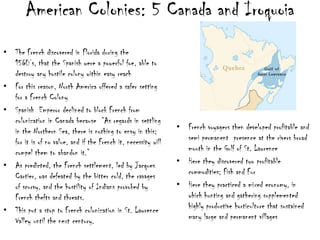
American Colonies: 5 Canada and IroquoiaThe French discovered in Florida during the 1560’s, that the Spanish were a powerful foe, able to destroy any hostile colony within easy reachFor this reason, North America offered a safer setting for a French ColonySpanish  Emperor declined to block French from colonization in Canada because  “As regards in settling in the Northern Sea, there is nothing to envy in this; for it is of no value, and if the French it, necessity will compel them to abandon it.”As predicted, the French settlement, led by Jacques Cartier, was defeated by the bitter cold, the ravages of scurvy, and the hostility of Indians provoked by French thefts and threats.This put a stop to French colonization in St. Lawrence Valley until the next century. French voyagers then developed profitable and semi permanent  presence at the rivers broad mouth in the Gulf of St. LawrenceHere they discovered two profitable commodities; Fish and FurHere they practiced a mixed economy, in which hunting and gathering supplemented highly productive horticulture that sustained many large and permanent villages
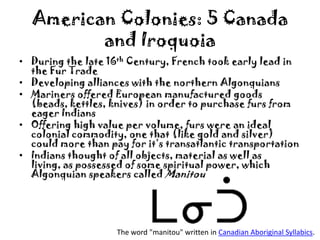
American Colonies: 5 Canada and IroquoiaDuring the late 16th Century, French took early lead in the Fur TradeDeveloping alliances with the northern AlgonquiansMariners offered European manufactured goods (beads, kettles, knives) in order to purchase furs from eager IndiansOffering high value per volume, furs were an ideal colonial commodity, one that (like gold and silver) could more than pay for it’s transatlantic transportationIndians thought of all objects, material as well as living, as possessed of some spiritual power, which Algonquian speakers called ManitouThe word "manitou" written in Canadian Aboriginal Syllabics.
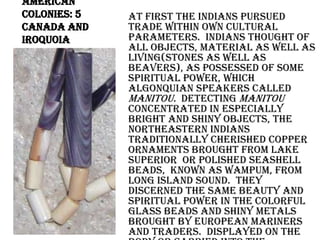
American Colonies: 5 Canada and IroquoiaAt first the Indians pursued trade within own cultural parameters.  Indians thought of all objects, material as well as living(stones as well as beavers), as possessed of some spiritual power, which Algonquian speakers called Manitou.  Detecting Manitou concentrated in especially bright and shiny objects, the northeastern Indians traditionally cherished copper ornaments brought from Lake Superior  or polished seashell  beads,  known as wampum, from Long Island Sound.  They discerned the same beauty and spiritual power in the colorful glass beads and shiny metals brought by European mariners and traders.  Displayed on the body or carried into the grave, the new goods demonstrated high status and access to Manitou.  Adapting the shiny new materials to traditional uses, Indians broke up brass kettles for reworking into arrowheads, necklaces, earrings, finger rings, and armbands
American Colonies: 5 Canada and IroquoiaNatives also adopted alcoholAt first they balked at the novel taste and disorienting effectEventually developed a cravingGot drunk as a shortcut to spiritual trancesAlso offered a tempting release of aggressionsOccasionally, the more ruthless mariners interrupted trade to kidnap Indians as human commoditiesThe Indians were often take to Europe where they were put on profitable display as curiosities, and trained to assist future voyages as interpreters
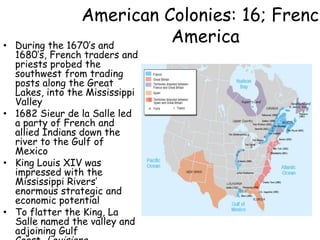
American Colonies: 16; French AmericaDuring the 1670’s and 1680’s, French traders and priests probed the southwest from trading posts along the Great Lakes, into the Mississippi Valley1682 Sieur de la Salle led a party of French and allied Indians down the river to the Gulf of MexicoKing Louis XIV was impressed with the Mississippi Rivers’ enormous strategic and economic potentialTo flatter the King, La Salle named the valley and adjoining Gulf Coast, Louisiana
American Colonies: 16; French AmericaNew France and Louisiana annually cost the crown more to administer than they generated in revenue from the fur and deerskin trades.Weary of the financial drain, the crown abruptly ordered a withdrawal from the upper country posts in 1696No longer able to live comfortably without metal ware, firearms, and gunpowder, the Indians faced hunger and destitution if denied access to European goodsBeginning in the late 1720’s French posts sold goods at below market value to dissuade Indians from trading with the British colonistsThis revealed that the French’s strategic dependence on Indians exceeded Indians’ dependence on French trade
American Colonies: 16; French AmericaDuring the long and hard-fought war of the Spanish Succession(1702-1713), Louisiana languished as Frances most peripheral colony in an outstretched EmpireAfter the war, the Crown entrusted Louisiana to the company of the Indies1718 established New Orleans1717-1730 Company of the Indies transported 5,400 European colonists, and 6,000 slaves into LouisianaSlaves included a mix of vagrants, blasphemers, thieves, smugglers, political prisoners, and prostitutesAfter 1731, Louisiana’s population grew by natural increase to 4,100 slaves, 3,000 slaves, 3,300 settlers, and 600 soldiers by 1746Louisiana failed to develop a profitable export staplePlanters raised inferior grades of tobacco and Indigo that sold in France for less than the high costs of production and shipment
American Colonies: 16; French AmericaDuring the 17th Century, fewer than 250 families emigrated to CanadaOnly 12% were femaleMost were poor, single young men in search of work and foodMost were urban laborers and artisansMost of the females came from an orphanage in Paris, and were known as filles du roi(daughtersof the King)Male emigrants arrived in servitude as either soldiers or indentured servants, known as engagesMost of the French who did emigrate (and stayed), significantly improved their status and standard of living, escaping their former poverty as landless laborersAt least 80% of colonists lived as habitants, leasing farms of about 100 acresEngages generally served only 3 year termsLoaded and unloaded ships, rowed boats, constructed buildings, and cleared forests to make farmsSoldiers served long and indeterminate terms until the Crown decided to demobilizeDrilled, hauled supplies, constructed and repaired forts, and fought the IroquoisFilles du roiwere provided passage and a cash marriage from the CrownWere technically free, but were expected to marry within a few weeks of their arrivalThey then became subject to legal authority of their new husbands, and served as housekeepers

American colonies prt 1

  • 1.
    American Colonies:The Settlingof North AmericaMegan Foster
  • 2.
    American Colonies: 5Canada and IroquoiaThe French discovered in Florida during the 1560’s, that the Spanish were a powerful foe, able to destroy any hostile colony within easy reachFor this reason, North America offered a safer setting for a French ColonySpanish Emperor declined to block French from colonization in Canada because “As regards in settling in the Northern Sea, there is nothing to envy in this; for it is of no value, and if the French it, necessity will compel them to abandon it.”As predicted, the French settlement, led by Jacques Cartier, was defeated by the bitter cold, the ravages of scurvy, and the hostility of Indians provoked by French thefts and threats.This put a stop to French colonization in St. Lawrence Valley until the next century. French voyagers then developed profitable and semi permanent presence at the rivers broad mouth in the Gulf of St. LawrenceHere they discovered two profitable commodities; Fish and FurHere they practiced a mixed economy, in which hunting and gathering supplemented highly productive horticulture that sustained many large and permanent villages
  • 3.
    American Colonies: 5Canada and IroquoiaDuring the late 16th Century, French took early lead in the Fur TradeDeveloping alliances with the northern AlgonquiansMariners offered European manufactured goods (beads, kettles, knives) in order to purchase furs from eager IndiansOffering high value per volume, furs were an ideal colonial commodity, one that (like gold and silver) could more than pay for it’s transatlantic transportationIndians thought of all objects, material as well as living, as possessed of some spiritual power, which Algonquian speakers called ManitouThe word "manitou" written in Canadian Aboriginal Syllabics.
  • 4.
    American Colonies: 5Canada and IroquoiaAt first the Indians pursued trade within own cultural parameters. Indians thought of all objects, material as well as living(stones as well as beavers), as possessed of some spiritual power, which Algonquian speakers called Manitou. Detecting Manitou concentrated in especially bright and shiny objects, the northeastern Indians traditionally cherished copper ornaments brought from Lake Superior or polished seashell beads, known as wampum, from Long Island Sound. They discerned the same beauty and spiritual power in the colorful glass beads and shiny metals brought by European mariners and traders. Displayed on the body or carried into the grave, the new goods demonstrated high status and access to Manitou. Adapting the shiny new materials to traditional uses, Indians broke up brass kettles for reworking into arrowheads, necklaces, earrings, finger rings, and armbands
  • 5.
    American Colonies: 5Canada and IroquoiaNatives also adopted alcoholAt first they balked at the novel taste and disorienting effectEventually developed a cravingGot drunk as a shortcut to spiritual trancesAlso offered a tempting release of aggressionsOccasionally, the more ruthless mariners interrupted trade to kidnap Indians as human commoditiesThe Indians were often take to Europe where they were put on profitable display as curiosities, and trained to assist future voyages as interpreters
  • 6.
    American Colonies: 16;French AmericaDuring the 1670’s and 1680’s, French traders and priests probed the southwest from trading posts along the Great Lakes, into the Mississippi Valley1682 Sieur de la Salle led a party of French and allied Indians down the river to the Gulf of MexicoKing Louis XIV was impressed with the Mississippi Rivers’ enormous strategic and economic potentialTo flatter the King, La Salle named the valley and adjoining Gulf Coast, Louisiana
  • 7.
    American Colonies: 16;French AmericaNew France and Louisiana annually cost the crown more to administer than they generated in revenue from the fur and deerskin trades.Weary of the financial drain, the crown abruptly ordered a withdrawal from the upper country posts in 1696No longer able to live comfortably without metal ware, firearms, and gunpowder, the Indians faced hunger and destitution if denied access to European goodsBeginning in the late 1720’s French posts sold goods at below market value to dissuade Indians from trading with the British colonistsThis revealed that the French’s strategic dependence on Indians exceeded Indians’ dependence on French trade
  • 8.
    American Colonies: 16;French AmericaDuring the long and hard-fought war of the Spanish Succession(1702-1713), Louisiana languished as Frances most peripheral colony in an outstretched EmpireAfter the war, the Crown entrusted Louisiana to the company of the Indies1718 established New Orleans1717-1730 Company of the Indies transported 5,400 European colonists, and 6,000 slaves into LouisianaSlaves included a mix of vagrants, blasphemers, thieves, smugglers, political prisoners, and prostitutesAfter 1731, Louisiana’s population grew by natural increase to 4,100 slaves, 3,000 slaves, 3,300 settlers, and 600 soldiers by 1746Louisiana failed to develop a profitable export staplePlanters raised inferior grades of tobacco and Indigo that sold in France for less than the high costs of production and shipment
  • 9.
    American Colonies: 16;French AmericaDuring the 17th Century, fewer than 250 families emigrated to CanadaOnly 12% were femaleMost were poor, single young men in search of work and foodMost were urban laborers and artisansMost of the females came from an orphanage in Paris, and were known as filles du roi(daughtersof the King)Male emigrants arrived in servitude as either soldiers or indentured servants, known as engagesMost of the French who did emigrate (and stayed), significantly improved their status and standard of living, escaping their former poverty as landless laborersAt least 80% of colonists lived as habitants, leasing farms of about 100 acresEngages generally served only 3 year termsLoaded and unloaded ships, rowed boats, constructed buildings, and cleared forests to make farmsSoldiers served long and indeterminate terms until the Crown decided to demobilizeDrilled, hauled supplies, constructed and repaired forts, and fought the IroquoisFilles du roiwere provided passage and a cash marriage from the CrownWere technically free, but were expected to marry within a few weeks of their arrivalThey then became subject to legal authority of their new husbands, and served as housekeepers