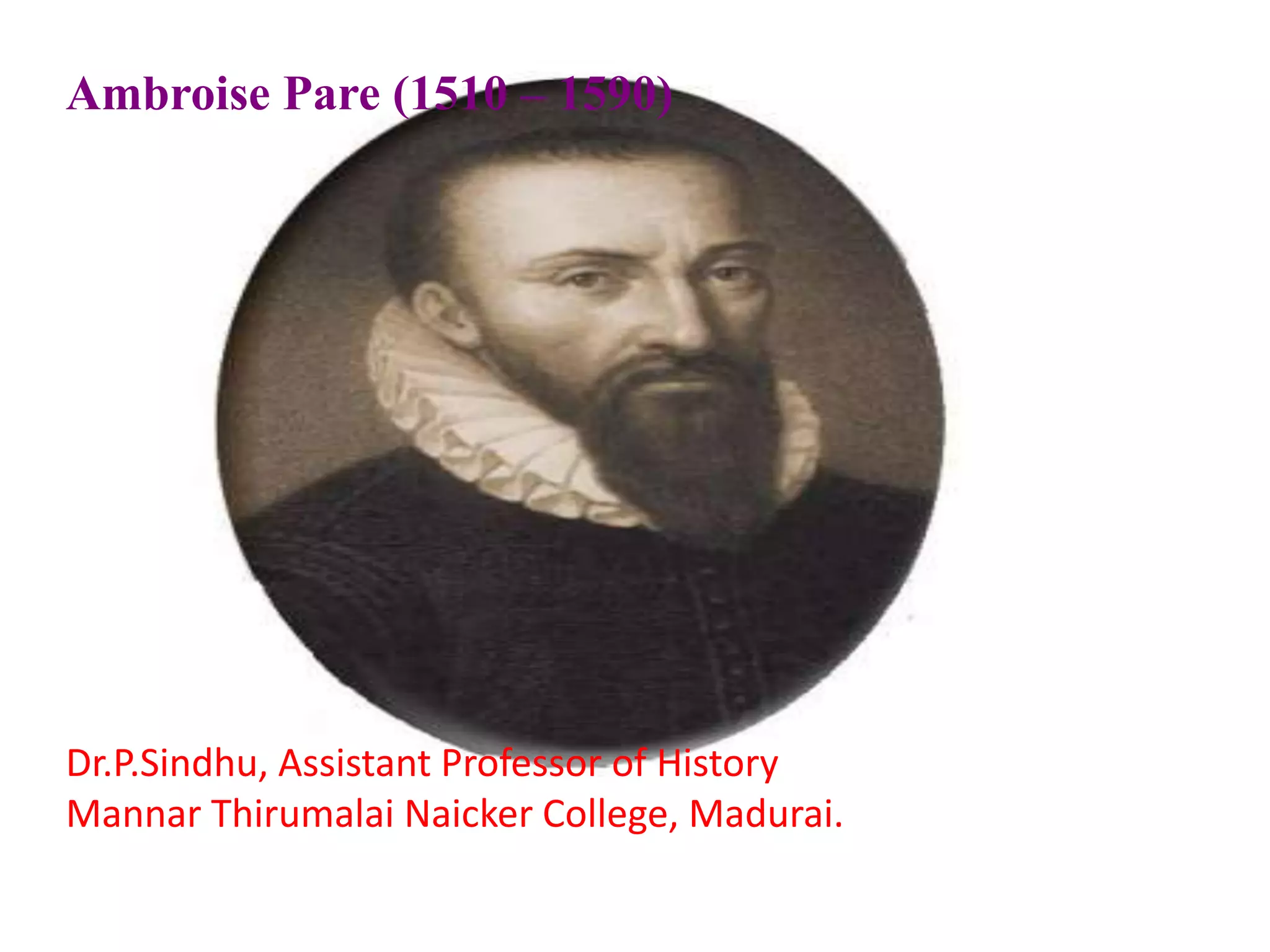
Ambroise Pare (1510 – 1590)
Dr.P.Sindhu, Assistant Professor of History
Mannar Thirumalai Naicker College, Madurai.
Introduction
 During the Renaissance the great progress in the
study of anatomy and physiology shed new light on
the structure and function of organs.
 Progress in anatomy brought about improvement in
the quality of surgery.
 A safe surgery is possible only with an adequate
knowledge of anatomy.
 The greatest surgeon of the 16th century was the
Frenchman Ambroise Pare, an admirer of Vesalius.
 The career of Ambroise Pare, the most famous
surgeon of the Renaissance, illustrates many
surgical aspects of the period.
 He made a thorough study of the anatomy of the
human body through experience and wrote an
abstract of his work in French.
 He is noted for his contribution to surgery and to
the antiseptic (germ-killing) care of wound.
Early Life
 Ambroise Pare, son of artisan was born in Laval in
Paris in 1510.
 In his early career, he became the rustic barber’s
apprentice in an hospital.
 The practice of medicine in Paris was regulated by a
stern and rigid code.
 Physicians at the top of the faculty of medicine were
powerful.
 They had university degrees and their word became
law in the medical field.
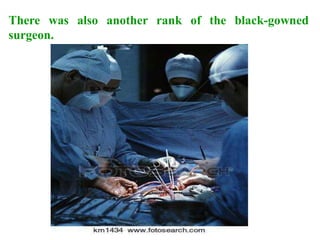
There was also another rank of the black-gowned
surgeon.
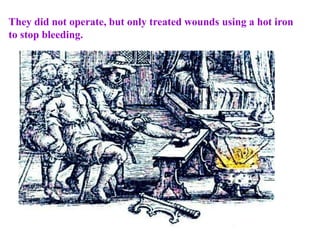
They did not operate, but only treated wounds using a hot iron
to stop bleeding.
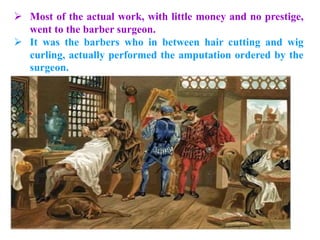
 Most of the actual work, with little money and no prestige,
went to the barber surgeon.
 It was the barbers who in between hair cutting and wig
curling, actually performed the amputation ordered by the
surgeon.
 At the absolute bottom, came the barber’s
apprentices.
 These were boys with no money, no
knowledge of Latin and no university degree.
 Ambroise Pare became a student of a barber
surgeon.
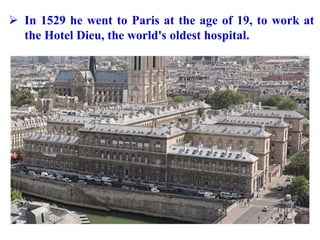
 In 1529 he went to Paris at the age of 19, to work at
the Hotel Dieu, the world's oldest hospital.
 In this hospital he got the opportunity to perform
autopsies and to dissect dead bodies.
 Pare then began a long career as a military surgeon
and finally attained the post of first surgeon to
successive kings of France.
As a Surgeon in Military
 As a surgeon to the military, he accompanied the
fighting troops in the military campaign.
 The campaign of the French troops in Italy from
1536 to 1545 gave him great experience in military
surgery, as a barber’s apprentice, and realised the
strange experience of treating the gunshot wounds by
pouring boiling oil over the wound.
 If the wound occurred in arm or leg, they usually
followed the practice of cutting them off.
 Then the bleeding in the wound was stopped by the
stumping of a red hot iron.
 This was the only method adopted to treat the
wound.
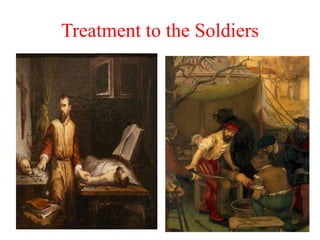
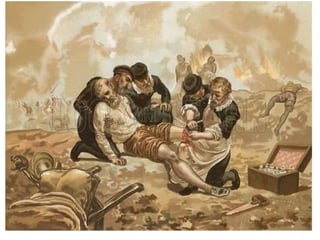
Treatment to the Soldiers
 The idea of pouring boiling oil into the wounds of the
injured man, seemed terrible to Pare.
 But he was disqualified in the field to argue with the
expert to change the a barbarous method of
treatment .
 Pare’s major achievement was his rejection of the
pervasive (general) practice of cauterizing (burning)
gunshot wound with boiling oil and introduced a
new method of treatment.
 At one war, when he treated the wounded soldiers, he
found the run out of the boiling oil.
 The men would die unless wounds were treated.
 The shortage of the oil was in shortage he was forced
to apply a method called “digestive”.
 He treated the wound with an ointment of egg yolk,
rose oil and turpentine with good results.
 Surprisingly the wounded soldiers who were treated
in the new method, were feeling remarkably well.
 The young surgeons were not at the moment, sure of
the new method of treatment.
 Pare arrived at a conclusion that he would not use
boiling oil on gun-shot wounds.
 Pare relied heavily on his own experiments and
observations and made contributions to the
development of his new techniques.
 His chance discovery of the new method of
treatment healed the gunshot wounds better without
the customary application of boiling oil.
 Pare then returned from the military campaign,
married and settled sown in Paris, and his wife
objected to his new method of treatment.
 But he was determined to follow the newly
discovered method of treatment.
 He began arguing about campfires with many
opponents.
 In 1552, his opponents were two young surgeons on
their second military campaign.
 He said, “We are cruel and inhuman surgeons.
 His humanitarian feeling forced him to say that the
surgeons were no better than Romans who stoned
people to death.
 His new method of surgery laid the foundation of
modern surgery.
 Pare’s greatest contribution was the introduction of
the new technique in surgery.
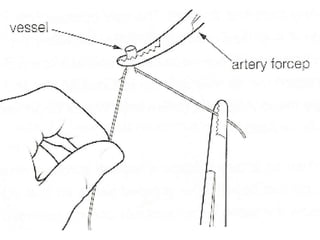
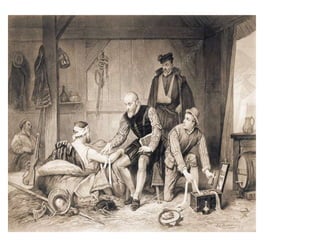
 Pare applied a new technique using thread and a
needle to close the edge of the wound.
 Pare made his incision and sawed through the bone.
 He was the first to control bleeding by the ligation
(tying off).
 It was Pare who put first his technique on a firm,
systematic and Practical basis.
 He treated the gunshots with simple dressing.
 He said, “I dress the wound, God heals it”.
 Pare announced his discoveries in 1545 in a
landmark book “The Method of Treating Wounds
Made by Harquebuses and Other Fire Arms”.
 This is the first surgical publication foe several
centuries and very first research work on surgery in
French language.
 Pare enhanced the prestige of surgery through his
dedication and his new methods of surgery.
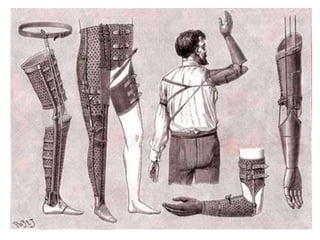
 He wrote other medical treaties in French and
devised artificial limbs.
 He invented several surgical and orthopedic devices.
 The human organs, lost during the war, were
replaced by planting artificial organs which received
a new status.
 He also contributed much in the field of obstetrics,
a branch of medicine and surgery concerned with
child birth.
 The introduction of suitable modifications in times
of child birth led to safe deliveries.
 Pare served thirty years as an army surgeon.
 His service were used by the French kings and he
became surgeon to four French kings, Henry II,
Franchise II, Charles IX and Henry III.
 Pare was French Protestant, popularly called
Huguenot.
 During the religious riot between the protestants and
Catholics, at the massacre of St.Bartholomew in
1572, his life was saved by king Charles IX.
 After his retirement from army, he settled in Paris,
and wrote autobiography giving a clear picture of his
life time.
 He was a famous for integrity and humanitarian
concern and dedication to the medical profession.
 He died in Paris on December 20, 1590.
 The discovery that bleeding in a major surgery could
be controlled by the use of the ligature, was his
greatest contribution.
 Pare laid the foundation for the future
progress of modern surgery.
 For his outstanding contribution to the field
of surgery he has been rightly called the
Father of Surgery.

Ambroise Pare

  • 1.
    Ambroise Pare (1510– 1590) Dr.P.Sindhu, Assistant Professor of History Mannar Thirumalai Naicker College, Madurai.
  • 2.
    Introduction  During theRenaissance the great progress in the study of anatomy and physiology shed new light on the structure and function of organs.  Progress in anatomy brought about improvement in the quality of surgery.  A safe surgery is possible only with an adequate knowledge of anatomy.  The greatest surgeon of the 16th century was the Frenchman Ambroise Pare, an admirer of Vesalius.  The career of Ambroise Pare, the most famous surgeon of the Renaissance, illustrates many surgical aspects of the period.
  • 3.
     He madea thorough study of the anatomy of the human body through experience and wrote an abstract of his work in French.  He is noted for his contribution to surgery and to the antiseptic (germ-killing) care of wound.
  • 4.
    Early Life  AmbroisePare, son of artisan was born in Laval in Paris in 1510.  In his early career, he became the rustic barber’s apprentice in an hospital.  The practice of medicine in Paris was regulated by a stern and rigid code.  Physicians at the top of the faculty of medicine were powerful.  They had university degrees and their word became law in the medical field.
  • 5.
    There was alsoanother rank of the black-gowned surgeon.
  • 6.
    They did notoperate, but only treated wounds using a hot iron to stop bleeding.
  • 7.
     Most ofthe actual work, with little money and no prestige, went to the barber surgeon.  It was the barbers who in between hair cutting and wig curling, actually performed the amputation ordered by the surgeon.
  • 8.
     At theabsolute bottom, came the barber’s apprentices.  These were boys with no money, no knowledge of Latin and no university degree.  Ambroise Pare became a student of a barber surgeon.
  • 9.
     In 1529he went to Paris at the age of 19, to work at the Hotel Dieu, the world's oldest hospital.
  • 10.
     In thishospital he got the opportunity to perform autopsies and to dissect dead bodies.  Pare then began a long career as a military surgeon and finally attained the post of first surgeon to successive kings of France.
  • 11.
    As a Surgeonin Military  As a surgeon to the military, he accompanied the fighting troops in the military campaign.  The campaign of the French troops in Italy from 1536 to 1545 gave him great experience in military surgery, as a barber’s apprentice, and realised the strange experience of treating the gunshot wounds by pouring boiling oil over the wound.  If the wound occurred in arm or leg, they usually followed the practice of cutting them off.  Then the bleeding in the wound was stopped by the stumping of a red hot iron.  This was the only method adopted to treat the wound.
  • 12.
  • 14.
     The ideaof pouring boiling oil into the wounds of the injured man, seemed terrible to Pare.  But he was disqualified in the field to argue with the expert to change the a barbarous method of treatment .  Pare’s major achievement was his rejection of the pervasive (general) practice of cauterizing (burning) gunshot wound with boiling oil and introduced a new method of treatment.  At one war, when he treated the wounded soldiers, he found the run out of the boiling oil.  The men would die unless wounds were treated.  The shortage of the oil was in shortage he was forced to apply a method called “digestive”.
  • 15.
     He treatedthe wound with an ointment of egg yolk, rose oil and turpentine with good results.  Surprisingly the wounded soldiers who were treated in the new method, were feeling remarkably well.  The young surgeons were not at the moment, sure of the new method of treatment.  Pare arrived at a conclusion that he would not use boiling oil on gun-shot wounds.  Pare relied heavily on his own experiments and observations and made contributions to the development of his new techniques.  His chance discovery of the new method of treatment healed the gunshot wounds better without the customary application of boiling oil.
  • 16.
     Pare thenreturned from the military campaign, married and settled sown in Paris, and his wife objected to his new method of treatment.  But he was determined to follow the newly discovered method of treatment.  He began arguing about campfires with many opponents.  In 1552, his opponents were two young surgeons on their second military campaign.  He said, “We are cruel and inhuman surgeons.  His humanitarian feeling forced him to say that the surgeons were no better than Romans who stoned people to death.  His new method of surgery laid the foundation of modern surgery.
  • 17.
     Pare’s greatestcontribution was the introduction of the new technique in surgery.  Pare applied a new technique using thread and a needle to close the edge of the wound.  Pare made his incision and sawed through the bone.  He was the first to control bleeding by the ligation (tying off).  It was Pare who put first his technique on a firm, systematic and Practical basis.  He treated the gunshots with simple dressing.  He said, “I dress the wound, God heals it”.
  • 20.
     Pare announcedhis discoveries in 1545 in a landmark book “The Method of Treating Wounds Made by Harquebuses and Other Fire Arms”.  This is the first surgical publication foe several centuries and very first research work on surgery in French language.  Pare enhanced the prestige of surgery through his dedication and his new methods of surgery.  He wrote other medical treaties in French and devised artificial limbs.  He invented several surgical and orthopedic devices.  The human organs, lost during the war, were replaced by planting artificial organs which received a new status.
  • 22.
     He alsocontributed much in the field of obstetrics, a branch of medicine and surgery concerned with child birth.  The introduction of suitable modifications in times of child birth led to safe deliveries.  Pare served thirty years as an army surgeon.  His service were used by the French kings and he became surgeon to four French kings, Henry II, Franchise II, Charles IX and Henry III.
  • 23.
     Pare wasFrench Protestant, popularly called Huguenot.  During the religious riot between the protestants and Catholics, at the massacre of St.Bartholomew in 1572, his life was saved by king Charles IX.  After his retirement from army, he settled in Paris, and wrote autobiography giving a clear picture of his life time.  He was a famous for integrity and humanitarian concern and dedication to the medical profession.  He died in Paris on December 20, 1590.  The discovery that bleeding in a major surgery could be controlled by the use of the ligature, was his greatest contribution.
  • 24.
     Pare laidthe foundation for the future progress of modern surgery.  For his outstanding contribution to the field of surgery he has been rightly called the Father of Surgery.