Alternative Dns Servers Choice And Deployment
And Optional Sql Ldap Backends Janpiet Mens
download
https://ebookbell.com/product/alternative-dns-servers-choice-and-
deployment-and-optional-sql-ldap-backends-janpiet-mens-2098876
Explore and download more ebooks at ebookbell.com
Here are some recommended products that we believe you will be
interested in. You can click the link to download.
Alternative Medicines For Diabetes Management Advances In
Pharmacognosy And Medicinal Chemistry Varma H Rambaran
https://ebookbell.com/product/alternative-medicines-for-diabetes-
management-advances-in-pharmacognosy-and-medicinal-chemistry-varma-h-
rambaran-44895978
Alternative Medicines For Diabetes Management Advances In
Pharmacognosy And Medicinal Chemistry Varma H Rambaran
https://ebookbell.com/product/alternative-medicines-for-diabetes-
management-advances-in-pharmacognosy-and-medicinal-chemistry-varma-h-
rambaran-44938954
Alternative Fuels And Advanced Vehicle Technologies For Improved
Environmental Performance Towards Zero Carbon Transportation 2nd
Edition Richard Folkson
https://ebookbell.com/product/alternative-fuels-and-advanced-vehicle-
technologies-for-improved-environmental-performance-towards-zero-
carbon-transportation-2nd-edition-richard-folkson-46098930
Alternative Immobilities Maria Alice De Faria Nogueira Editor
https://ebookbell.com/product/alternative-immobilities-maria-alice-de-
faria-nogueira-editor-46222796
Alternative Sweet And Supersweet Principles Natural Sweeteners And
Plants Ram Snehi Dwivedi
https://ebookbell.com/product/alternative-sweet-and-supersweet-
principles-natural-sweeteners-and-plants-ram-snehi-dwivedi-46364482
Alternative Lending Risks Supervision And Resolution Of Debt Funds
Promitheas Peridis
https://ebookbell.com/product/alternative-lending-risks-supervision-
and-resolution-of-debt-funds-promitheas-peridis-46495866
Alternative Comedy Now And Then Critical Perspectives Oliver Double
https://ebookbell.com/product/alternative-comedy-now-and-then-
critical-perspectives-oliver-double-46590274
Alternative Perspectives On Peacebuilding Theories And Case Studies
Mark S Cogan
https://ebookbell.com/product/alternative-perspectives-on-
peacebuilding-theories-and-case-studies-mark-s-cogan-46591422
Alternative Proteins Safety And Food Security Considerations Alaa
Eldin Bekhit William Riley Malik Hussain
https://ebookbell.com/product/alternative-proteins-safety-and-food-
security-considerations-alaa-eldin-bekhit-william-riley-malik-
hussain-46707768
Alternative DNS Servers
Choice and deployment, and optional SQL/LDAP back-ends
Jan-Piet Mens
UIT CAMBRIDGE LTD.
CAMBRIDGE, ENGLAND
First published in England in 2009.
UIT Cambridge Ltd.
PO Box 145
Cambridge
CB4 1GQ
England
Tel: +44 1223 302 041
Web: www.uit.co.uk
Copyright © 2009 UIT Cambridge Ltd.
All rights reserved.
ISBN 978-0-9544529-9-5
The right of Jan-Piet Mens to be identified as the author of this work
has been asserted by him in accordance with the Copyright, Designs
and Patents Act 1988.
The programs and instructions in this book have been included for
their instructional value. Neither the publisher nor the author offers
any warranties or representations in respect of their fitness for a
particular purpose, nor do they accept accept any liability for any
loss or damage arising from their use.
The publication is designed to provide accurate and authoritative
information in regard to the subject matter covered. Neither the
publisher nor the author makes any representation, express or
implied, with regard to the accuracy of information contained in
this book, nor do they accept any legal responsibility or liability for
any errors or omissions that may be made. This work is supplied
with the understanding that UIT Cambridge Ltd and its authors are
supplying information, but are not attempting to render engineering
or other professional services. If such services are required, the
assistance of an appropriate professional should be sought.
Many of the designations used by manufacturers and sellers to
distinguish their products are claimed as trade-marks. UIT
Cambridge Ltd acknowledges trademarks as the property of their
respective owners.
10 9 8 7 6 5 4 3 2 1
To Alexandra
For your interest, support, and enthusiasm (as well as relentless
page-count-checking) during this project, and for being my greatest
fan.
Related Titles
Practical TCP/IP – Designing, using, and troubleshooting TCP/IP
networks on Linux and Windows, (Second edition) Niall Mansfield
The Exim SMTP Mail Server – Official Guide for Release 4, (Second
edition) Philip Hazel
The Joy of X – The architecture of the X window system, Niall
Mansfield
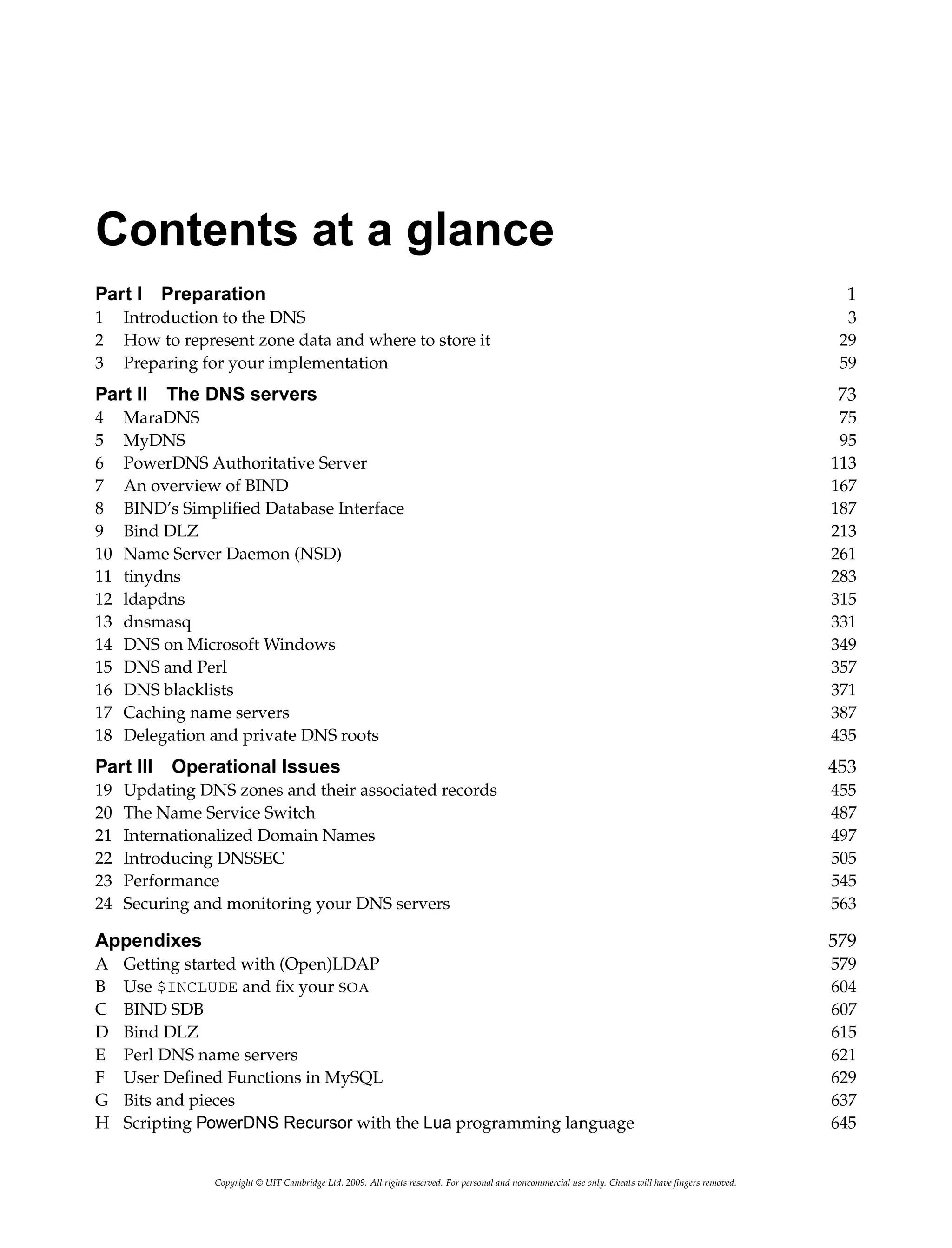
Contents at a glance
Part I Preparation 1
1 Introduction to the DNS 3
2 How to represent zone data and where to store it 29
3 Preparing for your implementation 59
Part II The DNS servers 73
4 MaraDNS 75
5 MyDNS 95
6 PowerDNS Authoritative Server 113
7 An overview of BIND 167
8 BIND’s Simplified Database Interface 187
9 Bind DLZ 213
10 Name Server Daemon (NSD) 261
11 tinydns 283
12 ldapdns 315
13 dnsmasq 331
14 DNS on Microsoft Windows 349
15 DNS and Perl 357
16 DNS blacklists 371
17 Caching name servers 387
18 Delegation and private DNS roots 435
Part III Operational Issues 453
19 Updating DNS zones and their associated records 455
20 The Name Service Switch 487
21 Internationalized Domain Names 497
22 Introducing DNSSEC 505
23 Performance 545
24 Securing and monitoring your DNS servers 563
Appendixes 579
A Getting started with (Open)LDAP 579
B Use $INCLUDE and fix your SOA 604
C BIND SDB 607
D Bind DLZ 615
E Perl DNS name servers 621
F User Defined Functions in MySQL 629
G Bits and pieces 637
H Scripting PowerDNS Recursor with the Lua programming language 645
Copyright © UIT Cambridge Ltd. 2009. All rights reserved. For personal and noncommercial use only. Cheats will have fingers removed.
Contents
Preface xxxi
Acknowledgments xxxv
Part I Preparation 1
1 Introduction to the DNS 3
1.1 The Domain Name System – overview and terminology . . . . . . . . . . . . . 4
1.1.1 The DNS tree . . . . . . . . . . . . . . . . . . . . . . . . . . . . . . . . . 4
How domains are named in the DNS . . . . . . . . . . . . . . . . . . . 4
Subdomains . . . . . . . . . . . . . . . . . . . . . . . . . . . . . . . . . . 6
1.1.2 Name resolution . . . . . . . . . . . . . . . . . . . . . . . . . . . . . . . 6
1.1.3 DNS packets . . . . . . . . . . . . . . . . . . . . . . . . . . . . . . . . . . 6
1.1.4 An example – translating domain name www.qupps.biz to an address . 7
1.1.5 Step 1 – the resolver . . . . . . . . . . . . . . . . . . . . . . . . . . . . . 9
1.1.6 Step 1, contd. – caching DNS servers . . . . . . . . . . . . . . . . . . . . 10
1.1.7 Step 2 – root DNS servers . . . . . . . . . . . . . . . . . . . . . . . . . . 10
1.1.8 Step 3 – authoritative DNS servers . . . . . . . . . . . . . . . . . . . . . 11
Distribution of responsibility . . . . . . . . . . . . . . . . . . . . . . . . 12
1.1.9 Steps 1&5 v. 2-4 – authoritative and caching servers contrasted . . . . 12
Recursive v. iterative queries . . . . . . . . . . . . . . . . . . . . . . . . 14
1.2 Deployment issues with DNS servers . . . . . . . . . . . . . . . . . . . . . . . 14
1.2.1 Where domain information is stored – “zones” . . . . . . . . . . . . . . 15
1.2.2 Creating redundancy – master/slave, primary/secondary servers . . . 16
A. Master and slave name servers . . . . . . . . . . . . . . . . . . . . . 16
B. File or database replication . . . . . . . . . . . . . . . . . . . . . . . . 18
1.2.3 Special authoritative server configurations – split horizon and hidden
servers . . . . . . . . . . . . . . . . . . . . . . . . . . . . . . . . . . . . . 18
Split horizon servers . . . . . . . . . . . . . . . . . . . . . . . . . . . . . 18
Hidden name servers . . . . . . . . . . . . . . . . . . . . . . . . . . . . 19
1.2.4 Special caching server configurations – forwarding, forwarder, proxy . 20
1.2.5 Special authoritative and caching server configurations . . . . . . . . . 21
1.3 Features you might want to have in a name server . . . . . . . . . . . . . . . . 21
Copyright © UIT Cambridge Ltd. 2009. All rights reserved. For personal and noncommercial use only. Cheats will have fingers removed.
x CONTENTS
1.4 Scenarios of name server deployment . . . . . . . . . . . . . . . . . . . . . . . 23
1.4.1 ISP . . . . . . . . . . . . . . . . . . . . . . . . . . . . . . . . . . . . . . . 23
1.4.2 SOHO network . . . . . . . . . . . . . . . . . . . . . . . . . . . . . . . . 24
1.4.3 Corporate environment . . . . . . . . . . . . . . . . . . . . . . . . . . . 25
Small to medium organizations . . . . . . . . . . . . . . . . . . . . . . . 25
Large organizations . . . . . . . . . . . . . . . . . . . . . . . . . . . . . 25
2 How to represent zone data and where to store it 29
2.1 dig – a DNS lookup utility . . . . . . . . . . . . . . . . . . . . . . . . . . . . . . 30
2.1.1 dig overview . . . . . . . . . . . . . . . . . . . . . . . . . . . . . . . . . . 30
2.1.2 Looking up an IP address (A record) . . . . . . . . . . . . . . . . . . . . 31
2.1.3 Find version of remote name server, using dig . . . . . . . . . . . . . . 32
2.1.4 Transfer a zone with dig . . . . . . . . . . . . . . . . . . . . . . . . . . . 32
2.1.5 Trace recursion using dig . . . . . . . . . . . . . . . . . . . . . . . . . . . 33
2.2 Contents of a DNS query . . . . . . . . . . . . . . . . . . . . . . . . . . . . . . . 33
2.3 Resource records define information about a domain name . . . . . . . . . . . 34
2.3.1 The format of a Resource Record . . . . . . . . . . . . . . . . . . . . . . 35
2.3.2 Resource record sets . . . . . . . . . . . . . . . . . . . . . . . . . . . . . 36
2.3.3 Resource records in detail . . . . . . . . . . . . . . . . . . . . . . . . . . 37
Address (A) resource records . . . . . . . . . . . . . . . . . . . . . . . . 37
Mail Exchanger (MX) resource records . . . . . . . . . . . . . . . . . . . 37
Pointer (PTR) resource records . . . . . . . . . . . . . . . . . . . . . . . . 38
Forward and reverse queries . . . . . . . . . . . . . . . . . . . . . . . . 38
Canonical name (CNAME) resource records . . . . . . . . . . . . . . . . 39
The Start of Authority (SOA) resource records . . . . . . . . . . . . . . . 41
Name Server (NS) resource records . . . . . . . . . . . . . . . . . . . . . 43
Text (TXT) resource records . . . . . . . . . . . . . . . . . . . . . . . . . . 44
Service (SRV) resource records . . . . . . . . . . . . . . . . . . . . . . . . 44
2.4 Creating zones from resource records . . . . . . . . . . . . . . . . . . . . . . . 45
2.4.1 Define a minimal zone . . . . . . . . . . . . . . . . . . . . . . . . . . . . 46
2.4.2 A more realistic “minimal” zone . . . . . . . . . . . . . . . . . . . . . . 46
2.4.3 Add desktop hosts, and Web and e-mail servers . . . . . . . . . . . . . 46
2.4.4 Add a reverse zone . . . . . . . . . . . . . . . . . . . . . . . . . . . . . . 47
2.4.5 Inconsistencies . . . . . . . . . . . . . . . . . . . . . . . . . . . . . . . . 48
Notes on master file syntax . . . . . . . . . . . . . . . . . . . . . . . . . 48
2.5 How and where zone data is stored . . . . . . . . . . . . . . . . . . . . . . . . . 49
2.5.1 Advantages and disadvantages of text files for zone data . . . . . . . . 49
2.5.2 Zone data in databases and directories . . . . . . . . . . . . . . . . . . 50
2.5.3 SQL databases . . . . . . . . . . . . . . . . . . . . . . . . . . . . . . . . . 51
Databases supported by DNS servers . . . . . . . . . . . . . . . . . . . 51
Replication of zone data stored in an SQL back-end . . . . . . . . . . . 52
Manipulating records in an SQL database . . . . . . . . . . . . . . . . . 52
2.5.4 LDAP Directories . . . . . . . . . . . . . . . . . . . . . . . . . . . . . . . 53
DNS servers that support LDAP . . . . . . . . . . . . . . . . . . . . . . 53
Choice of LDAP directory servers . . . . . . . . . . . . . . . . . . . . . 53
Copyright © UIT Cambridge Ltd. 2009. All rights reserved. For personal and noncommercial use only. Cheats will have fingers removed.
CONTENTS xi
Replicating LDAP data . . . . . . . . . . . . . . . . . . . . . . . . . . . . 54
Manipulating entries in an LDAP directory . . . . . . . . . . . . . . . . 54
2.5.5 How you maintain zone data stored in a back-end . . . . . . . . . . . . 55
2.5.6 Provisioning text files from a database back-end . . . . . . . . . . . . . 57
3 Preparing for your implementation 59
3.1 Planning your implementation . . . . . . . . . . . . . . . . . . . . . . . . . . . 60
3.1.1 Planning your name server placement . . . . . . . . . . . . . . . . . . . 63
3.1.2 Capacity planning . . . . . . . . . . . . . . . . . . . . . . . . . . . . . . 63
3.1.3 Business continuity . . . . . . . . . . . . . . . . . . . . . . . . . . . . . . 64
3.2 The programs and why we chose them . . . . . . . . . . . . . . . . . . . . . . . 66
3.3 Operating system and software requirements . . . . . . . . . . . . . . . . . . . 67
3.3.1 Using pre-built packages . . . . . . . . . . . . . . . . . . . . . . . . . . 68
Building software from source . . . . . . . . . . . . . . . . . . . . . . . 68
3.4 Back-ends supported by the various servers . . . . . . . . . . . . . . . . . . . . 69
3.5 Setting up a test environment . . . . . . . . . . . . . . . . . . . . . . . . . . . . 69
Part II The DNS servers 73
4 MaraDNS 75
4.1 Getting results quickly . . . . . . . . . . . . . . . . . . . . . . . . . . . . . . . . 77
4.1.1 Set up MaraDNS as a caching name server . . . . . . . . . . . . . . . . . 77
4.1.2 Set up MaraDNS as a caching and authoritative server . . . . . . . . . . 77
4.1.3 Set up MaraDNS as an authoritative name server . . . . . . . . . . . . . 77
4.1.4 Automatic zones . . . . . . . . . . . . . . . . . . . . . . . . . . . . . . . 78
4.2 Format of MaraDNS zone files . . . . . . . . . . . . . . . . . . . . . . . . . . . . 79
Typical resource records . . . . . . . . . . . . . . . . . . . . . . . . . . . 80
An example zone in csv2 format . . . . . . . . . . . . . . . . . . . . . . 81
Reverse zones . . . . . . . . . . . . . . . . . . . . . . . . . . . . . . . . . 81
4.3 Launch the maradns daemon . . . . . . . . . . . . . . . . . . . . . . . . . . . . . 82
4.4 Configuring MaraDNS behavior with the mararc file . . . . . . . . . . . . . . . 82
4.4.1 Normal variables . . . . . . . . . . . . . . . . . . . . . . . . . . . . . . . 83
4.4.2 Dictionary variables . . . . . . . . . . . . . . . . . . . . . . . . . . . . . 85
4.5 Zone transfers . . . . . . . . . . . . . . . . . . . . . . . . . . . . . . . . . . . . . 87
4.5.1 Using MaraDNS as a master DNS server . . . . . . . . . . . . . . . . . . 87
4.5.2 Using MaraDNS as a slave DNS server . . . . . . . . . . . . . . . . . . . 89
4.6 Recursion, roots and forwarders . . . . . . . . . . . . . . . . . . . . . . . . . . 90
4.6.1 Setting up private root servers . . . . . . . . . . . . . . . . . . . . . . . 90
4.6.2 Forwarding queries . . . . . . . . . . . . . . . . . . . . . . . . . . . . . . 90
4.7 Logging and utilities . . . . . . . . . . . . . . . . . . . . . . . . . . . . . . . . . 91
4.7.1 Logging and monitoring . . . . . . . . . . . . . . . . . . . . . . . . . . . 91
4.7.2 Converting BIND master zone files to csv2 format . . . . . . . . . . . . 91
4.7.3 The duende utility . . . . . . . . . . . . . . . . . . . . . . . . . . . . . . . 92
4.7.4 Querying DNS servers with askmara . . . . . . . . . . . . . . . . . . . . 92
Copyright © UIT Cambridge Ltd. 2009. All rights reserved. For personal and noncommercial use only. Cheats will have fingers removed.
xii CONTENTS
5 MyDNS 95
5.1 Getting MyDNS up and running . . . . . . . . . . . . . . . . . . . . . . . . . . . 96
5.1.1 Creating the MySQL database tables for MyDNS . . . . . . . . . . . . . 97
5.1.2 The MyDNS database tables . . . . . . . . . . . . . . . . . . . . . . . . . 97
The soa table . . . . . . . . . . . . . . . . . . . . . . . . . . . . . . . . . 97
The rr table . . . . . . . . . . . . . . . . . . . . . . . . . . . . . . . . . . 98
5.1.3 Example – Create a zone and its resource records . . . . . . . . . . . . 99
5.2 Changing the way MyDNS works . . . . . . . . . . . . . . . . . . . . . . . . . . 100
5.2.1 Configuration in mydns.conf . . . . . . . . . . . . . . . . . . . . . . . . 100
Basic database information . . . . . . . . . . . . . . . . . . . . . . . . . 101
Server options . . . . . . . . . . . . . . . . . . . . . . . . . . . . . . . . . 101
Options to control internal caching . . . . . . . . . . . . . . . . . . . . . 102
Options that affect the name server . . . . . . . . . . . . . . . . . . . . 103
5.3 Replicating zones . . . . . . . . . . . . . . . . . . . . . . . . . . . . . . . . . . . 104
5.3.1 Zone transfers . . . . . . . . . . . . . . . . . . . . . . . . . . . . . . . . . 105
5.4 Dynamic DNS updates in MyDNS . . . . . . . . . . . . . . . . . . . . . . . . . . 106
5.4.1 Enable dynamic DNS updates . . . . . . . . . . . . . . . . . . . . . . . 106
5.4.2 IP access rules for dynamic DNS updates . . . . . . . . . . . . . . . . . 106
5.5 Utilities included with MyDNS . . . . . . . . . . . . . . . . . . . . . . . . . . . . 107
5.5.1 Importing zones into MyDNS with mydnsimport . . . . . . . . . . . . . . 107
5.5.2 Exporting zones from MyDNS with mydnsexport . . . . . . . . . . . . . . 107
5.5.3 The MyDNS Web interface: admin.php . . . . . . . . . . . . . . . . . . . . 108
5.6 Monitoring MyDNS . . . . . . . . . . . . . . . . . . . . . . . . . . . . . . . . . . 109
5.6.1 Logging queries . . . . . . . . . . . . . . . . . . . . . . . . . . . . . . . . 109
6 PowerDNS Authoritative Server 113
6.1 How PowerDNS stores zone data . . . . . . . . . . . . . . . . . . . . . . . . . . 114
6.1.1 Generic SQL or OpenDBX for SQL back-ends? . . . . . . . . . . . . . . 116
6.2 Server roles – master/slave, superslave, native . . . . . . . . . . . . . . . . . . 116
6.2.1 Master . . . . . . . . . . . . . . . . . . . . . . . . . . . . . . . . . . . . . 116
6.2.2 Slave . . . . . . . . . . . . . . . . . . . . . . . . . . . . . . . . . . . . . . 117
6.2.3 Superslave . . . . . . . . . . . . . . . . . . . . . . . . . . . . . . . . . . . 118
6.2.4 Native . . . . . . . . . . . . . . . . . . . . . . . . . . . . . . . . . . . . . 118
6.2.5 Mixing roles . . . . . . . . . . . . . . . . . . . . . . . . . . . . . . . . . . 119
6.3 Getting started quickly . . . . . . . . . . . . . . . . . . . . . . . . . . . . . . . . 119
6.3.1 A. Configure the BIND zone file back-end . . . . . . . . . . . . . . . . . 119
Using the BIND back-end as a slave server . . . . . . . . . . . . . . . . . 122
6.3.2 B. Configure the generic MySQL back-end . . . . . . . . . . . . . . . . 122
6.3.3 Database schema used by the gmysql and opendbx back-ends . . . . . . 124
The domains table . . . . . . . . . . . . . . . . . . . . . . . . . . . . . . 125
The records table . . . . . . . . . . . . . . . . . . . . . . . . . . . . . . 126
6.3.4 Managing zones in the database . . . . . . . . . . . . . . . . . . . . . . 126
Create a new master or native zone in the database . . . . . . . . . . . 127
Adding resource records to the database . . . . . . . . . . . . . . . . . 127
Automating record inserts . . . . . . . . . . . . . . . . . . . . . . . . . . 128
Copyright © UIT Cambridge Ltd. 2009. All rights reserved. For personal and noncommercial use only. Cheats will have fingers removed.
CONTENTS xiii
Adding a slave zone . . . . . . . . . . . . . . . . . . . . . . . . . . . . . 128
How you configure a Superslave . . . . . . . . . . . . . . . . . . . . . . 129
6.4 The OpenDBX database back-end . . . . . . . . . . . . . . . . . . . . . . . . . . 130
6.4.1 Getting started with the OpenDBX back-end . . . . . . . . . . . . . . . . 132
6.4.2 Configuration options for the OpenDBX back-end . . . . . . . . . . . . 132
6.4.3 A – General options . . . . . . . . . . . . . . . . . . . . . . . . . . . . . 132
6.5 The LDAP directory server back-end . . . . . . . . . . . . . . . . . . . . . . . . 134
6.5.1 Designing the LDAP directory tree . . . . . . . . . . . . . . . . . . . . . 134
6.5.2 LDAP schema used by the LDAP back-end . . . . . . . . . . . . . . . . 135
6.5.3 Defining an LDAP back-end in pdns.conf . . . . . . . . . . . . . . . . 136
6.5.4 The zone2ldap utility . . . . . . . . . . . . . . . . . . . . . . . . . . . . . 137
6.5.5 Limitations of the LDAP back-end . . . . . . . . . . . . . . . . . . . . . 139
6.6 The Pipe back-end . . . . . . . . . . . . . . . . . . . . . . . . . . . . . . . . . . 139
6.6.1 How PowerDNS and the coprocess communicate . . . . . . . . . . . . . 140
6.6.2 Directives for the Pipe back-end . . . . . . . . . . . . . . . . . . . . . . 141
6.6.3 An example load balancer coprocess for the Pipe back-end . . . . . . . 142
6.7 Global PowerDNS configuration directives . . . . . . . . . . . . . . . . . . . . . 143
6.8 Monitoring PowerDNS . . . . . . . . . . . . . . . . . . . . . . . . . . . . . . . . 149
6.8.1 pdns control . . . . . . . . . . . . . . . . . . . . . . . . . . . . . . . . . . . 149
6.8.2 Built-in Web server . . . . . . . . . . . . . . . . . . . . . . . . . . . . . . 151
6.8.3 pdns init.d script . . . . . . . . . . . . . . . . . . . . . . . . . . . . . . . 152
6.9 Deployment and provisioning scenarios . . . . . . . . . . . . . . . . . . . . . . 153
6.9.1 Don’t create a single point of failure . . . . . . . . . . . . . . . . . . . . 153
6.9.2 Domain hoster . . . . . . . . . . . . . . . . . . . . . . . . . . . . . . . . 154
6.9.3 Set up NSD or BIND with a hidden/stealth MySQL PowerDNS . . . . . 154
6.9.4 Set up BIND with hidden/stealth PowerDNS and LDAP back-end . . . 156
6.9.5 Create your own provisioning tools . . . . . . . . . . . . . . . . . . . . 157
Update your database with PowerDNS::Backend::MySQL . . . . . . . . . 157
6.9.6 Enforce correct CNAME usage in your database . . . . . . . . . . . . . . 158
Creating the trigger . . . . . . . . . . . . . . . . . . . . . . . . . . . . . . 158
Viewing the effects of the trigger . . . . . . . . . . . . . . . . . . . . . . 159
7 An overview of BIND 167
7.1 Why use the BIND name server? . . . . . . . . . . . . . . . . . . . . . . . . . . . 169
7.2 Scenarios for deployment of BIND . . . . . . . . . . . . . . . . . . . . . . . . . . 169
7.2.1 Authoritative name server . . . . . . . . . . . . . . . . . . . . . . . . . . 169
7.2.2 Caching name server . . . . . . . . . . . . . . . . . . . . . . . . . . . . . 169
7.2.3 Front-end to stealth server . . . . . . . . . . . . . . . . . . . . . . . . . . 170
7.3 Configuring zones in BIND . . . . . . . . . . . . . . . . . . . . . . . . . . . . . . 170
7.3.1 A sample configuration of an authoritative BIND name server . . . . . 170
7.3.2 Defining zones . . . . . . . . . . . . . . . . . . . . . . . . . . . . . . . . 173
A,B. Master and slave zones . . . . . . . . . . . . . . . . . . . . . . . . . 174
C. Forwarding zones . . . . . . . . . . . . . . . . . . . . . . . . . . . . . 174
D. Stub zones . . . . . . . . . . . . . . . . . . . . . . . . . . . . . . . . . 175
E. Root hints . . . . . . . . . . . . . . . . . . . . . . . . . . . . . . . . . . 175
Copyright © UIT Cambridge Ltd. 2009. All rights reserved. For personal and noncommercial use only. Cheats will have fingers removed.
xiv CONTENTS
7.4 Using TSIG to secure zone transfers and updates . . . . . . . . . . . . . . . . . 176
1 – Generating TSIG keys . . . . . . . . . . . . . . . . . . . . . . . . . . . 177
2a – Configure zones with TSIG keys . . . . . . . . . . . . . . . . . . . . 178
2b – Protect updatable zones . . . . . . . . . . . . . . . . . . . . . . . . 178
7.5 Configuring BIND to accept dynamic DNS updates . . . . . . . . . . . . . . . . 178
7.5.1 How your zone is updated . . . . . . . . . . . . . . . . . . . . . . . . . 179
7.6 Split-horizon DNS using BIND views . . . . . . . . . . . . . . . . . . . . . . . . 179
7.7 Aspects of implementing a BIND name server . . . . . . . . . . . . . . . . . . . 180
7.7.1 How you create your zone files . . . . . . . . . . . . . . . . . . . . . . . 180
7.7.2 Monitoring your BIND name server . . . . . . . . . . . . . . . . . . . . . 181
Statistics . . . . . . . . . . . . . . . . . . . . . . . . . . . . . . . . . . . . 181
Query logging . . . . . . . . . . . . . . . . . . . . . . . . . . . . . . . . . 181
The BIND 9.5 stats Web server . . . . . . . . . . . . . . . . . . . . . . . . 182
7.8 Points to note when using BIND . . . . . . . . . . . . . . . . . . . . . . . . . . . 184
8 BIND’s Simplified Database Interface 187
8.1 Overview of BIND SDB . . . . . . . . . . . . . . . . . . . . . . . . . . . . . . . . 188
8.1.1 Existing BIND SDB drivers . . . . . . . . . . . . . . . . . . . . . . . . . . 189
8.2 Overview of BIND SDB LDAP driver . . . . . . . . . . . . . . . . . . . . . . . . 190
8.2.1 Limitations of the BIND-sdb-LDAP driver . . . . . . . . . . . . . . . . . . 190
8.3 Installing BIND SDB and configuring your LDAP server . . . . . . . . . . . . . 190
8.3.1 A – Compile BIND SDB with the LDAP driver . . . . . . . . . . . . . . 191
8.3.2 B – Configure your LDAP directory server . . . . . . . . . . . . . . . . 192
8.3.3 C – Indexes required by BIND-sdb-LDAP . . . . . . . . . . . . . . . . . . 192
8.3.4 D – Define the zone in named.conf . . . . . . . . . . . . . . . . . . . . . 193
8.3.5 E – Creating DNS zones in your LDAP directory server . . . . . . . . . 193
How you organize LDAP entries . . . . . . . . . . . . . . . . . . . . . . 195
8.3.6 F – Adding a zone . . . . . . . . . . . . . . . . . . . . . . . . . . . . . . 196
8.3.7 G – Adding a host . . . . . . . . . . . . . . . . . . . . . . . . . . . . . . 197
8.3.8 Watching LDAP queries . . . . . . . . . . . . . . . . . . . . . . . . . . . 197
8.3.9 Miscellaneous features . . . . . . . . . . . . . . . . . . . . . . . . . . . . 198
LDAP over IPC . . . . . . . . . . . . . . . . . . . . . . . . . . . . . . . . 198
Views . . . . . . . . . . . . . . . . . . . . . . . . . . . . . . . . . . . . . . 198
Zone transfers . . . . . . . . . . . . . . . . . . . . . . . . . . . . . . . . . 199
Controlling zone transfers . . . . . . . . . . . . . . . . . . . . . . . . . . 199
Create zone clauses for named.conf from LDAP . . . . . . . . . . . . . 200
Convert master zone files to LDIF . . . . . . . . . . . . . . . . . . . . . . 201
Performance . . . . . . . . . . . . . . . . . . . . . . . . . . . . . . . . . . 202
8.4 Anatomy of a BIND SDB driver . . . . . . . . . . . . . . . . . . . . . . . . . . . 202
8.4.1 Writing a Driver . . . . . . . . . . . . . . . . . . . . . . . . . . . . . . . 203
8.5 Load balancing with DNS, implemented using SDB . . . . . . . . . . . . . . . 204
8.5.1 Implementing a simple load-balancer driver . . . . . . . . . . . . . . . 204
Initializing the driver . . . . . . . . . . . . . . . . . . . . . . . . . . . . . 205
Performing lookups . . . . . . . . . . . . . . . . . . . . . . . . . . . . . 205
Returning all records in a zone transfer . . . . . . . . . . . . . . . . . . 207
Copyright © UIT Cambridge Ltd. 2009. All rights reserved. For personal and noncommercial use only. Cheats will have fingers removed.
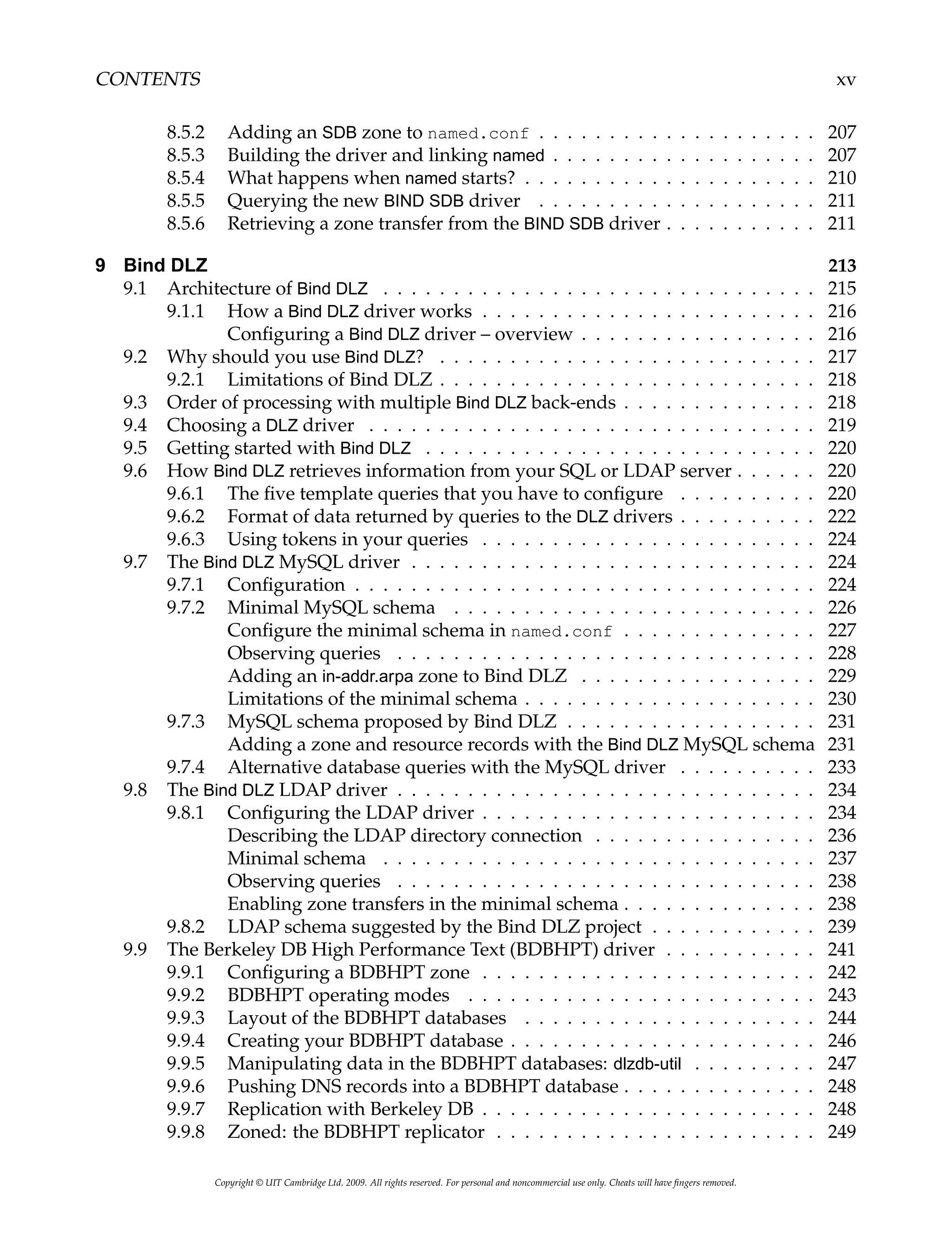
CONTENTS xv
8.5.2 Adding an SDB zone to named.conf . . . . . . . . . . . . . . . . . . . . 207
8.5.3 Building the driver and linking named . . . . . . . . . . . . . . . . . . . 207
8.5.4 What happens when named starts? . . . . . . . . . . . . . . . . . . . . . 210
8.5.5 Querying the new BIND SDB driver . . . . . . . . . . . . . . . . . . . . 211
8.5.6 Retrieving a zone transfer from the BIND SDB driver . . . . . . . . . . . 211
9 Bind DLZ 213
9.1 Architecture of Bind DLZ . . . . . . . . . . . . . . . . . . . . . . . . . . . . . . . 215
9.1.1 How a Bind DLZ driver works . . . . . . . . . . . . . . . . . . . . . . . . 216
Configuring a Bind DLZ driver – overview . . . . . . . . . . . . . . . . . 216
9.2 Why should you use Bind DLZ? . . . . . . . . . . . . . . . . . . . . . . . . . . . 217
9.2.1 Limitations of Bind DLZ . . . . . . . . . . . . . . . . . . . . . . . . . . . 218
9.3 Order of processing with multiple Bind DLZ back-ends . . . . . . . . . . . . . . 218
9.4 Choosing a DLZ driver . . . . . . . . . . . . . . . . . . . . . . . . . . . . . . . . 219
9.5 Getting started with Bind DLZ . . . . . . . . . . . . . . . . . . . . . . . . . . . . 220
9.6 How Bind DLZ retrieves information from your SQL or LDAP server . . . . . . 220
9.6.1 The five template queries that you have to configure . . . . . . . . . . 220
9.6.2 Format of data returned by queries to the DLZ drivers . . . . . . . . . . 222
9.6.3 Using tokens in your queries . . . . . . . . . . . . . . . . . . . . . . . . 224
9.7 The Bind DLZ MySQL driver . . . . . . . . . . . . . . . . . . . . . . . . . . . . . 224
9.7.1 Configuration . . . . . . . . . . . . . . . . . . . . . . . . . . . . . . . . . 224
9.7.2 Minimal MySQL schema . . . . . . . . . . . . . . . . . . . . . . . . . . 226
Configure the minimal schema in named.conf . . . . . . . . . . . . . . 227
Observing queries . . . . . . . . . . . . . . . . . . . . . . . . . . . . . . 228
Adding an in-addr.arpa zone to Bind DLZ . . . . . . . . . . . . . . . . . 229
Limitations of the minimal schema . . . . . . . . . . . . . . . . . . . . . 230
9.7.3 MySQL schema proposed by Bind DLZ . . . . . . . . . . . . . . . . . . 231
Adding a zone and resource records with the Bind DLZ MySQL schema 231
9.7.4 Alternative database queries with the MySQL driver . . . . . . . . . . 233
9.8 The Bind DLZ LDAP driver . . . . . . . . . . . . . . . . . . . . . . . . . . . . . . 234
9.8.1 Configuring the LDAP driver . . . . . . . . . . . . . . . . . . . . . . . . 234
Describing the LDAP directory connection . . . . . . . . . . . . . . . . 236
Minimal schema . . . . . . . . . . . . . . . . . . . . . . . . . . . . . . . 237
Observing queries . . . . . . . . . . . . . . . . . . . . . . . . . . . . . . 238
Enabling zone transfers in the minimal schema . . . . . . . . . . . . . . 238
9.8.2 LDAP schema suggested by the Bind DLZ project . . . . . . . . . . . . 239
9.9 The Berkeley DB High Performance Text (BDBHPT) driver . . . . . . . . . . . 241
9.9.1 Configuring a BDBHPT zone . . . . . . . . . . . . . . . . . . . . . . . . 242
9.9.2 BDBHPT operating modes . . . . . . . . . . . . . . . . . . . . . . . . . 243
9.9.3 Layout of the BDBHPT databases . . . . . . . . . . . . . . . . . . . . . 244
9.9.4 Creating your BDBHPT database . . . . . . . . . . . . . . . . . . . . . . 246
9.9.5 Manipulating data in the BDBHPT databases: dlzdb-util . . . . . . . . . 247
9.9.6 Pushing DNS records into a BDBHPT database . . . . . . . . . . . . . . 248
9.9.7 Replication with Berkeley DB . . . . . . . . . . . . . . . . . . . . . . . . 248
9.9.8 Zoned: the BDBHPT replicator . . . . . . . . . . . . . . . . . . . . . . . 249
Copyright © UIT Cambridge Ltd. 2009. All rights reserved. For personal and noncommercial use only. Cheats will have fingers removed.
xvi CONTENTS
9.10 Implementing Bind DLZ . . . . . . . . . . . . . . . . . . . . . . . . . . . . . . . . 250
9.10.1 Split-horizon DNS with views in Bind DLZ . . . . . . . . . . . . . . . . 250
An example: two views with different Bind DLZ drivers . . . . . . . . 250
Using similar Bind DLZ drivers in views . . . . . . . . . . . . . . . . . 252
9.10.2 Don’t create a single point of failure . . . . . . . . . . . . . . . . . . . . 253
9.10.3 High-availability through heterogeneous replication . . . . . . . . . . 253
9.10.4 Automatically creating PTR records . . . . . . . . . . . . . . . . . . . . . 253
9.11 How you can process Dynamic DNS Updates . . . . . . . . . . . . . . . . . . . 256
10 Name Server Daemon (NSD) 261
10.1 Overview of NSD . . . . . . . . . . . . . . . . . . . . . . . . . . . . . . . . . . . 262
10.1.1 NSD’s architecture . . . . . . . . . . . . . . . . . . . . . . . . . . . . . . 262
10.1.2 Setting up NSD . . . . . . . . . . . . . . . . . . . . . . . . . . . . . . . . 263
10.1.3 A minimal configuration file . . . . . . . . . . . . . . . . . . . . . . . . 264
10.1.4 Compile your zones . . . . . . . . . . . . . . . . . . . . . . . . . . . . . 264
10.1.5 Launch NSD . . . . . . . . . . . . . . . . . . . . . . . . . . . . . . . . . . 264
10.2 Configuring NSD with its nsd.conf file . . . . . . . . . . . . . . . . . . . . . . 265
a. Server options . . . . . . . . . . . . . . . . . . . . . . . . . . . . . . . 265
b. Zone options . . . . . . . . . . . . . . . . . . . . . . . . . . . . . . . . 266
c. Key declarations . . . . . . . . . . . . . . . . . . . . . . . . . . . . . . 268
10.3 Controlling NSD’s behavior with its utilities . . . . . . . . . . . . . . . . . . . . 268
The NSD control script, nsdc . . . . . . . . . . . . . . . . . . . . . . . . . 268
Check and parse the nsd.conf file with nsd-checkconf . . . . . . . . . . 270
Manually perform a zone transfer with nsd-xfer . . . . . . . . . . . . . . 270
10.4 Monitoring NSD . . . . . . . . . . . . . . . . . . . . . . . . . . . . . . . . . . . . 270
10.5 The different NSD server roles . . . . . . . . . . . . . . . . . . . . . . . . . . . . 271
10.5.1 Running NSD as a master server . . . . . . . . . . . . . . . . . . . . . . 272
Adding a new master zone . . . . . . . . . . . . . . . . . . . . . . . . . 272
Changes in your master zone . . . . . . . . . . . . . . . . . . . . . . . . 273
10.5.2 Running NSD as a slave server . . . . . . . . . . . . . . . . . . . . . . . 273
Adding a new slave zone . . . . . . . . . . . . . . . . . . . . . . . . . . 273
10.5.3 Running NSD as a private root server . . . . . . . . . . . . . . . . . . . 275
10.6 Securing NSD . . . . . . . . . . . . . . . . . . . . . . . . . . . . . . . . . . . . . 275
10.6.1 Transaction signatures (TSIG) . . . . . . . . . . . . . . . . . . . . . . . . 276
A – Generate TSIG keys for inclusion in nsd.conf . . . . . . . . . . . . 276
B – Set up ACLs for your zones . . . . . . . . . . . . . . . . . . . . . . . 277
C – Test a zone transfer . . . . . . . . . . . . . . . . . . . . . . . . . . . 277
10.6.2 Using NSD as a master and BIND as slave . . . . . . . . . . . . . . . . . 278
10.6.3 Using BIND as a master and NSD as slave . . . . . . . . . . . . . . . . . 279
11 tinydns 283
11.1 An overview of djbdns and its component parts . . . . . . . . . . . . . . . . . . 284
11.2 The tinydns authoritative server . . . . . . . . . . . . . . . . . . . . . . . . . . . 285
11.2.1 Setting up tinydns . . . . . . . . . . . . . . . . . . . . . . . . . . . . . . . 285
Configuration files and environment variables – overview . . . . . . . 285
Copyright © UIT Cambridge Ltd. 2009. All rights reserved. For personal and noncommercial use only. Cheats will have fingers removed.
CONTENTS xvii
Creating your configuration files, directories, and startup scripts . . . 286
11.2.2 Where tinydns stores its zone data . . . . . . . . . . . . . . . . . . . . . . 286
11.2.3 Format of information in the data file . . . . . . . . . . . . . . . . . . . 287
Line type % (percent) – create a “location” . . . . . . . . . . . . . . . . . 289
Line type . (period) – create a “complete name server” . . . . . . . . . 289
Line type Z – create “start of authority” . . . . . . . . . . . . . . . . . . 290
Line type & (ampersand) – create a “name server” . . . . . . . . . . . . 291
Line type = (equals) – create a “host” . . . . . . . . . . . . . . . . . . . 291
Line type + (plus) – create an “alias” . . . . . . . . . . . . . . . . . . . . 292
Line type @ (at) – create a “mail exchanger” . . . . . . . . . . . . . . . . 292
Line type - (dash) – disable a line . . . . . . . . . . . . . . . . . . . . . 293
Line type ’ (single-quote) – create a “text” . . . . . . . . . . . . . . . . 293
Line type ˆ (circumflex) – create a “pointer” . . . . . . . . . . . . . . . 293
Line type C – create a “canonical name” . . . . . . . . . . . . . . . . . . 294
Line type : (colon) – create “generic record” . . . . . . . . . . . . . . . 294
Notes on data syntax . . . . . . . . . . . . . . . . . . . . . . . . . . . . 294
Using tinydns-edit to add records to the data file . . . . . . . . . . . . . 295
Randomizing RR . . . . . . . . . . . . . . . . . . . . . . . . . . . . . . . 295
Wild-cards . . . . . . . . . . . . . . . . . . . . . . . . . . . . . . . . . . . 296
11.2.4 Starting tinydns . . . . . . . . . . . . . . . . . . . . . . . . . . . . . . . . 296
11.2.5 Controlling tinydns with environment variables . . . . . . . . . . . . . . 296
11.2.6 IPv6 . . . . . . . . . . . . . . . . . . . . . . . . . . . . . . . . . . . . . . 297
11.2.7 Provisioning DNS information for tinydns’ data file . . . . . . . . . . . 297
11.2.8 Replication to other tinydns servers . . . . . . . . . . . . . . . . . . . . . 299
11.2.9 Using AXFR zone transfers . . . . . . . . . . . . . . . . . . . . . . . . . . 301
11.2.10 Private root name server . . . . . . . . . . . . . . . . . . . . . . . . . . . 303
11.2.11 Useful utilities that assist in handling tinydns data files . . . . . . . . . 304
A pre-processor for the data file . . . . . . . . . . . . . . . . . . . . . . 304
Creating the data file from BIND zone files . . . . . . . . . . . . . . . . 304
Perl program to create SRV lines in the data file . . . . . . . . . . . . . . 304
11.3 Logging and statistics . . . . . . . . . . . . . . . . . . . . . . . . . . . . . . . . . 305
11.3.1 tinystats . . . . . . . . . . . . . . . . . . . . . . . . . . . . . . . . . . . . 305
11.4 Utilities . . . . . . . . . . . . . . . . . . . . . . . . . . . . . . . . . . . . . . . . . 306
11.4.1 Query domain names with dnsip . . . . . . . . . . . . . . . . . . . . . . 307
11.4.2 Qualify and query names with dnsipq . . . . . . . . . . . . . . . . . . . 307
11.4.3 Lookup reverse names with dnsname . . . . . . . . . . . . . . . . . . . 307
11.4.4 Query TXT records with dnstxt . . . . . . . . . . . . . . . . . . . . . . . . 308
11.4.5 Query MX records with dnsmx . . . . . . . . . . . . . . . . . . . . . . . . 308
11.4.6 Resolve addresses from a file with dnsfilter . . . . . . . . . . . . . . . . . 308
11.4.7 Query a name and type with dnsqr . . . . . . . . . . . . . . . . . . . . . 309
11.4.8 Tracing queries with dnstrace . . . . . . . . . . . . . . . . . . . . . . . . 309
11.5 Caching DNS . . . . . . . . . . . . . . . . . . . . . . . . . . . . . . . . . . . . . 309
12 ldapdns 315
12.1 Choosing your LDAP schema . . . . . . . . . . . . . . . . . . . . . . . . . . . . 316
Copyright © UIT Cambridge Ltd. 2009. All rights reserved. For personal and noncommercial use only. Cheats will have fingers removed.
xviii CONTENTS
12.2 Setting up ldapdns with ldapdns-conf . . . . . . . . . . . . . . . . . . . . . . . . . 317
12.3 Environment variables for controlling ldapdns . . . . . . . . . . . . . . . . . . . 319
12.4 Configuring zones and resource records . . . . . . . . . . . . . . . . . . . . . . 321
12.4.1 DNS resources supported by ldapdns . . . . . . . . . . . . . . . . . . . . 322
12.4.2 Adding a zone to ldapdns . . . . . . . . . . . . . . . . . . . . . . . . . . 323
Adding a minimal zone . . . . . . . . . . . . . . . . . . . . . . . . . . . 323
Adding a zone with more records . . . . . . . . . . . . . . . . . . . . . 324
12.4.3 Adding an in-addr.arpa zone to ldapdns . . . . . . . . . . . . . . . . . . . 325
Create the zone . . . . . . . . . . . . . . . . . . . . . . . . . . . . . . . . 325
Create the PTR resource record . . . . . . . . . . . . . . . . . . . . . . . 326
12.5 Managing zone data . . . . . . . . . . . . . . . . . . . . . . . . . . . . . . . . . 326
12.6 Providing DNS over TCP with ldapdns . . . . . . . . . . . . . . . . . . . . . . . 326
12.7 Integrate ldapdns with BIND . . . . . . . . . . . . . . . . . . . . . . . . . . . . . 327
13 dnsmasq 331
13.1 Preliminary explorations . . . . . . . . . . . . . . . . . . . . . . . . . . . . . . . 333
13.2 Live running . . . . . . . . . . . . . . . . . . . . . . . . . . . . . . . . . . . . . . 335
13.3 Advanced dnsmasq configuration . . . . . . . . . . . . . . . . . . . . . . . . . . 335
13.3.1 Interfaces and addresses . . . . . . . . . . . . . . . . . . . . . . . . . . . 335
13.3.2 Hosts and domains . . . . . . . . . . . . . . . . . . . . . . . . . . . . . . 336
13.3.3 DNS resolution . . . . . . . . . . . . . . . . . . . . . . . . . . . . . . . . 337
13.3.4 DHCP . . . . . . . . . . . . . . . . . . . . . . . . . . . . . . . . . . . . . 340
13.3.5 Debugging . . . . . . . . . . . . . . . . . . . . . . . . . . . . . . . . . . . 342
13.4 A complete example . . . . . . . . . . . . . . . . . . . . . . . . . . . . . . . . . 344
13.4.1 Booting a PC and watching it happen . . . . . . . . . . . . . . . . . . . 346
14 DNS on Microsoft Windows 349
14.1 An overview of Microsoft Windows DNS Server . . . . . . . . . . . . . . . . . . . 350
14.1.1 Zone types . . . . . . . . . . . . . . . . . . . . . . . . . . . . . . . . . . . 351
14.1.2 Forwarders . . . . . . . . . . . . . . . . . . . . . . . . . . . . . . . . . . 351
14.1.3 DNS on the command-line . . . . . . . . . . . . . . . . . . . . . . . . . 352
14.2 Using Open Source DNS servers on Windows . . . . . . . . . . . . . . . . . . 352
14.2.1 DNS servers with native Win32 support . . . . . . . . . . . . . . . . . . 352
Running BIND on Win32 . . . . . . . . . . . . . . . . . . . . . . . . . . . 352
Running Bind DLZ on Windows . . . . . . . . . . . . . . . . . . . . . . . 353
Running MaraDNS on Win32 . . . . . . . . . . . . . . . . . . . . . . . . 353
Running PowerDNS on Win32 . . . . . . . . . . . . . . . . . . . . . . . . 354
14.2.2 Cygwin . . . . . . . . . . . . . . . . . . . . . . . . . . . . . . . . . . . . 355
15 DNS and Perl 357
15.1 Querying the DNS from Perl . . . . . . . . . . . . . . . . . . . . . . . . . . . . . 358
15.2 Create your own dynamic name server in Perl . . . . . . . . . . . . . . . . . . 359
15.2.1 Why would I want to create my own name server? . . . . . . . . . . . 360
15.2.2 Perl tools for creating name servers . . . . . . . . . . . . . . . . . . . . 361
15.3 Example – A custom dynamic server using Stanford::DNSserver . . . . . . . . . 362
Copyright © UIT Cambridge Ltd. 2009. All rights reserved. For personal and noncommercial use only. Cheats will have fingers removed.
CONTENTS xix
Installing Stanford::DNSserver . . . . . . . . . . . . . . . . . . . . . . . . 362
Using DNS to find a user’s telephone number . . . . . . . . . . . . . . 363
The code . . . . . . . . . . . . . . . . . . . . . . . . . . . . . . . . . . . . 365
Integrate your Perl name server into your organization’s DNS . . . . . 368
16 DNS blacklists 371
16.1 Why would I want to implement a DNS blacklist? . . . . . . . . . . . . . . . . 373
16.2 How to use an existing blacklist in your e-mail server . . . . . . . . . . . . . . 373
16.3 Implementing a simple DNS blacklist . . . . . . . . . . . . . . . . . . . . . . . 375
16.3.1 A – Choose a domain to publish blacklist entries . . . . . . . . . . . . . 375
16.3.2 B – Add Address (and optionally Text) records to this zone . . . . . . . 376
16.3.3 C – Configure your MTA to query your new DNS blacklist . . . . . . . 377
16.4 Serving DNSBL with rbldnsd . . . . . . . . . . . . . . . . . . . . . . . . . . . . . 378
16.4.1 Running rbldnsd . . . . . . . . . . . . . . . . . . . . . . . . . . . . . . . . 378
16.4.2 Zone file formats in rbldnsd . . . . . . . . . . . . . . . . . . . . . . . . . 379
16.4.3 Running rbldnsd and a caching name server on the same system . . . . 380
16.5 Integrate DNS blacklists into your e-mail infrastructure . . . . . . . . . . . . . 381
16.5.1 Exim . . . . . . . . . . . . . . . . . . . . . . . . . . . . . . . . . . . . . . 381
Telling Exim to use the blacklist . . . . . . . . . . . . . . . . . . . . . . . 381
A sample SMTP dialog . . . . . . . . . . . . . . . . . . . . . . . . . . . . 382
Black-lists and white-lists . . . . . . . . . . . . . . . . . . . . . . . . . . 382
16.5.2 Sendmail . . . . . . . . . . . . . . . . . . . . . . . . . . . . . . . . . . . . 382
16.5.3 Postfix . . . . . . . . . . . . . . . . . . . . . . . . . . . . . . . . . . . . . 383
16.5.4 IBM Lotus Domino . . . . . . . . . . . . . . . . . . . . . . . . . . . . . . 383
17 Caching name servers 387
17.1 Deploying your caching name servers . . . . . . . . . . . . . . . . . . . . . . . 388
17.1.1 Where you place your caching name server . . . . . . . . . . . . . . . . 388
17.1.2 Checklist for deployment . . . . . . . . . . . . . . . . . . . . . . . . . . 389
17.1.3 Don’t forget the stub resolver . . . . . . . . . . . . . . . . . . . . . . . . 389
17.1.4 Special-case resolution requirements . . . . . . . . . . . . . . . . . . . . 390
17.1.5 The recursive caching name servers . . . . . . . . . . . . . . . . . . . . 391
17.2 The BIND caching server . . . . . . . . . . . . . . . . . . . . . . . . . . . . . . . 391
17.2.1 Setting up a BIND caching name server . . . . . . . . . . . . . . . . . . 392
A – Create named.conf . . . . . . . . . . . . . . . . . . . . . . . . . . . 392
B – Create an rndc key . . . . . . . . . . . . . . . . . . . . . . . . . . . . 392
C – Hints file for the root servers . . . . . . . . . . . . . . . . . . . . . . 393
D – Master zones for localhost . . . . . . . . . . . . . . . . . . . . . . . . 393
17.2.2 Adding features . . . . . . . . . . . . . . . . . . . . . . . . . . . . . . . . 394
Reloading named . . . . . . . . . . . . . . . . . . . . . . . . . . . . . . . 395
17.3 The PowerDNS Recursor caching server . . . . . . . . . . . . . . . . . . . . . . . 395
17.3.1 Configuration . . . . . . . . . . . . . . . . . . . . . . . . . . . . . . . . . 396
17.3.2 Controlling PowerDNS Recursor . . . . . . . . . . . . . . . . . . . . . . . 400
17.3.3 PowerDNS Recursor statistics . . . . . . . . . . . . . . . . . . . . . . . . . 401
17.3.4 Graphing PowerDNS Recursor . . . . . . . . . . . . . . . . . . . . . . . . 402
Copyright © UIT Cambridge Ltd. 2009. All rights reserved. For personal and noncommercial use only. Cheats will have fingers removed.
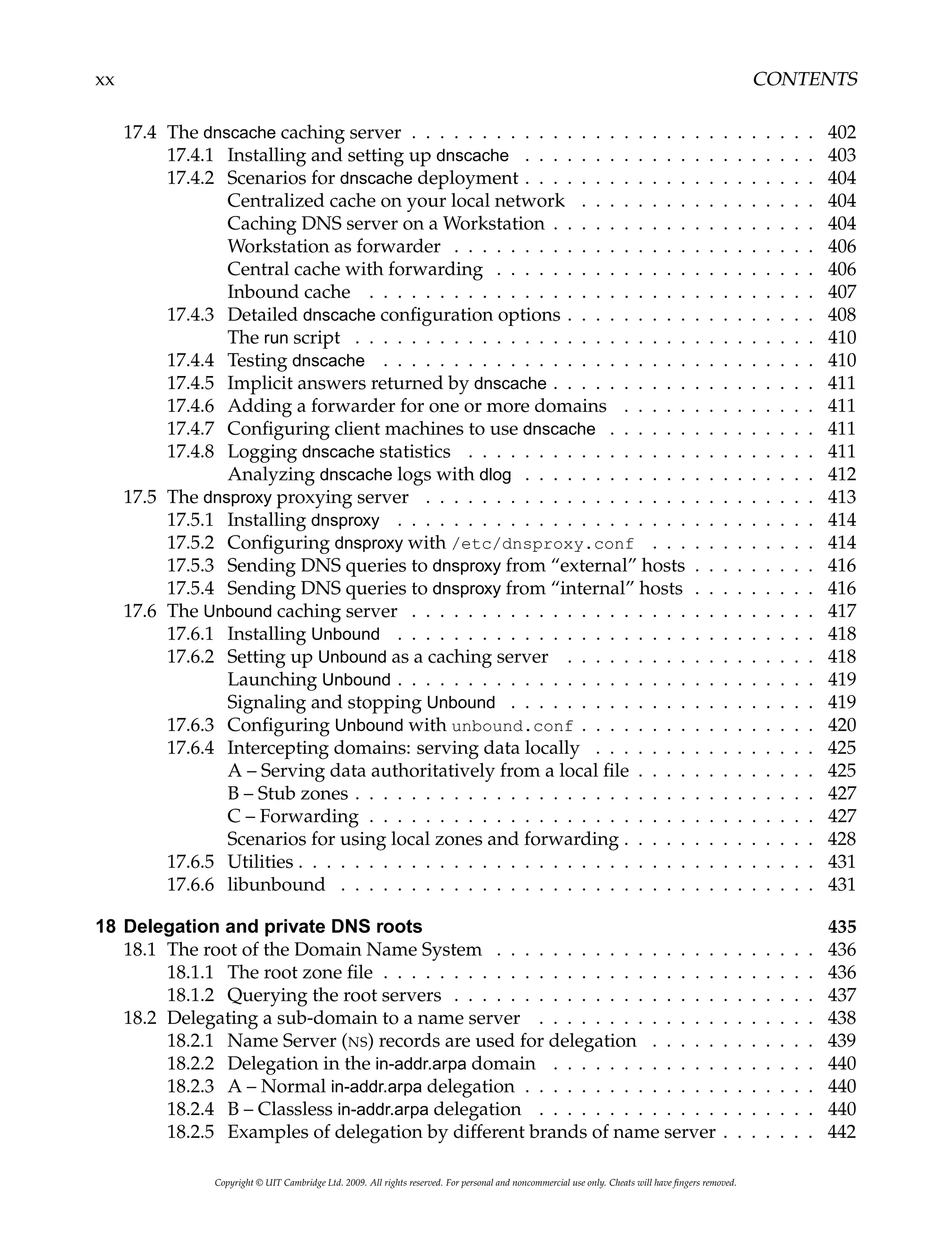
xx CONTENTS
17.4 The dnscache caching server . . . . . . . . . . . . . . . . . . . . . . . . . . . . . 402
17.4.1 Installing and setting up dnscache . . . . . . . . . . . . . . . . . . . . . 403
17.4.2 Scenarios for dnscache deployment . . . . . . . . . . . . . . . . . . . . . 404
Centralized cache on your local network . . . . . . . . . . . . . . . . . 404
Caching DNS server on a Workstation . . . . . . . . . . . . . . . . . . . 404
Workstation as forwarder . . . . . . . . . . . . . . . . . . . . . . . . . . 406
Central cache with forwarding . . . . . . . . . . . . . . . . . . . . . . . 406
Inbound cache . . . . . . . . . . . . . . . . . . . . . . . . . . . . . . . . 407
17.4.3 Detailed dnscache configuration options . . . . . . . . . . . . . . . . . . 408
The run script . . . . . . . . . . . . . . . . . . . . . . . . . . . . . . . . . 410
17.4.4 Testing dnscache . . . . . . . . . . . . . . . . . . . . . . . . . . . . . . . 410
17.4.5 Implicit answers returned by dnscache . . . . . . . . . . . . . . . . . . . 411
17.4.6 Adding a forwarder for one or more domains . . . . . . . . . . . . . . 411
17.4.7 Configuring client machines to use dnscache . . . . . . . . . . . . . . . 411
17.4.8 Logging dnscache statistics . . . . . . . . . . . . . . . . . . . . . . . . . 411
Analyzing dnscache logs with dlog . . . . . . . . . . . . . . . . . . . . . 412
17.5 The dnsproxy proxying server . . . . . . . . . . . . . . . . . . . . . . . . . . . . 413
17.5.1 Installing dnsproxy . . . . . . . . . . . . . . . . . . . . . . . . . . . . . . 414
17.5.2 Configuring dnsproxy with /etc/dnsproxy.conf . . . . . . . . . . . . 414
17.5.3 Sending DNS queries to dnsproxy from “external” hosts . . . . . . . . . 416
17.5.4 Sending DNS queries to dnsproxy from “internal” hosts . . . . . . . . . 416
17.6 The Unbound caching server . . . . . . . . . . . . . . . . . . . . . . . . . . . . . 417
17.6.1 Installing Unbound . . . . . . . . . . . . . . . . . . . . . . . . . . . . . . 418
17.6.2 Setting up Unbound as a caching server . . . . . . . . . . . . . . . . . . 418
Launching Unbound . . . . . . . . . . . . . . . . . . . . . . . . . . . . . . 419
Signaling and stopping Unbound . . . . . . . . . . . . . . . . . . . . . . 419
17.6.3 Configuring Unbound with unbound.conf . . . . . . . . . . . . . . . . . 420
17.6.4 Intercepting domains: serving data locally . . . . . . . . . . . . . . . . 425
A – Serving data authoritatively from a local file . . . . . . . . . . . . . 425
B – Stub zones . . . . . . . . . . . . . . . . . . . . . . . . . . . . . . . . . 427
C – Forwarding . . . . . . . . . . . . . . . . . . . . . . . . . . . . . . . . 427
Scenarios for using local zones and forwarding . . . . . . . . . . . . . . 428
17.6.5 Utilities . . . . . . . . . . . . . . . . . . . . . . . . . . . . . . . . . . . . . 431
17.6.6 libunbound . . . . . . . . . . . . . . . . . . . . . . . . . . . . . . . . . . 431
18 Delegation and private DNS roots 435
18.1 The root of the Domain Name System . . . . . . . . . . . . . . . . . . . . . . . 436
18.1.1 The root zone file . . . . . . . . . . . . . . . . . . . . . . . . . . . . . . . 436
18.1.2 Querying the root servers . . . . . . . . . . . . . . . . . . . . . . . . . . 437
18.2 Delegating a sub-domain to a name server . . . . . . . . . . . . . . . . . . . . 438
18.2.1 Name Server (NS) records are used for delegation . . . . . . . . . . . . 439
18.2.2 Delegation in the in-addr.arpa domain . . . . . . . . . . . . . . . . . . . 440
18.2.3 A – Normal in-addr.arpa delegation . . . . . . . . . . . . . . . . . . . . . 440
18.2.4 B – Classless in-addr.arpa delegation . . . . . . . . . . . . . . . . . . . . 440
18.2.5 Examples of delegation by different brands of name server . . . . . . . 442
Copyright © UIT Cambridge Ltd. 2009. All rights reserved. For personal and noncommercial use only. Cheats will have fingers removed.
CONTENTS xxi
Delegation in NSD or BIND . . . . . . . . . . . . . . . . . . . . . . . . . . 442
Delegation in MaraDNS . . . . . . . . . . . . . . . . . . . . . . . . . . . . 442
Delegation in PowerDNS . . . . . . . . . . . . . . . . . . . . . . . . . . . 443
Delegation in MyDNS . . . . . . . . . . . . . . . . . . . . . . . . . . . . . 444
Delegation in tinydns . . . . . . . . . . . . . . . . . . . . . . . . . . . . . 444
Delegation in ldapdns . . . . . . . . . . . . . . . . . . . . . . . . . . . . . 444
18.3 Creating your own private root name servers . . . . . . . . . . . . . . . . . . . 445
18.3.1 A – Install your root name servers . . . . . . . . . . . . . . . . . . . . . 446
18.3.2 B – Configuring name servers to serve the root zone . . . . . . . . . . . 446
B1 – Using NSD as a root server . . . . . . . . . . . . . . . . . . . . . . . 446
B2 – Using MyDNS as a root server . . . . . . . . . . . . . . . . . . . . . 447
B3 – Using BIND-sdb-LDAP as a root server . . . . . . . . . . . . . . . . . 448
Create the master “.” zone in named.conf . . . . . . . . . . . . . . . . 448
LDIF for the root zone . . . . . . . . . . . . . . . . . . . . . . . . . . . . 448
How clients query the root zone . . . . . . . . . . . . . . . . . . . . . . 450
18.3.3 C – Configure your caching servers . . . . . . . . . . . . . . . . . . . . 450
Configuring Unbound and BIND to access your root servers . . . . . . . 450
Configuring dnscache to access your root servers . . . . . . . . . . . . . 451
Part III Operational Issues 453
19 Updating DNS zones and their associated records 455
19.1 Using a registry to manage your DNS operations . . . . . . . . . . . . . . . . . 456
19.1.1 Do you need a registry? . . . . . . . . . . . . . . . . . . . . . . . . . . . 456
19.1.2 How to set up a registry . . . . . . . . . . . . . . . . . . . . . . . . . . . 457
19.2 How you update your DNS data . . . . . . . . . . . . . . . . . . . . . . . . . . 458
19.3 Managing DNS data in text files . . . . . . . . . . . . . . . . . . . . . . . . . . . 458
19.3.1 A – Editing by hand with a text editor . . . . . . . . . . . . . . . . . . . 458
19.3.2 B – Generating file content from an external data source . . . . . . . . 459
19.4 Updating name server back-end data stores . . . . . . . . . . . . . . . . . . . . 460
19.5 Web-based management . . . . . . . . . . . . . . . . . . . . . . . . . . . . . . . 462
Web-based tools for PowerDNS . . . . . . . . . . . . . . . . . . . . . . . 462
Web-based tools for BIND . . . . . . . . . . . . . . . . . . . . . . . . . . 462
Web-based tools for Bind DLZ . . . . . . . . . . . . . . . . . . . . . . . . 463
Web-based tools for tinydns . . . . . . . . . . . . . . . . . . . . . . . . . 463
19.6 Dynamic DNS Updates (RFC 2136) . . . . . . . . . . . . . . . . . . . . . . . . . 464
19.6.1 Dynamic updates from the command-line with nsupdate . . . . . . . . 465
Commands understood by nsupdate . . . . . . . . . . . . . . . . . . . . 465
19.6.2 Using nsupdate to add a host to MyDNS . . . . . . . . . . . . . . . . . . 466
Using nsupdate with TSIG . . . . . . . . . . . . . . . . . . . . . . . . . . 467
19.6.3 Net::DNS . . . . . . . . . . . . . . . . . . . . . . . . . . . . . . . . . . . 468
19.7 Dynamic DNS updates performed by DHCP client or server . . . . . . . . . . 469
19.7.1 ISC DHCP . . . . . . . . . . . . . . . . . . . . . . . . . . . . . . . . . . . 470
19.7.2 ISC’s dhclient . . . . . . . . . . . . . . . . . . . . . . . . . . . . . . . . . . 471
Copyright © UIT Cambridge Ltd. 2009. All rights reserved. For personal and noncommercial use only. Cheats will have fingers removed.
xxii CONTENTS
19.7.3 How an IP address is registered in the DNS . . . . . . . . . . . . . . . . 471
Configure your DNS server . . . . . . . . . . . . . . . . . . . . . . . . . 472
A – The DHCP server updates the DNS . . . . . . . . . . . . . . . . . . 473
B – dhclient updates the DNS . . . . . . . . . . . . . . . . . . . . . . . . 474
C – Use dhclient-script to update the DNS . . . . . . . . . . . . . . . . . . 475
D – Processing the dhcpd.leases file . . . . . . . . . . . . . . . . . . . 475
E – Updating your DNS the “poor man’s” way . . . . . . . . . . . . . . 476
19.8 Poor man’s dynamic updates . . . . . . . . . . . . . . . . . . . . . . . . . . . . 476
19.8.1 pmc: the poor man’s dynamic DNS client . . . . . . . . . . . . . . . . . 478
Invoking pmc on *nix . . . . . . . . . . . . . . . . . . . . . . . . . . . . . 480
Invoking pmc on Microsoft Windows . . . . . . . . . . . . . . . . . . . 480
19.8.2 pms: a server for pmc . . . . . . . . . . . . . . . . . . . . . . . . . . . . . 480
20 The Name Service Switch 487
20.1 How the resolver operates . . . . . . . . . . . . . . . . . . . . . . . . . . . . . . 488
20.1.1 Unix stub resolver . . . . . . . . . . . . . . . . . . . . . . . . . . . . . . 488
Configuring the resolver . . . . . . . . . . . . . . . . . . . . . . . . . . . 488
20.1.2 The lightweight resolver . . . . . . . . . . . . . . . . . . . . . . . . . . . 489
20.1.3 Microsoft Windows DNS Client . . . . . . . . . . . . . . . . . . . . . . 489
20.2 NSS – the Name Service Switch . . . . . . . . . . . . . . . . . . . . . . . . . . . 490
20.2.1 How NSS determines where to look for information . . . . . . . . . . 491
20.3 Using LDAP (RFC 2307) with the Name Service Switch . . . . . . . . . . . . . . 492
20.3.1 A – Configure NSS LDAP with /etc/ldap.conf . . . . . . . . . . . . . 492
20.3.2 B – Prepare your LDAP directory server . . . . . . . . . . . . . . . . . . 492
20.3.3 C – Migrating /etc/hosts to NSS LDAP . . . . . . . . . . . . . . . . . 493
20.3.4 D – Configure nsswitch.conf . . . . . . . . . . . . . . . . . . . . . . . 494
20.3.5 E – Testing your NSS LDAP . . . . . . . . . . . . . . . . . . . . . . . . . 494
20.3.6 Points to note when you implement RFC 2307 LDAP in NSS . . . . . . 495
21 Internationalized Domain Names 497
21.1 Converting internationalized domain names to ASCII . . . . . . . . . . . . . . 498
Homograph attacks on internationalized domain names . . . . . . . . 499
21.2 Adding internationalized domains to your DNS server . . . . . . . . . . . . . 499
21.3 Using IDNA in applications . . . . . . . . . . . . . . . . . . . . . . . . . . . . . 501
21.3.1 Using IDNA in Web browsers . . . . . . . . . . . . . . . . . . . . . . . . 501
21.3.2 Using IDNA in e-mail clients . . . . . . . . . . . . . . . . . . . . . . . . 502
21.3.3 Programming IDNA applications . . . . . . . . . . . . . . . . . . . . . 503
22 Introducing DNSSEC 505
22.1 The problem . . . . . . . . . . . . . . . . . . . . . . . . . . . . . . . . . . . . . . 506
22.2 A very brief introduction to cryptography . . . . . . . . . . . . . . . . . . . . . 507
22.2.1 Symmetric encryption . . . . . . . . . . . . . . . . . . . . . . . . . . . . 507
22.2.2 Asymmetric encryption . . . . . . . . . . . . . . . . . . . . . . . . . . . 508
22.2.3 Using public key encryption . . . . . . . . . . . . . . . . . . . . . . . . 509
Signatures, hashes and digests – verifying the sender of a message . . 509
Copyright © UIT Cambridge Ltd. 2009. All rights reserved. For personal and noncommercial use only. Cheats will have fingers removed.
CONTENTS xxiii
Typical applications of public key cryptography . . . . . . . . . . . . . 511
Ensuring public keys are genuine: certificates and authorities . . . . . 511
22.3 An overview of DNSSEC . . . . . . . . . . . . . . . . . . . . . . . . . . . . . . . 512
22.3.1 The scope of DNS data integrity in DNSSEC . . . . . . . . . . . . . . . . 513
22.3.2 How a zone file is signed for DNSSEC . . . . . . . . . . . . . . . . . . . 514
22.4 Implementing DNSSEC on an authoritative server . . . . . . . . . . . . . . . . . 517
22.4.1 A – Generating your keys . . . . . . . . . . . . . . . . . . . . . . . . . . 518
Why two separate keys? . . . . . . . . . . . . . . . . . . . . . . . . . . . 518
22.4.2 B – Sign the zone with your keys . . . . . . . . . . . . . . . . . . . . . . 520
22.4.3 C – Configure your authoritative servers . . . . . . . . . . . . . . . . . 521
22.4.4 D – Provide your public keys to caching server administrators . . . . . 523
22.5 Implementing DNSSEC on a caching name server . . . . . . . . . . . . . . . . . 524
22.5.1 How a caching server validates a DNSSEC-signed answer . . . . . . . . 525
22.5.2 Trust anchors, and islands of trust . . . . . . . . . . . . . . . . . . . . . 526
22.5.3 Configuring trust anchors in your caching server – Unbound . . . . . . 527
22.5.4 Configuring trust anchors in your caching server – BIND . . . . . . . . 528
22.5.5 Example of a DNSSEC validation . . . . . . . . . . . . . . . . . . . . . . 529
22.6 The chain of trust for delegated zones; DS records . . . . . . . . . . . . . . . . . 530
22.6.1 To configure the chain of trust from parent to child zone . . . . . . . . 531
22.7 Using DNSSEC automatically – DLV, look-aside validation . . . . . . . . . . . . 533
22.7.1 Authoritative server: create records to include in a DLV registry . . . . 534
22.7.2 Caching server: configure to use a DLV registry . . . . . . . . . . . . . 534
Testing DLV: off to Brazil . . . . . . . . . . . . . . . . . . . . . . . . . . 535
Points to note about DLV . . . . . . . . . . . . . . . . . . . . . . . . . . 536
22.8 Housekeeping and DNSSEC key management . . . . . . . . . . . . . . . . . . . 536
22.8.1 Organizing your keys to avoid confusion . . . . . . . . . . . . . . . . . 537
22.8.2 Administering your keys . . . . . . . . . . . . . . . . . . . . . . . . . . 537
22.9 Points to note when you deploy DNSSEC . . . . . . . . . . . . . . . . . . . . . . 538
23 Performance 545
23.1 How we carried out the performance tests . . . . . . . . . . . . . . . . . . . . . 546
23.1.1 Test environment . . . . . . . . . . . . . . . . . . . . . . . . . . . . . . . 546
23.1.2 Creating thousands of zone names . . . . . . . . . . . . . . . . . . . . . 547
Loading the zones . . . . . . . . . . . . . . . . . . . . . . . . . . . . . . 547
23.1.3 How we ran the tests . . . . . . . . . . . . . . . . . . . . . . . . . . . . . 548
23.1.4 Queries per second . . . . . . . . . . . . . . . . . . . . . . . . . . . . . . 549
23.1.5 Testing the performance of zone transfers . . . . . . . . . . . . . . . . . 551
23.1.6 Process sizes . . . . . . . . . . . . . . . . . . . . . . . . . . . . . . . . . . 551
23.2 Performance results for the authoritative name servers . . . . . . . . . . . . . 552
23.2.1 Performance results for MaraDNS . . . . . . . . . . . . . . . . . . . . . . 552
23.2.2 Performance results for tinydns . . . . . . . . . . . . . . . . . . . . . . . 552
23.2.3 Performance results for MyDNS . . . . . . . . . . . . . . . . . . . . . . . 553
23.2.4 Performance results for BIND . . . . . . . . . . . . . . . . . . . . . . . . 553
23.2.5 Performance results for PowerDNS . . . . . . . . . . . . . . . . . . . . . 554
A – PowerDNS with the LDAP back-end . . . . . . . . . . . . . . . . . 554
Copyright © UIT Cambridge Ltd. 2009. All rights reserved. For personal and noncommercial use only. Cheats will have fingers removed.
xxiv CONTENTS
B – PowerDNS with the OpenDBX back-end . . . . . . . . . . . . . . . . 555
C – PowerDNS with the BIND back-end . . . . . . . . . . . . . . . . . . 555
23.2.6 Performance results for Bind DLZ . . . . . . . . . . . . . . . . . . . . . . 555
A – LDAP driver . . . . . . . . . . . . . . . . . . . . . . . . . . . . . . . 555
B – MySQL driver . . . . . . . . . . . . . . . . . . . . . . . . . . . . . . 556
C – Berkeley DB High Performance Text driver . . . . . . . . . . . . . . 556
23.2.7 Performance results for BIND-sdb-LDAP . . . . . . . . . . . . . . . . . . 557
23.2.8 Performance results for NSD . . . . . . . . . . . . . . . . . . . . . . . . . 557
23.2.9 Servers not included in the performance tests . . . . . . . . . . . . . . 558
23.3 How the back-ends influence performance . . . . . . . . . . . . . . . . . . . . 558
23.3.1 Databases and LDAP directories . . . . . . . . . . . . . . . . . . . . . . 558
LDAP . . . . . . . . . . . . . . . . . . . . . . . . . . . . . . . . . . . . . 558
MySQL . . . . . . . . . . . . . . . . . . . . . . . . . . . . . . . . . . . . . 558
23.3.2 Caching . . . . . . . . . . . . . . . . . . . . . . . . . . . . . . . . . . . . 559
23.4 Performance results for caching name servers . . . . . . . . . . . . . . . . . . . 559
23.5 How important is performance? . . . . . . . . . . . . . . . . . . . . . . . . . . 560
24 Securing and monitoring your DNS servers 563
24.1 Securing your DNS name servers . . . . . . . . . . . . . . . . . . . . . . . . . . 564
24.2 Monitoring . . . . . . . . . . . . . . . . . . . . . . . . . . . . . . . . . . . . . . . 566
24.2.1 What does the monitoring system do? . . . . . . . . . . . . . . . . . . . 566
24.2.2 What should you monitor? . . . . . . . . . . . . . . . . . . . . . . . . . 567
24.3 Gathering statistics about your DNS operation . . . . . . . . . . . . . . . . . . 571
24.3.1 DNS Statistics Collector: dsc . . . . . . . . . . . . . . . . . . . . . . . . . 572
24.3.2 Other interesting programs . . . . . . . . . . . . . . . . . . . . . . . . . 573
collectd . . . . . . . . . . . . . . . . . . . . . . . . . . . . . . . . . . . . . 573
dnstop . . . . . . . . . . . . . . . . . . . . . . . . . . . . . . . . . . . . . 574
Appendixes 579
A Getting started with (Open)LDAP 579
A.1 A brief introduction to directories . . . . . . . . . . . . . . . . . . . . . . . . . . 579
A.1.1 LDAP – the Lightweight Directory Access Protocol . . . . . . . . . . . 579
A.1.2 The Directory Information Tree . . . . . . . . . . . . . . . . . . . . . . . 579
A.1.3 Entries in an LDAP directory . . . . . . . . . . . . . . . . . . . . . . . . 581
A.1.4 Object classes and attribute types . . . . . . . . . . . . . . . . . . . . . . 582
A.1.5 LDAP schema . . . . . . . . . . . . . . . . . . . . . . . . . . . . . . . . . 583
A.2 The OpenLDAP directory server . . . . . . . . . . . . . . . . . . . . . . . . . . 583
A.2.1 Symas OpenLDAP Silver . . . . . . . . . . . . . . . . . . . . . . . . . . 584
A – Download Symas OpenLDAP . . . . . . . . . . . . . . . . . . . . . 584
B – Install Symas OpenLDAP . . . . . . . . . . . . . . . . . . . . . . . . 585
C – Configure the server with our silverinst.sh script . . . . . . . . . . . 585
A.3 Manipulating your LDAP directory . . . . . . . . . . . . . . . . . . . . . . . . 587
Your LDAP directory . . . . . . . . . . . . . . . . . . . . . . . . . . . . . 587
Copyright © UIT Cambridge Ltd. 2009. All rights reserved. For personal and noncommercial use only. Cheats will have fingers removed.
CONTENTS xxv
A.3.1 LDIF – LDAP Data Interchange Format . . . . . . . . . . . . . . . . . . 588
A.3.2 Loading data into your OpenLDAP directory . . . . . . . . . . . . . . . 588
A.3.3 Access control . . . . . . . . . . . . . . . . . . . . . . . . . . . . . . . . . 589
A.3.4 Adding entries . . . . . . . . . . . . . . . . . . . . . . . . . . . . . . . . 590
A.3.5 Introducing LDAP search filters . . . . . . . . . . . . . . . . . . . . . . 590
A.3.6 Search scopes . . . . . . . . . . . . . . . . . . . . . . . . . . . . . . . . . 591
A.3.7 Searching entries . . . . . . . . . . . . . . . . . . . . . . . . . . . . . . . 592
A.3.8 Modifying entries . . . . . . . . . . . . . . . . . . . . . . . . . . . . . . . 593
A.3.9 Deleting entries . . . . . . . . . . . . . . . . . . . . . . . . . . . . . . . . 593
A.3.10 Interpreting slapd’s log-file . . . . . . . . . . . . . . . . . . . . . . . . . 594
A.3.11 LDAP URLs . . . . . . . . . . . . . . . . . . . . . . . . . . . . . . . . . . 594
A.3.12 Features you will probably want to add to your OpenLDAP server . . 595
Indexes . . . . . . . . . . . . . . . . . . . . . . . . . . . . . . . . . . . . . 595
Access control . . . . . . . . . . . . . . . . . . . . . . . . . . . . . . . . . 595
Transport Layer Security . . . . . . . . . . . . . . . . . . . . . . . . . . . 595
Simple Authentication and Security Layer . . . . . . . . . . . . . . . . 596
Overlays and back-ends . . . . . . . . . . . . . . . . . . . . . . . . . . . 596
SLAPI plug-ins . . . . . . . . . . . . . . . . . . . . . . . . . . . . . . . . 596
Replication . . . . . . . . . . . . . . . . . . . . . . . . . . . . . . . . . . 596
A.4 Extending your LDAP directory . . . . . . . . . . . . . . . . . . . . . . . . . . . 597
A.4.1 Objects and identifiers . . . . . . . . . . . . . . . . . . . . . . . . . . . . 598
A.4.2 Extending your schema . . . . . . . . . . . . . . . . . . . . . . . . . . . 599
A.4.3 A sample schema file for storing songs . . . . . . . . . . . . . . . . . . 600
A.4.4 A song in LDIF format . . . . . . . . . . . . . . . . . . . . . . . . . . . . 601
A.4.5 Loading and finding songs . . . . . . . . . . . . . . . . . . . . . . . . . 602
A.4.6 Finding entries with Perl’s Net::LDAP . . . . . . . . . . . . . . . . . . . . 602
B Use $INCLUDE and fix your SOA 604
The fixserial.pl program . . . . . . . . . . . . . . . . . . . . . . . . . . . . 606
C BIND SDB 607
C.1 Generate zone clauses for BIND-sdb-LDAP . . . . . . . . . . . . . . . . . . . . . 607
C.2 Simple BIND SDB load-balancer driver . . . . . . . . . . . . . . . . . . . . . . . 608
C.2.1 load.h . . . . . . . . . . . . . . . . . . . . . . . . . . . . . . . . . . . . . 608
C.2.2 load.c . . . . . . . . . . . . . . . . . . . . . . . . . . . . . . . . . . . . . . 609
C.2.3 named.conf . . . . . . . . . . . . . . . . . . . . . . . . . . . . . . . . . . 613
D Bind DLZ 615
D.1 Load BDBHPT from an SQL database . . . . . . . . . . . . . . . . . . . . . . . 615
D.2 Helper functions for automatically creating PTR records . . . . . . . . . . . . . 619
E Perl DNS name servers 621
E.1 Stanford::DNSserver . . . . . . . . . . . . . . . . . . . . . . . . . . . . . . . . . . 621
E.2 Net::DNS::Nameserver . . . . . . . . . . . . . . . . . . . . . . . . . . . . . . . . 625
E.3 Net::DNS::Server . . . . . . . . . . . . . . . . . . . . . . . . . . . . . . . . . . . 626
Copyright © UIT Cambridge Ltd. 2009. All rights reserved. For personal and noncommercial use only. Cheats will have fingers removed.
xxvi CONTENTS
F User Defined Functions in MySQL 629
F.1 A – Raise an error in a MySQL trigger with a UDF . . . . . . . . . . . . . . . . 629
F.1.1 The source code of the raise error() UDF function . . . . . . . . . . . 629
F.1.2 Install your UDF . . . . . . . . . . . . . . . . . . . . . . . . . . . . . . . 630
F.1.3 Create the trigger . . . . . . . . . . . . . . . . . . . . . . . . . . . . . . . 631
F.1.4 Testing the trigger in PowerDNS . . . . . . . . . . . . . . . . . . . . . . . 632
F.2 B – Use a UDF to update a file in the file system . . . . . . . . . . . . . . . . . 632
G Bits and pieces 637
G.1 Using the DNS to store arbitrary (configuration) strings . . . . . . . . . . . . . 637
G.1.1 Use TXT records to configure an application . . . . . . . . . . . . . . . . 638
G.1.2 A more sophisticated solution . . . . . . . . . . . . . . . . . . . . . . . 638
G.2 A DNSBL to look up country-codes . . . . . . . . . . . . . . . . . . . . . . . . . 639
G.2.1 Mirror and serve the blacklist . . . . . . . . . . . . . . . . . . . . . . . . 640
G.2.2 Using your new country blacklist . . . . . . . . . . . . . . . . . . . . . 641
Determine country of origin in Apache log files . . . . . . . . . . . . . 641
G.3 Automatic DNS NOTIFY with OpenLDAP and slapi-dnsnotify . . . . . . . . . . 643
H Scripting PowerDNS Recursor with the Lua programming language 645
H.1 A (very) short overview of Lua . . . . . . . . . . . . . . . . . . . . . . . . . . . 645
H.1.1 Example – embedding Lua into your program . . . . . . . . . . . . . . 646
H.2 Add Lua scripting to PowerDNS Recursor . . . . . . . . . . . . . . . . . . . . . . 647
H.2.1 Configure PowerDNS Recursor to use Lua scripts . . . . . . . . . . . . . 648
H.2.2 Writing a Lua function for PowerDNS Recursor . . . . . . . . . . . . . . . 649
H.2.3 Example – Override an NXDOMAIN . . . . . . . . . . . . . . . . . . . . 650
H.2.4 Example – Redirect a domain . . . . . . . . . . . . . . . . . . . . . . . . 650
Glossary 651
Index 655
Index 655
Colophon 695
Copyright © UIT Cambridge Ltd. 2009. All rights reserved. For personal and noncommercial use only. Cheats will have fingers removed.
List of Tables
3.1 Back-end support in authoritative name servers . . . . . . . . . . . . . . . . . 69
4.1 MaraDNS at a glance . . . . . . . . . . . . . . . . . . . . . . . . . . . . . . . . . . 76
4.2 MaraDNS query types and logging codes . . . . . . . . . . . . . . . . . . . . . . 91
5.1 MyDNS at a glance . . . . . . . . . . . . . . . . . . . . . . . . . . . . . . . . . . . 96
6.1 PowerDNS at a glance . . . . . . . . . . . . . . . . . . . . . . . . . . . . . . . . . 114
6.2 Roles in PowerDNS back-ends . . . . . . . . . . . . . . . . . . . . . . . . . . . . 117
6.3 OpenDBX drivers . . . . . . . . . . . . . . . . . . . . . . . . . . . . . . . . . . . 131
6.4 Attribute types used by PowerDNS LDAP back-end . . . . . . . . . . . . . . . 135
6.5 pdns control variable (metric) names . . . . . . . . . . . . . . . . . . . . . . . . . 151
6.6 Options that affect OpenDBX queries . . . . . . . . . . . . . . . . . . . . . . . . 165
7.1 BIND at a glance . . . . . . . . . . . . . . . . . . . . . . . . . . . . . . . . . . . . 168
8.1 BIND SDB at a glance . . . . . . . . . . . . . . . . . . . . . . . . . . . . . . . . . 188
8.2 Resource records in the dNSZone & Cosine schemas . . . . . . . . . . . . . . . 194
9.1 Bind DLZ at a glance . . . . . . . . . . . . . . . . . . . . . . . . . . . . . . . . . . 214
9.2 DLZ driver attribute type order . . . . . . . . . . . . . . . . . . . . . . . . . . . 223
9.3 Format of DNS records in BDBHPT . . . . . . . . . . . . . . . . . . . . . . . . . 245
10.1 NSD at a glance . . . . . . . . . . . . . . . . . . . . . . . . . . . . . . . . . . . . 262
10.2 NSD statistic codes . . . . . . . . . . . . . . . . . . . . . . . . . . . . . . . . . . 271
11.1 djbdns at a glance . . . . . . . . . . . . . . . . . . . . . . . . . . . . . . . . . . . 284
11.2 tinydns-data record syntax . . . . . . . . . . . . . . . . . . . . . . . . . . . . . . . 288
12.1 ldapdns at a glance . . . . . . . . . . . . . . . . . . . . . . . . . . . . . . . . . . . 316
13.1 dnsmasq at a glance . . . . . . . . . . . . . . . . . . . . . . . . . . . . . . . . . . 332
13.2 DHCP options supported by dnsmasq’s DHCP server . . . . . . . . . . . . . . 341
15.1 Perl name servers at a glance . . . . . . . . . . . . . . . . . . . . . . . . . . . . 358
Copyright © UIT Cambridge Ltd. 2009. All rights reserved. For personal and noncommercial use only. Cheats will have fingers removed.
xxviii LIST OF TABLES
16.1 rbldnsd at a glance . . . . . . . . . . . . . . . . . . . . . . . . . . . . . . . . . . . 372
17.1 BIND caching name server at a glance . . . . . . . . . . . . . . . . . . . . . . . . 391
17.2 PowerDNS Recursor at a glance . . . . . . . . . . . . . . . . . . . . . . . . . . . . 395
17.3 A selection of rec control variables . . . . . . . . . . . . . . . . . . . . . . . . . . 401
17.4 dnscache at a glance . . . . . . . . . . . . . . . . . . . . . . . . . . . . . . . . . . 402
17.5 dnsproxy at a glance . . . . . . . . . . . . . . . . . . . . . . . . . . . . . . . . . . 413
17.6 Unbound at a glance . . . . . . . . . . . . . . . . . . . . . . . . . . . . . . . . . . 417
23.1 Performance results of MaraDNS . . . . . . . . . . . . . . . . . . . . . . . . . . . 552
23.2 Performance results of tinydns . . . . . . . . . . . . . . . . . . . . . . . . . . . . 552
23.3 Performance results of MyDNS . . . . . . . . . . . . . . . . . . . . . . . . . . . . 553
23.4 Performance results of BIND . . . . . . . . . . . . . . . . . . . . . . . . . . . . . 554
23.5 Performance results of PowerDNS . . . . . . . . . . . . . . . . . . . . . . . . . . 555
23.6 Performance results of Bind DLZ . . . . . . . . . . . . . . . . . . . . . . . . . . . 556
23.7 Performance results of BIND SDB LDAP . . . . . . . . . . . . . . . . . . . . . . 557
23.8 Performance results of NSD . . . . . . . . . . . . . . . . . . . . . . . . . . . . . 557
23.9 How the caching name servers performed . . . . . . . . . . . . . . . . . . . . . 559
H.1 Common query types and codes . . . . . . . . . . . . . . . . . . . . . . . . . . 649
Copyright © UIT Cambridge Ltd. 2009. All rights reserved. For personal and noncommercial use only. Cheats will have fingers removed.
List of Listings
4.1 Safe fetchzone for MaraDNS . . . . . . . . . . . . . . . . . . . . . . . . . . . . . 89
6.1 Feed a zone transfer to zone2ldap . . . . . . . . . . . . . . . . . . . . . . . . . . 139
6.2 PowerDNS Pipe back-end: load-balancer . . . . . . . . . . . . . . . . . . . . . 142
6.3 Enumerate zones from MySQL for NSD with PowerDNS::Backend::MySQL . 155
6.4 Enumerate PowerDNS zones from LDAP for BIND . . . . . . . . . . . . . . . . 156
6.5 Create a zone in PowerDNS with PowerDNS::Backend::MySQL . . . . . . . . 157
6.6 Trigger prevents CNAME and other data . . . . . . . . . . . . . . . . . . . . . . 159
7.1 Parsing the XML produced by BIND’s statistics server . . . . . . . . . . . . . . 184
9.1 MySQL trigger copies records in Bind DLZ . . . . . . . . . . . . . . . . . . . . . 255
9.2 Patch to Bind DLZ changes tokens . . . . . . . . . . . . . . . . . . . . . . . . . . 259
11.1 isp2tiny.pl creates a tinydns data file from a MySQL database at an ISP . . . . . 298
11.2 Example of Perl’s Time::TAI64 . . . . . . . . . . . . . . . . . . . . . . . . . . . . 313
12.1 ldapdnsrun: a script to start ldapdns . . . . . . . . . . . . . . . . . . . . . . . . 319
13.1 dnsmasq configuration . . . . . . . . . . . . . . . . . . . . . . . . . . . . . . . . 344
15.1 Query a hostname with Net::DNS . . . . . . . . . . . . . . . . . . . . . . . . . . 359
16.1 Zone file with a DNS blacklist . . . . . . . . . . . . . . . . . . . . . . . . . . . . 376
16.2 An example input for rbldnsd . . . . . . . . . . . . . . . . . . . . . . . . . . . . 379
16.3 Adding a forwarder to BIND for rbldnsd . . . . . . . . . . . . . . . . . . . . . . . 380
17.1 named.conf for a BIND caching name server . . . . . . . . . . . . . . . . . . . . 392
17.2 Master zone file for the domain localhost . . . . . . . . . . . . . . . . . . . . . . 393
17.3 Master zone file for the domain 0.0.127.in-addr.arpa . . . . . . . . . . . . . . . . 393
17.4 dnsproxy.conf . . . . . . . . . . . . . . . . . . . . . . . . . . . . . . . . . . . . 414
17.5 unboundq.c: a sample program for libunbound . . . . . . . . . . . . . . . . . . . 432
18.1 Private root zone . . . . . . . . . . . . . . . . . . . . . . . . . . . . . . . . . . . 446
19.1 Perform an RFC 2136 Dynamic DNS Update with Net::DNS . . . . . . . . . . . 468
19.2 Perform an RFC 2136 Dynamic DNS Update with Net::DNS and TSIG . . . . . 469
19.3 A dhcpd.conf file . . . . . . . . . . . . . . . . . . . . . . . . . . . . . . . . . . . 470
19.4 pmc.c: the poor man’s dynamic DNS client (☞ D191) . . . . . . . . . . . . . . 478
19.5 pms.php: the poor man’s dynamic DNS server component (☞ D192) . . . . . 481
20.1 ldap.conf for NSS LDAP . . . . . . . . . . . . . . . . . . . . . . . . . . . . . . 492
20.2 Migrating /etc/hosts to NSS LDAP . . . . . . . . . . . . . . . . . . . . . . . 493
23.1 Generating queryperf.input . . . . . . . . . . . . . . . . . . . . . . . . . . . . 549
23.2 Zone transfers (AXFR) with Net::DNS . . . . . . . . . . . . . . . . . . . . . . . . 551
24.1 NOTIFY handler with Perl’s Net::DNS::Nameserver . . . . . . . . . . . . . . . . . 569
Copyright © UIT Cambridge Ltd. 2009. All rights reserved. For personal and noncommercial use only. Cheats will have fingers removed.
xxx LIST OF LISTINGS
A.1 A schema file for songs . . . . . . . . . . . . . . . . . . . . . . . . . . . . . . . . 600
A.2 Searching the directory for songs with Net::LDAP: songl . . . . . . . . . . . . 602
B.1 Makefile for fixing SOA in zone files automatically . . . . . . . . . . . . . . . . 605
B.2 fixserial.pl “fixes” a serial number in a zone file . . . . . . . . . . . . . . . . . . 606
C.1 Generate zone clauses for BIND SDB from LDAP . . . . . . . . . . . . . . . . . 607
C.2 Sample BIND SDB load balancer: jpload.h . . . . . . . . . . . . . . . . . . . . 608
C.3 Sample BIND SDB load balancer: jpload.c . . . . . . . . . . . . . . . . . . . . 609
C.4 Sample BIND SDB load balancer: named.conf . . . . . . . . . . . . . . . . . . . 613
D.1 Convert SQL data to BDB databases for DLZ’s BDBHPT driver . . . . . . . . . 616
D.2 Custom MySQL function revip4() in Bind DLZ . . . . . . . . . . . . . . . . . . 619
D.3 Custom MySQL function ip4octet() in Bind DLZ . . . . . . . . . . . . . . . . . 619
D.4 Custom MySQL function inarpa4() in Bind DLZ . . . . . . . . . . . . . . . . . 620
E.1 Perl DNS Nameserver: Stanford::DNSserver . . . . . . . . . . . . . . . . . . . . . 621
E.2 Handling Service (SRV) queries in Perl . . . . . . . . . . . . . . . . . . . . . . . 623
E.3 Perl DNS Nameserver: Net::DNS::Nameserver example . . . . . . . . . . . . . . 625
E.4 Perl DNS Nameserver: Net::DNS::Server example . . . . . . . . . . . . . . . . . 626
F.1 User Defined RAISE ERROR Function for MySQL . . . . . . . . . . . . . . . . . 630
F.2 Trigger uses raise error() UDF . . . . . . . . . . . . . . . . . . . . . . . . . . 631
F.3 UDF that “touches” a file on the file system . . . . . . . . . . . . . . . . . . . . 634
G.1 Query TXT RR for pms URL . . . . . . . . . . . . . . . . . . . . . . . . . . . . . . 639
G.2 Determine geographic location of Apache clients . . . . . . . . . . . . . . . . . 642
H.1 Lua-enabled getconfig() function retrieves a variable . . . . . . . . . . . . . . 646
H.2 Example Lua function for nxdomain . . . . . . . . . . . . . . . . . . . . . . . . . 650
H.3 Example Lua function for preresolve . . . . . . . . . . . . . . . . . . . . . . . . . 650
Copyright © UIT Cambridge Ltd. 2009. All rights reserved. For personal and noncommercial use only. Cheats will have fingers removed.
Preface
What’s different about this book
This book concentrates on two particular aspects of using the DNS:
1. Whereas most DNS documentation discusses only the BIND program (Berkeley Inter-
net Name Daemon), there are other implementations, which might be better suited to
your requirements. For example, MaraDNS is amazingly easy to set up, and NSD has
wonderful performance. We cover all the important alternative programs (and some
special features of BIND as well). We explain what environments they are particularly
suited for, and their advantages and disadvantages, and describe in detail how to im-
plement and manage them.
2. Traditionally, DNS data is kept in flat, plain text, files. Many of the servers we cover,
and the extensions to BIND, let you store your DNS data in SQL databases, LDAP
directories, or other special formats. We explain why you might want to do this –
primarily because it lets you automate your DNS management, and integrate it with
the rest of your systems – and how to implement these back-end data stores.
In addition we cover many other interesting topics, such as secure DNS (DNSSEC), Dy-
namic DNS with DHCP, DNS blacklists especially for mail system administrators, load bal-
ancing with the DNS, and implementing your own DNS servers in Perl.
Who should read this book
This book is aimed at three broad groups of people:
1. Systems administrators setting up a new DNS infrastructure, redesigning an existing
one, or who just want to manage an existing system better.
2. Consultants recommending or implementing DNS solutions for customers, perhaps
running them as an outsourced service.
3. IT or Network managers who need to understand what’s involved in getting a DNS
infrastructure up and running.
We cover the needs of all sizes of organization, from small Small Office / Home Office net-
works requiring simple DNS services, to corporate networks and ISPs requiring high perfor-
Copyright © UIT Cambridge Ltd. 2009. All rights reserved. For personal and noncommercial use only. Cheats will have fingers removed.
xxxii PREFACE
mance and very reliable services for public Internet use and for internal systems. Whichever
group you belong to, this book addresses you requirements:
• If you haven’t implemented a DNS server yet, or are considering moving to a different
server:
– We show what’s involved, from installation through to ongoing management.
– We help you choose the server best suited to your environment. For each server
we include a feature chart, showing you at a glance the particular server’s benefits
and drawbacks.
– We show you how to build a simple test environment to evaluate the different
servers. We show how to run the performance tests, and give you our test results.
• If you have an existing DNS system:
– You may be using only basic features, and want to investigate further facilities
that might be useful.
– You may want to investigate whether a change of server would improve perfor-
mance, or streamline your system management or allow you to automate it.
• Installing your chosen server is only the first step – there’s a lot more to running a
professional DNS setup. Whether you are managing a new or existing DNS system:
– You may want to simplify your system administration, or automate it, and/or
integrate your DNS data into a corporate database or LDAP directory. We discuss
the storage schemes used by DNS servers that support relational databases or
LDAP directories, and show you how to add and modify DNS entries
– If you are currently expanding your network, we show you how to configure
standalone internal servers for private networks, as well as providing public DNS
service to users on the Internet connecting to your public services such as Web
and e-mail servers.
– We explain how to implement dynamic DNS, and provide workarounds if the
server software of your choice doesn’t support the standard for updating DNS
directly. We explain how to get Dynamic DNS and DHCP to work together.
– We show you how to implement DNS blacklists, to reduce the spam load on your
e-mail system.
– If you like programming, we show you how you can create your own name
special-purpose servers in Perl.
– In addition to the security requirements of the individual programs, we show you
how to protect your DNS servers by implementing TSIG, and how you protect and
validate DNS replies with DNSSEC.
– We explain how to handle Internationalized Domain Names (IDNA).
All configurations tested are included in the book or on the companion Web site, so you
can use them as a basis for your own implementation. Sample code is provided where
appropriate, as well as detailed configuration descriptions.
Copyright © UIT Cambridge Ltd. 2009. All rights reserved. For personal and noncommercial use only. Cheats will have fingers removed.
PREFACE xxxiii
Organization of the book
The book is in three parts, as shown in the Figure. On first reading you should read Part I,
i.e. chapters 1–3, in order, although you can skip chapters 1 and 2 if you are a DNS expert.
If you haven’t decided which server to implement, skim through the individual servers in
Part II, to familiarize yourself with what’s available, and then concentrate on the relevant
server(s). Finally, but before you start your implementation – so you’re aware of the whole
picture in advance – read Part III, which tells you about operational issues that you should
factor in right from the beginning.
At the end of each chapter, a section called Related topics points you to other chapters that
relate to what you are currently reading. For example, when we discuss a programmable
back-end for one brand1
of name server, we point you to other brands that have similar
capabilities, or to a chapter where we discuss a different way of solving a similar problem.
Installation instructions for servers are in the Notes sections at the end of each chapter,
rather than in the chapter proper. This is for two reasons. First, many UNIX and GNU/Linux
distributions have pre-built packages for the various brands of server, so you can install us-
ing your distribution’s standard installation manager instead of using server-specific pro-
cedures. Secondly, you’re likely to install only one or two of the servers, so the installation
instructions for most of the servers will be irrelevant to you.
1We use the term “brand” of name server to distinguish between MyDNS, BIND, tinydns etc. Phrases such as “type
of name server” could be ambiguous, perhaps suggesting a particular feature (such as SQL support), rather than
meaning “brand X”.
Copyright © UIT Cambridge Ltd. 2009. All rights reserved. For personal and noncommercial use only. Cheats will have fingers removed.
xxxiv PREFACE
What you need to know
This isn’t a beginners book. We assume a basic understanding of the Domain Name System,
although we do fast-forward you over the essentials, and scenarios for the many different
types of DNS installation. Also, you need basic to intermediate UNIX or GNU/Linux skills
to work with the programs in this book. For example, you should feel comfortable creating
and editing files, starting and stopping services, checking content of log files, etc.
We cover two broad categories of DNS servers: (a) servers that store their DNS data
in text files. (b) servers that store their DNS data in an SQL database or LDAP directory
back-end. For the servers using flat-file data, you don’t need to know anything about SQL
or LDAP, and you can skip the SQL and LDAP sections completely. For servers with SQL
or LDAP back-ends, you should additionally be familiar with your SQL database system
or LDAP directory server. For SQL, you should be able to create database tables, under-
stand basic SQL statements, and understand how to manage your SQL database system. For
LDAP, you should be familiar with entries, attribute types and LDIF, be able to add, modify
and delete entries in your directory, and know how to perform the basic administration of
your directory server.
Some servers offer both SQL and LDAP back-ends. You can skip the parts that don’t
interest you: if you’re interested only in SQL, you don’t need to know anything about LDAP
and can skip the LDAP sections, and vice versa. Because of this, we occasionally duplicate
information relevant to both types of back-end, so that each section is complete in itself.
In the Notes and further reading sections of each chapter, we point you to books, good tools
or interesting sites that complement this book.
Platforms supported
The programs discussed in this book run on most modern *nix2
flavors including UNIX,
FreeBSD, GNU/Linux, and Mac OS X. Some of the programs also run natively on Microsoft
Windows and we show you how you implement them.
For some brands of name server, you will need an SQL database (such as PostgreSQL or
MySQL) or an LDAP directory server in which DNS data is stored. We show you how to
obtain a free, pre-packaged OpenLDAP server.
Conventions used in this book
• Sample code, and names of directories, operating system functions and files, are set in
a fixed-width font (e.g. resolv.conf).
• In commands, scripts and files, we indicate a continuation line with a backslash (“”)
if the shell or whatever allows that syntax; otherwise we use “←֓”. If the output of a
command is too wide, we break it onto more than a single line and indicate the break
with “←֓”.
2We use the term *nix throughout to indicate a UNIX or a GNU/Linux platform.
Copyright © UIT Cambridge Ltd. 2009. All rights reserved. For personal and noncommercial use only. Cheats will have fingers removed.
PREFACE xxxv
• Command-line invocations are shown with their output (if any), although we do trun-
cate output if necessary. Commands that you run as a non-privileged user have a
dollar prompt:
$ dig www.qupps.biz
...
whereas privileged (root) commands have a hash (sharp) prompt:
# mkdir /etc/unbound
• Throughout the book we refer to domain qupps.biz. We registered this for a fictitious
company invented for this book, called Quite Unusual People, Products and Services.
• Throughout the book we discuss tools that we’ve created for demonstration purposes.
You can download a file containing the whole lot at the book’s Web site (http://
www.uit.co.uk/altdns), and we indicate individual files you can download with a
number, for example, (☞ D001), that points to a link specifically for that item.
Suggestions and comments on this book
The author and publisher welcome feedback from all readers. If you have any comments
on this book, would like to make a suggestion, or have noticed an error, please e-mail us at
altdns@uit.co.uk
Acknowledgments
This book would not have been possible without the brilliant people who devoted time and
effort to write the software I write about. I’d like to thank all those who have reviewed drafts
of parts of the book, for their help in answering innumerable questions and providing valu-
able feedback: Simon Kelley (author of dnsmasq), Rob Butler (author of Bind DLZ), Bert Hu-
bert (principal author of PowerDNS), Norbert Sendetzky (author of OpenDBX and PowerDNS’
LDAP back-end), Wouter Wijngaards at NLnet Labs (for NSD and Unbound), Sam Trenholme
(author of MaraDNS), and Michael Metz. All omissions and mistakes are mine.
I appreciate the kind assistance of Symas™ Corporation who graciously provided us
with Symas™ OpenLDAP Directory Services, a prepackaged and supported version of OpenL-
DAP. Additionally, they are providing you with the same (Appendix A).
My family and friends haven’t resented hearing “...have to work on the book...”. Their
tremendous support has been encouraging.
All in all, however, it was UIT’s Niall Mansfield who, through determination, technical
expertise, and passion for perfection, brought this project to fruition.
Technical Reviewers
Andrew Findlay is an independent consultant specializing in directory services, mail sys-
tems, networks and systems management. He has worked with LDAP and its forerun-
ners since 1987 and is responsible for the design of central directory services now used
Copyright © UIT Cambridge Ltd. 2009. All rights reserved. For personal and noncommercial use only. Cheats will have fingers removed.
xxxvi PREFACE
by a number of large organizations. A collection of published papers can be found at
www.skills-1st.co.uk.
David Jones began programming on the 8-bit micros of the 1980s and has been program-
ming professionally since 1994. He has written garbage collectors, video games, embedded
control software, and the odd language implementation or two. Currently he lives on the
edge of the Peak District National Park in England, and is a senior consultant at Ravenbrook
Limited.
Copyrights etc.
• Firefox®
is a registered trademark of the Mozilla Foundation. Thunderbird™
is a trade-
mark of the Mozilla Foundation.
• The Figure on page 383 is Courtesy of International Business Machines Corporation,
copyright 2008 © International Business Machines Corporation.
• Linux is a registered trademark of Linus Torwalds.
• Microsoft product screen shots reprinted with permission from Microsoft Corporation.
• UNIX was a footnote of Bell Laboratories...As of 2007, the UNIX® trademark owner is
The Open Group.
• All trademarks herein are acknowledged as the property of their respective owners.
Copyright © UIT Cambridge Ltd. 2009. All rights reserved. For personal and noncommercial use only. Cheats will have fingers removed.
Part
I
Preparation
Chapter 1 introduces you to the Domain Name System. Chapter 2 shows you
how DNS resource records are stored. (You can skip these chapters if you are a
DNS expert.) Chapter 3 explains what you will need to set up the name servers
that we cover, and introduces you to dig, the DNS lookup tool.
Chapter
1 Introduction to the DNS
When you have disciplined thought, you
don’t need bureaucracy.
Jim Collins
1.1 The Domain Name System – overview and terminology
1.2 Deployment issues with DNS servers
1.3 Features you might want to have in a name server
1.4 Scenarios of name server deployment
Introduction
This chapter is a quick introduction to the Domain Name System. We fast-forward you over the ter-
minology we’ll need throughout the book, and in particular explain the different types of functions
performed by name servers, how they are commonly named, and where you locate your servers on
your network.
Copyright © UIT Cambridge Ltd. 2009. All rights reserved. For personal and noncommercial use only. Cheats will have fingers removed.
4 Alternative DNS Servers – Jan-Piet Mens
1.1 The Domain Name System – overview and terminology
The Domain Name System (DNS) denotes both the worldwide system that your computers
use to translate between machine names and network addresses, and also the software that
you use to perform and manage these translations. For example, the name google.com maps
to the address 72.14.207.99 and vice versa; it is the DNS that enables this mapping.
A survey taken in October 2007 (see Notes) estimates that there are over eleven million
DNS name servers on the public Internet, excluding the private name servers on networks
within organizations. DNS is a very important technology.
1.1.1 The DNS tree
Remember what the DNS is all about: we want to refer to machines at remote sites on the
Internet by name rather than IP number, e.g. to connect to the Web site www.tcpdump.org or
send e-mail to fred@example.com. (DNS is also used internally, within your organization,
but we’ll ignore that for now while we concentrate on the big issue of using DNS on the
Internet.)
Before domains were thought of, there was a single file called HOSTS.TXT that contained
the names and IP numbers of every host on the Internet. This was maintained centrally
by a couple of volunteers. Machine names were simple one-part names without any dots.
When you gave a name to a new machine, it had to be unique across the whole Internet. To
add a new machine to your site you had to coordinate with the HOSTS.TXT file maintainers,
who entered the changes in the HOSTS.TXT file for you. Every site on the Internet had to
download a fresh copy of the HOSTS.TXT file periodically (Figure 1.1). Translating a name to
Figure 1.1: hosts.txt was distributed via FTP
an IP address involved looking up names and IP numbers in this file. As the Internet grew,
this arrangement became unmanageable and the DNS was introduced instead, in the 1980s.
How domains are named in the DNS
DNS names are organized hierarchically in a tree structure (Figure 1.2) like the names of
files and directories on disk. In Unix and Linux, the full “pathname” of a file is the basic
filename (for example readme.txt), combined with the path to the file from the root (e.g.
Copyright © UIT Cambridge Ltd. 2009. All rights reserved. For personal and noncommercial use only. Cheats will have fingers removed.
Chapter 1. Introduction to the DNS 5
Figure 1.2: Tree structure of DNS names
/usr/local/doc/readme.txt). DNS naming works in much the same way. The basic name
of a node in the DNS tree is called its simple name.
A node’s fully-qualified domain name (FQDN), i.e. its full name, is its simple name followed
by the names of each of its parents in turn, separated by dots instead of slashes. In Figure
1.2 the FQDN of the node ns is ns.austin.ibm.com. Note that in DNS the most significant parts
are on the right, whereas in a file pathname they are on the left.
An individual node in the DNS tree is also called a label; it’s limited to 63 characters and
must not contain a period (just as in the *nix file system a filename must not contain a slash).
The depth of the DNS tree is limited to 127 levels, and a fully qualified domain name is
limited to 255 characters (including the dot separators).
A domain is a node in the naming tree, plus all its children, grandchildren, etc., if it has
any; its domain name is the full name of the node. E.g. ibm.com is the name of the domain
consisting of the whole sub-tree highlighted in gray in Figure 1.2, including the ibm node
itself, right down to the individual machines. Your DNS domain is a specific part of the
name space that is dedicated to you, so you can create your own names without clashing
with anyone else’s.
A hierarchy or tree structure avoids name clashes if you simply insist that no two chil-
dren of the same parent have the same name. E.g. two different children of .com can’t
have the same name, so you’re not allowed to have two separate domains called ibm.com
and ibm.com. However, IBM can have a machine called www and you can have one called
Copyright © UIT Cambridge Ltd. 2009. All rights reserved. For personal and noncommercial use only. Cheats will have fingers removed.
6 Alternative DNS Servers – Jan-Piet Mens
www too, because they are not children of the same parent; their full domain names are
www.ibm.com and www.example.com so there’s no ambiguity. (Files name work in exactly the
same way: you can’t have two files of the same name in the same directory. However, you
can have the same basic filename, e.g. readme.txt, in many different directories, because
the full pathname of the file is unique. Pathnames let you refer unambiguously to any file.)
The root of the tree has no name but is sometimes represented as a single dot (which,
in this chapter only, we often show as • to make it more visible), for ease of reference or to
emphasize the “tree-ness” of a name. Similarly, fully-qualified domain names (FQDNs) are
often written with a trailing dot, e.g. “bob.example.com•” to emphasize or indicate that they
are fully-qualified and go all the way back to the root.
Subdomains
Just as a file directory can contain sub-directories, a domain can contains subdomains. The
root domain • contains all the subdomains .com, .edu, .org, .uk, etc. (and therefore contains
the entire DNS tree). In turn, the .com domain has subdomains hp.com, ibm.com, sun.com, etc.
and each of these has its own subdomains too. E.g. ibm.com contains every domain whose
name ends with “.ibm.com”, including zurich.ibm.com, which in turn contains anything that
ends with “.zurich.ibm.com”.
By the way, the name of an individual machine, e.g. mx3.sun.com, is a “domain name”
because the name is a node in the DNS tree. The only thing in this domain is the machine
itself. In practice the name of a single machine isn’t usually referred to as a domain, even
though we frequently do refer to the “domain name of a host”.
1.1.2 Name resolution
When you visit a Web site, you enter the domain name of the site in the browser’s address
bar. The Web site name must be translated to a numeric IP network address for the browser
to be able to connect to the Web server, because, at the lowest level, TCP/IP can use only
numeric addresses. This process of translating a domain name to an address is called resolv-
ing or name resolution; it is performed in a number of steps via a number of DNS servers, as
we’ll see in the example in Section 1.1.4.
1.1.3 DNS packets
One of the DNS standards documents, RFC 1035, requires that DNS messages are sent over
the UDP protocol, and that their data payload is at most 512 octets (8-bit bytes) – to reduce
the chance of fragmentation occurring, which would render the message useless. Because
of this, most modern DNS software will not use larger UDP datagram packets.
However, some queries can require larger answers. (For example, queries that return
multiple address records for a single domain name, or large DNS security keys.) If the an-
swer to a query won’t fit in 512 octets, the server returns whatever will fit, and sets the TC
(content truncated) bit in the answer header. This should cause the DNS client to retry the
query over TCP instead of over UDP. TCP is an “expensive” protocol, in network resource
Copyright © UIT Cambridge Ltd. 2009. All rights reserved. For personal and noncommercial use only. Cheats will have fingers removed.
Chapter 1. Introduction to the DNS 7
terms, to use for a simple thing like a DNS query, and it should be avoided wherever possi-
ble.
We discuss in Chapter 22 that larger UDP datagrams are possible with DNS extensions.
We rarely have to consider whether TCP needs to be used, except when one server is trans-
ferring to a backup server all the data about a whole domain, and we’ll cover that explicitly.
1.1.4 An example – translating domain name www.qupps.biz to an address
To illustrate the various functions and components of the DNS, we’re going to look in detail
at an example of how a client computer uses the DNS to translate a name. After that we’ll
examine each of the steps in more detail, referring back to this example when required.
Assume you want to visit the Web site www.qupps.biz, a site remote from you on the
Internet. Your desktop PC, which has address 192.168.1.11, must translate this name to an
IP address. (For simplicity, we assume that all the client and server programs involved have
just started, so they don’t contain any information cached from previous sessions.) Figure
1.3 shows the steps and the software components involved:
Figure 1.3: The different steps in resolving the name www.qupps.biz
1. Your client PC contains software to send DNS queries to a server. This software is
called the resolver (Section 1.1.5 on page 9). The system administrator (oh: that is you!)
configures the resolver with the address of the DNS server that the client will send its
queries to, to be resolved, i.e. translated from name-to-address, or address-to-name. In
Copyright © UIT Cambridge Ltd. 2009. All rights reserved. For personal and noncommercial use only. Cheats will have fingers removed.
8 Alternative DNS Servers – Jan-Piet Mens
our example, the client’s resolver is configured to use the server 192.168.1.164, which is
our internal DNS server, so the client sends to 192.168.1.164 the DNS query requesting
the IP address for name www.qupps.biz.
2a. Server 192.168.1.164 receives the query for name www.qupps.biz. This is a domain name
owned by someone else. Your server has no knowledge of it, so your server has to use
one or more other DNS servers to resolve the query. How does your server go about
this?
We said that all the servers have just started up, so the only information 192.168.1.164
has is whatever is in its configuration files. This includes a list of root servers that know
about the root – the highest level of the DNS.
192.168.1.164 chooses a root server at random from its list, 202.12.27.33, say, and sends
the query for www.qupps.biz to that.
2b. The root servers know about the root domain (•), and very little else. However, what
they do know is addresses of other name servers that handle domains the next level
down from the root – .com, .edu, .biz, .uk, .au, etc. (These are called top level domains,
TLD.) And when queried for any domain ending in biz, for example, while a root server
can’t return the answer (because it doesn’t know it), it will return the addresses of the
name servers that know about .biz
So, root server 202.12.27.33 looks up, in the information its administrators configured
it with, the addresses of name servers that know about .biz, and it returns this list to
the server that sent it the query, i.e. to our internal DNS server 192.168.1.164.
3a. Our server 192.168.1.164 receives the list of servers for domain .biz, and randomly
chooses one from the list, 209.173.53.162, say. Our server sends the same query as
before, for www.qupps.biz, to 209.173.53.162.
3b. 209.173.53.162 knows about .biz, but just as we’ve seen above, it doesn’t know every-
thing about it. However, it certainly does know the addresses of other name servers
that handle domains the next level down, i.e. domains of the form anything.biz. Server
209.173.53.162 looks up, in the information its administrators configured it with, the
addresses of name servers that know about qupps.biz, and it returns this list to our
server.
4a. Once more, our server chooses a server (192.0.2.1, say) from the list it has just received,
and sends to it the query for www.qupps.biz
4b. Server 192.0.2.1 does know about www.qupps.biz. Remember: we said this is one of the
servers that knows about domain qupps.biz; in practice, this is almost certainly a server
that’s run either by the owner of this domain, or by someone on the owner’s behalf,
so it’s not surprising that it knows a lot about the internals (i.e. lower down names) of
qupps.biz.
Server 192.0.2.1 looks up www.qupps.biz in its data and returns the address 192.168.1.20
to our DNS server.
Copyright © UIT Cambridge Ltd. 2009. All rights reserved. For personal and noncommercial use only. Cheats will have fingers removed.
Chapter 1. Introduction to the DNS 9
5. Our server 192.68.1.164 sends, to the client in our desktop PC, the address 192.168.1.20
as the answer to the query for domain name www.qupps.biz.
In other words, our server repeatedly sends queries to carefully chosen name servers, and
gets progressively more information about www.qupps.biz each time, until finally it contacts
the server that either has the information or can definitely say that there is no such domain
name. (Looking at it the other way round, the remote servers queried in Steps 2 and 3
replied: “I don’t know what you want, but here’s a man who probably does know – ask him
instead”.)
Now we’re going to go through each of the above steps in more detail, looking at how
the various DNS servers and other components perform their functions.
1.1.5 Step 1 – the resolver
The resolver is the DNS client code that an application program uses to perform DNS queries.
“The resolver” is not a separate program. (And later on, when we talk about a “DNS client”,
the client isn’t a separate program either – it’s just the resolver in the application program
that wants to use the DNS.)
Where the resolver code resides depends on the implementation.
• On *nix the resolver is a set of functions in a library linked into the program (Fig-
ure 1.4). The *nix resolver does not remember (or “cache”) any names or addresses
it looked up in the past. When an application program uses the resolver to resolve
www.qupps.biz a name, the resolver sends a query over the network to the DNS server,
and waits for the answer. If the application immediately calls the resolver again to
resolve www.qupps.biz, the resolver will send another query over the network, and wait
for its reply, which might not be what you want on a very busy application. We’ll
see later (Section 1.1.6 on page 10) how you can get over this. This kind of resolver is
called a stub resolver; it doesn’t really do the work of resolution itself but hands it off to
to a DNS server that does.
Figure 1.4: The resolver on *nix is implemented as a library
• On Microsoft Windows, resolution is performed in a similar fashion. An application
invokes functions in a dynamic link library (DLL) which hands off the work of per-
forming resolution to one or more name servers. When the server(s) return an answer,
Copyright © UIT Cambridge Ltd. 2009. All rights reserved. For personal and noncommercial use only. Cheats will have fingers removed.
10 Alternative DNS Servers – Jan-Piet Mens
the functions pass that answer back to the application. It is worth noting that although
this stub resolver does not cache, programs such as the Internet Explorer will unfortu-
nately cache results themselves; this can be a cause of woe if you are debugging your
DNS.
Recent versions of Microsoft Windows include a caching resolver service called the
DNS Client, designed to reduce DNS network traffic by providing a local DNS cache
for all applications. If this service is enabled, the library routines attempt to “talk to” it
via an internal communications channel. The DNS Client service itself communicates
with DNS servers, and caches answers, including negative answers, to speed up client
processing. If you disable this service, workstations will use the stub resolver as before.
Irrespective of how it’s implemented, the resolver is configured with the addresses of one or
more DNS servers, that it should use to perform queries for clients. In the next section we
look more closely at those servers.
1.1.6 Step 1, contd. – caching DNS servers
Your client resolver is, as we said above, configured with the addresses of one or more
DNS servers, that it should use to perform queries for your client. In an organization of
a reasonable size, these are usually internal servers run by the organization itself (and we
show how to set up these servers later in the book). By contrast, for a Small Office / Home
Office network, these are probably servers provided by the ISP, at the ISP’s site (but we show
you that you might want to have your own caching servers in this case also).
As we saw in the example in Section 1.1.4, these servers often have to query many other
servers in succession, to resolve the name for the client. We also saw that the resolution
process is “recursive” – getting information from one server may require the server to issue
another query, and so on. For this reason, servers fulfilling this function are called recursive
servers.
Consider what happens if a different client on our example network queries our recur-
sive server, 192.168.1.164, for the same domain, www.qupps.biz, as before. It would clearly be
very slow, and very wasteful of Internet bandwidth, if our server went through the whole
procedure as before. Instead, our server caches (keeps a note of) the address it got in the
previous answer, and serves up this address immediately, whenever it receives a query for
www.qupps.biz, giving much better performance. All “internal” DNS servers that handle
queries for clients as above, use caching, and so are called caching (name) servers. The terms
“caching server” and “recursive server” are often used synonymously.
Note that the cache is built up from all the queries this server issues, including those
in Step 2, where we got the address of the .biz servers. That means that if our server now
receives a query for ftp.example.biz, it will be able to skip out at least Steps 2a and 2b, because
it has cached the list of .biz servers from earlier.
1.1.7 Step 2 – root DNS servers
In the example, the first external server that our caching server contacted when it began
resolving a name, was a root server. A root name server is one that answers requests for the
Copyright © UIT Cambridge Ltd. 2009. All rights reserved. For personal and noncommercial use only. Cheats will have fingers removed.
Chapter 1. Introduction to the DNS 11
root name-space (which is called •) and in effect “redirects” requests for a particular top-
level domain to the name servers of that domain. In our example, the root server 202.12.27.33
returned the list of servers for the top-level domain .biz, so we could continue resolving
www.qupps.biz.
There are 13 root server installations for the public DNS, called a.root-servers.net...m.root-
servers.net. All initial queries are directed to a root server determine the addresses of the
lower level DNS servers. We said 13 “installations”: in fact there are far more than 13 servers
(Figure 1.5); for example, i.root-servers.net consists of servers spread across 31 different sites.
As a matter of interest, at the time of this writing, the total number of DNS queries
arriving at all the root servers, is about 118 000 per second, equivalent to about 10 billion
(1010
) per day1
.
If you are on an large isolated network (i.e. one without an Internet connection) but need
a working DNS, then you have to fake the infrastructure (root servers, etc.) found on the
Internet. This sounds much more difficult than it actually is; we show you how to set it up
in Chapter 18. But don’t worry: most sites don’t need to do this, and you certainly won’t if
you are on a small network and want to set up DNS for your Small Office / Home Office.
Figure 1.5: Distribution of root name servers
1.1.8 Step 3 – authoritative DNS servers
In our example, the next server that our own server (192.168.1.164) contacted, after the root,
was a server that “knows about” the .biz domain. To be more precise, each of the .biz servers
returned in the list from the root server is authoritative for the .biz domain. This means that
each server can, from its own internal database or configuration files, answer the question:
“does domain something.biz” exist, and if so, what is the associated address?”. (The something
must not contain a dot; if it does, the .biz might have to pass us along to yet another server,
as we saw in Step 4.) The server doesn’t need to ask any other server: if its own database
doesn’t have a record of the requested domain name, then the domain name definitely does
1http://www.isoc.org/briefings/020/
Copyright © UIT Cambridge Ltd. 2009. All rights reserved. For personal and noncommercial use only. Cheats will have fingers removed.
12 Alternative DNS Servers – Jan-Piet Mens
not exist, and the authoritative server sends a negative reply saying so. Note that this is not
the same as saying “I don’t know if it exists – go ask someone else”.
In our example, we were querying for www.qupps.biz, which did exist, so the .biz servers
gave us the address, 192.0.2.1, of a server that “knows about” (is authoritative for) qupps.biz.
But how is that authoritative status set up, and who does it? When the domain qupps.biz
was allocated to its owner – the QUPPS company – control over it (and all its sub-domains,
by definition) was given to QUPPS. This assignment of the responsibility for a domain to
someone else is called delegation. Two thing are needed for delegation to work. First, you
must configure your name servers so that they believe themselves authoritative for your
domains, and contain the data for your domain. Secondly, the name server “above” yours
(i.e. your parent server) must be configured with the information that it is your server that is
authoritative for your domain. (This configuration is performed with Name Server records,
which we discuss in Chapter 2.) In our example above, the following chain of events have
made our servers authoritative for the qupps.biz domain:
• The root server operators have made the servers for biz authoritative for biz by config-
uring the root servers to point to the biz-servers whenever queries for biz are issued.
• The operators of the biz domain have made the qupps.biz servers authoritative for
qupps.biz by setting up records on the biz servers which define them to be authoritative.
• We configured our name servers to contain the DNS data for qupps.biz.
QUPPS had to decide whether to run their own authoritative server, or whether they
would get their ISP to make the ISP’s server authoritative for qupps.biz. For simplicity, we
assume QUPPS run their own server, which has address 192.0.2.1. QUPPS informed the .biz
server administrators of this address, and they configured the .biz servers to say that server
192.0.2.1 “knows more about” (is authoritative for) qupps.biz. This process of configuring one
server (for .biz) with a list of authoritative domains for a sub-domain (qupps.biz) is also called
delegation. (We discuss the process of delegation and how you delegate in Chapter 18.) Each
and every domain has at least one authoritative server responsible for it.
Distribution of responsibility
Delegation devolves the responsibility and authority for assigning IP addresses to domain
names. For example, if QUPPS want to change the IP address of www.qupps.biz they change
it themselves on their own server (192.0.2.1). They don’t have to tell the .biz server adminis-
trators about this. In other words, responsibility has been devolved to a lower level as part
of the the delegation process, so the worldwide DNS ends up as a hierarchical, distributed
database of information.
The only truly central part of the DNS is the root servers, which provide the initial entry
point into the DNS tree.
1.1.9 Steps 1&5 v. 2-4 – authoritative and caching servers contrasted
There are fundamental differences between authoritative and caching servers, both in their
function and how they operate. Whereas a caching name server will always attempt to find
Copyright © UIT Cambridge Ltd. 2009. All rights reserved. For personal and noncommercial use only. Cheats will have fingers removed.
Other documents randomly have
different content
[180]
[181]
Gladys had chummed with Faith and Helen Beavers
during the three years they had been at High Cliffs and
understood the sign language of her friend almost as
well as she did the spoken word. So she knew that
something unexpected was about to happen, and that
she was to take her cue from Faith.
Although Muriel occupied the seat formerly that of
Phyllis Dexter, the change had not pleased that proud
girl, who had so wished to be placed next to her
particular friend, Adelaine Stuart. Instead she found
herself placed between two seniors in whom she was
not remotely interested. The truth of the matter was
that Miss Gordon had long been observing the three
girls, Marianne, Phyllis and Adelaine, and thought it wise
to keep them apart whenever it was possible.
When Muriel, looking almost happy for the first time
since her arrival at High Cliffs, was seated, she felt a
compelling gaze and glanced across the room. There
she saw Marianne watching her through half-closed lids.
There seemed to be in the French girl’s expression a
threat that endangered her new-found joy and peace.
But Faith, who also had seen, reached under the table
and, finding Muriel’s hand, she held it in a close,
protecting clasp, and the island girl knew that come
what might she would not have to stand alone.
Saturday dawned gloriously bright, for it was Indian
summer on the Hudson. The air was soft and balmy, the
sunshine hazy and a dreamy little breeze rustled the few
yellowing leaves that were still clinging to the trees.
“Just the day for a hike,” Faith announced at breakfast.
[182]
Catherine Lambert, who sat across the table, looked up
eagerly and in answer to the speaker’s question, “Who
wants to go?” she at once replied, “I do.”
“Muriel is to be the guest of honor.” Faith smiled lovingly
at the girl next to her. “Gladys, how about you?”
“I thought we were to practice for the tennis
tournament today. There is only a month left, you
know.”
“That’s right. So we were. But, Gladys, if you will go
hiking with us today I’ll promise to practice tennis every
afternoon next week from four to five, my free time, on
one condition.”
Her friend looked at her inquiringly. “Name it,” she said.
“That fifteen minutes each day may be devoted to
teaching Muriel our favorite game.”
“Agreed. Who knows but that she may be just the
champion player for whom we are looking,” Gladys good
naturedly declared with sincere fervor.
And Catherine chimed in with: “Oh, wouldn’t it be great
if we could make a player out of Muriel? We haven’t
anyone on our side as light on her feet or as quick as
Marianne Carnot. Just because of that I’ve actually been
afraid that we might lose out on the great day.” Then, to
the wide-eyed listener, Faith explained: “On
Thanksgiving every year we have a tennis tournament.
Marianne and her friends are the opponents of Gladys
and her chums. Of course, naturally we are eager to
win. Now, Muriel, if you are willing, we will train you.
Not that we expect you really to bring victory to our
side; that would be asking too much, since Marianne
[183]
Carnot was the champion tennis player in the English
boarding school that she attended before she came to
America. She has three medals to prove her frequently
made boast, and, moreover, we have seen her play.”
Then, as the surveillant of the dining hall gave the
signal, the pupils rose and left.
In the lower corridor, near the office of the principal,
Faith paused. “Wait a minute,” she said softly. “I am
going to ask Miss Gordon if we may take our lunch. I do
not have to return to the school until three o’clock, just
in time for my violin lesson.”
The permission was readily granted and then the four
girls went to their rooms to dress for the hike.
Muriel was happier than she had supposed she would
be ever again, and she actually smiled at her reflection
as she donned her sport skirt, sweater and tam.
When she was dressed, Muriel stood gazing idly from
her window.
[184]
CHAPTER XXVI.
MURIEL RECEIVES A LETTER.
When Muriel Storm returned from the hike to the
woodlands and found upon her desk a letter from Gene
Beavers she did indeed rejoice, and without stopping to
remove her hiking apparel, she curled up on her window
seat to read the missive, which, as usual, was couched
in the simplest words.
The two weeks of tutoring which Muriel had received
from Faith had helped her to read with far greater ease.
The lad told of his long illness which had resulted from
the cold, stormy weather, the rough voyage and the
damp, foggy climate of London.
He had seen nothing of the city since his arrival, but
even though they were living in one of the fashionable
outlying districts, he could hear the distant roar of the
traffic, and now he yearned to be back on Windy Island,
where only were to be heard the sounds of nature.
When Gene wrote that letter he knew nothing of the
tragedy of the lighthouse, for although Faith had
mentioned it in a letter to Helen, his sister had thought
best not to sadden him with news that might be a shock
[185]
to him, for she well knew how greatly he admired the
old man who had been keeper of the light.
However, she had been glad to tell him that Muriel
Storm was attending the High Cliff Seminary. This did
not really surprise him, for often he had heard Doctor
Winslow say that, as soon as he could convert the old
sea captain to his point of view, he, at his own expense,
intended sending the girl, of whom he was fond, to
some good boarding school.
Little did Muriel dream that Gene’s proud mother had
sent for him that she might get him away from the
degrading influence of the fisherfolk with whom he had
been staying and about whom she had heard from
Marianne’s father, who was a business friend of Mr.
Beavers.
Then for months she positively forbade the boy to write
to the “island girl,” but at length, when his illness lasted
so long, the mother consented to permit Gene to write
if he would promise to remain in England until he was
twenty-one. By that time he would have forgotten that
daughter of the common people, for she, of course,
would be unable to travel, and so they would not meet.
For a long time after the reading of the epistle Muriel
sat with the letter lying in her lap as she gazed with
unseeing eyes at the busy Hudson. If only she knew
how to write! As yet she had never answered one of
Gene’s letters, nor had he expected a reply. Of course,
Faith, Gladys or Catherine Lambert, all dear friends,
would gladly pen a letter at her dictation, but that would
not be quite the same. She wanted to write the very
first letter all by herself.
[186]
She wondered how long it would be before she could
learn.
It was nearing five o’clock when there came a rap-i-tap
upon her door, a signal meaning that Faith awaited
without.
In reply to Rilla’s “Come in!” the door opened.
“Muriel Storm, I do believe that you have been day-
dreaming again! Why haven’t you removed your hiking
togs? I came up to tell you that Miss Widdemere wishes
us to gather in the study hall at five-fifteen for the first
class of the year in politeness.”
The island girl sprang up and hastily began to change
her costume. “A class in politeness, is it?” she repeated,
in a puzzled tone of voice. “What does one have to be
learnin’ in that kind of a class?”
Faith sat on the window seat to wait until her friend was
ready to accompany her. “Oh, it’s a sort of society stunt,
so to speak,” she explained. “We practice curtsies for
grace, make seven different varieties of calls, more or
less, are taught what to do with our hands and feet,
how to be a hostess and how to be a guest. Oh, yes,
and what to do and what not to do if we’re ever
presented to a queen.” Faith was purposely
exaggerating. She really believed the class in politeness
rather unnecessary, since the young ladies came from
homes where they learned from babyhood all that they
would need to know.
She had forgotten for the moment that Muriel had not
had these same home advantages.
[187]
“Oh, I wish I didn’t have to be goin’ to it,” the island girl
said as she turned away from the mirror, again dressed
in her dark blue school uniform. “I’ll be that awkward,
an’ I don’t know nothin’ about manners.” Her voice was
so truly distressed and the expression on her face so
tragic that Faith sprang up from the window seat and,
slipping a protecting arm about her friend, she said:
“Dear, I’ll ask Miss Widdemere to excuse you today; that
is, just let you watch the others, and then, this evening,
I’ll come up to your room and teach you the curtsy. It
would hardly be fair to ask you to begin with the others
when many of them practiced during the whole of last
year.”
Faith had suddenly recalled overhearing a conversation
when she was on her way to the cupola room. Adelaine
Stuart and the French girl had been just ahead of her
and she had distinctly heard the former say: “If it is
your desire to humiliate that lighthouse person wait until
she has to take the part of hostess in politeness class.
That will show her up before the whole school.”
The rest of the sentence Faith had not heard, as she
had passed the two schemers with her head held high,
but when she came to think it over she wondered why
Marianne Carnot wished to harm Rilla, whom she barely
knew.
Faith resolved to stay close to Muriel to protect her, if
she could, from whatever humiliation Adelaine and
Marianne might be planning, and it was indeed lucky for
the island girl that she had so staunch a friend.
Faith was glad to find that the Mistress of the Manners
Class was still in her office, and thither she led Muriel.
[188]
The young teacher glanced up and bade them enter.
Then Faith asked: “Miss Widdemere, have you met our
new pupil, Muriel Storm?”
There was a brightening expression in the kind grey
eyes back of the large, dark-rimmed glasses. The
teacher advanced, her right hand extended.
“No, indeed, and I am most pleased to meet you. A
lucky new pupil you are to have the friendship of our
Faith.” This with a loving glance at the girl who stood at
Muriel’s side.
“Yes, ma’am. Thanks!”
Miss Widdemere’s glance was puzzled, though not
unkindly critical. It was not customary for girls from the
North to say “ma’am,” but perhaps this new pupil was a
Southerner. The teacher was even more perplexed when
Faith beckoned to Gladys Goodsell, who stood near
awaiting her friend, and said: “Will you take Muriel to
the classroom? I wish to speak with Miss Widdemere for
a moment.”
When the door was closed, in as few words as possible
Faith told the tragic story of Muriel’s coming to High
Cliffs.
“She has never had an opportunity to learn the ways of
social life, Miss Widdemere,” the girl said earnestly, “but
when you know her better you will think her very
unusual, I am sure.”
Then, as she was eager to create a favorable
impression, she added: “Muriel has beautiful fancies and
our Miss Gordon believes that she is to be a real poet
some day.”
[189]
“What a loyal friend your friends have in you, Faith?
What is your request?”
It was granted as soon as heard. “Muriel may listen and
watch,” the teacher declared, “but we will not ask her to
take part until you tell me that you have coached her
sufficiently in private.”
Then, as the bell in the corridor was announcing that
laggards must make haste, these two went to the study
hall, where the pupils were assembled. Some were
seated on the desk tops, others standing in groups
chatting, but when Miss Widdemere appeared all arose,
and facing her, made deep curtsies. Muriel alone
remained erect, not knowing what to do.
Marianne, gazing across the room through half-closed
lids, smiled and nudged her companion.
“She’s as graceful as a hitching post,” Adelaine replied,
loud enough to be heard by several who stood near.
Muriel felt their gaze and flushed with embarrassment.
“The young ladies will now arrange their chairs in a
large semi-circle, the vacant space in the center to
represent a parlor.” Miss Widdemere waited until the
confusion was over and the pupils seated before
continuing:
“We will now select a hostess and ten guests to attend
an afternoon tea. Whom do you name as hostess,
Phyllis?” She had turned toward that young girl because
she had risen. “I name Muriel Storm,” said Phyllis, who
had been well coached by the girls who sat next to her.
[190]
Miss Widdemere sent a keen glance in their direction,
and she said, rather coldly: “Young ladies, partly
because of Muriel Storm’s recent bereavement, we are
not expecting her to share in our imaginary social
functions for a month at least.”
Marianne Carnot added in an undertone heard only by
those about her, “And the other ‘partly’ is that she
couldn’t if we did expect it.”
Faith eventually was chosen as hostess and Muriel
intently watched every move made by her friend. How
graceful she was and how gracious! A slip of a Japanese
girl, who was the daughter of the chef of the school,
appeared dressed in an attractive native costume and
played the part of maid for this class. When she was
older she, too, would be trained for the sphere that she
was to fill.
That evening Faith found her friend both discouraged
and homesick.
“It’s out of place I am among you all,” she said. “I’d
ruther be back with my seagulls, I’m thinkin’. I’ll never
take to bowin’ and goin’ to teas.”
Faith laughed merrily; then shaking a finger at Rilla,
prophesied: “The day is coming when you may be asked
to be hostess for a lord or an earl or someone like that;
then won’t you be glad that you learned how at High
Cliff Seminary?”
The idea was so absurd that even Muriel laughed.
“Me hostess at an earl’s tea party? You’re allays sayin’
you have no imagination, but I’m thinkin’ you have
some and to spare.”
[191]
Laughter brought a better humor, as it always does, and
for an hour that evening Muriel permitted her friend to
teach her the first positions to be made in the curtsy.
[192]
CHAPTER XXVII.
MURIEL BEGINS HER STUDIES.
A fortnight passed and during that time Miss Gordon
and Faith had started Muriel’s development in several
directions. In fact, the younger of her teachers soon
triumphantly announced that not a pupil at High Cliff
Seminary could make a more graceful curtsy than
Muriel.
The day before the expected arrival of Miss Humphrey,
who was to tutor the island girl, she confided to Faith
that she just knew that she could make far greater
headway with writing and reading if she might continue
practicing them with her best friend than she could with
a teacher, however learned, who was strange to her. It
was evident to the three girls who were her closest
comrades that Muriel dreaded the first hour that she
was to spend with Miss Humphrey.
As usual, the island girl seemed almost to foreknow
what was going to happen, and when the moment
arrived Muriel retreated within herself so entirely that,
at the close of a very trying hour, Miss Humphrey went
down to the office of Miss Gordon and remarked: “I
must confess that I am extremely disappointed in your
[193]
prodigy. Her English is deplorable. To correct it will take
indefinite patience and far more time than I can spare
from my legitimate classwork. Is there not some one
who could undertake her instruction during the fall term
in the fundamentals?” If Miss Gordon was discouraged
her voice did not betray it, when, after a thoughtful
moment, she replied: “I am sorry that I asked you to
undertake the tutoring of the island girl. I hoped that
you would see in her the possibilities of an unusual
nature that I still contend are there, but it will, as you
say, require infinite patience to develop them. Perhaps I
had better make some other arrangement, at least until
Muriel has caught up with your Junior English class.”
There was real relief pictured on the face that was lined
before its time. Rising, Miss Humphrey said: “I am
indeed glad that we are agreed on this matter and if
Muriel Storm is advanced enough at the midwinter term
to enter the junior class I will do all that I can to aid her,
but this dialect which she now speaks must be
overcome, and that means tireless prompting on the
part of some constant companion.”
Miss Gordon also arose and said, not unkindly: “Give
Doctor Winslow’s protege no more thought until the
midwinter term begins.” Then the principal added, with
a brightened smile: “I’ll prophesy that Muriel will then
be prepared to enter your sophomore class and not
your junior.”
“Impossible!” Miss Humphrey declared with conviction.
“Wonders never cease!” laughed Miss Gordon, who now
wished to end the interview.
[194]
“But who will tutor Muriel Storm that she is to make
such phenomenal progress?” With her hand on the knob
of the open door Miss Humphrey awaited the answer.
“I shall,” Miss Gordon replied.
Joy was in the heart of the island girl when she heard
this wonderful news.
“Oh, I’m that glad, Miss Gordon,” she exclaimed the
following evening when, just after dinner, she was
summoned to the attractive little apartment in a remote
wing of the school to which the principal retired when
the tasks of the day were over.
The larger of the two rooms was a library and study in
which there was a wide fireplace, and on either side
long, vine-hung windows that overlooked the Hudson.
Low shelves circled the walls and they were filled with
book-friends, actually read and loved by their owner.
Here and there were soft-toned copies of famous
paintings and a few charming originals in water color.
Too, there were ferns growing in the wicker window-
boxes and a blossoming plant on a low wicker stand.
The comfortable, inviting chairs of the same weave
were cushioned with soft hues and a shade on the
reading lamp harmonized. The little room just beyond,
in which Miss Gordon slept, had disappearing windows
on all sides, and at night, when these were opened,
only the screens sheltered her from the out-of-doors she
so loved. As the principal had prophesied, Muriel, in this
congenial atmosphere, blossomed not only rapidly but
also beautifully. No one but Faith guessed how her
friend was advancing and she did not have to guess.
She knew.
[195]
[196]
Miss Gordon had sent for Faith on the very day that Miss
Humphrey had visited the office, and together they had
divided the work and the joy of assisting Muriel.
In the beginning the principal had merely planned
asking Faith’s advice; it had not been her desire to
burden the girl, but at once Faith had said: “Oh, Miss
Gordon, I have not told you that for the past two weeks
I have been instructing Muriel in penmanship and also
in reading and spelling. It is a great pleasure to me to
aid her, and if you are willing I shall continue our little
class.”
The principal’s sweet face brightened. “Thank you,
Faith. If you will tutor Muriel in the fundamentals, I will
gladly instruct her in the higher branches.”
Then she added, and there was a twinkle in the sweet
grey-blue eyes: “Miss Humphrey would never be able to
understand it, but I actually enjoy reading poetry to that
island girl. She sits on a low stool at my feet and with
those liquid hazel eyes she drinks into her very soul the
beauty of the thought and the music of the rhythm.”
“Miss Gordon,” Faith said, “don’t let us tell anyone of
Muriel’s progress. Let’s keep it a secret until the
midwinter term. I would like to surprise Miss Humphrey
—and—and others.” Faith was thinking of Marianne,
whom she knew wished to humiliate Muriel.
CHAPTER XXVIII.
A LESSON IN TENNIS.
Faith and Muriel were studying together the next
morning, which chanced to be Saturday, when they
heard a hurrying of feet in the corridor and then a
merry banging on the door.
“Come in,” Muriel called. The door was flung open and
in bounced Gladys Goodsell and Catherine Lambert,
wearing tennis shoes and carrying their racquets and
balls.
“Top o’ the morning to you,” Gladys sang out.
“The coast is clear!” Catherine announced almost at the
same time.
The two, who were seated at a small table strewn with
papers and books, looked up inquiringly.
“What coast and how clear?” Faith inquired.
Gladys threw herself down upon the window seat while
Catherine perched on the foot of the bed.
[197]
“Marianne Carnot and Adelaine Stuart have gone to the
city for the day. Think of that! They left on the mail boat
at nine o’clock sharp, chaperoned by Miss Widdemere,
and are to return at six-thirty P. M. Were we ever in
greater luck?”
Still the listeners were puzzled.
“Faith Morley, put on your thinking bonnet! Don’t you
know that we have been just pining to have an
opportunity to instruct Muriel in the beginnings of tennis
without being spied upon by our arch-enemy, whatever
that may mean. Anyway, it sounds much grander than
just enemy.”
“That is true,” Faith replied, “but this morning Muriel
and I were planning to study. Can’t we play this
afternoon?”
Faith had not told the others that in reality she was
trying to instruct the island girl in spelling the simplest
words, but Muriel was quite willing that these two dear
friends might know, and so she said: “Teacher Faith, I
think I’m gettin’ a notion of what you mean about the
lesson, and if you’d like to be teachin’ me tennis, I’d
love to be learnin’ it.”
“Very well,” Faith said as she arose, glad indeed to join
in the outdoor game they all so enjoyed. “I haven’t a
thing to do until my violin lesson at three o’clock,
although I think I had better practice for an hour before
Herr Professor arrives on the scene today. Last Saturday
he said, ‘Mees Morley, the practice is less of late, why
for?’” Then she added: “Into your sport skirt, Muriel,
and if you haven’t tennis shoes I’ll loan you a pair. Fare-
thee-well. I’ll be back in a twinkling.”
[198]
[199]
Faith skipped away to her room to change her dress.
Catherine and Gladys announced that they would go
ahead to the court and practice until the others joined
them.
Ten minutes later Faith reappeared, holding a pair of
tennis shoes. She found Muriel studying the primer. Rilla
looked up with laughter in her hazel eyes. “D-e-a-r,” she
announced. “It’s the beginning of a letter. I wonder how
long ’twill be before I can be writin’ one that a person
could be readin’?”
She was putting a burnt orange tam atop of her red-
brown hair as she spoke, and then she slipped on a
sweater of the same becoming hue.
“Who are you so eager to write to, anyway?” Faith was
curious.
“Oh, it’s several friends I have that I’d like to be writin’
to,” Muriel began; then, chancing to glance at the chart
made for her by Faith to aid in correcting the mistakes
she so frequently made, she repeated, very slowly and
thoughtfully: “I have several friends to whom I wish to
write.”
“That’s great!” Faith exclaimed, her face glowing with
pleasure. “Think ahead of each word that you say for a
few weeks, dear, and soon you will find that it will be
hard for you to speak incorrectly.” Then, slipping her
arm within that of her friend, she added: “The
champion tennis players will now descend to the court.”
Faith chatted gaily as they went down the wide stairs,
out through the basement door, crossed the garden,
where few flowers were blossoming, as the nights were
frosty, and toward the tennis courts.
[200]
Muriel, however, was silent. She was wondering how
long it would be before she could write a letter to Gene
unaided.
“Greetings!” Gladys called as Muriel and Faith
approached. She waved her racket and then, as the ball,
sent with a smash by Catherine, landed in the court just
back of her, she whirled with a sudden swift movement,
caught it on the first bound and sent it flying back over
the net. The island girl stared at her in amazement.
“Why, Gladys, it’s like a top you’re whirling!” she
exclaimed. “Is it me that’s expected to learn such
antics?”
The other three laughed, and Catherine, catching the
ball, walked around the net to join the group.
“We don’t expect you to do such expert playing as that
for this tournament,” Faith assured her. “In fact, we do
not expect you to take part in any of the actual contest
games until next spring, but you might as well begin
your training. It’s jolly good fun, if nothing more.”
Muriel sighed audibly and Faith laughed. “Rilla,” she
said, and the island girl heard her grand-dad’s pet name
for her for the first time since she had arrived at High
Cliffs, “have you been worrying for fear we did expect
you to play against Marianne Carnot on that fateful day?
Indeed not! Catherine Lambert is the only pupil in this
school who can even approach Marianne in skill and
dexterity. You know the English are great for outdoor
sports of all kinds.”
“But it’s French Marianne is, I thought.”
[201]
“Her father is a Frenchman, but he is connected with
English and American shipping interests. It’s a huge
concern, I don’t know just what, but I have heard
Marianne say that their ships circle the globe. Because
of this, Monsieur Carnot resides in England, where his
daughter attended a school, and she takes every
opportunity to assure us it was really intended only for
the daughters of the lesser nobility, if you know what or
who they may be.”
“I plead total ignorance,” Gladys declared. “I’m glad that
I’m an American. My dad made every penny that he
possesses, and honestly, too. Grand-dad happened to
own vast farmlands which the City of New York wished
to possess, and for which it paid a fabulous price, hence
the grand-daughter of a farmer is attending High Cliffs
with the daughters of the lesser nobility, if any happen
to be here.”
Catherine Lambert laughed. “Well, since we four are not
guilty, let’s cease chatting and go to batting.”
“Cathy, I believe you are trying to be a poet,” Faith
remonstrated. “Don’t, dear, we’d hate to have our best
tennis player take to day-dreaming.”
“No danger of that! I simply couldn’t write a poem if my
life depended upon it. Now, let’s explain the game.
Muriel, here is a racket for you.”
Catherine looked over at Faith, who smilingly nodded,
and said: “Keep up the good work, Cathy. If you leave
out any leading points Gladys and I will supply them.”
“Very well, if I am appointed instructress, I will proceed
to instruct,” Catherine said. Then she added in a tone of
mock seriousness: “Miss Storm, before you is a tennis
[202]
court, the boundaries of which are outlined in white. A
net, you will perceive, is stretched across the center,
and the opponents stand two on either side. Comprenez
vous?” Then, noting the pupil’s puzzled expression, she
translated: “Do I make it clear?” Muriel nodded.
Catherine continued: “The first player to serve the ball is
selected and the game begins. Now, the object of the
server is to send the ball over the net in such a manner
that it will be difficult for the opponent to reach it before
it bounds twice. It may be returned after the first
bounce, but not after the second.” Then, turning to the
others: “Now, shall we begin? Muriel will learn more by
actual practice than by any amount of explanation. I will
take her for my partner.”
“Oh, Catherine, you’ll be sorry if you do,” Muriel
laughingly protested.
“No, she won’t,” Faith returned. “Catherine could win
the game singly against any two girls in this school if
Marianne were not an opponent.”
Then the game began. Gladys served and the ball fell
easily within Muriel’s reach, but she stood and gazed at
it. For a fraction of a second Catherine waited, then
realizing that Muriel did not understand that she was
expected to return the ball, she leaped to the other side
and, zip, it went flying gracefully back over the net.
After that it was kept in the air, one volley shot following
another in quick succession until Faith had the
misfortune to throw it into the net, then they all paused
for a breathing spell.
Muriel shook her head. “You might’s well give up the
notion of teachin’ me. Such spinnin’ around I never
[203]
[204]
could do.”
Faith laughed. “Don’t be discouraged. We all felt just
that way in the beginning. Now, Gladys, let’s sit beneath
this juniper tree and let Muriel get some actual
practice.”
This they did, and during the next half hour Muriel did
some leaping and running that made the observers
decide that, when she understood the rules of the
game, she would play at least as well as the majority.
“The luncheon bell is ringing,” Faith sang out at last.
The players stopped and the others, gazing at Muriel,
suddenly realized she was truly beautiful. Her loosened
hair clustered in moist ringlets about her flushed face,
her orange colored tam was jauntily askew, and her
eyes were glowing. “That was great fun,” she said,
when the garden door was reached. “Thank you all for
tryin’ to teach me.”
CHAPTER XXIX.
JOY KIERSEY.
That had been the first of many hours of practice on the
tennis courts. Running races with Shags and rowing had
been the only two outdoor sports Muriel had known. For
that reason, perhaps, she thoroughly enjoyed tennis,
and how her friends did enjoy watching her.
Every afternoon from four to five o’clock they had the
court to themselves, that being the hour when Marianne
Carnot was practicing her vocal lessons on the other
side of the school. These three friends did not wish
Marianne to even suspect that Muriel was being drilled.
Not that they had any hope of winning the game, which
was but a fortnight away. In fact, it would be unwise to
permit so new a player as Muriel to even take part, they
decided. Joy Kiersey, who usually played with Catherine
Lambert, had been ill, and was not yet strong enough to
practice, although she assured the girls that she would
not fail them on the day of the tournament.
Welcome to our website – the perfect destination for book lovers and
knowledge seekers. We believe that every book holds a new world,
offering opportunities for learning, discovery, and personal growth.
That’s why we are dedicated to bringing you a diverse collection of
books, ranging from classic literature and specialized publications to
self-development guides and children's books.
More than just a book-buying platform, we strive to be a bridge
connecting you with timeless cultural and intellectual values. With an
elegant, user-friendly interface and a smart search system, you can
quickly find the books that best suit your interests. Additionally,
our special promotions and home delivery services help you save time
and fully enjoy the joy of reading.
Join us on a journey of knowledge exploration, passion nurturing, and
personal growth every day!
ebookbell.com

Alternative Dns Servers Choice And Deployment And Optional Sql Ldap Backends Janpiet Mens

  • 1.
    Alternative Dns ServersChoice And Deployment And Optional Sql Ldap Backends Janpiet Mens download https://ebookbell.com/product/alternative-dns-servers-choice-and- deployment-and-optional-sql-ldap-backends-janpiet-mens-2098876 Explore and download more ebooks at ebookbell.com
  • 2.
    Here are somerecommended products that we believe you will be interested in. You can click the link to download. Alternative Medicines For Diabetes Management Advances In Pharmacognosy And Medicinal Chemistry Varma H Rambaran https://ebookbell.com/product/alternative-medicines-for-diabetes- management-advances-in-pharmacognosy-and-medicinal-chemistry-varma-h- rambaran-44895978 Alternative Medicines For Diabetes Management Advances In Pharmacognosy And Medicinal Chemistry Varma H Rambaran https://ebookbell.com/product/alternative-medicines-for-diabetes- management-advances-in-pharmacognosy-and-medicinal-chemistry-varma-h- rambaran-44938954 Alternative Fuels And Advanced Vehicle Technologies For Improved Environmental Performance Towards Zero Carbon Transportation 2nd Edition Richard Folkson https://ebookbell.com/product/alternative-fuels-and-advanced-vehicle- technologies-for-improved-environmental-performance-towards-zero- carbon-transportation-2nd-edition-richard-folkson-46098930 Alternative Immobilities Maria Alice De Faria Nogueira Editor https://ebookbell.com/product/alternative-immobilities-maria-alice-de- faria-nogueira-editor-46222796
  • 3.
    Alternative Sweet AndSupersweet Principles Natural Sweeteners And Plants Ram Snehi Dwivedi https://ebookbell.com/product/alternative-sweet-and-supersweet- principles-natural-sweeteners-and-plants-ram-snehi-dwivedi-46364482 Alternative Lending Risks Supervision And Resolution Of Debt Funds Promitheas Peridis https://ebookbell.com/product/alternative-lending-risks-supervision- and-resolution-of-debt-funds-promitheas-peridis-46495866 Alternative Comedy Now And Then Critical Perspectives Oliver Double https://ebookbell.com/product/alternative-comedy-now-and-then- critical-perspectives-oliver-double-46590274 Alternative Perspectives On Peacebuilding Theories And Case Studies Mark S Cogan https://ebookbell.com/product/alternative-perspectives-on- peacebuilding-theories-and-case-studies-mark-s-cogan-46591422 Alternative Proteins Safety And Food Security Considerations Alaa Eldin Bekhit William Riley Malik Hussain https://ebookbell.com/product/alternative-proteins-safety-and-food- security-considerations-alaa-eldin-bekhit-william-riley-malik- hussain-46707768
  • 7.
  • 9.
    Alternative DNS Servers Choiceand deployment, and optional SQL/LDAP back-ends Jan-Piet Mens UIT CAMBRIDGE LTD. CAMBRIDGE, ENGLAND
  • 10.
    First published inEngland in 2009. UIT Cambridge Ltd. PO Box 145 Cambridge CB4 1GQ England Tel: +44 1223 302 041 Web: www.uit.co.uk Copyright © 2009 UIT Cambridge Ltd. All rights reserved. ISBN 978-0-9544529-9-5 The right of Jan-Piet Mens to be identified as the author of this work has been asserted by him in accordance with the Copyright, Designs and Patents Act 1988. The programs and instructions in this book have been included for their instructional value. Neither the publisher nor the author offers any warranties or representations in respect of their fitness for a particular purpose, nor do they accept accept any liability for any loss or damage arising from their use. The publication is designed to provide accurate and authoritative information in regard to the subject matter covered. Neither the publisher nor the author makes any representation, express or implied, with regard to the accuracy of information contained in this book, nor do they accept any legal responsibility or liability for any errors or omissions that may be made. This work is supplied with the understanding that UIT Cambridge Ltd and its authors are supplying information, but are not attempting to render engineering or other professional services. If such services are required, the assistance of an appropriate professional should be sought. Many of the designations used by manufacturers and sellers to distinguish their products are claimed as trade-marks. UIT Cambridge Ltd acknowledges trademarks as the property of their respective owners. 10 9 8 7 6 5 4 3 2 1
  • 11.
    To Alexandra For yourinterest, support, and enthusiasm (as well as relentless page-count-checking) during this project, and for being my greatest fan.
  • 12.
    Related Titles Practical TCP/IP– Designing, using, and troubleshooting TCP/IP networks on Linux and Windows, (Second edition) Niall Mansfield The Exim SMTP Mail Server – Official Guide for Release 4, (Second edition) Philip Hazel The Joy of X – The architecture of the X window system, Niall Mansfield
  • 13.
    Contents at aglance Part I Preparation 1 1 Introduction to the DNS 3 2 How to represent zone data and where to store it 29 3 Preparing for your implementation 59 Part II The DNS servers 73 4 MaraDNS 75 5 MyDNS 95 6 PowerDNS Authoritative Server 113 7 An overview of BIND 167 8 BIND’s Simplified Database Interface 187 9 Bind DLZ 213 10 Name Server Daemon (NSD) 261 11 tinydns 283 12 ldapdns 315 13 dnsmasq 331 14 DNS on Microsoft Windows 349 15 DNS and Perl 357 16 DNS blacklists 371 17 Caching name servers 387 18 Delegation and private DNS roots 435 Part III Operational Issues 453 19 Updating DNS zones and their associated records 455 20 The Name Service Switch 487 21 Internationalized Domain Names 497 22 Introducing DNSSEC 505 23 Performance 545 24 Securing and monitoring your DNS servers 563 Appendixes 579 A Getting started with (Open)LDAP 579 B Use $INCLUDE and fix your SOA 604 C BIND SDB 607 D Bind DLZ 615 E Perl DNS name servers 621 F User Defined Functions in MySQL 629 G Bits and pieces 637 H Scripting PowerDNS Recursor with the Lua programming language 645 Copyright © UIT Cambridge Ltd. 2009. All rights reserved. For personal and noncommercial use only. Cheats will have fingers removed.
  • 15.
    Contents Preface xxxi Acknowledgments xxxv PartI Preparation 1 1 Introduction to the DNS 3 1.1 The Domain Name System – overview and terminology . . . . . . . . . . . . . 4 1.1.1 The DNS tree . . . . . . . . . . . . . . . . . . . . . . . . . . . . . . . . . 4 How domains are named in the DNS . . . . . . . . . . . . . . . . . . . 4 Subdomains . . . . . . . . . . . . . . . . . . . . . . . . . . . . . . . . . . 6 1.1.2 Name resolution . . . . . . . . . . . . . . . . . . . . . . . . . . . . . . . 6 1.1.3 DNS packets . . . . . . . . . . . . . . . . . . . . . . . . . . . . . . . . . . 6 1.1.4 An example – translating domain name www.qupps.biz to an address . 7 1.1.5 Step 1 – the resolver . . . . . . . . . . . . . . . . . . . . . . . . . . . . . 9 1.1.6 Step 1, contd. – caching DNS servers . . . . . . . . . . . . . . . . . . . . 10 1.1.7 Step 2 – root DNS servers . . . . . . . . . . . . . . . . . . . . . . . . . . 10 1.1.8 Step 3 – authoritative DNS servers . . . . . . . . . . . . . . . . . . . . . 11 Distribution of responsibility . . . . . . . . . . . . . . . . . . . . . . . . 12 1.1.9 Steps 1&5 v. 2-4 – authoritative and caching servers contrasted . . . . 12 Recursive v. iterative queries . . . . . . . . . . . . . . . . . . . . . . . . 14 1.2 Deployment issues with DNS servers . . . . . . . . . . . . . . . . . . . . . . . 14 1.2.1 Where domain information is stored – “zones” . . . . . . . . . . . . . . 15 1.2.2 Creating redundancy – master/slave, primary/secondary servers . . . 16 A. Master and slave name servers . . . . . . . . . . . . . . . . . . . . . 16 B. File or database replication . . . . . . . . . . . . . . . . . . . . . . . . 18 1.2.3 Special authoritative server configurations – split horizon and hidden servers . . . . . . . . . . . . . . . . . . . . . . . . . . . . . . . . . . . . . 18 Split horizon servers . . . . . . . . . . . . . . . . . . . . . . . . . . . . . 18 Hidden name servers . . . . . . . . . . . . . . . . . . . . . . . . . . . . 19 1.2.4 Special caching server configurations – forwarding, forwarder, proxy . 20 1.2.5 Special authoritative and caching server configurations . . . . . . . . . 21 1.3 Features you might want to have in a name server . . . . . . . . . . . . . . . . 21 Copyright © UIT Cambridge Ltd. 2009. All rights reserved. For personal and noncommercial use only. Cheats will have fingers removed.
  • 16.
    x CONTENTS 1.4 Scenariosof name server deployment . . . . . . . . . . . . . . . . . . . . . . . 23 1.4.1 ISP . . . . . . . . . . . . . . . . . . . . . . . . . . . . . . . . . . . . . . . 23 1.4.2 SOHO network . . . . . . . . . . . . . . . . . . . . . . . . . . . . . . . . 24 1.4.3 Corporate environment . . . . . . . . . . . . . . . . . . . . . . . . . . . 25 Small to medium organizations . . . . . . . . . . . . . . . . . . . . . . . 25 Large organizations . . . . . . . . . . . . . . . . . . . . . . . . . . . . . 25 2 How to represent zone data and where to store it 29 2.1 dig – a DNS lookup utility . . . . . . . . . . . . . . . . . . . . . . . . . . . . . . 30 2.1.1 dig overview . . . . . . . . . . . . . . . . . . . . . . . . . . . . . . . . . . 30 2.1.2 Looking up an IP address (A record) . . . . . . . . . . . . . . . . . . . . 31 2.1.3 Find version of remote name server, using dig . . . . . . . . . . . . . . 32 2.1.4 Transfer a zone with dig . . . . . . . . . . . . . . . . . . . . . . . . . . . 32 2.1.5 Trace recursion using dig . . . . . . . . . . . . . . . . . . . . . . . . . . . 33 2.2 Contents of a DNS query . . . . . . . . . . . . . . . . . . . . . . . . . . . . . . . 33 2.3 Resource records define information about a domain name . . . . . . . . . . . 34 2.3.1 The format of a Resource Record . . . . . . . . . . . . . . . . . . . . . . 35 2.3.2 Resource record sets . . . . . . . . . . . . . . . . . . . . . . . . . . . . . 36 2.3.3 Resource records in detail . . . . . . . . . . . . . . . . . . . . . . . . . . 37 Address (A) resource records . . . . . . . . . . . . . . . . . . . . . . . . 37 Mail Exchanger (MX) resource records . . . . . . . . . . . . . . . . . . . 37 Pointer (PTR) resource records . . . . . . . . . . . . . . . . . . . . . . . . 38 Forward and reverse queries . . . . . . . . . . . . . . . . . . . . . . . . 38 Canonical name (CNAME) resource records . . . . . . . . . . . . . . . . 39 The Start of Authority (SOA) resource records . . . . . . . . . . . . . . . 41 Name Server (NS) resource records . . . . . . . . . . . . . . . . . . . . . 43 Text (TXT) resource records . . . . . . . . . . . . . . . . . . . . . . . . . . 44 Service (SRV) resource records . . . . . . . . . . . . . . . . . . . . . . . . 44 2.4 Creating zones from resource records . . . . . . . . . . . . . . . . . . . . . . . 45 2.4.1 Define a minimal zone . . . . . . . . . . . . . . . . . . . . . . . . . . . . 46 2.4.2 A more realistic “minimal” zone . . . . . . . . . . . . . . . . . . . . . . 46 2.4.3 Add desktop hosts, and Web and e-mail servers . . . . . . . . . . . . . 46 2.4.4 Add a reverse zone . . . . . . . . . . . . . . . . . . . . . . . . . . . . . . 47 2.4.5 Inconsistencies . . . . . . . . . . . . . . . . . . . . . . . . . . . . . . . . 48 Notes on master file syntax . . . . . . . . . . . . . . . . . . . . . . . . . 48 2.5 How and where zone data is stored . . . . . . . . . . . . . . . . . . . . . . . . . 49 2.5.1 Advantages and disadvantages of text files for zone data . . . . . . . . 49 2.5.2 Zone data in databases and directories . . . . . . . . . . . . . . . . . . 50 2.5.3 SQL databases . . . . . . . . . . . . . . . . . . . . . . . . . . . . . . . . . 51 Databases supported by DNS servers . . . . . . . . . . . . . . . . . . . 51 Replication of zone data stored in an SQL back-end . . . . . . . . . . . 52 Manipulating records in an SQL database . . . . . . . . . . . . . . . . . 52 2.5.4 LDAP Directories . . . . . . . . . . . . . . . . . . . . . . . . . . . . . . . 53 DNS servers that support LDAP . . . . . . . . . . . . . . . . . . . . . . 53 Choice of LDAP directory servers . . . . . . . . . . . . . . . . . . . . . 53 Copyright © UIT Cambridge Ltd. 2009. All rights reserved. For personal and noncommercial use only. Cheats will have fingers removed.
  • 17.
    CONTENTS xi Replicating LDAPdata . . . . . . . . . . . . . . . . . . . . . . . . . . . . 54 Manipulating entries in an LDAP directory . . . . . . . . . . . . . . . . 54 2.5.5 How you maintain zone data stored in a back-end . . . . . . . . . . . . 55 2.5.6 Provisioning text files from a database back-end . . . . . . . . . . . . . 57 3 Preparing for your implementation 59 3.1 Planning your implementation . . . . . . . . . . . . . . . . . . . . . . . . . . . 60 3.1.1 Planning your name server placement . . . . . . . . . . . . . . . . . . . 63 3.1.2 Capacity planning . . . . . . . . . . . . . . . . . . . . . . . . . . . . . . 63 3.1.3 Business continuity . . . . . . . . . . . . . . . . . . . . . . . . . . . . . . 64 3.2 The programs and why we chose them . . . . . . . . . . . . . . . . . . . . . . . 66 3.3 Operating system and software requirements . . . . . . . . . . . . . . . . . . . 67 3.3.1 Using pre-built packages . . . . . . . . . . . . . . . . . . . . . . . . . . 68 Building software from source . . . . . . . . . . . . . . . . . . . . . . . 68 3.4 Back-ends supported by the various servers . . . . . . . . . . . . . . . . . . . . 69 3.5 Setting up a test environment . . . . . . . . . . . . . . . . . . . . . . . . . . . . 69 Part II The DNS servers 73 4 MaraDNS 75 4.1 Getting results quickly . . . . . . . . . . . . . . . . . . . . . . . . . . . . . . . . 77 4.1.1 Set up MaraDNS as a caching name server . . . . . . . . . . . . . . . . . 77 4.1.2 Set up MaraDNS as a caching and authoritative server . . . . . . . . . . 77 4.1.3 Set up MaraDNS as an authoritative name server . . . . . . . . . . . . . 77 4.1.4 Automatic zones . . . . . . . . . . . . . . . . . . . . . . . . . . . . . . . 78 4.2 Format of MaraDNS zone files . . . . . . . . . . . . . . . . . . . . . . . . . . . . 79 Typical resource records . . . . . . . . . . . . . . . . . . . . . . . . . . . 80 An example zone in csv2 format . . . . . . . . . . . . . . . . . . . . . . 81 Reverse zones . . . . . . . . . . . . . . . . . . . . . . . . . . . . . . . . . 81 4.3 Launch the maradns daemon . . . . . . . . . . . . . . . . . . . . . . . . . . . . . 82 4.4 Configuring MaraDNS behavior with the mararc file . . . . . . . . . . . . . . . 82 4.4.1 Normal variables . . . . . . . . . . . . . . . . . . . . . . . . . . . . . . . 83 4.4.2 Dictionary variables . . . . . . . . . . . . . . . . . . . . . . . . . . . . . 85 4.5 Zone transfers . . . . . . . . . . . . . . . . . . . . . . . . . . . . . . . . . . . . . 87 4.5.1 Using MaraDNS as a master DNS server . . . . . . . . . . . . . . . . . . 87 4.5.2 Using MaraDNS as a slave DNS server . . . . . . . . . . . . . . . . . . . 89 4.6 Recursion, roots and forwarders . . . . . . . . . . . . . . . . . . . . . . . . . . 90 4.6.1 Setting up private root servers . . . . . . . . . . . . . . . . . . . . . . . 90 4.6.2 Forwarding queries . . . . . . . . . . . . . . . . . . . . . . . . . . . . . . 90 4.7 Logging and utilities . . . . . . . . . . . . . . . . . . . . . . . . . . . . . . . . . 91 4.7.1 Logging and monitoring . . . . . . . . . . . . . . . . . . . . . . . . . . . 91 4.7.2 Converting BIND master zone files to csv2 format . . . . . . . . . . . . 91 4.7.3 The duende utility . . . . . . . . . . . . . . . . . . . . . . . . . . . . . . . 92 4.7.4 Querying DNS servers with askmara . . . . . . . . . . . . . . . . . . . . 92 Copyright © UIT Cambridge Ltd. 2009. All rights reserved. For personal and noncommercial use only. Cheats will have fingers removed.
  • 18.
    xii CONTENTS 5 MyDNS95 5.1 Getting MyDNS up and running . . . . . . . . . . . . . . . . . . . . . . . . . . . 96 5.1.1 Creating the MySQL database tables for MyDNS . . . . . . . . . . . . . 97 5.1.2 The MyDNS database tables . . . . . . . . . . . . . . . . . . . . . . . . . 97 The soa table . . . . . . . . . . . . . . . . . . . . . . . . . . . . . . . . . 97 The rr table . . . . . . . . . . . . . . . . . . . . . . . . . . . . . . . . . . 98 5.1.3 Example – Create a zone and its resource records . . . . . . . . . . . . 99 5.2 Changing the way MyDNS works . . . . . . . . . . . . . . . . . . . . . . . . . . 100 5.2.1 Configuration in mydns.conf . . . . . . . . . . . . . . . . . . . . . . . . 100 Basic database information . . . . . . . . . . . . . . . . . . . . . . . . . 101 Server options . . . . . . . . . . . . . . . . . . . . . . . . . . . . . . . . . 101 Options to control internal caching . . . . . . . . . . . . . . . . . . . . . 102 Options that affect the name server . . . . . . . . . . . . . . . . . . . . 103 5.3 Replicating zones . . . . . . . . . . . . . . . . . . . . . . . . . . . . . . . . . . . 104 5.3.1 Zone transfers . . . . . . . . . . . . . . . . . . . . . . . . . . . . . . . . . 105 5.4 Dynamic DNS updates in MyDNS . . . . . . . . . . . . . . . . . . . . . . . . . . 106 5.4.1 Enable dynamic DNS updates . . . . . . . . . . . . . . . . . . . . . . . 106 5.4.2 IP access rules for dynamic DNS updates . . . . . . . . . . . . . . . . . 106 5.5 Utilities included with MyDNS . . . . . . . . . . . . . . . . . . . . . . . . . . . . 107 5.5.1 Importing zones into MyDNS with mydnsimport . . . . . . . . . . . . . . 107 5.5.2 Exporting zones from MyDNS with mydnsexport . . . . . . . . . . . . . . 107 5.5.3 The MyDNS Web interface: admin.php . . . . . . . . . . . . . . . . . . . . 108 5.6 Monitoring MyDNS . . . . . . . . . . . . . . . . . . . . . . . . . . . . . . . . . . 109 5.6.1 Logging queries . . . . . . . . . . . . . . . . . . . . . . . . . . . . . . . . 109 6 PowerDNS Authoritative Server 113 6.1 How PowerDNS stores zone data . . . . . . . . . . . . . . . . . . . . . . . . . . 114 6.1.1 Generic SQL or OpenDBX for SQL back-ends? . . . . . . . . . . . . . . 116 6.2 Server roles – master/slave, superslave, native . . . . . . . . . . . . . . . . . . 116 6.2.1 Master . . . . . . . . . . . . . . . . . . . . . . . . . . . . . . . . . . . . . 116 6.2.2 Slave . . . . . . . . . . . . . . . . . . . . . . . . . . . . . . . . . . . . . . 117 6.2.3 Superslave . . . . . . . . . . . . . . . . . . . . . . . . . . . . . . . . . . . 118 6.2.4 Native . . . . . . . . . . . . . . . . . . . . . . . . . . . . . . . . . . . . . 118 6.2.5 Mixing roles . . . . . . . . . . . . . . . . . . . . . . . . . . . . . . . . . . 119 6.3 Getting started quickly . . . . . . . . . . . . . . . . . . . . . . . . . . . . . . . . 119 6.3.1 A. Configure the BIND zone file back-end . . . . . . . . . . . . . . . . . 119 Using the BIND back-end as a slave server . . . . . . . . . . . . . . . . . 122 6.3.2 B. Configure the generic MySQL back-end . . . . . . . . . . . . . . . . 122 6.3.3 Database schema used by the gmysql and opendbx back-ends . . . . . . 124 The domains table . . . . . . . . . . . . . . . . . . . . . . . . . . . . . . 125 The records table . . . . . . . . . . . . . . . . . . . . . . . . . . . . . . 126 6.3.4 Managing zones in the database . . . . . . . . . . . . . . . . . . . . . . 126 Create a new master or native zone in the database . . . . . . . . . . . 127 Adding resource records to the database . . . . . . . . . . . . . . . . . 127 Automating record inserts . . . . . . . . . . . . . . . . . . . . . . . . . . 128 Copyright © UIT Cambridge Ltd. 2009. All rights reserved. For personal and noncommercial use only. Cheats will have fingers removed.
  • 19.
    CONTENTS xiii Adding aslave zone . . . . . . . . . . . . . . . . . . . . . . . . . . . . . 128 How you configure a Superslave . . . . . . . . . . . . . . . . . . . . . . 129 6.4 The OpenDBX database back-end . . . . . . . . . . . . . . . . . . . . . . . . . . 130 6.4.1 Getting started with the OpenDBX back-end . . . . . . . . . . . . . . . . 132 6.4.2 Configuration options for the OpenDBX back-end . . . . . . . . . . . . 132 6.4.3 A – General options . . . . . . . . . . . . . . . . . . . . . . . . . . . . . 132 6.5 The LDAP directory server back-end . . . . . . . . . . . . . . . . . . . . . . . . 134 6.5.1 Designing the LDAP directory tree . . . . . . . . . . . . . . . . . . . . . 134 6.5.2 LDAP schema used by the LDAP back-end . . . . . . . . . . . . . . . . 135 6.5.3 Defining an LDAP back-end in pdns.conf . . . . . . . . . . . . . . . . 136 6.5.4 The zone2ldap utility . . . . . . . . . . . . . . . . . . . . . . . . . . . . . 137 6.5.5 Limitations of the LDAP back-end . . . . . . . . . . . . . . . . . . . . . 139 6.6 The Pipe back-end . . . . . . . . . . . . . . . . . . . . . . . . . . . . . . . . . . 139 6.6.1 How PowerDNS and the coprocess communicate . . . . . . . . . . . . . 140 6.6.2 Directives for the Pipe back-end . . . . . . . . . . . . . . . . . . . . . . 141 6.6.3 An example load balancer coprocess for the Pipe back-end . . . . . . . 142 6.7 Global PowerDNS configuration directives . . . . . . . . . . . . . . . . . . . . . 143 6.8 Monitoring PowerDNS . . . . . . . . . . . . . . . . . . . . . . . . . . . . . . . . 149 6.8.1 pdns control . . . . . . . . . . . . . . . . . . . . . . . . . . . . . . . . . . . 149 6.8.2 Built-in Web server . . . . . . . . . . . . . . . . . . . . . . . . . . . . . . 151 6.8.3 pdns init.d script . . . . . . . . . . . . . . . . . . . . . . . . . . . . . . . 152 6.9 Deployment and provisioning scenarios . . . . . . . . . . . . . . . . . . . . . . 153 6.9.1 Don’t create a single point of failure . . . . . . . . . . . . . . . . . . . . 153 6.9.2 Domain hoster . . . . . . . . . . . . . . . . . . . . . . . . . . . . . . . . 154 6.9.3 Set up NSD or BIND with a hidden/stealth MySQL PowerDNS . . . . . 154 6.9.4 Set up BIND with hidden/stealth PowerDNS and LDAP back-end . . . 156 6.9.5 Create your own provisioning tools . . . . . . . . . . . . . . . . . . . . 157 Update your database with PowerDNS::Backend::MySQL . . . . . . . . . 157 6.9.6 Enforce correct CNAME usage in your database . . . . . . . . . . . . . . 158 Creating the trigger . . . . . . . . . . . . . . . . . . . . . . . . . . . . . . 158 Viewing the effects of the trigger . . . . . . . . . . . . . . . . . . . . . . 159 7 An overview of BIND 167 7.1 Why use the BIND name server? . . . . . . . . . . . . . . . . . . . . . . . . . . . 169 7.2 Scenarios for deployment of BIND . . . . . . . . . . . . . . . . . . . . . . . . . . 169 7.2.1 Authoritative name server . . . . . . . . . . . . . . . . . . . . . . . . . . 169 7.2.2 Caching name server . . . . . . . . . . . . . . . . . . . . . . . . . . . . . 169 7.2.3 Front-end to stealth server . . . . . . . . . . . . . . . . . . . . . . . . . . 170 7.3 Configuring zones in BIND . . . . . . . . . . . . . . . . . . . . . . . . . . . . . . 170 7.3.1 A sample configuration of an authoritative BIND name server . . . . . 170 7.3.2 Defining zones . . . . . . . . . . . . . . . . . . . . . . . . . . . . . . . . 173 A,B. Master and slave zones . . . . . . . . . . . . . . . . . . . . . . . . . 174 C. Forwarding zones . . . . . . . . . . . . . . . . . . . . . . . . . . . . . 174 D. Stub zones . . . . . . . . . . . . . . . . . . . . . . . . . . . . . . . . . 175 E. Root hints . . . . . . . . . . . . . . . . . . . . . . . . . . . . . . . . . . 175 Copyright © UIT Cambridge Ltd. 2009. All rights reserved. For personal and noncommercial use only. Cheats will have fingers removed.
  • 20.
    xiv CONTENTS 7.4 UsingTSIG to secure zone transfers and updates . . . . . . . . . . . . . . . . . 176 1 – Generating TSIG keys . . . . . . . . . . . . . . . . . . . . . . . . . . . 177 2a – Configure zones with TSIG keys . . . . . . . . . . . . . . . . . . . . 178 2b – Protect updatable zones . . . . . . . . . . . . . . . . . . . . . . . . 178 7.5 Configuring BIND to accept dynamic DNS updates . . . . . . . . . . . . . . . . 178 7.5.1 How your zone is updated . . . . . . . . . . . . . . . . . . . . . . . . . 179 7.6 Split-horizon DNS using BIND views . . . . . . . . . . . . . . . . . . . . . . . . 179 7.7 Aspects of implementing a BIND name server . . . . . . . . . . . . . . . . . . . 180 7.7.1 How you create your zone files . . . . . . . . . . . . . . . . . . . . . . . 180 7.7.2 Monitoring your BIND name server . . . . . . . . . . . . . . . . . . . . . 181 Statistics . . . . . . . . . . . . . . . . . . . . . . . . . . . . . . . . . . . . 181 Query logging . . . . . . . . . . . . . . . . . . . . . . . . . . . . . . . . . 181 The BIND 9.5 stats Web server . . . . . . . . . . . . . . . . . . . . . . . . 182 7.8 Points to note when using BIND . . . . . . . . . . . . . . . . . . . . . . . . . . . 184 8 BIND’s Simplified Database Interface 187 8.1 Overview of BIND SDB . . . . . . . . . . . . . . . . . . . . . . . . . . . . . . . . 188 8.1.1 Existing BIND SDB drivers . . . . . . . . . . . . . . . . . . . . . . . . . . 189 8.2 Overview of BIND SDB LDAP driver . . . . . . . . . . . . . . . . . . . . . . . . 190 8.2.1 Limitations of the BIND-sdb-LDAP driver . . . . . . . . . . . . . . . . . . 190 8.3 Installing BIND SDB and configuring your LDAP server . . . . . . . . . . . . . 190 8.3.1 A – Compile BIND SDB with the LDAP driver . . . . . . . . . . . . . . 191 8.3.2 B – Configure your LDAP directory server . . . . . . . . . . . . . . . . 192 8.3.3 C – Indexes required by BIND-sdb-LDAP . . . . . . . . . . . . . . . . . . 192 8.3.4 D – Define the zone in named.conf . . . . . . . . . . . . . . . . . . . . . 193 8.3.5 E – Creating DNS zones in your LDAP directory server . . . . . . . . . 193 How you organize LDAP entries . . . . . . . . . . . . . . . . . . . . . . 195 8.3.6 F – Adding a zone . . . . . . . . . . . . . . . . . . . . . . . . . . . . . . 196 8.3.7 G – Adding a host . . . . . . . . . . . . . . . . . . . . . . . . . . . . . . 197 8.3.8 Watching LDAP queries . . . . . . . . . . . . . . . . . . . . . . . . . . . 197 8.3.9 Miscellaneous features . . . . . . . . . . . . . . . . . . . . . . . . . . . . 198 LDAP over IPC . . . . . . . . . . . . . . . . . . . . . . . . . . . . . . . . 198 Views . . . . . . . . . . . . . . . . . . . . . . . . . . . . . . . . . . . . . . 198 Zone transfers . . . . . . . . . . . . . . . . . . . . . . . . . . . . . . . . . 199 Controlling zone transfers . . . . . . . . . . . . . . . . . . . . . . . . . . 199 Create zone clauses for named.conf from LDAP . . . . . . . . . . . . . 200 Convert master zone files to LDIF . . . . . . . . . . . . . . . . . . . . . . 201 Performance . . . . . . . . . . . . . . . . . . . . . . . . . . . . . . . . . . 202 8.4 Anatomy of a BIND SDB driver . . . . . . . . . . . . . . . . . . . . . . . . . . . 202 8.4.1 Writing a Driver . . . . . . . . . . . . . . . . . . . . . . . . . . . . . . . 203 8.5 Load balancing with DNS, implemented using SDB . . . . . . . . . . . . . . . 204 8.5.1 Implementing a simple load-balancer driver . . . . . . . . . . . . . . . 204 Initializing the driver . . . . . . . . . . . . . . . . . . . . . . . . . . . . . 205 Performing lookups . . . . . . . . . . . . . . . . . . . . . . . . . . . . . 205 Returning all records in a zone transfer . . . . . . . . . . . . . . . . . . 207 Copyright © UIT Cambridge Ltd. 2009. All rights reserved. For personal and noncommercial use only. Cheats will have fingers removed.
  • 21.
    CONTENTS xv 8.5.2 Addingan SDB zone to named.conf . . . . . . . . . . . . . . . . . . . . 207 8.5.3 Building the driver and linking named . . . . . . . . . . . . . . . . . . . 207 8.5.4 What happens when named starts? . . . . . . . . . . . . . . . . . . . . . 210 8.5.5 Querying the new BIND SDB driver . . . . . . . . . . . . . . . . . . . . 211 8.5.6 Retrieving a zone transfer from the BIND SDB driver . . . . . . . . . . . 211 9 Bind DLZ 213 9.1 Architecture of Bind DLZ . . . . . . . . . . . . . . . . . . . . . . . . . . . . . . . 215 9.1.1 How a Bind DLZ driver works . . . . . . . . . . . . . . . . . . . . . . . . 216 Configuring a Bind DLZ driver – overview . . . . . . . . . . . . . . . . . 216 9.2 Why should you use Bind DLZ? . . . . . . . . . . . . . . . . . . . . . . . . . . . 217 9.2.1 Limitations of Bind DLZ . . . . . . . . . . . . . . . . . . . . . . . . . . . 218 9.3 Order of processing with multiple Bind DLZ back-ends . . . . . . . . . . . . . . 218 9.4 Choosing a DLZ driver . . . . . . . . . . . . . . . . . . . . . . . . . . . . . . . . 219 9.5 Getting started with Bind DLZ . . . . . . . . . . . . . . . . . . . . . . . . . . . . 220 9.6 How Bind DLZ retrieves information from your SQL or LDAP server . . . . . . 220 9.6.1 The five template queries that you have to configure . . . . . . . . . . 220 9.6.2 Format of data returned by queries to the DLZ drivers . . . . . . . . . . 222 9.6.3 Using tokens in your queries . . . . . . . . . . . . . . . . . . . . . . . . 224 9.7 The Bind DLZ MySQL driver . . . . . . . . . . . . . . . . . . . . . . . . . . . . . 224 9.7.1 Configuration . . . . . . . . . . . . . . . . . . . . . . . . . . . . . . . . . 224 9.7.2 Minimal MySQL schema . . . . . . . . . . . . . . . . . . . . . . . . . . 226 Configure the minimal schema in named.conf . . . . . . . . . . . . . . 227 Observing queries . . . . . . . . . . . . . . . . . . . . . . . . . . . . . . 228 Adding an in-addr.arpa zone to Bind DLZ . . . . . . . . . . . . . . . . . 229 Limitations of the minimal schema . . . . . . . . . . . . . . . . . . . . . 230 9.7.3 MySQL schema proposed by Bind DLZ . . . . . . . . . . . . . . . . . . 231 Adding a zone and resource records with the Bind DLZ MySQL schema 231 9.7.4 Alternative database queries with the MySQL driver . . . . . . . . . . 233 9.8 The Bind DLZ LDAP driver . . . . . . . . . . . . . . . . . . . . . . . . . . . . . . 234 9.8.1 Configuring the LDAP driver . . . . . . . . . . . . . . . . . . . . . . . . 234 Describing the LDAP directory connection . . . . . . . . . . . . . . . . 236 Minimal schema . . . . . . . . . . . . . . . . . . . . . . . . . . . . . . . 237 Observing queries . . . . . . . . . . . . . . . . . . . . . . . . . . . . . . 238 Enabling zone transfers in the minimal schema . . . . . . . . . . . . . . 238 9.8.2 LDAP schema suggested by the Bind DLZ project . . . . . . . . . . . . 239 9.9 The Berkeley DB High Performance Text (BDBHPT) driver . . . . . . . . . . . 241 9.9.1 Configuring a BDBHPT zone . . . . . . . . . . . . . . . . . . . . . . . . 242 9.9.2 BDBHPT operating modes . . . . . . . . . . . . . . . . . . . . . . . . . 243 9.9.3 Layout of the BDBHPT databases . . . . . . . . . . . . . . . . . . . . . 244 9.9.4 Creating your BDBHPT database . . . . . . . . . . . . . . . . . . . . . . 246 9.9.5 Manipulating data in the BDBHPT databases: dlzdb-util . . . . . . . . . 247 9.9.6 Pushing DNS records into a BDBHPT database . . . . . . . . . . . . . . 248 9.9.7 Replication with Berkeley DB . . . . . . . . . . . . . . . . . . . . . . . . 248 9.9.8 Zoned: the BDBHPT replicator . . . . . . . . . . . . . . . . . . . . . . . 249 Copyright © UIT Cambridge Ltd. 2009. All rights reserved. For personal and noncommercial use only. Cheats will have fingers removed.
  • 22.
    xvi CONTENTS 9.10 ImplementingBind DLZ . . . . . . . . . . . . . . . . . . . . . . . . . . . . . . . . 250 9.10.1 Split-horizon DNS with views in Bind DLZ . . . . . . . . . . . . . . . . 250 An example: two views with different Bind DLZ drivers . . . . . . . . 250 Using similar Bind DLZ drivers in views . . . . . . . . . . . . . . . . . 252 9.10.2 Don’t create a single point of failure . . . . . . . . . . . . . . . . . . . . 253 9.10.3 High-availability through heterogeneous replication . . . . . . . . . . 253 9.10.4 Automatically creating PTR records . . . . . . . . . . . . . . . . . . . . . 253 9.11 How you can process Dynamic DNS Updates . . . . . . . . . . . . . . . . . . . 256 10 Name Server Daemon (NSD) 261 10.1 Overview of NSD . . . . . . . . . . . . . . . . . . . . . . . . . . . . . . . . . . . 262 10.1.1 NSD’s architecture . . . . . . . . . . . . . . . . . . . . . . . . . . . . . . 262 10.1.2 Setting up NSD . . . . . . . . . . . . . . . . . . . . . . . . . . . . . . . . 263 10.1.3 A minimal configuration file . . . . . . . . . . . . . . . . . . . . . . . . 264 10.1.4 Compile your zones . . . . . . . . . . . . . . . . . . . . . . . . . . . . . 264 10.1.5 Launch NSD . . . . . . . . . . . . . . . . . . . . . . . . . . . . . . . . . . 264 10.2 Configuring NSD with its nsd.conf file . . . . . . . . . . . . . . . . . . . . . . 265 a. Server options . . . . . . . . . . . . . . . . . . . . . . . . . . . . . . . 265 b. Zone options . . . . . . . . . . . . . . . . . . . . . . . . . . . . . . . . 266 c. Key declarations . . . . . . . . . . . . . . . . . . . . . . . . . . . . . . 268 10.3 Controlling NSD’s behavior with its utilities . . . . . . . . . . . . . . . . . . . . 268 The NSD control script, nsdc . . . . . . . . . . . . . . . . . . . . . . . . . 268 Check and parse the nsd.conf file with nsd-checkconf . . . . . . . . . . 270 Manually perform a zone transfer with nsd-xfer . . . . . . . . . . . . . . 270 10.4 Monitoring NSD . . . . . . . . . . . . . . . . . . . . . . . . . . . . . . . . . . . . 270 10.5 The different NSD server roles . . . . . . . . . . . . . . . . . . . . . . . . . . . . 271 10.5.1 Running NSD as a master server . . . . . . . . . . . . . . . . . . . . . . 272 Adding a new master zone . . . . . . . . . . . . . . . . . . . . . . . . . 272 Changes in your master zone . . . . . . . . . . . . . . . . . . . . . . . . 273 10.5.2 Running NSD as a slave server . . . . . . . . . . . . . . . . . . . . . . . 273 Adding a new slave zone . . . . . . . . . . . . . . . . . . . . . . . . . . 273 10.5.3 Running NSD as a private root server . . . . . . . . . . . . . . . . . . . 275 10.6 Securing NSD . . . . . . . . . . . . . . . . . . . . . . . . . . . . . . . . . . . . . 275 10.6.1 Transaction signatures (TSIG) . . . . . . . . . . . . . . . . . . . . . . . . 276 A – Generate TSIG keys for inclusion in nsd.conf . . . . . . . . . . . . 276 B – Set up ACLs for your zones . . . . . . . . . . . . . . . . . . . . . . . 277 C – Test a zone transfer . . . . . . . . . . . . . . . . . . . . . . . . . . . 277 10.6.2 Using NSD as a master and BIND as slave . . . . . . . . . . . . . . . . . 278 10.6.3 Using BIND as a master and NSD as slave . . . . . . . . . . . . . . . . . 279 11 tinydns 283 11.1 An overview of djbdns and its component parts . . . . . . . . . . . . . . . . . . 284 11.2 The tinydns authoritative server . . . . . . . . . . . . . . . . . . . . . . . . . . . 285 11.2.1 Setting up tinydns . . . . . . . . . . . . . . . . . . . . . . . . . . . . . . . 285 Configuration files and environment variables – overview . . . . . . . 285 Copyright © UIT Cambridge Ltd. 2009. All rights reserved. For personal and noncommercial use only. Cheats will have fingers removed.
  • 23.
    CONTENTS xvii Creating yourconfiguration files, directories, and startup scripts . . . 286 11.2.2 Where tinydns stores its zone data . . . . . . . . . . . . . . . . . . . . . . 286 11.2.3 Format of information in the data file . . . . . . . . . . . . . . . . . . . 287 Line type % (percent) – create a “location” . . . . . . . . . . . . . . . . . 289 Line type . (period) – create a “complete name server” . . . . . . . . . 289 Line type Z – create “start of authority” . . . . . . . . . . . . . . . . . . 290 Line type & (ampersand) – create a “name server” . . . . . . . . . . . . 291 Line type = (equals) – create a “host” . . . . . . . . . . . . . . . . . . . 291 Line type + (plus) – create an “alias” . . . . . . . . . . . . . . . . . . . . 292 Line type @ (at) – create a “mail exchanger” . . . . . . . . . . . . . . . . 292 Line type - (dash) – disable a line . . . . . . . . . . . . . . . . . . . . . 293 Line type ’ (single-quote) – create a “text” . . . . . . . . . . . . . . . . 293 Line type ˆ (circumflex) – create a “pointer” . . . . . . . . . . . . . . . 293 Line type C – create a “canonical name” . . . . . . . . . . . . . . . . . . 294 Line type : (colon) – create “generic record” . . . . . . . . . . . . . . . 294 Notes on data syntax . . . . . . . . . . . . . . . . . . . . . . . . . . . . 294 Using tinydns-edit to add records to the data file . . . . . . . . . . . . . 295 Randomizing RR . . . . . . . . . . . . . . . . . . . . . . . . . . . . . . . 295 Wild-cards . . . . . . . . . . . . . . . . . . . . . . . . . . . . . . . . . . . 296 11.2.4 Starting tinydns . . . . . . . . . . . . . . . . . . . . . . . . . . . . . . . . 296 11.2.5 Controlling tinydns with environment variables . . . . . . . . . . . . . . 296 11.2.6 IPv6 . . . . . . . . . . . . . . . . . . . . . . . . . . . . . . . . . . . . . . 297 11.2.7 Provisioning DNS information for tinydns’ data file . . . . . . . . . . . 297 11.2.8 Replication to other tinydns servers . . . . . . . . . . . . . . . . . . . . . 299 11.2.9 Using AXFR zone transfers . . . . . . . . . . . . . . . . . . . . . . . . . . 301 11.2.10 Private root name server . . . . . . . . . . . . . . . . . . . . . . . . . . . 303 11.2.11 Useful utilities that assist in handling tinydns data files . . . . . . . . . 304 A pre-processor for the data file . . . . . . . . . . . . . . . . . . . . . . 304 Creating the data file from BIND zone files . . . . . . . . . . . . . . . . 304 Perl program to create SRV lines in the data file . . . . . . . . . . . . . . 304 11.3 Logging and statistics . . . . . . . . . . . . . . . . . . . . . . . . . . . . . . . . . 305 11.3.1 tinystats . . . . . . . . . . . . . . . . . . . . . . . . . . . . . . . . . . . . 305 11.4 Utilities . . . . . . . . . . . . . . . . . . . . . . . . . . . . . . . . . . . . . . . . . 306 11.4.1 Query domain names with dnsip . . . . . . . . . . . . . . . . . . . . . . 307 11.4.2 Qualify and query names with dnsipq . . . . . . . . . . . . . . . . . . . 307 11.4.3 Lookup reverse names with dnsname . . . . . . . . . . . . . . . . . . . 307 11.4.4 Query TXT records with dnstxt . . . . . . . . . . . . . . . . . . . . . . . . 308 11.4.5 Query MX records with dnsmx . . . . . . . . . . . . . . . . . . . . . . . . 308 11.4.6 Resolve addresses from a file with dnsfilter . . . . . . . . . . . . . . . . . 308 11.4.7 Query a name and type with dnsqr . . . . . . . . . . . . . . . . . . . . . 309 11.4.8 Tracing queries with dnstrace . . . . . . . . . . . . . . . . . . . . . . . . 309 11.5 Caching DNS . . . . . . . . . . . . . . . . . . . . . . . . . . . . . . . . . . . . . 309 12 ldapdns 315 12.1 Choosing your LDAP schema . . . . . . . . . . . . . . . . . . . . . . . . . . . . 316 Copyright © UIT Cambridge Ltd. 2009. All rights reserved. For personal and noncommercial use only. Cheats will have fingers removed.
  • 24.
    xviii CONTENTS 12.2 Settingup ldapdns with ldapdns-conf . . . . . . . . . . . . . . . . . . . . . . . . . 317 12.3 Environment variables for controlling ldapdns . . . . . . . . . . . . . . . . . . . 319 12.4 Configuring zones and resource records . . . . . . . . . . . . . . . . . . . . . . 321 12.4.1 DNS resources supported by ldapdns . . . . . . . . . . . . . . . . . . . . 322 12.4.2 Adding a zone to ldapdns . . . . . . . . . . . . . . . . . . . . . . . . . . 323 Adding a minimal zone . . . . . . . . . . . . . . . . . . . . . . . . . . . 323 Adding a zone with more records . . . . . . . . . . . . . . . . . . . . . 324 12.4.3 Adding an in-addr.arpa zone to ldapdns . . . . . . . . . . . . . . . . . . . 325 Create the zone . . . . . . . . . . . . . . . . . . . . . . . . . . . . . . . . 325 Create the PTR resource record . . . . . . . . . . . . . . . . . . . . . . . 326 12.5 Managing zone data . . . . . . . . . . . . . . . . . . . . . . . . . . . . . . . . . 326 12.6 Providing DNS over TCP with ldapdns . . . . . . . . . . . . . . . . . . . . . . . 326 12.7 Integrate ldapdns with BIND . . . . . . . . . . . . . . . . . . . . . . . . . . . . . 327 13 dnsmasq 331 13.1 Preliminary explorations . . . . . . . . . . . . . . . . . . . . . . . . . . . . . . . 333 13.2 Live running . . . . . . . . . . . . . . . . . . . . . . . . . . . . . . . . . . . . . . 335 13.3 Advanced dnsmasq configuration . . . . . . . . . . . . . . . . . . . . . . . . . . 335 13.3.1 Interfaces and addresses . . . . . . . . . . . . . . . . . . . . . . . . . . . 335 13.3.2 Hosts and domains . . . . . . . . . . . . . . . . . . . . . . . . . . . . . . 336 13.3.3 DNS resolution . . . . . . . . . . . . . . . . . . . . . . . . . . . . . . . . 337 13.3.4 DHCP . . . . . . . . . . . . . . . . . . . . . . . . . . . . . . . . . . . . . 340 13.3.5 Debugging . . . . . . . . . . . . . . . . . . . . . . . . . . . . . . . . . . . 342 13.4 A complete example . . . . . . . . . . . . . . . . . . . . . . . . . . . . . . . . . 344 13.4.1 Booting a PC and watching it happen . . . . . . . . . . . . . . . . . . . 346 14 DNS on Microsoft Windows 349 14.1 An overview of Microsoft Windows DNS Server . . . . . . . . . . . . . . . . . . . 350 14.1.1 Zone types . . . . . . . . . . . . . . . . . . . . . . . . . . . . . . . . . . . 351 14.1.2 Forwarders . . . . . . . . . . . . . . . . . . . . . . . . . . . . . . . . . . 351 14.1.3 DNS on the command-line . . . . . . . . . . . . . . . . . . . . . . . . . 352 14.2 Using Open Source DNS servers on Windows . . . . . . . . . . . . . . . . . . 352 14.2.1 DNS servers with native Win32 support . . . . . . . . . . . . . . . . . . 352 Running BIND on Win32 . . . . . . . . . . . . . . . . . . . . . . . . . . . 352 Running Bind DLZ on Windows . . . . . . . . . . . . . . . . . . . . . . . 353 Running MaraDNS on Win32 . . . . . . . . . . . . . . . . . . . . . . . . 353 Running PowerDNS on Win32 . . . . . . . . . . . . . . . . . . . . . . . . 354 14.2.2 Cygwin . . . . . . . . . . . . . . . . . . . . . . . . . . . . . . . . . . . . 355 15 DNS and Perl 357 15.1 Querying the DNS from Perl . . . . . . . . . . . . . . . . . . . . . . . . . . . . . 358 15.2 Create your own dynamic name server in Perl . . . . . . . . . . . . . . . . . . 359 15.2.1 Why would I want to create my own name server? . . . . . . . . . . . 360 15.2.2 Perl tools for creating name servers . . . . . . . . . . . . . . . . . . . . 361 15.3 Example – A custom dynamic server using Stanford::DNSserver . . . . . . . . . 362 Copyright © UIT Cambridge Ltd. 2009. All rights reserved. For personal and noncommercial use only. Cheats will have fingers removed.
  • 25.
    CONTENTS xix Installing Stanford::DNSserver. . . . . . . . . . . . . . . . . . . . . . . . 362 Using DNS to find a user’s telephone number . . . . . . . . . . . . . . 363 The code . . . . . . . . . . . . . . . . . . . . . . . . . . . . . . . . . . . . 365 Integrate your Perl name server into your organization’s DNS . . . . . 368 16 DNS blacklists 371 16.1 Why would I want to implement a DNS blacklist? . . . . . . . . . . . . . . . . 373 16.2 How to use an existing blacklist in your e-mail server . . . . . . . . . . . . . . 373 16.3 Implementing a simple DNS blacklist . . . . . . . . . . . . . . . . . . . . . . . 375 16.3.1 A – Choose a domain to publish blacklist entries . . . . . . . . . . . . . 375 16.3.2 B – Add Address (and optionally Text) records to this zone . . . . . . . 376 16.3.3 C – Configure your MTA to query your new DNS blacklist . . . . . . . 377 16.4 Serving DNSBL with rbldnsd . . . . . . . . . . . . . . . . . . . . . . . . . . . . . 378 16.4.1 Running rbldnsd . . . . . . . . . . . . . . . . . . . . . . . . . . . . . . . . 378 16.4.2 Zone file formats in rbldnsd . . . . . . . . . . . . . . . . . . . . . . . . . 379 16.4.3 Running rbldnsd and a caching name server on the same system . . . . 380 16.5 Integrate DNS blacklists into your e-mail infrastructure . . . . . . . . . . . . . 381 16.5.1 Exim . . . . . . . . . . . . . . . . . . . . . . . . . . . . . . . . . . . . . . 381 Telling Exim to use the blacklist . . . . . . . . . . . . . . . . . . . . . . . 381 A sample SMTP dialog . . . . . . . . . . . . . . . . . . . . . . . . . . . . 382 Black-lists and white-lists . . . . . . . . . . . . . . . . . . . . . . . . . . 382 16.5.2 Sendmail . . . . . . . . . . . . . . . . . . . . . . . . . . . . . . . . . . . . 382 16.5.3 Postfix . . . . . . . . . . . . . . . . . . . . . . . . . . . . . . . . . . . . . 383 16.5.4 IBM Lotus Domino . . . . . . . . . . . . . . . . . . . . . . . . . . . . . . 383 17 Caching name servers 387 17.1 Deploying your caching name servers . . . . . . . . . . . . . . . . . . . . . . . 388 17.1.1 Where you place your caching name server . . . . . . . . . . . . . . . . 388 17.1.2 Checklist for deployment . . . . . . . . . . . . . . . . . . . . . . . . . . 389 17.1.3 Don’t forget the stub resolver . . . . . . . . . . . . . . . . . . . . . . . . 389 17.1.4 Special-case resolution requirements . . . . . . . . . . . . . . . . . . . . 390 17.1.5 The recursive caching name servers . . . . . . . . . . . . . . . . . . . . 391 17.2 The BIND caching server . . . . . . . . . . . . . . . . . . . . . . . . . . . . . . . 391 17.2.1 Setting up a BIND caching name server . . . . . . . . . . . . . . . . . . 392 A – Create named.conf . . . . . . . . . . . . . . . . . . . . . . . . . . . 392 B – Create an rndc key . . . . . . . . . . . . . . . . . . . . . . . . . . . . 392 C – Hints file for the root servers . . . . . . . . . . . . . . . . . . . . . . 393 D – Master zones for localhost . . . . . . . . . . . . . . . . . . . . . . . . 393 17.2.2 Adding features . . . . . . . . . . . . . . . . . . . . . . . . . . . . . . . . 394 Reloading named . . . . . . . . . . . . . . . . . . . . . . . . . . . . . . . 395 17.3 The PowerDNS Recursor caching server . . . . . . . . . . . . . . . . . . . . . . . 395 17.3.1 Configuration . . . . . . . . . . . . . . . . . . . . . . . . . . . . . . . . . 396 17.3.2 Controlling PowerDNS Recursor . . . . . . . . . . . . . . . . . . . . . . . 400 17.3.3 PowerDNS Recursor statistics . . . . . . . . . . . . . . . . . . . . . . . . . 401 17.3.4 Graphing PowerDNS Recursor . . . . . . . . . . . . . . . . . . . . . . . . 402 Copyright © UIT Cambridge Ltd. 2009. All rights reserved. For personal and noncommercial use only. Cheats will have fingers removed.
  • 26.
    xx CONTENTS 17.4 Thednscache caching server . . . . . . . . . . . . . . . . . . . . . . . . . . . . . 402 17.4.1 Installing and setting up dnscache . . . . . . . . . . . . . . . . . . . . . 403 17.4.2 Scenarios for dnscache deployment . . . . . . . . . . . . . . . . . . . . . 404 Centralized cache on your local network . . . . . . . . . . . . . . . . . 404 Caching DNS server on a Workstation . . . . . . . . . . . . . . . . . . . 404 Workstation as forwarder . . . . . . . . . . . . . . . . . . . . . . . . . . 406 Central cache with forwarding . . . . . . . . . . . . . . . . . . . . . . . 406 Inbound cache . . . . . . . . . . . . . . . . . . . . . . . . . . . . . . . . 407 17.4.3 Detailed dnscache configuration options . . . . . . . . . . . . . . . . . . 408 The run script . . . . . . . . . . . . . . . . . . . . . . . . . . . . . . . . . 410 17.4.4 Testing dnscache . . . . . . . . . . . . . . . . . . . . . . . . . . . . . . . 410 17.4.5 Implicit answers returned by dnscache . . . . . . . . . . . . . . . . . . . 411 17.4.6 Adding a forwarder for one or more domains . . . . . . . . . . . . . . 411 17.4.7 Configuring client machines to use dnscache . . . . . . . . . . . . . . . 411 17.4.8 Logging dnscache statistics . . . . . . . . . . . . . . . . . . . . . . . . . 411 Analyzing dnscache logs with dlog . . . . . . . . . . . . . . . . . . . . . 412 17.5 The dnsproxy proxying server . . . . . . . . . . . . . . . . . . . . . . . . . . . . 413 17.5.1 Installing dnsproxy . . . . . . . . . . . . . . . . . . . . . . . . . . . . . . 414 17.5.2 Configuring dnsproxy with /etc/dnsproxy.conf . . . . . . . . . . . . 414 17.5.3 Sending DNS queries to dnsproxy from “external” hosts . . . . . . . . . 416 17.5.4 Sending DNS queries to dnsproxy from “internal” hosts . . . . . . . . . 416 17.6 The Unbound caching server . . . . . . . . . . . . . . . . . . . . . . . . . . . . . 417 17.6.1 Installing Unbound . . . . . . . . . . . . . . . . . . . . . . . . . . . . . . 418 17.6.2 Setting up Unbound as a caching server . . . . . . . . . . . . . . . . . . 418 Launching Unbound . . . . . . . . . . . . . . . . . . . . . . . . . . . . . . 419 Signaling and stopping Unbound . . . . . . . . . . . . . . . . . . . . . . 419 17.6.3 Configuring Unbound with unbound.conf . . . . . . . . . . . . . . . . . 420 17.6.4 Intercepting domains: serving data locally . . . . . . . . . . . . . . . . 425 A – Serving data authoritatively from a local file . . . . . . . . . . . . . 425 B – Stub zones . . . . . . . . . . . . . . . . . . . . . . . . . . . . . . . . . 427 C – Forwarding . . . . . . . . . . . . . . . . . . . . . . . . . . . . . . . . 427 Scenarios for using local zones and forwarding . . . . . . . . . . . . . . 428 17.6.5 Utilities . . . . . . . . . . . . . . . . . . . . . . . . . . . . . . . . . . . . . 431 17.6.6 libunbound . . . . . . . . . . . . . . . . . . . . . . . . . . . . . . . . . . 431 18 Delegation and private DNS roots 435 18.1 The root of the Domain Name System . . . . . . . . . . . . . . . . . . . . . . . 436 18.1.1 The root zone file . . . . . . . . . . . . . . . . . . . . . . . . . . . . . . . 436 18.1.2 Querying the root servers . . . . . . . . . . . . . . . . . . . . . . . . . . 437 18.2 Delegating a sub-domain to a name server . . . . . . . . . . . . . . . . . . . . 438 18.2.1 Name Server (NS) records are used for delegation . . . . . . . . . . . . 439 18.2.2 Delegation in the in-addr.arpa domain . . . . . . . . . . . . . . . . . . . 440 18.2.3 A – Normal in-addr.arpa delegation . . . . . . . . . . . . . . . . . . . . . 440 18.2.4 B – Classless in-addr.arpa delegation . . . . . . . . . . . . . . . . . . . . 440 18.2.5 Examples of delegation by different brands of name server . . . . . . . 442 Copyright © UIT Cambridge Ltd. 2009. All rights reserved. For personal and noncommercial use only. Cheats will have fingers removed.
  • 27.
    CONTENTS xxi Delegation inNSD or BIND . . . . . . . . . . . . . . . . . . . . . . . . . . 442 Delegation in MaraDNS . . . . . . . . . . . . . . . . . . . . . . . . . . . . 442 Delegation in PowerDNS . . . . . . . . . . . . . . . . . . . . . . . . . . . 443 Delegation in MyDNS . . . . . . . . . . . . . . . . . . . . . . . . . . . . . 444 Delegation in tinydns . . . . . . . . . . . . . . . . . . . . . . . . . . . . . 444 Delegation in ldapdns . . . . . . . . . . . . . . . . . . . . . . . . . . . . . 444 18.3 Creating your own private root name servers . . . . . . . . . . . . . . . . . . . 445 18.3.1 A – Install your root name servers . . . . . . . . . . . . . . . . . . . . . 446 18.3.2 B – Configuring name servers to serve the root zone . . . . . . . . . . . 446 B1 – Using NSD as a root server . . . . . . . . . . . . . . . . . . . . . . . 446 B2 – Using MyDNS as a root server . . . . . . . . . . . . . . . . . . . . . 447 B3 – Using BIND-sdb-LDAP as a root server . . . . . . . . . . . . . . . . . 448 Create the master “.” zone in named.conf . . . . . . . . . . . . . . . . 448 LDIF for the root zone . . . . . . . . . . . . . . . . . . . . . . . . . . . . 448 How clients query the root zone . . . . . . . . . . . . . . . . . . . . . . 450 18.3.3 C – Configure your caching servers . . . . . . . . . . . . . . . . . . . . 450 Configuring Unbound and BIND to access your root servers . . . . . . . 450 Configuring dnscache to access your root servers . . . . . . . . . . . . . 451 Part III Operational Issues 453 19 Updating DNS zones and their associated records 455 19.1 Using a registry to manage your DNS operations . . . . . . . . . . . . . . . . . 456 19.1.1 Do you need a registry? . . . . . . . . . . . . . . . . . . . . . . . . . . . 456 19.1.2 How to set up a registry . . . . . . . . . . . . . . . . . . . . . . . . . . . 457 19.2 How you update your DNS data . . . . . . . . . . . . . . . . . . . . . . . . . . 458 19.3 Managing DNS data in text files . . . . . . . . . . . . . . . . . . . . . . . . . . . 458 19.3.1 A – Editing by hand with a text editor . . . . . . . . . . . . . . . . . . . 458 19.3.2 B – Generating file content from an external data source . . . . . . . . 459 19.4 Updating name server back-end data stores . . . . . . . . . . . . . . . . . . . . 460 19.5 Web-based management . . . . . . . . . . . . . . . . . . . . . . . . . . . . . . . 462 Web-based tools for PowerDNS . . . . . . . . . . . . . . . . . . . . . . . 462 Web-based tools for BIND . . . . . . . . . . . . . . . . . . . . . . . . . . 462 Web-based tools for Bind DLZ . . . . . . . . . . . . . . . . . . . . . . . . 463 Web-based tools for tinydns . . . . . . . . . . . . . . . . . . . . . . . . . 463 19.6 Dynamic DNS Updates (RFC 2136) . . . . . . . . . . . . . . . . . . . . . . . . . 464 19.6.1 Dynamic updates from the command-line with nsupdate . . . . . . . . 465 Commands understood by nsupdate . . . . . . . . . . . . . . . . . . . . 465 19.6.2 Using nsupdate to add a host to MyDNS . . . . . . . . . . . . . . . . . . 466 Using nsupdate with TSIG . . . . . . . . . . . . . . . . . . . . . . . . . . 467 19.6.3 Net::DNS . . . . . . . . . . . . . . . . . . . . . . . . . . . . . . . . . . . 468 19.7 Dynamic DNS updates performed by DHCP client or server . . . . . . . . . . 469 19.7.1 ISC DHCP . . . . . . . . . . . . . . . . . . . . . . . . . . . . . . . . . . . 470 19.7.2 ISC’s dhclient . . . . . . . . . . . . . . . . . . . . . . . . . . . . . . . . . . 471 Copyright © UIT Cambridge Ltd. 2009. All rights reserved. For personal and noncommercial use only. Cheats will have fingers removed.
  • 28.
    xxii CONTENTS 19.7.3 Howan IP address is registered in the DNS . . . . . . . . . . . . . . . . 471 Configure your DNS server . . . . . . . . . . . . . . . . . . . . . . . . . 472 A – The DHCP server updates the DNS . . . . . . . . . . . . . . . . . . 473 B – dhclient updates the DNS . . . . . . . . . . . . . . . . . . . . . . . . 474 C – Use dhclient-script to update the DNS . . . . . . . . . . . . . . . . . . 475 D – Processing the dhcpd.leases file . . . . . . . . . . . . . . . . . . . 475 E – Updating your DNS the “poor man’s” way . . . . . . . . . . . . . . 476 19.8 Poor man’s dynamic updates . . . . . . . . . . . . . . . . . . . . . . . . . . . . 476 19.8.1 pmc: the poor man’s dynamic DNS client . . . . . . . . . . . . . . . . . 478 Invoking pmc on *nix . . . . . . . . . . . . . . . . . . . . . . . . . . . . . 480 Invoking pmc on Microsoft Windows . . . . . . . . . . . . . . . . . . . 480 19.8.2 pms: a server for pmc . . . . . . . . . . . . . . . . . . . . . . . . . . . . . 480 20 The Name Service Switch 487 20.1 How the resolver operates . . . . . . . . . . . . . . . . . . . . . . . . . . . . . . 488 20.1.1 Unix stub resolver . . . . . . . . . . . . . . . . . . . . . . . . . . . . . . 488 Configuring the resolver . . . . . . . . . . . . . . . . . . . . . . . . . . . 488 20.1.2 The lightweight resolver . . . . . . . . . . . . . . . . . . . . . . . . . . . 489 20.1.3 Microsoft Windows DNS Client . . . . . . . . . . . . . . . . . . . . . . 489 20.2 NSS – the Name Service Switch . . . . . . . . . . . . . . . . . . . . . . . . . . . 490 20.2.1 How NSS determines where to look for information . . . . . . . . . . 491 20.3 Using LDAP (RFC 2307) with the Name Service Switch . . . . . . . . . . . . . . 492 20.3.1 A – Configure NSS LDAP with /etc/ldap.conf . . . . . . . . . . . . . 492 20.3.2 B – Prepare your LDAP directory server . . . . . . . . . . . . . . . . . . 492 20.3.3 C – Migrating /etc/hosts to NSS LDAP . . . . . . . . . . . . . . . . . 493 20.3.4 D – Configure nsswitch.conf . . . . . . . . . . . . . . . . . . . . . . . 494 20.3.5 E – Testing your NSS LDAP . . . . . . . . . . . . . . . . . . . . . . . . . 494 20.3.6 Points to note when you implement RFC 2307 LDAP in NSS . . . . . . 495 21 Internationalized Domain Names 497 21.1 Converting internationalized domain names to ASCII . . . . . . . . . . . . . . 498 Homograph attacks on internationalized domain names . . . . . . . . 499 21.2 Adding internationalized domains to your DNS server . . . . . . . . . . . . . 499 21.3 Using IDNA in applications . . . . . . . . . . . . . . . . . . . . . . . . . . . . . 501 21.3.1 Using IDNA in Web browsers . . . . . . . . . . . . . . . . . . . . . . . . 501 21.3.2 Using IDNA in e-mail clients . . . . . . . . . . . . . . . . . . . . . . . . 502 21.3.3 Programming IDNA applications . . . . . . . . . . . . . . . . . . . . . 503 22 Introducing DNSSEC 505 22.1 The problem . . . . . . . . . . . . . . . . . . . . . . . . . . . . . . . . . . . . . . 506 22.2 A very brief introduction to cryptography . . . . . . . . . . . . . . . . . . . . . 507 22.2.1 Symmetric encryption . . . . . . . . . . . . . . . . . . . . . . . . . . . . 507 22.2.2 Asymmetric encryption . . . . . . . . . . . . . . . . . . . . . . . . . . . 508 22.2.3 Using public key encryption . . . . . . . . . . . . . . . . . . . . . . . . 509 Signatures, hashes and digests – verifying the sender of a message . . 509 Copyright © UIT Cambridge Ltd. 2009. All rights reserved. For personal and noncommercial use only. Cheats will have fingers removed.
  • 29.
    CONTENTS xxiii Typical applicationsof public key cryptography . . . . . . . . . . . . . 511 Ensuring public keys are genuine: certificates and authorities . . . . . 511 22.3 An overview of DNSSEC . . . . . . . . . . . . . . . . . . . . . . . . . . . . . . . 512 22.3.1 The scope of DNS data integrity in DNSSEC . . . . . . . . . . . . . . . . 513 22.3.2 How a zone file is signed for DNSSEC . . . . . . . . . . . . . . . . . . . 514 22.4 Implementing DNSSEC on an authoritative server . . . . . . . . . . . . . . . . . 517 22.4.1 A – Generating your keys . . . . . . . . . . . . . . . . . . . . . . . . . . 518 Why two separate keys? . . . . . . . . . . . . . . . . . . . . . . . . . . . 518 22.4.2 B – Sign the zone with your keys . . . . . . . . . . . . . . . . . . . . . . 520 22.4.3 C – Configure your authoritative servers . . . . . . . . . . . . . . . . . 521 22.4.4 D – Provide your public keys to caching server administrators . . . . . 523 22.5 Implementing DNSSEC on a caching name server . . . . . . . . . . . . . . . . . 524 22.5.1 How a caching server validates a DNSSEC-signed answer . . . . . . . . 525 22.5.2 Trust anchors, and islands of trust . . . . . . . . . . . . . . . . . . . . . 526 22.5.3 Configuring trust anchors in your caching server – Unbound . . . . . . 527 22.5.4 Configuring trust anchors in your caching server – BIND . . . . . . . . 528 22.5.5 Example of a DNSSEC validation . . . . . . . . . . . . . . . . . . . . . . 529 22.6 The chain of trust for delegated zones; DS records . . . . . . . . . . . . . . . . . 530 22.6.1 To configure the chain of trust from parent to child zone . . . . . . . . 531 22.7 Using DNSSEC automatically – DLV, look-aside validation . . . . . . . . . . . . 533 22.7.1 Authoritative server: create records to include in a DLV registry . . . . 534 22.7.2 Caching server: configure to use a DLV registry . . . . . . . . . . . . . 534 Testing DLV: off to Brazil . . . . . . . . . . . . . . . . . . . . . . . . . . 535 Points to note about DLV . . . . . . . . . . . . . . . . . . . . . . . . . . 536 22.8 Housekeeping and DNSSEC key management . . . . . . . . . . . . . . . . . . . 536 22.8.1 Organizing your keys to avoid confusion . . . . . . . . . . . . . . . . . 537 22.8.2 Administering your keys . . . . . . . . . . . . . . . . . . . . . . . . . . 537 22.9 Points to note when you deploy DNSSEC . . . . . . . . . . . . . . . . . . . . . . 538 23 Performance 545 23.1 How we carried out the performance tests . . . . . . . . . . . . . . . . . . . . . 546 23.1.1 Test environment . . . . . . . . . . . . . . . . . . . . . . . . . . . . . . . 546 23.1.2 Creating thousands of zone names . . . . . . . . . . . . . . . . . . . . . 547 Loading the zones . . . . . . . . . . . . . . . . . . . . . . . . . . . . . . 547 23.1.3 How we ran the tests . . . . . . . . . . . . . . . . . . . . . . . . . . . . . 548 23.1.4 Queries per second . . . . . . . . . . . . . . . . . . . . . . . . . . . . . . 549 23.1.5 Testing the performance of zone transfers . . . . . . . . . . . . . . . . . 551 23.1.6 Process sizes . . . . . . . . . . . . . . . . . . . . . . . . . . . . . . . . . . 551 23.2 Performance results for the authoritative name servers . . . . . . . . . . . . . 552 23.2.1 Performance results for MaraDNS . . . . . . . . . . . . . . . . . . . . . . 552 23.2.2 Performance results for tinydns . . . . . . . . . . . . . . . . . . . . . . . 552 23.2.3 Performance results for MyDNS . . . . . . . . . . . . . . . . . . . . . . . 553 23.2.4 Performance results for BIND . . . . . . . . . . . . . . . . . . . . . . . . 553 23.2.5 Performance results for PowerDNS . . . . . . . . . . . . . . . . . . . . . 554 A – PowerDNS with the LDAP back-end . . . . . . . . . . . . . . . . . 554 Copyright © UIT Cambridge Ltd. 2009. All rights reserved. For personal and noncommercial use only. Cheats will have fingers removed.
  • 30.
    xxiv CONTENTS B –PowerDNS with the OpenDBX back-end . . . . . . . . . . . . . . . . 555 C – PowerDNS with the BIND back-end . . . . . . . . . . . . . . . . . . 555 23.2.6 Performance results for Bind DLZ . . . . . . . . . . . . . . . . . . . . . . 555 A – LDAP driver . . . . . . . . . . . . . . . . . . . . . . . . . . . . . . . 555 B – MySQL driver . . . . . . . . . . . . . . . . . . . . . . . . . . . . . . 556 C – Berkeley DB High Performance Text driver . . . . . . . . . . . . . . 556 23.2.7 Performance results for BIND-sdb-LDAP . . . . . . . . . . . . . . . . . . 557 23.2.8 Performance results for NSD . . . . . . . . . . . . . . . . . . . . . . . . . 557 23.2.9 Servers not included in the performance tests . . . . . . . . . . . . . . 558 23.3 How the back-ends influence performance . . . . . . . . . . . . . . . . . . . . 558 23.3.1 Databases and LDAP directories . . . . . . . . . . . . . . . . . . . . . . 558 LDAP . . . . . . . . . . . . . . . . . . . . . . . . . . . . . . . . . . . . . 558 MySQL . . . . . . . . . . . . . . . . . . . . . . . . . . . . . . . . . . . . . 558 23.3.2 Caching . . . . . . . . . . . . . . . . . . . . . . . . . . . . . . . . . . . . 559 23.4 Performance results for caching name servers . . . . . . . . . . . . . . . . . . . 559 23.5 How important is performance? . . . . . . . . . . . . . . . . . . . . . . . . . . 560 24 Securing and monitoring your DNS servers 563 24.1 Securing your DNS name servers . . . . . . . . . . . . . . . . . . . . . . . . . . 564 24.2 Monitoring . . . . . . . . . . . . . . . . . . . . . . . . . . . . . . . . . . . . . . . 566 24.2.1 What does the monitoring system do? . . . . . . . . . . . . . . . . . . . 566 24.2.2 What should you monitor? . . . . . . . . . . . . . . . . . . . . . . . . . 567 24.3 Gathering statistics about your DNS operation . . . . . . . . . . . . . . . . . . 571 24.3.1 DNS Statistics Collector: dsc . . . . . . . . . . . . . . . . . . . . . . . . . 572 24.3.2 Other interesting programs . . . . . . . . . . . . . . . . . . . . . . . . . 573 collectd . . . . . . . . . . . . . . . . . . . . . . . . . . . . . . . . . . . . . 573 dnstop . . . . . . . . . . . . . . . . . . . . . . . . . . . . . . . . . . . . . 574 Appendixes 579 A Getting started with (Open)LDAP 579 A.1 A brief introduction to directories . . . . . . . . . . . . . . . . . . . . . . . . . . 579 A.1.1 LDAP – the Lightweight Directory Access Protocol . . . . . . . . . . . 579 A.1.2 The Directory Information Tree . . . . . . . . . . . . . . . . . . . . . . . 579 A.1.3 Entries in an LDAP directory . . . . . . . . . . . . . . . . . . . . . . . . 581 A.1.4 Object classes and attribute types . . . . . . . . . . . . . . . . . . . . . . 582 A.1.5 LDAP schema . . . . . . . . . . . . . . . . . . . . . . . . . . . . . . . . . 583 A.2 The OpenLDAP directory server . . . . . . . . . . . . . . . . . . . . . . . . . . 583 A.2.1 Symas OpenLDAP Silver . . . . . . . . . . . . . . . . . . . . . . . . . . 584 A – Download Symas OpenLDAP . . . . . . . . . . . . . . . . . . . . . 584 B – Install Symas OpenLDAP . . . . . . . . . . . . . . . . . . . . . . . . 585 C – Configure the server with our silverinst.sh script . . . . . . . . . . . 585 A.3 Manipulating your LDAP directory . . . . . . . . . . . . . . . . . . . . . . . . 587 Your LDAP directory . . . . . . . . . . . . . . . . . . . . . . . . . . . . . 587 Copyright © UIT Cambridge Ltd. 2009. All rights reserved. For personal and noncommercial use only. Cheats will have fingers removed.
  • 31.
    CONTENTS xxv A.3.1 LDIF– LDAP Data Interchange Format . . . . . . . . . . . . . . . . . . 588 A.3.2 Loading data into your OpenLDAP directory . . . . . . . . . . . . . . . 588 A.3.3 Access control . . . . . . . . . . . . . . . . . . . . . . . . . . . . . . . . . 589 A.3.4 Adding entries . . . . . . . . . . . . . . . . . . . . . . . . . . . . . . . . 590 A.3.5 Introducing LDAP search filters . . . . . . . . . . . . . . . . . . . . . . 590 A.3.6 Search scopes . . . . . . . . . . . . . . . . . . . . . . . . . . . . . . . . . 591 A.3.7 Searching entries . . . . . . . . . . . . . . . . . . . . . . . . . . . . . . . 592 A.3.8 Modifying entries . . . . . . . . . . . . . . . . . . . . . . . . . . . . . . . 593 A.3.9 Deleting entries . . . . . . . . . . . . . . . . . . . . . . . . . . . . . . . . 593 A.3.10 Interpreting slapd’s log-file . . . . . . . . . . . . . . . . . . . . . . . . . 594 A.3.11 LDAP URLs . . . . . . . . . . . . . . . . . . . . . . . . . . . . . . . . . . 594 A.3.12 Features you will probably want to add to your OpenLDAP server . . 595 Indexes . . . . . . . . . . . . . . . . . . . . . . . . . . . . . . . . . . . . . 595 Access control . . . . . . . . . . . . . . . . . . . . . . . . . . . . . . . . . 595 Transport Layer Security . . . . . . . . . . . . . . . . . . . . . . . . . . . 595 Simple Authentication and Security Layer . . . . . . . . . . . . . . . . 596 Overlays and back-ends . . . . . . . . . . . . . . . . . . . . . . . . . . . 596 SLAPI plug-ins . . . . . . . . . . . . . . . . . . . . . . . . . . . . . . . . 596 Replication . . . . . . . . . . . . . . . . . . . . . . . . . . . . . . . . . . 596 A.4 Extending your LDAP directory . . . . . . . . . . . . . . . . . . . . . . . . . . . 597 A.4.1 Objects and identifiers . . . . . . . . . . . . . . . . . . . . . . . . . . . . 598 A.4.2 Extending your schema . . . . . . . . . . . . . . . . . . . . . . . . . . . 599 A.4.3 A sample schema file for storing songs . . . . . . . . . . . . . . . . . . 600 A.4.4 A song in LDIF format . . . . . . . . . . . . . . . . . . . . . . . . . . . . 601 A.4.5 Loading and finding songs . . . . . . . . . . . . . . . . . . . . . . . . . 602 A.4.6 Finding entries with Perl’s Net::LDAP . . . . . . . . . . . . . . . . . . . . 602 B Use $INCLUDE and fix your SOA 604 The fixserial.pl program . . . . . . . . . . . . . . . . . . . . . . . . . . . . 606 C BIND SDB 607 C.1 Generate zone clauses for BIND-sdb-LDAP . . . . . . . . . . . . . . . . . . . . . 607 C.2 Simple BIND SDB load-balancer driver . . . . . . . . . . . . . . . . . . . . . . . 608 C.2.1 load.h . . . . . . . . . . . . . . . . . . . . . . . . . . . . . . . . . . . . . 608 C.2.2 load.c . . . . . . . . . . . . . . . . . . . . . . . . . . . . . . . . . . . . . . 609 C.2.3 named.conf . . . . . . . . . . . . . . . . . . . . . . . . . . . . . . . . . . 613 D Bind DLZ 615 D.1 Load BDBHPT from an SQL database . . . . . . . . . . . . . . . . . . . . . . . 615 D.2 Helper functions for automatically creating PTR records . . . . . . . . . . . . . 619 E Perl DNS name servers 621 E.1 Stanford::DNSserver . . . . . . . . . . . . . . . . . . . . . . . . . . . . . . . . . . 621 E.2 Net::DNS::Nameserver . . . . . . . . . . . . . . . . . . . . . . . . . . . . . . . . 625 E.3 Net::DNS::Server . . . . . . . . . . . . . . . . . . . . . . . . . . . . . . . . . . . 626 Copyright © UIT Cambridge Ltd. 2009. All rights reserved. For personal and noncommercial use only. Cheats will have fingers removed.
  • 32.
    xxvi CONTENTS F UserDefined Functions in MySQL 629 F.1 A – Raise an error in a MySQL trigger with a UDF . . . . . . . . . . . . . . . . 629 F.1.1 The source code of the raise error() UDF function . . . . . . . . . . . 629 F.1.2 Install your UDF . . . . . . . . . . . . . . . . . . . . . . . . . . . . . . . 630 F.1.3 Create the trigger . . . . . . . . . . . . . . . . . . . . . . . . . . . . . . . 631 F.1.4 Testing the trigger in PowerDNS . . . . . . . . . . . . . . . . . . . . . . . 632 F.2 B – Use a UDF to update a file in the file system . . . . . . . . . . . . . . . . . 632 G Bits and pieces 637 G.1 Using the DNS to store arbitrary (configuration) strings . . . . . . . . . . . . . 637 G.1.1 Use TXT records to configure an application . . . . . . . . . . . . . . . . 638 G.1.2 A more sophisticated solution . . . . . . . . . . . . . . . . . . . . . . . 638 G.2 A DNSBL to look up country-codes . . . . . . . . . . . . . . . . . . . . . . . . . 639 G.2.1 Mirror and serve the blacklist . . . . . . . . . . . . . . . . . . . . . . . . 640 G.2.2 Using your new country blacklist . . . . . . . . . . . . . . . . . . . . . 641 Determine country of origin in Apache log files . . . . . . . . . . . . . 641 G.3 Automatic DNS NOTIFY with OpenLDAP and slapi-dnsnotify . . . . . . . . . . 643 H Scripting PowerDNS Recursor with the Lua programming language 645 H.1 A (very) short overview of Lua . . . . . . . . . . . . . . . . . . . . . . . . . . . 645 H.1.1 Example – embedding Lua into your program . . . . . . . . . . . . . . 646 H.2 Add Lua scripting to PowerDNS Recursor . . . . . . . . . . . . . . . . . . . . . . 647 H.2.1 Configure PowerDNS Recursor to use Lua scripts . . . . . . . . . . . . . 648 H.2.2 Writing a Lua function for PowerDNS Recursor . . . . . . . . . . . . . . . 649 H.2.3 Example – Override an NXDOMAIN . . . . . . . . . . . . . . . . . . . . 650 H.2.4 Example – Redirect a domain . . . . . . . . . . . . . . . . . . . . . . . . 650 Glossary 651 Index 655 Index 655 Colophon 695 Copyright © UIT Cambridge Ltd. 2009. All rights reserved. For personal and noncommercial use only. Cheats will have fingers removed.
  • 33.
    List of Tables 3.1Back-end support in authoritative name servers . . . . . . . . . . . . . . . . . 69 4.1 MaraDNS at a glance . . . . . . . . . . . . . . . . . . . . . . . . . . . . . . . . . . 76 4.2 MaraDNS query types and logging codes . . . . . . . . . . . . . . . . . . . . . . 91 5.1 MyDNS at a glance . . . . . . . . . . . . . . . . . . . . . . . . . . . . . . . . . . . 96 6.1 PowerDNS at a glance . . . . . . . . . . . . . . . . . . . . . . . . . . . . . . . . . 114 6.2 Roles in PowerDNS back-ends . . . . . . . . . . . . . . . . . . . . . . . . . . . . 117 6.3 OpenDBX drivers . . . . . . . . . . . . . . . . . . . . . . . . . . . . . . . . . . . 131 6.4 Attribute types used by PowerDNS LDAP back-end . . . . . . . . . . . . . . . 135 6.5 pdns control variable (metric) names . . . . . . . . . . . . . . . . . . . . . . . . . 151 6.6 Options that affect OpenDBX queries . . . . . . . . . . . . . . . . . . . . . . . . 165 7.1 BIND at a glance . . . . . . . . . . . . . . . . . . . . . . . . . . . . . . . . . . . . 168 8.1 BIND SDB at a glance . . . . . . . . . . . . . . . . . . . . . . . . . . . . . . . . . 188 8.2 Resource records in the dNSZone & Cosine schemas . . . . . . . . . . . . . . . 194 9.1 Bind DLZ at a glance . . . . . . . . . . . . . . . . . . . . . . . . . . . . . . . . . . 214 9.2 DLZ driver attribute type order . . . . . . . . . . . . . . . . . . . . . . . . . . . 223 9.3 Format of DNS records in BDBHPT . . . . . . . . . . . . . . . . . . . . . . . . . 245 10.1 NSD at a glance . . . . . . . . . . . . . . . . . . . . . . . . . . . . . . . . . . . . 262 10.2 NSD statistic codes . . . . . . . . . . . . . . . . . . . . . . . . . . . . . . . . . . 271 11.1 djbdns at a glance . . . . . . . . . . . . . . . . . . . . . . . . . . . . . . . . . . . 284 11.2 tinydns-data record syntax . . . . . . . . . . . . . . . . . . . . . . . . . . . . . . . 288 12.1 ldapdns at a glance . . . . . . . . . . . . . . . . . . . . . . . . . . . . . . . . . . . 316 13.1 dnsmasq at a glance . . . . . . . . . . . . . . . . . . . . . . . . . . . . . . . . . . 332 13.2 DHCP options supported by dnsmasq’s DHCP server . . . . . . . . . . . . . . 341 15.1 Perl name servers at a glance . . . . . . . . . . . . . . . . . . . . . . . . . . . . 358 Copyright © UIT Cambridge Ltd. 2009. All rights reserved. For personal and noncommercial use only. Cheats will have fingers removed.
  • 34.
    xxviii LIST OFTABLES 16.1 rbldnsd at a glance . . . . . . . . . . . . . . . . . . . . . . . . . . . . . . . . . . . 372 17.1 BIND caching name server at a glance . . . . . . . . . . . . . . . . . . . . . . . . 391 17.2 PowerDNS Recursor at a glance . . . . . . . . . . . . . . . . . . . . . . . . . . . . 395 17.3 A selection of rec control variables . . . . . . . . . . . . . . . . . . . . . . . . . . 401 17.4 dnscache at a glance . . . . . . . . . . . . . . . . . . . . . . . . . . . . . . . . . . 402 17.5 dnsproxy at a glance . . . . . . . . . . . . . . . . . . . . . . . . . . . . . . . . . . 413 17.6 Unbound at a glance . . . . . . . . . . . . . . . . . . . . . . . . . . . . . . . . . . 417 23.1 Performance results of MaraDNS . . . . . . . . . . . . . . . . . . . . . . . . . . . 552 23.2 Performance results of tinydns . . . . . . . . . . . . . . . . . . . . . . . . . . . . 552 23.3 Performance results of MyDNS . . . . . . . . . . . . . . . . . . . . . . . . . . . . 553 23.4 Performance results of BIND . . . . . . . . . . . . . . . . . . . . . . . . . . . . . 554 23.5 Performance results of PowerDNS . . . . . . . . . . . . . . . . . . . . . . . . . . 555 23.6 Performance results of Bind DLZ . . . . . . . . . . . . . . . . . . . . . . . . . . . 556 23.7 Performance results of BIND SDB LDAP . . . . . . . . . . . . . . . . . . . . . . 557 23.8 Performance results of NSD . . . . . . . . . . . . . . . . . . . . . . . . . . . . . 557 23.9 How the caching name servers performed . . . . . . . . . . . . . . . . . . . . . 559 H.1 Common query types and codes . . . . . . . . . . . . . . . . . . . . . . . . . . 649 Copyright © UIT Cambridge Ltd. 2009. All rights reserved. For personal and noncommercial use only. Cheats will have fingers removed.
  • 35.
    List of Listings 4.1Safe fetchzone for MaraDNS . . . . . . . . . . . . . . . . . . . . . . . . . . . . . 89 6.1 Feed a zone transfer to zone2ldap . . . . . . . . . . . . . . . . . . . . . . . . . . 139 6.2 PowerDNS Pipe back-end: load-balancer . . . . . . . . . . . . . . . . . . . . . 142 6.3 Enumerate zones from MySQL for NSD with PowerDNS::Backend::MySQL . 155 6.4 Enumerate PowerDNS zones from LDAP for BIND . . . . . . . . . . . . . . . . 156 6.5 Create a zone in PowerDNS with PowerDNS::Backend::MySQL . . . . . . . . 157 6.6 Trigger prevents CNAME and other data . . . . . . . . . . . . . . . . . . . . . . 159 7.1 Parsing the XML produced by BIND’s statistics server . . . . . . . . . . . . . . 184 9.1 MySQL trigger copies records in Bind DLZ . . . . . . . . . . . . . . . . . . . . . 255 9.2 Patch to Bind DLZ changes tokens . . . . . . . . . . . . . . . . . . . . . . . . . . 259 11.1 isp2tiny.pl creates a tinydns data file from a MySQL database at an ISP . . . . . 298 11.2 Example of Perl’s Time::TAI64 . . . . . . . . . . . . . . . . . . . . . . . . . . . . 313 12.1 ldapdnsrun: a script to start ldapdns . . . . . . . . . . . . . . . . . . . . . . . . 319 13.1 dnsmasq configuration . . . . . . . . . . . . . . . . . . . . . . . . . . . . . . . . 344 15.1 Query a hostname with Net::DNS . . . . . . . . . . . . . . . . . . . . . . . . . . 359 16.1 Zone file with a DNS blacklist . . . . . . . . . . . . . . . . . . . . . . . . . . . . 376 16.2 An example input for rbldnsd . . . . . . . . . . . . . . . . . . . . . . . . . . . . 379 16.3 Adding a forwarder to BIND for rbldnsd . . . . . . . . . . . . . . . . . . . . . . . 380 17.1 named.conf for a BIND caching name server . . . . . . . . . . . . . . . . . . . . 392 17.2 Master zone file for the domain localhost . . . . . . . . . . . . . . . . . . . . . . 393 17.3 Master zone file for the domain 0.0.127.in-addr.arpa . . . . . . . . . . . . . . . . 393 17.4 dnsproxy.conf . . . . . . . . . . . . . . . . . . . . . . . . . . . . . . . . . . . . 414 17.5 unboundq.c: a sample program for libunbound . . . . . . . . . . . . . . . . . . . 432 18.1 Private root zone . . . . . . . . . . . . . . . . . . . . . . . . . . . . . . . . . . . 446 19.1 Perform an RFC 2136 Dynamic DNS Update with Net::DNS . . . . . . . . . . . 468 19.2 Perform an RFC 2136 Dynamic DNS Update with Net::DNS and TSIG . . . . . 469 19.3 A dhcpd.conf file . . . . . . . . . . . . . . . . . . . . . . . . . . . . . . . . . . . 470 19.4 pmc.c: the poor man’s dynamic DNS client (☞ D191) . . . . . . . . . . . . . . 478 19.5 pms.php: the poor man’s dynamic DNS server component (☞ D192) . . . . . 481 20.1 ldap.conf for NSS LDAP . . . . . . . . . . . . . . . . . . . . . . . . . . . . . . 492 20.2 Migrating /etc/hosts to NSS LDAP . . . . . . . . . . . . . . . . . . . . . . . 493 23.1 Generating queryperf.input . . . . . . . . . . . . . . . . . . . . . . . . . . . . 549 23.2 Zone transfers (AXFR) with Net::DNS . . . . . . . . . . . . . . . . . . . . . . . . 551 24.1 NOTIFY handler with Perl’s Net::DNS::Nameserver . . . . . . . . . . . . . . . . . 569 Copyright © UIT Cambridge Ltd. 2009. All rights reserved. For personal and noncommercial use only. Cheats will have fingers removed.
  • 36.
    xxx LIST OFLISTINGS A.1 A schema file for songs . . . . . . . . . . . . . . . . . . . . . . . . . . . . . . . . 600 A.2 Searching the directory for songs with Net::LDAP: songl . . . . . . . . . . . . 602 B.1 Makefile for fixing SOA in zone files automatically . . . . . . . . . . . . . . . . 605 B.2 fixserial.pl “fixes” a serial number in a zone file . . . . . . . . . . . . . . . . . . 606 C.1 Generate zone clauses for BIND SDB from LDAP . . . . . . . . . . . . . . . . . 607 C.2 Sample BIND SDB load balancer: jpload.h . . . . . . . . . . . . . . . . . . . . 608 C.3 Sample BIND SDB load balancer: jpload.c . . . . . . . . . . . . . . . . . . . . 609 C.4 Sample BIND SDB load balancer: named.conf . . . . . . . . . . . . . . . . . . . 613 D.1 Convert SQL data to BDB databases for DLZ’s BDBHPT driver . . . . . . . . . 616 D.2 Custom MySQL function revip4() in Bind DLZ . . . . . . . . . . . . . . . . . . 619 D.3 Custom MySQL function ip4octet() in Bind DLZ . . . . . . . . . . . . . . . . . 619 D.4 Custom MySQL function inarpa4() in Bind DLZ . . . . . . . . . . . . . . . . . 620 E.1 Perl DNS Nameserver: Stanford::DNSserver . . . . . . . . . . . . . . . . . . . . . 621 E.2 Handling Service (SRV) queries in Perl . . . . . . . . . . . . . . . . . . . . . . . 623 E.3 Perl DNS Nameserver: Net::DNS::Nameserver example . . . . . . . . . . . . . . 625 E.4 Perl DNS Nameserver: Net::DNS::Server example . . . . . . . . . . . . . . . . . 626 F.1 User Defined RAISE ERROR Function for MySQL . . . . . . . . . . . . . . . . . 630 F.2 Trigger uses raise error() UDF . . . . . . . . . . . . . . . . . . . . . . . . . . 631 F.3 UDF that “touches” a file on the file system . . . . . . . . . . . . . . . . . . . . 634 G.1 Query TXT RR for pms URL . . . . . . . . . . . . . . . . . . . . . . . . . . . . . . 639 G.2 Determine geographic location of Apache clients . . . . . . . . . . . . . . . . . 642 H.1 Lua-enabled getconfig() function retrieves a variable . . . . . . . . . . . . . . 646 H.2 Example Lua function for nxdomain . . . . . . . . . . . . . . . . . . . . . . . . . 650 H.3 Example Lua function for preresolve . . . . . . . . . . . . . . . . . . . . . . . . . 650 Copyright © UIT Cambridge Ltd. 2009. All rights reserved. For personal and noncommercial use only. Cheats will have fingers removed.
  • 37.
    Preface What’s different aboutthis book This book concentrates on two particular aspects of using the DNS: 1. Whereas most DNS documentation discusses only the BIND program (Berkeley Inter- net Name Daemon), there are other implementations, which might be better suited to your requirements. For example, MaraDNS is amazingly easy to set up, and NSD has wonderful performance. We cover all the important alternative programs (and some special features of BIND as well). We explain what environments they are particularly suited for, and their advantages and disadvantages, and describe in detail how to im- plement and manage them. 2. Traditionally, DNS data is kept in flat, plain text, files. Many of the servers we cover, and the extensions to BIND, let you store your DNS data in SQL databases, LDAP directories, or other special formats. We explain why you might want to do this – primarily because it lets you automate your DNS management, and integrate it with the rest of your systems – and how to implement these back-end data stores. In addition we cover many other interesting topics, such as secure DNS (DNSSEC), Dy- namic DNS with DHCP, DNS blacklists especially for mail system administrators, load bal- ancing with the DNS, and implementing your own DNS servers in Perl. Who should read this book This book is aimed at three broad groups of people: 1. Systems administrators setting up a new DNS infrastructure, redesigning an existing one, or who just want to manage an existing system better. 2. Consultants recommending or implementing DNS solutions for customers, perhaps running them as an outsourced service. 3. IT or Network managers who need to understand what’s involved in getting a DNS infrastructure up and running. We cover the needs of all sizes of organization, from small Small Office / Home Office net- works requiring simple DNS services, to corporate networks and ISPs requiring high perfor- Copyright © UIT Cambridge Ltd. 2009. All rights reserved. For personal and noncommercial use only. Cheats will have fingers removed.
  • 38.
    xxxii PREFACE mance andvery reliable services for public Internet use and for internal systems. Whichever group you belong to, this book addresses you requirements: • If you haven’t implemented a DNS server yet, or are considering moving to a different server: – We show what’s involved, from installation through to ongoing management. – We help you choose the server best suited to your environment. For each server we include a feature chart, showing you at a glance the particular server’s benefits and drawbacks. – We show you how to build a simple test environment to evaluate the different servers. We show how to run the performance tests, and give you our test results. • If you have an existing DNS system: – You may be using only basic features, and want to investigate further facilities that might be useful. – You may want to investigate whether a change of server would improve perfor- mance, or streamline your system management or allow you to automate it. • Installing your chosen server is only the first step – there’s a lot more to running a professional DNS setup. Whether you are managing a new or existing DNS system: – You may want to simplify your system administration, or automate it, and/or integrate your DNS data into a corporate database or LDAP directory. We discuss the storage schemes used by DNS servers that support relational databases or LDAP directories, and show you how to add and modify DNS entries – If you are currently expanding your network, we show you how to configure standalone internal servers for private networks, as well as providing public DNS service to users on the Internet connecting to your public services such as Web and e-mail servers. – We explain how to implement dynamic DNS, and provide workarounds if the server software of your choice doesn’t support the standard for updating DNS directly. We explain how to get Dynamic DNS and DHCP to work together. – We show you how to implement DNS blacklists, to reduce the spam load on your e-mail system. – If you like programming, we show you how you can create your own name special-purpose servers in Perl. – In addition to the security requirements of the individual programs, we show you how to protect your DNS servers by implementing TSIG, and how you protect and validate DNS replies with DNSSEC. – We explain how to handle Internationalized Domain Names (IDNA). All configurations tested are included in the book or on the companion Web site, so you can use them as a basis for your own implementation. Sample code is provided where appropriate, as well as detailed configuration descriptions. Copyright © UIT Cambridge Ltd. 2009. All rights reserved. For personal and noncommercial use only. Cheats will have fingers removed.
  • 39.
    PREFACE xxxiii Organization ofthe book The book is in three parts, as shown in the Figure. On first reading you should read Part I, i.e. chapters 1–3, in order, although you can skip chapters 1 and 2 if you are a DNS expert. If you haven’t decided which server to implement, skim through the individual servers in Part II, to familiarize yourself with what’s available, and then concentrate on the relevant server(s). Finally, but before you start your implementation – so you’re aware of the whole picture in advance – read Part III, which tells you about operational issues that you should factor in right from the beginning. At the end of each chapter, a section called Related topics points you to other chapters that relate to what you are currently reading. For example, when we discuss a programmable back-end for one brand1 of name server, we point you to other brands that have similar capabilities, or to a chapter where we discuss a different way of solving a similar problem. Installation instructions for servers are in the Notes sections at the end of each chapter, rather than in the chapter proper. This is for two reasons. First, many UNIX and GNU/Linux distributions have pre-built packages for the various brands of server, so you can install us- ing your distribution’s standard installation manager instead of using server-specific pro- cedures. Secondly, you’re likely to install only one or two of the servers, so the installation instructions for most of the servers will be irrelevant to you. 1We use the term “brand” of name server to distinguish between MyDNS, BIND, tinydns etc. Phrases such as “type of name server” could be ambiguous, perhaps suggesting a particular feature (such as SQL support), rather than meaning “brand X”. Copyright © UIT Cambridge Ltd. 2009. All rights reserved. For personal and noncommercial use only. Cheats will have fingers removed.
  • 40.
    xxxiv PREFACE What youneed to know This isn’t a beginners book. We assume a basic understanding of the Domain Name System, although we do fast-forward you over the essentials, and scenarios for the many different types of DNS installation. Also, you need basic to intermediate UNIX or GNU/Linux skills to work with the programs in this book. For example, you should feel comfortable creating and editing files, starting and stopping services, checking content of log files, etc. We cover two broad categories of DNS servers: (a) servers that store their DNS data in text files. (b) servers that store their DNS data in an SQL database or LDAP directory back-end. For the servers using flat-file data, you don’t need to know anything about SQL or LDAP, and you can skip the SQL and LDAP sections completely. For servers with SQL or LDAP back-ends, you should additionally be familiar with your SQL database system or LDAP directory server. For SQL, you should be able to create database tables, under- stand basic SQL statements, and understand how to manage your SQL database system. For LDAP, you should be familiar with entries, attribute types and LDIF, be able to add, modify and delete entries in your directory, and know how to perform the basic administration of your directory server. Some servers offer both SQL and LDAP back-ends. You can skip the parts that don’t interest you: if you’re interested only in SQL, you don’t need to know anything about LDAP and can skip the LDAP sections, and vice versa. Because of this, we occasionally duplicate information relevant to both types of back-end, so that each section is complete in itself. In the Notes and further reading sections of each chapter, we point you to books, good tools or interesting sites that complement this book. Platforms supported The programs discussed in this book run on most modern *nix2 flavors including UNIX, FreeBSD, GNU/Linux, and Mac OS X. Some of the programs also run natively on Microsoft Windows and we show you how you implement them. For some brands of name server, you will need an SQL database (such as PostgreSQL or MySQL) or an LDAP directory server in which DNS data is stored. We show you how to obtain a free, pre-packaged OpenLDAP server. Conventions used in this book • Sample code, and names of directories, operating system functions and files, are set in a fixed-width font (e.g. resolv.conf). • In commands, scripts and files, we indicate a continuation line with a backslash (“”) if the shell or whatever allows that syntax; otherwise we use “←֓”. If the output of a command is too wide, we break it onto more than a single line and indicate the break with “←֓”. 2We use the term *nix throughout to indicate a UNIX or a GNU/Linux platform. Copyright © UIT Cambridge Ltd. 2009. All rights reserved. For personal and noncommercial use only. Cheats will have fingers removed.
  • 41.
    PREFACE xxxv • Command-lineinvocations are shown with their output (if any), although we do trun- cate output if necessary. Commands that you run as a non-privileged user have a dollar prompt: $ dig www.qupps.biz ... whereas privileged (root) commands have a hash (sharp) prompt: # mkdir /etc/unbound • Throughout the book we refer to domain qupps.biz. We registered this for a fictitious company invented for this book, called Quite Unusual People, Products and Services. • Throughout the book we discuss tools that we’ve created for demonstration purposes. You can download a file containing the whole lot at the book’s Web site (http:// www.uit.co.uk/altdns), and we indicate individual files you can download with a number, for example, (☞ D001), that points to a link specifically for that item. Suggestions and comments on this book The author and publisher welcome feedback from all readers. If you have any comments on this book, would like to make a suggestion, or have noticed an error, please e-mail us at altdns@uit.co.uk Acknowledgments This book would not have been possible without the brilliant people who devoted time and effort to write the software I write about. I’d like to thank all those who have reviewed drafts of parts of the book, for their help in answering innumerable questions and providing valu- able feedback: Simon Kelley (author of dnsmasq), Rob Butler (author of Bind DLZ), Bert Hu- bert (principal author of PowerDNS), Norbert Sendetzky (author of OpenDBX and PowerDNS’ LDAP back-end), Wouter Wijngaards at NLnet Labs (for NSD and Unbound), Sam Trenholme (author of MaraDNS), and Michael Metz. All omissions and mistakes are mine. I appreciate the kind assistance of Symas™ Corporation who graciously provided us with Symas™ OpenLDAP Directory Services, a prepackaged and supported version of OpenL- DAP. Additionally, they are providing you with the same (Appendix A). My family and friends haven’t resented hearing “...have to work on the book...”. Their tremendous support has been encouraging. All in all, however, it was UIT’s Niall Mansfield who, through determination, technical expertise, and passion for perfection, brought this project to fruition. Technical Reviewers Andrew Findlay is an independent consultant specializing in directory services, mail sys- tems, networks and systems management. He has worked with LDAP and its forerun- ners since 1987 and is responsible for the design of central directory services now used Copyright © UIT Cambridge Ltd. 2009. All rights reserved. For personal and noncommercial use only. Cheats will have fingers removed.
  • 42.
    xxxvi PREFACE by anumber of large organizations. A collection of published papers can be found at www.skills-1st.co.uk. David Jones began programming on the 8-bit micros of the 1980s and has been program- ming professionally since 1994. He has written garbage collectors, video games, embedded control software, and the odd language implementation or two. Currently he lives on the edge of the Peak District National Park in England, and is a senior consultant at Ravenbrook Limited. Copyrights etc. • Firefox® is a registered trademark of the Mozilla Foundation. Thunderbird™ is a trade- mark of the Mozilla Foundation. • The Figure on page 383 is Courtesy of International Business Machines Corporation, copyright 2008 © International Business Machines Corporation. • Linux is a registered trademark of Linus Torwalds. • Microsoft product screen shots reprinted with permission from Microsoft Corporation. • UNIX was a footnote of Bell Laboratories...As of 2007, the UNIX® trademark owner is The Open Group. • All trademarks herein are acknowledged as the property of their respective owners. Copyright © UIT Cambridge Ltd. 2009. All rights reserved. For personal and noncommercial use only. Cheats will have fingers removed.
  • 43.
    Part I Preparation Chapter 1 introducesyou to the Domain Name System. Chapter 2 shows you how DNS resource records are stored. (You can skip these chapters if you are a DNS expert.) Chapter 3 explains what you will need to set up the name servers that we cover, and introduces you to dig, the DNS lookup tool.
  • 45.
    Chapter 1 Introduction tothe DNS When you have disciplined thought, you don’t need bureaucracy. Jim Collins 1.1 The Domain Name System – overview and terminology 1.2 Deployment issues with DNS servers 1.3 Features you might want to have in a name server 1.4 Scenarios of name server deployment Introduction This chapter is a quick introduction to the Domain Name System. We fast-forward you over the ter- minology we’ll need throughout the book, and in particular explain the different types of functions performed by name servers, how they are commonly named, and where you locate your servers on your network. Copyright © UIT Cambridge Ltd. 2009. All rights reserved. For personal and noncommercial use only. Cheats will have fingers removed.
  • 46.
    4 Alternative DNSServers – Jan-Piet Mens 1.1 The Domain Name System – overview and terminology The Domain Name System (DNS) denotes both the worldwide system that your computers use to translate between machine names and network addresses, and also the software that you use to perform and manage these translations. For example, the name google.com maps to the address 72.14.207.99 and vice versa; it is the DNS that enables this mapping. A survey taken in October 2007 (see Notes) estimates that there are over eleven million DNS name servers on the public Internet, excluding the private name servers on networks within organizations. DNS is a very important technology. 1.1.1 The DNS tree Remember what the DNS is all about: we want to refer to machines at remote sites on the Internet by name rather than IP number, e.g. to connect to the Web site www.tcpdump.org or send e-mail to fred@example.com. (DNS is also used internally, within your organization, but we’ll ignore that for now while we concentrate on the big issue of using DNS on the Internet.) Before domains were thought of, there was a single file called HOSTS.TXT that contained the names and IP numbers of every host on the Internet. This was maintained centrally by a couple of volunteers. Machine names were simple one-part names without any dots. When you gave a name to a new machine, it had to be unique across the whole Internet. To add a new machine to your site you had to coordinate with the HOSTS.TXT file maintainers, who entered the changes in the HOSTS.TXT file for you. Every site on the Internet had to download a fresh copy of the HOSTS.TXT file periodically (Figure 1.1). Translating a name to Figure 1.1: hosts.txt was distributed via FTP an IP address involved looking up names and IP numbers in this file. As the Internet grew, this arrangement became unmanageable and the DNS was introduced instead, in the 1980s. How domains are named in the DNS DNS names are organized hierarchically in a tree structure (Figure 1.2) like the names of files and directories on disk. In Unix and Linux, the full “pathname” of a file is the basic filename (for example readme.txt), combined with the path to the file from the root (e.g. Copyright © UIT Cambridge Ltd. 2009. All rights reserved. For personal and noncommercial use only. Cheats will have fingers removed.
  • 47.
    Chapter 1. Introductionto the DNS 5 Figure 1.2: Tree structure of DNS names /usr/local/doc/readme.txt). DNS naming works in much the same way. The basic name of a node in the DNS tree is called its simple name. A node’s fully-qualified domain name (FQDN), i.e. its full name, is its simple name followed by the names of each of its parents in turn, separated by dots instead of slashes. In Figure 1.2 the FQDN of the node ns is ns.austin.ibm.com. Note that in DNS the most significant parts are on the right, whereas in a file pathname they are on the left. An individual node in the DNS tree is also called a label; it’s limited to 63 characters and must not contain a period (just as in the *nix file system a filename must not contain a slash). The depth of the DNS tree is limited to 127 levels, and a fully qualified domain name is limited to 255 characters (including the dot separators). A domain is a node in the naming tree, plus all its children, grandchildren, etc., if it has any; its domain name is the full name of the node. E.g. ibm.com is the name of the domain consisting of the whole sub-tree highlighted in gray in Figure 1.2, including the ibm node itself, right down to the individual machines. Your DNS domain is a specific part of the name space that is dedicated to you, so you can create your own names without clashing with anyone else’s. A hierarchy or tree structure avoids name clashes if you simply insist that no two chil- dren of the same parent have the same name. E.g. two different children of .com can’t have the same name, so you’re not allowed to have two separate domains called ibm.com and ibm.com. However, IBM can have a machine called www and you can have one called Copyright © UIT Cambridge Ltd. 2009. All rights reserved. For personal and noncommercial use only. Cheats will have fingers removed.
  • 48.
    6 Alternative DNSServers – Jan-Piet Mens www too, because they are not children of the same parent; their full domain names are www.ibm.com and www.example.com so there’s no ambiguity. (Files name work in exactly the same way: you can’t have two files of the same name in the same directory. However, you can have the same basic filename, e.g. readme.txt, in many different directories, because the full pathname of the file is unique. Pathnames let you refer unambiguously to any file.) The root of the tree has no name but is sometimes represented as a single dot (which, in this chapter only, we often show as • to make it more visible), for ease of reference or to emphasize the “tree-ness” of a name. Similarly, fully-qualified domain names (FQDNs) are often written with a trailing dot, e.g. “bob.example.com•” to emphasize or indicate that they are fully-qualified and go all the way back to the root. Subdomains Just as a file directory can contain sub-directories, a domain can contains subdomains. The root domain • contains all the subdomains .com, .edu, .org, .uk, etc. (and therefore contains the entire DNS tree). In turn, the .com domain has subdomains hp.com, ibm.com, sun.com, etc. and each of these has its own subdomains too. E.g. ibm.com contains every domain whose name ends with “.ibm.com”, including zurich.ibm.com, which in turn contains anything that ends with “.zurich.ibm.com”. By the way, the name of an individual machine, e.g. mx3.sun.com, is a “domain name” because the name is a node in the DNS tree. The only thing in this domain is the machine itself. In practice the name of a single machine isn’t usually referred to as a domain, even though we frequently do refer to the “domain name of a host”. 1.1.2 Name resolution When you visit a Web site, you enter the domain name of the site in the browser’s address bar. The Web site name must be translated to a numeric IP network address for the browser to be able to connect to the Web server, because, at the lowest level, TCP/IP can use only numeric addresses. This process of translating a domain name to an address is called resolv- ing or name resolution; it is performed in a number of steps via a number of DNS servers, as we’ll see in the example in Section 1.1.4. 1.1.3 DNS packets One of the DNS standards documents, RFC 1035, requires that DNS messages are sent over the UDP protocol, and that their data payload is at most 512 octets (8-bit bytes) – to reduce the chance of fragmentation occurring, which would render the message useless. Because of this, most modern DNS software will not use larger UDP datagram packets. However, some queries can require larger answers. (For example, queries that return multiple address records for a single domain name, or large DNS security keys.) If the an- swer to a query won’t fit in 512 octets, the server returns whatever will fit, and sets the TC (content truncated) bit in the answer header. This should cause the DNS client to retry the query over TCP instead of over UDP. TCP is an “expensive” protocol, in network resource Copyright © UIT Cambridge Ltd. 2009. All rights reserved. For personal and noncommercial use only. Cheats will have fingers removed.
  • 49.
    Chapter 1. Introductionto the DNS 7 terms, to use for a simple thing like a DNS query, and it should be avoided wherever possi- ble. We discuss in Chapter 22 that larger UDP datagrams are possible with DNS extensions. We rarely have to consider whether TCP needs to be used, except when one server is trans- ferring to a backup server all the data about a whole domain, and we’ll cover that explicitly. 1.1.4 An example – translating domain name www.qupps.biz to an address To illustrate the various functions and components of the DNS, we’re going to look in detail at an example of how a client computer uses the DNS to translate a name. After that we’ll examine each of the steps in more detail, referring back to this example when required. Assume you want to visit the Web site www.qupps.biz, a site remote from you on the Internet. Your desktop PC, which has address 192.168.1.11, must translate this name to an IP address. (For simplicity, we assume that all the client and server programs involved have just started, so they don’t contain any information cached from previous sessions.) Figure 1.3 shows the steps and the software components involved: Figure 1.3: The different steps in resolving the name www.qupps.biz 1. Your client PC contains software to send DNS queries to a server. This software is called the resolver (Section 1.1.5 on page 9). The system administrator (oh: that is you!) configures the resolver with the address of the DNS server that the client will send its queries to, to be resolved, i.e. translated from name-to-address, or address-to-name. In Copyright © UIT Cambridge Ltd. 2009. All rights reserved. For personal and noncommercial use only. Cheats will have fingers removed.
  • 50.
    8 Alternative DNSServers – Jan-Piet Mens our example, the client’s resolver is configured to use the server 192.168.1.164, which is our internal DNS server, so the client sends to 192.168.1.164 the DNS query requesting the IP address for name www.qupps.biz. 2a. Server 192.168.1.164 receives the query for name www.qupps.biz. This is a domain name owned by someone else. Your server has no knowledge of it, so your server has to use one or more other DNS servers to resolve the query. How does your server go about this? We said that all the servers have just started up, so the only information 192.168.1.164 has is whatever is in its configuration files. This includes a list of root servers that know about the root – the highest level of the DNS. 192.168.1.164 chooses a root server at random from its list, 202.12.27.33, say, and sends the query for www.qupps.biz to that. 2b. The root servers know about the root domain (•), and very little else. However, what they do know is addresses of other name servers that handle domains the next level down from the root – .com, .edu, .biz, .uk, .au, etc. (These are called top level domains, TLD.) And when queried for any domain ending in biz, for example, while a root server can’t return the answer (because it doesn’t know it), it will return the addresses of the name servers that know about .biz So, root server 202.12.27.33 looks up, in the information its administrators configured it with, the addresses of name servers that know about .biz, and it returns this list to the server that sent it the query, i.e. to our internal DNS server 192.168.1.164. 3a. Our server 192.168.1.164 receives the list of servers for domain .biz, and randomly chooses one from the list, 209.173.53.162, say. Our server sends the same query as before, for www.qupps.biz, to 209.173.53.162. 3b. 209.173.53.162 knows about .biz, but just as we’ve seen above, it doesn’t know every- thing about it. However, it certainly does know the addresses of other name servers that handle domains the next level down, i.e. domains of the form anything.biz. Server 209.173.53.162 looks up, in the information its administrators configured it with, the addresses of name servers that know about qupps.biz, and it returns this list to our server. 4a. Once more, our server chooses a server (192.0.2.1, say) from the list it has just received, and sends to it the query for www.qupps.biz 4b. Server 192.0.2.1 does know about www.qupps.biz. Remember: we said this is one of the servers that knows about domain qupps.biz; in practice, this is almost certainly a server that’s run either by the owner of this domain, or by someone on the owner’s behalf, so it’s not surprising that it knows a lot about the internals (i.e. lower down names) of qupps.biz. Server 192.0.2.1 looks up www.qupps.biz in its data and returns the address 192.168.1.20 to our DNS server. Copyright © UIT Cambridge Ltd. 2009. All rights reserved. For personal and noncommercial use only. Cheats will have fingers removed.

  • 51.
    Chapter 1. Introductionto the DNS 9 5. Our server 192.68.1.164 sends, to the client in our desktop PC, the address 192.168.1.20 as the answer to the query for domain name www.qupps.biz. In other words, our server repeatedly sends queries to carefully chosen name servers, and gets progressively more information about www.qupps.biz each time, until finally it contacts the server that either has the information or can definitely say that there is no such domain name. (Looking at it the other way round, the remote servers queried in Steps 2 and 3 replied: “I don’t know what you want, but here’s a man who probably does know – ask him instead”.) Now we’re going to go through each of the above steps in more detail, looking at how the various DNS servers and other components perform their functions. 1.1.5 Step 1 – the resolver The resolver is the DNS client code that an application program uses to perform DNS queries. “The resolver” is not a separate program. (And later on, when we talk about a “DNS client”, the client isn’t a separate program either – it’s just the resolver in the application program that wants to use the DNS.) Where the resolver code resides depends on the implementation. • On *nix the resolver is a set of functions in a library linked into the program (Fig- ure 1.4). The *nix resolver does not remember (or “cache”) any names or addresses it looked up in the past. When an application program uses the resolver to resolve www.qupps.biz a name, the resolver sends a query over the network to the DNS server, and waits for the answer. If the application immediately calls the resolver again to resolve www.qupps.biz, the resolver will send another query over the network, and wait for its reply, which might not be what you want on a very busy application. We’ll see later (Section 1.1.6 on page 10) how you can get over this. This kind of resolver is called a stub resolver; it doesn’t really do the work of resolution itself but hands it off to to a DNS server that does. Figure 1.4: The resolver on *nix is implemented as a library • On Microsoft Windows, resolution is performed in a similar fashion. An application invokes functions in a dynamic link library (DLL) which hands off the work of per- forming resolution to one or more name servers. When the server(s) return an answer, Copyright © UIT Cambridge Ltd. 2009. All rights reserved. For personal and noncommercial use only. Cheats will have fingers removed.
  • 52.
    10 Alternative DNSServers – Jan-Piet Mens the functions pass that answer back to the application. It is worth noting that although this stub resolver does not cache, programs such as the Internet Explorer will unfortu- nately cache results themselves; this can be a cause of woe if you are debugging your DNS. Recent versions of Microsoft Windows include a caching resolver service called the DNS Client, designed to reduce DNS network traffic by providing a local DNS cache for all applications. If this service is enabled, the library routines attempt to “talk to” it via an internal communications channel. The DNS Client service itself communicates with DNS servers, and caches answers, including negative answers, to speed up client processing. If you disable this service, workstations will use the stub resolver as before. Irrespective of how it’s implemented, the resolver is configured with the addresses of one or more DNS servers, that it should use to perform queries for clients. In the next section we look more closely at those servers. 1.1.6 Step 1, contd. – caching DNS servers Your client resolver is, as we said above, configured with the addresses of one or more DNS servers, that it should use to perform queries for your client. In an organization of a reasonable size, these are usually internal servers run by the organization itself (and we show how to set up these servers later in the book). By contrast, for a Small Office / Home Office network, these are probably servers provided by the ISP, at the ISP’s site (but we show you that you might want to have your own caching servers in this case also). As we saw in the example in Section 1.1.4, these servers often have to query many other servers in succession, to resolve the name for the client. We also saw that the resolution process is “recursive” – getting information from one server may require the server to issue another query, and so on. For this reason, servers fulfilling this function are called recursive servers. Consider what happens if a different client on our example network queries our recur- sive server, 192.168.1.164, for the same domain, www.qupps.biz, as before. It would clearly be very slow, and very wasteful of Internet bandwidth, if our server went through the whole procedure as before. Instead, our server caches (keeps a note of) the address it got in the previous answer, and serves up this address immediately, whenever it receives a query for www.qupps.biz, giving much better performance. All “internal” DNS servers that handle queries for clients as above, use caching, and so are called caching (name) servers. The terms “caching server” and “recursive server” are often used synonymously. Note that the cache is built up from all the queries this server issues, including those in Step 2, where we got the address of the .biz servers. That means that if our server now receives a query for ftp.example.biz, it will be able to skip out at least Steps 2a and 2b, because it has cached the list of .biz servers from earlier. 1.1.7 Step 2 – root DNS servers In the example, the first external server that our caching server contacted when it began resolving a name, was a root server. A root name server is one that answers requests for the Copyright © UIT Cambridge Ltd. 2009. All rights reserved. For personal and noncommercial use only. Cheats will have fingers removed.
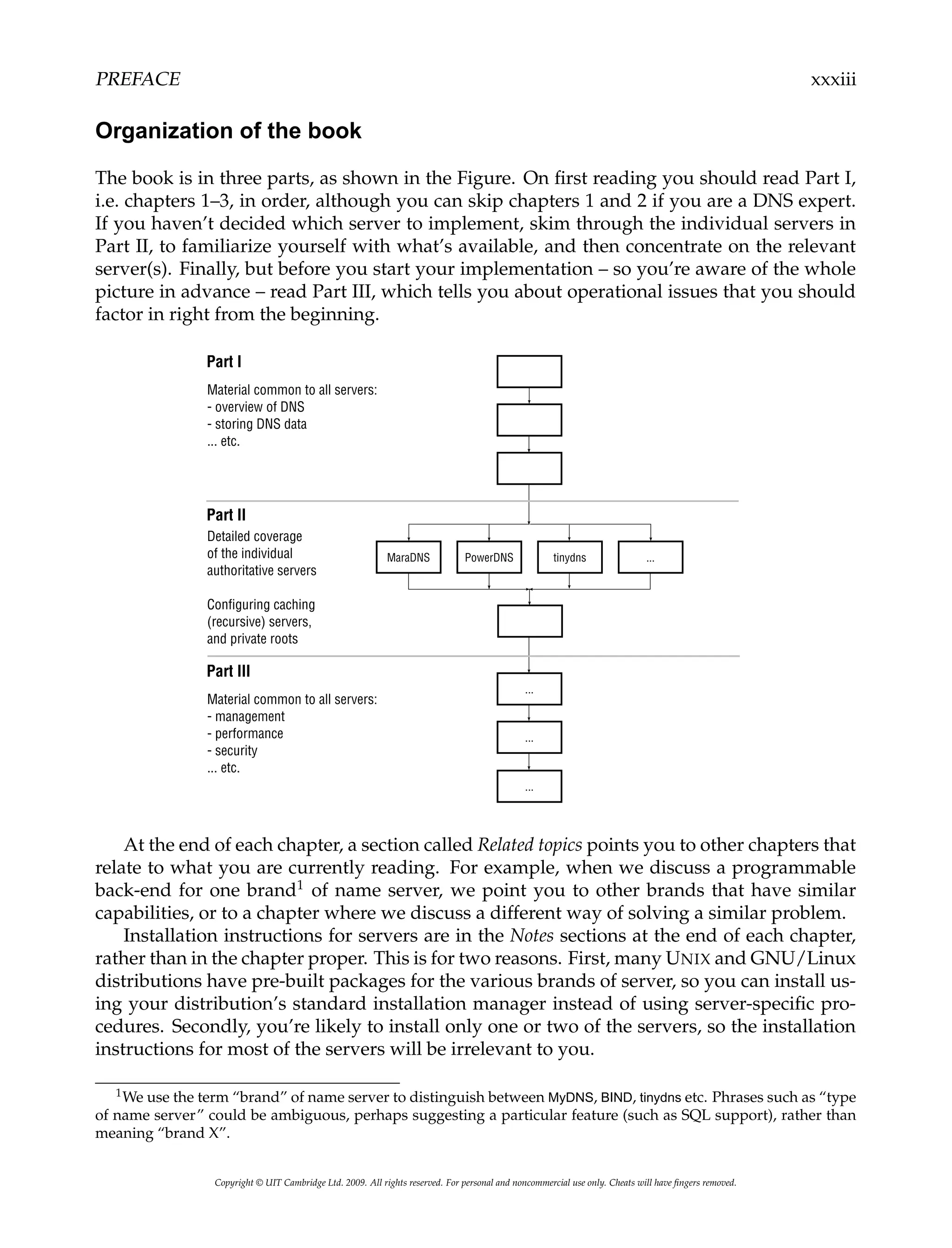
  • 53.
    Chapter 1. Introductionto the DNS 11 root name-space (which is called •) and in effect “redirects” requests for a particular top- level domain to the name servers of that domain. In our example, the root server 202.12.27.33 returned the list of servers for the top-level domain .biz, so we could continue resolving www.qupps.biz. There are 13 root server installations for the public DNS, called a.root-servers.net...m.root- servers.net. All initial queries are directed to a root server determine the addresses of the lower level DNS servers. We said 13 “installations”: in fact there are far more than 13 servers (Figure 1.5); for example, i.root-servers.net consists of servers spread across 31 different sites. As a matter of interest, at the time of this writing, the total number of DNS queries arriving at all the root servers, is about 118 000 per second, equivalent to about 10 billion (1010 ) per day1 . If you are on an large isolated network (i.e. one without an Internet connection) but need a working DNS, then you have to fake the infrastructure (root servers, etc.) found on the Internet. This sounds much more difficult than it actually is; we show you how to set it up in Chapter 18. But don’t worry: most sites don’t need to do this, and you certainly won’t if you are on a small network and want to set up DNS for your Small Office / Home Office. Figure 1.5: Distribution of root name servers 1.1.8 Step 3 – authoritative DNS servers In our example, the next server that our own server (192.168.1.164) contacted, after the root, was a server that “knows about” the .biz domain. To be more precise, each of the .biz servers returned in the list from the root server is authoritative for the .biz domain. This means that each server can, from its own internal database or configuration files, answer the question: “does domain something.biz” exist, and if so, what is the associated address?”. (The something must not contain a dot; if it does, the .biz might have to pass us along to yet another server, as we saw in Step 4.) The server doesn’t need to ask any other server: if its own database doesn’t have a record of the requested domain name, then the domain name definitely does 1http://www.isoc.org/briefings/020/ Copyright © UIT Cambridge Ltd. 2009. All rights reserved. For personal and noncommercial use only. Cheats will have fingers removed.
  • 54.
    12 Alternative DNSServers – Jan-Piet Mens not exist, and the authoritative server sends a negative reply saying so. Note that this is not the same as saying “I don’t know if it exists – go ask someone else”. In our example, we were querying for www.qupps.biz, which did exist, so the .biz servers gave us the address, 192.0.2.1, of a server that “knows about” (is authoritative for) qupps.biz. But how is that authoritative status set up, and who does it? When the domain qupps.biz was allocated to its owner – the QUPPS company – control over it (and all its sub-domains, by definition) was given to QUPPS. This assignment of the responsibility for a domain to someone else is called delegation. Two thing are needed for delegation to work. First, you must configure your name servers so that they believe themselves authoritative for your domains, and contain the data for your domain. Secondly, the name server “above” yours (i.e. your parent server) must be configured with the information that it is your server that is authoritative for your domain. (This configuration is performed with Name Server records, which we discuss in Chapter 2.) In our example above, the following chain of events have made our servers authoritative for the qupps.biz domain: • The root server operators have made the servers for biz authoritative for biz by config- uring the root servers to point to the biz-servers whenever queries for biz are issued. • The operators of the biz domain have made the qupps.biz servers authoritative for qupps.biz by setting up records on the biz servers which define them to be authoritative. • We configured our name servers to contain the DNS data for qupps.biz. QUPPS had to decide whether to run their own authoritative server, or whether they would get their ISP to make the ISP’s server authoritative for qupps.biz. For simplicity, we assume QUPPS run their own server, which has address 192.0.2.1. QUPPS informed the .biz server administrators of this address, and they configured the .biz servers to say that server 192.0.2.1 “knows more about” (is authoritative for) qupps.biz. This process of configuring one server (for .biz) with a list of authoritative domains for a sub-domain (qupps.biz) is also called delegation. (We discuss the process of delegation and how you delegate in Chapter 18.) Each and every domain has at least one authoritative server responsible for it. Distribution of responsibility Delegation devolves the responsibility and authority for assigning IP addresses to domain names. For example, if QUPPS want to change the IP address of www.qupps.biz they change it themselves on their own server (192.0.2.1). They don’t have to tell the .biz server adminis- trators about this. In other words, responsibility has been devolved to a lower level as part of the the delegation process, so the worldwide DNS ends up as a hierarchical, distributed database of information. The only truly central part of the DNS is the root servers, which provide the initial entry point into the DNS tree. 1.1.9 Steps 1&5 v. 2-4 – authoritative and caching servers contrasted There are fundamental differences between authoritative and caching servers, both in their function and how they operate. Whereas a caching name server will always attempt to find Copyright © UIT Cambridge Ltd. 2009. All rights reserved. For personal and noncommercial use only. Cheats will have fingers removed.
  • 55.
    Other documents randomlyhave different content
  • 56.
    [180] [181] Gladys had chummedwith Faith and Helen Beavers during the three years they had been at High Cliffs and understood the sign language of her friend almost as well as she did the spoken word. So she knew that something unexpected was about to happen, and that she was to take her cue from Faith. Although Muriel occupied the seat formerly that of Phyllis Dexter, the change had not pleased that proud girl, who had so wished to be placed next to her particular friend, Adelaine Stuart. Instead she found herself placed between two seniors in whom she was not remotely interested. The truth of the matter was that Miss Gordon had long been observing the three girls, Marianne, Phyllis and Adelaine, and thought it wise to keep them apart whenever it was possible. When Muriel, looking almost happy for the first time since her arrival at High Cliffs, was seated, she felt a compelling gaze and glanced across the room. There she saw Marianne watching her through half-closed lids. There seemed to be in the French girl’s expression a threat that endangered her new-found joy and peace. But Faith, who also had seen, reached under the table and, finding Muriel’s hand, she held it in a close, protecting clasp, and the island girl knew that come what might she would not have to stand alone. Saturday dawned gloriously bright, for it was Indian summer on the Hudson. The air was soft and balmy, the sunshine hazy and a dreamy little breeze rustled the few yellowing leaves that were still clinging to the trees. “Just the day for a hike,” Faith announced at breakfast.
  • 57.
    [182] Catherine Lambert, whosat across the table, looked up eagerly and in answer to the speaker’s question, “Who wants to go?” she at once replied, “I do.” “Muriel is to be the guest of honor.” Faith smiled lovingly at the girl next to her. “Gladys, how about you?” “I thought we were to practice for the tennis tournament today. There is only a month left, you know.” “That’s right. So we were. But, Gladys, if you will go hiking with us today I’ll promise to practice tennis every afternoon next week from four to five, my free time, on one condition.” Her friend looked at her inquiringly. “Name it,” she said. “That fifteen minutes each day may be devoted to teaching Muriel our favorite game.” “Agreed. Who knows but that she may be just the champion player for whom we are looking,” Gladys good naturedly declared with sincere fervor. And Catherine chimed in with: “Oh, wouldn’t it be great if we could make a player out of Muriel? We haven’t anyone on our side as light on her feet or as quick as Marianne Carnot. Just because of that I’ve actually been afraid that we might lose out on the great day.” Then, to the wide-eyed listener, Faith explained: “On Thanksgiving every year we have a tennis tournament. Marianne and her friends are the opponents of Gladys and her chums. Of course, naturally we are eager to win. Now, Muriel, if you are willing, we will train you. Not that we expect you really to bring victory to our side; that would be asking too much, since Marianne
  • 58.
    [183] Carnot was thechampion tennis player in the English boarding school that she attended before she came to America. She has three medals to prove her frequently made boast, and, moreover, we have seen her play.” Then, as the surveillant of the dining hall gave the signal, the pupils rose and left. In the lower corridor, near the office of the principal, Faith paused. “Wait a minute,” she said softly. “I am going to ask Miss Gordon if we may take our lunch. I do not have to return to the school until three o’clock, just in time for my violin lesson.” The permission was readily granted and then the four girls went to their rooms to dress for the hike. Muriel was happier than she had supposed she would be ever again, and she actually smiled at her reflection as she donned her sport skirt, sweater and tam. When she was dressed, Muriel stood gazing idly from her window.
  • 59.
    [184] CHAPTER XXVI. MURIEL RECEIVESA LETTER. When Muriel Storm returned from the hike to the woodlands and found upon her desk a letter from Gene Beavers she did indeed rejoice, and without stopping to remove her hiking apparel, she curled up on her window seat to read the missive, which, as usual, was couched in the simplest words. The two weeks of tutoring which Muriel had received from Faith had helped her to read with far greater ease. The lad told of his long illness which had resulted from the cold, stormy weather, the rough voyage and the damp, foggy climate of London. He had seen nothing of the city since his arrival, but even though they were living in one of the fashionable outlying districts, he could hear the distant roar of the traffic, and now he yearned to be back on Windy Island, where only were to be heard the sounds of nature. When Gene wrote that letter he knew nothing of the tragedy of the lighthouse, for although Faith had mentioned it in a letter to Helen, his sister had thought best not to sadden him with news that might be a shock
  • 60.
    [185] to him, forshe well knew how greatly he admired the old man who had been keeper of the light. However, she had been glad to tell him that Muriel Storm was attending the High Cliff Seminary. This did not really surprise him, for often he had heard Doctor Winslow say that, as soon as he could convert the old sea captain to his point of view, he, at his own expense, intended sending the girl, of whom he was fond, to some good boarding school. Little did Muriel dream that Gene’s proud mother had sent for him that she might get him away from the degrading influence of the fisherfolk with whom he had been staying and about whom she had heard from Marianne’s father, who was a business friend of Mr. Beavers. Then for months she positively forbade the boy to write to the “island girl,” but at length, when his illness lasted so long, the mother consented to permit Gene to write if he would promise to remain in England until he was twenty-one. By that time he would have forgotten that daughter of the common people, for she, of course, would be unable to travel, and so they would not meet. For a long time after the reading of the epistle Muriel sat with the letter lying in her lap as she gazed with unseeing eyes at the busy Hudson. If only she knew how to write! As yet she had never answered one of Gene’s letters, nor had he expected a reply. Of course, Faith, Gladys or Catherine Lambert, all dear friends, would gladly pen a letter at her dictation, but that would not be quite the same. She wanted to write the very first letter all by herself.
  • 61.
    [186] She wondered howlong it would be before she could learn. It was nearing five o’clock when there came a rap-i-tap upon her door, a signal meaning that Faith awaited without. In reply to Rilla’s “Come in!” the door opened. “Muriel Storm, I do believe that you have been day- dreaming again! Why haven’t you removed your hiking togs? I came up to tell you that Miss Widdemere wishes us to gather in the study hall at five-fifteen for the first class of the year in politeness.” The island girl sprang up and hastily began to change her costume. “A class in politeness, is it?” she repeated, in a puzzled tone of voice. “What does one have to be learnin’ in that kind of a class?” Faith sat on the window seat to wait until her friend was ready to accompany her. “Oh, it’s a sort of society stunt, so to speak,” she explained. “We practice curtsies for grace, make seven different varieties of calls, more or less, are taught what to do with our hands and feet, how to be a hostess and how to be a guest. Oh, yes, and what to do and what not to do if we’re ever presented to a queen.” Faith was purposely exaggerating. She really believed the class in politeness rather unnecessary, since the young ladies came from homes where they learned from babyhood all that they would need to know. She had forgotten for the moment that Muriel had not had these same home advantages.
  • 62.
    [187] “Oh, I wishI didn’t have to be goin’ to it,” the island girl said as she turned away from the mirror, again dressed in her dark blue school uniform. “I’ll be that awkward, an’ I don’t know nothin’ about manners.” Her voice was so truly distressed and the expression on her face so tragic that Faith sprang up from the window seat and, slipping a protecting arm about her friend, she said: “Dear, I’ll ask Miss Widdemere to excuse you today; that is, just let you watch the others, and then, this evening, I’ll come up to your room and teach you the curtsy. It would hardly be fair to ask you to begin with the others when many of them practiced during the whole of last year.” Faith had suddenly recalled overhearing a conversation when she was on her way to the cupola room. Adelaine Stuart and the French girl had been just ahead of her and she had distinctly heard the former say: “If it is your desire to humiliate that lighthouse person wait until she has to take the part of hostess in politeness class. That will show her up before the whole school.” The rest of the sentence Faith had not heard, as she had passed the two schemers with her head held high, but when she came to think it over she wondered why Marianne Carnot wished to harm Rilla, whom she barely knew. Faith resolved to stay close to Muriel to protect her, if she could, from whatever humiliation Adelaine and Marianne might be planning, and it was indeed lucky for the island girl that she had so staunch a friend. Faith was glad to find that the Mistress of the Manners Class was still in her office, and thither she led Muriel.
  • 63.
    [188] The young teacherglanced up and bade them enter. Then Faith asked: “Miss Widdemere, have you met our new pupil, Muriel Storm?” There was a brightening expression in the kind grey eyes back of the large, dark-rimmed glasses. The teacher advanced, her right hand extended. “No, indeed, and I am most pleased to meet you. A lucky new pupil you are to have the friendship of our Faith.” This with a loving glance at the girl who stood at Muriel’s side. “Yes, ma’am. Thanks!” Miss Widdemere’s glance was puzzled, though not unkindly critical. It was not customary for girls from the North to say “ma’am,” but perhaps this new pupil was a Southerner. The teacher was even more perplexed when Faith beckoned to Gladys Goodsell, who stood near awaiting her friend, and said: “Will you take Muriel to the classroom? I wish to speak with Miss Widdemere for a moment.” When the door was closed, in as few words as possible Faith told the tragic story of Muriel’s coming to High Cliffs. “She has never had an opportunity to learn the ways of social life, Miss Widdemere,” the girl said earnestly, “but when you know her better you will think her very unusual, I am sure.” Then, as she was eager to create a favorable impression, she added: “Muriel has beautiful fancies and our Miss Gordon believes that she is to be a real poet some day.”
  • 64.
    [189] “What a loyalfriend your friends have in you, Faith? What is your request?” It was granted as soon as heard. “Muriel may listen and watch,” the teacher declared, “but we will not ask her to take part until you tell me that you have coached her sufficiently in private.” Then, as the bell in the corridor was announcing that laggards must make haste, these two went to the study hall, where the pupils were assembled. Some were seated on the desk tops, others standing in groups chatting, but when Miss Widdemere appeared all arose, and facing her, made deep curtsies. Muriel alone remained erect, not knowing what to do. Marianne, gazing across the room through half-closed lids, smiled and nudged her companion. “She’s as graceful as a hitching post,” Adelaine replied, loud enough to be heard by several who stood near. Muriel felt their gaze and flushed with embarrassment. “The young ladies will now arrange their chairs in a large semi-circle, the vacant space in the center to represent a parlor.” Miss Widdemere waited until the confusion was over and the pupils seated before continuing: “We will now select a hostess and ten guests to attend an afternoon tea. Whom do you name as hostess, Phyllis?” She had turned toward that young girl because she had risen. “I name Muriel Storm,” said Phyllis, who had been well coached by the girls who sat next to her.
  • 65.
    [190] Miss Widdemere senta keen glance in their direction, and she said, rather coldly: “Young ladies, partly because of Muriel Storm’s recent bereavement, we are not expecting her to share in our imaginary social functions for a month at least.” Marianne Carnot added in an undertone heard only by those about her, “And the other ‘partly’ is that she couldn’t if we did expect it.” Faith eventually was chosen as hostess and Muriel intently watched every move made by her friend. How graceful she was and how gracious! A slip of a Japanese girl, who was the daughter of the chef of the school, appeared dressed in an attractive native costume and played the part of maid for this class. When she was older she, too, would be trained for the sphere that she was to fill. That evening Faith found her friend both discouraged and homesick. “It’s out of place I am among you all,” she said. “I’d ruther be back with my seagulls, I’m thinkin’. I’ll never take to bowin’ and goin’ to teas.” Faith laughed merrily; then shaking a finger at Rilla, prophesied: “The day is coming when you may be asked to be hostess for a lord or an earl or someone like that; then won’t you be glad that you learned how at High Cliff Seminary?” The idea was so absurd that even Muriel laughed. “Me hostess at an earl’s tea party? You’re allays sayin’ you have no imagination, but I’m thinkin’ you have some and to spare.”
  • 66.
    [191] Laughter brought abetter humor, as it always does, and for an hour that evening Muriel permitted her friend to teach her the first positions to be made in the curtsy.
  • 67.
    [192] CHAPTER XXVII. MURIEL BEGINSHER STUDIES. A fortnight passed and during that time Miss Gordon and Faith had started Muriel’s development in several directions. In fact, the younger of her teachers soon triumphantly announced that not a pupil at High Cliff Seminary could make a more graceful curtsy than Muriel. The day before the expected arrival of Miss Humphrey, who was to tutor the island girl, she confided to Faith that she just knew that she could make far greater headway with writing and reading if she might continue practicing them with her best friend than she could with a teacher, however learned, who was strange to her. It was evident to the three girls who were her closest comrades that Muriel dreaded the first hour that she was to spend with Miss Humphrey. As usual, the island girl seemed almost to foreknow what was going to happen, and when the moment arrived Muriel retreated within herself so entirely that, at the close of a very trying hour, Miss Humphrey went down to the office of Miss Gordon and remarked: “I must confess that I am extremely disappointed in your
  • 68.
    [193] prodigy. Her Englishis deplorable. To correct it will take indefinite patience and far more time than I can spare from my legitimate classwork. Is there not some one who could undertake her instruction during the fall term in the fundamentals?” If Miss Gordon was discouraged her voice did not betray it, when, after a thoughtful moment, she replied: “I am sorry that I asked you to undertake the tutoring of the island girl. I hoped that you would see in her the possibilities of an unusual nature that I still contend are there, but it will, as you say, require infinite patience to develop them. Perhaps I had better make some other arrangement, at least until Muriel has caught up with your Junior English class.” There was real relief pictured on the face that was lined before its time. Rising, Miss Humphrey said: “I am indeed glad that we are agreed on this matter and if Muriel Storm is advanced enough at the midwinter term to enter the junior class I will do all that I can to aid her, but this dialect which she now speaks must be overcome, and that means tireless prompting on the part of some constant companion.” Miss Gordon also arose and said, not unkindly: “Give Doctor Winslow’s protege no more thought until the midwinter term begins.” Then the principal added, with a brightened smile: “I’ll prophesy that Muriel will then be prepared to enter your sophomore class and not your junior.” “Impossible!” Miss Humphrey declared with conviction. “Wonders never cease!” laughed Miss Gordon, who now wished to end the interview.
  • 69.
    [194] “But who willtutor Muriel Storm that she is to make such phenomenal progress?” With her hand on the knob of the open door Miss Humphrey awaited the answer. “I shall,” Miss Gordon replied. Joy was in the heart of the island girl when she heard this wonderful news. “Oh, I’m that glad, Miss Gordon,” she exclaimed the following evening when, just after dinner, she was summoned to the attractive little apartment in a remote wing of the school to which the principal retired when the tasks of the day were over. The larger of the two rooms was a library and study in which there was a wide fireplace, and on either side long, vine-hung windows that overlooked the Hudson. Low shelves circled the walls and they were filled with book-friends, actually read and loved by their owner. Here and there were soft-toned copies of famous paintings and a few charming originals in water color. Too, there were ferns growing in the wicker window- boxes and a blossoming plant on a low wicker stand. The comfortable, inviting chairs of the same weave were cushioned with soft hues and a shade on the reading lamp harmonized. The little room just beyond, in which Miss Gordon slept, had disappearing windows on all sides, and at night, when these were opened, only the screens sheltered her from the out-of-doors she so loved. As the principal had prophesied, Muriel, in this congenial atmosphere, blossomed not only rapidly but also beautifully. No one but Faith guessed how her friend was advancing and she did not have to guess. She knew.
  • 70.
    [195] [196] Miss Gordon hadsent for Faith on the very day that Miss Humphrey had visited the office, and together they had divided the work and the joy of assisting Muriel. In the beginning the principal had merely planned asking Faith’s advice; it had not been her desire to burden the girl, but at once Faith had said: “Oh, Miss Gordon, I have not told you that for the past two weeks I have been instructing Muriel in penmanship and also in reading and spelling. It is a great pleasure to me to aid her, and if you are willing I shall continue our little class.” The principal’s sweet face brightened. “Thank you, Faith. If you will tutor Muriel in the fundamentals, I will gladly instruct her in the higher branches.” Then she added, and there was a twinkle in the sweet grey-blue eyes: “Miss Humphrey would never be able to understand it, but I actually enjoy reading poetry to that island girl. She sits on a low stool at my feet and with those liquid hazel eyes she drinks into her very soul the beauty of the thought and the music of the rhythm.” “Miss Gordon,” Faith said, “don’t let us tell anyone of Muriel’s progress. Let’s keep it a secret until the midwinter term. I would like to surprise Miss Humphrey —and—and others.” Faith was thinking of Marianne, whom she knew wished to humiliate Muriel.
  • 71.
    CHAPTER XXVIII. A LESSONIN TENNIS. Faith and Muriel were studying together the next morning, which chanced to be Saturday, when they heard a hurrying of feet in the corridor and then a merry banging on the door. “Come in,” Muriel called. The door was flung open and in bounced Gladys Goodsell and Catherine Lambert, wearing tennis shoes and carrying their racquets and balls. “Top o’ the morning to you,” Gladys sang out. “The coast is clear!” Catherine announced almost at the same time. The two, who were seated at a small table strewn with papers and books, looked up inquiringly. “What coast and how clear?” Faith inquired. Gladys threw herself down upon the window seat while Catherine perched on the foot of the bed.
  • 72.
    [197] “Marianne Carnot andAdelaine Stuart have gone to the city for the day. Think of that! They left on the mail boat at nine o’clock sharp, chaperoned by Miss Widdemere, and are to return at six-thirty P. M. Were we ever in greater luck?” Still the listeners were puzzled. “Faith Morley, put on your thinking bonnet! Don’t you know that we have been just pining to have an opportunity to instruct Muriel in the beginnings of tennis without being spied upon by our arch-enemy, whatever that may mean. Anyway, it sounds much grander than just enemy.” “That is true,” Faith replied, “but this morning Muriel and I were planning to study. Can’t we play this afternoon?” Faith had not told the others that in reality she was trying to instruct the island girl in spelling the simplest words, but Muriel was quite willing that these two dear friends might know, and so she said: “Teacher Faith, I think I’m gettin’ a notion of what you mean about the lesson, and if you’d like to be teachin’ me tennis, I’d love to be learnin’ it.” “Very well,” Faith said as she arose, glad indeed to join in the outdoor game they all so enjoyed. “I haven’t a thing to do until my violin lesson at three o’clock, although I think I had better practice for an hour before Herr Professor arrives on the scene today. Last Saturday he said, ‘Mees Morley, the practice is less of late, why for?’” Then she added: “Into your sport skirt, Muriel, and if you haven’t tennis shoes I’ll loan you a pair. Fare- thee-well. I’ll be back in a twinkling.”
  • 73.
    [198] [199] Faith skipped awayto her room to change her dress. Catherine and Gladys announced that they would go ahead to the court and practice until the others joined them. Ten minutes later Faith reappeared, holding a pair of tennis shoes. She found Muriel studying the primer. Rilla looked up with laughter in her hazel eyes. “D-e-a-r,” she announced. “It’s the beginning of a letter. I wonder how long ’twill be before I can be writin’ one that a person could be readin’?” She was putting a burnt orange tam atop of her red- brown hair as she spoke, and then she slipped on a sweater of the same becoming hue. “Who are you so eager to write to, anyway?” Faith was curious. “Oh, it’s several friends I have that I’d like to be writin’ to,” Muriel began; then, chancing to glance at the chart made for her by Faith to aid in correcting the mistakes she so frequently made, she repeated, very slowly and thoughtfully: “I have several friends to whom I wish to write.” “That’s great!” Faith exclaimed, her face glowing with pleasure. “Think ahead of each word that you say for a few weeks, dear, and soon you will find that it will be hard for you to speak incorrectly.” Then, slipping her arm within that of her friend, she added: “The champion tennis players will now descend to the court.” Faith chatted gaily as they went down the wide stairs, out through the basement door, crossed the garden, where few flowers were blossoming, as the nights were frosty, and toward the tennis courts.
  • 74.
    [200] Muriel, however, wassilent. She was wondering how long it would be before she could write a letter to Gene unaided. “Greetings!” Gladys called as Muriel and Faith approached. She waved her racket and then, as the ball, sent with a smash by Catherine, landed in the court just back of her, she whirled with a sudden swift movement, caught it on the first bound and sent it flying back over the net. The island girl stared at her in amazement. “Why, Gladys, it’s like a top you’re whirling!” she exclaimed. “Is it me that’s expected to learn such antics?” The other three laughed, and Catherine, catching the ball, walked around the net to join the group. “We don’t expect you to do such expert playing as that for this tournament,” Faith assured her. “In fact, we do not expect you to take part in any of the actual contest games until next spring, but you might as well begin your training. It’s jolly good fun, if nothing more.” Muriel sighed audibly and Faith laughed. “Rilla,” she said, and the island girl heard her grand-dad’s pet name for her for the first time since she had arrived at High Cliffs, “have you been worrying for fear we did expect you to play against Marianne Carnot on that fateful day? Indeed not! Catherine Lambert is the only pupil in this school who can even approach Marianne in skill and dexterity. You know the English are great for outdoor sports of all kinds.” “But it’s French Marianne is, I thought.”
  • 75.
    [201] “Her father isa Frenchman, but he is connected with English and American shipping interests. It’s a huge concern, I don’t know just what, but I have heard Marianne say that their ships circle the globe. Because of this, Monsieur Carnot resides in England, where his daughter attended a school, and she takes every opportunity to assure us it was really intended only for the daughters of the lesser nobility, if you know what or who they may be.” “I plead total ignorance,” Gladys declared. “I’m glad that I’m an American. My dad made every penny that he possesses, and honestly, too. Grand-dad happened to own vast farmlands which the City of New York wished to possess, and for which it paid a fabulous price, hence the grand-daughter of a farmer is attending High Cliffs with the daughters of the lesser nobility, if any happen to be here.” Catherine Lambert laughed. “Well, since we four are not guilty, let’s cease chatting and go to batting.” “Cathy, I believe you are trying to be a poet,” Faith remonstrated. “Don’t, dear, we’d hate to have our best tennis player take to day-dreaming.” “No danger of that! I simply couldn’t write a poem if my life depended upon it. Now, let’s explain the game. Muriel, here is a racket for you.” Catherine looked over at Faith, who smilingly nodded, and said: “Keep up the good work, Cathy. If you leave out any leading points Gladys and I will supply them.” “Very well, if I am appointed instructress, I will proceed to instruct,” Catherine said. Then she added in a tone of mock seriousness: “Miss Storm, before you is a tennis
  • 76.
    [202] court, the boundariesof which are outlined in white. A net, you will perceive, is stretched across the center, and the opponents stand two on either side. Comprenez vous?” Then, noting the pupil’s puzzled expression, she translated: “Do I make it clear?” Muriel nodded. Catherine continued: “The first player to serve the ball is selected and the game begins. Now, the object of the server is to send the ball over the net in such a manner that it will be difficult for the opponent to reach it before it bounds twice. It may be returned after the first bounce, but not after the second.” Then, turning to the others: “Now, shall we begin? Muriel will learn more by actual practice than by any amount of explanation. I will take her for my partner.” “Oh, Catherine, you’ll be sorry if you do,” Muriel laughingly protested. “No, she won’t,” Faith returned. “Catherine could win the game singly against any two girls in this school if Marianne were not an opponent.” Then the game began. Gladys served and the ball fell easily within Muriel’s reach, but she stood and gazed at it. For a fraction of a second Catherine waited, then realizing that Muriel did not understand that she was expected to return the ball, she leaped to the other side and, zip, it went flying gracefully back over the net. After that it was kept in the air, one volley shot following another in quick succession until Faith had the misfortune to throw it into the net, then they all paused for a breathing spell. Muriel shook her head. “You might’s well give up the notion of teachin’ me. Such spinnin’ around I never
  • 77.
    [203] [204] could do.” Faith laughed.“Don’t be discouraged. We all felt just that way in the beginning. Now, Gladys, let’s sit beneath this juniper tree and let Muriel get some actual practice.” This they did, and during the next half hour Muriel did some leaping and running that made the observers decide that, when she understood the rules of the game, she would play at least as well as the majority. “The luncheon bell is ringing,” Faith sang out at last. The players stopped and the others, gazing at Muriel, suddenly realized she was truly beautiful. Her loosened hair clustered in moist ringlets about her flushed face, her orange colored tam was jauntily askew, and her eyes were glowing. “That was great fun,” she said, when the garden door was reached. “Thank you all for tryin’ to teach me.”
  • 78.
    CHAPTER XXIX. JOY KIERSEY. Thathad been the first of many hours of practice on the tennis courts. Running races with Shags and rowing had been the only two outdoor sports Muriel had known. For that reason, perhaps, she thoroughly enjoyed tennis, and how her friends did enjoy watching her. Every afternoon from four to five o’clock they had the court to themselves, that being the hour when Marianne Carnot was practicing her vocal lessons on the other side of the school. These three friends did not wish Marianne to even suspect that Muriel was being drilled. Not that they had any hope of winning the game, which was but a fortnight away. In fact, it would be unwise to permit so new a player as Muriel to even take part, they decided. Joy Kiersey, who usually played with Catherine Lambert, had been ill, and was not yet strong enough to practice, although she assured the girls that she would not fail them on the day of the tournament.
  • 79.
    Welcome to ourwebsite – the perfect destination for book lovers and knowledge seekers. We believe that every book holds a new world, offering opportunities for learning, discovery, and personal growth. That’s why we are dedicated to bringing you a diverse collection of books, ranging from classic literature and specialized publications to self-development guides and children's books. More than just a book-buying platform, we strive to be a bridge connecting you with timeless cultural and intellectual values. With an elegant, user-friendly interface and a smart search system, you can quickly find the books that best suit your interests. Additionally, our special promotions and home delivery services help you save time and fully enjoy the joy of reading. Join us on a journey of knowledge exploration, passion nurturing, and personal growth every day! ebookbell.com