Evolution of Animal Phyla
and of Vertebrates
CRISTIAN D. ALONZO
Discussant
Precambrian, period of time extending from about 4.6 billion years ago to the
beginning of the Cambrian Period, 541 million years ago. The
Precambrian encompasses the Archean and Proterozoic eons, which are formal
geologic intervals that lasted from 4 billion to about 541 million years ago, and
the Hadean Eon, which is an informal interval spanning from 4.6 billion to 4 billion
years ago. The Precambrian represents more than 80 percent of the total geologic
record.
Cambrian Period, earliest time division of the Paleozoic Era, extending from 541
million to 485.4 million years ago.
Geologic Time
Ordovician- geologic period 485. 4 million years ago- 443 million years ago.
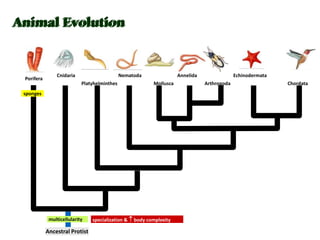
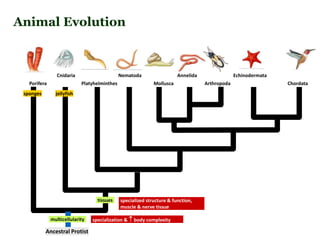
Porifera
Cnidaria
Platyhelminthes
sponges
Nematoda
Mollusca Arthropoda Chordata
Annelida Echinodermata
multicellularity
Ancestral Protist
specialization &  body complexity
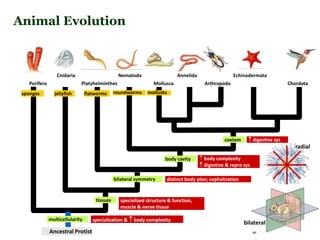
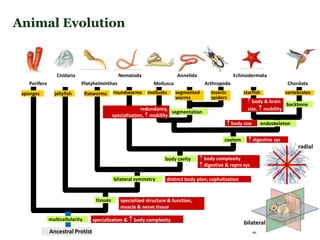
Animal Evolution
Animal Evolution
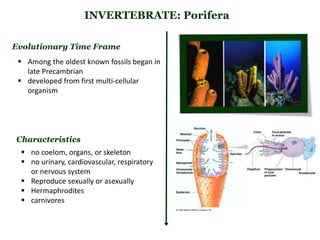
INVERTEBRATE: Porifera
Evolutionary Time Frame
 Among the oldest known fossils began in
late Precambrian
 developed from first multi-cellular
organism
 no coelom, organs, or skeleton
 no urinary, cardiovascular, respiratory
or nervous system
 Reproduce sexually or asexually
 Hermaphrodites
 carnivores
Characteristics
Porifera
Cnidaria
Platyhelminthes
sponges
Nematoda
Mollusca Arthropoda Chordata
Annelida Echinodermata
multicellularity
Ancestral Protist
specialization &  body complexity
tissues specialized structure & function,
muscle & nerve tissue
jellyfish
Animal Evolution
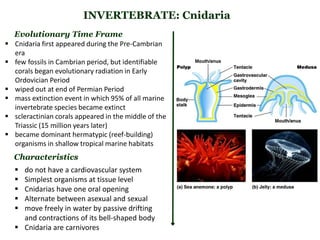
INVERTEBRATE: Cnidaria
Evolutionary Time Frame
 Cnidaria first appeared during the Pre-Cambrian
era
 few fossils in Cambrian period, but identifiable
corals began evolutionary radiation in Early
Ordovician Period
 wiped out at end of Permian Period
 mass extinction event in which 95% of all marine
invertebrate species became extinct
 scleractinian corals appeared in the middle of the
Triassic (15 million years later)
 became dominant hermatypic (reef-building)
organisms in shallow tropical marine habitats
 do not have a cardiovascular system
 Simplest organisms at tissue level
 Cnidarias have one oral opening
 Alternate between asexual and sexual
 move freely in water by passive drifting
and contractions of its bell-shaped body
 Cnidaria are carnivores
Characteristics
Porifera
Cnidaria
Platyhelminthes
sponges
Nematoda
Mollusca Arthropoda Chordata
Annelida Echinodermata
multicellularity
Ancestral Protist
specialization &  body complexity
tissues specialized structure & function,
muscle & nerve tissue
jellyfish
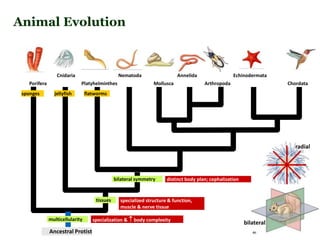
bilateral symmetry distinct body plan; cephalization
flatworms
radial
bilateral
Animal Evolution
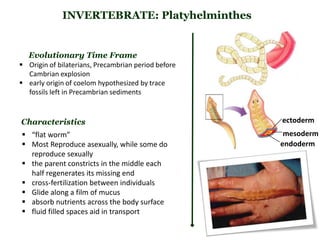
INVERTEBRATE: Platyhelminthes
Evolutionary Time Frame
 Origin of bilaterians, Precambrian period before
Cambrian explosion
 early origin of coelom hypothesized by trace
fossils left in Precambrian sediments
 “flat worm”
 Most Reproduce asexually, while some do
reproduce sexually
 the parent constricts in the middle each
half regenerates its missing end
 cross-fertilization between individuals
 Glide along a film of mucus
 absorb nutrients across the body surface
 fluid filled spaces aid in transport
Characteristics ectoderm
mesoderm
endoderm
Porifera
Cnidaria
Platyhelminthes
sponges
Nematoda
Mollusca Arthropoda Chordata
Annelida Echinodermata
multicellularity
Ancestral Protist
specialization &  body complexity
tissues specialized structure & function,
muscle & nerve tissue
jellyfish
bilateral symmetry distinct body plan; cephalization
flatworms
radial
bilateral
body cavity  body complexity
 digestive & repro sys
roundworms
Animal Evolution
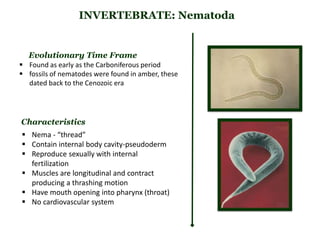
INVERTEBRATE: Nematoda
Evolutionary Time Frame
 Found as early as the Carboniferous period
 fossils of nematodes were found in amber, these
dated back to the Cenozoic era
 Nema - “thread”
 Contain internal body cavity-pseudoderm
 Reproduce sexually with internal
fertilization
 Muscles are longitudinal and contract
producing a thrashing motion
 Have mouth opening into pharynx (throat)
 No cardiovascular system
Characteristics
Porifera
Cnidaria
Platyhelminthes
sponges
Nematoda
Mollusca Arthropoda Chordata
Annelida Echinodermata
multicellularity
Ancestral Protist
specialization &  body complexity
tissues specialized structure & function,
muscle & nerve tissue
jellyfish
bilateral symmetry distinct body plan; cephalization
flatworms
radial
bilateral
body cavity  body complexity
 digestive & repro sys
roundworms
coelom  digestive sys
mollusks
Animal Evolution
INVERTEBRATE: Mollusca
Evolutionary Time Frame
 Lived in freshwater streams as early as 400 million
years ago
 developed the ability to be able to live in most
aquatic environments-300 million years ago
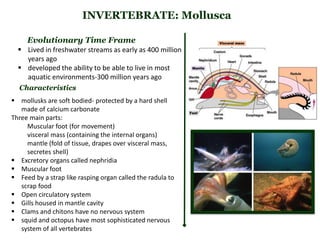
 mollusks are soft bodied- protected by a hard shell
made of calcium carbonate
Three main parts:
Muscular foot (for movement)
visceral mass (containing the internal organs)
mantle (fold of tissue, drapes over visceral mass,
secretes shell)
 Excretory organs called nephridia
 Muscular foot
 Feed by a strap like rasping organ called the radula to
scrap food
 Open circulatory system
 Gills housed in mantle cavity
 Clams and chitons have no nervous system
 squid and octopus have most sophisticated nervous
system of all vertebrates
Characteristics
Porifera
Cnidaria
Platyhelminthes
sponges
Nematoda
Mollusca Arthropoda Chordata
Annelida Echinodermata
multicellularity
Ancestral Protist
specialization &  body complexity
tissues specialized structure & function,
muscle & nerve tissue
jellyfish
bilateral symmetry distinct body plan; cephalization
flatworms
radial
bilateral
body cavity  body complexity
 digestive & repro sys
roundworms
coelom  digestive sys
mollusks
segmentation
redundancy,
specialization,  mobility
segmented
worms
Animal Evolution
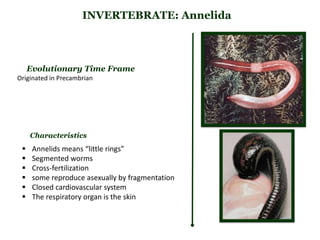
INVERTEBRATE: Annelida
Evolutionary Time Frame
Originated in Precambrian
 Annelids means “little rings”
 Segmented worms
 Cross-fertilization
 some reproduce asexually by fragmentation
 Closed cardiovascular system
 The respiratory organ is the skin
Characteristics
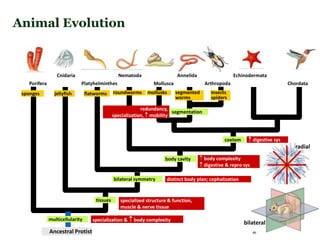
Porifera
Cnidaria
Platyhelminthes
sponges
Nematoda
Mollusca Arthropoda Chordata
Annelida Echinodermata
multicellularity
Ancestral Protist
specialization &  body complexity
tissues specialized structure & function,
muscle & nerve tissue
jellyfish
bilateral symmetry distinct body plan; cephalization
flatworms
radial
bilateral
body cavity  body complexity
 digestive & repro sys
roundworms
coelom  digestive sys
mollusks
segmentation
redundancy,
specialization,  mobility
segmented
worms
insects
spiders
Animal Evolution
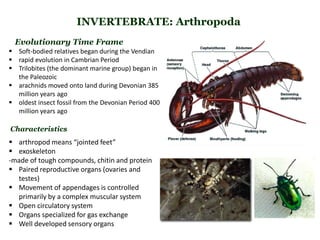
INVERTEBRATE: Arthropoda
Evolutionary Time Frame
 Soft-bodied relatives began during the Vendian
 rapid evolution in Cambrian Period
 Trilobites (the dominant marine group) began in
the Paleozoic
 arachnids moved onto land during Devonian 385
million years ago
 oldest insect fossil from the Devonian Period 400
million years ago
 arthropod means “jointed feet”
 exoskeleton
-made of tough compounds, chitin and protein
 Paired reproductive organs (ovaries and
testes)
 Movement of appendages is controlled
primarily by a complex muscular system
 Open circulatory system
 Organs specialized for gas exchange
 Well developed sensory organs
Characteristics
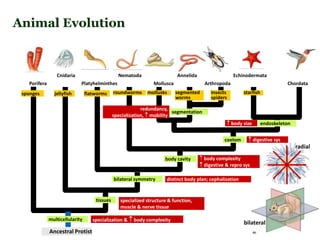
Porifera
Cnidaria
Platyhelminthes
sponges
Nematoda
Mollusca Arthropoda Chordata
Annelida Echinodermata
multicellularity
Ancestral Protist
specialization &  body complexity
tissues specialized structure & function,
muscle & nerve tissue
jellyfish
bilateral symmetry distinct body plan; cephalization
flatworms
radial
bilateral
body cavity  body complexity
 digestive & repro sys
roundworms
coelom  digestive sys
mollusks
segmentation
redundancy,
specialization,  mobility
segmented
worms
insects
spiders
endoskeleton
 body size
starfish
Animal Evolution
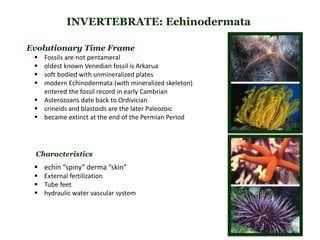
INVERTEBRATE: Echinodermata
Evolutionary Time Frame
 Fossils are not pentameral
 oldest known Venedian fossil is Arkarua
 soft bodied with unmineralized plates
 modern Echinodermata (with mineralized skeleton)
entered the fossil record in early Cambrian
 Asterozoans date back to Ordivician
 crineids and blastoids are the later Paleozoic
 became extinct at the end of the Permian Period
 echin “spiny” derma “skin”
 External fertilization
 Tube feet
 hydraulic water vascular system
Characteristics
Porifera
Cnidaria
Platyhelminthes
sponges
Nematoda
Mollusca Arthropoda Chordata
Annelida Echinodermata
multicellularity
Ancestral Protist
specialization &  body complexity
tissues specialized structure & function,
muscle & nerve tissue
jellyfish
bilateral symmetry distinct body plan; cephalization
flatworms
radial
bilateral
body cavity  body complexity
 digestive & repro sys
roundworms
coelom  digestive sys
mollusks
segmentation
redundancy,
specialization,  mobility
segmented
worms
insects
spiders
endoskeleton
 body size
starfish vertebrates
backbone
 body & brain
size,  mobility
Animal Evolution
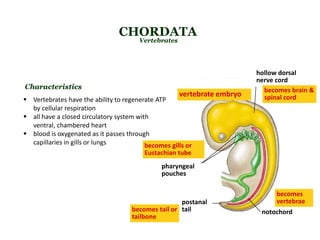
postanal
tail notochord
hollow dorsal
nerve cord
pharyngeal
pouches
becomes brain &
spinal cord
becomes
vertebrae
becomes gills or
Eustachian tube
becomes tail or
tailbone
vertebrate embryo
CHORDATA
Vertebrates
 Vertebrates have the ability to regenerate ATP
by cellular respiration
 all have a closed circulatory system with
ventral, chambered heart
 blood is oxygenated as it passes through
capillaries in gills or lungs
Characteristics
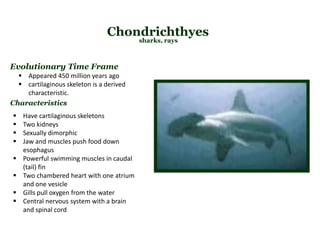
Chondrichthyes
sharks, rays
 Have cartilaginous skeletons
 Two kidneys
 Sexually dimorphic
 Jaw and muscles push food down
esophagus
 Powerful swimming muscles in caudal
(tail) fin
 Two chambered heart with one atrium
and one vesicle
 Gills pull oxygen from the water
 Central nervous system with a brain
and spinal cord
Characteristics
Evolutionary Time Frame
 Appeared 450 million years ago
 cartilaginous skeleton is a derived
characteristic.
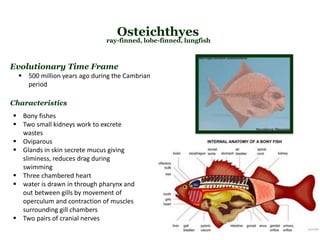
Osteichthyes
ray-finned, lobe-finned, lungfish
 Bony fishes
 Two small kidneys work to excrete
wastes
 Oviparous
 Glands in skin secrete mucus giving
sliminess, reduces drag during
swimming
 Three chambered heart
 water is drawn in through pharynx and
out between gills by movement of
operculum and contraction of muscles
surrounding gill chambers
 Two pairs of cranial nerves
Characteristics
Evolutionary Time Frame
 500 million years ago during the Cambrian
period
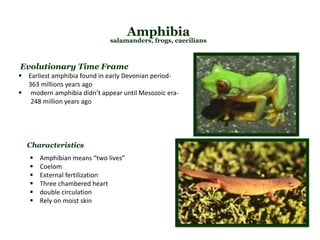
Amphibia
salamanders, frogs, caecilians
 Amphibian means “two lives”
 Coelom
 External fertilization
 Three chambered heart
 double circulation
 Rely on moist skin
Characteristics
Evolutionary Time Frame
 Earliest amphibia found in early Devonian period-
363 millions years ago
 modern amphibia didn’t appear until Mesozoic era-
248 million years ago
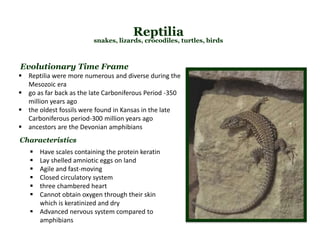
Reptilia
snakes, lizards, crocodiles, turtles, birds
 Have scales containing the protein keratin
 Lay shelled amniotic eggs on land
 Agile and fast-moving
 Closed circulatory system
 three chambered heart
 Cannot obtain oxygen through their skin
which is keratinized and dry
 Advanced nervous system compared to
amphibians
Characteristics
Evolutionary Time Frame
 Reptilia were more numerous and diverse during the
Mesozoic era
 go as far back as the late Carboniferous Period -350
million years ago
 the oldest fossils were found in Kansas in the late
Carboniferous period-300 million years ago
 ancestors are the Devonian amphibians
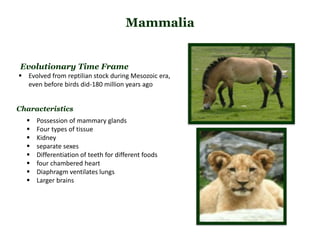
Mammalia
 Possession of mammary glands
 Four types of tissue
 Kidney
 separate sexes
 Differentiation of teeth for different foods
 four chambered heart
 Diaphragm ventilates lungs
 Larger brains
Characteristics
Evolutionary Time Frame
 Evolved from reptilian stock during Mesozoic era,
even before birds did-180 million years ago

Alonzo_Cristian_Evolution_of_Animal_Phyla.pptx

  • 1.
    Evolution of AnimalPhyla and of Vertebrates CRISTIAN D. ALONZO Discussant
  • 2.
    Precambrian, period oftime extending from about 4.6 billion years ago to the beginning of the Cambrian Period, 541 million years ago. The Precambrian encompasses the Archean and Proterozoic eons, which are formal geologic intervals that lasted from 4 billion to about 541 million years ago, and the Hadean Eon, which is an informal interval spanning from 4.6 billion to 4 billion years ago. The Precambrian represents more than 80 percent of the total geologic record. Cambrian Period, earliest time division of the Paleozoic Era, extending from 541 million to 485.4 million years ago. Geologic Time Ordovician- geologic period 485. 4 million years ago- 443 million years ago.
  • 3.
    Porifera Cnidaria Platyhelminthes sponges Nematoda Mollusca Arthropoda Chordata AnnelidaEchinodermata multicellularity Ancestral Protist specialization &  body complexity Animal Evolution Animal Evolution
  • 4.
    INVERTEBRATE: Porifera Evolutionary TimeFrame  Among the oldest known fossils began in late Precambrian  developed from first multi-cellular organism  no coelom, organs, or skeleton  no urinary, cardiovascular, respiratory or nervous system  Reproduce sexually or asexually  Hermaphrodites  carnivores Characteristics
  • 5.
    Porifera Cnidaria Platyhelminthes sponges Nematoda Mollusca Arthropoda Chordata AnnelidaEchinodermata multicellularity Ancestral Protist specialization &  body complexity tissues specialized structure & function, muscle & nerve tissue jellyfish Animal Evolution
  • 6.
    INVERTEBRATE: Cnidaria Evolutionary TimeFrame  Cnidaria first appeared during the Pre-Cambrian era  few fossils in Cambrian period, but identifiable corals began evolutionary radiation in Early Ordovician Period  wiped out at end of Permian Period  mass extinction event in which 95% of all marine invertebrate species became extinct  scleractinian corals appeared in the middle of the Triassic (15 million years later)  became dominant hermatypic (reef-building) organisms in shallow tropical marine habitats  do not have a cardiovascular system  Simplest organisms at tissue level  Cnidarias have one oral opening  Alternate between asexual and sexual  move freely in water by passive drifting and contractions of its bell-shaped body  Cnidaria are carnivores Characteristics
  • 7.
    Porifera Cnidaria Platyhelminthes sponges Nematoda Mollusca Arthropoda Chordata AnnelidaEchinodermata multicellularity Ancestral Protist specialization &  body complexity tissues specialized structure & function, muscle & nerve tissue jellyfish bilateral symmetry distinct body plan; cephalization flatworms radial bilateral Animal Evolution
  • 8.
    INVERTEBRATE: Platyhelminthes Evolutionary TimeFrame  Origin of bilaterians, Precambrian period before Cambrian explosion  early origin of coelom hypothesized by trace fossils left in Precambrian sediments  “flat worm”  Most Reproduce asexually, while some do reproduce sexually  the parent constricts in the middle each half regenerates its missing end  cross-fertilization between individuals  Glide along a film of mucus  absorb nutrients across the body surface  fluid filled spaces aid in transport Characteristics ectoderm mesoderm endoderm
  • 9.
    Porifera Cnidaria Platyhelminthes sponges Nematoda Mollusca Arthropoda Chordata AnnelidaEchinodermata multicellularity Ancestral Protist specialization &  body complexity tissues specialized structure & function, muscle & nerve tissue jellyfish bilateral symmetry distinct body plan; cephalization flatworms radial bilateral body cavity  body complexity  digestive & repro sys roundworms Animal Evolution
  • 10.
    INVERTEBRATE: Nematoda Evolutionary TimeFrame  Found as early as the Carboniferous period  fossils of nematodes were found in amber, these dated back to the Cenozoic era  Nema - “thread”  Contain internal body cavity-pseudoderm  Reproduce sexually with internal fertilization  Muscles are longitudinal and contract producing a thrashing motion  Have mouth opening into pharynx (throat)  No cardiovascular system Characteristics
  • 11.
    Porifera Cnidaria Platyhelminthes sponges Nematoda Mollusca Arthropoda Chordata AnnelidaEchinodermata multicellularity Ancestral Protist specialization &  body complexity tissues specialized structure & function, muscle & nerve tissue jellyfish bilateral symmetry distinct body plan; cephalization flatworms radial bilateral body cavity  body complexity  digestive & repro sys roundworms coelom  digestive sys mollusks Animal Evolution
  • 12.
    INVERTEBRATE: Mollusca Evolutionary TimeFrame  Lived in freshwater streams as early as 400 million years ago  developed the ability to be able to live in most aquatic environments-300 million years ago  mollusks are soft bodied- protected by a hard shell made of calcium carbonate Three main parts: Muscular foot (for movement) visceral mass (containing the internal organs) mantle (fold of tissue, drapes over visceral mass, secretes shell)  Excretory organs called nephridia  Muscular foot  Feed by a strap like rasping organ called the radula to scrap food  Open circulatory system  Gills housed in mantle cavity  Clams and chitons have no nervous system  squid and octopus have most sophisticated nervous system of all vertebrates Characteristics
  • 13.
    Porifera Cnidaria Platyhelminthes sponges Nematoda Mollusca Arthropoda Chordata AnnelidaEchinodermata multicellularity Ancestral Protist specialization &  body complexity tissues specialized structure & function, muscle & nerve tissue jellyfish bilateral symmetry distinct body plan; cephalization flatworms radial bilateral body cavity  body complexity  digestive & repro sys roundworms coelom  digestive sys mollusks segmentation redundancy, specialization,  mobility segmented worms Animal Evolution
  • 14.
    INVERTEBRATE: Annelida Evolutionary TimeFrame Originated in Precambrian  Annelids means “little rings”  Segmented worms  Cross-fertilization  some reproduce asexually by fragmentation  Closed cardiovascular system  The respiratory organ is the skin Characteristics
  • 15.
    Porifera Cnidaria Platyhelminthes sponges Nematoda Mollusca Arthropoda Chordata AnnelidaEchinodermata multicellularity Ancestral Protist specialization &  body complexity tissues specialized structure & function, muscle & nerve tissue jellyfish bilateral symmetry distinct body plan; cephalization flatworms radial bilateral body cavity  body complexity  digestive & repro sys roundworms coelom  digestive sys mollusks segmentation redundancy, specialization,  mobility segmented worms insects spiders Animal Evolution
  • 16.
    INVERTEBRATE: Arthropoda Evolutionary TimeFrame  Soft-bodied relatives began during the Vendian  rapid evolution in Cambrian Period  Trilobites (the dominant marine group) began in the Paleozoic  arachnids moved onto land during Devonian 385 million years ago  oldest insect fossil from the Devonian Period 400 million years ago  arthropod means “jointed feet”  exoskeleton -made of tough compounds, chitin and protein  Paired reproductive organs (ovaries and testes)  Movement of appendages is controlled primarily by a complex muscular system  Open circulatory system  Organs specialized for gas exchange  Well developed sensory organs Characteristics
  • 17.
    Porifera Cnidaria Platyhelminthes sponges Nematoda Mollusca Arthropoda Chordata AnnelidaEchinodermata multicellularity Ancestral Protist specialization &  body complexity tissues specialized structure & function, muscle & nerve tissue jellyfish bilateral symmetry distinct body plan; cephalization flatworms radial bilateral body cavity  body complexity  digestive & repro sys roundworms coelom  digestive sys mollusks segmentation redundancy, specialization,  mobility segmented worms insects spiders endoskeleton  body size starfish Animal Evolution
  • 18.
    INVERTEBRATE: Echinodermata Evolutionary TimeFrame  Fossils are not pentameral  oldest known Venedian fossil is Arkarua  soft bodied with unmineralized plates  modern Echinodermata (with mineralized skeleton) entered the fossil record in early Cambrian  Asterozoans date back to Ordivician  crineids and blastoids are the later Paleozoic  became extinct at the end of the Permian Period  echin “spiny” derma “skin”  External fertilization  Tube feet  hydraulic water vascular system Characteristics
  • 19.
    Porifera Cnidaria Platyhelminthes sponges Nematoda Mollusca Arthropoda Chordata AnnelidaEchinodermata multicellularity Ancestral Protist specialization &  body complexity tissues specialized structure & function, muscle & nerve tissue jellyfish bilateral symmetry distinct body plan; cephalization flatworms radial bilateral body cavity  body complexity  digestive & repro sys roundworms coelom  digestive sys mollusks segmentation redundancy, specialization,  mobility segmented worms insects spiders endoskeleton  body size starfish vertebrates backbone  body & brain size,  mobility Animal Evolution
  • 20.
    postanal tail notochord hollow dorsal nervecord pharyngeal pouches becomes brain & spinal cord becomes vertebrae becomes gills or Eustachian tube becomes tail or tailbone vertebrate embryo CHORDATA Vertebrates  Vertebrates have the ability to regenerate ATP by cellular respiration  all have a closed circulatory system with ventral, chambered heart  blood is oxygenated as it passes through capillaries in gills or lungs Characteristics
  • 21.
    Chondrichthyes sharks, rays  Havecartilaginous skeletons  Two kidneys  Sexually dimorphic  Jaw and muscles push food down esophagus  Powerful swimming muscles in caudal (tail) fin  Two chambered heart with one atrium and one vesicle  Gills pull oxygen from the water  Central nervous system with a brain and spinal cord Characteristics Evolutionary Time Frame  Appeared 450 million years ago  cartilaginous skeleton is a derived characteristic.
  • 22.
    Osteichthyes ray-finned, lobe-finned, lungfish Bony fishes  Two small kidneys work to excrete wastes  Oviparous  Glands in skin secrete mucus giving sliminess, reduces drag during swimming  Three chambered heart  water is drawn in through pharynx and out between gills by movement of operculum and contraction of muscles surrounding gill chambers  Two pairs of cranial nerves Characteristics Evolutionary Time Frame  500 million years ago during the Cambrian period
  • 23.
    Amphibia salamanders, frogs, caecilians Amphibian means “two lives”  Coelom  External fertilization  Three chambered heart  double circulation  Rely on moist skin Characteristics Evolutionary Time Frame  Earliest amphibia found in early Devonian period- 363 millions years ago  modern amphibia didn’t appear until Mesozoic era- 248 million years ago
  • 24.
    Reptilia snakes, lizards, crocodiles,turtles, birds  Have scales containing the protein keratin  Lay shelled amniotic eggs on land  Agile and fast-moving  Closed circulatory system  three chambered heart  Cannot obtain oxygen through their skin which is keratinized and dry  Advanced nervous system compared to amphibians Characteristics Evolutionary Time Frame  Reptilia were more numerous and diverse during the Mesozoic era  go as far back as the late Carboniferous Period -350 million years ago  the oldest fossils were found in Kansas in the late Carboniferous period-300 million years ago  ancestors are the Devonian amphibians
  • 25.
    Mammalia  Possession ofmammary glands  Four types of tissue  Kidney  separate sexes  Differentiation of teeth for different foods  four chambered heart  Diaphragm ventilates lungs  Larger brains Characteristics Evolutionary Time Frame  Evolved from reptilian stock during Mesozoic era, even before birds did-180 million years ago