9/4/2022 A.J. Jacobson – CMC-UH 1
Alternative Energy Technologies:
Fuel Cells
Allan J. Jacobson
Center for Materials Chemistry
University of Houston
9/4/2022 A.J. Jacobson – CMC-UH 2
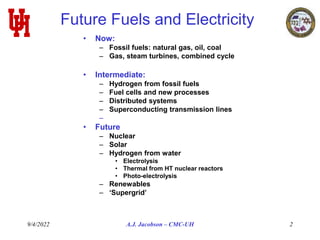
Future Fuels and Electricity
• Now:
– Fossil fuels: natural gas, oil, coal
– Gas, steam turbines, combined cycle
• Intermediate:
– Hydrogen from fossil fuels
– Fuel cells and new processes
– Distributed systems
– Superconducting transmission lines
–
• Future
– Nuclear
– Solar
– Hydrogen from water
• Electrolysis
• Thermal from HT nuclear reactors
• Photo-electrolysis
– Renewables
– ‘Supergrid’
9/4/2022 A.J. Jacobson – CMC-UH 3
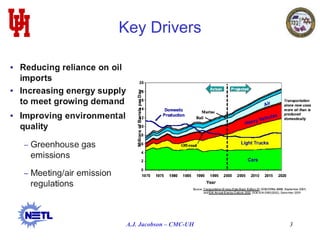
Key Drivers
9/4/2022 A.J. Jacobson – CMC-UH 4
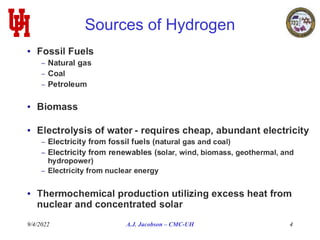
Sources of Hydrogen
9/4/2022 A.J. Jacobson – CMC-UH 5
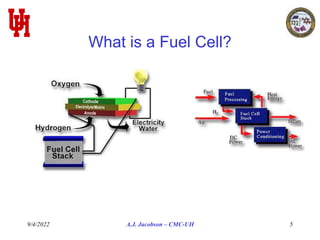
What is a Fuel Cell?
9/4/2022 A.J. Jacobson – CMC-UH 6
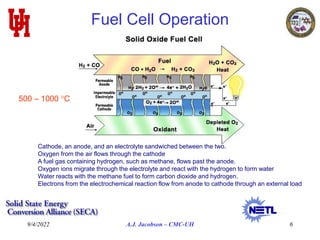
Fuel Cell Operation
electrolyte/membrane
porous cathode
Cathode, an anode, and an electrolyte sandwiched between the two.
Oxygen from the air flows through the cathode
A fuel gas containing hydrogen, such as methane, flows past the anode.
Oxygen ions migrate through the electrolyte and react with the hydrogen to form water
Water reacts with the methane fuel to form carbon dioxide and hydrogen.
Electrons from the electrochemical reaction flow from anode to cathode through an external load
500 – 1000 °C
9/4/2022 A.J. Jacobson – CMC-UH 7
Advantages of Fuel Cells
• High efficiency
• Modular
• Quiet
• Non Polluting - no NOx
• Distributed
• Combined heat and power
• Load flexible
9/4/2022 A.J. Jacobson – CMC-UH 8
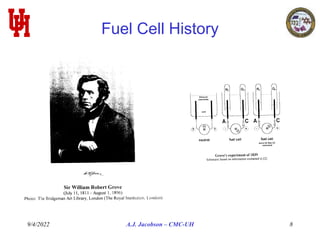
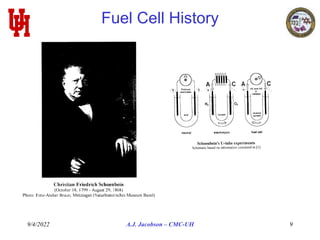
Fuel Cell History
9/4/2022 A.J. Jacobson – CMC-UH 9
Fuel Cell History
9/4/2022 A.J. Jacobson – CMC-UH 10
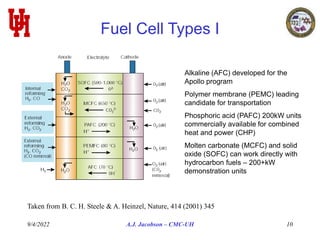
Fuel Cell Types I
Taken from B. C. H. Steele & A. Heinzel, Nature, 414 (2001) 345
Alkaline (AFC) developed for the
Apollo program
Polymer membrane (PEMC) leading
candidate for transportation
Phosphoric acid (PAFC) 200kW units
commercially available for combined
heat and power (CHP)
Molten carbonate (MCFC) and solid
oxide (SOFC) can work directly with
hydrocarbon fuels – 200+kW
demonstration units
9/4/2022 A.J. Jacobson – CMC-UH 11
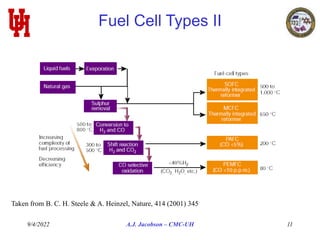
Fuel Cell Types II
Taken from B. C. H. Steele & A. Heinzel, Nature, 414 (2001) 345
9/4/2022 A.J. Jacobson – CMC-UH 12
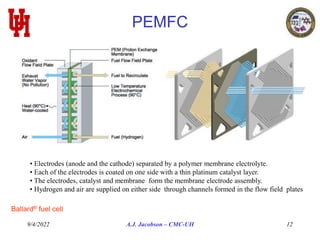
PEMFC
• Electrodes (anode and the cathode) separated by a polymer membrane electrolyte.
• Each of the electrodes is coated on one side with a thin platinum catalyst layer.
• The electrodes, catalyst and membrane form the membrane electrode assembly.
• Hydrogen and air are supplied on either side through channels formed in the flow field plates
Ballard® fuel cell
9/4/2022 A.J. Jacobson – CMC-UH 13
Advanced Fuel Cell Electrodes-PEM
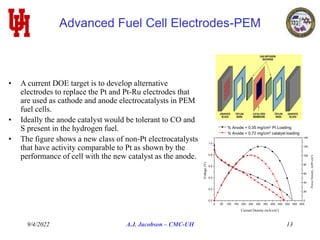
• A current DOE target is to develop alternative
electrodes to replace the Pt and Pt-Ru electrodes that
are used as cathode and anode electrocatalysts in PEM
fuel cells.
• Ideally the anode catalyst would be tolerant to CO and
S present in the hydrogen fuel.
• The figure shows a new class of non-Pt electrocatalysts
that have activity comparable to Pt as shown by the
performance of cell with the new catalyst as the anode.
% Anode = 0.35 mg/cm2 Pt Loading
% Anode = 0.72 mg/cm2 catalyst loading
0 50 100 150 200 250 300 350 400 450 500 550 600
0.0
0.2
0.4
0.6
0.8
1.0
Voltage
(V)
Current Density (mA/cm2)
0
20
40
60
80
100
120
140
Power
Density,
(mW/cm
2
)
9/4/2022 A.J. Jacobson – CMC-UH 14
SOFC
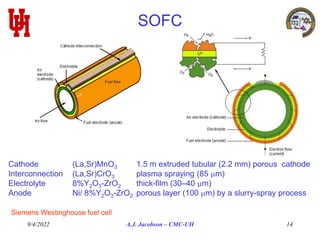
Cathode (La,Sr)MnO3 1.5 m extruded tubular (2.2 mm) porous cathode
Interconnection (La,Sr)CrO3 plasma spraying (85 m)
Electrolyte 8%Y2O3-ZrO2 thick-film (30–40 m)
Anode Ni/ 8%Y2O3-ZrO2 porous layer (100 m) by a slurry-spray process
Siemens Westinghouse fuel cell
9/4/2022 A.J. Jacobson – CMC-UH 15
9/4/2022 A.J. Jacobson – CMC-UH 16
9/4/2022 A.J. Jacobson – CMC-UH 17
9/4/2022 A.J. Jacobson – CMC-UH 18
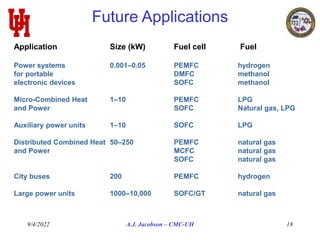
Future Applications
Application Size (kW) Fuel cell Fuel
Power systems 0.001–0.05 PEMFC hydrogen
for portable DMFC methanol
electronic devices SOFC methanol
Micro-Combined Heat 1–10 PEMFC LPG
and Power SOFC Natural gas, LPG
Auxiliary power units 1–10 SOFC LPG
Distributed Combined Heat 50–250 PEMFC natural gas
and Power MCFC natural gas
SOFC natural gas
City buses 200 PEMFC hydrogen
Large power units 1000–10,000 SOFC/GT natural gas
9/4/2022 A.J. Jacobson – CMC-UH 19
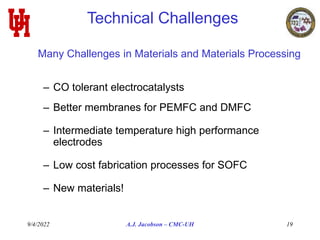
Technical Challenges
– CO tolerant electrocatalysts
– Better membranes for PEMFC and DMFC
– Intermediate temperature high performance
electrodes
– Low cost fabrication processes for SOFC
– New materials!
Many Challenges in Materials and Materials Processing
9/4/2022 A.J. Jacobson – CMC-UH 20
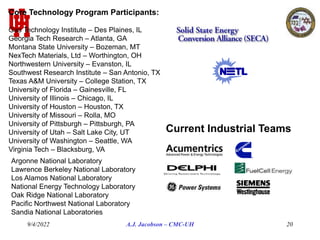
Core Technology Program Participants:
Gas Technology Institute – Des Plaines, IL
Georgia Tech Research – Atlanta, GA
Montana State University – Bozeman, MT
NexTech Materials, Ltd – Worthington, OH
Northwestern University – Evanston, IL
Southwest Research Institute – San Antonio, TX
Texas A&M University – College Station, TX
University of Florida – Gainesville, FL
University of Illinois – Chicago, IL
University of Houston – Houston, TX
University of Missouri – Rolla, MO
University of Pittsburgh – Pittsburgh, PA
University of Utah – Salt Lake City, UT
University of Washington – Seattle, WA
Virginia Tech – Blacksburg, VA
Argonne National Laboratory
Lawrence Berkeley National Laboratory
Los Alamos National Laboratory
National Energy Technology Laboratory
Oak Ridge National Laboratory
Pacific Northwest National Laboratory
Sandia National Laboratories
Current Industrial Teams
9/4/2022 A.J. Jacobson – CMC-UH 21
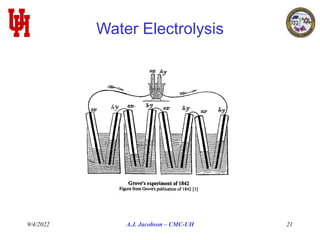
Water Electrolysis
9/4/2022 A.J. Jacobson – CMC-UH 22
Sources of Hydrogen
9/4/2022 A.J. Jacobson – CMC-UH 23
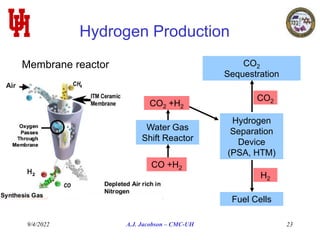
Water Gas
Shift Reactor
Fuel Cells
Hydrogen Production
CO2
Sequestration
Hydrogen
Separation
Device
(PSA, HTM)
CO2 +H2
CO2
H2
CO +H2
Membrane reactor

Allan Jacobson - ENERGY-Fuel Cell-2.ppt

  • 1.
    9/4/2022 A.J. Jacobson– CMC-UH 1 Alternative Energy Technologies: Fuel Cells Allan J. Jacobson Center for Materials Chemistry University of Houston
  • 2.
    9/4/2022 A.J. Jacobson– CMC-UH 2 Future Fuels and Electricity • Now: – Fossil fuels: natural gas, oil, coal – Gas, steam turbines, combined cycle • Intermediate: – Hydrogen from fossil fuels – Fuel cells and new processes – Distributed systems – Superconducting transmission lines – • Future – Nuclear – Solar – Hydrogen from water • Electrolysis • Thermal from HT nuclear reactors • Photo-electrolysis – Renewables – ‘Supergrid’
  • 3.
    9/4/2022 A.J. Jacobson– CMC-UH 3 Key Drivers
  • 4.
    9/4/2022 A.J. Jacobson– CMC-UH 4 Sources of Hydrogen
  • 5.
    9/4/2022 A.J. Jacobson– CMC-UH 5 What is a Fuel Cell?
  • 6.
    9/4/2022 A.J. Jacobson– CMC-UH 6 Fuel Cell Operation electrolyte/membrane porous cathode Cathode, an anode, and an electrolyte sandwiched between the two. Oxygen from the air flows through the cathode A fuel gas containing hydrogen, such as methane, flows past the anode. Oxygen ions migrate through the electrolyte and react with the hydrogen to form water Water reacts with the methane fuel to form carbon dioxide and hydrogen. Electrons from the electrochemical reaction flow from anode to cathode through an external load 500 – 1000 °C
  • 7.
    9/4/2022 A.J. Jacobson– CMC-UH 7 Advantages of Fuel Cells • High efficiency • Modular • Quiet • Non Polluting - no NOx • Distributed • Combined heat and power • Load flexible
  • 8.
    9/4/2022 A.J. Jacobson– CMC-UH 8 Fuel Cell History
  • 9.
    9/4/2022 A.J. Jacobson– CMC-UH 9 Fuel Cell History
  • 10.
    9/4/2022 A.J. Jacobson– CMC-UH 10 Fuel Cell Types I Taken from B. C. H. Steele & A. Heinzel, Nature, 414 (2001) 345 Alkaline (AFC) developed for the Apollo program Polymer membrane (PEMC) leading candidate for transportation Phosphoric acid (PAFC) 200kW units commercially available for combined heat and power (CHP) Molten carbonate (MCFC) and solid oxide (SOFC) can work directly with hydrocarbon fuels – 200+kW demonstration units
  • 11.
    9/4/2022 A.J. Jacobson– CMC-UH 11 Fuel Cell Types II Taken from B. C. H. Steele & A. Heinzel, Nature, 414 (2001) 345
  • 12.
    9/4/2022 A.J. Jacobson– CMC-UH 12 PEMFC • Electrodes (anode and the cathode) separated by a polymer membrane electrolyte. • Each of the electrodes is coated on one side with a thin platinum catalyst layer. • The electrodes, catalyst and membrane form the membrane electrode assembly. • Hydrogen and air are supplied on either side through channels formed in the flow field plates Ballard® fuel cell
  • 13.
    9/4/2022 A.J. Jacobson– CMC-UH 13 Advanced Fuel Cell Electrodes-PEM • A current DOE target is to develop alternative electrodes to replace the Pt and Pt-Ru electrodes that are used as cathode and anode electrocatalysts in PEM fuel cells. • Ideally the anode catalyst would be tolerant to CO and S present in the hydrogen fuel. • The figure shows a new class of non-Pt electrocatalysts that have activity comparable to Pt as shown by the performance of cell with the new catalyst as the anode. % Anode = 0.35 mg/cm2 Pt Loading % Anode = 0.72 mg/cm2 catalyst loading 0 50 100 150 200 250 300 350 400 450 500 550 600 0.0 0.2 0.4 0.6 0.8 1.0 Voltage (V) Current Density (mA/cm2) 0 20 40 60 80 100 120 140 Power Density, (mW/cm 2 )
  • 14.
    9/4/2022 A.J. Jacobson– CMC-UH 14 SOFC Cathode (La,Sr)MnO3 1.5 m extruded tubular (2.2 mm) porous cathode Interconnection (La,Sr)CrO3 plasma spraying (85 m) Electrolyte 8%Y2O3-ZrO2 thick-film (30–40 m) Anode Ni/ 8%Y2O3-ZrO2 porous layer (100 m) by a slurry-spray process Siemens Westinghouse fuel cell
  • 15.
  • 16.
  • 17.
  • 18.
    9/4/2022 A.J. Jacobson– CMC-UH 18 Future Applications Application Size (kW) Fuel cell Fuel Power systems 0.001–0.05 PEMFC hydrogen for portable DMFC methanol electronic devices SOFC methanol Micro-Combined Heat 1–10 PEMFC LPG and Power SOFC Natural gas, LPG Auxiliary power units 1–10 SOFC LPG Distributed Combined Heat 50–250 PEMFC natural gas and Power MCFC natural gas SOFC natural gas City buses 200 PEMFC hydrogen Large power units 1000–10,000 SOFC/GT natural gas
  • 19.
    9/4/2022 A.J. Jacobson– CMC-UH 19 Technical Challenges – CO tolerant electrocatalysts – Better membranes for PEMFC and DMFC – Intermediate temperature high performance electrodes – Low cost fabrication processes for SOFC – New materials! Many Challenges in Materials and Materials Processing
  • 20.
    9/4/2022 A.J. Jacobson– CMC-UH 20 Core Technology Program Participants: Gas Technology Institute – Des Plaines, IL Georgia Tech Research – Atlanta, GA Montana State University – Bozeman, MT NexTech Materials, Ltd – Worthington, OH Northwestern University – Evanston, IL Southwest Research Institute – San Antonio, TX Texas A&M University – College Station, TX University of Florida – Gainesville, FL University of Illinois – Chicago, IL University of Houston – Houston, TX University of Missouri – Rolla, MO University of Pittsburgh – Pittsburgh, PA University of Utah – Salt Lake City, UT University of Washington – Seattle, WA Virginia Tech – Blacksburg, VA Argonne National Laboratory Lawrence Berkeley National Laboratory Los Alamos National Laboratory National Energy Technology Laboratory Oak Ridge National Laboratory Pacific Northwest National Laboratory Sandia National Laboratories Current Industrial Teams
  • 21.
    9/4/2022 A.J. Jacobson– CMC-UH 21 Water Electrolysis
  • 22.
    9/4/2022 A.J. Jacobson– CMC-UH 22 Sources of Hydrogen
  • 23.
    9/4/2022 A.J. Jacobson– CMC-UH 23 Water Gas Shift Reactor Fuel Cells Hydrogen Production CO2 Sequestration Hydrogen Separation Device (PSA, HTM) CO2 +H2 CO2 H2 CO +H2 Membrane reactor