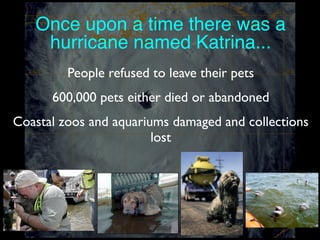
Once upon a time there was a
hurricane named Katrina...
People refused to leave their pets
600,000 pets either died or abandoned
Coastal zoos and aquariums damaged and collections
lost
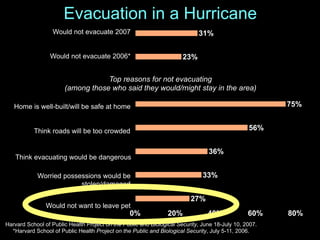
Evacuation in a Hurricane
Would not evacuate 2007
Would not evacuate 2006*

31%
23%

Top reasons for not evacuating
(among those who said they would/might stay in the area)
75%

Home is well-built/will be safe at home

56%

Think roads will be too crowded

36%

Think evacuating would be dangerous

33%

Worried possessions would be
stolen/damaged
Would not want to leave pet

0%

27%
20%

40%

60%

Harvard School of Public Health Project on the Public and Biological Security, June 18-July 10, 2007.
*Harvard School of Public Health Project on the Public and Biological Security, July 5-11, 2006.

80%
Evacuation in a Hurricane
Would not evacuate 2007
Would not evacuate 2006*

31%
23%

Top reasons for not evacuating
(among those who said they would/might stay in the area)
75%

Home is well-built/will be safe at home

56%

Think roads will be too crowded

36%

Think evacuating would be dangerous

33%

Worried possessions would be
stolen/damaged
Would not want to leave pet

0%

27%
20%

40%

60%

Harvard School of Public Health Project on the Public and Biological Security, June 18-July 10, 2007.
*Harvard School of Public Health Project on the Public and Biological Security, July 5-11, 2006.

80%
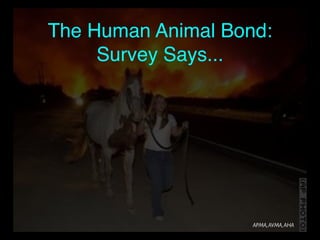
The Human Animal Bond:
Survey Says...

APMA, AVMA, AHA
The Human Animal Bond:
Survey Says...

46.9% Pet is FAMILY

APMA, AVMA, AHA
The Human Animal Bond:
Survey Says...

46.9% Pet is FAMILY
47% wont leave their pets
APMA, AVMA, AHA
Pre-Katrina recommendation:
Leave pets with three days of food and
water.
Pre-Katrina recommendation:
Leave pets with three days of food and
water.
Snowball, Katrina, and the PETS Act

The dog was taken away from this little boy, and to watch his
face was a singularly revealing and tragic experience. This
legislation was born at that moment.
-- Rep Tom Lantos (D-CA)
The PETS Act
Pets Evacuation and Transportation Standards Act

Support states
Disaster preparedness
Evacuation
Shelter plans
The PETS Act
Pets Evacuation and Transportation Standards Act

Support states
s
n

a pets
um ld
H preparednesss
o imal
Disaster
h n
e a
usEvacuation
o ice
H Shelter plans
v
r
e
S
All Creatures in Catastrophe
How Your Tax Dollars Go Towards Rescue and Shelter of
Wild and Captive Animals During an Emergency

Jeleen Briscoe, VMD, DABVP (Avian)
USDA APHIS Animal Care Program
Jereme Altendorf, CHHM
US Coast Guard National Strike Force
The Paradigm Shift
The General Life Cycle of an Issue

Politicians

Publicity
Exposure and
who is involved

Public
Media

Fringe

Phase

Interest
Scientists Groups
Academia

Emergence
Best opportunity to Save Resources

Time

Trigger
Event

Anticipatory

Crisis/Public
Positioning

Resolution

Crisis
Time

Courtesy of Don Butler

Source: Corporate Environmental Strategy, Autumn, 1997, Deborah
Anderson, Procter & Gamble
The Paradigm Shift
The General Life Cycle of an Issue

Politicians

Publicity
Exposure and
who is involved

Public
Media

Fringe

Phase

Interest
Scientists Groups
Academia

Emergence
Best opportunity to Save Resources

Time

Trigger
Event

Anticipatory

Crisis/Public
Positioning

Resolution

Crisis
Time

Courtesy of Don Butler

Source: Corporate Environmental Strategy, Autumn, 1997, Deborah
Anderson, Procter & Gamble
October 19, 2011
October 22, 2011

“No person shall by any means acquire a dangerous
exotic animal”
“Dangerous exotic animal means...large cat,
nonhuman primate, constricting snake, venomous
snake, any other animal designated by chief in
rules…”
The PETS Act
Pets Evacuation and Transportation Standards Act

Support states
s
n

a pets
um ld
H preparednesss
o imal
Disaster
h n
e a
usEvacuation
o ice
H Shelter plans
v
r
e
S
“Household Pet”
A domesticated pet, such as a dog, cat, bird, rabbit,
rodent, or turtle that is traditionally kept in the
home for pleasure rather than for commercial
purposes and can travel in commercial carriers and
be housed in temporary facilities. Household pets
do not include reptiles (with the exception of
turtles), amphibians, fish, insects/arachnids, farm
animals (including horses), and animals kept for
racing purposes.
State & Local Response
Veterinary Emergency Managers
Personnel overwhelmed
Resources dwindle
Prolonged response

HELP!
Other States
Emergency Management
Assistance Compact

Federal Government
Presidential Declaration (Stafford Act)

Federal Emergency Management
Association
National Response Framework
Nation’s approach to all-hazards response
Key response principles
Roles
Organizational structure
National Response
Framework

National Incident
Management System
National Incident Management System
Incident Command System
Unified Command
Participants
May Include:

Local Official(s)
State Official(s)
Federal Official(s)
Responsible Party Representative(s)

Information

Safety

Liaison

Operations

Planning

Logistics

Finance and Administration
National Response Framework
ESF #5 – Emergency
Management

Base Plan

ESF #10 – Oil and
Hazardous Materials
Response

ESF #4 - Firefighting

ESF # 9 –Search and Rescue
ESF #3 – Public Works and
Engineering
ESF #2 –
Telecommunications
ESF #1 - Transportation

Emergency Support
Function Annexes

ESF #8 – Public Health &
Medical Services
ESF #7 –Logistics
Management & Resource
Support
ESF #6 – Mass Care,
Housing & Human
Services

ESF #15 – External Affairs
ESF #14 – Long-Term
Community Recovery
ESF #13 – Public Safety and
Security
ESF #12 - Energy

ESF #11 –Agriculture and
Natural Resources

Emergency Support Functions
Cyber Incident

Food and Agriculture
Incident

Public Affairs

Tribal Relations

Biological Incident

Private-Sector Coordination
Financial Management
Worker Safety and Health

Support Annexes

Terrorism Incident Law
Enforcement and
Investigation

Volunteer and Donations
Management
International Coordination

Nuclear/Radiological
Incident
Catastrophic Incident

Critical Infrastructure and
Key Resources

Incident Annexes

Federal Response
Private-Sector and
Nongovernmental
State Response
Local Government
Response

Partner Guides
Emergency Support Functions
ESF#6: Mass care and emergency services including pets
ESF#8:Veterinary medical support
ESF#11: Safety and well-being of pets,
ensuring a coordinated Federal response
PETS Act and USDA
Animal Plant Health Inspection Service
Animal Care Emergency Programs

Two regional teams of veterinary personnel that
will:
Assist States with planning and preparedness
Staff ESF #11 position at Unified Incident
Command Post, and/or State desks
USDA-APHIS Organization
Secretary of Agriculture

Marketing and Regulatory
Programs

Agricultural Marketing Service

Animal and Plant Health
Inspection Service

Grain Inspection, Packers, and
Stockyards Administration

Biotechnology Regulatory
Services

International Services

Plant Protection and Quarantine

Veterinary Services

Wildlife Services

Animal Care
What Animal Care is NOT
Animal Care Mission

Animal Welfare Act
Horse Protection Act
Pets Mission Emergency Response
Animal Welfare Act
Federal law
Minimum standards
Care and treatment
Covered animals
Horse Protection Act
• Prohibits owners and trainers from showing,
exhibiting, or selling sored horses.
• Prohibits drivers from transporting sored horses
to compete in shows
Emergency Response for Pets
What are the four phases of
emergency management?
Preparedness
Response
Recovery
Mitigation
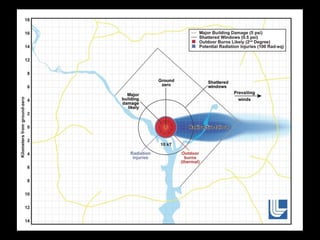
Brooke Buddemeier, Lawrence Livermore National Laboratory
LA County Public Health Conference 2010
Brooke Buddemeier, Lawrence Livermore National Laboratory
LA County Public Health Conference 2010
On average:
0.67 pets per person in
the typical U.S.
community
25,000 people
16,750 pets
25,000 people
16,750 pets

145,000 people
97,150 pets
25,000 people
16,750 pets

145,000 people
97,150 pets
850,000 people
569,500 pets
25,000 people
16,750 pets

145,000 people
97,150 pets
300,000 people
201,000 pets

850,000 people
569,500 pets
The
Future

The Past
APHIS Animal Care and Preparedness
Federal partnerships
National Alliance of State Animal and Agricultural Emergency
Programs Collaboration (NASAAEP): Best Practices Working
Groups
National Animal Rescue and Shelter Coalition
Association of Zoos and Aquariums
Contingency Plan Docket
PETS Multi-Agency Coordination
Federal Partnerships
Federal Animal Emergency Working Group
FEMA
– Statutory authority (Stafford Act)
– Resources
USDA / APHIS / Animal Care
– Federal government’s subject matter experts on animal
welfare
– Staff of veterinarians and VHT’s
– Program Response Team
Department of Interior (USFWS)
HHS – Veterinary Resources (NVRT, VMRC)
AWA Contingency Plans: Four Criteria
WHEN?
Identify situations that would trigger a contingency plan
WHAT?
Outline specific tasks required in emergencies
WHO?
Identify a chain of command
HOW?
Address response and recover in terms of materials, resources
and training
NASAAEP BPWG Collaboration
National Alliance of State Animal and Agriculture Emergency Programs
Best Practice Working Groups

Animal Search & Rescue
Evacuation & Transportation
Emergency Animal Sheltering
Disaster Veterinary Care
Animal Decontamination
Planning & Resource Management
Preparedness & Community Outreach
Training
AI and Public Health
41
USDA Zoo Animal Health Network AI
Surveillance Project

• Lincoln Park Zoo, Chicago --> UMN
• Cleveland Metroparks Zoo --> Cornell
• Sacramento Zoo --> UC Davis
ZBPWG Contingency Guide
Roadmap
State vs federal emergency response
Involve local stakeholders
Risk assessment
Flexible and scalable
Cross training and role definition
http://www.zooanimalhealthnetwork.org/ZooBest.aspx
National Animal Rescue and Shelter
Coalition
American Humane Association
ASPCA
Best Friends Animal Society
Code 3 Associations
International Fund for Animal Welfare
National Animal Control Association
RedRover (UAN)
Associate: AVMA
Affiliates: Society of Animal Welfare Administrators, American
Red Cross, NASAAEP, PetFinder.com Foundation, American
Veterinary Medical Foundation
Pets Multi-Agency
Coordination Unit

APHIS Emergency Operations Center
The Paradigm Shift
The General Life Cycle of an Issue

Politicians

Publicity
Exposure and
who is involved

Public
Media

Fringe

Phase

Interest
Scientists Groups
Academia

Emergence
Best opportunity to Save Resources

Time

Trigger
Event

Anticipatory

Crisis/Public
Positioning

Resolution

Crisis
Time

Courtesy of Don Butler

Source: Corporate Environmental Strategy, Autumn, 1997, Deborah
Anderson, Procter & Gamble
The Paradigm Shift
The General Life Cycle of an Issue

Politicians

Publicity
Exposure and
who is involved

Public
Media

Fringe

Phase

Interest
Scientists Groups
Academia

Emergence
Best opportunity to Save Resources

Time

Trigger
Event

Anticipatory

Crisis/Public
Positioning

Resolution

Crisis
Time

Courtesy of Don Butler

Source: Corporate Environmental Strategy, Autumn, 1997, Deborah
Anderson, Procter & Gamble
National
Response
Framework

National
Response
system
National
Response
Framework

Emergency Support Functions
Presidential Declaration
required
THE GOVERNMENT PAYS

National
Response
system

Clean Water Act
Superfund
No Presidential Declaration
required
THE COMPANY PAYS
The National Response System
Local, regional, and national
Oil and hazardous materials
emergencies
The National Response System
National Response Framework
ESF #5 – Emergency
Management

Base Plan

ESF #10 – Oil and
Hazardous Materials
Response

ESF #4 - Firefighting

ESF # 9 –Search and Rescue
ESF #3 – Public Works and
Engineering
ESF #2 –
Telecommunications
ESF #1 - Transportation

Emergency Support
Function Annexes

ESF #8 – Public Health &
Medical Services
ESF #7 –Logistics
Management & Resource
Support
ESF #6 – Mass Care,
Housing & Human Services

ESF #15 – External Affairs
ESF #14 – Long-Term
Community Recovery
ESF #13 – Public Safety and
Security
ESF #12 - Energy

ESF #11 –Agriculture and
Natural Resources

Emergency Support Functions
Cyber Incident

Food and Agriculture
Incident

Public Affairs

Tribal Relations

Biological Incident

Private-Sector Coordination
Financial Management
Worker Safety and Health

Support Annexes

Terrorism Incident Law
Enforcement and
Investigation

Volunteer and Donations
Management
International Coordination

Nuclear/Radiological
Incident
Catastrophic Incident

Critical Infrastructure and
Key Resources

Incident Annexes

Federal Response
Private-Sector and
Nongovernmental
State Response
Local Government
Response

Partner Guides
National Response Framework
Notification and Decisions

Natural Resource
Trustees
Natural Resource
Trustees

Restore natural resources and services
Scientific natural resource damage assessments
Engage responsible parties: regulation, settlement, or
litigation
Natural Resource
Trustees

Restore natural resources and services
Scientific natural resource damage assessments
Engage responsible parties: regulation, settlement, or
litigation
UC Davis Wildlife Health Center

Readiness
Response
Research
Reaching Out
www.owcn.org
Tri-State Bird Rescue & Research
Rehabilitation of injured, orphaned, and oiled
native wild birds
Goal: healthy birds to their natural environment
Compassionate care, humane research, and
education
www.tristatebird.org
Conclusion
All emergencies start locally
Federal emergency disaster response: FEMA
Federal hazardous & oil emergencies: EPA and USCG
Partnerships and mutual understanding
Pets mission & protection of natural resources
Conclusion
All emergencies start locally

e
g
a USCG
l and
il
Federal hazardous & oil emergencies: EPA
v
a understanding
s mutual
Partnerships and
e
k
a
t & protection of natural resources
t
IPets mission
Federal emergency disaster response: FEMA
Conclusion
All emergencies start locally

e
g
a USCG
l and
il ns
Federal hazardous & oil emergencies: EPA
v ria
a ina
s mutual understanding
Partnerships and
e eter
k DV
a AN
t … & protection of natural resources
t
IPets mission
Federal emergency disaster response: FEMA

All Creatures in Catastrophe

  • 1.
    Once upon atime there was a hurricane named Katrina... People refused to leave their pets 600,000 pets either died or abandoned Coastal zoos and aquariums damaged and collections lost
  • 2.
    Evacuation in aHurricane Would not evacuate 2007 Would not evacuate 2006* 31% 23% Top reasons for not evacuating (among those who said they would/might stay in the area) 75% Home is well-built/will be safe at home 56% Think roads will be too crowded 36% Think evacuating would be dangerous 33% Worried possessions would be stolen/damaged Would not want to leave pet 0% 27% 20% 40% 60% Harvard School of Public Health Project on the Public and Biological Security, June 18-July 10, 2007. *Harvard School of Public Health Project on the Public and Biological Security, July 5-11, 2006. 80%
  • 3.
    Evacuation in aHurricane Would not evacuate 2007 Would not evacuate 2006* 31% 23% Top reasons for not evacuating (among those who said they would/might stay in the area) 75% Home is well-built/will be safe at home 56% Think roads will be too crowded 36% Think evacuating would be dangerous 33% Worried possessions would be stolen/damaged Would not want to leave pet 0% 27% 20% 40% 60% Harvard School of Public Health Project on the Public and Biological Security, June 18-July 10, 2007. *Harvard School of Public Health Project on the Public and Biological Security, July 5-11, 2006. 80%
  • 4.
    The Human AnimalBond: Survey Says... APMA, AVMA, AHA
  • 5.
    The Human AnimalBond: Survey Says... 46.9% Pet is FAMILY APMA, AVMA, AHA
  • 6.
    The Human AnimalBond: Survey Says... 46.9% Pet is FAMILY 47% wont leave their pets APMA, AVMA, AHA
  • 7.
    Pre-Katrina recommendation: Leave petswith three days of food and water.
  • 8.
    Pre-Katrina recommendation: Leave petswith three days of food and water.
  • 9.
    Snowball, Katrina, andthe PETS Act The dog was taken away from this little boy, and to watch his face was a singularly revealing and tragic experience. This legislation was born at that moment. -- Rep Tom Lantos (D-CA)
  • 10.
    The PETS Act PetsEvacuation and Transportation Standards Act Support states Disaster preparedness Evacuation Shelter plans
  • 11.
    The PETS Act PetsEvacuation and Transportation Standards Act Support states s n a pets um ld H preparednesss o imal Disaster h n e a usEvacuation o ice H Shelter plans v r e S
  • 12.
    All Creatures inCatastrophe How Your Tax Dollars Go Towards Rescue and Shelter of Wild and Captive Animals During an Emergency Jeleen Briscoe, VMD, DABVP (Avian) USDA APHIS Animal Care Program Jereme Altendorf, CHHM US Coast Guard National Strike Force
  • 13.
    The Paradigm Shift TheGeneral Life Cycle of an Issue Politicians Publicity Exposure and who is involved Public Media Fringe Phase Interest Scientists Groups Academia Emergence Best opportunity to Save Resources Time Trigger Event Anticipatory Crisis/Public Positioning Resolution Crisis Time Courtesy of Don Butler Source: Corporate Environmental Strategy, Autumn, 1997, Deborah Anderson, Procter & Gamble
  • 14.
    The Paradigm Shift TheGeneral Life Cycle of an Issue Politicians Publicity Exposure and who is involved Public Media Fringe Phase Interest Scientists Groups Academia Emergence Best opportunity to Save Resources Time Trigger Event Anticipatory Crisis/Public Positioning Resolution Crisis Time Courtesy of Don Butler Source: Corporate Environmental Strategy, Autumn, 1997, Deborah Anderson, Procter & Gamble
  • 16.
  • 17.
    October 22, 2011 “Noperson shall by any means acquire a dangerous exotic animal” “Dangerous exotic animal means...large cat, nonhuman primate, constricting snake, venomous snake, any other animal designated by chief in rules…”
  • 18.
    The PETS Act PetsEvacuation and Transportation Standards Act Support states s n a pets um ld H preparednesss o imal Disaster h n e a usEvacuation o ice H Shelter plans v r e S
  • 19.
    “Household Pet” A domesticatedpet, such as a dog, cat, bird, rabbit, rodent, or turtle that is traditionally kept in the home for pleasure rather than for commercial purposes and can travel in commercial carriers and be housed in temporary facilities. Household pets do not include reptiles (with the exception of turtles), amphibians, fish, insects/arachnids, farm animals (including horses), and animals kept for racing purposes.
  • 20.
    State & LocalResponse Veterinary Emergency Managers Personnel overwhelmed Resources dwindle Prolonged response HELP! Other States Emergency Management Assistance Compact Federal Government Presidential Declaration (Stafford Act) Federal Emergency Management Association
  • 21.
    National Response Framework Nation’sapproach to all-hazards response Key response principles Roles Organizational structure
  • 22.
  • 23.
    National Incident ManagementSystem Incident Command System Unified Command Participants May Include: Local Official(s) State Official(s) Federal Official(s) Responsible Party Representative(s) Information Safety Liaison Operations Planning Logistics Finance and Administration
  • 27.
    National Response Framework ESF#5 – Emergency Management Base Plan ESF #10 – Oil and Hazardous Materials Response ESF #4 - Firefighting ESF # 9 –Search and Rescue ESF #3 – Public Works and Engineering ESF #2 – Telecommunications ESF #1 - Transportation Emergency Support Function Annexes ESF #8 – Public Health & Medical Services ESF #7 –Logistics Management & Resource Support ESF #6 – Mass Care, Housing & Human Services ESF #15 – External Affairs ESF #14 – Long-Term Community Recovery ESF #13 – Public Safety and Security ESF #12 - Energy ESF #11 –Agriculture and Natural Resources Emergency Support Functions Cyber Incident Food and Agriculture Incident Public Affairs Tribal Relations Biological Incident Private-Sector Coordination Financial Management Worker Safety and Health Support Annexes Terrorism Incident Law Enforcement and Investigation Volunteer and Donations Management International Coordination Nuclear/Radiological Incident Catastrophic Incident Critical Infrastructure and Key Resources Incident Annexes Federal Response Private-Sector and Nongovernmental State Response Local Government Response Partner Guides
  • 28.
    Emergency Support Functions ESF#6:Mass care and emergency services including pets ESF#8:Veterinary medical support ESF#11: Safety and well-being of pets, ensuring a coordinated Federal response
  • 29.
    PETS Act andUSDA Animal Plant Health Inspection Service Animal Care Emergency Programs Two regional teams of veterinary personnel that will: Assist States with planning and preparedness Staff ESF #11 position at Unified Incident Command Post, and/or State desks
  • 30.
    USDA-APHIS Organization Secretary ofAgriculture Marketing and Regulatory Programs Agricultural Marketing Service Animal and Plant Health Inspection Service Grain Inspection, Packers, and Stockyards Administration Biotechnology Regulatory Services International Services Plant Protection and Quarantine Veterinary Services Wildlife Services Animal Care
  • 31.
  • 32.
  • 33.
  • 34.
  • 35.
  • 36.
    Animal Care Mission AnimalWelfare Act Horse Protection Act Pets Mission Emergency Response
  • 37.
    Animal Welfare Act Federallaw Minimum standards Care and treatment Covered animals
  • 38.
    Horse Protection Act •Prohibits owners and trainers from showing, exhibiting, or selling sored horses. • Prohibits drivers from transporting sored horses to compete in shows
  • 39.
  • 40.
    What are thefour phases of emergency management?
  • 41.
  • 42.
    Brooke Buddemeier, LawrenceLivermore National Laboratory LA County Public Health Conference 2010
  • 43.
    Brooke Buddemeier, LawrenceLivermore National Laboratory LA County Public Health Conference 2010
  • 44.
    On average: 0.67 petsper person in the typical U.S. community
  • 46.
  • 47.
  • 48.
    25,000 people 16,750 pets 145,000people 97,150 pets 850,000 people 569,500 pets
  • 49.
    25,000 people 16,750 pets 145,000people 97,150 pets 300,000 people 201,000 pets 850,000 people 569,500 pets
  • 50.
  • 51.
    APHIS Animal Careand Preparedness Federal partnerships National Alliance of State Animal and Agricultural Emergency Programs Collaboration (NASAAEP): Best Practices Working Groups National Animal Rescue and Shelter Coalition Association of Zoos and Aquariums Contingency Plan Docket PETS Multi-Agency Coordination
  • 52.
    Federal Partnerships Federal AnimalEmergency Working Group FEMA – Statutory authority (Stafford Act) – Resources USDA / APHIS / Animal Care – Federal government’s subject matter experts on animal welfare – Staff of veterinarians and VHT’s – Program Response Team Department of Interior (USFWS) HHS – Veterinary Resources (NVRT, VMRC)
  • 53.
    AWA Contingency Plans:Four Criteria WHEN? Identify situations that would trigger a contingency plan WHAT? Outline specific tasks required in emergencies WHO? Identify a chain of command HOW? Address response and recover in terms of materials, resources and training
  • 54.
    NASAAEP BPWG Collaboration NationalAlliance of State Animal and Agriculture Emergency Programs Best Practice Working Groups Animal Search & Rescue Evacuation & Transportation Emergency Animal Sheltering Disaster Veterinary Care Animal Decontamination Planning & Resource Management Preparedness & Community Outreach Training
  • 56.
  • 57.
  • 58.
    USDA Zoo AnimalHealth Network AI Surveillance Project • Lincoln Park Zoo, Chicago --> UMN • Cleveland Metroparks Zoo --> Cornell • Sacramento Zoo --> UC Davis
  • 59.
    ZBPWG Contingency Guide Roadmap Statevs federal emergency response Involve local stakeholders Risk assessment Flexible and scalable Cross training and role definition http://www.zooanimalhealthnetwork.org/ZooBest.aspx
  • 60.
    National Animal Rescueand Shelter Coalition American Humane Association ASPCA Best Friends Animal Society Code 3 Associations International Fund for Animal Welfare National Animal Control Association RedRover (UAN) Associate: AVMA Affiliates: Society of Animal Welfare Administrators, American Red Cross, NASAAEP, PetFinder.com Foundation, American Veterinary Medical Foundation
  • 61.
    Pets Multi-Agency Coordination Unit APHISEmergency Operations Center
  • 65.
    The Paradigm Shift TheGeneral Life Cycle of an Issue Politicians Publicity Exposure and who is involved Public Media Fringe Phase Interest Scientists Groups Academia Emergence Best opportunity to Save Resources Time Trigger Event Anticipatory Crisis/Public Positioning Resolution Crisis Time Courtesy of Don Butler Source: Corporate Environmental Strategy, Autumn, 1997, Deborah Anderson, Procter & Gamble
  • 66.
    The Paradigm Shift TheGeneral Life Cycle of an Issue Politicians Publicity Exposure and who is involved Public Media Fringe Phase Interest Scientists Groups Academia Emergence Best opportunity to Save Resources Time Trigger Event Anticipatory Crisis/Public Positioning Resolution Crisis Time Courtesy of Don Butler Source: Corporate Environmental Strategy, Autumn, 1997, Deborah Anderson, Procter & Gamble
  • 70.
  • 71.
    National Response Framework Emergency Support Functions PresidentialDeclaration required THE GOVERNMENT PAYS National Response system Clean Water Act Superfund No Presidential Declaration required THE COMPANY PAYS
  • 72.
    The National ResponseSystem Local, regional, and national Oil and hazardous materials emergencies
  • 73.
  • 74.
    National Response Framework ESF#5 – Emergency Management Base Plan ESF #10 – Oil and Hazardous Materials Response ESF #4 - Firefighting ESF # 9 –Search and Rescue ESF #3 – Public Works and Engineering ESF #2 – Telecommunications ESF #1 - Transportation Emergency Support Function Annexes ESF #8 – Public Health & Medical Services ESF #7 –Logistics Management & Resource Support ESF #6 – Mass Care, Housing & Human Services ESF #15 – External Affairs ESF #14 – Long-Term Community Recovery ESF #13 – Public Safety and Security ESF #12 - Energy ESF #11 –Agriculture and Natural Resources Emergency Support Functions Cyber Incident Food and Agriculture Incident Public Affairs Tribal Relations Biological Incident Private-Sector Coordination Financial Management Worker Safety and Health Support Annexes Terrorism Incident Law Enforcement and Investigation Volunteer and Donations Management International Coordination Nuclear/Radiological Incident Catastrophic Incident Critical Infrastructure and Key Resources Incident Annexes Federal Response Private-Sector and Nongovernmental State Response Local Government Response Partner Guides
  • 75.
    National Response Framework Notificationand Decisions Natural Resource Trustees
  • 76.
    Natural Resource Trustees Restore naturalresources and services Scientific natural resource damage assessments Engage responsible parties: regulation, settlement, or litigation
  • 77.
    Natural Resource Trustees Restore naturalresources and services Scientific natural resource damage assessments Engage responsible parties: regulation, settlement, or litigation
  • 78.
    UC Davis WildlifeHealth Center Readiness Response Research Reaching Out www.owcn.org
  • 79.
    Tri-State Bird Rescue& Research Rehabilitation of injured, orphaned, and oiled native wild birds Goal: healthy birds to their natural environment Compassionate care, humane research, and education www.tristatebird.org
  • 80.
    Conclusion All emergencies startlocally Federal emergency disaster response: FEMA Federal hazardous & oil emergencies: EPA and USCG Partnerships and mutual understanding Pets mission & protection of natural resources
  • 81.
    Conclusion All emergencies startlocally e g a USCG l and il Federal hazardous & oil emergencies: EPA v a understanding s mutual Partnerships and e k a t & protection of natural resources t IPets mission Federal emergency disaster response: FEMA
  • 82.
    Conclusion All emergencies startlocally e g a USCG l and il ns Federal hazardous & oil emergencies: EPA v ria a ina s mutual understanding Partnerships and e eter k DV a AN t … & protection of natural resources t IPets mission Federal emergency disaster response: FEMA