The training of Trainers
Analyzing midterm educational outcomes


 Umberto Margiotta – Juliana Raffaghelli
IL can be a twofold purpose
  process, that improve
  dialogue among
  generations through civic
  participation in common
  social and institutional
  spaces,
while at the same time enacts
  processes of informal
  learning towards the
  achievement, both by adults
  and children, of key
  competences for lifelong
  learning
   European and non-European cultural heritage:
    ◦ art (music/paintings/theatre);
    ◦ elder people stories;
    ◦ children's literature;
   Social media to promote sharing of learning
    results -digitalization of contents created above-
   Games, according to children ages, to stimulate
    problem solving, creativity, entrepreneurship.
1.        Train adults' trainers to understand and implement
          ALICE’s approach.
2.        Trainers will implement ALICE’s approach through an
          informal education environment. Different adults could be
          engaged: partners, senior citizen, teachers, volunteers.
3.         Testing phase where adults will use creative languages
          with children. The phase is accomplished with
          participatory evaluation (as adults and trainers reflection
          process) on impact on intergenerational dialogue.

     The project will also implement a strategy of communication to
      raise awareness among international scientific community, as
      well as local policy makers and adults’ education providers on
      ALICE’s strategy and impact, for further adoption of the model
   Adults’ trainers must be able of understanding the
    value of informal learning situations, developing skills
    to promote events with strategic impact on key
    competences.
   It is not enough to promote cultural events:
    trainers, as scaffolders of generational dialogue are
    called to be aware of the educational impacts of their
    informal activities as a way to engage adults that are
    normally far from formal (University, Further
    training) and/or non-formal (training on the job) in
    lifelong learning trajectories
Training of Trainers for implementing A.L.I.C.E. Pedagogical Innovation
                   (Adults Learning for Intergenerational Creative Experiences )


                                        Unit 2                                 Unit 4                         Unit 6
                  • A ZPD for IL                    • CL2: Digital                      • C4L: Games
                                   • CL1: Music      Storytelling         •CL3:                          •CL: Learning
                                    and skills to                          Children’s                     Design
                                    listen                                 Literature
                       Unit 1                            Unit 3                             Unit 5

•National Awareness
 Sessions                                                                                               •National Closing TT
•The value of IL                                                 Local                                  •Strategies for Piloting
                                                               Coaching
Every partner -                                                                                                          Every partner -
      FTF                                                                                                                      FTF


                                                                                                        Unit 7: Project Work
                                                                                                                 (AL Design)
                                                                                                       Pilot Implementation
                                                                                                             European Value
   How can we say that something is good if we do not
    adopt a set of instruments, based on our own
    pedagogical values?

   Two important dimensions of evaluation:

    ◦ Learners Satisfaction
    ◦ Learning Effectiveness (intended in terms of teachers’
      evaluation, like quizzes, assignments, participation; and in terms
      of self-assessment and reflection)
Learners’ Satisfaction
                                  A training framework: ILEP
                                           (Margiotta, 2006)
                                      (information, laboratory
                                  , assessment, personalizati
  Personalization   Information                            on)

                                      We use this approach
                                      during eLearning
                                      activities.
                                      The Educational
                                      Environment and the
                                      training activities are
                                      organized accordingly…

   Assessment          Lab            Quality assessment
                                      require feed-back on
                                      the framework efficacy
What’s ILAP ? (Margiotta, 2006)

• ILAP is an instrumental framework that aims to support effective
learning.
• The ILAP framework is composed by four phases where the learner is engaged
in different activities. These are supposed to promote specific learning
outcomes and hence shape specific competences
• The four phases are:

    INFORMATION: See, Listen, Read, Explore
    LAB: Discuss, Reflect, Try, Do
    ASSESSMENT: Check your knowledge and skills
    PERSONALIZATION: Make your learning useful for your
    personal/professional purposes
60


50


40


30
                                                                                                    IC

                                                                                                    IA
20
                                                                                                    II

10


 0

     SD   D   RD NDA RA   A   SA   SD   D   RD NDA RA   A   SA   SD   D   RD NDA RA       A   SA


                 LU1                           LU2                            LU3

                                                        IC: Information Clearness
                                                        IA: Information Appropriateness
                                                        II: Information Interest
                                                        SD: Strongly Disagree – D: Disagree – RD:
                                                        Rather Disagree – NDA: Neither Disagree
                                                        or agree – RA: rather agree – A: agree –
                                                        SA: Strongly Agree
70


60


50


40

                                                                                                    LC
30
                                                                                                    LA

                                                                                                    LI
20


10


 0

     SD   D   RD NDA RA   A   SA   SD   D   RD NDA RA    A   SA   SD   D   RD NDA RA   A   SA


                 LU1                           LU2                            LU3

                                                        LC: Lab Clearness
                                                        LA: Lab Appropriateness
                                                        LI: Lab Interest
                                                        SD: Strongly Disagree – D: Disagree – RD:
                                                        Rather Disagree – NDA: Neither Disagree
                                                        or agree – RA: rather agree – A: agree –
                                                        SA: Strongly Agree
60


50


40


30
                                                                                                APC

                                                                                                APA
20
                                                                                                API

10


 0

     SD   D   RD NDA RA   A   SA SD   D   RD NDA RA   A     SA SD   D   RD NDA RA    A   SA


                 LU1                         LU2                            LU3

                                                          APC: Assessment &Personalization Clearness
                                                          APA: Assessment &Personalization
                                                          Appropriateness
                                                          API: Assessment &Personalization Interest

                                                          SD: Strongly Disagree – D: Disagree – RD:
                                                          Rather Disagree – NDA: Neither Disagree
                                                          or agree – RA: rather agree – A: agree –
                                                          SA: Strongly Agree
   In general the resources provided are clear and well
    structured: participants showed more disagreements
    regarding the LU1 (more theoretical) and enjoyed
    most activities on Creative Languages (LU2 and LU3)
   The people that showed disagreement probably
    retired from the course (28 respondents for LU1, 24
    for LU2, 16 LU3; less participation in the last case can
    be due to the fact that there is people that is still
    completing their assignments)
   Resources are appropriated in terms of examples for
    practice
   Resources are interesting in terms of innovative
    content for the trainers
   The Lab activities allow trainers to work on concepts;
    it is more difficult to work on specific skills that
    regard CL, but the labs are a good “a taste” of them
   Assessment is based on self-analysis of
    knowledge and competences achieved
   The model seems to be clear, appropriate and
    interesting
   Regarding personalization, the results of it
    (Trainers’ log) should become the base of the
    production (Learning Design and further Adults
    Learning Pilot Programmes)
   Some trainers are collecting their impressions
    and best works on social media / internal blogs
   This last trend is expected to grow as part of
    dissemination of activities
   Every Education Coordinator has defined, for the
    own coordinated Learning Unit , key knowledges
    and skills relating to a competence.
   The threshold of mastery is as follows:
    ◦ Being Informed: “I generally know about”
    ◦ Being Prepared: “I know and understand in some detail”
    ◦ Being Ready: “I know and understand and I feel ready to
     pass to action”
    ◦ Being Creative: “Not only I could pass to action: I could
     make an original proposal”
   The more the participant becomes
    competent, the more she/he will be able of
    adopting the project’s approach.
   LU1: Adults as Educators
Umberto Margiotta, Juliana Raffaghelli, Elena
 Zambianchi, Barbara Baschiera
    A. Knowledge about the policy context and
       the project’s strategies
    B. Knowledge about the importance of
       reflexive parenting
    C. Knowledge of main tools to generate ILE
       (intergenerational Learning
       Environtments)
   LU1: Adults as Educators
                   (4) 44%                  C        (2) 44%
      A            Creative                          Creative

                                                     (3) 16%
(3) 20%                        (1) 24%
                                                     Prepared
Ready               (1) 16%    Ready
                    Informed                        (4) 16%
(2) 20%
                                                    Informed
Prepared
                           B
                                         (4) 32%
               (3) 28%                   Creative
               Ready
                                         (1) 12%
                                         Informed
                (2) 28%
                Prepared
    LU1: Adults as Educators

                                                 Course Content Interactions


          C
                                                 eTutor Interactions


                                                 Peers' Interactions
    LU1


          B
                                                 Activities outside the course


                                                 Personal previous experience


          A
                                                 Personal relationships


                                                Personal information and activities
              0%   20%   40%   60%   80%   100% during the course
   LU2: Creative Language MUSIC
Teresa dello Monaco, Evangelos Himonides
    A. Knowledge about the value of music as
       creative language in adult-child interplay
    B. Knowledge about Singing as strategy for
       learning
    C. Knowledge of main tools to generate
       educational experiences with and
       through the music
   LU2: Creative Language MUSIC
                   (4) 42%                   C     (2) 29%
          A        Creative                        Prepared

                   (1) 8%     (3) 42%              (1) 13%
(3) 29%            Informed   Ready                Informed
Ready
                   (2) 21%                         (4) 17%
                   Prepared                        Creative
                              B         (4) 25%
               (3) 17%                  Creative
               Ready
                                        (1) 8%
                                        Informed
                (2) 50%
                Prepared
   LU2: Music as Creative Language
                                                    Course Content Interactions


            C
                                                    eTutor Interactions


                                                    Peers' Interactions
      LU2


            B
                                                    Activities outside the course


                                                    Personal previous experience


            A
                                                    Personal relationships


                                                    Personal information and activities
                0%   20%   40%   60%   80%   100%   during the course
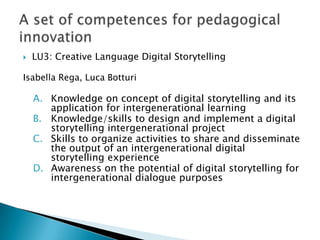
   LU3: Creative Language Digital Storytelling

Isabella Rega, Luca Botturi

    A. Knowledge on concept of digital storytelling and its
       application for intergenerational learning
    B. Knowledge/skills to design and implement a digital
       storytelling intergenerational project
    C. Skills to organize activities to share and disseminate
       the output of an intergenerational digital
       storytelling experience
    D. Awareness on the potential of digital storytelling for
       intergenerational dialogue purposes
   LU3: Creative Language Digital Storytelling
                  (4) 38%                  C      (2) 31%
        A         Creative      (3) 6%            Prepared
                  (1) 6%        Ready
                  Informed
 (3) 50%                        (4) 38%
                 (2) 6%
 Ready                          Creative            (1) 25%
                 Prepared
                                                    Informed
            B                                   (2) 38%
                    (4) 31%
                                                Ready
(3) Ready           Creative
31%                (1) 6%      (2) 38%          (1) 19%
                   Informed    Creative         Informed
                   (2) 31%                     (2) 6%
                                           D   Prepared
                   Prepared
   LU3: Digital Storytelling as Creative Language

          D                                       Course Content Interactions


                                                  eTutor Interactions


          C
                                                  Peers' Interactions
    LU3


                                                  Activities outside the course


          B
                                                  Personal previous experience


                                                  Personal relationships

          A
                                                  Personal information and activities
                                                  during the course


              0%   20%   40%   60%   80%   100%
   Reflecting about results

    1. There’s a good balance towards the achievement of
       technical competences to operate in the field
    2. It depends, in a good measure (across LU1, LU2 and
       LU3, more than 60%), from course contents
       interaction, and from the interactions with eTutors
       and peers in a second place.
    3. Skills need to be improved, regarding the CL that
       the trainer will select for the own project work.
    4. Probably support provided by local coachers, and
       tight connection with CL experts will be necessary
       in the design and implementation of ALPP
    5. More exchanges (both local and transnational) with
       peers will be helpful to spark ideas and creativity.
   Reflecting about results

    1. The results indicate that the participants are
       deepening on areas of knowledge that
       could have influence in their pedagogical
       practices.
    2. All trainers currently engaged are not only
       reflecting but producing draft resources
       that can become a consistent piece of their
       future plans of action in the field.
    3. The programme is intensive and the good
       levels of qualified participation allow to
       consider that motivation is high.
We hope you are enjoying this learning
                       experience!!!!

Alice midterm-educational-impact

  • 1.
    The training ofTrainers Analyzing midterm educational outcomes Umberto Margiotta – Juliana Raffaghelli
  • 2.
    IL can bea twofold purpose process, that improve dialogue among generations through civic participation in common social and institutional spaces, while at the same time enacts processes of informal learning towards the achievement, both by adults and children, of key competences for lifelong learning
  • 3.
    European and non-European cultural heritage: ◦ art (music/paintings/theatre); ◦ elder people stories; ◦ children's literature;  Social media to promote sharing of learning results -digitalization of contents created above-  Games, according to children ages, to stimulate problem solving, creativity, entrepreneurship.
  • 4.
    1. Train adults' trainers to understand and implement ALICE’s approach. 2. Trainers will implement ALICE’s approach through an informal education environment. Different adults could be engaged: partners, senior citizen, teachers, volunteers. 3. Testing phase where adults will use creative languages with children. The phase is accomplished with participatory evaluation (as adults and trainers reflection process) on impact on intergenerational dialogue. The project will also implement a strategy of communication to raise awareness among international scientific community, as well as local policy makers and adults’ education providers on ALICE’s strategy and impact, for further adoption of the model
  • 5.
    Adults’ trainers must be able of understanding the value of informal learning situations, developing skills to promote events with strategic impact on key competences.  It is not enough to promote cultural events: trainers, as scaffolders of generational dialogue are called to be aware of the educational impacts of their informal activities as a way to engage adults that are normally far from formal (University, Further training) and/or non-formal (training on the job) in lifelong learning trajectories
  • 6.
    Training of Trainersfor implementing A.L.I.C.E. Pedagogical Innovation (Adults Learning for Intergenerational Creative Experiences ) Unit 2 Unit 4 Unit 6 • A ZPD for IL • CL2: Digital • C4L: Games • CL1: Music Storytelling •CL3: •CL: Learning and skills to Children’s Design listen Literature Unit 1 Unit 3 Unit 5 •National Awareness Sessions •National Closing TT •The value of IL Local •Strategies for Piloting Coaching Every partner - Every partner - FTF FTF Unit 7: Project Work (AL Design) Pilot Implementation European Value
  • 7.
    How can we say that something is good if we do not adopt a set of instruments, based on our own pedagogical values?  Two important dimensions of evaluation: ◦ Learners Satisfaction ◦ Learning Effectiveness (intended in terms of teachers’ evaluation, like quizzes, assignments, participation; and in terms of self-assessment and reflection)
  • 8.
    Learners’ Satisfaction A training framework: ILEP (Margiotta, 2006) (information, laboratory , assessment, personalizati Personalization Information on) We use this approach during eLearning activities. The Educational Environment and the training activities are organized accordingly… Assessment Lab Quality assessment require feed-back on the framework efficacy
  • 9.
    What’s ILAP ?(Margiotta, 2006) • ILAP is an instrumental framework that aims to support effective learning. • The ILAP framework is composed by four phases where the learner is engaged in different activities. These are supposed to promote specific learning outcomes and hence shape specific competences • The four phases are: INFORMATION: See, Listen, Read, Explore LAB: Discuss, Reflect, Try, Do ASSESSMENT: Check your knowledge and skills PERSONALIZATION: Make your learning useful for your personal/professional purposes
  • 10.
    60 50 40 30 IC IA 20 II 10 0 SD D RD NDA RA A SA SD D RD NDA RA A SA SD D RD NDA RA A SA LU1 LU2 LU3 IC: Information Clearness IA: Information Appropriateness II: Information Interest SD: Strongly Disagree – D: Disagree – RD: Rather Disagree – NDA: Neither Disagree or agree – RA: rather agree – A: agree – SA: Strongly Agree
  • 11.
    70 60 50 40 LC 30 LA LI 20 10 0 SD D RD NDA RA A SA SD D RD NDA RA A SA SD D RD NDA RA A SA LU1 LU2 LU3 LC: Lab Clearness LA: Lab Appropriateness LI: Lab Interest SD: Strongly Disagree – D: Disagree – RD: Rather Disagree – NDA: Neither Disagree or agree – RA: rather agree – A: agree – SA: Strongly Agree
  • 12.
    60 50 40 30 APC APA 20 API 10 0 SD D RD NDA RA A SA SD D RD NDA RA A SA SD D RD NDA RA A SA LU1 LU2 LU3 APC: Assessment &Personalization Clearness APA: Assessment &Personalization Appropriateness API: Assessment &Personalization Interest SD: Strongly Disagree – D: Disagree – RD: Rather Disagree – NDA: Neither Disagree or agree – RA: rather agree – A: agree – SA: Strongly Agree
  • 13.
    In general the resources provided are clear and well structured: participants showed more disagreements regarding the LU1 (more theoretical) and enjoyed most activities on Creative Languages (LU2 and LU3)  The people that showed disagreement probably retired from the course (28 respondents for LU1, 24 for LU2, 16 LU3; less participation in the last case can be due to the fact that there is people that is still completing their assignments)  Resources are appropriated in terms of examples for practice  Resources are interesting in terms of innovative content for the trainers  The Lab activities allow trainers to work on concepts; it is more difficult to work on specific skills that regard CL, but the labs are a good “a taste” of them
  • 14.
    Assessment is based on self-analysis of knowledge and competences achieved  The model seems to be clear, appropriate and interesting  Regarding personalization, the results of it (Trainers’ log) should become the base of the production (Learning Design and further Adults Learning Pilot Programmes)  Some trainers are collecting their impressions and best works on social media / internal blogs  This last trend is expected to grow as part of dissemination of activities
  • 15.
    Every Education Coordinator has defined, for the own coordinated Learning Unit , key knowledges and skills relating to a competence.  The threshold of mastery is as follows: ◦ Being Informed: “I generally know about” ◦ Being Prepared: “I know and understand in some detail” ◦ Being Ready: “I know and understand and I feel ready to pass to action” ◦ Being Creative: “Not only I could pass to action: I could make an original proposal”  The more the participant becomes competent, the more she/he will be able of adopting the project’s approach.
  • 16.
    LU1: Adults as Educators Umberto Margiotta, Juliana Raffaghelli, Elena Zambianchi, Barbara Baschiera A. Knowledge about the policy context and the project’s strategies B. Knowledge about the importance of reflexive parenting C. Knowledge of main tools to generate ILE (intergenerational Learning Environtments)
  • 17.
    LU1: Adults as Educators (4) 44% C (2) 44% A Creative Creative (3) 16% (3) 20% (1) 24% Prepared Ready (1) 16% Ready Informed (4) 16% (2) 20% Informed Prepared B (4) 32% (3) 28% Creative Ready (1) 12% Informed (2) 28% Prepared
  • 18.
    LU1: Adults as Educators Course Content Interactions C eTutor Interactions Peers' Interactions LU1 B Activities outside the course Personal previous experience A Personal relationships Personal information and activities 0% 20% 40% 60% 80% 100% during the course
  • 19.
    LU2: Creative Language MUSIC Teresa dello Monaco, Evangelos Himonides A. Knowledge about the value of music as creative language in adult-child interplay B. Knowledge about Singing as strategy for learning C. Knowledge of main tools to generate educational experiences with and through the music
  • 20.
    LU2: Creative Language MUSIC (4) 42% C (2) 29% A Creative Prepared (1) 8% (3) 42% (1) 13% (3) 29% Informed Ready Informed Ready (2) 21% (4) 17% Prepared Creative B (4) 25% (3) 17% Creative Ready (1) 8% Informed (2) 50% Prepared
  • 21.
    LU2: Music as Creative Language Course Content Interactions C eTutor Interactions Peers' Interactions LU2 B Activities outside the course Personal previous experience A Personal relationships Personal information and activities 0% 20% 40% 60% 80% 100% during the course
  • 22.
    LU3: Creative Language Digital Storytelling Isabella Rega, Luca Botturi A. Knowledge on concept of digital storytelling and its application for intergenerational learning B. Knowledge/skills to design and implement a digital storytelling intergenerational project C. Skills to organize activities to share and disseminate the output of an intergenerational digital storytelling experience D. Awareness on the potential of digital storytelling for intergenerational dialogue purposes
  • 23.
    LU3: Creative Language Digital Storytelling (4) 38% C (2) 31% A Creative (3) 6% Prepared (1) 6% Ready Informed (3) 50% (4) 38% (2) 6% Ready Creative (1) 25% Prepared Informed B (2) 38% (4) 31% Ready (3) Ready Creative 31% (1) 6% (2) 38% (1) 19% Informed Creative Informed (2) 31% (2) 6% D Prepared Prepared
  • 24.
    LU3: Digital Storytelling as Creative Language D Course Content Interactions eTutor Interactions C Peers' Interactions LU3 Activities outside the course B Personal previous experience Personal relationships A Personal information and activities during the course 0% 20% 40% 60% 80% 100%
  • 25.
    Reflecting about results 1. There’s a good balance towards the achievement of technical competences to operate in the field 2. It depends, in a good measure (across LU1, LU2 and LU3, more than 60%), from course contents interaction, and from the interactions with eTutors and peers in a second place. 3. Skills need to be improved, regarding the CL that the trainer will select for the own project work. 4. Probably support provided by local coachers, and tight connection with CL experts will be necessary in the design and implementation of ALPP 5. More exchanges (both local and transnational) with peers will be helpful to spark ideas and creativity.
  • 26.
    Reflecting about results 1. The results indicate that the participants are deepening on areas of knowledge that could have influence in their pedagogical practices. 2. All trainers currently engaged are not only reflecting but producing draft resources that can become a consistent piece of their future plans of action in the field. 3. The programme is intensive and the good levels of qualified participation allow to consider that motivation is high.
  • 27.
    We hope youare enjoying this learning experience!!!!