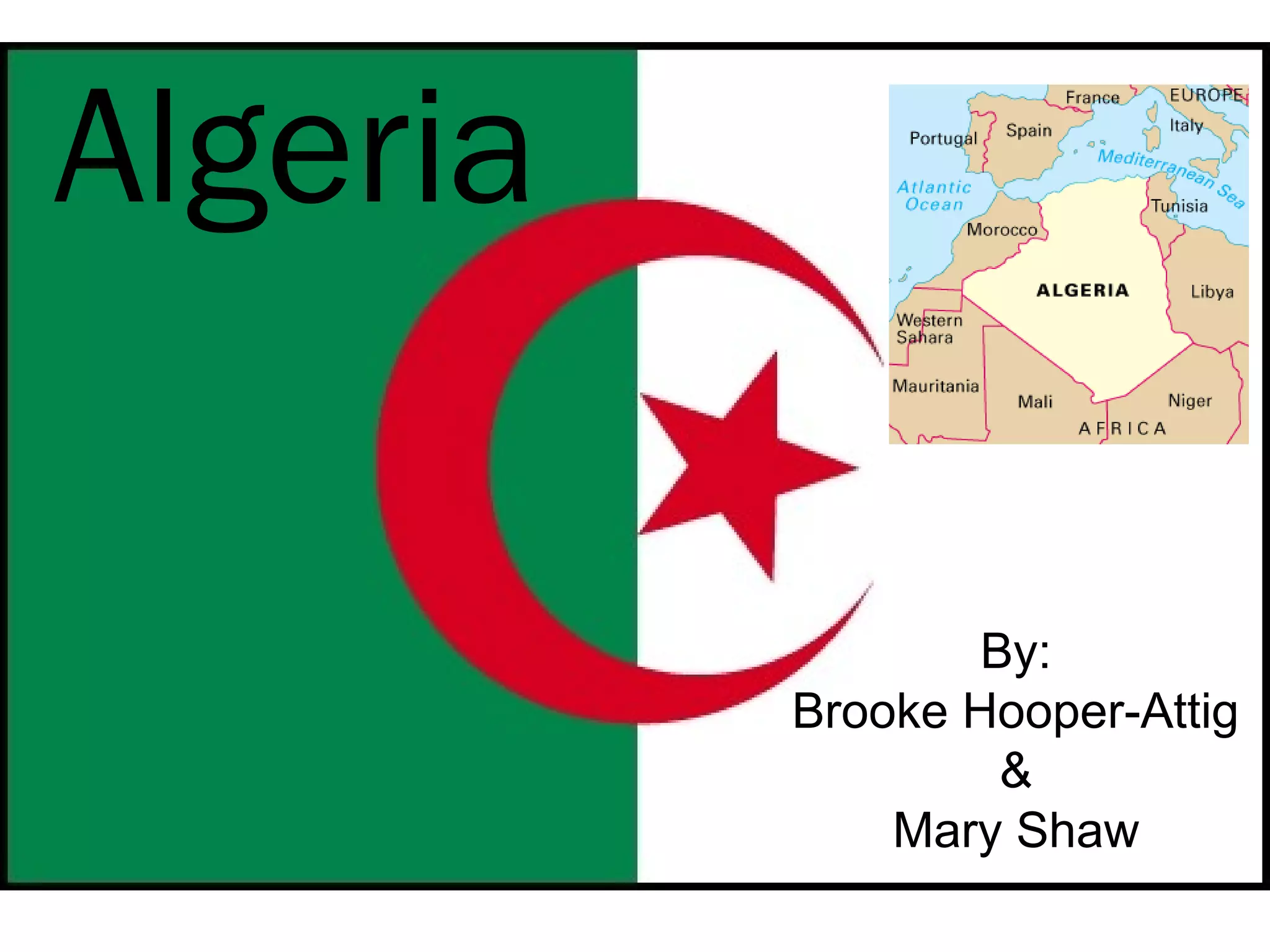
Algeria
By:
Brooke Hooper-Attig
&
Mary Shaw
The Land
• Algeria is located in the north of Africa
beside Morocco.
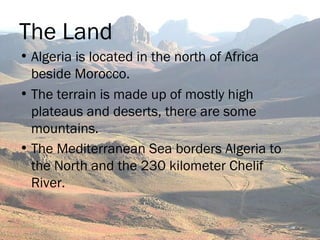
• The terrain is made up of mostly high
plateaus and deserts, there are some
mountains.
• The Mediterranean Sea borders Algeria to
the North and the 230 kilometer Chelif
River.
Land Cont.
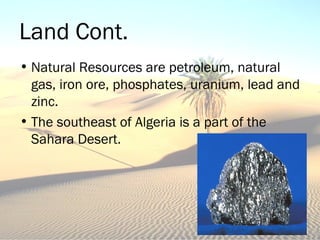
• Natural Resources are petroleum, natural
gas, iron ore, phosphates, uranium, lead and
zinc.
• The southeast of Algeria is a part of the
Sahara Desert.
Climate
• Mostly arid to semiarid
• Mild, wet winters and hot, dry summers
along the coast line.
• Cold winters and hot summers on the high
plateaus.
• Sirocco- a hot sand and dust filled wind that
is very common in the summer.
Government
• A Parliamentary Republic
• President is called the Chief of State, a new
one is elected every five years by a popular
vote.
• The Chief of State appoints a prime minister
to be the head of government.
Government Cont.
• Life expectancy is 73.3 years.
• Since 1974 the citizens of Algeria have
received free health care.
• The health system is poor, and the water is
contaminated which causes many illnesses.
• In July of 2008 the estimated population
was 33, 769, 668 people.
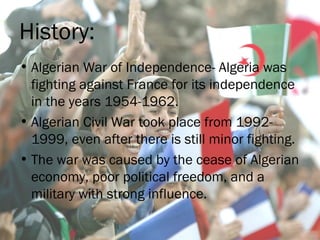
History:
• Algerian War of Independence- Algeria was
fighting against France for its independence
in the years 1954-1962.
• Algerian Civil War took place from 1992-
1999, even after there is still minor fighting.
• The war was caused by the cease of Algerian
economy, poor political freedom, and a
military with strong influence.
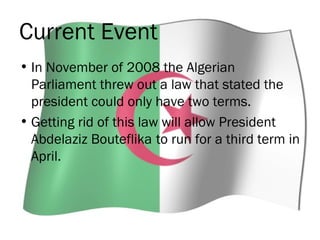
Current Event
• In November of 2008 the Algerian
Parliament threw out a law that stated the
president could only have two terms.
• Getting rid of this law will allow President
Abdelaziz Bouteflika to run for a third term in
April.
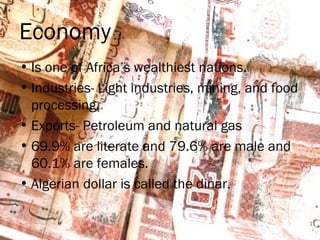
Economy
• Is one of Africa’s wealthiest nations.
• Industries- Light industries, mining, and food
processing.
• Exports- Petroleum and natural gas
• 69.9% are literate and 79.6% are male and
60.1% are females.
• Algerian dollar is called the dinar.
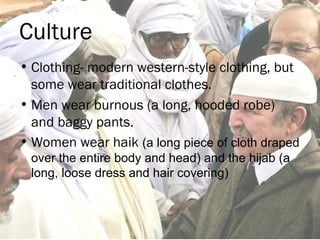
Culture
• Clothing- modern western-style clothing, but
some wear traditional clothes.
• Men wear burnous (a long, hooded robe)
and baggy pants.
• Women wear haik (a long piece of cloth draped
over the entire body and head) and the hijab (a
long, loose dress and hair covering)
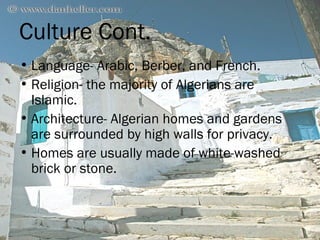
Culture Cont.
• Language- Arabic, Berber, and French.
• Religion- the majority of Algerians are
Islamic.
• Architecture- Algerian homes and gardens
are surrounded by high walls for privacy.
• Homes are usually made of white-washed
brick or stone.
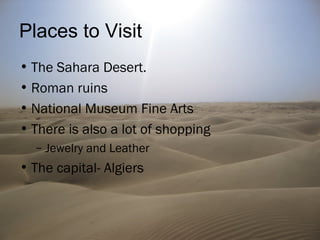
Places to Visit
• The Sahara Desert.
• Roman ruins
• National Museum Fine Arts
• There is also a lot of shopping
– Jewelry and Leather
• The capital- Algiers
Work Cited
• https://www.cia.gov/library/publications/the-world-fact
2/18/09
• http://www.novelguide.com/a/discover/jwpg_01/j
wpg_01_00013.html 2/18/09
• http://i-cias.com/e.o/algerian_civil_war.htm
2/23/09
• http://www.everyculture.com/wc/Afghanist
an-to-Bosnia-Herzegovina/Algerians.html
2/23/09
Work Cited
• http://news.bbc.co.uk/2/hi/africa/772463
5.stm 2/24/09

Algeria Economic Outlook

  • 1.
  • 2.
    The Land • Algeriais located in the north of Africa beside Morocco. • The terrain is made up of mostly high plateaus and deserts, there are some mountains. • The Mediterranean Sea borders Algeria to the North and the 230 kilometer Chelif River.
  • 3.
    Land Cont. • NaturalResources are petroleum, natural gas, iron ore, phosphates, uranium, lead and zinc. • The southeast of Algeria is a part of the Sahara Desert.
  • 4.
    Climate • Mostly aridto semiarid • Mild, wet winters and hot, dry summers along the coast line. • Cold winters and hot summers on the high plateaus. • Sirocco- a hot sand and dust filled wind that is very common in the summer.
  • 5.
    Government • A ParliamentaryRepublic • President is called the Chief of State, a new one is elected every five years by a popular vote. • The Chief of State appoints a prime minister to be the head of government.
  • 6.
    Government Cont. • Lifeexpectancy is 73.3 years. • Since 1974 the citizens of Algeria have received free health care. • The health system is poor, and the water is contaminated which causes many illnesses. • In July of 2008 the estimated population was 33, 769, 668 people.
  • 7.
    History: • Algerian Warof Independence- Algeria was fighting against France for its independence in the years 1954-1962. • Algerian Civil War took place from 1992- 1999, even after there is still minor fighting. • The war was caused by the cease of Algerian economy, poor political freedom, and a military with strong influence.
  • 8.
    Current Event • InNovember of 2008 the Algerian Parliament threw out a law that stated the president could only have two terms. • Getting rid of this law will allow President Abdelaziz Bouteflika to run for a third term in April.
  • 9.
    Economy • Is oneof Africa’s wealthiest nations. • Industries- Light industries, mining, and food processing. • Exports- Petroleum and natural gas • 69.9% are literate and 79.6% are male and 60.1% are females. • Algerian dollar is called the dinar.
  • 10.
    Culture • Clothing- modernwestern-style clothing, but some wear traditional clothes. • Men wear burnous (a long, hooded robe) and baggy pants. • Women wear haik (a long piece of cloth draped over the entire body and head) and the hijab (a long, loose dress and hair covering)
  • 11.
    Culture Cont. • Language-Arabic, Berber, and French. • Religion- the majority of Algerians are Islamic. • Architecture- Algerian homes and gardens are surrounded by high walls for privacy. • Homes are usually made of white-washed brick or stone.
  • 12.
    Places to Visit •The Sahara Desert. • Roman ruins • National Museum Fine Arts • There is also a lot of shopping – Jewelry and Leather • The capital- Algiers
  • 13.
    Work Cited • https://www.cia.gov/library/publications/the-world-fact 2/18/09 •http://www.novelguide.com/a/discover/jwpg_01/j wpg_01_00013.html 2/18/09 • http://i-cias.com/e.o/algerian_civil_war.htm 2/23/09 • http://www.everyculture.com/wc/Afghanist an-to-Bosnia-Herzegovina/Algerians.html 2/23/09
  • 14.