North Africa – Human
Geography

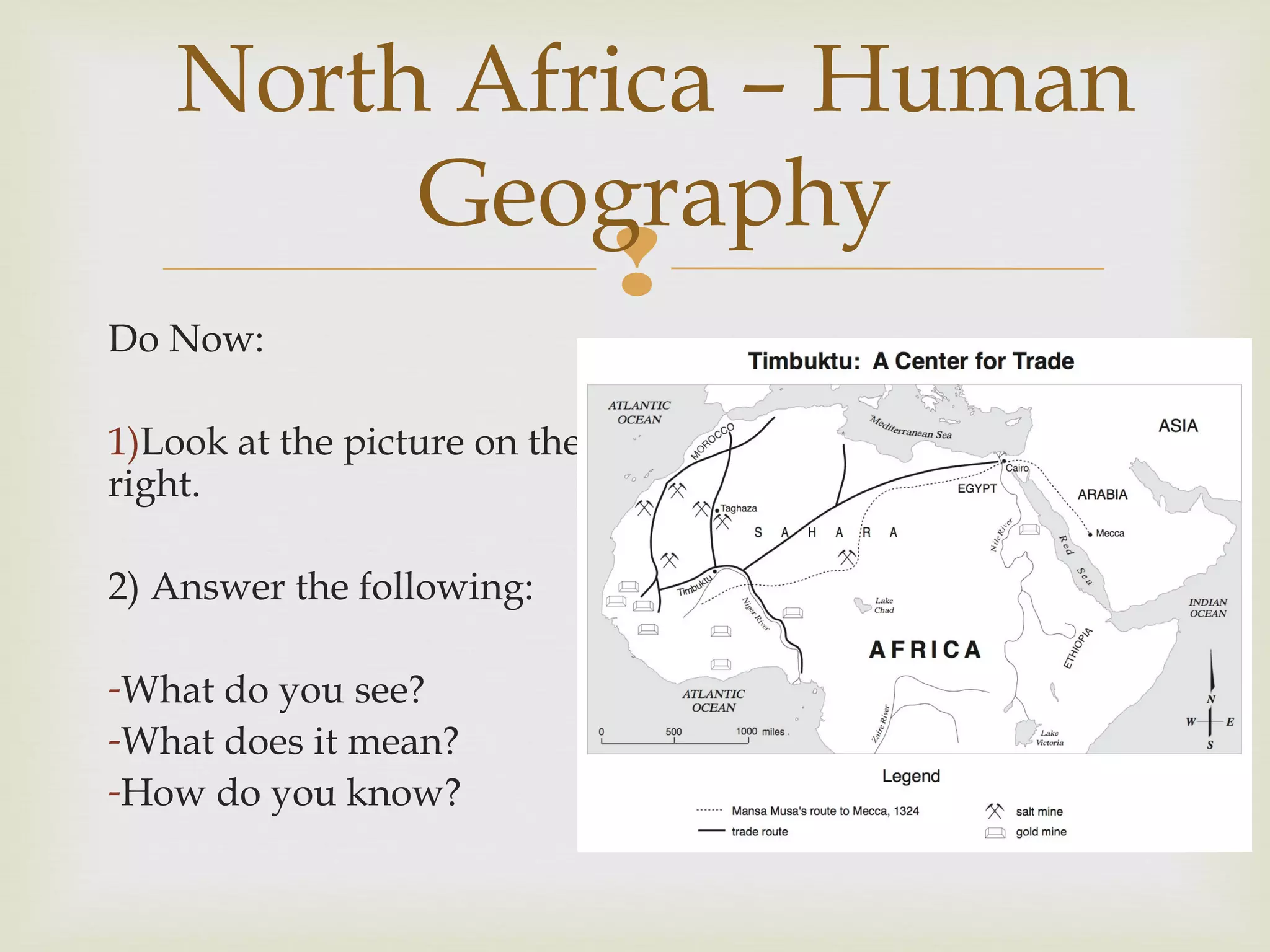
Do Now:
1)Look at the picture on the
right.
2) Answer the following:
-What do you see?
-What does it mean?
-How do you know?
North Africa - Trade

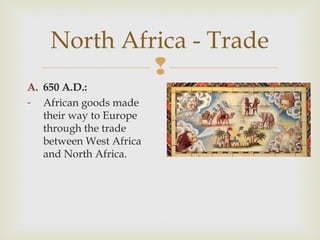
A. 650 A.D.:
- African goods made
their way to Europe
through the trade
between West Africa
and North Africa.
North Africa - Trade

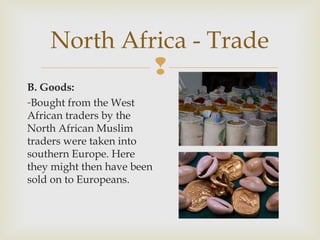
B. Goods:
-Bought from the West
African traders by the
North African Muslim
traders were taken into
southern Europe. Here
they might then have been
sold on to Europeans.
North Africa – Trade

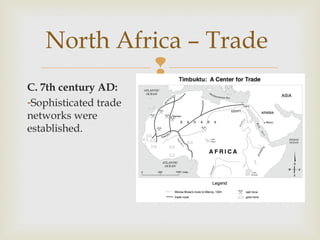
C. 7th century AD:
-Sophisticated trade
networks were
established.
North Africa - Trade

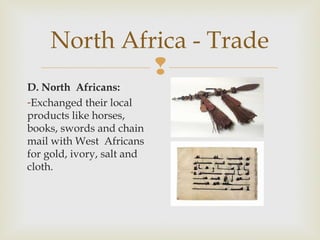
D. North Africans:
-Exchanged their local
products like horses,
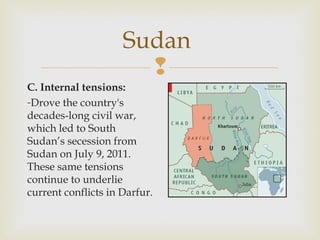
books, swords and chain
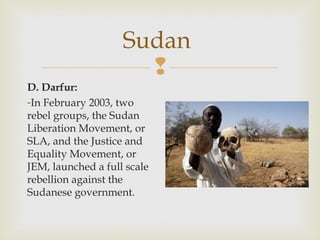
mail with West Africans
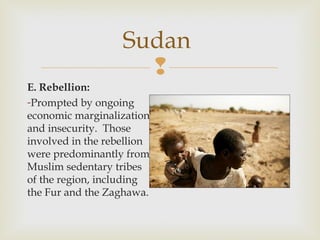
for gold, ivory, salt and
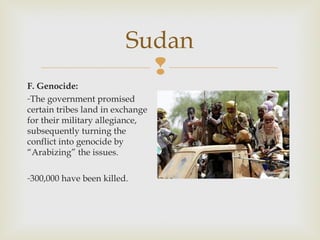
cloth.
North Africa – Trade

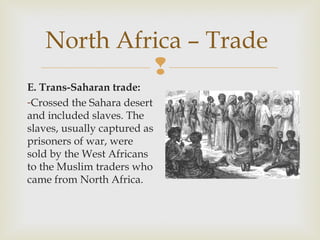
E. Trans-Saharan trade:
-Crossed the Sahara desert
and included slaves. The
slaves, usually captured as
prisoners of war, were
sold by the West Africans
to the Muslim traders who
came from North Africa.
North Africa – Trade

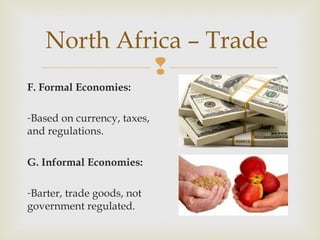
F. Formal Economies:
-Based on currency, taxes,
and regulations.
G. Informal Economies:
-Barter, trade goods, not
government regulated.
North Africa - Trade


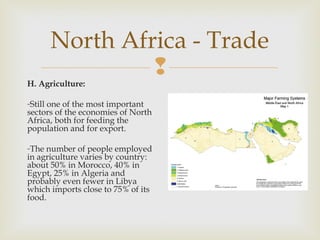
H. Agriculture:

-Still one of the most important
sectors of the economies of North
Africa, both for feeding the
population and for export.
-The number of people employed
in agriculture varies by country:
about 50% in Morocco, 40% in
Egypt, 25% in Algeria and
probably even fewer in Libya
which imports close to 75% of its
food.
North Africa – Trade


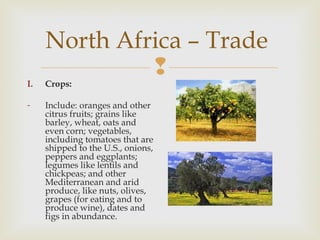
I.

Crops:

-

Include: oranges and other
citrus fruits; grains like
barley, wheat, oats and
even corn; vegetables,
including tomatoes that are
shipped to the U.S., onions,
peppers and eggplants;
legumes like lentils and
chickpeas; and other
Mediterranean and arid
produce, like nuts, olives,
grapes (for eating and to
produce wine), dates and
figs in abundance.
North Africa – Trade

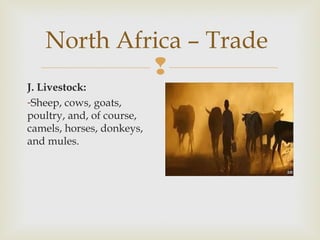
J. Livestock:
-Sheep, cows, goats,
poultry, and, of course,
camels, horses, donkeys,
and mules.
North Africa – Trade

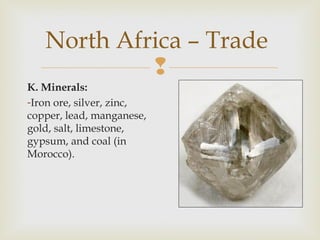
K. Minerals:
-Iron ore, silver, zinc,
copper, lead, manganese,
gold, salt, limestone,
gypsum, and coal (in
Morocco).
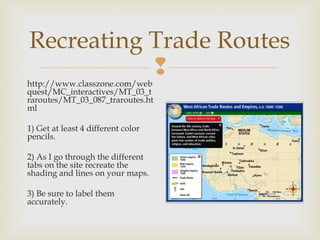
Recreating Trade Routes


http://www.classzone.com/web
quest/MC_interactives/MT_03_t
raroutes/MT_03_087_traroutes.ht
ml
1) Get at least 4 different color
pencils.
2) As I go through the different
tabs on the site recreate the
shading and lines on your maps.
3) Be sure to label them
accurately.
Trade Simulation


1) You should have 3 index cards
with different goods on them.

2) Your goal is to get 3 index cards
with the same goods on them.
3) You will do this by travelling
around the room and bartering with
other people.
4)You must trade something with the
other person to get something in
return.
5)When you have obtained all 3 of
the same come and tell me.
Trade Simulation Open
Response

1) Respond to the following
on a sheet of paper.
2) I will pick this up at the
end of the time allowed.
In what ways do North
Africans trade? Based on
the simulation, do you
think this can create
issues? How so?

Rubric:

100: Answers all of the questions
and is at least 4 sentences long.
75: Answers at least two of the
questions and is less than four
sentences long.
50: Answers less than two of the
questions and is less than four
sentences long.
0: Nothing is answered.
Open Response – Think,
Pair, Share

1) Think about your
answer for one minute.
2) Turn to a neighbor and
share your answer for
one minute.
3) Come back as a class
and share out.
Exit Ticket

Answer the following
question on your post it:
How do goods and ideas
move throughout North
Africa?
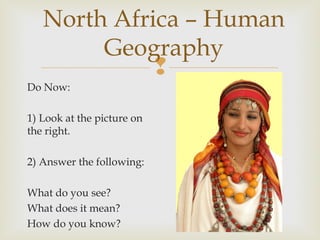
North Africa – Human
Geography

Do Now:
1) Look at the picture on
the right.
2) Answer the following:
What do you see?
What does it mean?
How do you know?
North Africa –
Morocco and Algeria

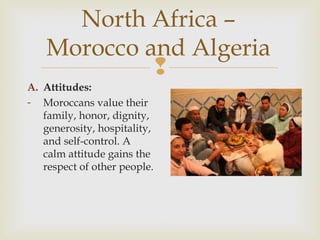
A. Attitudes:
- Moroccans value their
family, honor, dignity,
generosity, hospitality,
and self-control. A
calm attitude gains the
respect of other people.
Morocco and Algeria

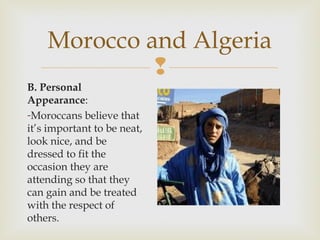
B. Personal
Appearance:
-Moroccans believe that
it’s important to be neat,
look nice, and be
dressed to fit the
occasion they are
attending so that they
can gain and be treated
with the respect of
others.
Morocco and Algeria

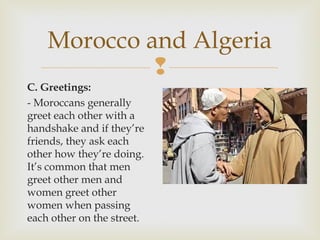
C. Greetings:
- Moroccans generally
greet each other with a
handshake and if they’re
friends, they ask each
other how they’re doing.
It’s common that men
greet other men and
women greet other
women when passing
each other on the street.
Morocco and Algeria

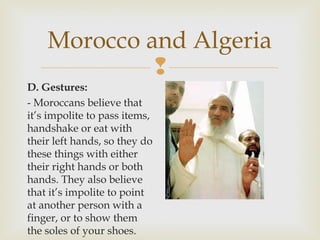
D. Gestures:
- Moroccans believe that
it’s impolite to pass items,
handshake or eat with
their left hands, so they do
these things with either
their right hands or both
hands. They also believe
that it’s impolite to point
at another person with a
finger, or to show them
the soles of your shoes.
Morocco and Algeria

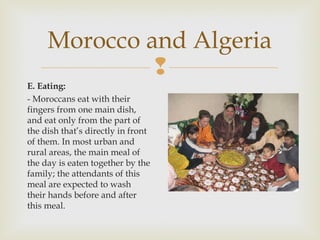
E. Eating:
- Moroccans eat with their
fingers from one main dish,
and eat only from the part of
the dish that’s directly in front
of them. In most urban and
rural areas, the main meal of
the day is eaten together by the
family; the attendants of this
meal are expected to wash
their hands before and after
this meal.
Morocco and Algeria

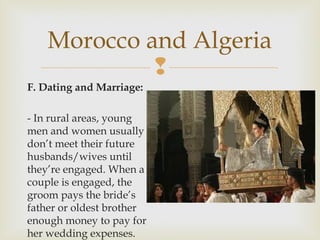
F. Dating and Marriage:
- In rural areas, young
men and women usually
don’t meet their future
husbands/wives until
they’re engaged. When a
couple is engaged, the
groom pays the bride’s
father or oldest brother
enough money to pay for
her wedding expenses.
Morocco and Algeria

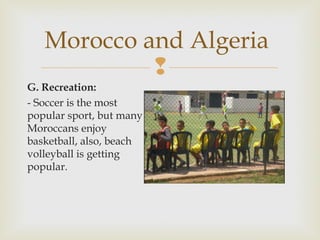
G. Recreation:
- Soccer is the most
popular sport, but many
Moroccans enjoy
basketball, also, beach
volleyball is getting
popular.
Morocco and Algeria

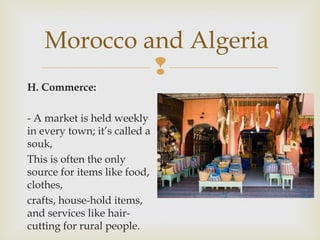
H. Commerce:
- A market is held weekly
in every town; it’s called a
souk,
This is often the only
source for items like food,
clothes,
crafts, house-hold items,
and services like haircutting for rural people.
Morocco and Algeria

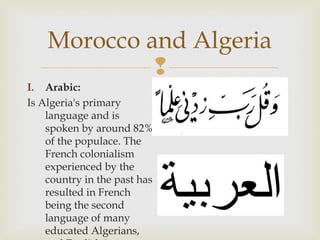
I. Arabic:
Is Algeria's primary
language and is
spoken by around 82%
of the populace. The
French colonialism
experienced by the
country in the past has
resulted in French
being the second
language of many
educated Algerians,
Morocco and Algeria

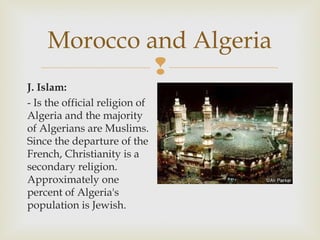
J. Islam:
- Is the official religion of
Algeria and the majority
of Algerians are Muslims.
Since the departure of the
French, Christianity is a
secondary religion.
Approximately one
percent of Algeria's
population is Jewish.
Morocco and Algeria

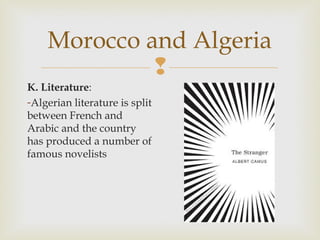
K. Literature:
-Algerian literature is split
between French and
Arabic and the country
has produced a number of
famous novelists
Morocco and Algeria

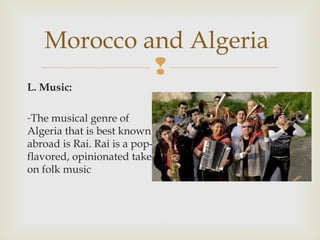
L. Music:
-The musical genre of
Algeria that is best known
abroad is Rai. Rai is a popflavored, opinionated take
on folk music
Morocco and Algeria

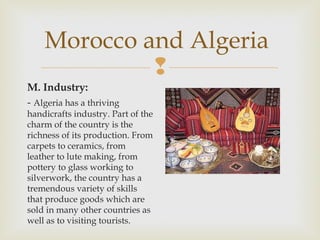
M. Industry:
- Algeria has a thriving

handicrafts industry. Part of the
charm of the country is the
richness of its production. From
carpets to ceramics, from
leather to lute making, from
pottery to glass working to
silverwork, the country has a
tremendous variety of skills
that produce goods which are
sold in many other countries as
well as to visiting tourists.
Creating a Travel Flyer

1) Get a laptop.
2) Visit:
http://www.morocca
nmoments.com/culture
/
3) Create a travel flyer to
entice tourists to come
to Morocco. Also
inform them of the
traditions there.

4) Flyer must include at
least 3 facts from each
category:
-Language
-Religion
-Dress Code
-Women Travelers
-Holy Places
-Hospitality
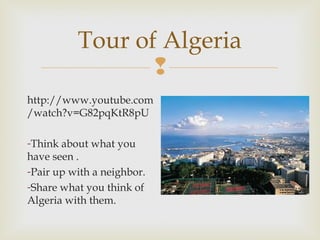
Tour of Algeria

http://www.youtube.com
/watch?v=G82pqKtR8pU
-Think about what you
have seen .
-Pair up with a neighbor.
-Share what you think of
Algeria with them.
Economic Freedom of
Algeria

1) Visit:
http://www.heritage.
org/index/
2) Search for Algeria
3) Record its score and
ranking.
4) Search for America
5) Records its ranking.
6) Compare the two.
7) What do you think this
means?
Exit Ticket

1) Using one word
describe the impact
that people have had
on the ideas and trade
in Mediterranean
North Africa.
2) Explain why you chose
this answer.
North Africa: Human
Geography

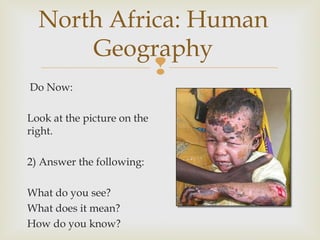
Do Now:
Look at the picture on the
right.
2) Answer the following:
What do you see?
What does it mean?
How do you know?
Find Your Family
Simulation


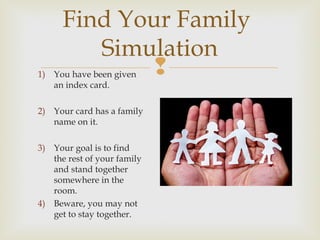
1) You have been given
an index card.

2) Your card has a family
name on it.
3) Your goal is to find
the rest of your family
and stand together
somewhere in the
room.
4) Beware, you may not
get to stay together.
Reflection

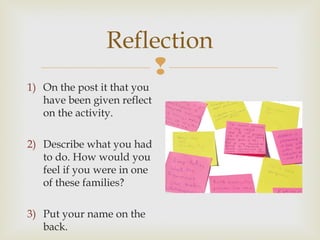
1) On the post it that you
have been given reflect
on the activity.
2) Describe what you had
to do. How would you
feel if you were in one
of these families?
3) Put your name on the
back.
Sudan

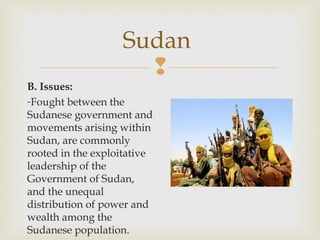
B. Issues:
-Fought between the
Sudanese government and
movements arising within
Sudan, are commonly
rooted in the exploitative
leadership of the
Government of Sudan,
and the unequal
distribution of power and
wealth among the
Sudanese population.
Sudan

C. Internal tensions:
-Drove the country's
decades-long civil war,
which led to South
Sudan’s secession from
Sudan on July 9, 2011.
These same tensions
continue to underlie
current conflicts in Darfur.
Sudan

D. Darfur:
-In February 2003, two
rebel groups, the Sudan
Liberation Movement, or
SLA, and the Justice and
Equality Movement, or
JEM, launched a full scale
rebellion against the
Sudanese government.
Sudan

E. Rebellion:
-Prompted by ongoing
economic marginalization
and insecurity. Those
involved in the rebellion
were predominantly from
Muslim sedentary tribes
of the region, including
the Fur and the Zaghawa.
Sudan

F. Genocide:
-The government promised
certain tribes land in exchange
for their military allegiance,
subsequently turning the
conflict into genocide by
“Arabizing” the issues.
-300,000 have been killed.
Sudan

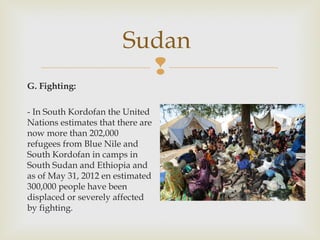
G. Fighting:
- In South Kordofan the United
Nations estimates that there are
now more than 202,000
refugees from Blue Nile and
South Kordofan in camps in
South Sudan and Ethiopia and
as of May 31, 2012 en estimated
300,000 people have been
displaced or severely affected
by fighting.
Sudan

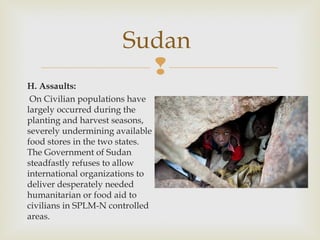
H. Assaults:
On Civilian populations have
largely occurred during the
planting and harvest seasons,
severely undermining available
food stores in the two states.
The Government of Sudan
steadfastly refuses to allow
international organizations to
deliver desperately needed
humanitarian or food aid to
civilians in SPLM-N controlled
areas.
Sudan

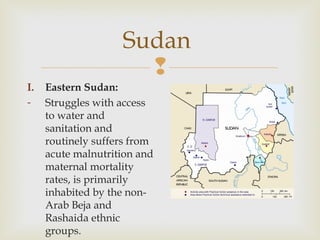
I.
-

Eastern Sudan:
Struggles with access
to water and
sanitation and
routinely suffers from
acute malnutrition and
maternal mortality
rates, is primarily
inhabited by the nonArab Beja and
Rashaida ethnic
groups.
Sudan

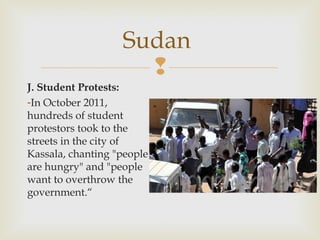
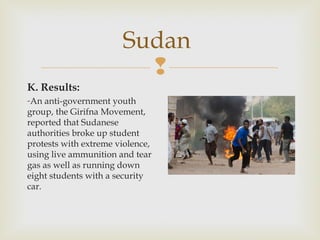
J. Student Protests:
-In October 2011,
hundreds of student
protestors took to the
streets in the city of
Kassala, chanting "people
are hungry" and "people
want to overthrow the
government.“
Sudan

K. Results:
-An anti-government youth
group, the Girifna Movement,
reported that Sudanese
authorities broke up student
protests with extreme violence,
using live ammunition and tear
gas as well as running down
eight students with a security
car.
Sudan

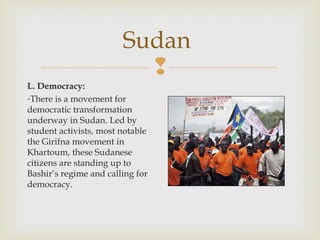
L. Democracy:
-There is a movement for
democratic transformation
underway in Sudan. Led by
student activists, most notable
the Girifna movement in
Khartoum, these Sudanese
citizens are standing up to
Bashir’s regime and calling for
democracy.
Genocide

1) Read “What Has
Happened in Darfur?”
reading.
2) Take a minute to think
about what you have
read.
3) Turn to your neighbor
and share what you
have learned.

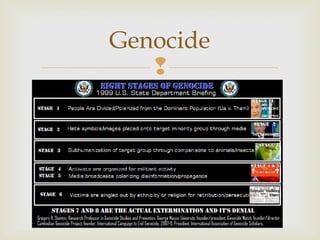
4) Use the chart on the
next slide to decide with
your partner how many
stages the genocide in
Darfur has gone through.
Genocide

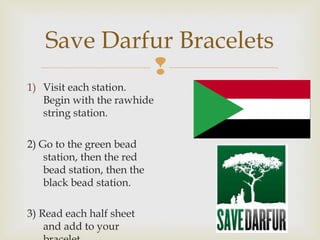
Save Darfur Bracelets

1) Visit each station.
Begin with the rawhide
string station.
2) Go to the green bead
station, then the red
bead station, then the
black bead station.
3) Read each half sheet
and add to your
Exit Ticket

1) Describe the culture of
Sudan in at least 2
complete sentences.
2) Create a cause and
effect chart of
genocide.
North Africa – Human
Geography

Do Now:
How can social media
(Twitter, Facebook,
Youtube) help to spread
ideas? What kind of ideas
can they spread?
Libya

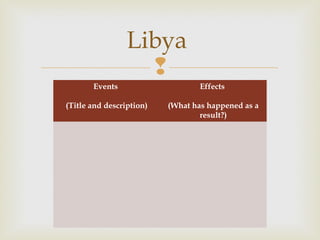
Events

Effects

(Title and description)

(What has happened as a
result?)
Libya

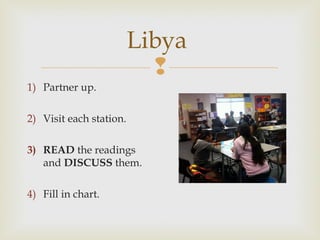
1) Partner up.
2) Visit each station.
3) READ the readings
and DISCUSS them.
4) Fill in chart.
Libya

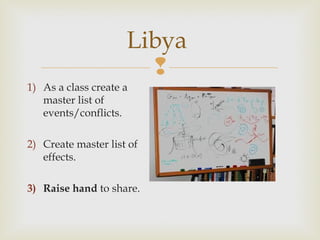
1) As a class create a
master list of
events/conflicts.
2) Create master list of
effects.
3) Raise hand to share.
Libya

News Clip:
http://www.cbsnews.co
m/8301-250_16257602348/one-year-laterbenghazis-lingeringissues/
Exit Ticket

Answer the following:
How can the outside
world influence the
society and politics of a
nation? Use Libya and
Libyan notes as examples
to support your claims.
North Africa – Human
Geography

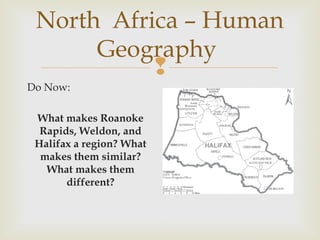
Do Now:
What makes Roanoke
Rapids, Weldon, and
Halifax a region? What
makes them similar?
What makes them
different?
Stop and Jot

1) Take 2 minutes to
individually and silently
to think of things that make
countries in North Africa
similar.
2) Take 1 minute to write these
down.
3) Do the same for differences.
Comparisons

News Segment

1) Partner Up
2) Separate from other
groups.
3) Do not distract other
groups.
4) Come up with a news
segment about
anything occurring in
any country in North
Africa.

5) Compare the event
and/or country you
choose with another in
North Africa.
6) Create a script (things
you will say)
Study Time

1) Take 10 minutes to
study over your notes
on North Africa.
2) You may quiz a friend if
you would like.

North Africa – Human Geography

  • 1.
    North Africa –Human Geography  Do Now: 1)Look at the picture on the right. 2) Answer the following: -What do you see? -What does it mean? -How do you know?
  • 2.
    North Africa -Trade  A. 650 A.D.: - African goods made their way to Europe through the trade between West Africa and North Africa.
  • 3.
    North Africa -Trade  B. Goods: -Bought from the West African traders by the North African Muslim traders were taken into southern Europe. Here they might then have been sold on to Europeans.
  • 4.
    North Africa –Trade  C. 7th century AD: -Sophisticated trade networks were established.
  • 5.
    North Africa -Trade  D. North Africans: -Exchanged their local products like horses, books, swords and chain mail with West Africans for gold, ivory, salt and cloth.
  • 6.
    North Africa –Trade  E. Trans-Saharan trade: -Crossed the Sahara desert and included slaves. The slaves, usually captured as prisoners of war, were sold by the West Africans to the Muslim traders who came from North Africa.
  • 7.
    North Africa –Trade  F. Formal Economies: -Based on currency, taxes, and regulations. G. Informal Economies: -Barter, trade goods, not government regulated.
  • 8.
    North Africa -Trade  H. Agriculture: -Still one of the most important sectors of the economies of North Africa, both for feeding the population and for export. -The number of people employed in agriculture varies by country: about 50% in Morocco, 40% in Egypt, 25% in Algeria and probably even fewer in Libya which imports close to 75% of its food.
  • 9.
    North Africa –Trade  I. Crops: - Include: oranges and other citrus fruits; grains like barley, wheat, oats and even corn; vegetables, including tomatoes that are shipped to the U.S., onions, peppers and eggplants; legumes like lentils and chickpeas; and other Mediterranean and arid produce, like nuts, olives, grapes (for eating and to produce wine), dates and figs in abundance.
  • 10.
    North Africa –Trade  J. Livestock: -Sheep, cows, goats, poultry, and, of course, camels, horses, donkeys, and mules.
  • 11.
    North Africa –Trade  K. Minerals: -Iron ore, silver, zinc, copper, lead, manganese, gold, salt, limestone, gypsum, and coal (in Morocco).
  • 12.
    Recreating Trade Routes  http://www.classzone.com/web quest/MC_interactives/MT_03_t raroutes/MT_03_087_traroutes.ht ml 1)Get at least 4 different color pencils. 2) As I go through the different tabs on the site recreate the shading and lines on your maps. 3) Be sure to label them accurately.
  • 13.
    Trade Simulation  1) Youshould have 3 index cards with different goods on them. 2) Your goal is to get 3 index cards with the same goods on them. 3) You will do this by travelling around the room and bartering with other people. 4)You must trade something with the other person to get something in return. 5)When you have obtained all 3 of the same come and tell me.
  • 14.
    Trade Simulation Open Response  1)Respond to the following on a sheet of paper. 2) I will pick this up at the end of the time allowed. In what ways do North Africans trade? Based on the simulation, do you think this can create issues? How so? Rubric: 100: Answers all of the questions and is at least 4 sentences long. 75: Answers at least two of the questions and is less than four sentences long. 50: Answers less than two of the questions and is less than four sentences long. 0: Nothing is answered.
  • 15.
    Open Response –Think, Pair, Share  1) Think about your answer for one minute. 2) Turn to a neighbor and share your answer for one minute. 3) Come back as a class and share out.
  • 16.
    Exit Ticket  Answer thefollowing question on your post it: How do goods and ideas move throughout North Africa?
  • 17.
    North Africa –Human Geography  Do Now: 1) Look at the picture on the right. 2) Answer the following: What do you see? What does it mean? How do you know?
  • 18.
    North Africa – Moroccoand Algeria  A. Attitudes: - Moroccans value their family, honor, dignity, generosity, hospitality, and self-control. A calm attitude gains the respect of other people.
  • 19.
    Morocco and Algeria  B.Personal Appearance: -Moroccans believe that it’s important to be neat, look nice, and be dressed to fit the occasion they are attending so that they can gain and be treated with the respect of others.
  • 20.
    Morocco and Algeria  C.Greetings: - Moroccans generally greet each other with a handshake and if they’re friends, they ask each other how they’re doing. It’s common that men greet other men and women greet other women when passing each other on the street.
  • 21.
    Morocco and Algeria  D.Gestures: - Moroccans believe that it’s impolite to pass items, handshake or eat with their left hands, so they do these things with either their right hands or both hands. They also believe that it’s impolite to point at another person with a finger, or to show them the soles of your shoes.
  • 22.
    Morocco and Algeria  E.Eating: - Moroccans eat with their fingers from one main dish, and eat only from the part of the dish that’s directly in front of them. In most urban and rural areas, the main meal of the day is eaten together by the family; the attendants of this meal are expected to wash their hands before and after this meal.
  • 23.
    Morocco and Algeria  F.Dating and Marriage: - In rural areas, young men and women usually don’t meet their future husbands/wives until they’re engaged. When a couple is engaged, the groom pays the bride’s father or oldest brother enough money to pay for her wedding expenses.
  • 24.
    Morocco and Algeria  G.Recreation: - Soccer is the most popular sport, but many Moroccans enjoy basketball, also, beach volleyball is getting popular.
  • 25.
    Morocco and Algeria  H.Commerce: - A market is held weekly in every town; it’s called a souk, This is often the only source for items like food, clothes, crafts, house-hold items, and services like haircutting for rural people.
  • 26.
    Morocco and Algeria  I.Arabic: Is Algeria's primary language and is spoken by around 82% of the populace. The French colonialism experienced by the country in the past has resulted in French being the second language of many educated Algerians,
  • 27.
    Morocco and Algeria  J.Islam: - Is the official religion of Algeria and the majority of Algerians are Muslims. Since the departure of the French, Christianity is a secondary religion. Approximately one percent of Algeria's population is Jewish.
  • 28.
    Morocco and Algeria  K.Literature: -Algerian literature is split between French and Arabic and the country has produced a number of famous novelists
  • 29.
    Morocco and Algeria  L.Music: -The musical genre of Algeria that is best known abroad is Rai. Rai is a popflavored, opinionated take on folk music
  • 30.
    Morocco and Algeria  M.Industry: - Algeria has a thriving handicrafts industry. Part of the charm of the country is the richness of its production. From carpets to ceramics, from leather to lute making, from pottery to glass working to silverwork, the country has a tremendous variety of skills that produce goods which are sold in many other countries as well as to visiting tourists.
  • 31.
    Creating a TravelFlyer  1) Get a laptop. 2) Visit: http://www.morocca nmoments.com/culture / 3) Create a travel flyer to entice tourists to come to Morocco. Also inform them of the traditions there. 4) Flyer must include at least 3 facts from each category: -Language -Religion -Dress Code -Women Travelers -Holy Places -Hospitality
  • 32.
    Tour of Algeria  http://www.youtube.com /watch?v=G82pqKtR8pU -Thinkabout what you have seen . -Pair up with a neighbor. -Share what you think of Algeria with them.
  • 33.
    Economic Freedom of Algeria  1)Visit: http://www.heritage. org/index/ 2) Search for Algeria 3) Record its score and ranking. 4) Search for America 5) Records its ranking. 6) Compare the two. 7) What do you think this means?
  • 34.
    Exit Ticket  1) Usingone word describe the impact that people have had on the ideas and trade in Mediterranean North Africa. 2) Explain why you chose this answer.
  • 35.
    North Africa: Human Geography  DoNow: Look at the picture on the right. 2) Answer the following: What do you see? What does it mean? How do you know?
  • 36.
    Find Your Family Simulation  1)You have been given an index card. 2) Your card has a family name on it. 3) Your goal is to find the rest of your family and stand together somewhere in the room. 4) Beware, you may not get to stay together.
  • 37.
    Reflection  1) On thepost it that you have been given reflect on the activity. 2) Describe what you had to do. How would you feel if you were in one of these families? 3) Put your name on the back.
  • 38.
    Sudan  B. Issues: -Fought betweenthe Sudanese government and movements arising within Sudan, are commonly rooted in the exploitative leadership of the Government of Sudan, and the unequal distribution of power and wealth among the Sudanese population.
  • 39.
    Sudan  C. Internal tensions: -Drovethe country's decades-long civil war, which led to South Sudan’s secession from Sudan on July 9, 2011. These same tensions continue to underlie current conflicts in Darfur.
  • 40.
    Sudan  D. Darfur: -In February2003, two rebel groups, the Sudan Liberation Movement, or SLA, and the Justice and Equality Movement, or JEM, launched a full scale rebellion against the Sudanese government.
  • 41.
    Sudan  E. Rebellion: -Prompted byongoing economic marginalization and insecurity. Those involved in the rebellion were predominantly from Muslim sedentary tribes of the region, including the Fur and the Zaghawa.
  • 42.
    Sudan  F. Genocide: -The governmentpromised certain tribes land in exchange for their military allegiance, subsequently turning the conflict into genocide by “Arabizing” the issues. -300,000 have been killed.
  • 43.
    Sudan  G. Fighting: - InSouth Kordofan the United Nations estimates that there are now more than 202,000 refugees from Blue Nile and South Kordofan in camps in South Sudan and Ethiopia and as of May 31, 2012 en estimated 300,000 people have been displaced or severely affected by fighting.
  • 44.
    Sudan  H. Assaults: On Civilianpopulations have largely occurred during the planting and harvest seasons, severely undermining available food stores in the two states. The Government of Sudan steadfastly refuses to allow international organizations to deliver desperately needed humanitarian or food aid to civilians in SPLM-N controlled areas.
  • 45.
    Sudan  I. - Eastern Sudan: Struggles withaccess to water and sanitation and routinely suffers from acute malnutrition and maternal mortality rates, is primarily inhabited by the nonArab Beja and Rashaida ethnic groups.
  • 46.
    Sudan  J. Student Protests: -InOctober 2011, hundreds of student protestors took to the streets in the city of Kassala, chanting "people are hungry" and "people want to overthrow the government.“
  • 47.
    Sudan  K. Results: -An anti-governmentyouth group, the Girifna Movement, reported that Sudanese authorities broke up student protests with extreme violence, using live ammunition and tear gas as well as running down eight students with a security car.
  • 48.
    Sudan  L. Democracy: -There isa movement for democratic transformation underway in Sudan. Led by student activists, most notable the Girifna movement in Khartoum, these Sudanese citizens are standing up to Bashir’s regime and calling for democracy.
  • 49.
    Genocide  1) Read “WhatHas Happened in Darfur?” reading. 2) Take a minute to think about what you have read. 3) Turn to your neighbor and share what you have learned. 4) Use the chart on the next slide to decide with your partner how many stages the genocide in Darfur has gone through.
  • 50.
  • 51.
    Save Darfur Bracelets  1)Visit each station. Begin with the rawhide string station. 2) Go to the green bead station, then the red bead station, then the black bead station. 3) Read each half sheet and add to your
  • 52.
    Exit Ticket  1) Describethe culture of Sudan in at least 2 complete sentences. 2) Create a cause and effect chart of genocide.
  • 53.
    North Africa –Human Geography  Do Now: How can social media (Twitter, Facebook, Youtube) help to spread ideas? What kind of ideas can they spread?
  • 54.
  • 55.
    Libya  1) Partner up. 2)Visit each station. 3) READ the readings and DISCUSS them. 4) Fill in chart.
  • 56.
    Libya  1) As aclass create a master list of events/conflicts. 2) Create master list of effects. 3) Raise hand to share.
  • 57.
  • 58.
    Exit Ticket  Answer thefollowing: How can the outside world influence the society and politics of a nation? Use Libya and Libyan notes as examples to support your claims.
  • 59.
    North Africa –Human Geography  Do Now: What makes Roanoke Rapids, Weldon, and Halifax a region? What makes them similar? What makes them different?
  • 60.
    Stop and Jot  1)Take 2 minutes to individually and silently to think of things that make countries in North Africa similar. 2) Take 1 minute to write these down. 3) Do the same for differences.
  • 61.
  • 62.
    News Segment  1) PartnerUp 2) Separate from other groups. 3) Do not distract other groups. 4) Come up with a news segment about anything occurring in any country in North Africa. 5) Compare the event and/or country you choose with another in North Africa. 6) Create a script (things you will say)
  • 63.
    Study Time  1) Take10 minutes to study over your notes on North Africa. 2) You may quiz a friend if you would like.