Because learning changes everything.®
Fundamentals of
Electric Circuits
Chapter 1
© 2021 McGraw Hill. All rights reserved. Authorized only for instructor use in the classroom.
No reproduction or further distribution permitted without the prior written consent of McGraw Hill.
© McGraw Hill 2
Introduction
• This chapter introduces the concept of voltage and
current.
• The concept of a circuit will be introduced.
• Sources will be introduced.
• These can provide either a specified voltage or
current.
• Dependent and independent sources will be
discussed.
• Also a strategy for solving problems will be
introduced.
© McGraw Hill 3
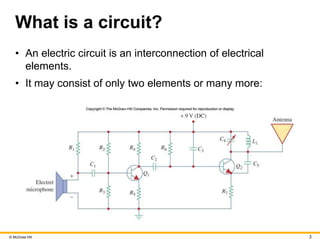
What is a circuit?
• An electric circuit is an interconnection of electrical
elements.
• It may consist of only two elements or many more:
© McGraw Hill 4
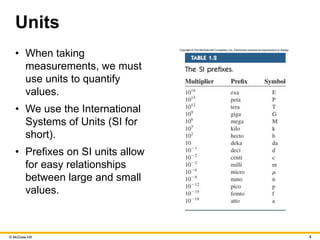
Units
• When taking
measurements, we must
use units to quantify
values.
• We use the International
Systems of Units (SI for
short).
• Prefixes on SI units allow
for easy relationships
between large and small
values.
© McGraw Hill 5
Charge
• Charge is a basic SI unit, measured in
Coulombs (C).
• Counts the number of electrons (or positive
charges) present.
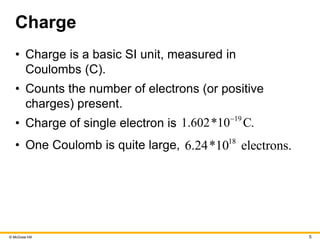
• Charge of single electron is 19
1.602*10 C.

• One Coulomb is quite large, 18
6.24*10 electrons.
© McGraw Hill 6
Charge II
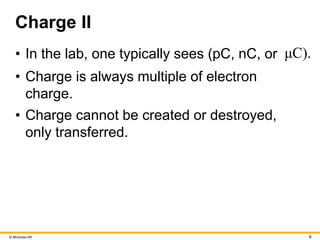
• In the lab, one typically sees (pC, nC, or μC).
• Charge is always multiple of electron
charge.
• Charge cannot be created or destroyed,
only transferred.
© McGraw Hill 7
Current
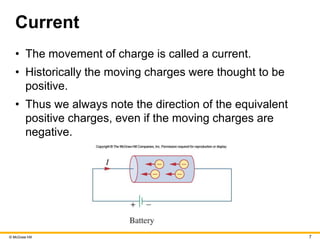
• The movement of charge is called a current.
• Historically the moving charges were thought to be
positive.
• Thus we always note the direction of the equivalent
positive charges, even if the moving charges are
negative.
© McGraw Hill 8
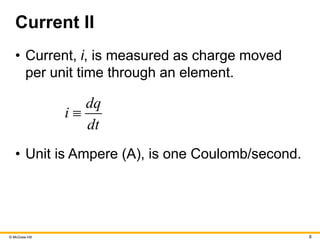
Current II
• Current, i, is measured as charge moved
per unit time through an element.
dq
i
dt

• Unit is Ampere (A), is one Coulomb/second.
© McGraw Hill 9
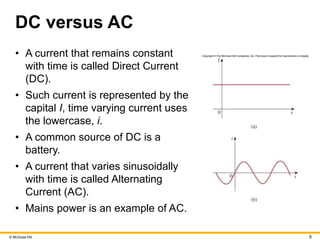
DC versus AC
• A current that remains constant
with time is called Direct Current
(DC).
• Such current is represented by the
capital I, time varying current uses
the lowercase, i.
• A common source of DC is a
battery.
• A current that varies sinusoidally
with time is called Alternating
Current (AC).
• Mains power is an example of AC.
© McGraw Hill 10
Direction of Current
• The sign of the current indicates the
direction in which the charge is moving
with reference to the direction of interest
we define.
• We need not use the direction that the
charge moves in as our reference, and
often have no choice in the matter.
© McGraw Hill 11
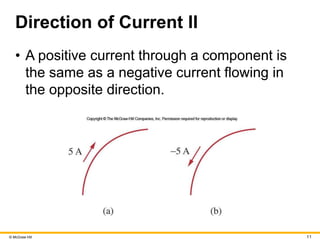
Direction of Current II
• A positive current through a component is
the same as a negative current flowing in
the opposite direction.
© McGraw Hill 12
Voltage
• Electrons move when there is a difference in
charge between two locations.
• This difference is expressed at the potential
difference, or voltage (V).
• It is always expressed with reference to two
locations.
© McGraw Hill 13
Voltage II
• It is equal to the energy needed to move a
unit charge between the locations.
• Positive charge moving from a higher
potential to a lower yields energy.
• Moving from negative to positive requires
energy.
© McGraw Hill 14
Power and Energy
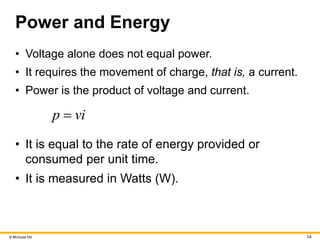
• Voltage alone does not equal power.
• It requires the movement of charge, that is, a current.
• Power is the product of voltage and current.
p vi

• It is equal to the rate of energy provided or
consumed per unit time.
• It is measured in Watts (W).
© McGraw Hill 15
Passive Sign Convention
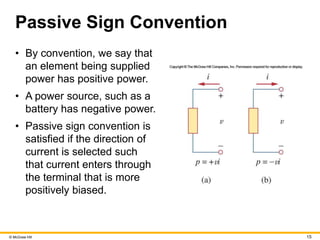
• By convention, we say that
an element being supplied
power has positive power.
• A power source, such as a
battery has negative power.
• Passive sign convention is
satisfied if the direction of
current is selected such
that current enters through
the terminal that is more
positively biased.
© McGraw Hill 16
Conservation of Energy
• In a circuit, energy cannot be created or
destroyed.
• Thus power also must be conserved.
• The sum of all power supplied must be
absorbed by the other elements.
• Energy can be described as watts x time.
• Power companies usually measure energy
in watt-hours.
© McGraw Hill 17
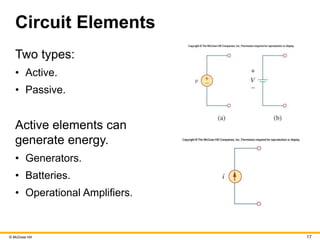
Circuit Elements
Two types:
• Active.
• Passive.
Active elements can
generate energy.
• Generators.
• Batteries.
• Operational Amplifiers.
© McGraw Hill 18
Circuit Elements II
Passives absorb energy.
• Resistors.
• Capacitors.
• Inductors.
But it should be noted that only the resistor
dissipates energy ideally.
The inductor and capacitor do not.
© McGraw Hill 19
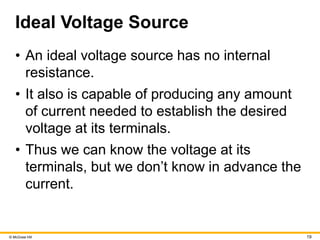
Ideal Voltage Source
• An ideal voltage source has no internal
resistance.
• It also is capable of producing any amount
of current needed to establish the desired
voltage at its terminals.
• Thus we can know the voltage at its
terminals, but we don’t know in advance the
current.
© McGraw Hill 20
Ideal Current Source
• Current sources are the opposite of the
voltage source:
• They have infinite resistance.
• They will generate any voltage to establish
the desired current through them.
• We can know the current through them in
advance, but not the voltage.
© McGraw Hill 21
Ideal sources
• Both the voltage and current source ideally
can generate infinite power.
• They are also capable of absorbing power
from the circuit.
• It is important to remember that these
sources do have limits in reality:
• Voltage sources have an upper current limit.
• Current sources have an upper voltage limit.
© McGraw Hill 22
Dependent Sources
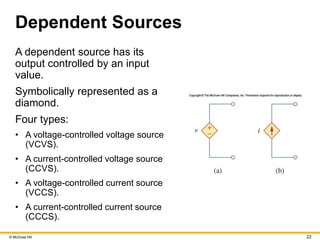
A dependent source has its
output controlled by an input
value.
Symbolically represented as a
diamond.
Four types:
• A voltage-controlled voltage source
(VCVS).
• A current-controlled voltage source
(CCVS).
• A voltage-controlled current source
(VCCS).
• A current-controlled current source
(CCCS).
© McGraw Hill 23
Dependent Source example
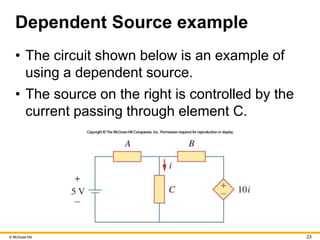
• The circuit shown below is an example of
using a dependent source.
• The source on the right is controlled by the
current passing through element C.
© McGraw Hill 24
Circuit Applications of Dependent
Sources
Dependent sources are good models for
some common circuit elements:
• Transistors: In certain modes of operation, transistors
take either a voltage or current input to one terminal
and cause a current that is somehow proportional to
the input to appear at two other terminals.
• Operational Amplifiers: Not covered yet, but the basic
concept is they take an input voltage and generate an
output voltage that is proportional to that.
© McGraw Hill 25
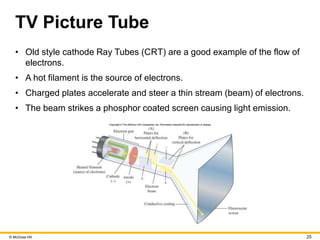
TV Picture Tube
• Old style cathode Ray Tubes (CRT) are a good example of the flow of
electrons.
• A hot filament is the source of electrons.
• Charged plates accelerate and steer a thin stream (beam) of electrons.
• The beam strikes a phosphor coated screen causing light emission.
© McGraw Hill 26
Problem Solving I
• Successfully solving an engineering problem
requires a process.
• Shown here is an effective method for determining
the solution any problem.
1. Carefully define the problem.
2. Present everything you know about the problem.
3. Establish a set of alternative solutions and
determine the one that promises the greatest
likelihood of success.
© McGraw Hill 27
Problem Solving II
4. Attempt a problem solution.
5. Evaluate the solution and check for accuracy.
6. Has the problem been solved satisfactorily? If so,
present the solution; if not, then return to step 3
and continue through the process again.
© McGraw Hill 28
Problem Solving III
Carefully define the problem.
• This is the most important step.
• What needs to be solved?
• What questions need to be addressed before solving?
Find the sources to answer them.
Present everything you know about the problem.
• What do you know?
• What don’t you?
© McGraw Hill 29
Problem Solving IV
Establish a set of alternative solutions and
determine the one that promises the greatest
likelihood of success.
• Most problems have more than one way to be solved.
• But not all solutions are as simple.
• Are the required tools available?
© McGraw Hill 30
Problem Solving V
Attempt to solve the problem.
• Documenting this process is very important.
Evaluate the solution and check for accuracy.
• Does it makes sense?
• Is it consistent with any assumptions made?
Is the solution satisfactory? If not, try an alternate
solution.
Because learning changes everything.®
www.mheducation.com
© 2021 McGraw Hill. All rights reserved. Authorized only for instructor use in the classroom.
No reproduction or further distribution permitted without the prior written consent of McGraw Hill.

Alexander_FundamentalsElectricCircuits_7e_Chap001_PPTs.pptx

  • 1.
    Because learning changeseverything.® Fundamentals of Electric Circuits Chapter 1 © 2021 McGraw Hill. All rights reserved. Authorized only for instructor use in the classroom. No reproduction or further distribution permitted without the prior written consent of McGraw Hill.
  • 2.
    © McGraw Hill2 Introduction • This chapter introduces the concept of voltage and current. • The concept of a circuit will be introduced. • Sources will be introduced. • These can provide either a specified voltage or current. • Dependent and independent sources will be discussed. • Also a strategy for solving problems will be introduced.
  • 3.
    © McGraw Hill3 What is a circuit? • An electric circuit is an interconnection of electrical elements. • It may consist of only two elements or many more:
  • 4.
    © McGraw Hill4 Units • When taking measurements, we must use units to quantify values. • We use the International Systems of Units (SI for short). • Prefixes on SI units allow for easy relationships between large and small values.
  • 5.
    © McGraw Hill5 Charge • Charge is a basic SI unit, measured in Coulombs (C). • Counts the number of electrons (or positive charges) present. • Charge of single electron is 19 1.602*10 C.  • One Coulomb is quite large, 18 6.24*10 electrons.
  • 6.
    © McGraw Hill6 Charge II • In the lab, one typically sees (pC, nC, or μC). • Charge is always multiple of electron charge. • Charge cannot be created or destroyed, only transferred.
  • 7.
    © McGraw Hill7 Current • The movement of charge is called a current. • Historically the moving charges were thought to be positive. • Thus we always note the direction of the equivalent positive charges, even if the moving charges are negative.
  • 8.
    © McGraw Hill8 Current II • Current, i, is measured as charge moved per unit time through an element. dq i dt  • Unit is Ampere (A), is one Coulomb/second.
  • 9.
    © McGraw Hill9 DC versus AC • A current that remains constant with time is called Direct Current (DC). • Such current is represented by the capital I, time varying current uses the lowercase, i. • A common source of DC is a battery. • A current that varies sinusoidally with time is called Alternating Current (AC). • Mains power is an example of AC.
  • 10.
    © McGraw Hill10 Direction of Current • The sign of the current indicates the direction in which the charge is moving with reference to the direction of interest we define. • We need not use the direction that the charge moves in as our reference, and often have no choice in the matter.
  • 11.
    © McGraw Hill11 Direction of Current II • A positive current through a component is the same as a negative current flowing in the opposite direction.
  • 12.
    © McGraw Hill12 Voltage • Electrons move when there is a difference in charge between two locations. • This difference is expressed at the potential difference, or voltage (V). • It is always expressed with reference to two locations.
  • 13.
    © McGraw Hill13 Voltage II • It is equal to the energy needed to move a unit charge between the locations. • Positive charge moving from a higher potential to a lower yields energy. • Moving from negative to positive requires energy.
  • 14.
    © McGraw Hill14 Power and Energy • Voltage alone does not equal power. • It requires the movement of charge, that is, a current. • Power is the product of voltage and current. p vi  • It is equal to the rate of energy provided or consumed per unit time. • It is measured in Watts (W).
  • 15.
    © McGraw Hill15 Passive Sign Convention • By convention, we say that an element being supplied power has positive power. • A power source, such as a battery has negative power. • Passive sign convention is satisfied if the direction of current is selected such that current enters through the terminal that is more positively biased.
  • 16.
    © McGraw Hill16 Conservation of Energy • In a circuit, energy cannot be created or destroyed. • Thus power also must be conserved. • The sum of all power supplied must be absorbed by the other elements. • Energy can be described as watts x time. • Power companies usually measure energy in watt-hours.
  • 17.
    © McGraw Hill17 Circuit Elements Two types: • Active. • Passive. Active elements can generate energy. • Generators. • Batteries. • Operational Amplifiers.
  • 18.
    © McGraw Hill18 Circuit Elements II Passives absorb energy. • Resistors. • Capacitors. • Inductors. But it should be noted that only the resistor dissipates energy ideally. The inductor and capacitor do not.
  • 19.
    © McGraw Hill19 Ideal Voltage Source • An ideal voltage source has no internal resistance. • It also is capable of producing any amount of current needed to establish the desired voltage at its terminals. • Thus we can know the voltage at its terminals, but we don’t know in advance the current.
  • 20.
    © McGraw Hill20 Ideal Current Source • Current sources are the opposite of the voltage source: • They have infinite resistance. • They will generate any voltage to establish the desired current through them. • We can know the current through them in advance, but not the voltage.
  • 21.
    © McGraw Hill21 Ideal sources • Both the voltage and current source ideally can generate infinite power. • They are also capable of absorbing power from the circuit. • It is important to remember that these sources do have limits in reality: • Voltage sources have an upper current limit. • Current sources have an upper voltage limit.
  • 22.
    © McGraw Hill22 Dependent Sources A dependent source has its output controlled by an input value. Symbolically represented as a diamond. Four types: • A voltage-controlled voltage source (VCVS). • A current-controlled voltage source (CCVS). • A voltage-controlled current source (VCCS). • A current-controlled current source (CCCS).
  • 23.
    © McGraw Hill23 Dependent Source example • The circuit shown below is an example of using a dependent source. • The source on the right is controlled by the current passing through element C.
  • 24.
    © McGraw Hill24 Circuit Applications of Dependent Sources Dependent sources are good models for some common circuit elements: • Transistors: In certain modes of operation, transistors take either a voltage or current input to one terminal and cause a current that is somehow proportional to the input to appear at two other terminals. • Operational Amplifiers: Not covered yet, but the basic concept is they take an input voltage and generate an output voltage that is proportional to that.
  • 25.
    © McGraw Hill25 TV Picture Tube • Old style cathode Ray Tubes (CRT) are a good example of the flow of electrons. • A hot filament is the source of electrons. • Charged plates accelerate and steer a thin stream (beam) of electrons. • The beam strikes a phosphor coated screen causing light emission.
  • 26.
    © McGraw Hill26 Problem Solving I • Successfully solving an engineering problem requires a process. • Shown here is an effective method for determining the solution any problem. 1. Carefully define the problem. 2. Present everything you know about the problem. 3. Establish a set of alternative solutions and determine the one that promises the greatest likelihood of success.
  • 27.
    © McGraw Hill27 Problem Solving II 4. Attempt a problem solution. 5. Evaluate the solution and check for accuracy. 6. Has the problem been solved satisfactorily? If so, present the solution; if not, then return to step 3 and continue through the process again.
  • 28.
    © McGraw Hill28 Problem Solving III Carefully define the problem. • This is the most important step. • What needs to be solved? • What questions need to be addressed before solving? Find the sources to answer them. Present everything you know about the problem. • What do you know? • What don’t you?
  • 29.
    © McGraw Hill29 Problem Solving IV Establish a set of alternative solutions and determine the one that promises the greatest likelihood of success. • Most problems have more than one way to be solved. • But not all solutions are as simple. • Are the required tools available?
  • 30.
    © McGraw Hill30 Problem Solving V Attempt to solve the problem. • Documenting this process is very important. Evaluate the solution and check for accuracy. • Does it makes sense? • Is it consistent with any assumptions made? Is the solution satisfactory? If not, try an alternate solution.
  • 31.
    Because learning changeseverything.® www.mheducation.com © 2021 McGraw Hill. All rights reserved. Authorized only for instructor use in the classroom. No reproduction or further distribution permitted without the prior written consent of McGraw Hill.