Health Effects of Alcohol
- Dr. Udit
Narang
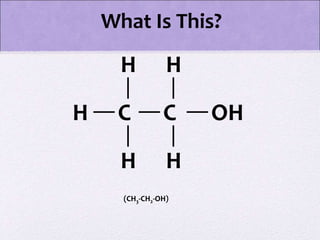
What Is This?
C
H
H
H
OH
C
H
H
(CH3-CH2-OH)
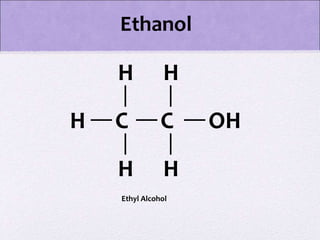
Ethanol
C
H
H
H
OH
Ethyl Alcohol
C
H
H
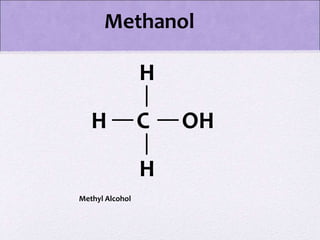
Methanol
C
H
H
H
OH
Methyl Alcohol
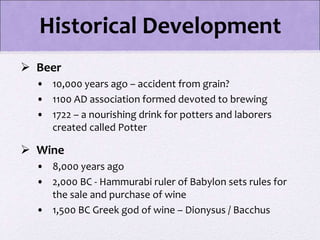
 Beer
• 10,000 years ago – accident from grain?
• 1100 AD association formed devoted to brewing
• 1722 – a nourishing drink for potters and laborers
created called Potter
 Wine
• 8,000 years ago
• 2,000 BC - Hammurabi ruler of Babylon sets rules for
the sale and purchase of wine
• 1,500 BC Greek god of wine – Dionysus / Bacchus
Historical Development
Alcohol
 Alchemist of the 16th century saw alcohol
as the essence from distillation.
 The middle of the 18th century alcohol took
on its current meaning of the intoxicating
ingredient of many common beverages.
Historical Awareness
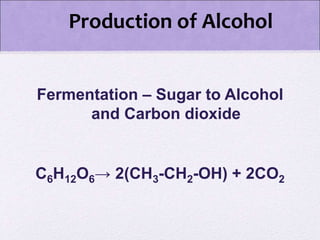
Production of Alcohol
Fermentation – Sugar to Alcohol
and Carbon dioxide
C6H12O6→ 2(CH3-CH2-OH) + 2CO2
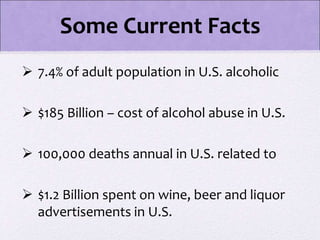
 7.4% of adult population in U.S. alcoholic
 $185 Billion – cost of alcohol abuse in U.S.
 100,000 deaths annual in U.S. related to
 $1.2 Billion spent on wine, beer and liquor
advertisements in U.S.
Some Current Facts
“Drinker” Definitions
• Binge drinking: Four or more drinks for
a female and five or more drinks for a
male at one sitting
“Drinker” Definitions
• Chronic drinking: Daily or almost
daily alcohol consumption
(60 drinks per month)
 Rapidly absorbed from stomach, small
intestine, and colon
 Maximal blood concentration within 30
to 90 minutes
 Can be absorbed through the lungs
Absorption
 Uniformly distributed throughout tissues
and body fluids
 Readily crosses placenta, to exposure
fetus
Distribution
Consumption
Have you ever drank
alcohol?
Why?
Have you ever drank
too much alcohol?
Health Effects
What are the pleasant
effects of alcohol?
The adverse effects
(toxicity)?
Short-term Effects
• Slower reaction times/reflexes
• Heavy sweating
• Blurry vision
• Nausea and vomiting
• Lowered reasoning ability
Short-term Effects cont..
• Poor motor coordination
• Slower heart rate/breathing rate
• Increased blood pressure
• Anxiety/restlessness
• Lower inhibition
Short-term Effects cont..
• Mental confusion
• Memory loss
• Coma
• Death from respiratory arrest
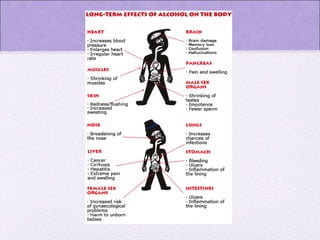
Long-term Effects(5,6)
• Nervous system
• Muscles
• Lungs
• Liver
Long-term Effects
(cont.)(5,6)
• Sexual organs
• Brain
• Heart
• Esophagus/stomach
Alcohol & Cancer
Ethanol consumption increases risk
of cancer
Oral Cavity
Pharynx and Larynx
Esophagus
Liver
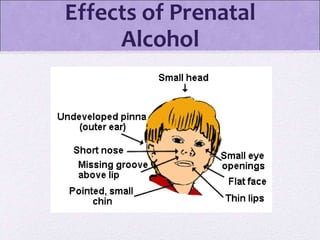
Fetal Alcohol Syndrome
(FAS)
Most common preventable cause of adverse
CNS development
4,000-12,000 infants per year in US
Characteristics
 Growth retardation
 Facial malformations
 Small head
 Greatly reduce intelligence
Fetal Alcohol Effect (FAE)
Milder form of FAS
7,000-36,000 infants per year in US
Characteristics
 Growth deficiency
 Learning dysfunction
 Nervous systems disabilities
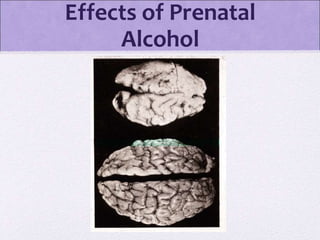
Effects of Prenatal
Alcohol
Effects of Prenatal
Alcohol
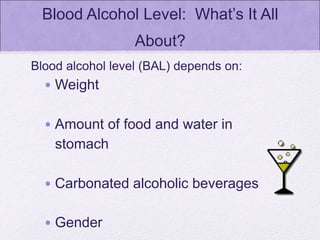
Blood Alcohol Level: What’s It All
About?
Blood alcohol level (BAL) depends on:
• Weight
• Amount of food and water in
stomach
• Carbonated alcoholic beverages
• Gender
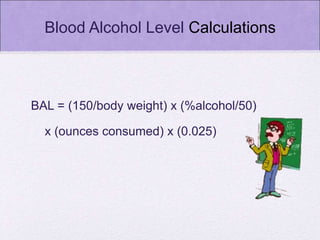
Blood Alcohol Level Calculations
BAL = (150/body weight) x (%alcohol/50)
x (ounces consumed) x (0.025)
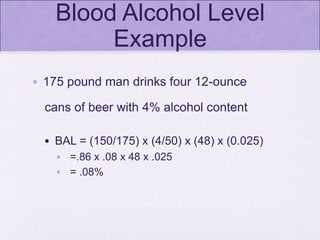
Blood Alcohol Level
Example
• 175 pound man drinks four 12-ounce
cans of beer with 4% alcohol content
• BAL = (150/175) x (4/50) x (48) x (0.025)
• =.86 x .08 x 48 x .025
• = .08%
Blood Alcohol Levels: So What?
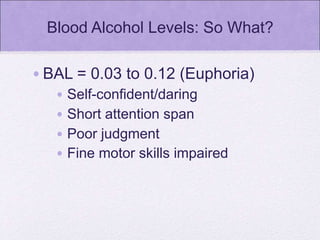
•BAL = 0.03 to 0.12 (Euphoria)
• Self-confident/daring
• Short attention span
• Poor judgment
• Fine motor skills impaired
Blood Alcohol Levels(8)
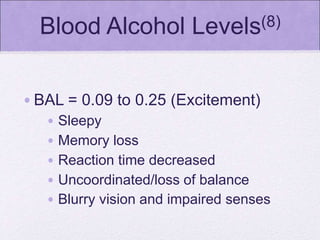
•BAL = 0.09 to 0.25 (Excitement)
• Sleepy
• Memory loss
• Reaction time decreased
• Uncoordinated/loss of balance
• Blurry vision and impaired senses
Blood Alcohol Levels
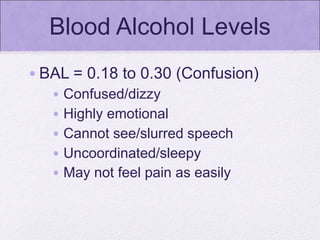
•BAL = 0.18 to 0.30 (Confusion)
• Confused/dizzy
• Highly emotional
• Cannot see/slurred speech
• Uncoordinated/sleepy
• May not feel pain as easily
Blood Alcohol Levels
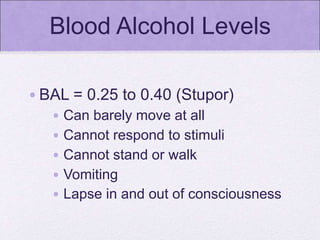
•BAL = 0.25 to 0.40 (Stupor)
• Can barely move at all
• Cannot respond to stimuli
• Cannot stand or walk
• Vomiting
• Lapse in and out of consciousness
Blood Alcohol Levels
•BAL = 0.35 to 0.50 (Coma)
• Unconscious
• Reflexes depressed
• Decreased body temperature
• Decreased breathing rate
• Decreased heart rate
• Could die
Blood Alcohol Levels
•BAL = Greater than 0.50 (Death)
• Breathing stops
• That says it all!
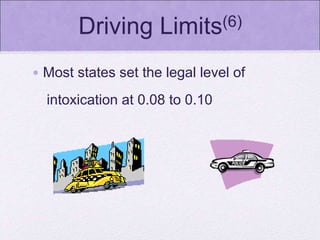
Driving Limits(6)
• Most states set the legal level of
intoxication at 0.08 to 0.10
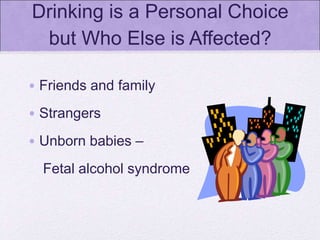
Drinking is a Personal Choice
but Who Else is Affected?
• Friends and family
• Strangers
• Unborn babies –
Fetal alcohol syndrome
Urinary Excretion
Exhalation
Metabolism
Elimination
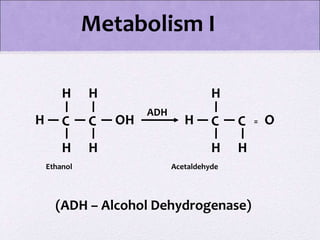
Metabolism I
C
H OH
Ethanol
H
H
C
H
H
C
H
H
H
C O
H
=
Acetaldehyde
(ADH – Alcohol Dehydrogenase)
ADH
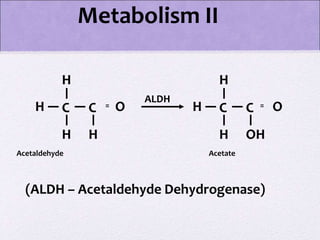
Metabolism II
C
H
H
H
C O
H
=
Acetaldehyde
(ALDH – Acetaldehyde Dehydrogenase)
ALDH
Acetate
C
H
H
H
C O
OH
=
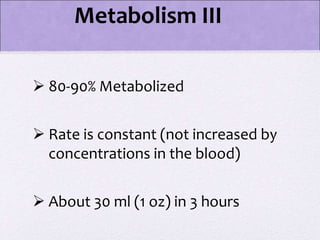
Metabolism III
 80-90% Metabolized
 Rate is constant (not increased by
concentrations in the blood)
 About 30 ml (1 oz) in 3 hours
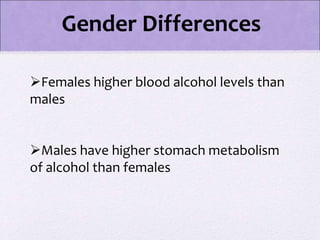
Gender Differences
Females higher blood alcohol levels than
males
Males have higher stomach metabolism
of alcohol than females
Alcoholism - Disulfiram
Alcoholism Treatment with Disulfiram
Inhibits acetaldehyde dehydrogenase (ALDH)
Elevated acetaldehyde cause increased
flushing, tachycardia (elevated heart rate),
nausea, vomiting & hyperventilation.
Alcoholism – Alcohol Dependence
 Craving: A strong need, or compulsion, to drink.
 Loss of control: The inability to limit one’s drinking on any
given occasion.
 Physical dependence: Withdrawal symptoms, such as
nausea, sweating, shakiness, and anxiety, occur when
alcohol use is stopped after a period of heavy drinking.
 Tolerance: The need to drink greater amounts of alcohol in
order to “get high.”
 Tremor
 Nausea
 Irritability
 Agitation
Alcohol Withdrawal
Effects
 Tachycardia
 Hypertension
 Seizures
 Hallucinations
Looking Back
• Drinking has various definitions
• Binge and Chronic
• Drinking can have short- and long-term
effects
• Slower reaction times
• Memory loss
• Nervous system/liver problems
Looking Back (cont.)
• Blood alcohol levels are affected by
weight and gender
• Drinking is a personal choice, but it
can affect those around you
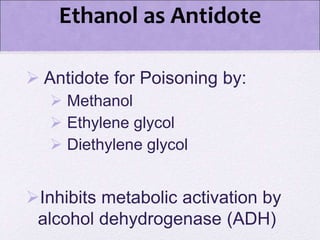
Ethanol as Antidote
 Antidote for Poisoning by:
 Methanol
 Ethylene glycol
 Diethylene glycol
Inhibits metabolic activation by
alcohol dehydrogenase (ADH)
Thank you

Alcohol and Hazards.ppt

  • 1.
    Health Effects ofAlcohol - Dr. Udit Narang
  • 2.
  • 3.
  • 4.
  • 5.
     Beer • 10,000years ago – accident from grain? • 1100 AD association formed devoted to brewing • 1722 – a nourishing drink for potters and laborers created called Potter  Wine • 8,000 years ago • 2,000 BC - Hammurabi ruler of Babylon sets rules for the sale and purchase of wine • 1,500 BC Greek god of wine – Dionysus / Bacchus Historical Development
  • 6.
    Alcohol  Alchemist ofthe 16th century saw alcohol as the essence from distillation.  The middle of the 18th century alcohol took on its current meaning of the intoxicating ingredient of many common beverages. Historical Awareness
  • 7.
    Production of Alcohol Fermentation– Sugar to Alcohol and Carbon dioxide C6H12O6→ 2(CH3-CH2-OH) + 2CO2
  • 8.
     7.4% ofadult population in U.S. alcoholic  $185 Billion – cost of alcohol abuse in U.S.  100,000 deaths annual in U.S. related to  $1.2 Billion spent on wine, beer and liquor advertisements in U.S. Some Current Facts
  • 9.
    “Drinker” Definitions • Bingedrinking: Four or more drinks for a female and five or more drinks for a male at one sitting
  • 10.
    “Drinker” Definitions • Chronicdrinking: Daily or almost daily alcohol consumption (60 drinks per month)
  • 11.
     Rapidly absorbedfrom stomach, small intestine, and colon  Maximal blood concentration within 30 to 90 minutes  Can be absorbed through the lungs Absorption
  • 12.
     Uniformly distributedthroughout tissues and body fluids  Readily crosses placenta, to exposure fetus Distribution
  • 13.
    Consumption Have you everdrank alcohol? Why? Have you ever drank too much alcohol?
  • 14.
    Health Effects What arethe pleasant effects of alcohol? The adverse effects (toxicity)?
  • 15.
    Short-term Effects • Slowerreaction times/reflexes • Heavy sweating • Blurry vision • Nausea and vomiting • Lowered reasoning ability
  • 16.
    Short-term Effects cont.. •Poor motor coordination • Slower heart rate/breathing rate • Increased blood pressure • Anxiety/restlessness • Lower inhibition
  • 17.
    Short-term Effects cont.. •Mental confusion • Memory loss • Coma • Death from respiratory arrest
  • 18.
    Long-term Effects(5,6) • Nervoussystem • Muscles • Lungs • Liver
  • 19.
    Long-term Effects (cont.)(5,6) • Sexualorgans • Brain • Heart • Esophagus/stomach
  • 21.
    Alcohol & Cancer Ethanolconsumption increases risk of cancer Oral Cavity Pharynx and Larynx Esophagus Liver
  • 22.
    Fetal Alcohol Syndrome (FAS) Mostcommon preventable cause of adverse CNS development 4,000-12,000 infants per year in US Characteristics  Growth retardation  Facial malformations  Small head  Greatly reduce intelligence
  • 23.
    Fetal Alcohol Effect(FAE) Milder form of FAS 7,000-36,000 infants per year in US Characteristics  Growth deficiency  Learning dysfunction  Nervous systems disabilities
  • 24.
  • 25.
  • 26.
    Blood Alcohol Level:What’s It All About? Blood alcohol level (BAL) depends on: • Weight • Amount of food and water in stomach • Carbonated alcoholic beverages • Gender
  • 27.
    Blood Alcohol LevelCalculations BAL = (150/body weight) x (%alcohol/50) x (ounces consumed) x (0.025)
  • 28.
    Blood Alcohol Level Example •175 pound man drinks four 12-ounce cans of beer with 4% alcohol content • BAL = (150/175) x (4/50) x (48) x (0.025) • =.86 x .08 x 48 x .025 • = .08%
  • 29.
    Blood Alcohol Levels:So What? •BAL = 0.03 to 0.12 (Euphoria) • Self-confident/daring • Short attention span • Poor judgment • Fine motor skills impaired
  • 30.
    Blood Alcohol Levels(8) •BAL= 0.09 to 0.25 (Excitement) • Sleepy • Memory loss • Reaction time decreased • Uncoordinated/loss of balance • Blurry vision and impaired senses
  • 31.
    Blood Alcohol Levels •BAL= 0.18 to 0.30 (Confusion) • Confused/dizzy • Highly emotional • Cannot see/slurred speech • Uncoordinated/sleepy • May not feel pain as easily
  • 32.
    Blood Alcohol Levels •BAL= 0.25 to 0.40 (Stupor) • Can barely move at all • Cannot respond to stimuli • Cannot stand or walk • Vomiting • Lapse in and out of consciousness
  • 33.
    Blood Alcohol Levels •BAL= 0.35 to 0.50 (Coma) • Unconscious • Reflexes depressed • Decreased body temperature • Decreased breathing rate • Decreased heart rate • Could die
  • 34.
    Blood Alcohol Levels •BAL= Greater than 0.50 (Death) • Breathing stops • That says it all!
  • 35.
    Driving Limits(6) • Moststates set the legal level of intoxication at 0.08 to 0.10
  • 36.
    Drinking is aPersonal Choice but Who Else is Affected? • Friends and family • Strangers • Unborn babies – Fetal alcohol syndrome
  • 37.
  • 38.
    Metabolism I C H OH Ethanol H H C H H C H H H CO H = Acetaldehyde (ADH – Alcohol Dehydrogenase) ADH
  • 39.
    Metabolism II C H H H C O H = Acetaldehyde (ALDH– Acetaldehyde Dehydrogenase) ALDH Acetate C H H H C O OH =
  • 40.
    Metabolism III  80-90%Metabolized  Rate is constant (not increased by concentrations in the blood)  About 30 ml (1 oz) in 3 hours
  • 41.
    Gender Differences Females higherblood alcohol levels than males Males have higher stomach metabolism of alcohol than females
  • 42.
    Alcoholism - Disulfiram AlcoholismTreatment with Disulfiram Inhibits acetaldehyde dehydrogenase (ALDH) Elevated acetaldehyde cause increased flushing, tachycardia (elevated heart rate), nausea, vomiting & hyperventilation.
  • 43.
    Alcoholism – AlcoholDependence  Craving: A strong need, or compulsion, to drink.  Loss of control: The inability to limit one’s drinking on any given occasion.  Physical dependence: Withdrawal symptoms, such as nausea, sweating, shakiness, and anxiety, occur when alcohol use is stopped after a period of heavy drinking.  Tolerance: The need to drink greater amounts of alcohol in order to “get high.”
  • 44.
     Tremor  Nausea Irritability  Agitation Alcohol Withdrawal Effects  Tachycardia  Hypertension  Seizures  Hallucinations
  • 45.
    Looking Back • Drinkinghas various definitions • Binge and Chronic • Drinking can have short- and long-term effects • Slower reaction times • Memory loss • Nervous system/liver problems
  • 46.
    Looking Back (cont.) •Blood alcohol levels are affected by weight and gender • Drinking is a personal choice, but it can affect those around you
  • 47.
    Ethanol as Antidote Antidote for Poisoning by:  Methanol  Ethylene glycol  Diethylene glycol Inhibits metabolic activation by alcohol dehydrogenase (ADH)
  • 48.