Alberto
Ginastera
CJ., Bailey, Delilah
Background Information
Alberto Ginastera was born in Buenos Aires, Argentina
to a Catalan father and Italian mother in 1916
Musically gifted as a child, Ginastera studied in
Buenos Aires at the Conservatorio Williams and the
National Conservatory
He is one of the most renowned composers of the 20th
century with a repertoire consisting of ballets, operas,
and concertos
The Renovation Movement
In 1929 a group of young composers founded the
Grupo Renocación (Renovation Group)
Key members included Juan José Castro, Juan Carlos
Paz, and Luis Gianneo
Championed dissonant, atonal music alongside
serialism. Employed Neo-classical techniques
Career
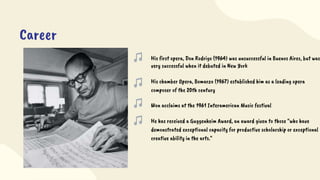
His first opera, Don Rodrigo (1964) was unsuccessful in Buenos Aires, but was
very successful when it debuted in New York
His chamber Opera, Bomarzo (1967) established him as a leading opera
composer of the 20th century
Won acclaims at the 1961 Interamerican Music festival
He has received a Guggenheim Award, an award given to those "who have
demonstrated exceptional capacity for productive scholarship or exceptional
creative ability in the arts."
Genre
Genre: Classical
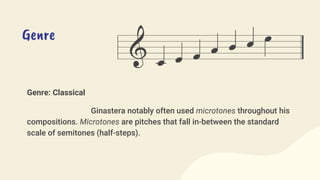
Ginastera notably often used microtones throughout his
compositions. Microtones are pitches that fall in-between the standard
scale of semitones (half-steps).
Microtones
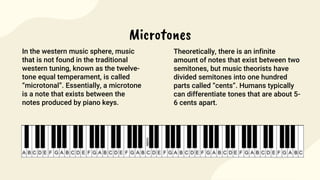
In the western music sphere, music
that is not found in the traditional
western tuning, known as the twelve-
tone equal temperament, is called
“microtonal”. Essentially, a microtone
is a note that exists between the
notes produced by piano keys.
Theoretically, there is an infinite
amount of notes that exist between two
semitones, but music theorists have
divided semitones into one hundred
parts called “cents”. Humans typically
can differentiate tones that are about 5-
6 cents apart.
Genre
Genre: Classical
Ginastera featured folk guitar traditions and syncopated folk dance rhythms
with a development of the musical themes through: the vidala, a type of
vocal music found in Argentina and Bolivia; the baguala, a lyric song form
that comprises of three pitches found in Northern Argentina and Paraguay;
and andino cantos de caja, folk music originating from the Andes region.
Style
○ Often Integrates Argentine folk themes
in a straightforward fashion
○ He would construct original thematic
material, rhythmic patterns and
harmonic progressions that were
predicated on the rhythmic and
harmonic properties of actual Latin
folk music
Style
His compositions composed of unified musical styles to create a
harmonious musical expression. He would compose his music in 3
different periods:
○ Objective Nationalism (1934-1948)
○ Subjective Nationalism (1948-1958)
○ Neo-Expressionism (1958-1963)
Styles incorporated:
● Gato
● Bailecito
● Huella
● Malambo
● Milonga
● Tango
“La doma" (Horsebreaking), from Estancia
A piece from “objective nationalism” period
Date of Composition 1941
Genre: chamber orchestra
Style: Malambo
Famous Compositions
Variaciones Concertantes op.23
A central work during his era of “subjective nationalism” at
a time where he was forced to resign as director of the music
conservatory at the National University of La Plata due to
political conflicts.
Date of composition: 1953
Genre: chamber orchestra
Style: Malambo
Famous Compositions
"Bomarzo" op.23 (Act II: Scene XI The Garden of Eros)
The production was originally banned due to sexual content and was not performed
in Argentina until 1972
Date of composition: 1967
Genre: chamber orchestral/opera
Famous Compositions
“The main point of crisis in the opera is the Erotic Ballet, in which the Duke of Bomarzo
dreams and his nightmare foresees his Scaro Bosco—the garden of monsters, which he
creates at the end of his life. In death he becomes one with the statues. They are his
immortality.” -Alberto Ginastera
Works Cited
“Alberto Ginastera.” Alberto Ginastera - New World Encyclopedia,
www.newworldencyclopedia.org/entry/Alberto_Ginastera.
“Alberto Ginastera: South American Musical Spokesman.” Musics of Latin America, by Robin Moore, Norton &
Company, 2012, pp. 313–317.
The Editors of Encyclopaedia Britannica. "Alberto Ginastera". Encyclopedia Britannica, 21 Jun. 2020,
https://www.britannica.com/biography/Alberto-Ginastera.
Ginastera, Alberto. “Bomarzo.” Boosey & Hawkes, boosey.com/cr/music/Alberto-Ginastera-Bomarzo/2132.
CREDITS: This presentation template was
created by Slidesgo, including icons by Flaticon,
and infographics & images by Freepik.
Thanks
Please keep this slide for attribution.

Alberto Ginastera

  • 1.
  • 2.
    Background Information Alberto Ginasterawas born in Buenos Aires, Argentina to a Catalan father and Italian mother in 1916 Musically gifted as a child, Ginastera studied in Buenos Aires at the Conservatorio Williams and the National Conservatory He is one of the most renowned composers of the 20th century with a repertoire consisting of ballets, operas, and concertos
  • 3.
    The Renovation Movement In1929 a group of young composers founded the Grupo Renocación (Renovation Group) Key members included Juan José Castro, Juan Carlos Paz, and Luis Gianneo Championed dissonant, atonal music alongside serialism. Employed Neo-classical techniques
  • 4.
    Career His first opera,Don Rodrigo (1964) was unsuccessful in Buenos Aires, but was very successful when it debuted in New York His chamber Opera, Bomarzo (1967) established him as a leading opera composer of the 20th century Won acclaims at the 1961 Interamerican Music festival He has received a Guggenheim Award, an award given to those "who have demonstrated exceptional capacity for productive scholarship or exceptional creative ability in the arts."
  • 5.
    Genre Genre: Classical Ginastera notablyoften used microtones throughout his compositions. Microtones are pitches that fall in-between the standard scale of semitones (half-steps).
  • 6.
    Microtones In the westernmusic sphere, music that is not found in the traditional western tuning, known as the twelve- tone equal temperament, is called “microtonal”. Essentially, a microtone is a note that exists between the notes produced by piano keys. Theoretically, there is an infinite amount of notes that exist between two semitones, but music theorists have divided semitones into one hundred parts called “cents”. Humans typically can differentiate tones that are about 5- 6 cents apart.
  • 7.
    Genre Genre: Classical Ginastera featuredfolk guitar traditions and syncopated folk dance rhythms with a development of the musical themes through: the vidala, a type of vocal music found in Argentina and Bolivia; the baguala, a lyric song form that comprises of three pitches found in Northern Argentina and Paraguay; and andino cantos de caja, folk music originating from the Andes region.
  • 8.
    Style ○ Often IntegratesArgentine folk themes in a straightforward fashion ○ He would construct original thematic material, rhythmic patterns and harmonic progressions that were predicated on the rhythmic and harmonic properties of actual Latin folk music
  • 9.
    Style His compositions composedof unified musical styles to create a harmonious musical expression. He would compose his music in 3 different periods: ○ Objective Nationalism (1934-1948) ○ Subjective Nationalism (1948-1958) ○ Neo-Expressionism (1958-1963)
  • 10.
    Styles incorporated: ● Gato ●Bailecito ● Huella ● Malambo ● Milonga ● Tango
  • 11.
    “La doma" (Horsebreaking),from Estancia A piece from “objective nationalism” period Date of Composition 1941 Genre: chamber orchestra Style: Malambo Famous Compositions
  • 12.
    Variaciones Concertantes op.23 Acentral work during his era of “subjective nationalism” at a time where he was forced to resign as director of the music conservatory at the National University of La Plata due to political conflicts. Date of composition: 1953 Genre: chamber orchestra Style: Malambo Famous Compositions
  • 13.
    "Bomarzo" op.23 (ActII: Scene XI The Garden of Eros) The production was originally banned due to sexual content and was not performed in Argentina until 1972 Date of composition: 1967 Genre: chamber orchestral/opera Famous Compositions “The main point of crisis in the opera is the Erotic Ballet, in which the Duke of Bomarzo dreams and his nightmare foresees his Scaro Bosco—the garden of monsters, which he creates at the end of his life. In death he becomes one with the statues. They are his immortality.” -Alberto Ginastera
  • 14.
    Works Cited “Alberto Ginastera.”Alberto Ginastera - New World Encyclopedia, www.newworldencyclopedia.org/entry/Alberto_Ginastera. “Alberto Ginastera: South American Musical Spokesman.” Musics of Latin America, by Robin Moore, Norton & Company, 2012, pp. 313–317. The Editors of Encyclopaedia Britannica. "Alberto Ginastera". Encyclopedia Britannica, 21 Jun. 2020, https://www.britannica.com/biography/Alberto-Ginastera. Ginastera, Alberto. “Bomarzo.” Boosey & Hawkes, boosey.com/cr/music/Alberto-Ginastera-Bomarzo/2132.
  • 15.
    CREDITS: This presentationtemplate was created by Slidesgo, including icons by Flaticon, and infographics & images by Freepik. Thanks Please keep this slide for attribution.

Editor's Notes

  • #13 Highlights variety of instruments: movement 1: cello + harp; movement 2: string orchestra; movement 3: flute (including piccolo); movement four: clarinet; movement 5: viola; movement 6: oboe + bassoon; movement 7: trumpet + trombone; movement 8: violin; movement 9: horn; 10 interlude: wind movement; 11 reprise) double bass + harp, movement 12/finale: full orchestra