Markers of low socio-economic status
and lack of social support are associated
with low health-related quality-of-life in
colorectal cancer survivors
Linda Sharp, Alan O’Ceilleachair, Eamonn O’Leary,
Mairead Skally, Paul Hanly
email: a.oceilleachair@ucc.ie
Introduction & Methods
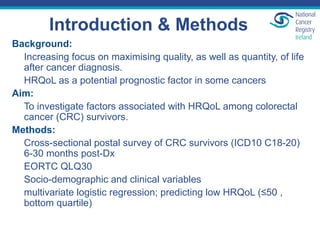
Background:
Increasing focus on maximising quality, as well as quantity, of life
after cancer diagnosis.
HRQoL as a potential prognostic factor in some cancers
Aim:
To investigate factors associated with HRQoL among colorectal
cancer (CRC) survivors.
Methods:
Cross-sectional postal survey of CRC survivors (ICD10 C18-20)
6-30 months post-Dx
EORTC QLQ30
Socio-demographic and clinical variables
multivariate logistic regression; predicting low HRQoL (≤50 ,
bottom quartile)
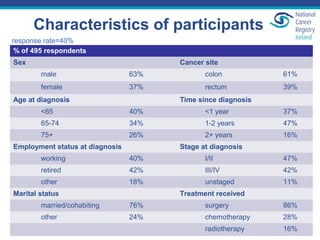
Characteristics of participants
% of 495 respondents
Sex Cancer site
male 63% colon 61%
female 37% rectum 39%
Age at diagnosis Time since diagnosis
<65 40% <1 year 37%
65-74 34% 1-2 years 47%
75+ 26% 2+ years 16%
Employment status at diagnosis Stage at diagnosis
working 40% I/II 47%
retired 42% III/IV 42%
other 18% unstaged 11%
Marital status Treatment received
married/cohabiting 76% surgery 86%
other 24% chemotherapy 28%
radiotherapy 16%
response rate=40%
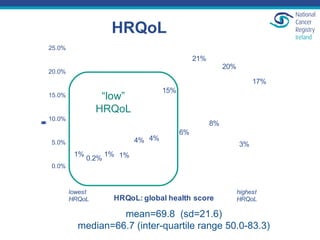
HRQoL
1%
0.2%
1% 1%
4% 4%
15%
6%
21%
8%
20%
3%
17%
0.0%
5.0%
10.0%
15.0%
20.0%
25.0%
Frequency
HRQoL: global health score
lowest
HRQoL
highest
HRQoL
mean=69.8 (sd=21.6)
median=66.7 (inter-quartile range 50.0-83.3)
“low”
HRQoL
Results/Conclusions
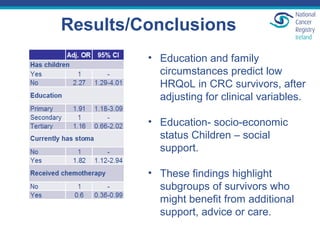
• Education and family
circumstances predict low
HRQoL in CRC survivors, after
adjusting for clinical variables.
• Education- socio-economic
status Children – social
support.
• These findings highlight
subgroups of survivors who
might benefit from additional
support, advice or care.
Results/Conclusions
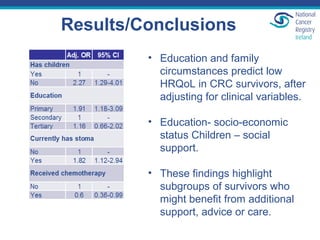
• Education and family
circumstances predict low
HRQoL in CRC survivors, after
adjusting for clinical variables.
• Education- socio-economic
status Children – social
support.
• These findings highlight
subgroups of survivors who
might benefit from additional
support, advice or care.

Markers of low socio-economic status and lack of social support are associated with low health-related quality-of-life in colorectal cancer survivors

  • 1.
    Markers of lowsocio-economic status and lack of social support are associated with low health-related quality-of-life in colorectal cancer survivors Linda Sharp, Alan O’Ceilleachair, Eamonn O’Leary, Mairead Skally, Paul Hanly email: a.oceilleachair@ucc.ie
  • 2.
    Introduction & Methods Background: Increasingfocus on maximising quality, as well as quantity, of life after cancer diagnosis. HRQoL as a potential prognostic factor in some cancers Aim: To investigate factors associated with HRQoL among colorectal cancer (CRC) survivors. Methods: Cross-sectional postal survey of CRC survivors (ICD10 C18-20) 6-30 months post-Dx EORTC QLQ30 Socio-demographic and clinical variables multivariate logistic regression; predicting low HRQoL (≤50 , bottom quartile)
  • 3.
    Characteristics of participants %of 495 respondents Sex Cancer site male 63% colon 61% female 37% rectum 39% Age at diagnosis Time since diagnosis <65 40% <1 year 37% 65-74 34% 1-2 years 47% 75+ 26% 2+ years 16% Employment status at diagnosis Stage at diagnosis working 40% I/II 47% retired 42% III/IV 42% other 18% unstaged 11% Marital status Treatment received married/cohabiting 76% surgery 86% other 24% chemotherapy 28% radiotherapy 16% response rate=40%
  • 4.
    HRQoL 1% 0.2% 1% 1% 4% 4% 15% 6% 21% 8% 20% 3% 17% 0.0% 5.0% 10.0% 15.0% 20.0% 25.0% Frequency HRQoL:global health score lowest HRQoL highest HRQoL mean=69.8 (sd=21.6) median=66.7 (inter-quartile range 50.0-83.3) “low” HRQoL
  • 5.
    Results/Conclusions • Education andfamily circumstances predict low HRQoL in CRC survivors, after adjusting for clinical variables. • Education- socio-economic status Children – social support. • These findings highlight subgroups of survivors who might benefit from additional support, advice or care.
  • 6.
    Results/Conclusions • Education andfamily circumstances predict low HRQoL in CRC survivors, after adjusting for clinical variables. • Education- socio-economic status Children – social support. • These findings highlight subgroups of survivors who might benefit from additional support, advice or care.