Bertrand Russell and the Challenges of Contemporary 
China 
Tanweer Akram (Voya Investment Management) 
12th International Post Keynesian Conference (Sep 25-Sep 27, 2014) 
University of Missouri Kansas City (UMKC) 
Kansas City, Missouri, USA
Important Disclaimer 
This commentary has been prepared by Voya Investment Management for informational purposes. Nothing 
contained herein should be construed as (i) an offer to sell or solicitation of an offer to buy any security or (ii) 
a recommendation as to the advisability of investing in, purchasing or selling any security. Any opinions 
expressed herein reflect our judgment and are subject to change. Certain of the statements contained herein 
are statements of future expectations and other forward-looking statements that are based on management’s 
current views and assumptions and involve known and unknown risks and uncertainties that could cause 
actual results, performance or events to differ materially from those expressed or implied in such statements. 
Actual results, performance or events may differ materially from those in such statements due to, without 
limitation, (1) general economic conditions, (2) performance of financial markets, (3) interest rate levels, (4) 
increasing levels of loan defaults (5) changes in laws and regulations and (6) changes in the policies of 
governments and/or regulatory authorities. The opinions, views and information expressed in this 
commentary regarding holdings are subject to change without notice. The information provided regarding 
holdings is not a recommendation to buy or sell any security. Fund holdings are fluid and are subject to daily 
change based on market conditions and other factors. Past performance is no guarantee of future results. 
Voya Compliance ID # 10534 
2
Motivation 
 More than 90 years ago Bertrand Russell 
wrote The Problem of China (1922). 
 This presentation will discuss some of the 
key challenges of contemporary China in 
light of Russell’s dated but insightful and 
prescient analysis. 
 Many of the issues that Russell identified still 
apply to contemporary China but there are 
other important issues crucial today that were 
not topical 90 years ago! 
5
Russell in China 
6
Bertrand Russell and China 
 Among the first major Western philosophers who visited 
China 
 Taught at Peking Government University 
 Published The Problem of China (1922) 
 Retained an interest in China throughout his life 
 Corresponded with Chinese leaders, particularly during and 
after the Sino-Indian war (1962) 
7
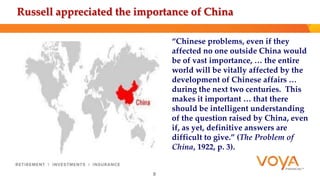
Russell appreciated the importance of China 
“Chinese problems, even if they 
affected no one outside China would 
be of vast importance, … the entire 
world will be vitally affected by the 
development of Chinese affairs … 
during the next two centuries. This 
makes it important … that there 
should be intelligent understanding 
of the question raised by China, even 
if, as yet, definitive answers are 
difficult to give.” (The Problem of 
China, 1922, p. 3). 
8
China today is a lot different than during Russell’s visit! 
 The world’s second largest economy (measured in 
purchasing-power parity terms) 
 Important driver of global growth 
 Vital role in international trade and global 
manufacturing and supply chain 
 Strong per capita real income growth and impressive 
reduction of income poverty since 1980 
9
China is the world’s second largest economy 
10
Per capita real income in China has increased rapidly 
12
China’s challenges today 
 Still a lower medium income country 
 The standard of living remains low for the vast majority 
of its people 
 Problems of rebalancing aggregate demand, 
environmental degradation, and widening social 
disparities 
 One party system 
15
The main problems that Russell identified in 1922 
1. The establishment of a stable, orderly and sovereign 
government 
2. The industrialization and modernization of the 
country’s economy with Chinese control 
3. The spread of education 
16
Industrialization and economic transformation in China 
 Russell understood that industrialization would be important for China. He 
believed that Chinese industrialization would occur only under socialism. 
Even though he thought industrialization is essential, he believed that China 
would remain a predominantly agrarian country in the foreseeable future. 
 Indeed, substantial industrialization and modernization did occur after the 
establishment of the People’s Republic of China. But renewed impetus to 
strong growth came after the post-Maoist reforms in both agriculture and 
industry. 
 China is a now a “mixed economy”, with substantial state ownership and 
control of the means of production but also with private ownership of 
capital. 
18
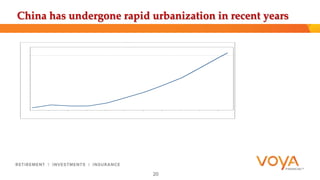
China has undergone rapid urbanization in recent years 
20
Challenges for contemporary China that are relevant today 
but were not topics of the day during Russell’s times 
 Structural composition of aggregate demand 
 Aging population, low fertility rate, biased sex ratio and demographic 
transition 
 Environmental degradation 
 Social disparities 
 Health standards and food safety 
 Banking and finance 
 Elevated real estate prices 
 Energy security 
21
Both consumption and investment underlie domestic demand 
growth 
22
Consumerism and consumption in China 
Consumption in China has risen 
in conjunction with growth and 
the rise of real income, even 
though household consumption 
as a share of national income 
remains low and has declined 
since the early 1990s. 
24
High investment, fixed asset and infrastructure Spending 
 Investment has been important driver of growth. Construction of 
industrial, commercial and residential real estate has boomed. Chinese 
cities have changed dramatically since Russell’s times! 
 By 2025, in China 
 Urban population will grow to about 250 million 
 More than 200 Chinese cities shall have more than one million residents, 
compared to 35 such cities in Europe 
 50,000 skyscrapers is expected to be constructed (= 10 Manhattans!) 
 Beijing’s subway (underground metro) system will exceed 1,000 km and the 
country will be building more subway lines that what the total of Europe’s 
currently installed subway systems 
25
Impressive skyscrapers!
China’s population is expected to decline by mid-2030s. 
29
China is benefiting from demographic dividend 
30
Some indicators of human development in China 
Indicator of Human Capital Development People’s Republic of China 
(CHN) 
34 
South Korea 
(KOR) 
Japan 
(JPN) 
Life expectancy at birth, years, 2012 
73.7 80.7 83.6 
Mean years of schooling, years, 2010 7.5 11.6 11.6 
Expected years of schooling, years, 2011 
11.7 17.2 15.3 
Maternal mortality rate, death per 100,000 
birth, 2010 
37 16 5 
Physicians, per 1,000 people, 2005-2010 1.4 2.0 2.1 
Source: UNDP, Human Development Report 2013
Progress in health and life expectancy has not been 
impressive since the beginning of economic reforms 
 While China continues to make impressive progress in education, 
scientific and technological capabilities, since the beginning of 
economic reforms China’s life expectancy gains and health gains 
have been less impressive. 
 China will need to investment in public health infrastructure, 
public health security and insurance, and improve food and water 
safety standards to improve the health outcomes of its people 
going forward. 
35
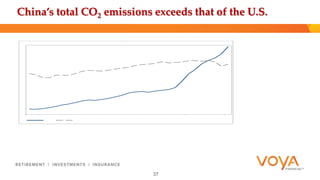
China’s total CO2 emissions exceeds that of the U.S. 
37
But China’s per capita CO2 emissions are still far below 
that of advanced capitalist economies 
38
China’s oil consumption to GDP ratio is high 
39
The peaceful rise of China 
42
China’s dispute with Japan 
43
Disputes in South China Seas with its neighbors 
45
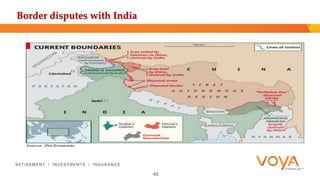
Border disputes with India 
46
Cooperation with Russia: Tactical or strategic? 
47
How to “recover” Taiwan? 
48
China 3.0
Major long term challenges for contemporary China 
 Governance, regime stability, and human rights. Or how to 
avoid an “Orange Revolution”! 
 Industrialization and modernization of the economy 
 Job growth and poverty reduction 
 Inequality and social disparities 
 Human capital development, education and health care 
 Managing the demographic transition 
 Improving the quality of the environment 
 Ensuring energy security and access to resources 
 Regulating of the financial sector, including shadow banking 
 Ensuring the “peaceful rise” of its global power without 
incurring the wrath of the Western countries!
Conclusions 
 China’s challenges are still formidable but the country has made 
impressive gains, particularly in real per capita income growth, in 
recent decades. Russell realized the vital importance of 
industrialization for China’s development and modernization, but 
also the role of governance, regime stability, and human capital 
development and scientific and technological capability. 
 There are similarities between the problems that Russell identified 
years ago and contemporary China’s challenges, as well as differences 
and, of course, new problems. 
 Russell hoped that China, unlike Western nations, could and would 
develop without resorting to ultra nationalism, militarism, and crass 
materialism. He was optimistic that China would be a progressive 
force in the community of nations. 
52

Bertrand Russell and the Challenges of Contemporary China

  • 1.
    Bertrand Russell andthe Challenges of Contemporary China Tanweer Akram (Voya Investment Management) 12th International Post Keynesian Conference (Sep 25-Sep 27, 2014) University of Missouri Kansas City (UMKC) Kansas City, Missouri, USA
  • 2.
    Important Disclaimer Thiscommentary has been prepared by Voya Investment Management for informational purposes. Nothing contained herein should be construed as (i) an offer to sell or solicitation of an offer to buy any security or (ii) a recommendation as to the advisability of investing in, purchasing or selling any security. Any opinions expressed herein reflect our judgment and are subject to change. Certain of the statements contained herein are statements of future expectations and other forward-looking statements that are based on management’s current views and assumptions and involve known and unknown risks and uncertainties that could cause actual results, performance or events to differ materially from those expressed or implied in such statements. Actual results, performance or events may differ materially from those in such statements due to, without limitation, (1) general economic conditions, (2) performance of financial markets, (3) interest rate levels, (4) increasing levels of loan defaults (5) changes in laws and regulations and (6) changes in the policies of governments and/or regulatory authorities. The opinions, views and information expressed in this commentary regarding holdings are subject to change without notice. The information provided regarding holdings is not a recommendation to buy or sell any security. Fund holdings are fluid and are subject to daily change based on market conditions and other factors. Past performance is no guarantee of future results. Voya Compliance ID # 10534 2
  • 3.
    Motivation  Morethan 90 years ago Bertrand Russell wrote The Problem of China (1922).  This presentation will discuss some of the key challenges of contemporary China in light of Russell’s dated but insightful and prescient analysis.  Many of the issues that Russell identified still apply to contemporary China but there are other important issues crucial today that were not topical 90 years ago! 5
  • 4.
  • 5.
    Bertrand Russell andChina  Among the first major Western philosophers who visited China  Taught at Peking Government University  Published The Problem of China (1922)  Retained an interest in China throughout his life  Corresponded with Chinese leaders, particularly during and after the Sino-Indian war (1962) 7
  • 6.
    Russell appreciated theimportance of China “Chinese problems, even if they affected no one outside China would be of vast importance, … the entire world will be vitally affected by the development of Chinese affairs … during the next two centuries. This makes it important … that there should be intelligent understanding of the question raised by China, even if, as yet, definitive answers are difficult to give.” (The Problem of China, 1922, p. 3). 8
  • 7.
    China today isa lot different than during Russell’s visit!  The world’s second largest economy (measured in purchasing-power parity terms)  Important driver of global growth  Vital role in international trade and global manufacturing and supply chain  Strong per capita real income growth and impressive reduction of income poverty since 1980 9
  • 8.
    China is theworld’s second largest economy 10
  • 9.
    Per capita realincome in China has increased rapidly 12
  • 10.
    China’s challenges today  Still a lower medium income country  The standard of living remains low for the vast majority of its people  Problems of rebalancing aggregate demand, environmental degradation, and widening social disparities  One party system 15
  • 11.
    The main problemsthat Russell identified in 1922 1. The establishment of a stable, orderly and sovereign government 2. The industrialization and modernization of the country’s economy with Chinese control 3. The spread of education 16
  • 12.
    Industrialization and economictransformation in China  Russell understood that industrialization would be important for China. He believed that Chinese industrialization would occur only under socialism. Even though he thought industrialization is essential, he believed that China would remain a predominantly agrarian country in the foreseeable future.  Indeed, substantial industrialization and modernization did occur after the establishment of the People’s Republic of China. But renewed impetus to strong growth came after the post-Maoist reforms in both agriculture and industry.  China is a now a “mixed economy”, with substantial state ownership and control of the means of production but also with private ownership of capital. 18
  • 13.
    China has undergonerapid urbanization in recent years 20
  • 14.
    Challenges for contemporaryChina that are relevant today but were not topics of the day during Russell’s times  Structural composition of aggregate demand  Aging population, low fertility rate, biased sex ratio and demographic transition  Environmental degradation  Social disparities  Health standards and food safety  Banking and finance  Elevated real estate prices  Energy security 21
  • 15.
    Both consumption andinvestment underlie domestic demand growth 22
  • 16.
    Consumerism and consumptionin China Consumption in China has risen in conjunction with growth and the rise of real income, even though household consumption as a share of national income remains low and has declined since the early 1990s. 24
  • 17.
    High investment, fixedasset and infrastructure Spending  Investment has been important driver of growth. Construction of industrial, commercial and residential real estate has boomed. Chinese cities have changed dramatically since Russell’s times!  By 2025, in China  Urban population will grow to about 250 million  More than 200 Chinese cities shall have more than one million residents, compared to 35 such cities in Europe  50,000 skyscrapers is expected to be constructed (= 10 Manhattans!)  Beijing’s subway (underground metro) system will exceed 1,000 km and the country will be building more subway lines that what the total of Europe’s currently installed subway systems 25
  • 18.
  • 19.
    China’s population isexpected to decline by mid-2030s. 29
  • 20.
    China is benefitingfrom demographic dividend 30
  • 21.
    Some indicators ofhuman development in China Indicator of Human Capital Development People’s Republic of China (CHN) 34 South Korea (KOR) Japan (JPN) Life expectancy at birth, years, 2012 73.7 80.7 83.6 Mean years of schooling, years, 2010 7.5 11.6 11.6 Expected years of schooling, years, 2011 11.7 17.2 15.3 Maternal mortality rate, death per 100,000 birth, 2010 37 16 5 Physicians, per 1,000 people, 2005-2010 1.4 2.0 2.1 Source: UNDP, Human Development Report 2013
  • 22.
    Progress in healthand life expectancy has not been impressive since the beginning of economic reforms  While China continues to make impressive progress in education, scientific and technological capabilities, since the beginning of economic reforms China’s life expectancy gains and health gains have been less impressive.  China will need to investment in public health infrastructure, public health security and insurance, and improve food and water safety standards to improve the health outcomes of its people going forward. 35
  • 23.
    China’s total CO2emissions exceeds that of the U.S. 37
  • 24.
    But China’s percapita CO2 emissions are still far below that of advanced capitalist economies 38
  • 25.
    China’s oil consumptionto GDP ratio is high 39
  • 26.
    The peaceful riseof China 42
  • 27.
  • 28.
    Disputes in SouthChina Seas with its neighbors 45
  • 29.
  • 30.
    Cooperation with Russia:Tactical or strategic? 47
  • 31.
  • 32.
  • 33.
    Major long termchallenges for contemporary China  Governance, regime stability, and human rights. Or how to avoid an “Orange Revolution”!  Industrialization and modernization of the economy  Job growth and poverty reduction  Inequality and social disparities  Human capital development, education and health care  Managing the demographic transition  Improving the quality of the environment  Ensuring energy security and access to resources  Regulating of the financial sector, including shadow banking  Ensuring the “peaceful rise” of its global power without incurring the wrath of the Western countries!
  • 34.
    Conclusions  China’schallenges are still formidable but the country has made impressive gains, particularly in real per capita income growth, in recent decades. Russell realized the vital importance of industrialization for China’s development and modernization, but also the role of governance, regime stability, and human capital development and scientific and technological capability.  There are similarities between the problems that Russell identified years ago and contemporary China’s challenges, as well as differences and, of course, new problems.  Russell hoped that China, unlike Western nations, could and would develop without resorting to ultra nationalism, militarism, and crass materialism. He was optimistic that China would be a progressive force in the community of nations. 52