AKI VS CKD
FRACP course 2015
OVERVIEW
 How to tell the difference between acute and chronic
kidney disease for exam purposes
 How to work out whether is it glomerular or tubular and
what the cause is
 Some background info time permitting
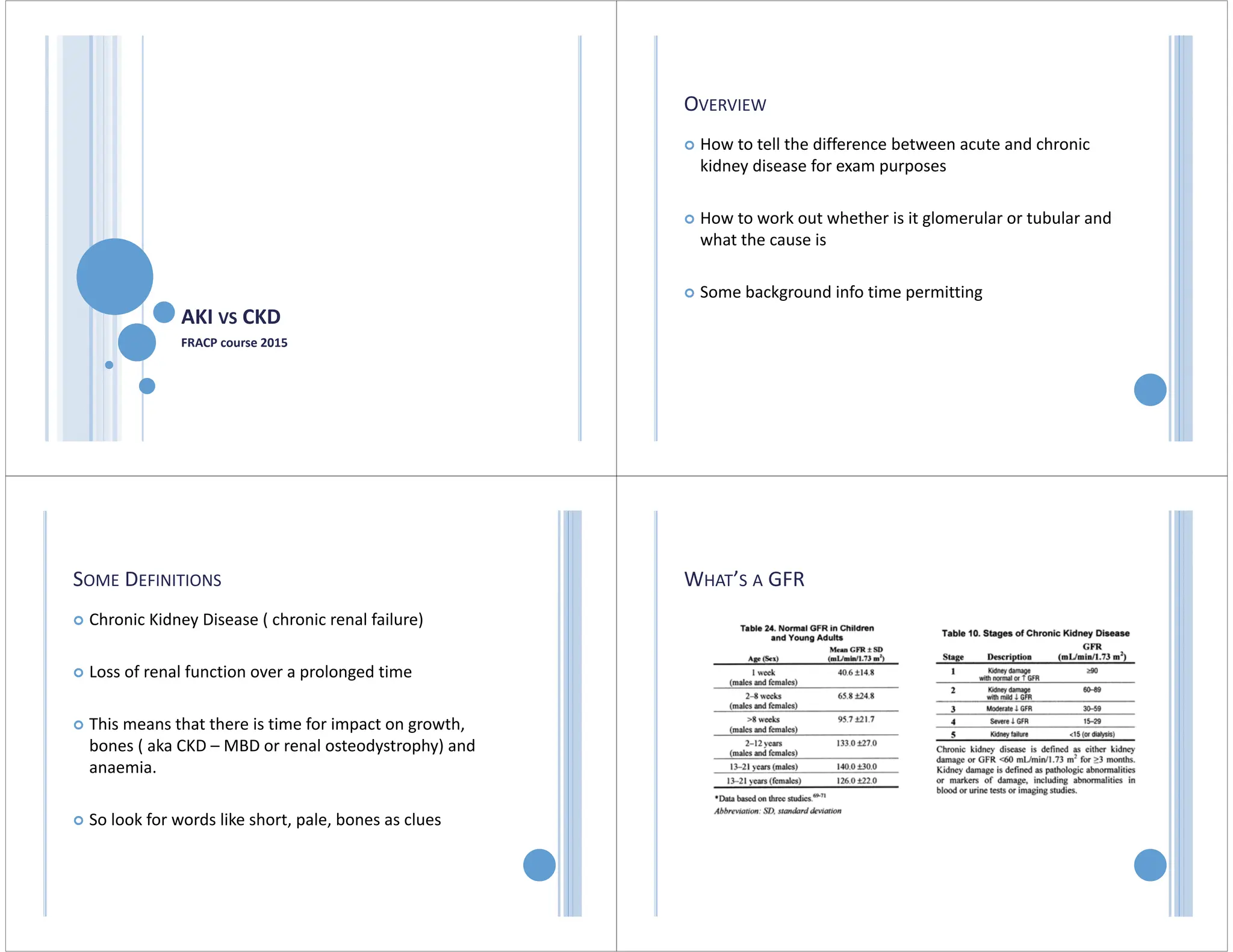
SOME DEFINITIONS
 Chronic Kidney Disease ( chronic renal failure)
 Loss of renal function over a prolonged time
 This means that there is time for impact on growth,
bones ( aka CKD – MBD or renal osteodystrophy) and
anaemia.
 So look for words like short, pale, bones as clues
WHAT’S A GFR
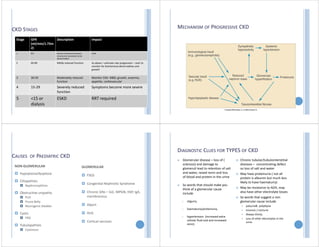
CKD STAGES
Stage GFR
(ml/min/1.73m
2)
Description Impact
1 90+ Normal function but known
structural or persistent urine
abnormalities
Little
2 60‐89 Mildly reduced function As above + estimate rate progression – start to
monitor for biochemical abnormalities and
growth
3 30‐59 Moderately reduced
function
Monitor CKD‐ MBD, growth, anaemia,
appetite, cardiovascular
4 15‐29 Severely reduced
function
Symptoms become more severe
5 <15 or
dialysis
ESKD RRT required
MECHANISM OF PROGRESSIVE CKD
CAUSES OF PAEDIATRIC CKD
NON‐GLOMERULAR
 Hypoplasia/dysplasia
 Ciliopathies
 Nephronopthisis
 Obstructive uropathy
 PUV
 Prune Belly
 Neurogenic bladder
 Cystic
 PKD
 Tubulopathies
 Cystinosis
GLOMERULAR
 FSGS
 Congenital Nephrotic Syndrome
 Chronic GNs – SLE, MPGN, HSP, IgA,
membranous
 Alport
 HUS
 Cortical necrosis
DIAGNOSTIC CLUES FOR TYPES OF CKD
 Glomerular disease – loss of (
sclerosis) and damage to
glomeruli lead to retention of salt
and water, raised renin and loss
of blood and protein in the urine
 So words that should make you
think of a glomerular cause
include
 oliguria,
 haematuria/proteinuria,
 hypertension (increased extra
cellular fluid and and increased
renin)
 Chronic tubular/tubulointerstitial
diseases – concentrating defect
so loss of salt and water
 May have proteinuria ( not all
protein is albumin but much less
likely to have haematuria)
 May be resistance to ADH, may
also have other electrolyte losses
 So words that suggest a non
glomerular cause include
 polyuria& polydipsia
 enuresis / nocturia
 Always thirsty
 Loss of other electrolytes in the
urine
CAUSES OF PAEDIATRIC CKD
NON‐GLOMERULAR
 Hypoplasia/dysplasia
 Ciliopathies
 Nephronopthisis
 Obstructive uropathy
 PUV
 Prune Belly
 Neurogenic bladder
 Cystic
 PKD
 Tubulopathies
 Cystinosis
Clues
CAUSES OF PAEDIATRIC CKD
Clues GLOMERULAR
 FSGS
 Congenital Nephrotic Syndrome
 Chronic GNs – SLE, MPGN, HSP, IgA,
membranous
 Alport
 HUS
 Cortical necrosis
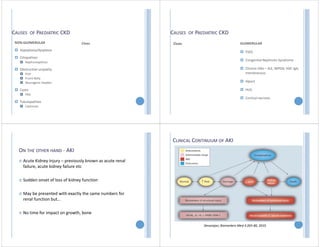
ON THE OTHER HAND ‐ AKI
 Acute Kidney Injury – previously known as acute renal
failure, acute kidney failure etc
 Sudden onset of loss of kidney function
 May be presented with exactly the same numbers for
renal function but…
 No time for impact on growth, bone
CLINICAL CONTINUUM OF AKI
Devarajan, Biomarkers Med 4:265‐80, 2010
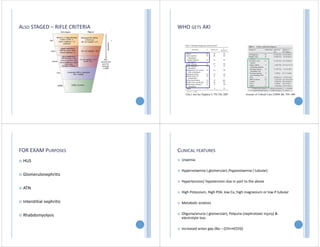
ALSO STAGED – RIFLE CRITERIA WHO GETS AKI
FOR EXAM PURPOSES
 HUS
 Glomerulonephritis
 ATN
 Interstitial nephritis
 Rhabdomyolysis
CLINICAL FEATURES
 Uraemia
 Hypervolaemia ( glomerular) /hypovolaemia ( tubular)
 Hypertension/ hypotension due in part to the above
 High Potassium, High P04, low Ca, high magnesium or low if tubular
 Metabolic acidosis
 Oliguria/anuria ( glomerular), Polyuria (nephrotoxic injury) &
electrolyte loss
 Increased anion gap (Na – (Chl+HCO3))
AKI VS CKD
FRACP course 2015
Tonya Kara
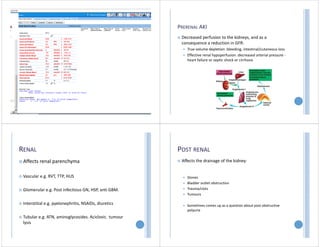
PRERENAL AKI
 Decreased perfusion to the kidneys, and as a
consequence a reduction in GFR:
 True volume depletion :bleeding, intestinal/cutaneous loss
 Effective renal hypoperfusion :decreased arterial pressure ‐
heart failure or septic shock or cirrhosis
RENAL
 Affects renal parenchyma
 Vascular e.g. RVT, TTP, HUS
 Glomerular e.g. Post infectious GN, HSP, anti GBM.
 Interstitial e.g. pyelonephritis, NSAIDs, diuretics
 Tubular e.g. ATN, aminoglycosides. Aciclovir, tumour
lysis
POST RENAL
 Affects the drainage of the kidney:
 Stones
 Bladder outlet obstruction
 Trauma/clots
 Tumours
 Sometimes comes up as a question about post obstructive
polyuria
ACUTE
Urine osmolality
Urine Na (mmol/l)
Urinalysis
Urea/creat ratio
Fractional excretion
of Na (%)
U Na x P Cr x 100
U Cr x P Na
Pre renal ATN
> 500 < 350
< 20 > 40
Bland Casts
>100 <40
< 1 > 1
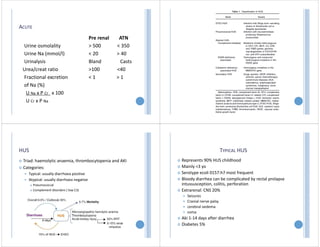
HUS
 Triad: haemolytic anaemia, thrombocytopenia and AKI
 Categories:
 Typical: usually diarrhoea positive
 Atypical: usually diarrhoea negative
 Pneumococcal
 Complement disorders ( low C3)
TYPICAL HUS
 Represents 90% HUS childhood
 Mainly <3 yo
 Serotype ecoli 0157:h7 most frequent
 Bloody diarrhea can be complicated by rectal prolapse
intussusception, colitis, perforation
 Extrarenal: CNS 20%
 Seizures
 Cranial nerve palsy
 cerebral oedema
 coma
 Aki 1‐14 days after diarrhea
 Diabetes 5%
Spontaneous
Resolution
(85-90%)
HUS
(~15%)
-3 -2 -1 0 1 2 3 4 5 6 7
Diarrhea
Bloody
diarrhea
HUS FOR THE FRACP
 History of bloody diarrhoea
 Full blood count – Hb low, WCC
up(Neutrophilia – predictor of
disease severity) Plt low
 Haemolysis screen‐
 reticulocyte count, ‐ up
 LDH, ‐ up
 Bilirubin, ‐ up
 haptoglobin ‐ down
 PT/APTT/ ‐ normal
 Fibrinogen ‐ up
 U&Es – UP!!
 Blood film – fragments,
schistocytes
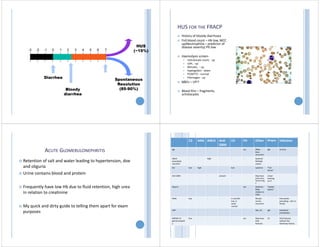
ACUTE GLOMERULONEPHRITIS
 Retention of salt and water leading to hypertension, doe
and oliguria
 Urine contains blood and protein
 Frequently have low Hb due to fluid retention, high urea
in relation to creatinine
 My quick and dirty guide to telling them apart for exam
purposes
C3 ANA ANCA Anti
GBM
C4 FH Other Biopsy Infection
IgA ‐ ‐ ‐ ‐ ‐ occ Often
boys
recurrent
IgA At time
ANCA
associated
vasculitis
‐ ‐ High ‐ ‐ ‐ Systemic
Multiple
causes
‐
SLE low high low systemic “Full
house”
‐
Anti GBM ‐ ‐ ‐ present ‐ ‐ May have
pulmonary
haenorrhag
e
Linear
staining
on IF
‐
Alports ‐ ‐ ‐ ‐ ‐ yes Deafness
Male
relative in
ESKD
“basket
weave”
‐
PIGN low ‐ ‐ ‐ In real life
low, in
exam
normal
‐ Should
not be
recurrent
Few weeks
preceding – skin or
throat
HSP ‐ ‐ ‐ ‐ ‐ ‐ Skin, GI IgA Sometime
precipitates
MPGN/ C3
glomerulopath
y
low ‐ ‐ ‐ ‐ occ May have
HUS
features
C3 HUS features
without the
diarrhoea history
THINKING RHABDOMAYOLYSIS?
 Typical history of exercise followed by bright red urine +/
‐ minus muscle pain
 Tests to confirm:
 The dipstick tests +ve for blood but no haematuria on
microscopy
 Urine and serum myoglobin up
 Very high CK
INTERSTITIAL NEPHRITIS
 Often drug related, can also be autoimmune with
associated uveitis
 Polyuria
 Tired, generally not right
 Generalised tubular dysfunction including glycosuria,
loss of electrolytes, tubular proteinuria
 Important differential is nephropthisis – remember
growth
RECAP ‐CLUES TO ACUTE V CHRONIC
 Think about things associated with renal disease
 Growth parameters
 Anaemia
 Bones
 With little blood or protein in the urine think about tubular
disease
 You can usually work out a GN from the story
 Imaging
 Small kidneys usually chronic structural disease.
 Large echogenic kidneys – acute disease – GNs or ARF.
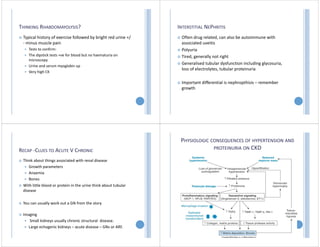
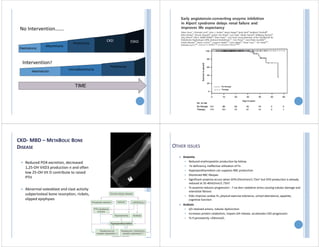
PHYSIOLOGIC CONSEQUENCES OF HYPERTENSION AND
PROTEINURIA ON CKD
TIME
Haematuria
microalbuminuria
Proteinuria
No Intervention…….
Intervention?
Albuminuria
Proteinuria
CKD ESKD
Haematuria
CKD‐ MBD – METABOLIC BONE
DISEASE
 Reduced PO4 excretion, decreased
1,25‐OH VitD3 production n and often
low 25‐OH Vit D contribute to raised
PTH
 Abnormal osteoblast and clast activity
subperiosteal bone resorption, rickets,
slipped epiphyses
OTHER ISSUES
 Anaemia
 Reduced erythropoietin production by kidney
 Fe deficiency, ineffective utilisation of Fe
 Hyperparathyroidism can suppress RBC production
 Shortened RBC lifespan
 Significant anaemia occurs when GFR<25ml/min/1.73m2 but EPO production is already
reduced at 35‐40ml/min/1.73m2
 Tx anaemia reduces progression ‐ ? via decr oxidative stress causing tubular damage and
interstitial fibrosis
 ESAs improve cardiac fn, physical exercise tolerance, school attendance, appetite,
cognitive function
 Acidosis
 d/t retained anions, tubular dysfunction
 Increases protein catabolism, impairs GH release, accelerates CKD progression
 Tx if persistently <20mmol/L
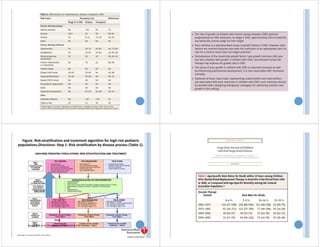
Figure. Risk‐stratification and treatment algorithm for high‐risk pediatric
populations.Directions: Step 1: Risk stratification by disease process (Table 1).
Kavey R W et al. Circulation 2006;114:2710-2738
Copyright © American Heart Association
TAKE HOME NON EXAM MESSAGE
 AKI can result in chronic proteinuria
 Proteinuria is CKD, and untreated will progress
 CKD affects much more than the kidney
 Advanced disease is under recognised
 Overall mortality higher than ALL
 Good luck for your exam

aki_vs_ckd2015.pdf the differences between aki and ckd

  • 1.
    AKI VS CKD FRACPcourse 2015 OVERVIEW  How to tell the difference between acute and chronic kidney disease for exam purposes  How to work out whether is it glomerular or tubular and what the cause is  Some background info time permitting SOME DEFINITIONS  Chronic Kidney Disease ( chronic renal failure)  Loss of renal function over a prolonged time  This means that there is time for impact on growth, bones ( aka CKD – MBD or renal osteodystrophy) and anaemia.  So look for words like short, pale, bones as clues WHAT’S A GFR
  • 2.
    CKD STAGES Stage GFR (ml/min/1.73m 2) DescriptionImpact 1 90+ Normal function but known structural or persistent urine abnormalities Little 2 60‐89 Mildly reduced function As above + estimate rate progression – start to monitor for biochemical abnormalities and growth 3 30‐59 Moderately reduced function Monitor CKD‐ MBD, growth, anaemia, appetite, cardiovascular 4 15‐29 Severely reduced function Symptoms become more severe 5 <15 or dialysis ESKD RRT required MECHANISM OF PROGRESSIVE CKD CAUSES OF PAEDIATRIC CKD NON‐GLOMERULAR  Hypoplasia/dysplasia  Ciliopathies  Nephronopthisis  Obstructive uropathy  PUV  Prune Belly  Neurogenic bladder  Cystic  PKD  Tubulopathies  Cystinosis GLOMERULAR  FSGS  Congenital Nephrotic Syndrome  Chronic GNs – SLE, MPGN, HSP, IgA, membranous  Alport  HUS  Cortical necrosis DIAGNOSTIC CLUES FOR TYPES OF CKD  Glomerular disease – loss of ( sclerosis) and damage to glomeruli lead to retention of salt and water, raised renin and loss of blood and protein in the urine  So words that should make you think of a glomerular cause include  oliguria,  haematuria/proteinuria,  hypertension (increased extra cellular fluid and and increased renin)  Chronic tubular/tubulointerstitial diseases – concentrating defect so loss of salt and water  May have proteinuria ( not all protein is albumin but much less likely to have haematuria)  May be resistance to ADH, may also have other electrolyte losses  So words that suggest a non glomerular cause include  polyuria& polydipsia  enuresis / nocturia  Always thirsty  Loss of other electrolytes in the urine
  • 3.
    CAUSES OF PAEDIATRICCKD NON‐GLOMERULAR  Hypoplasia/dysplasia  Ciliopathies  Nephronopthisis  Obstructive uropathy  PUV  Prune Belly  Neurogenic bladder  Cystic  PKD  Tubulopathies  Cystinosis Clues CAUSES OF PAEDIATRIC CKD Clues GLOMERULAR  FSGS  Congenital Nephrotic Syndrome  Chronic GNs – SLE, MPGN, HSP, IgA, membranous  Alport  HUS  Cortical necrosis ON THE OTHER HAND ‐ AKI  Acute Kidney Injury – previously known as acute renal failure, acute kidney failure etc  Sudden onset of loss of kidney function  May be presented with exactly the same numbers for renal function but…  No time for impact on growth, bone CLINICAL CONTINUUM OF AKI Devarajan, Biomarkers Med 4:265‐80, 2010
  • 4.
    ALSO STAGED –RIFLE CRITERIA WHO GETS AKI FOR EXAM PURPOSES  HUS  Glomerulonephritis  ATN  Interstitial nephritis  Rhabdomyolysis CLINICAL FEATURES  Uraemia  Hypervolaemia ( glomerular) /hypovolaemia ( tubular)  Hypertension/ hypotension due in part to the above  High Potassium, High P04, low Ca, high magnesium or low if tubular  Metabolic acidosis  Oliguria/anuria ( glomerular), Polyuria (nephrotoxic injury) & electrolyte loss  Increased anion gap (Na – (Chl+HCO3))
  • 5.
    AKI VS CKD FRACPcourse 2015 Tonya Kara PRERENAL AKI  Decreased perfusion to the kidneys, and as a consequence a reduction in GFR:  True volume depletion :bleeding, intestinal/cutaneous loss  Effective renal hypoperfusion :decreased arterial pressure ‐ heart failure or septic shock or cirrhosis RENAL  Affects renal parenchyma  Vascular e.g. RVT, TTP, HUS  Glomerular e.g. Post infectious GN, HSP, anti GBM.  Interstitial e.g. pyelonephritis, NSAIDs, diuretics  Tubular e.g. ATN, aminoglycosides. Aciclovir, tumour lysis POST RENAL  Affects the drainage of the kidney:  Stones  Bladder outlet obstruction  Trauma/clots  Tumours  Sometimes comes up as a question about post obstructive polyuria
  • 6.
    ACUTE Urine osmolality Urine Na(mmol/l) Urinalysis Urea/creat ratio Fractional excretion of Na (%) U Na x P Cr x 100 U Cr x P Na Pre renal ATN > 500 < 350 < 20 > 40 Bland Casts >100 <40 < 1 > 1 HUS  Triad: haemolytic anaemia, thrombocytopenia and AKI  Categories:  Typical: usually diarrhoea positive  Atypical: usually diarrhoea negative  Pneumococcal  Complement disorders ( low C3) TYPICAL HUS  Represents 90% HUS childhood  Mainly <3 yo  Serotype ecoli 0157:h7 most frequent  Bloody diarrhea can be complicated by rectal prolapse intussusception, colitis, perforation  Extrarenal: CNS 20%  Seizures  Cranial nerve palsy  cerebral oedema  coma  Aki 1‐14 days after diarrhea  Diabetes 5%
  • 7.
    Spontaneous Resolution (85-90%) HUS (~15%) -3 -2 -10 1 2 3 4 5 6 7 Diarrhea Bloody diarrhea HUS FOR THE FRACP  History of bloody diarrhoea  Full blood count – Hb low, WCC up(Neutrophilia – predictor of disease severity) Plt low  Haemolysis screen‐  reticulocyte count, ‐ up  LDH, ‐ up  Bilirubin, ‐ up  haptoglobin ‐ down  PT/APTT/ ‐ normal  Fibrinogen ‐ up  U&Es – UP!!  Blood film – fragments, schistocytes ACUTE GLOMERULONEPHRITIS  Retention of salt and water leading to hypertension, doe and oliguria  Urine contains blood and protein  Frequently have low Hb due to fluid retention, high urea in relation to creatinine  My quick and dirty guide to telling them apart for exam purposes C3 ANA ANCA Anti GBM C4 FH Other Biopsy Infection IgA ‐ ‐ ‐ ‐ ‐ occ Often boys recurrent IgA At time ANCA associated vasculitis ‐ ‐ High ‐ ‐ ‐ Systemic Multiple causes ‐ SLE low high low systemic “Full house” ‐ Anti GBM ‐ ‐ ‐ present ‐ ‐ May have pulmonary haenorrhag e Linear staining on IF ‐ Alports ‐ ‐ ‐ ‐ ‐ yes Deafness Male relative in ESKD “basket weave” ‐ PIGN low ‐ ‐ ‐ In real life low, in exam normal ‐ Should not be recurrent Few weeks preceding – skin or throat HSP ‐ ‐ ‐ ‐ ‐ ‐ Skin, GI IgA Sometime precipitates MPGN/ C3 glomerulopath y low ‐ ‐ ‐ ‐ occ May have HUS features C3 HUS features without the diarrhoea history
  • 8.
    THINKING RHABDOMAYOLYSIS?  Typicalhistory of exercise followed by bright red urine +/ ‐ minus muscle pain  Tests to confirm:  The dipstick tests +ve for blood but no haematuria on microscopy  Urine and serum myoglobin up  Very high CK INTERSTITIAL NEPHRITIS  Often drug related, can also be autoimmune with associated uveitis  Polyuria  Tired, generally not right  Generalised tubular dysfunction including glycosuria, loss of electrolytes, tubular proteinuria  Important differential is nephropthisis – remember growth RECAP ‐CLUES TO ACUTE V CHRONIC  Think about things associated with renal disease  Growth parameters  Anaemia  Bones  With little blood or protein in the urine think about tubular disease  You can usually work out a GN from the story  Imaging  Small kidneys usually chronic structural disease.  Large echogenic kidneys – acute disease – GNs or ARF. PHYSIOLOGIC CONSEQUENCES OF HYPERTENSION AND PROTEINURIA ON CKD
  • 9.
    TIME Haematuria microalbuminuria Proteinuria No Intervention……. Intervention? Albuminuria Proteinuria CKD ESKD Haematuria CKD‐MBD – METABOLIC BONE DISEASE  Reduced PO4 excretion, decreased 1,25‐OH VitD3 production n and often low 25‐OH Vit D contribute to raised PTH  Abnormal osteoblast and clast activity subperiosteal bone resorption, rickets, slipped epiphyses OTHER ISSUES  Anaemia  Reduced erythropoietin production by kidney  Fe deficiency, ineffective utilisation of Fe  Hyperparathyroidism can suppress RBC production  Shortened RBC lifespan  Significant anaemia occurs when GFR<25ml/min/1.73m2 but EPO production is already reduced at 35‐40ml/min/1.73m2  Tx anaemia reduces progression ‐ ? via decr oxidative stress causing tubular damage and interstitial fibrosis  ESAs improve cardiac fn, physical exercise tolerance, school attendance, appetite, cognitive function  Acidosis  d/t retained anions, tubular dysfunction  Increases protein catabolism, impairs GH release, accelerates CKD progression  Tx if persistently <20mmol/L
  • 11.
    Figure. Risk‐stratification andtreatment algorithm for high‐risk pediatric populations.Directions: Step 1: Risk stratification by disease process (Table 1). Kavey R W et al. Circulation 2006;114:2710-2738 Copyright © American Heart Association
  • 12.
    TAKE HOME NONEXAM MESSAGE  AKI can result in chronic proteinuria  Proteinuria is CKD, and untreated will progress  CKD affects much more than the kidney  Advanced disease is under recognised  Overall mortality higher than ALL  Good luck for your exam