AIR CONDITIONING
SYSTEMS-2
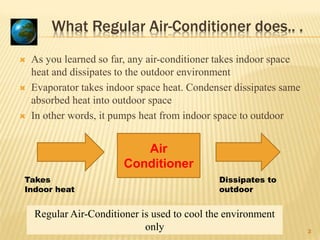
What Regular Air-Conditioner does.. .
2
 As you learned so far, any air-conditioner takes indoor space
heat and dissipates to the outdoor environment
 Evaporator takes indoor space heat. Condenser dissipates same
absorbed heat into outdoor space
 In other words, it pumps heat from indoor space to outdoor
Air
Conditioner
Takes
Indoor heat
Dissipates to
outdoor
Regular Air-Conditioner is used to cool the environment
only
3.0 WHAT IS HEAT PUMP?
3
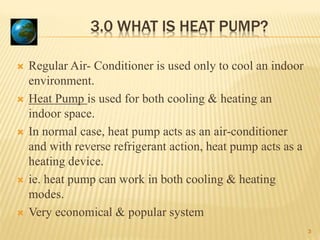
 Regular Air- Conditioner is used only to cool an indoor
environment.
 Heat Pump is used for both cooling & heating an
indoor space.
 In normal case, heat pump acts as an air-conditioner
and with reverse refrigerant action, heat pump acts as a
heating device.
 ie. heat pump can work in both cooling & heating
modes.
 Very economical & popular system
WHAT IS HEAT PUMP…..
4
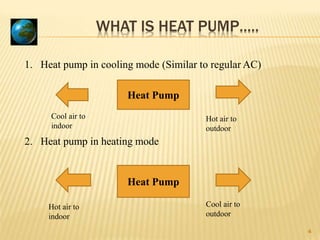
1. Heat pump in cooling mode (Similar to regular AC)
2. Heat pump in heating mode
Heat Pump
Heat Pump
Cool air to
indoor
Hot air to
outdoor
Hot air to
indoor
Cool air to
outdoor
Heat Pump
5
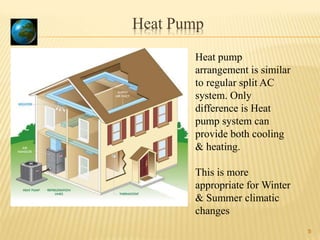
Heat pump
arrangement is similar
to regular split AC
system. Only
difference is Heat
pump system can
provide both cooling
& heating.
This is more
appropriate for Winter
& Summer climatic
changes
Heat Pump in Cooling Mode
6
Heat Pump in Cooling Mode……
7
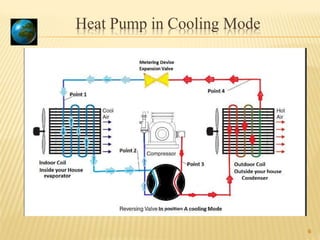
 Similar to regular AC cycle
 Refrigerant is used as the heat transfer media
 Cool air provides to the indoor space and hot air dissipates to the
outdoor space.
 New component which is not in regular air conditioner is the
reversing valve. Reversing valve can change the direction of the
refrigerant flow.
 When the heat pump is in cooling mode, reversing valve flows the
refrigerant in normal direction and refrigerant actions are similar
to the regular air-conditioner throughout the process.
8
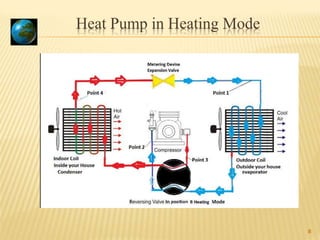
Heat Pump in Heating Mode
Heat Pump in Heating Mode……
9
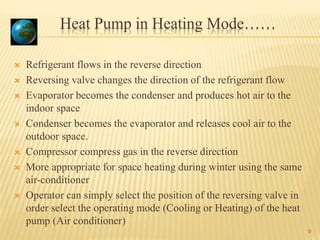
 Refrigerant flows in the reverse direction
 Reversing valve changes the direction of the refrigerant flow
 Evaporator becomes the condenser and produces hot air to the
indoor space
 Condenser becomes the evaporator and releases cool air to the
outdoor space.
 Compressor compress gas in the reverse direction
 More appropriate for space heating during winter using the same
air-conditioner
 Operator can simply select the position of the reversing valve in
order select the operating mode (Cooling or Heating) of the heat
pump (Air conditioner)
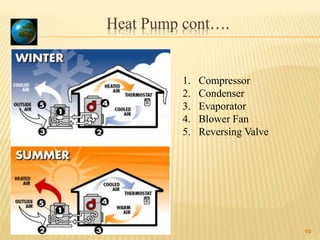
Heat Pump cont….
10
1. Compressor
2. Condenser
3. Evaporator
4. Blower Fan
5. Reversing Valve
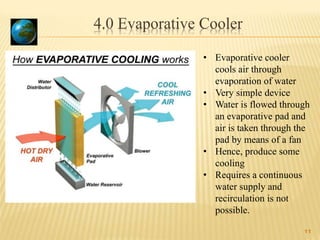
4.0 Evaporative Cooler
11
• Evaporative cooler
cools air through
evaporation of water
• Very simple device
• Water is flowed through
an evaporative pad and
air is taken through the
pad by means of a fan
• Hence, produce some
cooling
• Requires a continuous
water supply and
recirculation is not
possible.
12
Evaporative Cooler cont….
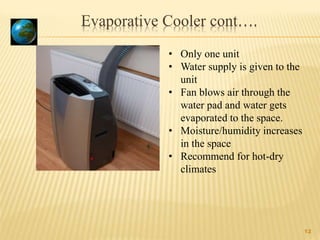
• Only one unit
• Water supply is given to the
unit
• Fan blows air through the
water pad and water gets
evaporated to the space.
• Moisture/humidity increases
in the space
• Recommend for hot-dry
climates
13
Air-Conditioner Categorization
Generally, any air-conditioner can be categorized in to main
types
1. Air cooled type
Condenser is cooled by air using a fan. Fan blows air
through the condenser and takes condenser heat in to the
air
2. Water cooled type
Condenser is cooled by water. Water is circulated through
the condenser using a pump. Water takes condenser heat
and dissipates to the environment at the cooling tower.
14
Types of Compressors
Some common types are;
1. Reciprocating compressor
3. Rotary compressor
2. Scroll compressor
3. Screw compressor
4. Centrifugal compressor
• Reciprocating is a very old technology.
• Chiller types are generally identified by the type of the
compressor.
Ex/ A chiller having a centrifugal compressor, called as
centrifugal chiller.
15
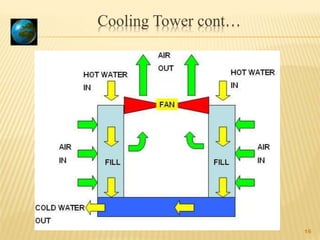
Cooling Tower
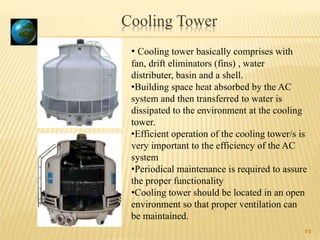
• Cooling tower basically comprises with
fan, drift eliminators (fins) , water
distributer, basin and a shell.
•Building space heat absorbed by the AC
system and then transferred to water is
dissipated to the environment at the cooling
tower.
•Efficient operation of the cooling tower/s is
very important to the efficiency of the AC
system
•Periodical maintenance is required to assure
the proper functionality
•Cooling tower should be located in an open
environment so that proper ventilation can
be maintained.
16
Cooling Tower cont…
Sizing Air Conditioners
There are several methods to assess the size of the air conditioner.
CLTD method is one of the popular calculation methods. Lot of
software are now available to size air conditioner. Basically
following factors are considered when AC is sized
 Geographical location of the city/country
 Directions of building facades
 Building dimensions and nos and sizes of windows, doors and
walls. Roof details
 Shading on facades, windows, walls, and roof;
 Type of insulation of ceiling, walls and roof;
 Possible air leaks (infiltration) into the building from outside
 How much heat the occupants and appliances in the building
generate
17
Sizing Air Conditioners…..
 Air conditioners are rated by the number of British Thermal
Units (Btu) of heat they can remove per hour. Another
common rating term for air conditioning size is the “Ton,"
which is 12,000 Btu per hour.
 Room air conditioners range from 5,500 Btu per hour to
14,000 Btu per hour.
 As a thumb rule, 200-300 sqft area can be saved by a 1 Ton
air-conditioner. However a precise calculation is required to
asses the size of the air-conditioner
18
1 Ton = 12,000 Btuh
Sizing Air Conditioners…..
Ex/ A 10mx20m lecture hall to be air conditioned. What is
the thumb-rule size of the air conditioner. (use 1 ton for
250 sqft area)
Ex/ Four story building to be air conditioned with a water
cooled chiller system. All floors are typical and total area
is 32,000 sqft. Calculate the thumb-rule size of the AC
system. Draw a schematic design diagram of the proposed
AC system.
Assume : Chillers can be located in the ground floor and
cooling towers are on roof. One AHU per floor with
supply air ducts & diffusers.
19
Energy Efficiency
 Today's best air conditioners use 30% to 50% less energy than
1970s
 Even if your air conditioner is only 10 years old, you may save
20% to 40% of your cooling energy costs by replacing it with a
newer, more efficient model
 Rating is based on how many Btu per hour are removed for each
watt of power it draws
 For room air conditioners, this efficiency rating is the Energy
Efficiency Ratio, or EER
 For central air conditioners, it is the Seasonal Energy Efficiency
Ratio, or SEER. COP or kW/Ton ratio is widely used to measure
efficiency in central air conditioners
20
Room Air Conditioners
 Built after January 1, 1990, need have an
EER of 8.0 or greater
 EER of at least 9.0 if you live in a mild climate
 EER over 10 for warmer climates
21
Central AC
 National minimum standards for central air
conditioners require a SEER of
 9.7 for single-package and
 10.0 for split-systems
 Units are available with SEERs reaching nearly
17
22
Energy Saving Methods
 Locate the air conditioner in a window or wall
area near the center of the room and on the
shadiest side of the house.
 Minimize air leakage by fitting the room air
conditioner snugly into its opening and
sealing gaps with a foam weather stripping
material.
23
Numerical Problem
 A EER from 5.0 to 9 saving and pay back
period
24

Air_Conditioning_Systems_2.ppt

  • 1.
  • 2.
    What Regular Air-Conditionerdoes.. . 2  As you learned so far, any air-conditioner takes indoor space heat and dissipates to the outdoor environment  Evaporator takes indoor space heat. Condenser dissipates same absorbed heat into outdoor space  In other words, it pumps heat from indoor space to outdoor Air Conditioner Takes Indoor heat Dissipates to outdoor Regular Air-Conditioner is used to cool the environment only
  • 3.
    3.0 WHAT ISHEAT PUMP? 3  Regular Air- Conditioner is used only to cool an indoor environment.  Heat Pump is used for both cooling & heating an indoor space.  In normal case, heat pump acts as an air-conditioner and with reverse refrigerant action, heat pump acts as a heating device.  ie. heat pump can work in both cooling & heating modes.  Very economical & popular system
  • 4.
    WHAT IS HEATPUMP….. 4 1. Heat pump in cooling mode (Similar to regular AC) 2. Heat pump in heating mode Heat Pump Heat Pump Cool air to indoor Hot air to outdoor Hot air to indoor Cool air to outdoor
  • 5.
    Heat Pump 5 Heat pump arrangementis similar to regular split AC system. Only difference is Heat pump system can provide both cooling & heating. This is more appropriate for Winter & Summer climatic changes
  • 6.
    Heat Pump inCooling Mode 6
  • 7.
    Heat Pump inCooling Mode…… 7  Similar to regular AC cycle  Refrigerant is used as the heat transfer media  Cool air provides to the indoor space and hot air dissipates to the outdoor space.  New component which is not in regular air conditioner is the reversing valve. Reversing valve can change the direction of the refrigerant flow.  When the heat pump is in cooling mode, reversing valve flows the refrigerant in normal direction and refrigerant actions are similar to the regular air-conditioner throughout the process.
  • 8.
    8 Heat Pump inHeating Mode
  • 9.
    Heat Pump inHeating Mode…… 9  Refrigerant flows in the reverse direction  Reversing valve changes the direction of the refrigerant flow  Evaporator becomes the condenser and produces hot air to the indoor space  Condenser becomes the evaporator and releases cool air to the outdoor space.  Compressor compress gas in the reverse direction  More appropriate for space heating during winter using the same air-conditioner  Operator can simply select the position of the reversing valve in order select the operating mode (Cooling or Heating) of the heat pump (Air conditioner)
  • 10.
    Heat Pump cont…. 10 1.Compressor 2. Condenser 3. Evaporator 4. Blower Fan 5. Reversing Valve
  • 11.
    4.0 Evaporative Cooler 11 •Evaporative cooler cools air through evaporation of water • Very simple device • Water is flowed through an evaporative pad and air is taken through the pad by means of a fan • Hence, produce some cooling • Requires a continuous water supply and recirculation is not possible.
  • 12.
    12 Evaporative Cooler cont…. •Only one unit • Water supply is given to the unit • Fan blows air through the water pad and water gets evaporated to the space. • Moisture/humidity increases in the space • Recommend for hot-dry climates
  • 13.
    13 Air-Conditioner Categorization Generally, anyair-conditioner can be categorized in to main types 1. Air cooled type Condenser is cooled by air using a fan. Fan blows air through the condenser and takes condenser heat in to the air 2. Water cooled type Condenser is cooled by water. Water is circulated through the condenser using a pump. Water takes condenser heat and dissipates to the environment at the cooling tower.
  • 14.
    14 Types of Compressors Somecommon types are; 1. Reciprocating compressor 3. Rotary compressor 2. Scroll compressor 3. Screw compressor 4. Centrifugal compressor • Reciprocating is a very old technology. • Chiller types are generally identified by the type of the compressor. Ex/ A chiller having a centrifugal compressor, called as centrifugal chiller.
  • 15.
    15 Cooling Tower • Coolingtower basically comprises with fan, drift eliminators (fins) , water distributer, basin and a shell. •Building space heat absorbed by the AC system and then transferred to water is dissipated to the environment at the cooling tower. •Efficient operation of the cooling tower/s is very important to the efficiency of the AC system •Periodical maintenance is required to assure the proper functionality •Cooling tower should be located in an open environment so that proper ventilation can be maintained.
  • 16.
  • 17.
    Sizing Air Conditioners Thereare several methods to assess the size of the air conditioner. CLTD method is one of the popular calculation methods. Lot of software are now available to size air conditioner. Basically following factors are considered when AC is sized  Geographical location of the city/country  Directions of building facades  Building dimensions and nos and sizes of windows, doors and walls. Roof details  Shading on facades, windows, walls, and roof;  Type of insulation of ceiling, walls and roof;  Possible air leaks (infiltration) into the building from outside  How much heat the occupants and appliances in the building generate 17
  • 18.
    Sizing Air Conditioners….. Air conditioners are rated by the number of British Thermal Units (Btu) of heat they can remove per hour. Another common rating term for air conditioning size is the “Ton," which is 12,000 Btu per hour.  Room air conditioners range from 5,500 Btu per hour to 14,000 Btu per hour.  As a thumb rule, 200-300 sqft area can be saved by a 1 Ton air-conditioner. However a precise calculation is required to asses the size of the air-conditioner 18 1 Ton = 12,000 Btuh
  • 19.
    Sizing Air Conditioners….. Ex/A 10mx20m lecture hall to be air conditioned. What is the thumb-rule size of the air conditioner. (use 1 ton for 250 sqft area) Ex/ Four story building to be air conditioned with a water cooled chiller system. All floors are typical and total area is 32,000 sqft. Calculate the thumb-rule size of the AC system. Draw a schematic design diagram of the proposed AC system. Assume : Chillers can be located in the ground floor and cooling towers are on roof. One AHU per floor with supply air ducts & diffusers. 19
  • 20.
    Energy Efficiency  Today'sbest air conditioners use 30% to 50% less energy than 1970s  Even if your air conditioner is only 10 years old, you may save 20% to 40% of your cooling energy costs by replacing it with a newer, more efficient model  Rating is based on how many Btu per hour are removed for each watt of power it draws  For room air conditioners, this efficiency rating is the Energy Efficiency Ratio, or EER  For central air conditioners, it is the Seasonal Energy Efficiency Ratio, or SEER. COP or kW/Ton ratio is widely used to measure efficiency in central air conditioners 20
  • 21.
    Room Air Conditioners Built after January 1, 1990, need have an EER of 8.0 or greater  EER of at least 9.0 if you live in a mild climate  EER over 10 for warmer climates 21
  • 22.
    Central AC  Nationalminimum standards for central air conditioners require a SEER of  9.7 for single-package and  10.0 for split-systems  Units are available with SEERs reaching nearly 17 22
  • 23.
    Energy Saving Methods Locate the air conditioner in a window or wall area near the center of the room and on the shadiest side of the house.  Minimize air leakage by fitting the room air conditioner snugly into its opening and sealing gaps with a foam weather stripping material. 23
  • 24.
    Numerical Problem  AEER from 5.0 to 9 saving and pay back period 24

Editor's Notes

  • #2 EGEE 102- S. Pisupati