

AIR TRAFFIC
CONTROLLER
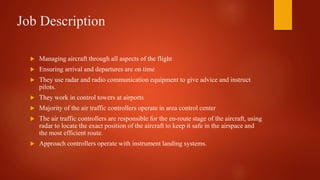
Job Description
 Managing aircraft through all aspects of the flight
 Ensuring arrival and departures are on time
 They use radar and radio communication equipment to give advice and instruct
pilots.
 They work in control towers at airports
 Majority of the air traffic controllers operate in area control center
 The air traffic controllers are responsible for the en-route stage of the aircraft, using
radar to locate the exact position of the aircraft to keep it safe in the airspace and
the most efficient route.
 Approach controllers operate with instrument landing systems.
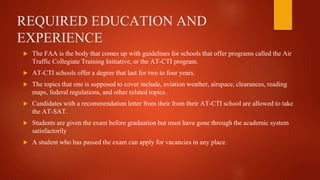
REQUIRED EDUCATION AND
EXPERIENCE
 The FAA is the body that comes up with guidelines for schools that offer programs called the Air
Traffic Collegiate Training Initiative, or the AT-CTI program.
 AT-CTI schools offer a degree that last for two to four years.
 The topics that one is supposed to cover include, aviation weather, airspace, clearances, reading
maps, federal regulations, and other related topics.
 Candidates with a recommendation letter from their from their AT-CTI school are allowed to take
the AT-SAT.
 Students are given the exam before graduation but must have gone through the academic system
satisfactorily
 A student who has passed the exam can apply for vacancies in any place.
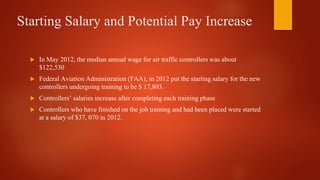
Starting Salary and Potential Pay Increase
 In May 2012, the median annual wage for air traffic controllers was about
$122,530
 Federal Aviation Administration (FAA), in 2012 put the starting salary for the new
controllers undergoing training to be $ 17,803.
 Controllers’ salaries increase after completing each training phase
 Controllers who have finished on the job training and had been placed were started
at a salary of $37, 070 in 2012.
Work Schedule and vs. time off
 Most air traffic controllers operate full time with others even working extra hours.
 Controllers may rotate shifts between, evening, and night, since most control
centers operate full time.
 Controllers work on weekend as well and holiday shifts.
Benefits and Perks
Air traffic controllers are entitled to a complete package of federal benefits such as
 Annual leave
 Sick leave
 Life and health insurance
 Salary increment after every phase of training
Quality of life
 Air Traffic controllers enjoy hefty packs of averagely $118,430 annually, thus
making them have quality life
Progression
 Graduates of the FAA Academy begin as developmental controllers.
 They advance to different positions with on the time training , including
simulations and class study
Retirement
 An air traffic controller can work and retire at an early age without a decrease in
their annual pay.
 Most controllers retire at their fifties.
 One is required to retire at least at age fifty after about twenty years of service.

Air traffic control

  • 1.
  • 2.
    Job Description  Managingaircraft through all aspects of the flight  Ensuring arrival and departures are on time  They use radar and radio communication equipment to give advice and instruct pilots.  They work in control towers at airports  Majority of the air traffic controllers operate in area control center  The air traffic controllers are responsible for the en-route stage of the aircraft, using radar to locate the exact position of the aircraft to keep it safe in the airspace and the most efficient route.  Approach controllers operate with instrument landing systems.
  • 3.
    REQUIRED EDUCATION AND EXPERIENCE The FAA is the body that comes up with guidelines for schools that offer programs called the Air Traffic Collegiate Training Initiative, or the AT-CTI program.  AT-CTI schools offer a degree that last for two to four years.  The topics that one is supposed to cover include, aviation weather, airspace, clearances, reading maps, federal regulations, and other related topics.  Candidates with a recommendation letter from their from their AT-CTI school are allowed to take the AT-SAT.  Students are given the exam before graduation but must have gone through the academic system satisfactorily  A student who has passed the exam can apply for vacancies in any place.
  • 4.
    Starting Salary andPotential Pay Increase  In May 2012, the median annual wage for air traffic controllers was about $122,530  Federal Aviation Administration (FAA), in 2012 put the starting salary for the new controllers undergoing training to be $ 17,803.  Controllers’ salaries increase after completing each training phase  Controllers who have finished on the job training and had been placed were started at a salary of $37, 070 in 2012.
  • 5.
    Work Schedule andvs. time off  Most air traffic controllers operate full time with others even working extra hours.  Controllers may rotate shifts between, evening, and night, since most control centers operate full time.  Controllers work on weekend as well and holiday shifts.
  • 6.
    Benefits and Perks Airtraffic controllers are entitled to a complete package of federal benefits such as  Annual leave  Sick leave  Life and health insurance  Salary increment after every phase of training
  • 7.
    Quality of life Air Traffic controllers enjoy hefty packs of averagely $118,430 annually, thus making them have quality life
  • 8.
    Progression  Graduates ofthe FAA Academy begin as developmental controllers.  They advance to different positions with on the time training , including simulations and class study
  • 9.
    Retirement  An airtraffic controller can work and retire at an early age without a decrease in their annual pay.  Most controllers retire at their fifties.  One is required to retire at least at age fifty after about twenty years of service.