Air Quality Modelling
Mark Chapman, Air Quality and Odour Discipline Manager
mark.chapman@mouchel.com
01483 731378
07976 344 311
Air Quality Modelling
Mark Chapman, Air Quality and Odour Discipline Manager
mark.chapman@mouchel.com
01483 731378
07976 344 311
33
Air Quality Modelling Overview
• Key Guidance Documents
• Defining the AQ Modelling Domain
• Model Setup
– Input Parameters
– Road Traffic Emissions;
• Model Verification and Adjustment
44
Key Guidance Documents
55
Defining The AQ Modelling Domain
Brief Reminder: DMRB Screening Criteria (Guidance)
For Local Air Quality ‘Affected roads’ are those that
meet any of the following criteria:
• road alignment will change by 5 m or more; or
• daily traffic flows will change by 1,000 AADT or
more; or
• Heavy Duty Vehicle (HDV) flows will change by
200 AADT or more; or
• daily average speed will change by 10 km/hr or
more; or
• peak hour speed will change by 20 km/hr or
more.
66
Defining The AQ Modelling Domain
For Regional Emissions ‘Affected roads’ are those
that are expected to have :
• a change of more than 10% in AADT; or
• a change of more than 10% to the number of
HDV; or
• a change in daily average speed of more than 20
km/hr.
However…
Air Quality Assessments are
Receptor Based not Source Based
77
Defining The AQ Modelling Domain
In addition to identifying ‘Affected roads’:
• Receptors within 200m of Affected roads;
– Including future receptors
• Roads (including non-affected) within 200m of
these receptors;
• Locations where it is anticipated that EU Limit
Values are likely to be exceeded in the Opening
Year;
– Air Quality Management Areas (AQMA)
– Monitoring Locations
88
Air Quality Modelling – Affected Roads
99
Air Quality Modelling - Final Study Area
10101010
Model Setup
11111111
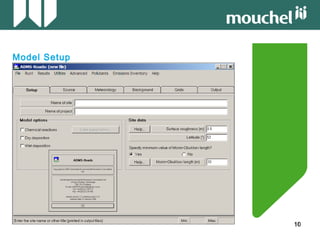
Model Setup – The ‘basics’
Air Quality Concentration = …
Emission
• Factors derived from speeds, fleet
composition (LDV/HDV), fleet age (EURO
Standard)
X
Activity
• Magnitude of each factor for local network
X
Dispersion
• Chemistry - Oxidation reactions, etc.
• Physics – Turbulence, Meteorology, etc.
Better inputs = Better outputs
12121212
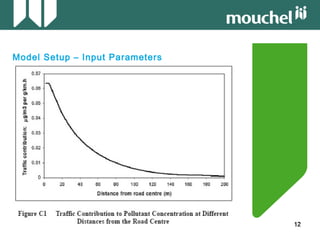
Model Setup – Input Parameters
13131313
Model Setup – Input Parameters
Internal to Model:
• Terrain Data
• Meteorological Data
• Surface Roughness (Horizontal Dispersion)
• Monin-Obukhov Length (Vertical Dispersion)
• Road Traffic Emissions Data
14141414
Model Setup – Input Parameters
External Processing:
• Local Monitoring Data
– Model Verification and Adjustment
• Background Concentrations
– National Mapping
– Local Monitoring Data
• NOx to NO2 Empirical Formulae (Basic Chemistry)
15151515
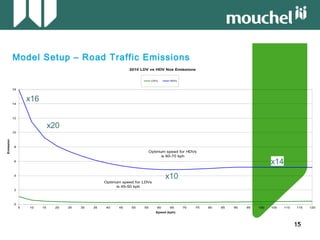
Model Setup – Road Traffic Emissions
2010 LDV vs HDV Nox Emissions
0
2
4
6
8
10
12
14
16
5 10 15 20 25 30 35 40 45 50 55 60 65 70 75 80 85 90 95 100 105 110 115 120
Speed (kph)
Emissions
LDVs HDVs
Optimum speed for HDVs
is 60-70 kph
Optimum speed for LDVs
is 45-50 kph
x16
x20
x14
x10
16161616
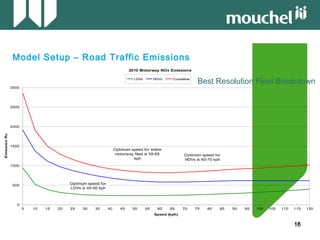
Model Setup – Road Traffic Emissions
2010 Motorway NOx Emissions
0
500
1000
1500
2000
2500
3000
5 10 15 20 25 30 35 40 45 50 55 60 65 70 75 80 85 90 95 100 105 110 115 120
Speed (kph)
EmissionRate
LDVs HDVs Cumulative
Optimum speed for
LDVs is 45-50 kph
Optimum speed for
HDVs is 60-70 kph
Optimum speed for entire
motorway fleet is 55-65
kph
Best Resolution Fleet Breakdown
17171717
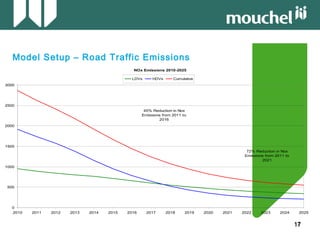
Model Setup – Road Traffic Emissions
NOx Emissions 2010-2025
0
500
1000
1500
2000
2500
3000
2010 2011 2012 2013 2014 2015 2016 2017 2018 2019 2020 2021 2022 2023 2024 2025
LDVs HDVs Cumulative
45% Reduction in Nox
Emissions from 2011 to
2016
72% Reduction in Nox
Emissions from 2011 to
2021
18181818
19191919
Model Verification and Adjustment
The predicted results from a dispersion model may differ
from measured concentrations for a large number of
reasons:
• estimates of background concentrations;
• meteorological data uncertainties;
• uncertainties in source activity data such as traffic flows
and emissions factors;
• model input parameters such as roughness length,
minimum Monin-Obukhov; and
• overall model limitations; and
• uncertainties associated with monitoring data, including
locations.
20202020
Model Verification and Adjustment
• checks on:
– traffic data;
– road widths;
– distance between sources and monitoring;
– monitoring data;
– estimates of background concentrations;
• consideration of speed estimates on roads in
particular at junctions where speed limits are
unlikely to be appropriate;
• consideration of source type, such as roads and
street canyons;
21212121
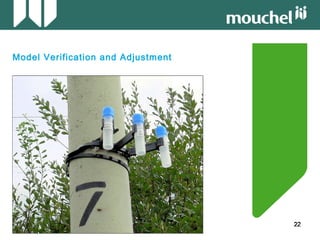
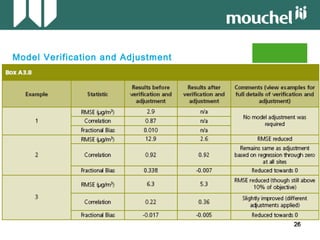
Model Verification and Adjustment
22222222
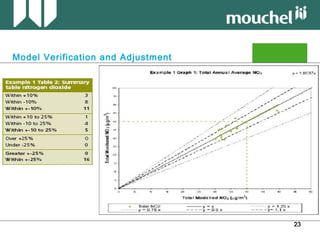
Model Verification and Adjustment
23232323
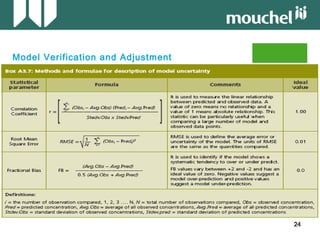
Model Verification and Adjustment
24242424
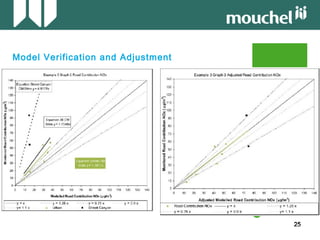
Model Verification and Adjustment
25252525
Model Verification and Adjustment
26262626
Model Verification and Adjustment
Mark Chapman
Air Quality and Odour Discipline Manager
mark.chapman@mouchel.com
01483 731 378
07976 344 311

Air Quality Modelling

  • 1.
    Air Quality Modelling MarkChapman, Air Quality and Odour Discipline Manager mark.chapman@mouchel.com 01483 731378 07976 344 311
  • 2.
    Air Quality Modelling MarkChapman, Air Quality and Odour Discipline Manager mark.chapman@mouchel.com 01483 731378 07976 344 311
  • 3.
    33 Air Quality ModellingOverview • Key Guidance Documents • Defining the AQ Modelling Domain • Model Setup – Input Parameters – Road Traffic Emissions; • Model Verification and Adjustment
  • 4.
  • 5.
    55 Defining The AQModelling Domain Brief Reminder: DMRB Screening Criteria (Guidance) For Local Air Quality ‘Affected roads’ are those that meet any of the following criteria: • road alignment will change by 5 m or more; or • daily traffic flows will change by 1,000 AADT or more; or • Heavy Duty Vehicle (HDV) flows will change by 200 AADT or more; or • daily average speed will change by 10 km/hr or more; or • peak hour speed will change by 20 km/hr or more.
  • 6.
    66 Defining The AQModelling Domain For Regional Emissions ‘Affected roads’ are those that are expected to have : • a change of more than 10% in AADT; or • a change of more than 10% to the number of HDV; or • a change in daily average speed of more than 20 km/hr. However… Air Quality Assessments are Receptor Based not Source Based
  • 7.
    77 Defining The AQModelling Domain In addition to identifying ‘Affected roads’: • Receptors within 200m of Affected roads; – Including future receptors • Roads (including non-affected) within 200m of these receptors; • Locations where it is anticipated that EU Limit Values are likely to be exceeded in the Opening Year; – Air Quality Management Areas (AQMA) – Monitoring Locations
  • 8.
    88 Air Quality Modelling– Affected Roads
  • 9.
    99 Air Quality Modelling- Final Study Area
  • 10.
  • 11.
    11111111 Model Setup –The ‘basics’ Air Quality Concentration = … Emission • Factors derived from speeds, fleet composition (LDV/HDV), fleet age (EURO Standard) X Activity • Magnitude of each factor for local network X Dispersion • Chemistry - Oxidation reactions, etc. • Physics – Turbulence, Meteorology, etc. Better inputs = Better outputs
  • 12.
    12121212 Model Setup –Input Parameters
  • 13.
    13131313 Model Setup –Input Parameters Internal to Model: • Terrain Data • Meteorological Data • Surface Roughness (Horizontal Dispersion) • Monin-Obukhov Length (Vertical Dispersion) • Road Traffic Emissions Data
  • 14.
    14141414 Model Setup –Input Parameters External Processing: • Local Monitoring Data – Model Verification and Adjustment • Background Concentrations – National Mapping – Local Monitoring Data • NOx to NO2 Empirical Formulae (Basic Chemistry)
  • 15.
    15151515 Model Setup –Road Traffic Emissions 2010 LDV vs HDV Nox Emissions 0 2 4 6 8 10 12 14 16 5 10 15 20 25 30 35 40 45 50 55 60 65 70 75 80 85 90 95 100 105 110 115 120 Speed (kph) Emissions LDVs HDVs Optimum speed for HDVs is 60-70 kph Optimum speed for LDVs is 45-50 kph x16 x20 x14 x10
  • 16.
    16161616 Model Setup –Road Traffic Emissions 2010 Motorway NOx Emissions 0 500 1000 1500 2000 2500 3000 5 10 15 20 25 30 35 40 45 50 55 60 65 70 75 80 85 90 95 100 105 110 115 120 Speed (kph) EmissionRate LDVs HDVs Cumulative Optimum speed for LDVs is 45-50 kph Optimum speed for HDVs is 60-70 kph Optimum speed for entire motorway fleet is 55-65 kph Best Resolution Fleet Breakdown
  • 17.
    17171717 Model Setup –Road Traffic Emissions NOx Emissions 2010-2025 0 500 1000 1500 2000 2500 3000 2010 2011 2012 2013 2014 2015 2016 2017 2018 2019 2020 2021 2022 2023 2024 2025 LDVs HDVs Cumulative 45% Reduction in Nox Emissions from 2011 to 2016 72% Reduction in Nox Emissions from 2011 to 2021
  • 18.
  • 19.
    19191919 Model Verification andAdjustment The predicted results from a dispersion model may differ from measured concentrations for a large number of reasons: • estimates of background concentrations; • meteorological data uncertainties; • uncertainties in source activity data such as traffic flows and emissions factors; • model input parameters such as roughness length, minimum Monin-Obukhov; and • overall model limitations; and • uncertainties associated with monitoring data, including locations.
  • 20.
    20202020 Model Verification andAdjustment • checks on: – traffic data; – road widths; – distance between sources and monitoring; – monitoring data; – estimates of background concentrations; • consideration of speed estimates on roads in particular at junctions where speed limits are unlikely to be appropriate; • consideration of source type, such as roads and street canyons;
  • 21.
  • 22.
  • 23.
  • 24.
  • 25.
  • 26.
  • 27.
    Mark Chapman Air Qualityand Odour Discipline Manager mark.chapman@mouchel.com 01483 731 378 07976 344 311