React JS Using Machine Learning Specialization Syllabus
Module
1
Module’s Takeaways
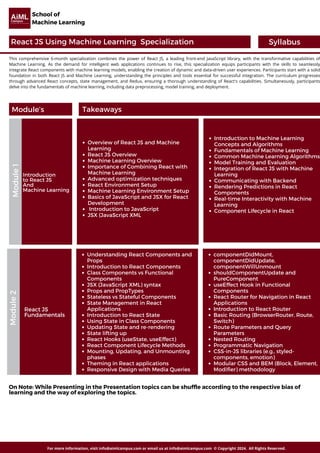
Overview of React JS and Machine
Learning
React JS Overview
Machine Learning Overview
Importance of Combining React with
Machine Learning
Advanced optimization techniques
React Environment Setup
Machine Learning Environment Setup
Basics of JavaScript and JSX for React
Development
Introduction to JavaScript
JSX (JavaScript XML
This comprehensive 6-month specialization combines the power of React JS, a leading front-end JavaScript library, with the transformative capabilities of
Machine Learning. As the demand for intelligent web applications continues to rise, this specialization equips participants with the skills to seamlessly
integrate React components with machine learning models, enabling the creation of dynamic and data-driven user experiences. Participants start with a solid
foundation in both React JS and Machine Learning, understanding the principles and tools essential for successful integration. The curriculum progresses
through advanced React concepts, state management, and Redux, ensuring a thorough understanding of React's capabilities. Simultaneously, participants
delve into the fundamentals of machine learning, including data preprocessing, model training, and deployment.
H O W T O G E T I D E A S & M E A S U R E
For more information, visit info@aimlcampus.com or email us at info@aimlcampus.com © Copyright 2024. All Rights Reserved.
AiML
Campus
Human Intelligence Meets Artificial Learning Intelligence
School of
Machine Learning
Introduction to Machine Learning
Concepts and Algorithms
Fundamentals of Machine Learning
Common Machine Learning Algorithms
Model Training and Evaluation
Integration of React JS with Machine
Learning
Communicating with Backend
Rendering Predictions in React
Components
Real-time Interactivity with Machine
Learning
Component Lifecycle in React
On Note: While Presenting in the Presentation topics can be shuffle according to the respective bias of
learning and the way of exploring the topics.
Understanding React Components and
Props
Introduction to React Components
Class Components vs Functional
Components
JSX (JavaScript XML) syntax
Props and PropTypes
Stateless vs Stateful Components
State Management in React
Applications
Introduction to React State
Using State in Class Components
Updating State and re-rendering
State lifting up
React Hooks (useState, useEffect)
React Component Lifecycle Methods
Mounting, Updating, and Unmounting
phases
Theming in React applications
Responsive Design with Media Queries
React JS
Fundamentals
componentDidMount,
componentDidUpdate,
componentWillUnmount
shouldComponentUpdate and
PureComponent
useEffect Hook in Functional
Components
React Router for Navigation in React
Applications
Introduction to React Router
Basic Routing (BrowserRouter, Route,
Switch)
Route Parameters and Query
Parameters
Nested Routing
Programmatic Navigation
CSS-in-JS libraries (e.g., styled-
components, emotion)
Modular CSS and BEM (Block, Element,
Modifier) methodology
Introduction
to React JS
And
Machine Learning
Module
2
React JS Using Machine Learning Specialization Syllabus
Module
3
Module’s Takeaways
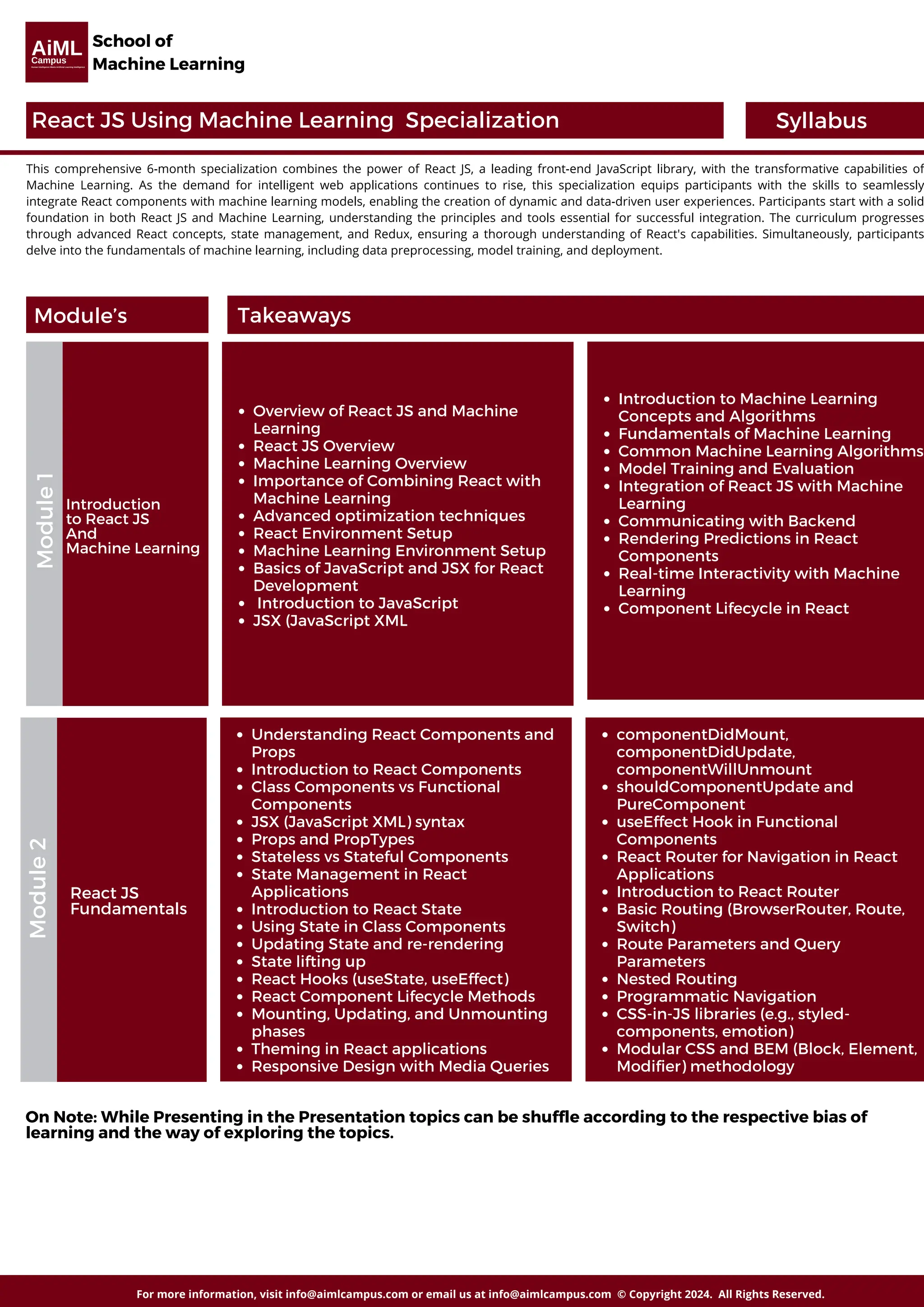
Machine Learning Basics
Cross-Validation Techniques
Understanding and implementing K-
Fold Cross-Validation
Leave-One-Out Cross-Validation and its
use cases
Hyperparameter Tuning
The importance of hyperparameters in
machine learning models
Grid Search and Random Search for
Hyperparameter Optimization
Ensemble Learning
Concepts of ensemble learning and its
benefits
opular ensemble methods like Random
Forest, Gradient Boosting, and Bagging
Feature Selection
Working with different plot styles
H O W T O G E T I D E A S & M E A S U R E
Machine
Learning
Basics
For more information, visit info@aimlcampus.com or email us at info@aimlcampus.com © Copyright 2024. All Rights Reserved.
AiML
Campus
Human Intelligence Meets Artificial Learning Intelligence
School of
Machine Learning
Techniques for selecting relevant
Features
Importance of feature selection in
model performance and
interpretability.
Model Interpretability
Understanding and interpreting
machine learning models
Techniques like SHAP
(SHapley Additive exPlanations)
for model interpretability
Basic Seaborn plots: Distplot, countplot,
boxplot
Basics of neural networks and deep
learning
Popular deep learning frameworks
such as TensorFlow and PyTorch
Module
4
Introduction to React Router
Implementing client-side navigation in
React applications
Navigating between different views and
passing parameters
React Testing Library
Writing tests for React components
using the React Testing Library
Best practices for testing React
applications
Higher-Order Components (HOCs):
Understanding and creating HOCs for
code reusability
Implementing cross-cutting concerns
using HOCs
H O W T O G E T I D E A S & M E A S U R E
React Hooks
And Context
API
Redux for State Management:
Integrating Redux as a state
management solution in React.
Actions, reducers, and the store in a
Redux-based application.
React-Redux
Combining React with Redux for
efficient state management
Connecting React components to the
Redux store
Server-Side Rendering (SSR)
with React
React Performance Optimization
GraphQL with React
React Native
Authentication and Authorization in
React
Internationalization (i18n) in React
On Note: While Presenting in the Presentation topics can be shuffle according to the respective bias of
learning and the way of exploring the topics.
This comprehensive 6-month specialization combines the power of React JS, a leading front-end JavaScript library, with the transformative capabilities of
Machine Learning. As the demand for intelligent web applications continues to rise, this specialization equips participants with the skills to seamlessly
integrate React components with machine learning models, enabling the creation of dynamic and data-driven user experiences. Participants start with a solid
foundation in both React JS and Machine Learning, understanding the principles and tools essential for successful integration. The curriculum progresses
through advanced React concepts, state management, and Redux, ensuring a thorough understanding of React's capabilities. Simultaneously, participants
delve into the fundamentals of machine learning, including data preprocessing, model training, and deployment.
React JS Using Machine Learning Specialization Syllabus
Module
5
Module’s Takeaways
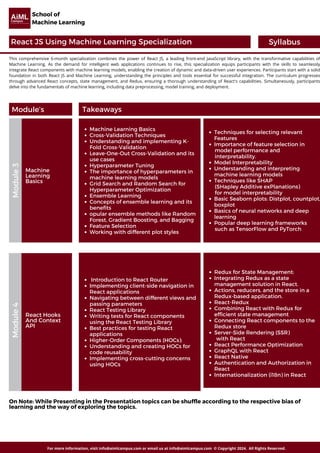
Edge Computing for Machine Learning
Understanding and implementing
machine learning on edge devices
Utilizing frameworks like TensorFlow
Lite for mobile and edge deployments
Serverless Architecture for ML
Implementing serverless functions for
deploying and serving machine learning
models
Exploring platforms like AWS Lambda,
Azure Functions, or Google Cloud
Functions
Model Monitoring and Management
Strategies for model versioning, rollback,
and A/B testing in production
Scalability and Load Balancing
Scaling machine learning APIs to handle
increased load
Implementing load balancing strategies
for efficient resource utilization
H O W T O G E T I D E A S & M E A S U R E
Advanced
Machine
Learning
Integration
For more information, visit info@aimlcampus.com or email us at info@aimlcampus.com © Copyright 2024. All Rights Reserved.
AiML
Campus
Human Intelligence Meets Artificial Learning Intelligence
School of
Machine Learning
Multi-Cloud Deployments
Deploying machine learning models on
multiple cloud providers for
redundancy and flexibility.
Ensuring interoperability and
consistency across different cloud
environments.
Security Best Practices
Addressing common security
challenges in machine learning
Model Lifecycle Management
Developing comprehensive strategies
the entire lifecycle of a machine
Learning model, from development to
retirement
Real-time Collaboration in ML Teams
Model Explainability Techniques
Module
6
Overview of React Hooks
Understanding and using built-in hooks
like useState, useEffect, useContext, etc.
Creating custom hooks for code reuse
and organization
Context API
Deep dive into React's Context API for
state management in larger applications
React Router
Building complex navigation structures
and handling route parameters
Utilizing nested routes and route guards
Error Boundaries
Implementing error boundaries to
gracefully handle errors in components.
Redux
Global state management with Redux
Middleware and asynchronous
operations with Redux Thunk or Redux
Saga.
H O W T O G E T I D E A S & M E A S U R E
Advanced
React
Concepts
Integrating GraphQL for efficient data
fetching
Apollo Client and Relay for managing
GraphQL data in React applications
React Performance Optimization
Memoization techniques and using
React.memo for functional
components.
Dynamic import and code splitting for
better application performance
Real-time communication using
WebSockets in React applications
Using React Portals for rendering
components outside the usual DOM
hierarchy.
Managing complex state logic using
state machines (e.g., XState).
Implementing animations with React
Spring, Framer Motion, or CSS-in-JS
libraries.
On Note: While Presenting in the Presentation topics can be shuffle according to the respective bias of
learning and the way of exploring the topics.
This comprehensive 6-month specialization combines the power of React JS, a leading front-end JavaScript library, with the transformative capabilities of
Machine Learning. As the demand for intelligent web applications continues to rise, this specialization equips participants with the skills to seamlessly
integrate React components with machine learning models, enabling the creation of dynamic and data-driven user experiences. Participants start with a solid
foundation in both React JS and Machine Learning, understanding the principles and tools essential for successful integration. The curriculum progresses
through advanced React concepts, state management, and Redux, ensuring a thorough understanding of React's capabilities. Simultaneously, participants
delve into the fundamentals of machine learning, including data preprocessing, model training, and deployment.
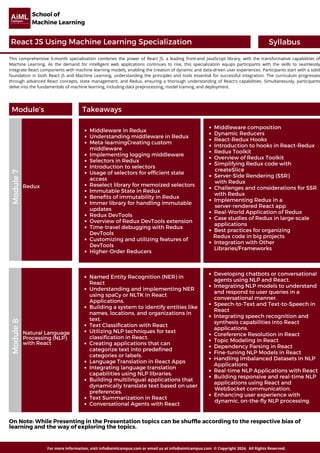
React JS Using Machine Learning Specialization Syllabus
Module
7
Module’s Takeaways
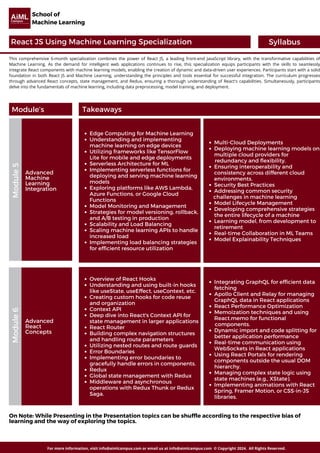
Middleware in Redux
Understanding middleware in Redux
Meta-learningCreating custom
middleware
Implementing logging middleware
Selectors in Redux
Introduction to selectors
Usage of selectors for efficient state
access
Reselect library for memoized selectors
Immutable State in Redux
Benefits of immutability in Redux
Immer library for handling immutable
updates
Redux DevTools
Overview of Redux DevTools extension
Time-travel debugging with Redux
DevTools
Customizing and utilizing features of
DevTools
Higher-Order Reducers
H O W T O G E T I D E A S & M E A S U R E
Redux
For more information, visit info@aimlcampus.com or email us at info@aimlcampus.com © Copyright 2024. All Rights Reserved.
AiML
Campus
Human Intelligence Meets Artificial Learning Intelligence
School of
Machine Learning
Middleware composition
Dynamic Reducers
React-Redux Hooks
Introduction to hooks in React-Redux
Redux Toolkit
Overview of Redux Toolkit
Simplifying Redux code with
createSlice
Server-Side Rendering (SSR)
with Redux
Challenges and considerations for SSR
with Redux
Implementing Redux in a
server-rendered React app
Real-World Application of Redux
Case studies of Redux in large-scale
applications
Best practices for organizing
Redux code in big projects
Integration with Other
Libraries/Frameworks
On Note: While Presenting in the Presentation topics can be shuffle according to the respective bias of
learning and the way of exploring the topics.
Module
8
Named Entity Recognition (NER) in
React
Understanding and implementing NER
using spaCy or NLTK in React
Applications.
Building a system to identify entities like
names, locations, and organizations in
text.
Text Classification with React
Utilizing NLP techniques for text
classification in React.
Creating applications that can
categorize text into predefined
categories or labels.
Language Translation in React Apps
Integrating language translation
capabilities using NLP libraries.
Building multilingual applications that
dynamically translate text based on user
preferences.
Text Summarization in React
Conversational Agents with React
H O W T O G E T I D E A S & M E A S U R E
Natural Language
Processing (NLP)
with React
Developing chatbots or conversational
agents using NLP and React.
Integrating NLP models to understand
and respond to user queries in a
conversational manner.
Speech-to-Text and Text-to-Speech in
React
Integrating speech recognition and
synthesis capabilities into React
applications.
Coreference Resolution in React
Topic Modeling in React
Dependency Parsing in React
Fine-tuning NLP Models in React
Handling Imbalanced Datasets in NLP
Applications
Real-time NLP Applications with React
Building responsive and real-time NLP
applications using React and
WebSocket communication.
Enhancing user experience with
dynamic, on-the-fly NLP processing.
This comprehensive 6-month specialization combines the power of React JS, a leading front-end JavaScript library, with the transformative capabilities of
Machine Learning. As the demand for intelligent web applications continues to rise, this specialization equips participants with the skills to seamlessly
integrate React components with machine learning models, enabling the creation of dynamic and data-driven user experiences. Participants start with a solid
foundation in both React JS and Machine Learning, understanding the principles and tools essential for successful integration. The curriculum progresses
through advanced React concepts, state management, and Redux, ensuring a thorough understanding of React's capabilities. Simultaneously, participants
delve into the fundamentals of machine learning, including data preprocessing, model training, and deployment.
React JS Using Machine Learning Specialization Syllabus
Module
9
Module’s Takeaways
Capstone Project on React JS Using
Machine Learning
H O W T O G E T I D E A S & M E A S U R E
Project 1
For more information, visit info@aimlcampus.com or email us at info@aimlcampus.com © Copyright 2024. All Rights Reserved.
AiML
Campus
Human Intelligence Meets Artificial Learning Intelligence
School of
Machine Learning
Capstone Project on React JS Using
Machine Learning
On Note: While Presenting in the Presentation topics can be shuffle according to the respective bias of
learning and the way of exploring the topics.
Module
10
Capstone Project on React JS Using
Machine Learning
H O W T O G E T I D E A S & M E A S U R E
Project 2
Capstone Project on React JS Using
Machine Learning
This comprehensive 6-month specialization combines the power of React JS, a leading front-end JavaScript library, with the transformative capabilities of
Machine Learning. As the demand for intelligent web applications continues to rise, this specialization equips participants with the skills to seamlessly
integrate React components with machine learning models, enabling the creation of dynamic and data-driven user experiences. Participants start with a solid
foundation in both React JS and Machine Learning, understanding the principles and tools essential for successful integration. The curriculum progresses
through advanced React concepts, state management, and Redux, ensuring a thorough understanding of React's capabilities. Simultaneously, participants
delve into the fundamentals of machine learning, including data preprocessing, model training, and deployment.

AiML Campus React JS Using Machine Learning

  • 1.
    React JS UsingMachine Learning Specialization Syllabus Module 1 Module’s Takeaways Overview of React JS and Machine Learning React JS Overview Machine Learning Overview Importance of Combining React with Machine Learning Advanced optimization techniques React Environment Setup Machine Learning Environment Setup Basics of JavaScript and JSX for React Development Introduction to JavaScript JSX (JavaScript XML This comprehensive 6-month specialization combines the power of React JS, a leading front-end JavaScript library, with the transformative capabilities of Machine Learning. As the demand for intelligent web applications continues to rise, this specialization equips participants with the skills to seamlessly integrate React components with machine learning models, enabling the creation of dynamic and data-driven user experiences. Participants start with a solid foundation in both React JS and Machine Learning, understanding the principles and tools essential for successful integration. The curriculum progresses through advanced React concepts, state management, and Redux, ensuring a thorough understanding of React's capabilities. Simultaneously, participants delve into the fundamentals of machine learning, including data preprocessing, model training, and deployment. H O W T O G E T I D E A S & M E A S U R E For more information, visit info@aimlcampus.com or email us at info@aimlcampus.com © Copyright 2024. All Rights Reserved. AiML Campus Human Intelligence Meets Artificial Learning Intelligence School of Machine Learning Introduction to Machine Learning Concepts and Algorithms Fundamentals of Machine Learning Common Machine Learning Algorithms Model Training and Evaluation Integration of React JS with Machine Learning Communicating with Backend Rendering Predictions in React Components Real-time Interactivity with Machine Learning Component Lifecycle in React On Note: While Presenting in the Presentation topics can be shuffle according to the respective bias of learning and the way of exploring the topics. Understanding React Components and Props Introduction to React Components Class Components vs Functional Components JSX (JavaScript XML) syntax Props and PropTypes Stateless vs Stateful Components State Management in React Applications Introduction to React State Using State in Class Components Updating State and re-rendering State lifting up React Hooks (useState, useEffect) React Component Lifecycle Methods Mounting, Updating, and Unmounting phases Theming in React applications Responsive Design with Media Queries React JS Fundamentals componentDidMount, componentDidUpdate, componentWillUnmount shouldComponentUpdate and PureComponent useEffect Hook in Functional Components React Router for Navigation in React Applications Introduction to React Router Basic Routing (BrowserRouter, Route, Switch) Route Parameters and Query Parameters Nested Routing Programmatic Navigation CSS-in-JS libraries (e.g., styled- components, emotion) Modular CSS and BEM (Block, Element, Modifier) methodology Introduction to React JS And Machine Learning Module 2
  • 2.
    React JS UsingMachine Learning Specialization Syllabus Module 3 Module’s Takeaways Machine Learning Basics Cross-Validation Techniques Understanding and implementing K- Fold Cross-Validation Leave-One-Out Cross-Validation and its use cases Hyperparameter Tuning The importance of hyperparameters in machine learning models Grid Search and Random Search for Hyperparameter Optimization Ensemble Learning Concepts of ensemble learning and its benefits opular ensemble methods like Random Forest, Gradient Boosting, and Bagging Feature Selection Working with different plot styles H O W T O G E T I D E A S & M E A S U R E Machine Learning Basics For more information, visit info@aimlcampus.com or email us at info@aimlcampus.com © Copyright 2024. All Rights Reserved. AiML Campus Human Intelligence Meets Artificial Learning Intelligence School of Machine Learning Techniques for selecting relevant Features Importance of feature selection in model performance and interpretability. Model Interpretability Understanding and interpreting machine learning models Techniques like SHAP (SHapley Additive exPlanations) for model interpretability Basic Seaborn plots: Distplot, countplot, boxplot Basics of neural networks and deep learning Popular deep learning frameworks such as TensorFlow and PyTorch Module 4 Introduction to React Router Implementing client-side navigation in React applications Navigating between different views and passing parameters React Testing Library Writing tests for React components using the React Testing Library Best practices for testing React applications Higher-Order Components (HOCs): Understanding and creating HOCs for code reusability Implementing cross-cutting concerns using HOCs H O W T O G E T I D E A S & M E A S U R E React Hooks And Context API Redux for State Management: Integrating Redux as a state management solution in React. Actions, reducers, and the store in a Redux-based application. React-Redux Combining React with Redux for efficient state management Connecting React components to the Redux store Server-Side Rendering (SSR) with React React Performance Optimization GraphQL with React React Native Authentication and Authorization in React Internationalization (i18n) in React On Note: While Presenting in the Presentation topics can be shuffle according to the respective bias of learning and the way of exploring the topics. This comprehensive 6-month specialization combines the power of React JS, a leading front-end JavaScript library, with the transformative capabilities of Machine Learning. As the demand for intelligent web applications continues to rise, this specialization equips participants with the skills to seamlessly integrate React components with machine learning models, enabling the creation of dynamic and data-driven user experiences. Participants start with a solid foundation in both React JS and Machine Learning, understanding the principles and tools essential for successful integration. The curriculum progresses through advanced React concepts, state management, and Redux, ensuring a thorough understanding of React's capabilities. Simultaneously, participants delve into the fundamentals of machine learning, including data preprocessing, model training, and deployment.
  • 3.
    React JS UsingMachine Learning Specialization Syllabus Module 5 Module’s Takeaways Edge Computing for Machine Learning Understanding and implementing machine learning on edge devices Utilizing frameworks like TensorFlow Lite for mobile and edge deployments Serverless Architecture for ML Implementing serverless functions for deploying and serving machine learning models Exploring platforms like AWS Lambda, Azure Functions, or Google Cloud Functions Model Monitoring and Management Strategies for model versioning, rollback, and A/B testing in production Scalability and Load Balancing Scaling machine learning APIs to handle increased load Implementing load balancing strategies for efficient resource utilization H O W T O G E T I D E A S & M E A S U R E Advanced Machine Learning Integration For more information, visit info@aimlcampus.com or email us at info@aimlcampus.com © Copyright 2024. All Rights Reserved. AiML Campus Human Intelligence Meets Artificial Learning Intelligence School of Machine Learning Multi-Cloud Deployments Deploying machine learning models on multiple cloud providers for redundancy and flexibility. Ensuring interoperability and consistency across different cloud environments. Security Best Practices Addressing common security challenges in machine learning Model Lifecycle Management Developing comprehensive strategies the entire lifecycle of a machine Learning model, from development to retirement Real-time Collaboration in ML Teams Model Explainability Techniques Module 6 Overview of React Hooks Understanding and using built-in hooks like useState, useEffect, useContext, etc. Creating custom hooks for code reuse and organization Context API Deep dive into React's Context API for state management in larger applications React Router Building complex navigation structures and handling route parameters Utilizing nested routes and route guards Error Boundaries Implementing error boundaries to gracefully handle errors in components. Redux Global state management with Redux Middleware and asynchronous operations with Redux Thunk or Redux Saga. H O W T O G E T I D E A S & M E A S U R E Advanced React Concepts Integrating GraphQL for efficient data fetching Apollo Client and Relay for managing GraphQL data in React applications React Performance Optimization Memoization techniques and using React.memo for functional components. Dynamic import and code splitting for better application performance Real-time communication using WebSockets in React applications Using React Portals for rendering components outside the usual DOM hierarchy. Managing complex state logic using state machines (e.g., XState). Implementing animations with React Spring, Framer Motion, or CSS-in-JS libraries. On Note: While Presenting in the Presentation topics can be shuffle according to the respective bias of learning and the way of exploring the topics. This comprehensive 6-month specialization combines the power of React JS, a leading front-end JavaScript library, with the transformative capabilities of Machine Learning. As the demand for intelligent web applications continues to rise, this specialization equips participants with the skills to seamlessly integrate React components with machine learning models, enabling the creation of dynamic and data-driven user experiences. Participants start with a solid foundation in both React JS and Machine Learning, understanding the principles and tools essential for successful integration. The curriculum progresses through advanced React concepts, state management, and Redux, ensuring a thorough understanding of React's capabilities. Simultaneously, participants delve into the fundamentals of machine learning, including data preprocessing, model training, and deployment.
  • 4.
    React JS UsingMachine Learning Specialization Syllabus Module 7 Module’s Takeaways Middleware in Redux Understanding middleware in Redux Meta-learningCreating custom middleware Implementing logging middleware Selectors in Redux Introduction to selectors Usage of selectors for efficient state access Reselect library for memoized selectors Immutable State in Redux Benefits of immutability in Redux Immer library for handling immutable updates Redux DevTools Overview of Redux DevTools extension Time-travel debugging with Redux DevTools Customizing and utilizing features of DevTools Higher-Order Reducers H O W T O G E T I D E A S & M E A S U R E Redux For more information, visit info@aimlcampus.com or email us at info@aimlcampus.com © Copyright 2024. All Rights Reserved. AiML Campus Human Intelligence Meets Artificial Learning Intelligence School of Machine Learning Middleware composition Dynamic Reducers React-Redux Hooks Introduction to hooks in React-Redux Redux Toolkit Overview of Redux Toolkit Simplifying Redux code with createSlice Server-Side Rendering (SSR) with Redux Challenges and considerations for SSR with Redux Implementing Redux in a server-rendered React app Real-World Application of Redux Case studies of Redux in large-scale applications Best practices for organizing Redux code in big projects Integration with Other Libraries/Frameworks On Note: While Presenting in the Presentation topics can be shuffle according to the respective bias of learning and the way of exploring the topics. Module 8 Named Entity Recognition (NER) in React Understanding and implementing NER using spaCy or NLTK in React Applications. Building a system to identify entities like names, locations, and organizations in text. Text Classification with React Utilizing NLP techniques for text classification in React. Creating applications that can categorize text into predefined categories or labels. Language Translation in React Apps Integrating language translation capabilities using NLP libraries. Building multilingual applications that dynamically translate text based on user preferences. Text Summarization in React Conversational Agents with React H O W T O G E T I D E A S & M E A S U R E Natural Language Processing (NLP) with React Developing chatbots or conversational agents using NLP and React. Integrating NLP models to understand and respond to user queries in a conversational manner. Speech-to-Text and Text-to-Speech in React Integrating speech recognition and synthesis capabilities into React applications. Coreference Resolution in React Topic Modeling in React Dependency Parsing in React Fine-tuning NLP Models in React Handling Imbalanced Datasets in NLP Applications Real-time NLP Applications with React Building responsive and real-time NLP applications using React and WebSocket communication. Enhancing user experience with dynamic, on-the-fly NLP processing. This comprehensive 6-month specialization combines the power of React JS, a leading front-end JavaScript library, with the transformative capabilities of Machine Learning. As the demand for intelligent web applications continues to rise, this specialization equips participants with the skills to seamlessly integrate React components with machine learning models, enabling the creation of dynamic and data-driven user experiences. Participants start with a solid foundation in both React JS and Machine Learning, understanding the principles and tools essential for successful integration. The curriculum progresses through advanced React concepts, state management, and Redux, ensuring a thorough understanding of React's capabilities. Simultaneously, participants delve into the fundamentals of machine learning, including data preprocessing, model training, and deployment.
  • 5.
    React JS UsingMachine Learning Specialization Syllabus Module 9 Module’s Takeaways Capstone Project on React JS Using Machine Learning H O W T O G E T I D E A S & M E A S U R E Project 1 For more information, visit info@aimlcampus.com or email us at info@aimlcampus.com © Copyright 2024. All Rights Reserved. AiML Campus Human Intelligence Meets Artificial Learning Intelligence School of Machine Learning Capstone Project on React JS Using Machine Learning On Note: While Presenting in the Presentation topics can be shuffle according to the respective bias of learning and the way of exploring the topics. Module 10 Capstone Project on React JS Using Machine Learning H O W T O G E T I D E A S & M E A S U R E Project 2 Capstone Project on React JS Using Machine Learning This comprehensive 6-month specialization combines the power of React JS, a leading front-end JavaScript library, with the transformative capabilities of Machine Learning. As the demand for intelligent web applications continues to rise, this specialization equips participants with the skills to seamlessly integrate React components with machine learning models, enabling the creation of dynamic and data-driven user experiences. Participants start with a solid foundation in both React JS and Machine Learning, understanding the principles and tools essential for successful integration. The curriculum progresses through advanced React concepts, state management, and Redux, ensuring a thorough understanding of React's capabilities. Simultaneously, participants delve into the fundamentals of machine learning, including data preprocessing, model training, and deployment.