Value added :Prof.Srikant Kapoor
Points to Ponder
 Pay for 3 pieces of ‘Liril’ and get the 4th free !!!
 Buy one ‘Harpic’ and get an ‘Odonil’ free !!!
 Exchange your Maruti Alto for a Maruti Swift at a
Rs 40,000/= discount !!!
 Buy ‘Fast Track’ watches and get 5 different
colored wrist-bands free !!!
 New LG Television with unique ‘Child Lock’
feature !!!
Why are such offers given to consumers??
2
Some more examples…..
• ‘Dar ke aage jeet hai’ ….. Mountain Dew
• ‘Pappu Pass ho gaya’ ….. Cadbury’s
• ‘We also make steel’ …… Tata Steel
• ‘Filmi sitaron ka saundarya sabun’ ……..
Lux
• ‘Jaago India Jaago’ …….. Tata Tea
• ‘Desh ki Dhadkan’ ……… Hero Honda
• ‘An Idea can change your life’ ……. Idea
3
Behaviour……..what is it?
All such activities done by a consumer, while
obtaining , consuming and disposing of
products and services. This includes the
decision making processes that precede
and follow such actions.
4
Subject draws its concepts from:
 Psychology
 Sociology
 Anthropology
 Economics
 Marketing
5
Why study Consumer Behavior?
• Consumers ‘evolve’ with time, learning,
exposure and experience. They cannot be taken
for granted.
e.g. People booked their railway tickets from the station
counters, now they prefer online purchase thru website.
• As a consequence, a sound understanding of
consumer behavior is a pre-requisite for
sustained success of any marketing program
6
7
The study of Consumer Behaviour
covers:
1. Consumers in the Market Place.
2. Consumers as individuals.
3. Consumers as decision makers.
4. Consumers and subcultures.
5. Consumers and cultures.
8
Marketing decisions
• Market Segmentation: Process of dividing the market into distinct
subsets of consumers with common needs and characteristics and
selecting one or more segments to target with distinct marketing mix.
E.g. Bathing soap, detergents, shampoos etc.
• Segment Marketing: Serving needs of a particular group; different
marketing mix for different segments. e.g. Vegetarian recipes by
Haldiram.
• Niche Marketing: Marketing to a single group, tailoring the mix to
their specific needs and attract them, allowing the firm to engage in
relationship marketing. e.g. Nutralite bread spread, Diet Coke, Sugar
– free etc.
• Differentiated Marketing: organizations sell multiple versions of a
product; each appealing to different market segment. Differentiated
strategy can produce greater sales. e.g. Pepsi in 300ml as well as 2
litres.
• Individual Marketing: tailoring market mix to suit individual
customers and create value for each individual. e.g. Designer clothes
9
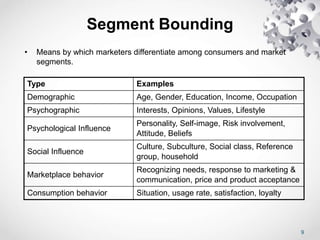
Segment Bounding
• Means by which marketers differentiate among consumers and market
segments.
Type Examples
Demographic Age, Gender, Education, Income, Occupation
Psychographic Interests, Opinions, Values, Lifestyle
Psychological Influence
Personality, Self-image, Risk involvement,
Attitude, Beliefs
Social Influence
Culture, Subculture, Social class, Reference
group, household
Marketplace behavior
Recognizing needs, response to marketing &
communication, price and product acceptance
Consumption behavior Situation, usage rate, satisfaction, loyalty
10
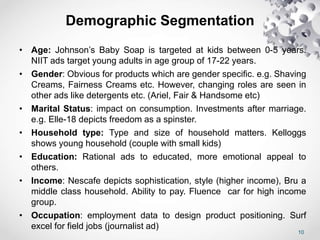
Demographic Segmentation
• Age: Johnson’s Baby Soap is targeted at kids between 0-5 years.
NIIT ads target young adults in age group of 17-22 years.
• Gender: Obvious for products which are gender specific. e.g. Shaving
Creams, Fairness Creams etc. However, changing roles are seen in
other ads like detergents etc. (Ariel, Fair & Handsome etc)
• Marital Status: impact on consumption. Investments after marriage.
e.g. Elle-18 depicts freedom as a spinster.
• Household type: Type and size of household matters. Kelloggs
shows young household (couple with small kids)
• Education: Rational ads to educated, more emotional appeal to
others.
• Income: Nescafe depicts sophistication, style (higher income), Bru a
middle class household. Ability to pay. Fluence car for high income
group.
• Occupation: employment data to design product positioning. Surf
excel for field jobs (journalist ad)
11
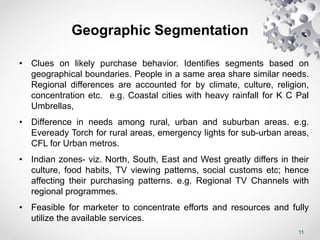
Geographic Segmentation
• Clues on likely purchase behavior. Identifies segments based on
geographical boundaries. People in a same area share similar needs.
Regional differences are accounted for by climate, culture, religion,
concentration etc. e.g. Coastal cities with heavy rainfall for K C Pal
Umbrellas,
• Difference in needs among rural, urban and suburban areas. e.g.
Eveready Torch for rural areas, emergency lights for sub-urban areas,
CFL for Urban metros.
• Indian zones- viz. North, South, East and West greatly differs in their
culture, food habits, TV viewing patterns, social customs etc; hence
affecting their purchasing patterns. e.g. Regional TV Channels with
regional programmes.
• Feasible for marketer to concentrate efforts and resources and fully
utilize the available services.
12
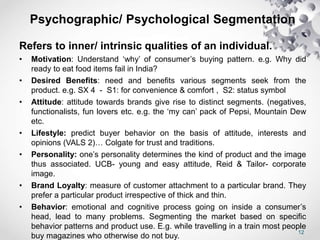
Psychographic/ Psychological Segmentation
Refers to inner/ intrinsic qualities of an individual.
• Motivation: Understand ‘why’ of consumer’s buying pattern. e.g. Why did
ready to eat food items fail in India?
• Desired Benefits: need and benefits various segments seek from the
product. e.g. SX 4 - S1: for convenience & comfort , S2: status symbol
• Attitude: attitude towards brands give rise to distinct segments. (negatives,
functionalists, fun lovers etc. e.g. the ‘my can’ pack of Pepsi, Mountain Dew
etc.
• Lifestyle: predict buyer behavior on the basis of attitude, interests and
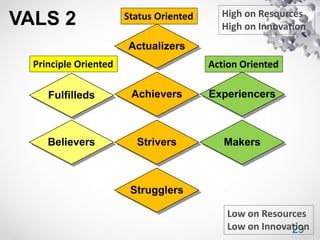
opinions (VALS 2)… Colgate for trust and traditions.
• Personality: one’s personality determines the kind of product and the image
thus associated. UCB- young and easy attitude, Reid & Tailor- corporate
image.
• Brand Loyalty: measure of customer attachment to a particular brand. They
prefer a particular product irrespective of thick and thin.
• Behavior: emotional and cognitive process going on inside a consumer’s
head, lead to many problems. Segmenting the market based on specific
behavior patterns and product use. E.g. while travelling in a train most people
buy magazines who otherwise do not buy.
13
Socio-Cultural Segmentation
• Family Life Cycle: All families pass through phases of formation,
growth and dissolution. At each stage, requirements vary and hence
becomes an important segment to be captured. (Maruti 800 ads in
year 2000-01)
• Social Class: relative status and social standing is important to
consumers. It is a function of income, education and occupation.
Knowledge of buying patterns, behavior etc. is important to appeal to
different segments. (Raymond)
• Culture, Cross Culture & Sub culture: segmenting the domestic
and international markets on the basis of cultural heritage as
members of the same culture share same values, beliefs and
customs. Within the larger culture distinct subgroups and subcultures
are united by certain experiences, values or beliefs and make
effective segments. Culturally different segments. (Health conscious
Indian urban upper middle class-LG)
14
Purchase Segmentation
• Usage rate: segmenting based on the rate of product usage. Division
of market into heavy, moderate and light users and planning the
marketing mix differently for each. e.g. ‘Frequent Flyer’ scheme of
airlines
• Loyalty status: consistency with which consumers continue to buy
same brand of a particular product and show their commitment. e.g.
‘Loyality Cards’ offered by retail stores.
• User status: whether consumers have used the product in past, use
it currently or are likely to use the same in future. Different mix could
be needed for each category. e.g. Upgrade your Godrej Refrigerator,
return the old one and buy a frost-free one.
Pavlov’s Classical Conditioning Theory:
•Whenever you hear the ‘Intel’ jingle, you
recall ‘Intel’
•Whenever you see the name ‘McDonald’,
you are reminded of Burgers.
•Whenever you see the Amul ‘Butter Girl’
you are reminded of ‘Amul Butter’.
16
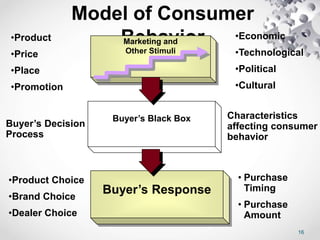
Model of Consumer
Behavior
Marketing and
Other Stimuli
Buyer’s Black Box
Buyer’s Response
•Product
•Price
•Place
•Promotion
•Economic
•Technological
•Political
•Cultural
Characteristics
affecting consumer
behavior
Buyer’s Decision
Process
•Product Choice
•Brand Choice
•Dealer Choice
• Purchase
Timing
• Purchase
Amount
Consumer Behavior
Logical Positivism
 Understanding consumer behavior & and
predicting
 Cause and effect relationships that govern
persuasion and/or education
Modern
 Understand consumption behavior without
any attempt to influence it.
17
study of Consumer Behavior
• Of all the products launched every year, only
55% survive five years later.
e.g. FIAT launched Uno, Palio, Sienna etc but the could
not survive profitably.
• Of the various new product concepts offerred by
over 100 leading companies, only 8% reached
the market and out of this 8% only 17%
achieved the marketing objectives.
e.g. HUL launched pre-cooked ready-to-eat rice, in line
with Nestle’s Maggi, but failed miserably.
18
Satisfying the consumer’s need is
more important than the expectations
of the management.
For survival, there is not option
before the companies but to
understand and adapt to consumer
motivation and behavior.
19
Effective Marketing can positively
influence the consumer, provided the
product/service offered satisfies his/her
needs and expectations
The right marketing program can
activate a latent demand and lead to
successful sales.
20
Consumer Research: The Dominant
Forces
 Economy moving from – ‘production/product-
centric’ to ‘market/customer-centric’.
e.g. Hindustan Motors (Ambassador) followed product
centric approach and lost its market share to Maruti
which followed the customer centric approach.
 Better understanding of human behavior through
improved tools of psychology and other
behavioral sciences.
21
The Marketing Challenge:
Environmental factors
 Extent of gap between the supply and demand of the valid
products/services. e.g. LPG cylinders are often sold at a
‘premium’ due to demand-supply gap.
 Speed and accuracy of communication with/from customers.
e.g. Most PSU Banks lost their market share to Private Banks
because of speed & accuracy of communication.
 Efficient and multiple distribution channels. e.g. sales of
telephone connections increased after mobile service providers
started appointing dealers, contrary to MTNL & BSNL.
 Marketers power to influence and induce channel partners to
comply with overall marketing strategy. e.g. certain Dish
Antenna companies offer certain channels free.
 National & Global Economic growth.
22
What is Motivational Research?
Study to explore the factors that motivate consumers
in making choices. The techniques delve into the
conscious, subconscious and the unconscious state of
the consumer.
‘Bata sells lovely feet, and not foot-ware’.
‘Women don’t buy Ponds, they buy hope.’
‘While buying a Rolex, people don’t buy a time-
keeping machine, rather style’.
23
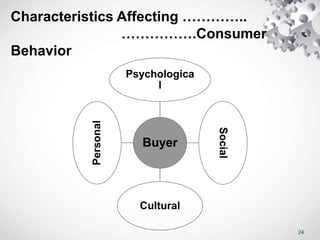
Characteristics Affecting …………..
…………….Consumer
Behavior
Buyer
Psychologica
l
Social
Cultural
Personal
24
Factors Affecting Consumer Behavior:
Culture
25
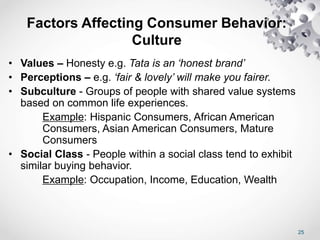
• Values – Honesty e.g. Tata is an ‘honest brand’
• Perceptions – e.g. ‘fair & lovely’ will make you fairer.
• Subculture - Groups of people with shared value systems
based on common life experiences.
Example: Hispanic Consumers, African American
Consumers, Asian American Consumers, Mature
Consumers
• Social Class - People within a social class tend to exhibit
similar buying behavior.
Example: Occupation, Income, Education, Wealth
26
Factors Affecting Consumer Behavior:
Social
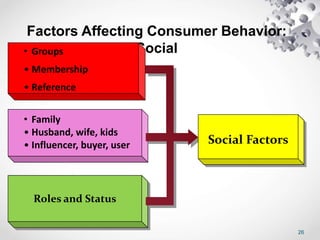
• Groups
• Membership
• Reference
• Family
• Husband, wife, kids
• Influencer, buyer, user
Roles and Status
Social Factors
27
Factors Affecting Consumer Behavior:
Personal
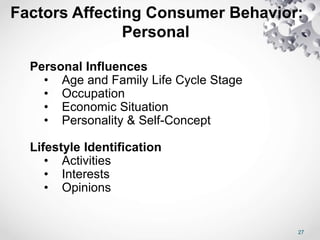
Personal Influences
• Age and Family Life Cycle Stage
• Occupation
• Economic Situation
• Personality & Self-Concept
Lifestyle Identification
• Activities
• Interests
• Opinions
28
28
Lifestyle Dimension
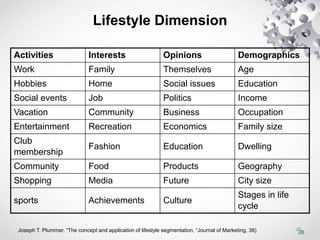
Activities Interests Opinions Demographics
Work Family Themselves Age
Hobbies Home Social issues Education
Social events Job Politics Income
Vacation Community Business Occupation
Entertainment Recreation Economics Family size
Club
membership
Fashion Education Dwelling
Community Food Products Geography
Shopping Media Future City size
sports Achievements Culture
Stages in life
cycle
Joseph T. Plummer, “The concept and application of lifestyle segmentation, “Journal of Marketing, 38)
29
VALS 2
Achievers
Actualizers
Strugglers
Strivers
Fulfilleds
Believers
Experiencers
Makers
High on Resources
High on Innovation
Low on Resources
Low on Innovation
Principle Oriented
Status Oriented
Action Oriented
30
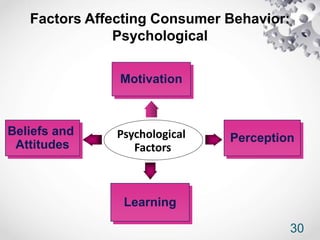
Psychological
Factors
Motivation
Perception
Learning
Beliefs and
Attitudes
Factors Affecting Consumer Behavior:
Psychological
31
Motivation refers to an activated state within a person that
leads to goal-directed behavior.
It consists of the drives, urges, wishes, or desires that
initiate the sequence of events leading to a behavior.
e.g. A banner announcing “50% off” on Lewis Jeans –
leading to youth discussing plans to visit the store.
A combo pack of “Harpic & Odonil” - leading
housewives shifting their favorite store.
What is Motivation?
32
 Motivation begins a stimulus that leads to the
recognition of a need. E.g. the free Odonil with Harpic was a
stimulus for the housewife.
 Need recognition occurs when a perceived
discrepancy exists between an actual and a desired
state of being
• Needs can be either innate or learned.
• Needs are never fully satisfied.
• Feelings and emotions accompany needs
 Expressive needs involve desires by consumers to
fulfill social and/or aesthetic requirements. E.g. buying of
a M F Hussain Painting
 Utilitarian needs involve desires by consumers to
solve basic problems . E.g. filling a car’s gas tank.
33
The Types of Emotions
 The Ten Emotions People Experience:
Disgust Interest
Joy Surprise
Sadness Anger
Fear Contempt
Shame Guilt
34
Some General Theories of Motivation
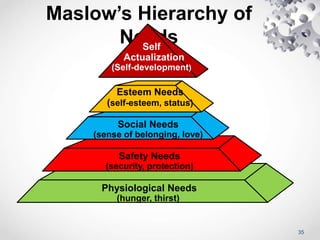
 Maslow’s Need Hierarchy
 McClelland’s Theory of Learned Needs
 Achievement motivation is seeking to get ahead, to strive for
success, and to take responsibility for solving problems.
 Need for affiliation motivates people to make friends, to
become members of groups, and to associate with others.
 Need for power refers to the desire to obtain and exercise
control over others.
 Need for uniqueness refers to desires to perceive ourselves
as original and different.
35
Maslow’s Hierarchy of
Needs
Esteem Needs
(self-esteem, status)
Social Needs
(sense of belonging, love)
Safety Needs
(security, protection)
Physiological Needs
(hunger, thirst)
Self
Actualization
(Self-development)
36
Learning
Kotler’s Definition : Learning involves changes in an individual’s
behaviour arising out of experience. Most of the human behaviour
is learned over time out of experience.
Schiffman and Kanuk’s Definition : Learning is a process by
which individuals acquire the purchase and consumption knowledge
and experience that they apply to future related behaviour.
Loudon and Della Bitta’s Definition : Learning can be viewed as a
relatively permanent change in behaviour occurring as a result of
experience.
37
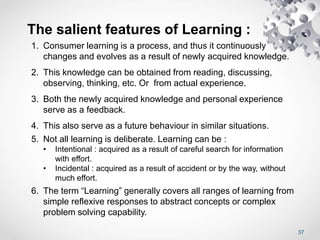
The salient features of Learning :
1. Consumer learning is a process, and thus it continuously
changes and evolves as a result of newly acquired knowledge.
2. This knowledge can be obtained from reading, discussing,
observing, thinking, etc. Or from actual experience.
3. Both the newly acquired knowledge and personal experience
serve as a feedback.
4. This also serve as a future behaviour in similar situations.
5. Not all learning is deliberate. Learning can be :
• Intentional : acquired as a result of careful search for information
with effort.
• Incidental : acquired as a result of accident or by the way, without
much effort.
6. The term “Learning” generally covers all ranges of learning from
simple reflexive responses to abstract concepts or complex
problem solving capability.
38
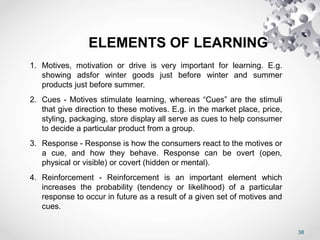
ELEMENTS OF LEARNING
1. Motives, motivation or drive is very important for learning. E.g.
showing adsfor winter goods just before winter and summer
products just before summer.
2. Cues - Motives stimulate learning, whereas “Cues” are the stimuli
that give direction to these motives. E.g. in the market place, price,
styling, packaging, store display all serve as cues to help consumer
to decide a particular product from a group.
3. Response - Response is how the consumers react to the motives or
a cue, and how they behave. Response can be overt (open,
physical or visible) or covert (hidden or mental).
4. Reinforcement - Reinforcement is an important element which
increases the probability (tendency or likelihood) of a particular
response to occur in future as a result of a given set of motives and
cues.
39
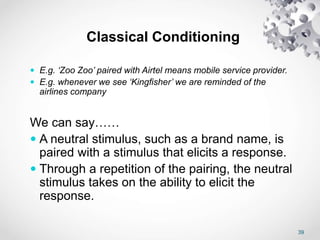
Classical Conditioning
 E.g. ‘Zoo Zoo’ paired with Airtel means mobile service provider.
 E.g. whenever we see ‘Kingfisher’ we are reminded of the
airlines company
We can say……
 A neutral stimulus, such as a brand name, is
paired with a stimulus that elicits a response.
 Through a repetition of the pairing, the neutral
stimulus takes on the ability to elicit the
response.
40
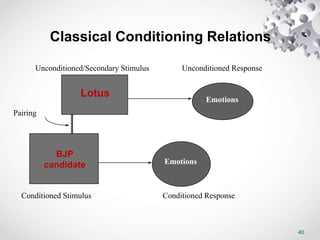
Unconditioned/Secondary Stimulus Unconditioned Response
Pairing
Conditioned Stimulus Conditioned Response
Lotus
Emotions
BJP
candidate Emotions
Classical Conditioning Relations
41
Classical Conditioning: Applications
 Applications: communications--advertising, public
relations, personal selling.
 Goal: identify powerful positive stimulus and
associate brand with it.
 Examples of powerful, emotion causing stimuli:
 beautiful, sexy people
 patriotic themes, religious symbols
 Music, beautiful scenes
 Also, negative stimuli can be associated with competitors.
 Credit card insignia may elicit spending responses
42
Operant Conditioning :
The process in which the frequency of occurrence of
a bit of behavior is modified by the consequences of
the behavior.
 If positively reinforced, the likelihood of the
behavior being repeated increases. E.g. buy one shirt,
get another shirt at 50% discount. Buy two shirts, get the third
at 75% discount.
 If punished, the likelihood of the behavior being
repeated decreases. E.g. the more electricity you use,
the rate per unit increases.
43
Reinforcement & Influencing
Behavior
 A reinforcer is anything that occurs after a behavior
and changes the likelihood that it will be emitted
again.
 Positive reinforcers are positive rewards that follow
immediately after a behavior occurs.
 Negative reinforcers are the removal of an aversive
stimulus.
44
Secondary reinforcers . . .
. . . are a previously neutral stimulus that acquires
reinforcing properties through its association with a
primary reinforcer.
 Over a period of time, previously neutral stimuli can
become secondary reinforcers.
 In marketing, most reinforcers are secondary (e.g.
a product performing well, a reduction in price)
45
A Punisher . . .
. . . is any stimulus whose presence after a behavior
decreases the likelihood of the behavior reoccurring.
e.g. anti-smoking ads.
46
Extinction & Eliminating Behaviors
 Once an operant
response is conditioned,
it will persist as long as
it is periodically
reinforced.
 Extinction is the
disappearance of a
response due to lack of
reinforcement.
47
Perception
Selecting, organizing and interpreting information in a
way to produce a meaningful experience of the world is
called perception.
48
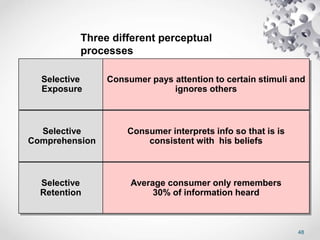
Selective
Exposure
Selective
Comprehension
Selective
Retention
Consumer pays attention to certain stimuli and
ignores others
Consumer interprets info so that is is
consistent with his beliefs
Average consumer only remembers
30% of information heard
Three different perceptual
processes
49
Perceived risk
Perceived risk represents the anxieties felt because
the consumer cannot anticipate the outcomes of a
purchase but believes that there may be negative
consequences.
Perceived risk is a consumer’s perception of the
overall negativity of a course of action based upon as
assessment of the possible negative outcomes and of
the likelihood that these outcomes will occur.
Perceived risk consists of two major concepts - the
negative outcomes of a decision and the probability
these outcomes will occur.
50
7 Types of Consumer Risks.
 Financial/Economic
 Performance
 Physical/Personal
 Psychological
 Social
 Time
 Opportunity Loss
51
Factors Influencing Risk Perception
 Characteristics of the person—e.g., need for
stimulation
 Nature of the task
 Voluntary risks are perceived as less risky than involuntary
tasks.
 Characteristics of the product—price
 Salience of negative outcomes
52
Six risk-reduction strategies
 Be brand loyal and
consistently purchase the
same brand.
 Buy through brand image
and purchase a quality
national brand.
 Buy through store image
from a retailer that you
trust.
 Seek out information in
order to make a well
informed decision.
 Buy the most expensive
brand, which is likely to
have high quality.
 Buy the least expensive
brand in order to
reduce financial risk.
53
Beliefs & Attitudes
Belief
• A descriptive thought about a brand or service
• May be based on real knowledge, opinion or
faith
Attitude
• Describes a person’s evaluations, feelings and
tendencies towards an object or idea
• They are difficult to change
54
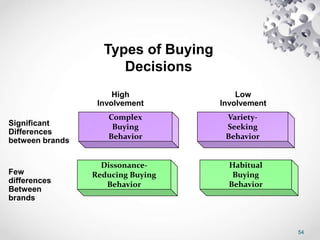
Types of Buying
Decisions
Complex
Buying
Behavior
Dissonance-
Reducing Buying
Behavior
Variety-
Seeking
Behavior
Habitual
Buying
Behavior
High
Involvement
Significant
Differences
between brands
Few
differences
Between
brands
Low
Involvement
55
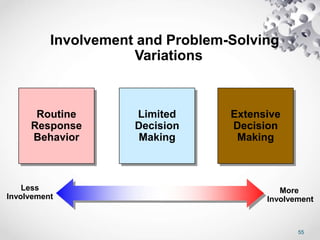
Involvement and Problem-Solving
Variations
More
Involvement
Less
Involvement
Routine
Response
Behavior
Limited
Decision
Making
Extensive
Decision
Making
56
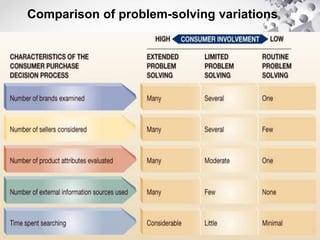
Comparison of problem-solving variations
57
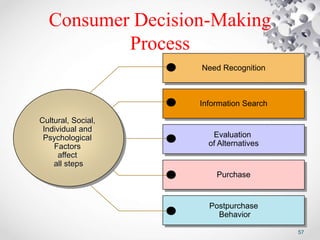
Consumer Decision-Making
Process
Postpurchase
Behavior
Purchase
Evaluation
of Alternatives
Information Search
Need Recognition
Cultural, Social,
Individual and
Psychological
Factors
affect
all steps
58
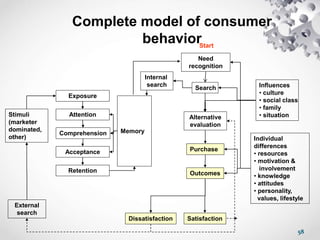
Complete model of consumer
behavior
Stimuli
(marketer
dominated,
other)
External
search
Memory
Internal
search
Exposure
Attention
Comprehension
Acceptance
Retention
Search
Need
recognition
Alternative
evaluation
Purchase
Outcomes
Dissatisfaction Satisfaction
Individual
differences
• resources
• motivation &
involvement
• knowledge
• attitudes
• personality,
values, lifestyle
Influences
• culture
• social class
• family
• situation
Start
59
• How do we know when to shop or buy a product/service?
• What are the triggers that initiate an awareness & search?
• What are the internal & external sources of such triggers?
60
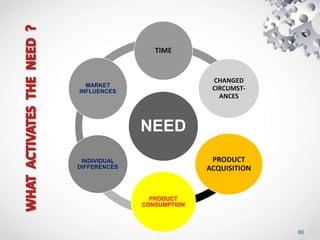
NEED
TIME
CHANGED
CIRCUMST-
ANCES
PRODUCT
ACQUISITION
PRODUCT
CONSUMPTION
INDIVIDUAL
DIFFERENCES
MARKET
INFLUENCES
61
• When the current product/service is
not satisfying the need
• When the consumer is running out of
an product/service
• When another product/service seems
superior to the one currently being
used
62
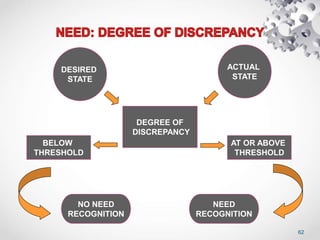
DEGREE OF
DISCREPANCY
DESIRED
STATE
ACTUAL
STATE
BELOW
THRESHOLD
AT OR ABOVE
THRESHOLD
NO NEED
RECOGNITION
NEED
RECOGNITION
63
Internal search involves the scanning of one's memory to recall
previous experiences or knowledge concerning solutions to the
problem/satisfying need.
Generally done for frequently purchased products/low
involvement products/services .
External search may be necessary when past experience or
knowledge is insufficient, the risk of making a wrong purchase
decision is high, and/or the cost of gathering information is low.
Generally done for high involvement products
64
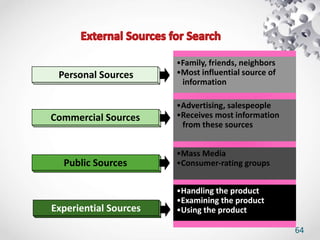
•Family, friends, neighbors
•Most influential source of
information
•Advertising, salespeople
•Receives most information
from these sources
•Mass Media
•Consumer-rating groups
•Handling the product
•Examining the product
•Using the product
Personal Sources
Commercial Sources
Public Sources
Experiential Sources
65
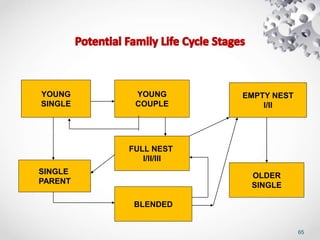
YOUNG
SINGLE
BLENDED
SINGLE
PARENT
FULL NEST
I/II/III
EMPTY NEST
I/II
OLDER
SINGLE
YOUNG
COUPLE
66
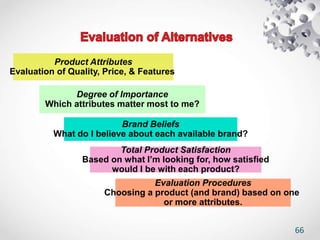
Product Attributes
Evaluation of Quality, Price, & Features
Degree of Importance
Which attributes matter most to me?
Brand Beliefs
What do I believe about each available brand?
Total Product Satisfaction
Based on what I’m looking for, how satisfied
would I be with each product?
Evaluation Procedures
Choosing a product (and brand) based on one
or more attributes.
67
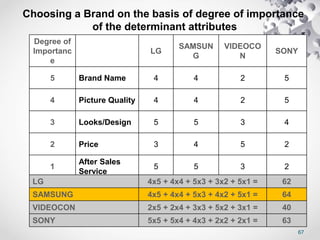
Degree of
Importanc
e
LG
SAMSUN
G
VIDEOCO
N
SONY
5 Brand Name 4 4 2 5
4 Picture Quality 4 4 2 5
3 Looks/Design 5 5 3 4
2 Price 3 4 5 2
1
After Sales
Service
5 5 3 2
LG 4x5 + 4x4 + 5x3 + 3x2 + 5x1 = 62
SAMSUNG 4x5 + 4x4 + 5x3 + 4x2 + 5x1 = 64
VIDEOCON 2x5 + 2x4 + 3x3 + 5x2 + 3x1 = 40
SONY 5x5 + 5x4 + 4x3 + 2x2 + 2x1 = 63
Choosing a Brand on the basis of degree of importance
of the determinant attributes
68
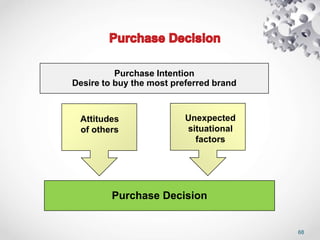
Purchase Intention
Desire to buy the most preferred brand
Purchase Decision
Attitudes
of others
Unexpected
situational
factors
69
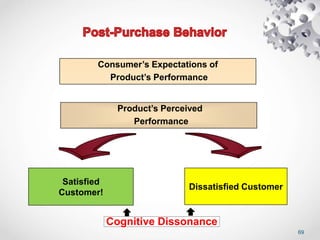
Consumer’s Expectations of
Product’s Performance
Dissatisfied Customer
Satisfied
Customer!
Product’s Perceived
Performance
Cognitive Dissonance
70
• Consumer Behavior, 10/e,
Pearson Education,
Leon G. Schiffman, Leslie Lazar Kanuk, S Ramesh Kumar
• Consumer Behavior: Building Marketing Strategy
McGraw Hill education
Del Hawkins, David Mothersbaugh, Amit Mookherjee
• Consumer Behavior: Concepts and Applications
David L. Loudon and Albert J. Della Bitta

AIMA-Consumer Behavior.pptx

  • 1.
  • 2.
    Points to Ponder Pay for 3 pieces of ‘Liril’ and get the 4th free !!!  Buy one ‘Harpic’ and get an ‘Odonil’ free !!!  Exchange your Maruti Alto for a Maruti Swift at a Rs 40,000/= discount !!!  Buy ‘Fast Track’ watches and get 5 different colored wrist-bands free !!!  New LG Television with unique ‘Child Lock’ feature !!! Why are such offers given to consumers?? 2
  • 3.
    Some more examples….. •‘Dar ke aage jeet hai’ ….. Mountain Dew • ‘Pappu Pass ho gaya’ ….. Cadbury’s • ‘We also make steel’ …… Tata Steel • ‘Filmi sitaron ka saundarya sabun’ …….. Lux • ‘Jaago India Jaago’ …….. Tata Tea • ‘Desh ki Dhadkan’ ……… Hero Honda • ‘An Idea can change your life’ ……. Idea 3
  • 4.
    Behaviour……..what is it? Allsuch activities done by a consumer, while obtaining , consuming and disposing of products and services. This includes the decision making processes that precede and follow such actions. 4
  • 5.
    Subject draws itsconcepts from:  Psychology  Sociology  Anthropology  Economics  Marketing 5
  • 6.
    Why study ConsumerBehavior? • Consumers ‘evolve’ with time, learning, exposure and experience. They cannot be taken for granted. e.g. People booked their railway tickets from the station counters, now they prefer online purchase thru website. • As a consequence, a sound understanding of consumer behavior is a pre-requisite for sustained success of any marketing program 6
  • 7.
    7 The study ofConsumer Behaviour covers: 1. Consumers in the Market Place. 2. Consumers as individuals. 3. Consumers as decision makers. 4. Consumers and subcultures. 5. Consumers and cultures.
  • 8.
    8 Marketing decisions • MarketSegmentation: Process of dividing the market into distinct subsets of consumers with common needs and characteristics and selecting one or more segments to target with distinct marketing mix. E.g. Bathing soap, detergents, shampoos etc. • Segment Marketing: Serving needs of a particular group; different marketing mix for different segments. e.g. Vegetarian recipes by Haldiram. • Niche Marketing: Marketing to a single group, tailoring the mix to their specific needs and attract them, allowing the firm to engage in relationship marketing. e.g. Nutralite bread spread, Diet Coke, Sugar – free etc. • Differentiated Marketing: organizations sell multiple versions of a product; each appealing to different market segment. Differentiated strategy can produce greater sales. e.g. Pepsi in 300ml as well as 2 litres. • Individual Marketing: tailoring market mix to suit individual customers and create value for each individual. e.g. Designer clothes
  • 9.
    9 Segment Bounding • Meansby which marketers differentiate among consumers and market segments. Type Examples Demographic Age, Gender, Education, Income, Occupation Psychographic Interests, Opinions, Values, Lifestyle Psychological Influence Personality, Self-image, Risk involvement, Attitude, Beliefs Social Influence Culture, Subculture, Social class, Reference group, household Marketplace behavior Recognizing needs, response to marketing & communication, price and product acceptance Consumption behavior Situation, usage rate, satisfaction, loyalty
  • 10.
    10 Demographic Segmentation • Age:Johnson’s Baby Soap is targeted at kids between 0-5 years. NIIT ads target young adults in age group of 17-22 years. • Gender: Obvious for products which are gender specific. e.g. Shaving Creams, Fairness Creams etc. However, changing roles are seen in other ads like detergents etc. (Ariel, Fair & Handsome etc) • Marital Status: impact on consumption. Investments after marriage. e.g. Elle-18 depicts freedom as a spinster. • Household type: Type and size of household matters. Kelloggs shows young household (couple with small kids) • Education: Rational ads to educated, more emotional appeal to others. • Income: Nescafe depicts sophistication, style (higher income), Bru a middle class household. Ability to pay. Fluence car for high income group. • Occupation: employment data to design product positioning. Surf excel for field jobs (journalist ad)
  • 11.
    11 Geographic Segmentation • Clueson likely purchase behavior. Identifies segments based on geographical boundaries. People in a same area share similar needs. Regional differences are accounted for by climate, culture, religion, concentration etc. e.g. Coastal cities with heavy rainfall for K C Pal Umbrellas, • Difference in needs among rural, urban and suburban areas. e.g. Eveready Torch for rural areas, emergency lights for sub-urban areas, CFL for Urban metros. • Indian zones- viz. North, South, East and West greatly differs in their culture, food habits, TV viewing patterns, social customs etc; hence affecting their purchasing patterns. e.g. Regional TV Channels with regional programmes. • Feasible for marketer to concentrate efforts and resources and fully utilize the available services.
  • 12.
    12 Psychographic/ Psychological Segmentation Refersto inner/ intrinsic qualities of an individual. • Motivation: Understand ‘why’ of consumer’s buying pattern. e.g. Why did ready to eat food items fail in India? • Desired Benefits: need and benefits various segments seek from the product. e.g. SX 4 - S1: for convenience & comfort , S2: status symbol • Attitude: attitude towards brands give rise to distinct segments. (negatives, functionalists, fun lovers etc. e.g. the ‘my can’ pack of Pepsi, Mountain Dew etc. • Lifestyle: predict buyer behavior on the basis of attitude, interests and opinions (VALS 2)… Colgate for trust and traditions. • Personality: one’s personality determines the kind of product and the image thus associated. UCB- young and easy attitude, Reid & Tailor- corporate image. • Brand Loyalty: measure of customer attachment to a particular brand. They prefer a particular product irrespective of thick and thin. • Behavior: emotional and cognitive process going on inside a consumer’s head, lead to many problems. Segmenting the market based on specific behavior patterns and product use. E.g. while travelling in a train most people buy magazines who otherwise do not buy.
  • 13.
    13 Socio-Cultural Segmentation • FamilyLife Cycle: All families pass through phases of formation, growth and dissolution. At each stage, requirements vary and hence becomes an important segment to be captured. (Maruti 800 ads in year 2000-01) • Social Class: relative status and social standing is important to consumers. It is a function of income, education and occupation. Knowledge of buying patterns, behavior etc. is important to appeal to different segments. (Raymond) • Culture, Cross Culture & Sub culture: segmenting the domestic and international markets on the basis of cultural heritage as members of the same culture share same values, beliefs and customs. Within the larger culture distinct subgroups and subcultures are united by certain experiences, values or beliefs and make effective segments. Culturally different segments. (Health conscious Indian urban upper middle class-LG)
  • 14.
    14 Purchase Segmentation • Usagerate: segmenting based on the rate of product usage. Division of market into heavy, moderate and light users and planning the marketing mix differently for each. e.g. ‘Frequent Flyer’ scheme of airlines • Loyalty status: consistency with which consumers continue to buy same brand of a particular product and show their commitment. e.g. ‘Loyality Cards’ offered by retail stores. • User status: whether consumers have used the product in past, use it currently or are likely to use the same in future. Different mix could be needed for each category. e.g. Upgrade your Godrej Refrigerator, return the old one and buy a frost-free one.
  • 15.
    Pavlov’s Classical ConditioningTheory: •Whenever you hear the ‘Intel’ jingle, you recall ‘Intel’ •Whenever you see the name ‘McDonald’, you are reminded of Burgers. •Whenever you see the Amul ‘Butter Girl’ you are reminded of ‘Amul Butter’.
  • 16.
    16 Model of Consumer Behavior Marketingand Other Stimuli Buyer’s Black Box Buyer’s Response •Product •Price •Place •Promotion •Economic •Technological •Political •Cultural Characteristics affecting consumer behavior Buyer’s Decision Process •Product Choice •Brand Choice •Dealer Choice • Purchase Timing • Purchase Amount
  • 17.
    Consumer Behavior Logical Positivism Understanding consumer behavior & and predicting  Cause and effect relationships that govern persuasion and/or education Modern  Understand consumption behavior without any attempt to influence it. 17
  • 18.
    study of ConsumerBehavior • Of all the products launched every year, only 55% survive five years later. e.g. FIAT launched Uno, Palio, Sienna etc but the could not survive profitably. • Of the various new product concepts offerred by over 100 leading companies, only 8% reached the market and out of this 8% only 17% achieved the marketing objectives. e.g. HUL launched pre-cooked ready-to-eat rice, in line with Nestle’s Maggi, but failed miserably. 18
  • 19.
    Satisfying the consumer’sneed is more important than the expectations of the management. For survival, there is not option before the companies but to understand and adapt to consumer motivation and behavior. 19
  • 20.
    Effective Marketing canpositively influence the consumer, provided the product/service offered satisfies his/her needs and expectations The right marketing program can activate a latent demand and lead to successful sales. 20
  • 21.
    Consumer Research: TheDominant Forces  Economy moving from – ‘production/product- centric’ to ‘market/customer-centric’. e.g. Hindustan Motors (Ambassador) followed product centric approach and lost its market share to Maruti which followed the customer centric approach.  Better understanding of human behavior through improved tools of psychology and other behavioral sciences. 21
  • 22.
    The Marketing Challenge: Environmentalfactors  Extent of gap between the supply and demand of the valid products/services. e.g. LPG cylinders are often sold at a ‘premium’ due to demand-supply gap.  Speed and accuracy of communication with/from customers. e.g. Most PSU Banks lost their market share to Private Banks because of speed & accuracy of communication.  Efficient and multiple distribution channels. e.g. sales of telephone connections increased after mobile service providers started appointing dealers, contrary to MTNL & BSNL.  Marketers power to influence and induce channel partners to comply with overall marketing strategy. e.g. certain Dish Antenna companies offer certain channels free.  National & Global Economic growth. 22
  • 23.
    What is MotivationalResearch? Study to explore the factors that motivate consumers in making choices. The techniques delve into the conscious, subconscious and the unconscious state of the consumer. ‘Bata sells lovely feet, and not foot-ware’. ‘Women don’t buy Ponds, they buy hope.’ ‘While buying a Rolex, people don’t buy a time- keeping machine, rather style’. 23
  • 24.
  • 25.
    Factors Affecting ConsumerBehavior: Culture 25 • Values – Honesty e.g. Tata is an ‘honest brand’ • Perceptions – e.g. ‘fair & lovely’ will make you fairer. • Subculture - Groups of people with shared value systems based on common life experiences. Example: Hispanic Consumers, African American Consumers, Asian American Consumers, Mature Consumers • Social Class - People within a social class tend to exhibit similar buying behavior. Example: Occupation, Income, Education, Wealth
  • 26.
    26 Factors Affecting ConsumerBehavior: Social • Groups • Membership • Reference • Family • Husband, wife, kids • Influencer, buyer, user Roles and Status Social Factors
  • 27.
    27 Factors Affecting ConsumerBehavior: Personal Personal Influences • Age and Family Life Cycle Stage • Occupation • Economic Situation • Personality & Self-Concept Lifestyle Identification • Activities • Interests • Opinions
  • 28.
    28 28 Lifestyle Dimension Activities InterestsOpinions Demographics Work Family Themselves Age Hobbies Home Social issues Education Social events Job Politics Income Vacation Community Business Occupation Entertainment Recreation Economics Family size Club membership Fashion Education Dwelling Community Food Products Geography Shopping Media Future City size sports Achievements Culture Stages in life cycle Joseph T. Plummer, “The concept and application of lifestyle segmentation, “Journal of Marketing, 38)
  • 29.
    29 VALS 2 Achievers Actualizers Strugglers Strivers Fulfilleds Believers Experiencers Makers High onResources High on Innovation Low on Resources Low on Innovation Principle Oriented Status Oriented Action Oriented
  • 30.
  • 31.
    31 Motivation refers toan activated state within a person that leads to goal-directed behavior. It consists of the drives, urges, wishes, or desires that initiate the sequence of events leading to a behavior. e.g. A banner announcing “50% off” on Lewis Jeans – leading to youth discussing plans to visit the store. A combo pack of “Harpic & Odonil” - leading housewives shifting their favorite store. What is Motivation?
  • 32.
    32  Motivation beginsa stimulus that leads to the recognition of a need. E.g. the free Odonil with Harpic was a stimulus for the housewife.  Need recognition occurs when a perceived discrepancy exists between an actual and a desired state of being • Needs can be either innate or learned. • Needs are never fully satisfied. • Feelings and emotions accompany needs  Expressive needs involve desires by consumers to fulfill social and/or aesthetic requirements. E.g. buying of a M F Hussain Painting  Utilitarian needs involve desires by consumers to solve basic problems . E.g. filling a car’s gas tank.
  • 33.
    33 The Types ofEmotions  The Ten Emotions People Experience: Disgust Interest Joy Surprise Sadness Anger Fear Contempt Shame Guilt
  • 34.
    34 Some General Theoriesof Motivation  Maslow’s Need Hierarchy  McClelland’s Theory of Learned Needs  Achievement motivation is seeking to get ahead, to strive for success, and to take responsibility for solving problems.  Need for affiliation motivates people to make friends, to become members of groups, and to associate with others.  Need for power refers to the desire to obtain and exercise control over others.  Need for uniqueness refers to desires to perceive ourselves as original and different.
  • 35.
    35 Maslow’s Hierarchy of Needs EsteemNeeds (self-esteem, status) Social Needs (sense of belonging, love) Safety Needs (security, protection) Physiological Needs (hunger, thirst) Self Actualization (Self-development)
  • 36.
    36 Learning Kotler’s Definition :Learning involves changes in an individual’s behaviour arising out of experience. Most of the human behaviour is learned over time out of experience. Schiffman and Kanuk’s Definition : Learning is a process by which individuals acquire the purchase and consumption knowledge and experience that they apply to future related behaviour. Loudon and Della Bitta’s Definition : Learning can be viewed as a relatively permanent change in behaviour occurring as a result of experience.
  • 37.
    37 The salient featuresof Learning : 1. Consumer learning is a process, and thus it continuously changes and evolves as a result of newly acquired knowledge. 2. This knowledge can be obtained from reading, discussing, observing, thinking, etc. Or from actual experience. 3. Both the newly acquired knowledge and personal experience serve as a feedback. 4. This also serve as a future behaviour in similar situations. 5. Not all learning is deliberate. Learning can be : • Intentional : acquired as a result of careful search for information with effort. • Incidental : acquired as a result of accident or by the way, without much effort. 6. The term “Learning” generally covers all ranges of learning from simple reflexive responses to abstract concepts or complex problem solving capability.
  • 38.
    38 ELEMENTS OF LEARNING 1.Motives, motivation or drive is very important for learning. E.g. showing adsfor winter goods just before winter and summer products just before summer. 2. Cues - Motives stimulate learning, whereas “Cues” are the stimuli that give direction to these motives. E.g. in the market place, price, styling, packaging, store display all serve as cues to help consumer to decide a particular product from a group. 3. Response - Response is how the consumers react to the motives or a cue, and how they behave. Response can be overt (open, physical or visible) or covert (hidden or mental). 4. Reinforcement - Reinforcement is an important element which increases the probability (tendency or likelihood) of a particular response to occur in future as a result of a given set of motives and cues.
  • 39.
    39 Classical Conditioning  E.g.‘Zoo Zoo’ paired with Airtel means mobile service provider.  E.g. whenever we see ‘Kingfisher’ we are reminded of the airlines company We can say……  A neutral stimulus, such as a brand name, is paired with a stimulus that elicits a response.  Through a repetition of the pairing, the neutral stimulus takes on the ability to elicit the response.
  • 40.
    40 Unconditioned/Secondary Stimulus UnconditionedResponse Pairing Conditioned Stimulus Conditioned Response Lotus Emotions BJP candidate Emotions Classical Conditioning Relations
  • 41.
    41 Classical Conditioning: Applications Applications: communications--advertising, public relations, personal selling.  Goal: identify powerful positive stimulus and associate brand with it.  Examples of powerful, emotion causing stimuli:  beautiful, sexy people  patriotic themes, religious symbols  Music, beautiful scenes  Also, negative stimuli can be associated with competitors.  Credit card insignia may elicit spending responses
  • 42.
    42 Operant Conditioning : Theprocess in which the frequency of occurrence of a bit of behavior is modified by the consequences of the behavior.  If positively reinforced, the likelihood of the behavior being repeated increases. E.g. buy one shirt, get another shirt at 50% discount. Buy two shirts, get the third at 75% discount.  If punished, the likelihood of the behavior being repeated decreases. E.g. the more electricity you use, the rate per unit increases.
  • 43.
    43 Reinforcement & Influencing Behavior A reinforcer is anything that occurs after a behavior and changes the likelihood that it will be emitted again.  Positive reinforcers are positive rewards that follow immediately after a behavior occurs.  Negative reinforcers are the removal of an aversive stimulus.
  • 44.
    44 Secondary reinforcers .. . . . . are a previously neutral stimulus that acquires reinforcing properties through its association with a primary reinforcer.  Over a period of time, previously neutral stimuli can become secondary reinforcers.  In marketing, most reinforcers are secondary (e.g. a product performing well, a reduction in price)
  • 45.
    45 A Punisher .. . . . . is any stimulus whose presence after a behavior decreases the likelihood of the behavior reoccurring. e.g. anti-smoking ads.
  • 46.
    46 Extinction & EliminatingBehaviors  Once an operant response is conditioned, it will persist as long as it is periodically reinforced.  Extinction is the disappearance of a response due to lack of reinforcement.
  • 47.
    47 Perception Selecting, organizing andinterpreting information in a way to produce a meaningful experience of the world is called perception.
  • 48.
    48 Selective Exposure Selective Comprehension Selective Retention Consumer pays attentionto certain stimuli and ignores others Consumer interprets info so that is is consistent with his beliefs Average consumer only remembers 30% of information heard Three different perceptual processes
  • 49.
    49 Perceived risk Perceived riskrepresents the anxieties felt because the consumer cannot anticipate the outcomes of a purchase but believes that there may be negative consequences. Perceived risk is a consumer’s perception of the overall negativity of a course of action based upon as assessment of the possible negative outcomes and of the likelihood that these outcomes will occur. Perceived risk consists of two major concepts - the negative outcomes of a decision and the probability these outcomes will occur.
  • 50.
    50 7 Types ofConsumer Risks.  Financial/Economic  Performance  Physical/Personal  Psychological  Social  Time  Opportunity Loss
  • 51.
    51 Factors Influencing RiskPerception  Characteristics of the person—e.g., need for stimulation  Nature of the task  Voluntary risks are perceived as less risky than involuntary tasks.  Characteristics of the product—price  Salience of negative outcomes
  • 52.
    52 Six risk-reduction strategies Be brand loyal and consistently purchase the same brand.  Buy through brand image and purchase a quality national brand.  Buy through store image from a retailer that you trust.  Seek out information in order to make a well informed decision.  Buy the most expensive brand, which is likely to have high quality.  Buy the least expensive brand in order to reduce financial risk.
  • 53.
    53 Beliefs & Attitudes Belief •A descriptive thought about a brand or service • May be based on real knowledge, opinion or faith Attitude • Describes a person’s evaluations, feelings and tendencies towards an object or idea • They are difficult to change
  • 54.
    54 Types of Buying Decisions Complex Buying Behavior Dissonance- ReducingBuying Behavior Variety- Seeking Behavior Habitual Buying Behavior High Involvement Significant Differences between brands Few differences Between brands Low Involvement
  • 55.
  • 56.
  • 57.
    57 Consumer Decision-Making Process Postpurchase Behavior Purchase Evaluation of Alternatives InformationSearch Need Recognition Cultural, Social, Individual and Psychological Factors affect all steps
  • 58.
    58 Complete model ofconsumer behavior Stimuli (marketer dominated, other) External search Memory Internal search Exposure Attention Comprehension Acceptance Retention Search Need recognition Alternative evaluation Purchase Outcomes Dissatisfaction Satisfaction Individual differences • resources • motivation & involvement • knowledge • attitudes • personality, values, lifestyle Influences • culture • social class • family • situation Start
  • 59.
    59 • How dowe know when to shop or buy a product/service? • What are the triggers that initiate an awareness & search? • What are the internal & external sources of such triggers?
  • 60.
  • 61.
    61 • When thecurrent product/service is not satisfying the need • When the consumer is running out of an product/service • When another product/service seems superior to the one currently being used
  • 62.
    62 DEGREE OF DISCREPANCY DESIRED STATE ACTUAL STATE BELOW THRESHOLD AT ORABOVE THRESHOLD NO NEED RECOGNITION NEED RECOGNITION
  • 63.
    63 Internal search involvesthe scanning of one's memory to recall previous experiences or knowledge concerning solutions to the problem/satisfying need. Generally done for frequently purchased products/low involvement products/services . External search may be necessary when past experience or knowledge is insufficient, the risk of making a wrong purchase decision is high, and/or the cost of gathering information is low. Generally done for high involvement products
  • 64.
    64 •Family, friends, neighbors •Mostinfluential source of information •Advertising, salespeople •Receives most information from these sources •Mass Media •Consumer-rating groups •Handling the product •Examining the product •Using the product Personal Sources Commercial Sources Public Sources Experiential Sources
  • 65.
  • 66.
    66 Product Attributes Evaluation ofQuality, Price, & Features Degree of Importance Which attributes matter most to me? Brand Beliefs What do I believe about each available brand? Total Product Satisfaction Based on what I’m looking for, how satisfied would I be with each product? Evaluation Procedures Choosing a product (and brand) based on one or more attributes.
  • 67.
    67 Degree of Importanc e LG SAMSUN G VIDEOCO N SONY 5 BrandName 4 4 2 5 4 Picture Quality 4 4 2 5 3 Looks/Design 5 5 3 4 2 Price 3 4 5 2 1 After Sales Service 5 5 3 2 LG 4x5 + 4x4 + 5x3 + 3x2 + 5x1 = 62 SAMSUNG 4x5 + 4x4 + 5x3 + 4x2 + 5x1 = 64 VIDEOCON 2x5 + 2x4 + 3x3 + 5x2 + 3x1 = 40 SONY 5x5 + 5x4 + 4x3 + 2x2 + 2x1 = 63 Choosing a Brand on the basis of degree of importance of the determinant attributes
  • 68.
    68 Purchase Intention Desire tobuy the most preferred brand Purchase Decision Attitudes of others Unexpected situational factors
  • 69.
    69 Consumer’s Expectations of Product’sPerformance Dissatisfied Customer Satisfied Customer! Product’s Perceived Performance Cognitive Dissonance
  • 70.
    70 • Consumer Behavior,10/e, Pearson Education, Leon G. Schiffman, Leslie Lazar Kanuk, S Ramesh Kumar • Consumer Behavior: Building Marketing Strategy McGraw Hill education Del Hawkins, David Mothersbaugh, Amit Mookherjee • Consumer Behavior: Concepts and Applications David L. Loudon and Albert J. Della Bitta