International Research Journal of Engineering and Technology (IRJET) e-ISSN: 2395-0056
Volume: 10 Issue: 05 | May 2023 www.irjet.net p-ISSN: 2395-0072
© 2023, IRJET | Impact Factor value: 8.226 | ISO 9001:2008 Certified Journal | Page 1556
AI-Learning style prediction for primary education
R. Varun Reddy1, A. Haritha2, Sri Vaishnavi3, Mr. Miryala Rama krishna4
1,2,3
B.Tech Scholars, Department of Computer Science and Engineering, SNIST, Hyderabad-501301, India
4
Professor, Department of Computer Science and Engineering, SNIST, Hyderabad- 501301, India
---------------------------------------------------------------------***---------------------------------------------------------------------
Abstract - Thewidespreaduseofonlinelearningisaresultof
information technology advancements. For primary school
children, there are, however, fewer pertinent evaluations and
applications. The goal of any learning innovation project is to
make learning more engaging for students while also raising
the standard of instruction. By choosing instructional
materials that complement each student's preferred learning
style, teachers can increase their students' engagement in the
teaching-learning process. The goal of the study is to create
and assess the effectiveness of an AI-based learning style
prediction model in an online learning environment for
elementary school pupils. Grades 4 through 6 Indonesian
elementaryschoolkidswereusedasthesubjects.TheAImodelin
the online learning portal was created to offer educational
materials that fit students' learning preferences in order to
uphold the notion of personalized learning. We developed a
novel AI strategy that enables learning style prediction to
drive collaborative filtering-based AI models.
Key Words: Learning Style, Strategy, Matrix, Students,
Ability, Rating.
1. INTRODUCTION
For primary school students to learn effectively, more work
must be put into raising the standard of instruction. In
primary schools, a variety of research techniques are usedto
create an engaging learning environment that will improve
motivation and independent learning. According to the
findings of earlier studies, activestudent participation in the
learning process—suchasthroughtheimplementationofthe
Team-Based Learning (TBL) approach, advancements in
information technology,andonlinelearning—wouldresultin
successful learning. In order for students to actively
participatein the learning process,theteacher,whoservesas
the learning manager, mustbeabletoselectthebestteaching
strategy. Thiscanbeaccomplished by utilizing technological
advancements to enhance the results of the educational
process. With the useof technology, such as online learning,
which promotes an interactive learning environment,
teacherscanalsodevelopandmaintainstudentmotivationand
independent learning. Online education is now being
developed in response to information technology
advancements. Students have accessto a variety of learning
tools thathavebeenproduced by theteacherthroughtheuse
of online learning. The several kinds of learning resources
mentioned include slideshows, e- books, animated films,
video lectures, and online articles. Teachers can arrange
these learning resources in an onlinelearning management
system (LMS) portal like Moodle to make them easier for
studentstoaccess.Onebenefitofusingonline learning is that
individual student peculiarities are taken into account.
1.1 Existing System
Learning enhancement as a specific topic of study has given
rise to tweaked learning, particularly mechanized modified
learning with pre-packaged courses, assessment, and
constantdatacollection.ArtificialIntelligence(AI)onadigital
platform can deliver personalized learning. To choose the
understudy's preferred learning method,oneofthemisused.
Speaking styles, learning systems, how to complete
obligations, how to assist others, and other embeddedworks
out are examples oflearningstyles, which are the preference
or method by which studentssuccessfullyacquireandimpart
information.
1.2 Proposed System
The goal of this work is to plan and assess the effects of
deploying a synthetic intelligence-based internet learning
gateway in order to boost student engagement and benefit
from data technology advancements. The artificial
intelligence model for the electronic learning entry was
developed to suggest suitable learning materials depending
on the student's preferred learning methods. To do this, we
developed a novel strategythatenabledthecoordination ofa
viable isolating-based AI model based on the supposition of
learning style. The technique enables the AI model to work
autonomously as a learning style assumption plan model at
this time. Our suggested computation differs from earlier
artificial intelligence-based methodsinthatitisindependent
of the learning strategy chosen by people. The inert learning
material vectors in the practical filtering structure are
layered with a softmax assumption layer to create the
suggested strategy's independence. The proposed
assessment limits the human propensity to take the
understudy's learning style into account while identifying
assets because of its autonomy. Theonlinelearning entrance
could make use of this artificial intelligence framework to
provide resources that are tuned to each student'spreferred
learning methods and learning styles.
2. LITERATURE SURVEY
Using the Team-Based Learning (TBL) teachingandlearning
strategy, this article was created to help lecturers establisha
International Research Journal of Engineering and Technology (IRJET) e-ISSN: 2395-0056
Volume: 10 Issue: 05 | May 2023 www.irjet.net p-ISSN: 2395-0072
© 2023, IRJET | Impact Factor value: 8.226 | ISO 9001:2008 Certified Journal | Page 1557
teachingportfoliothathelpsthemmaximizetheadvantagesof
blended learning, which combines in-person and online
learning [2]. According to studies, TBL can help students
learn how to work together effectively and can improve
active learning, two things thatcould help to make up forthe
shortcomings of blended learning implementation [6]. The
creation of a blended teaching portfolio for an international
human resource management course included a course
overview, graduate competency, syllabus, course resources,
teaching scenario, reading assurance test, midterm/final
exams, student assignments, assessment of learning
outcomes, and a course quality improvement sheet.[1] The
course's attributeswereusedtobuildeachitem.Thisstudyis
a first step to provide comparative quantitative empirical
evidence for the usefulness of TBL for leading to continuous
improvement in the learning process, which has been
identifiedasonewaytoimprovestudentlearningoutcomesin
undergraduate health science curriculam [10].
3. IMPORT LIBRARIES:
The appropriate libraries and frameworks must be installed
before we can begin the model-building process. The
following libraries are necessary for this project to run.
Python Numpy TensorflowPython Pandas PythonMatplotlib
Scikitlearn
4. METHODOLOGIES:
4.1 Matrix Factorization
A group of cooperative filtering methods used in
recommender systems is called matrix factorization [7]. The
user-item interaction matrixisbrokendownintotheproduct
oftworectangularmatriceswithlesserdimensionsbymatrix
factorizationmethods.AsnotedbySimonFunkinhisblogpost
from 2006, where he shared his findings withthe research
community, this family of techniquesgained notorietyduring
the Netflix prize challenge due to its efficacy. [8]Byallocating
various regularization weights to the latent components
based on the popularity of the items and the level of user
activity, the prediction outcomes can beenhanced. Consider
LDA as an example of nonnegative matrix factorization.
4.2 Support Vector Machine
An approach for supervised machine learning called the
Support Vector Machine (SVM) is utilized for both
classification and regression. Even if we also refer to
regression issues, classification is the best fit. Finding a
hyperplane inanN-dimensionalspace36thatcategorizesthe
data points clearly is the SVM algorithm's goal.
4.3 Random Forest
An incredibly well-liked supervised machine learning
approach called the Random Forest approach is utilized to
solveclassificationandregressionissues.Weareawarethata
forest is madeup of countlesstrees, and the more trees there
are, the more robust the forest will be.
4.4 Decision Tree
The non-parametric supervised learning approach used for
classificationandregressionapplicationsisthedecisiontree.It
is organized hierarchically and has a root node, branches,
internal nodes, and leaf nodes.
4.5 Voting Classifier
Kagglers frequently employ the machine-learning algorithm
voting classifier to improve the performance of their model
and move up the rank ladder. Voting Classifier has various
restrictions but can be used for real-world datasets to
enhance performance.
5. ALGORITHM:
In order to assist students' mastery of the subjectmatterand
self-learning, personalized learning is a teaching strategy
basedonindividuallearningstyles,aptitudes,andinterests.In
accordance with the demands and preferences of the
students, the learning system also offers instructions and
suggestions to enhance students' abilities.
A certain area of student learning growth is currently
personalized learning, particularly digital personalized
learningwithpre-packagedcourses,testing,andongoingdata
collection. Currently, thedigitalplatformmakespersonalized
learningconvenientbyutilizing a variety of mediaintheform
of animated images,videos,andaudiothatsupportpreschool
and primary school students' preferred learning styles. [3]
Additionally, usingAIto assist learners, such as figuring out
the concerned student's learning style,personalizedlearning
on a digital platform can be realized. [4]A student's
inclination to efficientlyabsorbandtransmitinformationcan
be characterized by their learning style, which also includes
how they complete assignments, interact with others, and
engage in other favored activities. Students with diverse
talents and habits inmonitoringlearningsettingsarethought
to benefit from learning styles depending on personality,
which may help them develop their cognitive skills.
According to Cassidy's study, learning styles that are
predicted using modules and assessments that take into
account cognitive personality style performance are those
thatareconsistentwiththeinterestsand routines of pupilsin
primary schools.
6. MODULES
The module will enable us to incorporate data into the
system. Data analyses include.
Responsible: We'll look at the details required to use this
module to manage things.
International Research Journal of Engineering and Technology (IRJET) e-ISSN: 2395-0056
Volume: 10 Issue: 05 | May 2023 www.irjet.net p-ISSN: 2395-0072
© 2023, IRJET | Impact Factor value: 8.226 | ISO 9001:2008 Certified Journal | Page 1558
Data separation for testing and preparation: Using this
module, information will be divided into train and test
groups.
Model development:
constructing the model:
MF, LDA, SVM, Decision Tree, and Voting Classifier are
examples of (SVC + RF + DT).
correctness of the calculation algorithm
Client data trading and login: To use this module, you must
register and authenticate.
Customer feedback: This module will elicit the desired
answer.
Expectation: The last expected respect is manifested.
7. DATA COLLECTION:
A sample of 72 students from higher education institutions
was randomly chosen to participate in our study. Four
distinct learning styles—visual (V), auditory (A),
reading/writing (R), and kinesthetic (K)—were found inthe
sampledata usingtheVARKInventory questionnaire [9].The
questionnaire has 16 questions that eachaddress a different
aspect of how students prefer to learn or present
information. The questions are based on scenarios in which
choices anddecisionsaboutwhatmighthappenareavailable.
We created an online versionusing Microsoft Forms tomake
it simple to get the responses from the students. The
responses are then imported as an Excel file, where each
response is shown as a binary vector with the letters "A, V, K,
R" in it. After that, the data is preprocessed (as explained in
Section [5]) to make it suitable for the machine learning
techniques being used. Here, we divided the entire dataset
into four matrices, one for each type of learning. Each matrix
has 16 columns that show whether a learning styleispresent
or absent and 5 output columns (4 columns show the
probability of the learning styles, and thelast column shows
the label of the chosen learning style).
8. SYSTEM ARCHITECTURE
9. DATA FLOW DIAGRAM
10. OUTPUT
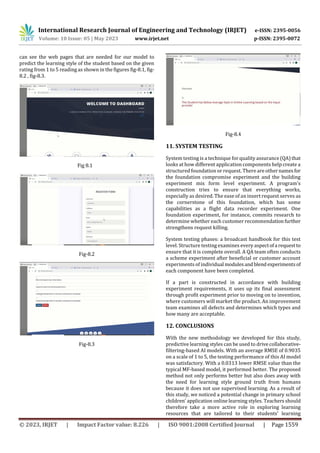
Launch the path of the code directory into the Anaconda
prompt. Now execute the command python app.py to getthe
link of the running code. Now copy the command that has
displayed on the screen and paste it in the google. Now you
International Research Journal of Engineering and Technology (IRJET) e-ISSN: 2395-0056
Volume: 10 Issue: 05 | May 2023 www.irjet.net p-ISSN: 2395-0072
© 2023, IRJET | Impact Factor value: 8.226 | ISO 9001:2008 Certified Journal | Page 1559
can see the web pages that are needed for our model to
predict the learning style of the student based on the given
rating from 1 to 5 reading as shown in the figures fig-8.1, fig-
8.2 , fig-8.3.
Fig 8.1
Fig-8.2
Fig-8.3
Fig-8.4
11. SYSTEM TESTING
System testing is a technique for quality assurance(QA)that
looks at how different application components help create a
structured foundation or request. There are othernamesfor
the foundation compromise experiment and the building
experiment mix form level experiment. A program's
construction tries to ensure that everything works,
especially as desired. The ease of an insert request serves as
the cornerstone of this foundation, which has some
capabilities as a flight data recorder experiment. One
foundation experiment, for instance, commits research to
determine whether each customer recommendationfurther
strengthens request killing.
System testing phases: a broadcast handbook for this test
level. Structure testing examines every aspectofa requestto
ensure that it is complete overall. A QA team often conducts
a scheme experiment after beneficial or customer account
experiments of individual modulesandblend experimentsof
each component have been completed.
If a part is constructed in accordance with building
experiment requirements, it uses up its final assessment
through profit experiment prior to moving on to invention,
where customers will market the product. An improvement
team examines all defects and determines which types and
how many are acceptable.
12. CONCLUSIONS
With the new methodology we developed for this study,
predictive learning styles can be used to drive collaborative-
filtering-based AI models. With an average RMSE of 0.9035
on a scale of 1 to 5, the testing performance of this AI model
was satisfactory. With a 0.0313 lower RMSE value than the
typical MF-based model, it performed better. The proposed
method not only performs better but also does away with
the need for learning style ground truth from humans
because it does not use supervised learning. As a result of
this study, we noticed a potential change in primary school
children' application online learning styles. Teachers should
therefore take a more active role in exploring learning
resources that are tailored to their students' learning
International Research Journal of Engineering and Technology (IRJET) e-ISSN: 2395-0056
Volume: 10 Issue: 05 | May 2023 www.irjet.net p-ISSN: 2395-0072
© 2023, IRJET | Impact Factor value: 8.226 | ISO 9001:2008 Certified Journal | Page 1560
preferences. This can be facilitated by having them use the
online learning platform that we created for this study. The
online learning platform employed in this study is
advantageous for both teachers and students, as seen by the
improvement in the students' test scores.
13. ACKNOWLEDGEMENT
We would like to express our special thanks to our mentor
Mr.MiryalaRamakrishnawhogaveusagoldenopportunityto
dothiswonderful projectonthistopic whichalsohelpedusin
doing a lot of research and we came to know about somany
new things. We are really thankful to them. Secondly, we
would also like to thank my friends who helped us a lot in
finalizing this project within the limited time frame.
14. REFERENCES
[1] E. Bodur, F. Özkan, E. Altun, and Ö. Şimşek, ‘‘The role of
teacher in web enhanced learning activities in primary
school information technologies lesson: A case study,’’ Proc.
Social Behav. Sci., vol. 1, no. 1, pp. 1043–1051, 2009.
[2] B. Pardamean, H. Prabowo, H. H. Muljo, T. Suparyanto, E.
K. Masli, and J. Donovan, ‘‘The development of blended-
learning teaching portfolio course using TBL approach,’’ Int.
J. Virtual Pers. Learn. Environ., vol. 7, no. 1, pp. 30–43, Jan.
2017.
[3] B. Pardamean, J. Donovan, E. Masli, T. Suparyanto, H.
Muljo, and H. Prabowo, ‘‘Team based learning as an
instructional strategy: A comparative study,’’ New Educ.
Rev., vol. 50, no. 4, pp. 134–145, Dec. 2017.
[4] K. Gunawan and B. Pardamean, ‘‘School information
systems design for mobile phones,’’ J. Comput. Sci., vol. 9,no.
9, pp. 1140–1145, Sep. 2013.
[5] B. Pardamean, ‘‘Enhancement of creativity through logo
programming,’’ Amer. J. Appl. Sci., vol. 11, no.4,pp.528–533,
Apr. 2014.
[6] B. Pardamean, T. Suparyanto, E. Masli, and J. Donovan,
‘‘Enhancing the use of digital model with team-based
learning approach in scienceteaching,’’inProc.Inf.Commun.
Technol.-EurAsia Conf. Denpasar, Indonesia:Springer,2014,
pp. 267–276.
[7] B. Pardamean, T. Suparyanto, and E. Evelyn, ‘‘Improving
problem-solvingskillsthroughlogoprogramminglanguage,’’
New Educ. Rev., vol. 41, no. 3, pp. 52–64, Sep. 2015.
[8] F. Xiao and B. Pardamean, ‘‘MOOCmodel:Dimensionsand
model design to develop learning,’’ New Educ. Rev., vol. 43,
no. 1, pp. 28–40, 2016.
[9] B. Pardamean, T. Suparyanto, and R. Kurniawan,
‘‘Assessment of graph theory e-learning utilizing learning
management system,’’ J. Theor. Appl. Inf.Technol.,vol.55,no
3, pp. 353–358, 2013.
[10] B. Pardamean and T. Suparyanto, ‘‘A systematic
approach to improving E-learning implementations in high
schools,’’ Turkish Online J. Educ. Technol., vol. 13, no. 3, pp.
19–26, 2014.

AI-Learning style prediction for primary education

  • 1.
    International Research Journalof Engineering and Technology (IRJET) e-ISSN: 2395-0056 Volume: 10 Issue: 05 | May 2023 www.irjet.net p-ISSN: 2395-0072 © 2023, IRJET | Impact Factor value: 8.226 | ISO 9001:2008 Certified Journal | Page 1556 AI-Learning style prediction for primary education R. Varun Reddy1, A. Haritha2, Sri Vaishnavi3, Mr. Miryala Rama krishna4 1,2,3 B.Tech Scholars, Department of Computer Science and Engineering, SNIST, Hyderabad-501301, India 4 Professor, Department of Computer Science and Engineering, SNIST, Hyderabad- 501301, India ---------------------------------------------------------------------***--------------------------------------------------------------------- Abstract - Thewidespreaduseofonlinelearningisaresultof information technology advancements. For primary school children, there are, however, fewer pertinent evaluations and applications. The goal of any learning innovation project is to make learning more engaging for students while also raising the standard of instruction. By choosing instructional materials that complement each student's preferred learning style, teachers can increase their students' engagement in the teaching-learning process. The goal of the study is to create and assess the effectiveness of an AI-based learning style prediction model in an online learning environment for elementary school pupils. Grades 4 through 6 Indonesian elementaryschoolkidswereusedasthesubjects.TheAImodelin the online learning portal was created to offer educational materials that fit students' learning preferences in order to uphold the notion of personalized learning. We developed a novel AI strategy that enables learning style prediction to drive collaborative filtering-based AI models. Key Words: Learning Style, Strategy, Matrix, Students, Ability, Rating. 1. INTRODUCTION For primary school students to learn effectively, more work must be put into raising the standard of instruction. In primary schools, a variety of research techniques are usedto create an engaging learning environment that will improve motivation and independent learning. According to the findings of earlier studies, activestudent participation in the learning process—suchasthroughtheimplementationofthe Team-Based Learning (TBL) approach, advancements in information technology,andonlinelearning—wouldresultin successful learning. In order for students to actively participatein the learning process,theteacher,whoservesas the learning manager, mustbeabletoselectthebestteaching strategy. Thiscanbeaccomplished by utilizing technological advancements to enhance the results of the educational process. With the useof technology, such as online learning, which promotes an interactive learning environment, teacherscanalsodevelopandmaintainstudentmotivationand independent learning. Online education is now being developed in response to information technology advancements. Students have accessto a variety of learning tools thathavebeenproduced by theteacherthroughtheuse of online learning. The several kinds of learning resources mentioned include slideshows, e- books, animated films, video lectures, and online articles. Teachers can arrange these learning resources in an onlinelearning management system (LMS) portal like Moodle to make them easier for studentstoaccess.Onebenefitofusingonline learning is that individual student peculiarities are taken into account. 1.1 Existing System Learning enhancement as a specific topic of study has given rise to tweaked learning, particularly mechanized modified learning with pre-packaged courses, assessment, and constantdatacollection.ArtificialIntelligence(AI)onadigital platform can deliver personalized learning. To choose the understudy's preferred learning method,oneofthemisused. Speaking styles, learning systems, how to complete obligations, how to assist others, and other embeddedworks out are examples oflearningstyles, which are the preference or method by which studentssuccessfullyacquireandimpart information. 1.2 Proposed System The goal of this work is to plan and assess the effects of deploying a synthetic intelligence-based internet learning gateway in order to boost student engagement and benefit from data technology advancements. The artificial intelligence model for the electronic learning entry was developed to suggest suitable learning materials depending on the student's preferred learning methods. To do this, we developed a novel strategythatenabledthecoordination ofa viable isolating-based AI model based on the supposition of learning style. The technique enables the AI model to work autonomously as a learning style assumption plan model at this time. Our suggested computation differs from earlier artificial intelligence-based methodsinthatitisindependent of the learning strategy chosen by people. The inert learning material vectors in the practical filtering structure are layered with a softmax assumption layer to create the suggested strategy's independence. The proposed assessment limits the human propensity to take the understudy's learning style into account while identifying assets because of its autonomy. Theonlinelearning entrance could make use of this artificial intelligence framework to provide resources that are tuned to each student'spreferred learning methods and learning styles. 2. LITERATURE SURVEY Using the Team-Based Learning (TBL) teachingandlearning strategy, this article was created to help lecturers establisha
  • 2.
    International Research Journalof Engineering and Technology (IRJET) e-ISSN: 2395-0056 Volume: 10 Issue: 05 | May 2023 www.irjet.net p-ISSN: 2395-0072 © 2023, IRJET | Impact Factor value: 8.226 | ISO 9001:2008 Certified Journal | Page 1557 teachingportfoliothathelpsthemmaximizetheadvantagesof blended learning, which combines in-person and online learning [2]. According to studies, TBL can help students learn how to work together effectively and can improve active learning, two things thatcould help to make up forthe shortcomings of blended learning implementation [6]. The creation of a blended teaching portfolio for an international human resource management course included a course overview, graduate competency, syllabus, course resources, teaching scenario, reading assurance test, midterm/final exams, student assignments, assessment of learning outcomes, and a course quality improvement sheet.[1] The course's attributeswereusedtobuildeachitem.Thisstudyis a first step to provide comparative quantitative empirical evidence for the usefulness of TBL for leading to continuous improvement in the learning process, which has been identifiedasonewaytoimprovestudentlearningoutcomesin undergraduate health science curriculam [10]. 3. IMPORT LIBRARIES: The appropriate libraries and frameworks must be installed before we can begin the model-building process. The following libraries are necessary for this project to run. Python Numpy TensorflowPython Pandas PythonMatplotlib Scikitlearn 4. METHODOLOGIES: 4.1 Matrix Factorization A group of cooperative filtering methods used in recommender systems is called matrix factorization [7]. The user-item interaction matrixisbrokendownintotheproduct oftworectangularmatriceswithlesserdimensionsbymatrix factorizationmethods.AsnotedbySimonFunkinhisblogpost from 2006, where he shared his findings withthe research community, this family of techniquesgained notorietyduring the Netflix prize challenge due to its efficacy. [8]Byallocating various regularization weights to the latent components based on the popularity of the items and the level of user activity, the prediction outcomes can beenhanced. Consider LDA as an example of nonnegative matrix factorization. 4.2 Support Vector Machine An approach for supervised machine learning called the Support Vector Machine (SVM) is utilized for both classification and regression. Even if we also refer to regression issues, classification is the best fit. Finding a hyperplane inanN-dimensionalspace36thatcategorizesthe data points clearly is the SVM algorithm's goal. 4.3 Random Forest An incredibly well-liked supervised machine learning approach called the Random Forest approach is utilized to solveclassificationandregressionissues.Weareawarethata forest is madeup of countlesstrees, and the more trees there are, the more robust the forest will be. 4.4 Decision Tree The non-parametric supervised learning approach used for classificationandregressionapplicationsisthedecisiontree.It is organized hierarchically and has a root node, branches, internal nodes, and leaf nodes. 4.5 Voting Classifier Kagglers frequently employ the machine-learning algorithm voting classifier to improve the performance of their model and move up the rank ladder. Voting Classifier has various restrictions but can be used for real-world datasets to enhance performance. 5. ALGORITHM: In order to assist students' mastery of the subjectmatterand self-learning, personalized learning is a teaching strategy basedonindividuallearningstyles,aptitudes,andinterests.In accordance with the demands and preferences of the students, the learning system also offers instructions and suggestions to enhance students' abilities. A certain area of student learning growth is currently personalized learning, particularly digital personalized learningwithpre-packagedcourses,testing,andongoingdata collection. Currently, thedigitalplatformmakespersonalized learningconvenientbyutilizing a variety of mediaintheform of animated images,videos,andaudiothatsupportpreschool and primary school students' preferred learning styles. [3] Additionally, usingAIto assist learners, such as figuring out the concerned student's learning style,personalizedlearning on a digital platform can be realized. [4]A student's inclination to efficientlyabsorbandtransmitinformationcan be characterized by their learning style, which also includes how they complete assignments, interact with others, and engage in other favored activities. Students with diverse talents and habits inmonitoringlearningsettingsarethought to benefit from learning styles depending on personality, which may help them develop their cognitive skills. According to Cassidy's study, learning styles that are predicted using modules and assessments that take into account cognitive personality style performance are those thatareconsistentwiththeinterestsand routines of pupilsin primary schools. 6. MODULES The module will enable us to incorporate data into the system. Data analyses include. Responsible: We'll look at the details required to use this module to manage things.
  • 3.
    International Research Journalof Engineering and Technology (IRJET) e-ISSN: 2395-0056 Volume: 10 Issue: 05 | May 2023 www.irjet.net p-ISSN: 2395-0072 © 2023, IRJET | Impact Factor value: 8.226 | ISO 9001:2008 Certified Journal | Page 1558 Data separation for testing and preparation: Using this module, information will be divided into train and test groups. Model development: constructing the model: MF, LDA, SVM, Decision Tree, and Voting Classifier are examples of (SVC + RF + DT). correctness of the calculation algorithm Client data trading and login: To use this module, you must register and authenticate. Customer feedback: This module will elicit the desired answer. Expectation: The last expected respect is manifested. 7. DATA COLLECTION: A sample of 72 students from higher education institutions was randomly chosen to participate in our study. Four distinct learning styles—visual (V), auditory (A), reading/writing (R), and kinesthetic (K)—were found inthe sampledata usingtheVARKInventory questionnaire [9].The questionnaire has 16 questions that eachaddress a different aspect of how students prefer to learn or present information. The questions are based on scenarios in which choices anddecisionsaboutwhatmighthappenareavailable. We created an online versionusing Microsoft Forms tomake it simple to get the responses from the students. The responses are then imported as an Excel file, where each response is shown as a binary vector with the letters "A, V, K, R" in it. After that, the data is preprocessed (as explained in Section [5]) to make it suitable for the machine learning techniques being used. Here, we divided the entire dataset into four matrices, one for each type of learning. Each matrix has 16 columns that show whether a learning styleispresent or absent and 5 output columns (4 columns show the probability of the learning styles, and thelast column shows the label of the chosen learning style). 8. SYSTEM ARCHITECTURE 9. DATA FLOW DIAGRAM 10. OUTPUT Launch the path of the code directory into the Anaconda prompt. Now execute the command python app.py to getthe link of the running code. Now copy the command that has displayed on the screen and paste it in the google. Now you
  • 4.
    International Research Journalof Engineering and Technology (IRJET) e-ISSN: 2395-0056 Volume: 10 Issue: 05 | May 2023 www.irjet.net p-ISSN: 2395-0072 © 2023, IRJET | Impact Factor value: 8.226 | ISO 9001:2008 Certified Journal | Page 1559 can see the web pages that are needed for our model to predict the learning style of the student based on the given rating from 1 to 5 reading as shown in the figures fig-8.1, fig- 8.2 , fig-8.3. Fig 8.1 Fig-8.2 Fig-8.3 Fig-8.4 11. SYSTEM TESTING System testing is a technique for quality assurance(QA)that looks at how different application components help create a structured foundation or request. There are othernamesfor the foundation compromise experiment and the building experiment mix form level experiment. A program's construction tries to ensure that everything works, especially as desired. The ease of an insert request serves as the cornerstone of this foundation, which has some capabilities as a flight data recorder experiment. One foundation experiment, for instance, commits research to determine whether each customer recommendationfurther strengthens request killing. System testing phases: a broadcast handbook for this test level. Structure testing examines every aspectofa requestto ensure that it is complete overall. A QA team often conducts a scheme experiment after beneficial or customer account experiments of individual modulesandblend experimentsof each component have been completed. If a part is constructed in accordance with building experiment requirements, it uses up its final assessment through profit experiment prior to moving on to invention, where customers will market the product. An improvement team examines all defects and determines which types and how many are acceptable. 12. CONCLUSIONS With the new methodology we developed for this study, predictive learning styles can be used to drive collaborative- filtering-based AI models. With an average RMSE of 0.9035 on a scale of 1 to 5, the testing performance of this AI model was satisfactory. With a 0.0313 lower RMSE value than the typical MF-based model, it performed better. The proposed method not only performs better but also does away with the need for learning style ground truth from humans because it does not use supervised learning. As a result of this study, we noticed a potential change in primary school children' application online learning styles. Teachers should therefore take a more active role in exploring learning resources that are tailored to their students' learning
  • 5.
    International Research Journalof Engineering and Technology (IRJET) e-ISSN: 2395-0056 Volume: 10 Issue: 05 | May 2023 www.irjet.net p-ISSN: 2395-0072 © 2023, IRJET | Impact Factor value: 8.226 | ISO 9001:2008 Certified Journal | Page 1560 preferences. This can be facilitated by having them use the online learning platform that we created for this study. The online learning platform employed in this study is advantageous for both teachers and students, as seen by the improvement in the students' test scores. 13. ACKNOWLEDGEMENT We would like to express our special thanks to our mentor Mr.MiryalaRamakrishnawhogaveusagoldenopportunityto dothiswonderful projectonthistopic whichalsohelpedusin doing a lot of research and we came to know about somany new things. We are really thankful to them. Secondly, we would also like to thank my friends who helped us a lot in finalizing this project within the limited time frame. 14. REFERENCES [1] E. Bodur, F. Özkan, E. Altun, and Ö. Şimşek, ‘‘The role of teacher in web enhanced learning activities in primary school information technologies lesson: A case study,’’ Proc. Social Behav. Sci., vol. 1, no. 1, pp. 1043–1051, 2009. [2] B. Pardamean, H. Prabowo, H. H. Muljo, T. Suparyanto, E. K. Masli, and J. Donovan, ‘‘The development of blended- learning teaching portfolio course using TBL approach,’’ Int. J. Virtual Pers. Learn. Environ., vol. 7, no. 1, pp. 30–43, Jan. 2017. [3] B. Pardamean, J. Donovan, E. Masli, T. Suparyanto, H. Muljo, and H. Prabowo, ‘‘Team based learning as an instructional strategy: A comparative study,’’ New Educ. Rev., vol. 50, no. 4, pp. 134–145, Dec. 2017. [4] K. Gunawan and B. Pardamean, ‘‘School information systems design for mobile phones,’’ J. Comput. Sci., vol. 9,no. 9, pp. 1140–1145, Sep. 2013. [5] B. Pardamean, ‘‘Enhancement of creativity through logo programming,’’ Amer. J. Appl. Sci., vol. 11, no.4,pp.528–533, Apr. 2014. [6] B. Pardamean, T. Suparyanto, E. Masli, and J. Donovan, ‘‘Enhancing the use of digital model with team-based learning approach in scienceteaching,’’inProc.Inf.Commun. Technol.-EurAsia Conf. Denpasar, Indonesia:Springer,2014, pp. 267–276. [7] B. Pardamean, T. Suparyanto, and E. Evelyn, ‘‘Improving problem-solvingskillsthroughlogoprogramminglanguage,’’ New Educ. Rev., vol. 41, no. 3, pp. 52–64, Sep. 2015. [8] F. Xiao and B. Pardamean, ‘‘MOOCmodel:Dimensionsand model design to develop learning,’’ New Educ. Rev., vol. 43, no. 1, pp. 28–40, 2016. [9] B. Pardamean, T. Suparyanto, and R. Kurniawan, ‘‘Assessment of graph theory e-learning utilizing learning management system,’’ J. Theor. Appl. Inf.Technol.,vol.55,no 3, pp. 353–358, 2013. [10] B. Pardamean and T. Suparyanto, ‘‘A systematic approach to improving E-learning implementations in high schools,’’ Turkish Online J. Educ. Technol., vol. 13, no. 3, pp. 19–26, 2014.